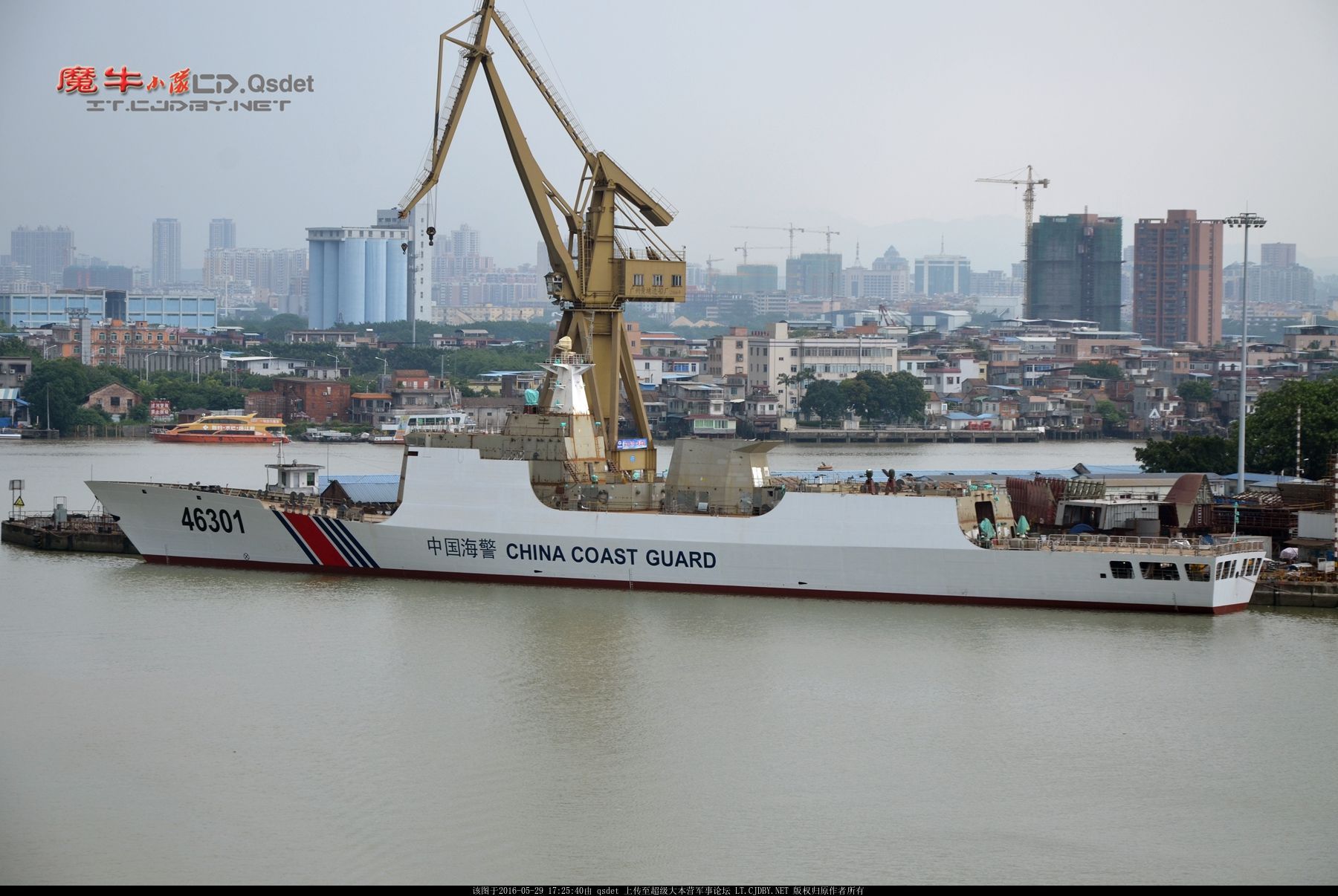
China Acknowledges Building Cutter to be Upgraded to Frigate in Crisis

type818ccgc

The National Interest reports that the Chinese have openly acknowledged that their newest Coast Guard cutter is being built with provision for upgrading to frigate status should a need arise.

Moreover they were apparently influenced by the example of the USCG during WWII.

In the same issue of this magazine, published by the major Chinese shipbuilding conglomerate China State Shipbuilding Corporation (CSSC), builder of the Type 818, there is not coincidentally a very detailed article about U.S. Coast Guard cutters in combat during the Second World War. That article explains that both USCGC Campbell and also USCGC Spencer were able to sink German U-boats (U-606 and U-175 respectively) during the pivotal Battle of the Atlantic. Most of the article examines the operations of 10 American USCG cutters that were 76.2 meters in length and built between 1928 and 1932. These ships were transferred to the hard pressed Royal Navy (RN) during 1941-42 and achieved an enviable war record in RN service, sinking both U-522 and U-954 – the latter with Germany Navy Commander Karl Donitz’s son aboard. The analysis notes that, according to UK naval records, the American cutters were viewed so favorably as to be rated as “surpassing each kind of comparable British designed frigate.” These ships are labeled as an “ideal anti-submarine escort ship” [理想的反潜护航舰] and the implications for the CCG going forward are obvious.

They actually sold the cutters a bit short. The 327s actually sank at least three and probably four U-boats and the ten 76.2 meter cutters, the 250 foot Lake Class, sank three submarines (two U-boats and an Italian). Six subs sunk by 17 ships may not sound particularly impressive, but in fact by comparison, it was spectacular.

The new Type 818 cutters are based on the Type 054 frigates. Its not too much of a stretch to expect them to be upgunned with the same weapons found on the “parent craft,” but if the time ever comes, there may be better systems available for upgrading the cutters or they might be given different capabilities to support emerging missions. That can be an advantage of having ships with unused upgadability.

The Type 054 are only slightly smaller than the Bertholf class, displacement 4,053 tons full load, length 134.1 m (440 ft), beam 16 m (52 ft), 30,400 HP, 27 knots, compared to the Bertholf’s 4,500 tons, 127.4 m (418 ft), 16.46 m (54 ft), 49,875 HP, and 28 knots. They actually appear to be the same size as the Offshore Patrol Cutters, but their design leans more toward higher speed. Their range is not as great as the OPC at about 8,000 miles compared to the OPCs’ 10,200, but it is a greater range than USN frigates enjoyed.

The Chinese have learned a lesson from USCG experience in World War II. I wonder if it is a lesson we may have forgotten.

Thanks to Luke for bringing this to my attention. 

UN Command doing Fisheries in S. Korea

I find this report from MarineLink a bit curious.

South Korea and the U.N. Command, which overseas the Korean War armistice, said on Friday they had begun a joint operation to keep Chinese fishing vessels from operating illegally off the west coast.”

Why would the UN command be interested in enforcing fisheries regulation? It maybe because the area in question has been a flash point in the conflict between North and South Korea. Still seems a little strange.

New S. Korean Cutter

SKoreaLargestCutter

Jane’s 360 is reporting that the S. Korean Coast Guard has commissioned their largest and most heavily armed cutter.

Lee Chung-ho has a length of 150.5 m, a beam of 16.5 m, a loaded displacement of 6500 tonnes and a complement of 104 persons, although 140 persons can be embarked.

The hybrid propulsion system has four MTU 20V1163M94 diesels (each rated at 9,900 bhp) and two 750KW electric motors that are connected to the propellers.

How big is it?

The cutter, at 6,500 tons, is 44% larger than the Bertholf class. While its length and beam are almost identical to Japan Coast Guard’s two largest cutters, the displacement is reportedly far less. I have seen no info on the draft, so that is at least possible. In any case, it is definitely much smaller than the huge cutters the Chinese have built.

The post compares the new cutter to the slightly smaller Sambong-ho (pennant 5001), which entered service in 2002 and was previously the largest cutter in the S. Korean Coast Guard, stating it is three knots faster. That would indicate a top speed of 24 knots. The new cutter has a four diesel power plant compared to its predecessor’s two engine plant. In addition, the two 750 HP electric motors mounted on the shafts which should allow the cutter to slow cruise while the main diesels are cold iron.

Weapons: 

According to Wikipedia, S. Korean has 34 cutters over 1000 tons. All are armed with one or more 20 mm Vulcan Gatling Guns and .50 caliber machine guns. Fourteen have Bofors 40 mm guns, and one other also has a 76 mm. The 20 mm and 40 mm mounts are locally produced in S. Korea.

Looking at the armament, it may be an upgrade compared to the typical S. Korean cutter, but only slightly better armed than what appears to be, becoming a world wide standard for offshore patrol vessels–a medium caliber gun, 57 or 76 mm, and a pair of 20 to 30mm machineguns in remotely controlled weapon stations. It is really no better armed than the 1,150 ton PC-1005, the Hankang, smallest of S. Korea’s 34 cutters major cutters, commissioned in 1985.

All the weapons appear to have been recycled from previous installations. In the photo, an older model OTO Melara 76 mm, like those used on the FRAMed Hamilton class WHECs and Bear class WMECs is clearly visible on the bow. There is also a Vulcan 20 mm mount on the O-3 deck superfiring over the 76 mm mount forward of the bridge. It also appears to have a locally built twin Bofors 40 mm compact mount using an earlier version of the Bofors than the 70 caliber weapon currently offered, which appears to be atop the superstructure aft. She has no CIWS, missiles, or ASW capability.

What is it with these very large cutters?:

Japan, China, and S. Korea, have now each built two very large cutters. Why to they exist?

It is their size, not their weapons, that make them exceptional. The Russian Coast Guard has smaller, but much more heavily armed ships (Krivak III frigates and Grisha II class corvettes).

There has been a general trend for ships of all types to grow in size. Their crews are not exceptionally large, so the operating cost may not be that much more.

Still these are significantly bigger than other cutters built by the same coast guards, at the same time, apparently for the same missions.

None of these three nations has a patrol area as distant and demanding as Alaska.

Japan did have a reason for building the first of these. Shikishimacommissioned in 1992, was intended to escort plutonium transport ships between Europe and Japan, but I have seen no explanation for the ships that followed.

Is it prestige, just “keeping up with the Jones?”

Are they intended for a future shoving match? If so, they are giving up agility for presence.

Are they perhaps intended as flag ships for long term operations?

I would love to hear the reasoning from someone in the know.


China Coast Guard Cutter Built on Frigate Hull

Type054cutter

China Defense Blog is reporting the Chinese Coast Guard is getting at least one cutter based on the same hull used for the Type 054 frigate. I have to believe there will be several more.

The Type 054 is a large and apparently successful class of frigate. The ships are only slightly smaller than the Bertholf class, displacement 4,053 tons full load, length 134.1 m (440 ft), beam 16 m (52 ft), 30,400 HP, 27 knots, compared to the Bertholf’s 4,500 tons, 127.4 m (418 ft), 16.46 m (54 ft), 49,875 HP, and 28 knots.

My first reaction is that they should make very good cutters. They have a four diesel power plant that should be economical to operate and very flexible. The frigates reportedly have a range of over 8,000 miles. They also have reasonably good aviation facilities.

Type054A800px-Aft-deck_of_the_PLAN_frigate_Yi_Yang_(FF_548)

US Navy photo:  120917-N-YF306-107 GULF OF ADEN (Sept. 17, 2012) Sailors from the guided-missile destroyer USS Winston S. Churchill (DDG 81) board the Chinese People’s Liberation Army (Navy) frigate Yi Yang (FF 548) to meet prior to conducting a bilateral counter-piracy exercise.

The Chinese Coast Guard has been experiencing explosive growth. China has built some huge cutters, they have gotten some hand-me-down frigates from their navy, and there have been reports that the China Coast Guard will be getting ships based on the Type 056 Corvette, but until recently, new construction Chinese cutters were not warships. They looked more like research vessels. Most have been armed with nothing heavier than 14.5 mm machine guns. This ship may mark a change.

Building based on a Navy design assures that should the need arise, these ships can be upgraded to a more combat ready configuration. How they are equipped when commissioned will give us an indication of the future direction of the Chinese Coast Guard. Will it remain essentially civilian, or will it become an increasingly capable naval auxiliary?

Which systems will be retained from the frigate configuration, and which systems are deleted? My guess is, that they will emerge with a medium caliber gun (either the 76 mm being currently fitted to the Navy’s Type 054As or the older 100 mm that was fitted on the original Type 054s) and two 30 mm gatling guns (these may be older model AK-630s rather than the newer CIWS fitted on current Navy Type 054As). I don’t expect to see the Vertical Launch Systems that support AAW and ASW systems, Anti-Ship Cruise missiles, torpedo tubes, or the sonars which are being fitted to the Navy versions, but if any of these are fitted, it will mark a drastic change in the character of the Chinese Coast Guard.

Thanks to Lee for bringing this to my attention.

Argentine Coast Guard Sinks Chinese Fishing Vessel

This Video does not appear to show the sinking of the fishing vessel. Speckles on the hull of the F/V seen at time 0:20 and 0:50 may be bullet holes. The video does appear to show the participants.  

We have reports (here and here) that the Argentine Coast Guard (Prefectura Naval Argentina (PNA)) fired on and sank a Chinese fishing vessel (F/V), the Lu Yan Yuan Yu 010, believed to have been fishing illegally, after the F/V failed to stop after shots were fired across its bow and it allegedly attempted to ram the Coast Guard vessel. The crew reportedly was rescued, without fatalities, four by the Argentine vessel and the rest of the crew by another Chinese F/V.

ArgentineCutter

Photo by Diegoventu: PNA Doctor Manuel Mantilla (GC-24), a sistership of the Argentine vessel involved.

The PNA vessel seen in the video, Prefecto Durbes (GC-28) is one of five offshore patrol vessels (OPVs) built in Spain for Argentina. The Mexican Navy also has six similar vessels with larger flight decks and more powerful engines. In size they slot between the Reliance Class and the Bear Class, being 67 meters (220 feet) overall. Unlike the Reliance class, they have a hangar for their version of the H-65.

In addition to machine guns, these ships are reportedly armed with a Bofors 40mm/70, but looking at the video, the location where the gun was mounted (on the platform forward of the bridge and one deck above the foc’sle) is vacant. This suggest that the damage was probably done by .50 cal. machine guns. We know from our Vietnam experience that .50 cal. can sink fishing vessels, but the ranges are very short. Looking at the video the ships appeared to be no more than 300 yards apart.

It is a bit surprising no casualties were reported, although the reports say no fatalities, they do not say no injuries so that is still a possibility. Did the crew of the OPV order the Chinese crew to abandon before sinking the F/V, or did they perhaps tell them where they were not going to shoot so that the crew could assemble safely? It does not sound like it. We have only this statement from an Argentine representative that after actions by the Chinese vessel,  “…the order was given to fire on different sections of the vessel, damaging it,” It is unlikely, but not impossible, the crew helped the ship sink to destroy any evidence of wrong doing.

Japan CG Vice Commandant for Ops Interview

Maritime Reporter & Engineering News interviews VADM Satoshi NAKAJIMA, Vice Commandant for Operations, Japan Coast Guard.

The Japan Coast Guard has a long association with the USCG, Capt. Frank Meals provided advice, prior to its formation.

It is apparent Chinese claims regarding, and actions around, the Senkaku Islands are much on his mind. The Japan Coast Guard making moves to assist similar organizations, notably the Coast Guards of Vietnam and the Philippines.

There is also a brief description of the Japan Coast Guard.


Document Alert: World Wide Threat Assessment of the US Intelligence Community, 2/9/16

We have a statement for the record (pdf) from James R. Clapper, Director of National Intelligence, dated February 9, 2016. Perhaps it is the nature of the beast, but there is no good news, and much that is bad.

Smuggling of every type appears to be on the rise including drugs and people. We can expect an increase in illegal immigration as a result of violence, poverty, and disorder in Latin America and particularly Cuba and Central America.

It is a relatively compact document. There are sections on Terrorism (pp 4-6), transnational organized crime (pp 11-12), Arctic (p 13), Environmental Risks and Climate Change (pp 13-14), health (including potential pandemics) (pp 14-15), and Global Displacement, “These 60 million consist of approximately 20 million refugees, 38 million internally displaced persons (IDPs), and approximately 2 million stateless persons, also according to UNHCR statistics.” (p.15)

There are also regional assessments including one on Latin America and the Caribbean (pp 28-29).

There is no regional assessment for the US. In terms of direct terrorist threats to the US, while there is a recognition of an aspiration on the part of various groups to attack the US, but the emphasis seems to be on “homegrown violent extremists” (HVEs) and there is nothing about the possibility of a maritime attack on the US. Is that because none exist?

Lighter Than Air Maritime Domain Awareness with Chinese Characteristics

Popular Science reports the Chinese have begun testing a largely solar powered airship capable of carrying heavy loads to high altitude (20,000 meters/65,600 feet) and remaining aloft for up to six months.

The airship is expected to have a role similar to that envisioned for the US Army’s JLENS currently being tested with apparently limited success in the Washington DC area, but it would cover a much larger area than the JLENS aerostats.

From its high altitude it can theoretically maintain radar and visual surveillance over a hundred thousand square miles.

The prototype seen in the accompanying video looks much less impressive, but remember that the gas will expand many times, filling out the envelop.