“Coast Guard offloads over $517.5 million in illicit drugs interdicted in Eastern Pacific Ocean” –D7

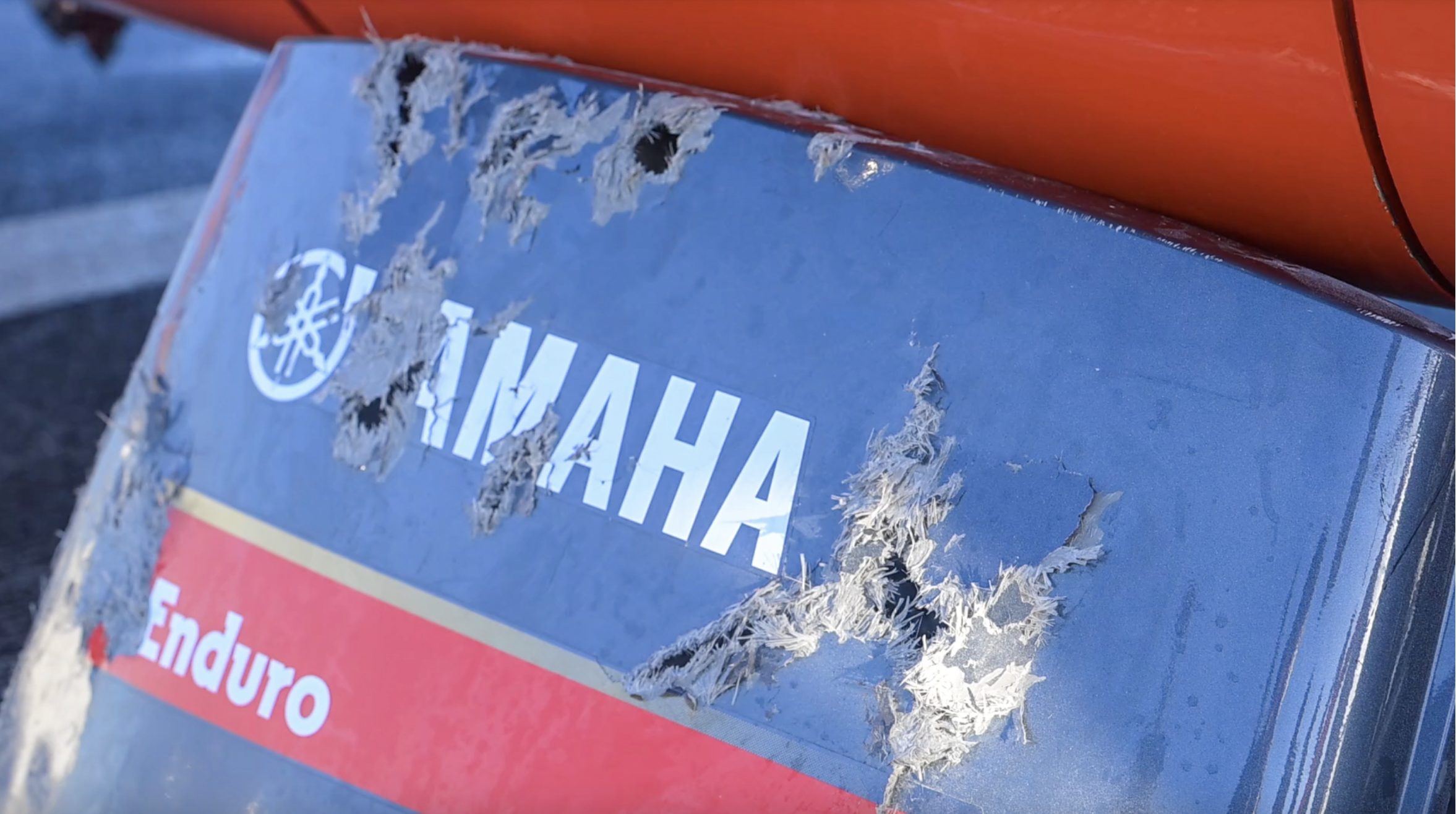
An engine cowling rests against an MH-65 dolphin helicopter at Port Everglades, on March 20, 2025. After attempts to stop a non-complaint vessel failed, the Coast Guard’s Helicopter Interdiction Tactical Squadron was authorized to use force, including disabling fire. (Coast Guard photo by Petty Officer 3rd Class Nicholas Strasburg)

Below is a news release from District Seven. I don’t pass along every ship’s off load of  drugs because they have gotten to be routine, but this patrol was anything but routine.

  • For one ship to interdict 12 drug smugglers in a single patrol is unusual.
  • This interdiction of four go-fast vessels operating in company moving almost as if in formation was unusual.

“On Feb. 19, Stone’s embarked UAS crew detected multiple suspicious vessels approximately 110 miles south of the Galapagos Islands, Ecuador. Stone’s embarked HITRON aircrew employed airborne use of force tactics to compel the non-compliant vessels to stop, and their boarding teams interdicted four go-fast vessels, apprehending eight suspected smugglers and seizing approximately 10,885 pounds of cocaine.”

  • Success of the UAS was notable.
  • The location of that interdiction is unusual in that it is probably at least 500 nautical miles west of Ecuador and well South of Colombia, the country we normally think of as the source for cocaine.

(Could the four vessels intercepted Feb. 19 have been on the way to meet a larger vessel offshore? –either to transfer the load or to refuel?)

The photo above, at the head of this post, was the first thing that really got my attention, but apparently, that cowling was not unique.
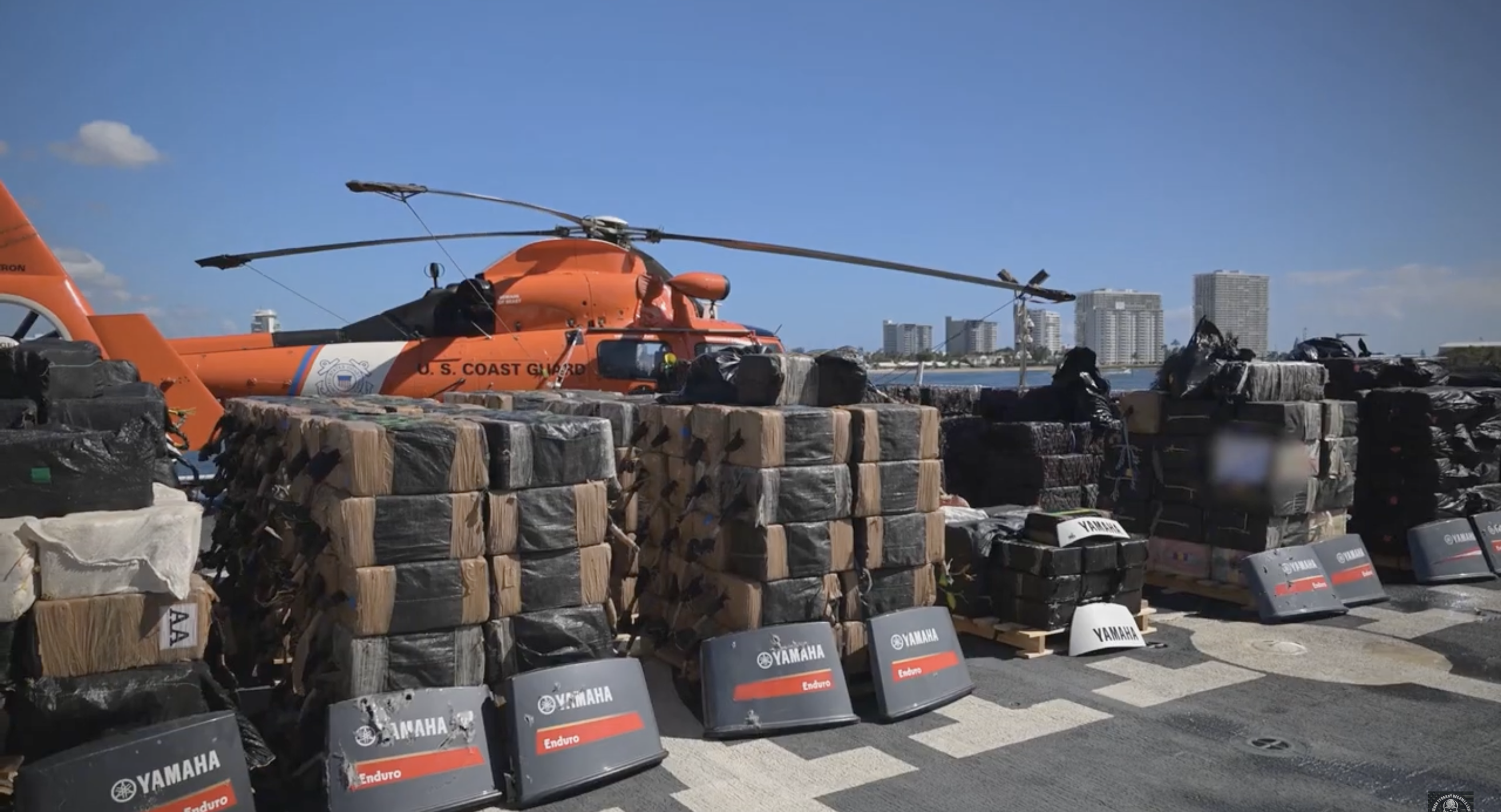
USCGC Stone (WMSL-758) delivers $517.5 million in illicit drugs interdicted in Eastern Pacific Ocean. Along side are displayed cowlings of outboard motor disabled by the Airborne Use of Force crew from the Coast Guard’s Helicopter Interdiction Tactical Squadron (HITRON) based in Jacksonville, FL.


March 20, 2025

Coast Guard offloads over $517.5 million in illicit drugs interdicted in Eastern Pacific Ocean

MIAMI – The crew of U.S. Coast Guard Cutter Stone offloaded approximately 45,600 pounds of illicit narcotics worth more than $517.5 million at Port Everglades, Thursday.

The seized contraband was the result of 14 interdictions in international waters of the Eastern Pacific Ocean, and 35 suspected smugglers were transferred ashore to face federal prosecution in U.S. courts.

“You heard it said before that the Coast Guard’s national security cutters are game changers in the counter-drug mission, but they still require a crew of men and women willing to serve on or over the sea, and place themselves in harm’s way,” said Capt. Jonathan Carter, commanding officer of Stone. “I’m incredibly proud of our crew’s performance and their efforts to combat narco-terrorism this deployment. In one exceptional case, the crew interdicted four go-fast vessels in 15 minutes, seizing nearly 11,000 pounds of cocaine that will never be mixed with deadly fentanyl to threaten American lives here at home.”

On Dec. 21, Stone’s embarked aircrew from Coast Guard Helicopter Interdiction Tactical Squadron detected a suspicious vessel in international waters approximately 321 miles west of Ecuador. Stone’s boarding team interdicted the go-fast vessel, apprehended three suspected smugglers and seized over 1,630 pounds of cocaine.

On Dec. 22, a maritime patrol Dash-8 aircrew detected a suspicious vessel in international waters approximately 180 miles southeast of the Galapagos Islands, Ecuador. Stone’s embarked HITRON aircrew and boarding team interdicted the low-profile go-fast vessel, apprehended three suspected smugglers and seized approximately 12,220 pounds of cocaine.

On Jan. 9, a maritime patrol Dash-8 aircrew detected a suspicious vessel in international waters approximately 148 miles west of Salinas, Ecuador. Stone’s embarked HITRON aircrew and boarding team interdicted the go-fast vessel, apprehended three suspected smugglers and seized approximately 2,370 pounds of cocaine.

On Jan. 28, Stone’s embarked unmanned aircraft system (drone) crew detected a suspicious vessel in international waters approximately 459 miles south of Manzanillo, Mexico. Stone’s boarding team interdicted the vessel, apprehended five suspected smugglers and seized approximately 3,885 pounds of cocaine.

On Jan. 30, Stone’s embarked UAS crew detected a suspicious vessel in international waters approximately 715 miles off Mexico. Stone’s boarding team interdicted the vessel, apprehended two suspected smugglers and seized approximately 3,800 pounds of cocaine.

On Jan. 31, Stone’s embarked UAS crew detected a suspicious vessel in international waters approximately 630 miles off Mexico. Stone’s embarked HITRON aircrew employed airborne use of force tactics to compel the non-compliant vessel to stop, and the boarding team apprehended three suspected smugglers and seized more than 2,565 pounds of cocaine.

On Feb. 12, Stone’s embarked UAS crew detected a suspicious vessel in international waters approximately 655 miles south of Mexico. Stone’s embarked HITRON aircrew employed airborne use of force tactics to compel the non-compliant vessel to stop, and the boarding team apprehended three suspected smugglers and seized more than 3,640 pounds of cocaine.

On Feb. 18, Coast Guard Cutter Mohawk’s crew detected and boarded a sailing vessel approximately 70 miles northwest of Isla Malpelo, Colombia. Mohawk’s boarding team apprehended three suspected smugglers and seized approximately 635 pounds of cocaine.

On Feb. 19, Stone’s embarked UAS crew detected multiple suspicious vessels approximately 110 miles south of the Galapagos Islands, Ecuador. Stone’s embarked HITRON aircrew employed airborne use of force tactics to compel the non-compliant vessels to stop, and their boarding teams interdicted four go-fast vessels, apprehending eight suspected smugglers and seizing approximately 10,885 pounds of cocaine.

On Feb. 25, Mohawk’s crew detected and interdicted a suspicious vessel approximately 230 miles south of Costa Rica. Mohawk’s boarding team apprehended three suspected smugglers and seized approximately 1,600 pounds of cocaine and 330 pounds of marijuana. Costa Rican authorities took custody of the fishing vessel, suspects and bulk contraband for prosecution.

On March 10, Stone’s embarked HITRON aircrew detected a suspicious vessel in international waters approximately 270 miles southeast of the Galapagos Islands, Ecuador. The HITRON aircrew employed airborne use of force tactics to compel the vessel to stop, and Stone’s boarding team interdicted the go-fast vessel, apprehending two suspected smugglers and seizing approximately 3,980 pounds of cocaine. The transfer of custody from this case will occur at a later date.

“The fight against drug trafficking and transnational criminal organizations doesn’t begin at our U.S. maritime borders,” said Cmdr. David Ratner, commanding officer of Mohawk. “Our efforts to defend Americans at home begins with denying drug traffickers access to maritime routes and disrupting the flow far out at sea where we operate alongside interagency and strategic regional partners like Costa Rica.”

The following assets and crews were involved in the interdiction operations:

Detecting and interdicting illicit drug traffickers on the high seas involves significant interagency and international coordination. Joint Interagency Task Force-South, in Key West, conducts the detection and monitoring of aerial and maritime transit of illegal drugs. Once an interdiction becomes imminent, the law enforcement phase of the operation begins, and control of the operation shifts to the U.S. Coast Guard for the interdiction and apprehension phases. Interdictions in the Eastern Pacific Ocean are performed by members of the U.S. Coast Guard under the authority and control of the Eleventh Coast Guard District, headquartered in Alameda, California.

The Coast Guard continues increased operations to interdict, seize and disrupt transshipments of cocaine and other bulk illicit drugs by sea. These drugs fuel and enable cartels and transnational criminal organizations to produce and traffic illegal fentanyl, threatening the United States.

Each of these interdictions initiate criminal investigations by federal law enforcement partners. Several were tied to the transnational criminal organizations responsible. Drug evidence from these cases is linked to cartels recently designated as foreign terrorist organizations by the U.S. government, including Sinaloa and Cartel Jalisco Nueva Generaciόn. These interdictions denied those criminal organizations more than half a billion dollars and provide critical evidence for their total elimination.

USCGC Stone is one of four 418-foot Legend-class national security cutters homeported in Charleston, South Carolina under U.S. Coast Guard Atlantic Area Command. The U.S. Coast Guard Maritime Law Enforcement Academy where Coast Guard boarding officers train to conduct these missions, in Charleston, celebrated its 20th anniversary on March 14.

For breaking news, follow us on X (formerly Twitter). For additional information, find us on Facebook and follow us on Instagram.

Make a difference on land, at sea or in the air with the Coast Guard. Visit GoCoastGuard.com to learn more about active duty and reserve, officer and enlisted opportunities. Information on how to apply to the U.S. Coast Guard Academy can be found here.

“U.S. Coast Guard Cutter Terrell Horne returns to home port following a 52-day multi-mission patrol in the Eastern Pacific” –CG News

PERU, 10.06.2023, Courtesy Photo, USCG District 11
The crew of the U.S. Coast Guard Cutter Terrell Horne conducts a patrol in the Eastern Pacific Ocean in support of Operation Southern Shield 2023, October 2023. The Coast Guard recently completed the first high-seas boardings and inspections off the coast of Peru under a newly adopted multi-lateral agreement to monitor fishing and transshipment operations within the South Pacific Regional Fisheries Management Organization (SPRFMO) Convention Area. (U.S. Coast Guard photo)

Below is a news release from Coast Guard News. This patrol was unusual enough to draw some special attention. It is not a typical patrol craft mission. It involved the pairing of a buoy tender with a “Fast Response Cutter” (FRC) to put two units far from their homeports. The Pacific Area has done this before in the Western Pacific, but I think this may be the first time it has been done in the Eastern Pacific off the West coast of South America. Pacific Area Webber class FRCs have previously conducted drug enforcement missions in the Eastern Pacific at least as far South as Central America. We talked about portions of this multiunit deployment earlier, “Buoy Tender, FRC, C-130 Used for International Fisheries Enforcement–Operation Southern Shield.” USCGC Alder, homeported in San Franciso, was the buoy tender involved.

The emphasis of the operation was international fisheries enforcement, but USCGC Terrell Horne still managed to do a bit of drug enforcement. I look forward to seeing the report of USCGC Alder’s portion of the operation.

09.25.2023, Courtesy Photo, USCG District 11
U.S. Coast Guard Cutter Alder (background) transits in formation alongside Peru BAP (Buque Armada Peruana) Bolognesi (FM-57) as it prepares for the next exercise during GALAPEX 2023, Sept.25, 2023. GALAPEX is a recurring multi-national maritime exercise led by Ecuador and included participation of delegates from Argentina, Brazil, Chile, Colombia, Costa Rica, the European Union, France, Italy, Mexico, Panama, Peru, the United Kingdom, and the United
States. (U.S. Coast Guard photo)

Nov. 8, 2023

U.S. Coast Guard Cutter Terrell Horne returns to home port following a 52-day multi-mission patrol in the Eastern Pacific

Coast Guard District Eleven

SAN PEDRO, Calif. — The U.S. Coast Guard Cutter Terrell Horne and crew returned to their home port in Los Angeles/Long Beach Tuesday after a 52-day patrol across the Eastern Pacific.

The crew of the Terrell Horne deployed in support of multiple missions, including Operations Green Flash, Albatross, Martillo, and Southern Shield, within the 11th Coast Guard District’s area of responsibility. During the patrol, Terrell Horne’s crew conducted a range of missions encompassing law enforcement, counter-drug operations, illegal, unreported, and unregulated fishing enforcement, and search and rescue operations.

“The crew of the Terrel Horne lived up to the cutter’s namesake in every way during this patrol. Operation Southern Shield allowed the cutter to showcase the versatility of the Fast Response Cutter. This operation brought a patrol boat and a buoy tender almost 4,000 nautical miles from home, conducting operations and international engagements with Mexico, Ecuador, Peru, and Costa Rica, said Chief Warrant Officer Jason Bussell, the commanding officer of the Coast Guard Cutter Terrell Horne. “The crew excelled in counter-illegal fishing missions, search and rescue, and counter-drug operations. Working alongside other Coast Guard assets, the crew was able to interdict a drug smuggling vessel and assisted in the seizure of nearly 2,000 lbs of contraband.”

The Coast Guard commissioned the Terrell Horne as the 31st Fast Response Cutter on March 22, 2019. Coast The cutter is named for Senior Chief Terrell Horne III, who died from injuries sustained while conducting maritime law enforcement operations off the California coast in December 2012. He was the executive petty officer aboard the Coast Guard Cutter Halibut at the time. For his heroic actions, the Coast Guard posthumously promoted Horne to senior chief petty officer.

For information on how to join the U.S. Coast Guard, visit GoCoastGuard.com to learn about active duty, reserve, officer and enlisted opportunities. Information on how to apply to the U.S. Coast Guard Academy can be found here.
Buoy Tender, FRC, C-130 Used for International Fisheries Enforcement–Operation Southern Shield

PERU, 10.06.2023, Courtesy Photo, USCG District 11
San Francisco based USCGC Alder (WLB-216) raises the South Pacific Regional Fisheries Management Organization (SPRFMO) flag while patrolling the Eastern Pacific Ocean during Operation Southern Shield in October 2023. The Coast Guard recently completed the first high-seas boardings and inspections off the coast of Peru under a newly adopted multi-lateral agreement to monitor fishing and transshipment operations within the SPRFMO Convention Area, a region which encompasses nearly a quarter of the Earth’s high seas. (U.S. Coast Guard photo by Petty Officer 2nd Class Kenneth Honore)

Below is a District 11 news release. It came with 24 photos. I have included a few here. The captions are informative. I have edited some of the captions to include homeports and minimize duplication. I have also added a few links and the schematic below.

SPRFMO CONVENTION AREA
This schematic is available only to illustrate the Area of application of the SPRFMO Convention, which is described in legal terms in Article 5. The schematic is not part of the Convention text and has no legal status; it is not intended to reflect exactly the maritime spaces of adjoining coastal states.

PERU, 10.07.2023, Courtesy Photo, USCG District 11
The Coast Guard Cutter Alder approaches a squid fishing vessel while CG-2007, a C-130 from Air Station Barbers Point in Hawaii, flies over (upper left) during Operation Southern Shield 2023, October 2023. The Coast Guard recently completed the first high-seas boardings and inspections off the coast of Peru under a newly adopted multi-lateral agreement to monitor fishing
and transshipment operations within the South Pacific Regional Fisheries Management Organization (SPRFMO)Convention Area. (U.S. Coast Guard photo)

LIMA, PERU, 10.06.2023, Courtesy Photo, USCG District 11
The aircrew of the Coast Guard 2007, an HC-130 based out of U.S. Coast Guard
Air Station Barbers Point, Hawaii, poses for a picture with observers from the Peruvian Navy and Air Force, in Lima Peru, October 2023. During the course of two weeks, Peruvian observers accompanied the USCG aircrew as they conducted overflights of the fishing fleet on the high seas during Operation Southern Shield 2023. (U.S. Coast Guard photo by pilot-in-charge, Lt. Zachary Hunter)

There was a Webber Class WPC involved as well. This follows the pattern of pairing a WLB with an FRC for distant operations that we have also seen in the Western Pacific.

PERU, 10.06.2023, Courtesy Photo, USCG District 11
The crew of San Pedro based USCGC Terrell Horne (WPC-1131) conducts a patrol in the Eastern Pacific Ocean in support of Operation Southern Shield 2023, October 2023. (U.S. Coast Guard photo)

These operations followed an international exercise, GALAPEX 2023.

09.23.2023, Courtesy Photo, USCG District 11
Participants in GALAPEX 2023 pose for a group picture following a law enforcement boarding exercise during GALAPEX 2023, Sept. 23, 2023. Coast Guard Cutters Alder and Terrell Horne conducted a boarding of Ecuador Bae Isla Floreana as the first major exercise and introduction to GALAPEX, a recurring multi-national maritime exercise led by Ecuador and included participation with delegates from Argentina, Brazil, Chile, Colombia, Costa Rica, the European Union, France, Italy, Mexico, Panama, Peru, the United Kingdom, and the United States. (U.S. Coast Guard photo by Lt. j.g. Kimberly Byron)

09.25.2023, Courtesy Photo, USCG District 11
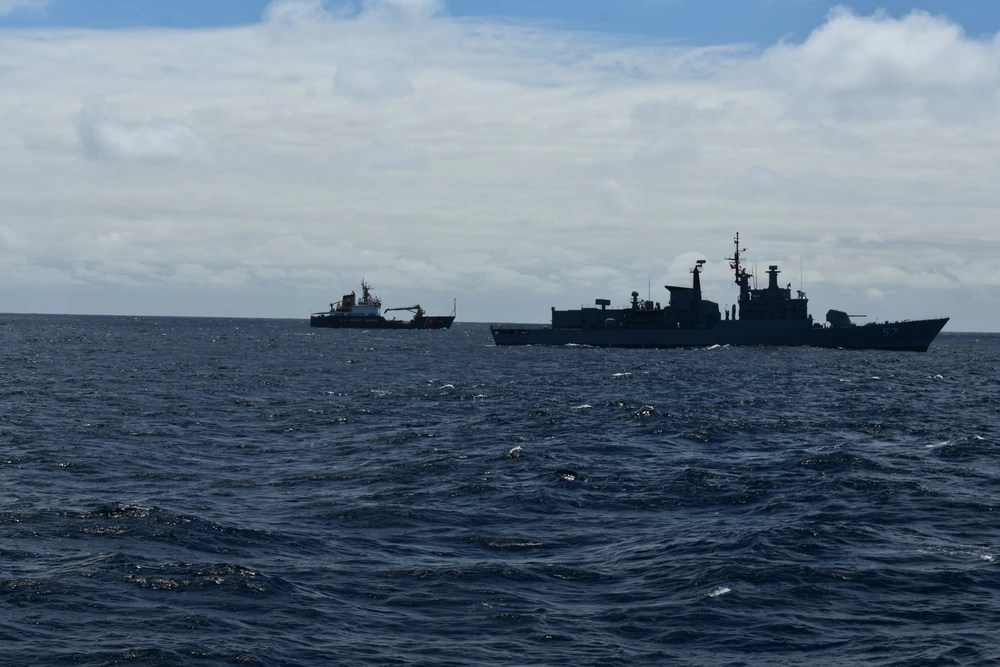
U.S. Coast Guard Cutter Alder (background) transits in formation alongside Peru BAP (Buque Armada Peruana) Bolognesi (FM-57) as it prepares for the next exercise during GALAPEX 2023, Sept.25, 2023. (U.S. Coast Guard photo)


 Oct. 16, 2023

Coast Guard Cutter crews conduct first high-seas boardings off the coast of Peru, under new SPRFMO measure

ALAMEDA, Calif. — The crews of the Coast Guard Cutters Alder, Terrell Horne and an HC-130 Hercules aircraft recently completed the first high-seas boardings and inspections, in the Eastern Pacific Ocean, under a newly adopted conservation and management measure to monitor and inspect fishing and transshipment operations at-sea in the South Pacific Regional Fisheries Management Organization (SPRFMO) Convention Area.

As part of Operation Southern Shield, the Coast Guard conducted boardings and overflights within the SPRFMO Convention Area on the high seas off the coast of Peru. For years, the Coast Guard has executed counter-illegal, unreported, or unregulated (IUU) fishing operations and participated in high seas boarding inspections (HSBI) around the globe. This operation was significant as it was timed to implement newly adopted rules in the SPRFMO Convention Area, which comprises nearly a quarter of the Earth’s high seas. The SPRFMO Commission consists of 17 members from Asia, Europe, the Americas, and Oceania, as well as two cooperating non-contracting parties. The primary species targeted in the Convention area are jack mackerel and jumbo flying squid.

Just prior to Operation Southern Shield, the Coast Guard participated in GALAPEX 2023, a recurring joint and multinational exercise hosted by Ecuador and executed in the vicinity of the Galapagos Islands. The Coast Guard conducted communications exercises, practiced counter-narcotics boarding scenarios, and hosted observers from Peru, Ecuador, and Brazil. GALAPEX culminated with full-scale exercises focused on a coordinated multinational response to counter IUU fishing. At the conclusion of the exercise, the Coast Guard patrolled south to focus on high seas boarding inspections off the coast of Peru.

“The U.S. Coast Guard remains committed to conducting combined maritime operations and exercises throughout the Eastern Pacific and will continue to capitalize on every opportunity to work with, learn from, and coordinate through our partners,” said Capt. James O’Mara, Chief of Enforcement for Coast Guard 11th District.  “The relationships our services build while planning and executing these operations are essential. The logistics required to enable these operations are significant, and it only happens with the tremendous support of partners like Ecuador and Peru.”

IUU fishing has replaced piracy as the leading global maritime security threat. Areas out on the high seas, beyond any country’s exclusive economic zone, can be exploited by fishermen engaged in IUU fishing, as they fish beyond the reach of most law enforcement entities. The Coast Guard’s actions provide inspection presence on the high seas among a distant water fishing fleet made up of more than 400 fishing and transshipment vessels. Much of the fishing in the Eastern Pacific is accomplished by these distant water fishing vessels, some which remain at sea for years at a time, and many of which are supported by transshipment vessels. The Coast Guard’s recent operation directly supported Central and South American partners and their desire to monitor and expand maritime domain awareness of fishing activity near their exclusive economic zones.

Each day during the operation a Coast Guard C-130 aircraft flew sorties over the fishing fleet on the high seas with observers from the Peruvian Navy and Air Force. The crew of the Coast Guard Cutter Terrell Horne also diverted to assist the Peruvian Navy in a search and rescue operation. The Terrell Horne located the vessel, then transported an injured fisherman back to shore to receive further medical care from local Peruvian officials.

“The U.S. Coast Guard is committed to working with our allies and partners to strengthen the international fisheries enforcement regime and stop the pervasive IUU fishing threat,” said Rear Adm. Andrew Sugimoto, commander, Coast Guard 11th District. “Operation Southern Shield is just the latest example of that commitment, and we will continue to model and support rules-based order. We applaud the SPRFMO Commission for adopting these latest inspection guidelines and hope to see additional management measures adopted in the future to ensure the sustainability of our ocean resources. Last year we operated off the Galapagos, this year off the coast of Peru, and we will continue to deploy aircraft, cutters, and personnel to support our partners and monitor these distant water fleets wherever they roam. These operations help bring like-minded countries closer together to protect vulnerable fish stocks, support the economic stability of coastal nations, the livelihoods of small-scale and artisanal fishermen, and safeguard ocean resources that fuel global populations and economies.”

Chinese F/V Attempts to Ram USCGC James –AP

In this photo made available by the U.S. Coast Guard, guardsmen from the cutter James, seen at background right, conduct a boarding of a fishing vessel in the eastern Pacific Ocean, on Aug. 4, 2022. During the 10-day patrol for illegal, unreported or unregulated fishing, three vessels steamed away. Another turned aggressively 90 degrees toward the James, forcing the American vessel to maneuver to avoid being rammed. (Petty Officer 3rd Class Hunter Schnabel/U.S. Coast Guard via AP)

The Associated Press is reporting,

“…a heavily-armed U.S. Coast Guard cutter sailed up to a fleet of a few hundred Chinese squid-fishing boats not far from Ecuador’s Galapagos Islands. Its mission: inspect the vessels for any signs of illegal, unreported or unregulated fishing…But in this case, the Chinese captains of several fishing boats did something unexpected. Three vessels sped away, one turning aggressively 90 degrees toward the Coast Guard cutter James, forcing the American vessel to take evasive action to avoid being rammed.”

Of course there is much more to the story.

NATIONAL 5-YEAR STRATEGY FOR COMBATING ILLEGAL, UNREPORTED, AND UNREGULATED FISHING (2022-2026) / and the Missing Air Element

Under NOAA auspices, the U. S. Interagency Working Group on IUU Fishing has issued a five year strategy to address IUU fishing.

There are three identified objectives:

  • Promote Sustainable Fisheries Management and Governance
  • Enhance the Monitoring, Control, and Surveillance of Marine Fishing Operations
  • Ensure Only Legal, Sustainable, and Responsibly Harvested Seafood Enters
    Trade

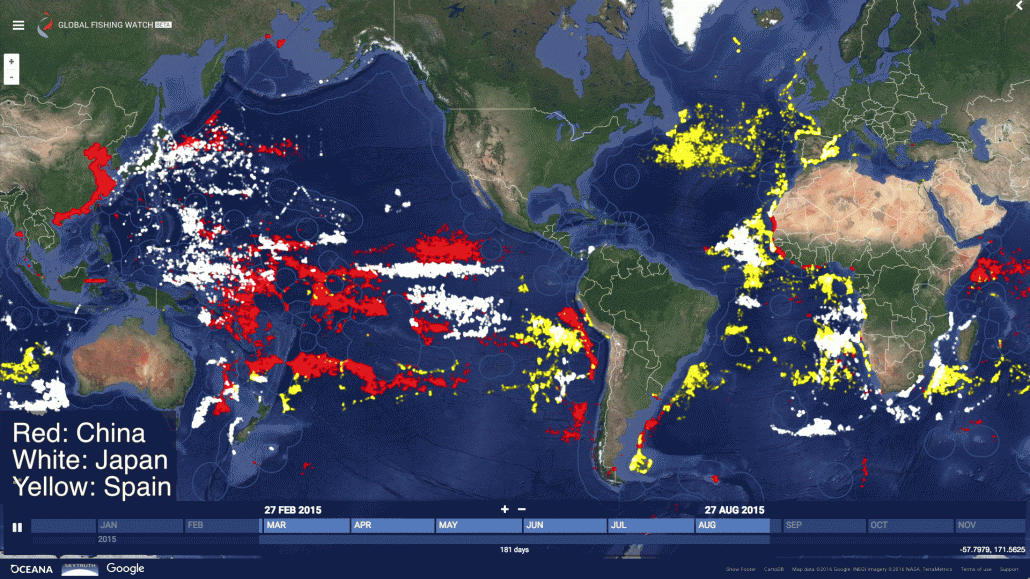
Five nations have been identified as priorities for development of self sufficiency in the prevention of IUU fishing: Ecuador, Panama, Senegal, Taiwan, and Vietnam. These “Priority States” were selected because their “…vessels: “actively engage in, knowingly profit from, or are complicit in IUU fishing” and, at the same time, the priority flag state “is willing, but lacks the capacity, to monitor or take effective enforcement action against its fleet.”

090808-G-3885B-136
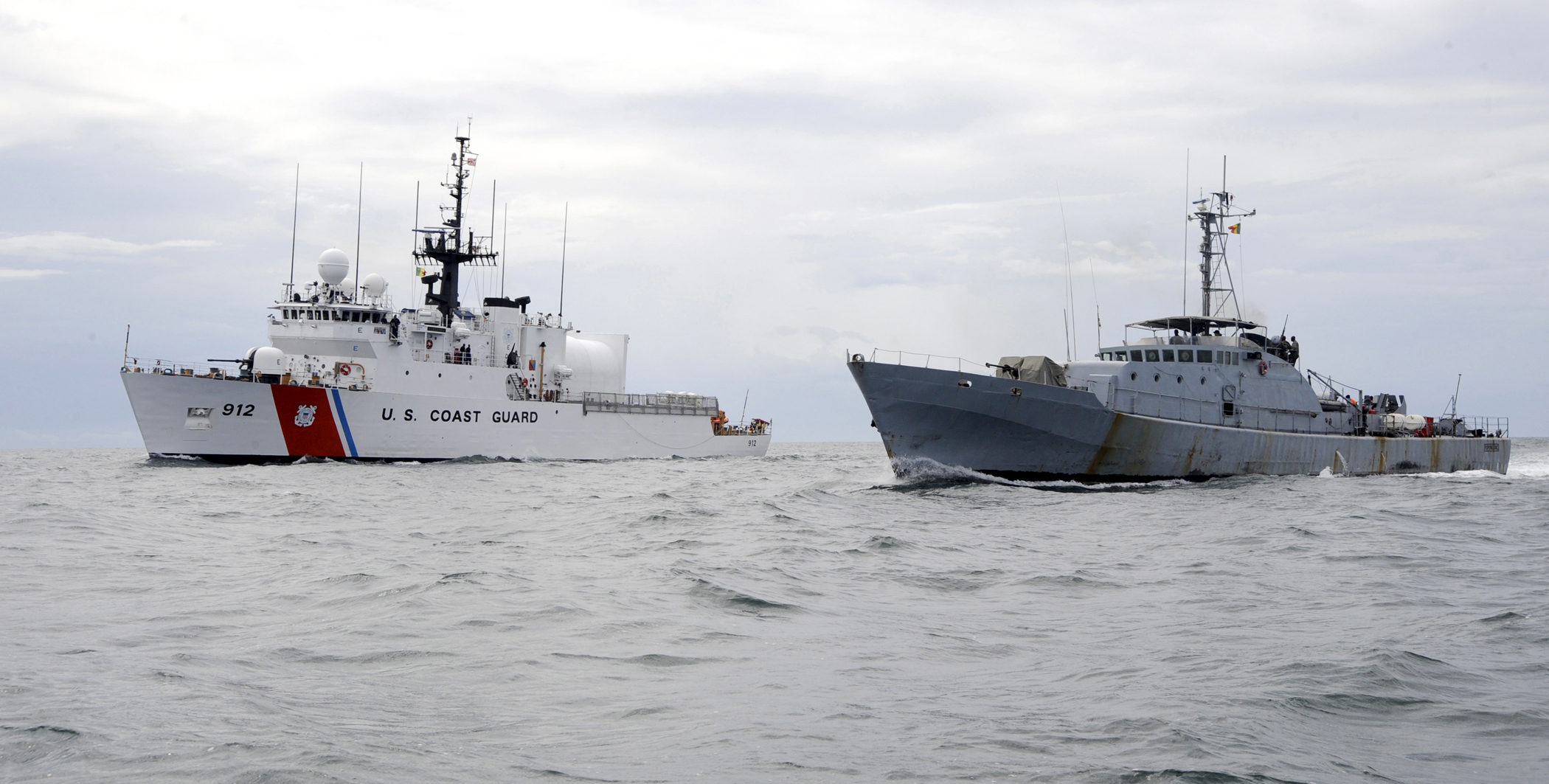
ATLANTIC OCEAN (Aug. 8, 2009) The U.S. Coast Guard Cutter Legare (WMEC 912), left, patrols along side the Senegalese Navy vessel, Poponquine, during joint operations as part of the Africa Partnership Station. The Legare is deployed off the west and central coast of Africa for the six-day joint U.S/Senegalese operation, during which several Senegalese naval vessel boarding team members embarked aboard the Legare and participated in joint boarding and training exercises. (U.S. Coast Guard photo by Petty Officer 2nd Class Thomas M. Blue/ Released)

It is likely the Coast Guard will be spending time helping these states build capacity in their navies, coast guards, or maritime police.

The Missing Air Element  

One of the great strengths of the US Coast Guard is its fleet of fixed wing aircraft. They provide an essential detection capability. An air search capability allows the patrol vessels to do less searching and more boardings. Most smaller nations’ maritime law enforcement agencies have only limited, or in many cases, no comparable organic air search capability. Frequently, if they are to have an air search, they require cooperation of another service.

What I have seen of our capacity building efforts, seem to have been focused on surface operations and boarding team work.

Recognizing fishing vessels is not in the skill set of most air force crews. Frequently communications between surface vessels and air units are not compatible. In many air forces their aircraft virtually never go out over blue water.

The US Coast Guard could certainly help build capacity on the air side, as well as the surface side of the IUU fishing problem.

Land based Unmanned Air Systems now appear to be a way maritime law enforcement agencies might have an organic fixed wing air search capability at a lower cost. Unfortunately the US Coast Guard still is not particularly experienced in this area. The Japanese Coast Guard might be able to provide valuable advice to at least Taiwan and Vietnam in the use of UAS, as they gain experience with their newly acquired MQ-9Bs.

“Ecuadorian Navy Sailing Ship Interdicts Drug Smugglers in the Pacific” –USNI

Ecuadorian Navy Sailing Ship Interdicts Drug Smugglers in the Pacific

The US Naval Institute news service reports,

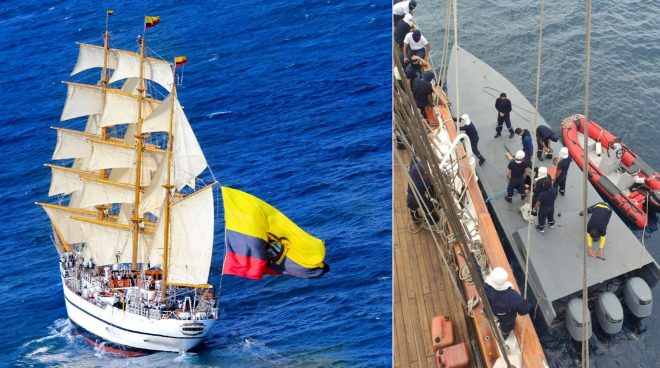
A three-masted training ship interdicted a drug-laden high-speed smuggling vessel off the coast of Colombia on Friday, the Ecuadorian Navy announced.

Sailing ship BAE Guayas caught the low-profile vessel within the 200-nautical miles of the Colombian exclusive economic zone, the service announced.

Maybe we should put Eagle to work.