Force Protection Unit “Coast Guard cutters Sea Dog, Sea Dragon decommissioned in St. Marys, Georgia” –News Release

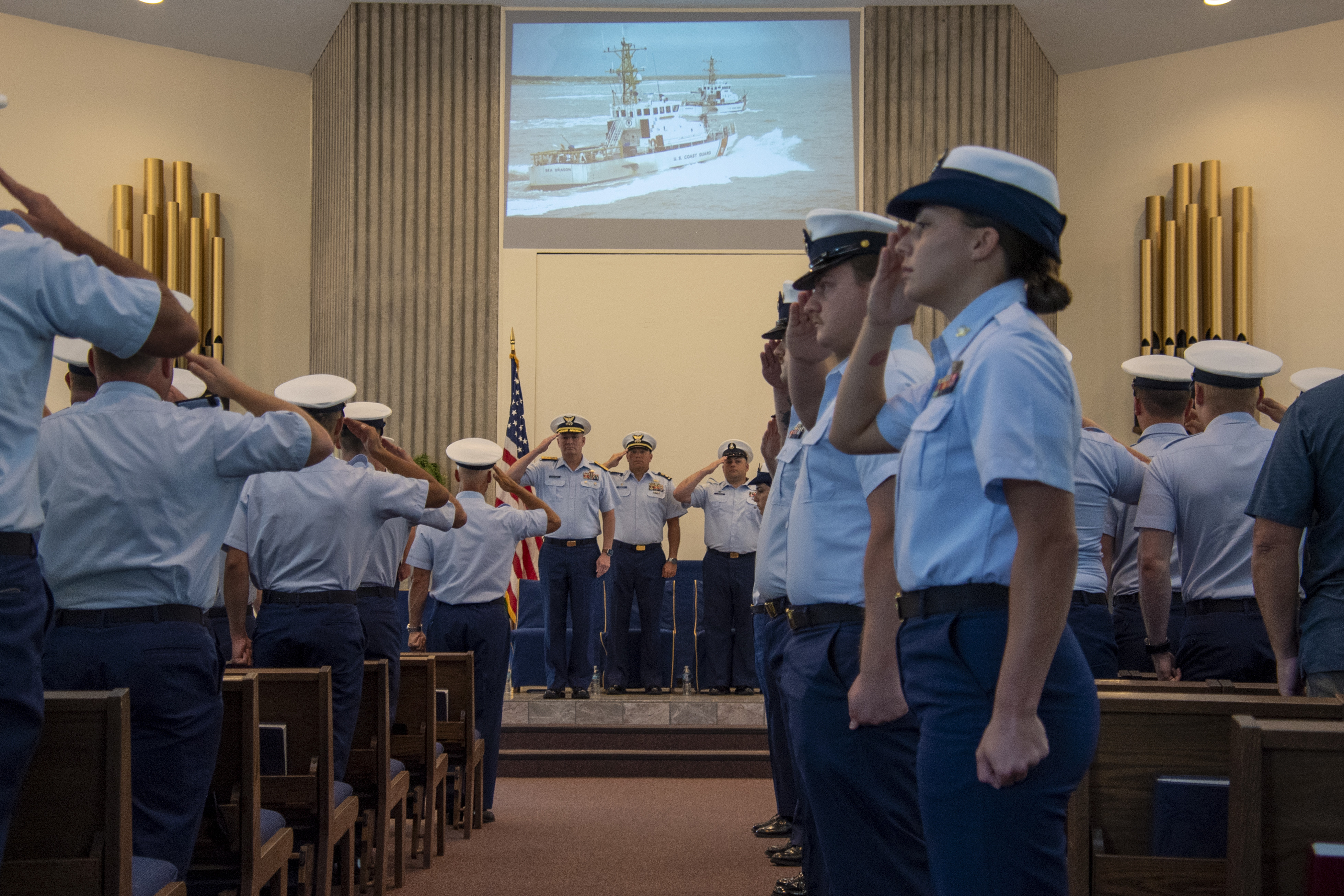
Coast Guard members salute during the playing of the national anthem during a decommissioning ceremony for the Coast Guard Cutters Sea Dog and Sea Dragon in St. Marys, Georgia, May 29, 2024. Rear Adm. Douglas M. Schofield, Coast Guard District Seven Commander, presided over the ceremony honoring the years of service the Sea Dog and Sea Dragon and their crews provided to the nation. (U.S. Coast Guard photo by Petty Officer 1st Class Ryan Dickinson)

Below is a press release. The two 87 foot patrol boats were assigned to a Force Protection unit for the Fleet Ballistic Missile Submarines (SSBNs) based at Kings Bay, GA.

“The Coast Guard cutters Sea Devil (WPB 87368) and Sea Fox (WPB 87374) have relocated from Bangor, Washington, to replace the Sea Dog and Sea Dragon.”

Sea Devil and Sea Fox were assigned to the Force Protection Unit that escorts SSBNs from Bangor, WA. Is that unit being decommissioned, or are they being reequipped? The two WPBs at each unit were not the only boats used by these units.

As I recall these WPBs and their operating costs were paid for by the Navy Department. In any case these decommissionings do not affect normal Coast Guard operations.

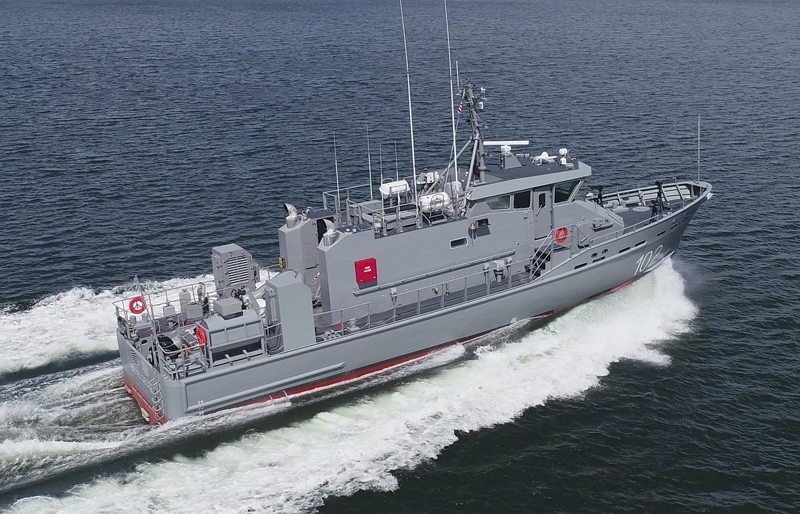
These four WPBs were equipped a bit differently from standard Marine Protector class 87 footers, including having a .50 cal. mounted in a remote weapon station on a band stand on the bow.
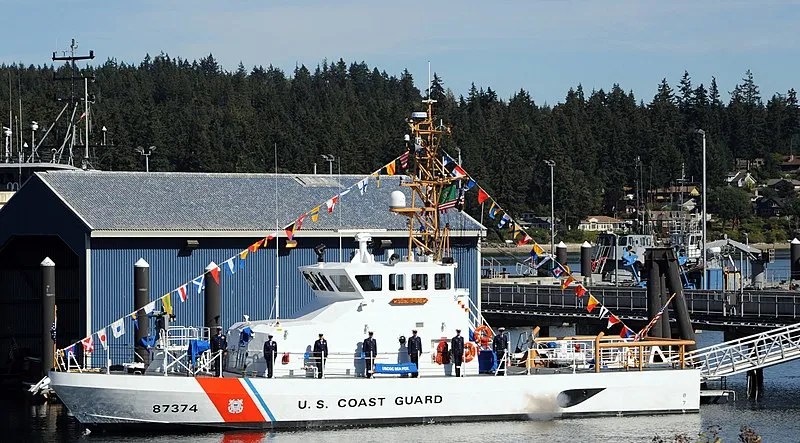
KEYPORT, Wash. (Aug. 18, 2009) U. S. Coast Guardsmen man the rails as the U.S. Coast Guard Cutter Sea Fox (WPB 87374) is brought to life at Naval Base Kitsap. (U.S. Navy photo Ray Narimatsu/Released)

Thanks to Paul for bringing this to my attention.


May 29, 2024

PHOTO RELEASE: Coast Guard cutters Sea Dog, Sea Dragon decommissioned in St. Marys, Georgia

JACKSONVILLE, Fla. — The Coast Guard decommissioned the U.S. Coast Guard cutters Sea Dog (WPB 87373) and Sea Dragon (WPB 87367), Wednesday, during a ceremony in St. Marys, Georgia.

Rear Adm. Douglas M. Schofield, Coast Guard District Seven commander, presided over the ceremony honoring the years of service the Sea Dog and Sea Dragon provided to the nation.

The Sea Dog and Sea Dragon were 87-foot marine protector-class cutters assigned to Coast Guard Maritime Force Protection Unit Kings Bay in the Coast Guard’s Seventh District.

Maritime Force Protection Unit Kings Bay is designed to support the Navy’s efforts to provide anti-terrorism and force protection for its Ohio-class ballistic missile submarines and to assist in meeting its Presidential mandates for ballistic weapon security.

The Sea Dragon was commissioned in January 2008 and the Sea Dog was commissioned in July 2009.

“The men and women of the cutters Sea Dog and Sea Dragon, past and present, have exemplified unwavering professionalism and dedication, safeguarding our nation’s waters and supporting critical defense missions,” said Capt. David Vicks, commanding officer of Maritime Force Protection Unit Kings Bay. “I extend my profound gratitude to these courageous crews as we honor their steadfast service.”

Following the decommissioning ceremony, the cutters will be transferred to Marine Corps Air Station Cherry Point.

The Coast Guard cutters Sea Devil (WPB 87368) and Sea Fox (WPB 87374) have relocated from Bangor, Washington, to replace the Sea Dog and Sea Dragon.

For breaking news, follow us on X (formerly Twitter). For additional information, find us on Facebook and Instagram.

Helicopter Door Gunner Takes Down Kamikaze Drone

French Armed Forces via X

The War Zone reports, “A French Navy helicopter used machine gun fire to shoot down a Houthi drone over the Red Sea today.”

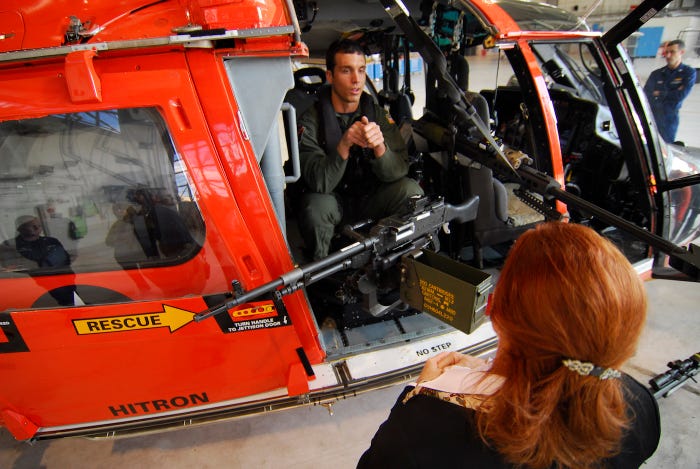
This is a potential Coast Guard capability, given its airborne use of force capability includes a door mounted rifle caliber machine gun, though I do not know if every Coast Guard Air Station has qualified gunners. The .50 caliber sniper rifle included in the package might even be more effective than the machine gun.

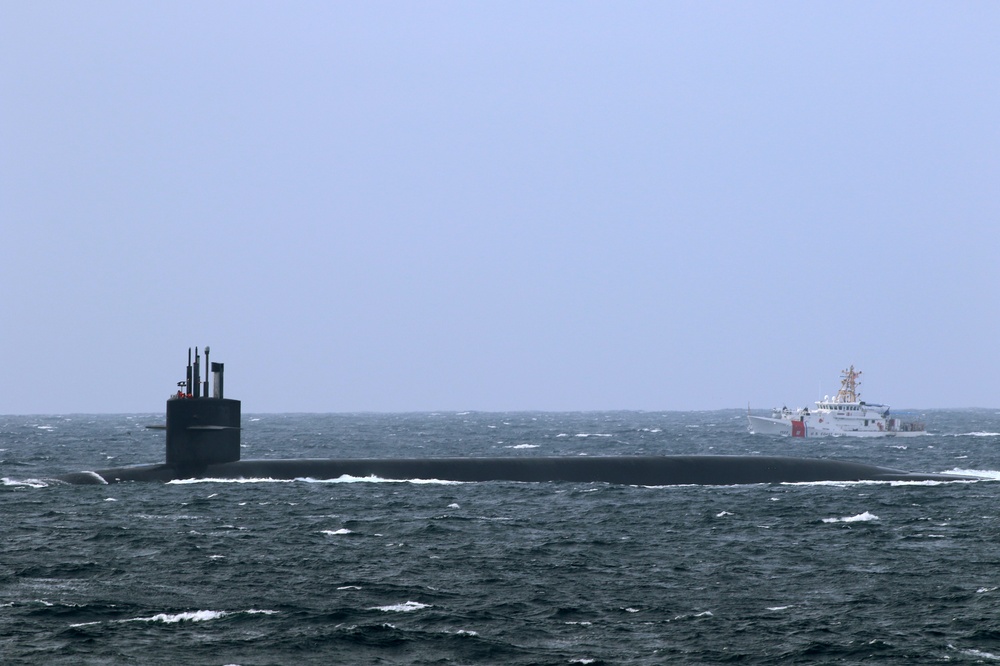
I am not suggesting the Coast Guard send helicopters to the Red Sea, but when the Coast Guard provides protection for vessels transiting to sea, it has generally been done with small boats with crew served rifle caliber machine guns. Ballistic Missile submarines have been an exception. They may be escorted by 82 foot patrol boats with .50 caliber machine guns in remote weapon stations. Perhaps the Coast Guard should consider providing an armed helicopter overwatch. An armed helicopter could be effective against hostile surface systems as well as air systems.

Petty Officer 2nd Class Anthony Phillips, a precision marksman at Helicopter Interdiction Tactical Squadron, displays the weaponry used by a HITRON during missions, February 23, 2010. US Coast Guard/Petty Officer 1st Class Bobby Nash

Below is a video taken by the French helicopter (an AS565 Panther, similar to the Coast Guard’s H-65s) as it shoots down the drone.

A US Navy helicopter demonstrated this capability over eight years ago. It is certainly less expensive than bringing down a drone with a missile. On the other hand, I would not want to be in a helicopter near a drone if the Navy decides to use a missile to destroy the drone.

“U.S., Indian Coast Guards Drill Against Drone Attacks In Sea Defenders 2024” –Naval News

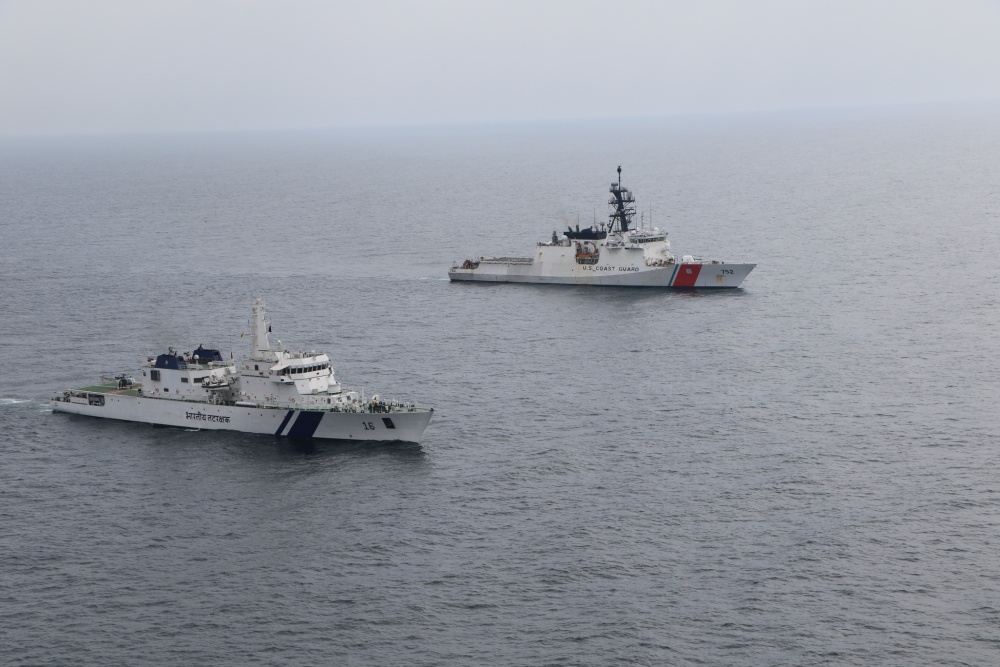
USCGC Bertholf and an ICG offshore patrol vessel sail together during Sea Defenders 2024.

Naval News reports,

U.S. and Indian Coast Guards held this year’s Sea Defender with recent events in the Red Sea in mind, training against both drone and piracy threats…Taking place off the Malacca Strait off the Andaman and Nicobar Islands, USCGC Bertholf (WMSL-750) and Indian Coast Guard vessels and aircraft held several maritime security activities in port and at sea over four days. This exercise also marked the first time a U.S. Coast Guard vessel visited New Delhi’s southernmost territory, strategically located at the entrance to the Malacca Strait between the Indian and Pacific oceans. 

The Indian Navy and Coast Guard both operate large numbers of Offshore Patrol Vessels. Established in 1978, the Indian Coast Guard has been growing rapidly and is now one of the largest in the world. Following the 2008 Mumbai Terrorist Attack, which came by sea, the Indian Coast Guard grew even more rapidly.

The Indian Coast Guard now operates 27 Offshore Patrol Vessels (OPV), all commissioned within the last 28 years, 18 within the last ten years. The Indian CG has ordered six more. The Indian Navy also operates ten OPVs, all commissioned in the last 35 years, four commissioned within the last eleven years. The Indian Navy has ordered eleven more OPVs.

The US Coast Guard operates, I believe, 36 OPVs now, soon to be 34. Only six of those have been commissioned in the last ten years. 26 of the USCG OPVs are over 33 years old.

The NSCs are doing things we would have never expected when they were conceived.

As included in this exercise, it appears there is an emerging requirement for the Coast Guard to be prepared to counter unmanned systems of various types, both for self defense and for the defense of maritime assets. Unmanned systems are likely the weapon of choice for future terrorist attacks.

Of all Coast Guard assets, the large cutters are currently the most capable against the various types of one-way attack unmanned systems, but they are unlikely to be involved in the most likely scenarios. Attacks on passenger ships, submarines, or aircraft carriers, during transit from port to open sea seem most probable. Here we are decidedly unprepared, but perhaps PATFORSWA is leading the way.

“Gaza Pier Announced by the US, How the US Military Builds a Pier, Joint Logistics Over the Sea” –What’s Going on with Shipping

Above is a YouTube video, talking about the pier that is expected to be built to bring supplies into Gaza as announced in the President’s State of the Union address.

Reportedly this will not involve putting US “boots on the ground” in Gaza, but…the Coast Guard may be involved in providing waterside security, states-side load out, and perhaps in the processing of shipments through Cyprus.

The War Zone discusses the risks of the operation here, “This Is How The U.S. Could Set Up a Gaza Beachhead, But Not Without Risks.”

A US Army logistics ship is already on the way.

U.S. Army Vessel General Frank S. Besson (LSV-1) from the 7th Transportation Brigade (Expeditionary), 3rd Expeditionary Sustainment Command, XVIII Airborne Corps, departed Joint Base Langley-Eustis, Va., March 9, 2024, en route to the Eastern Mediterranean carrying the first equipment to establish a temporary pier to deliver vital humanitarian supplies. (U.S. Central Command photo)

Meanwhile, World Central Kitchens is working on its own possible solution. It is not unlikely other non-government organizations will want to bring in supplies as well. Presumably these supplies will also have to be processed through Cyprus where the Israelis have set up a check point.

Teledyne FLIR Defense Unveils Advanced Thermal Weapon Sight at SHOT Show in Las Vegas” –News release

Below is a news release. Sorry that this is late, but I think still interesting. More on the system from Army Times here.

I am particularly concerned about the fact that the PATFORSWA‘s six FRCs have only .50 cal. machine guns to defend the vessels from attacks coming up the stern. While we have seen some indication, they may have been given improved sights (this looks like a lead computing sight), but as far as we know, those weapons have only iron sights. In view of the possibility of swarming surface and drone attacks, I would hope for some improvements. I would like to see remote weapon stations and/or APKWS, but if not, then at least improvements in the protection of the gunner and his ability to take out the maximum number of targets with the minimum number of rounds. Hopefully they will not have to stop to reload in the middle of an engagement.

Spray and pray is just not a good answer.

There are a number of improvements that might be beneficial. A sight like this would help with initial target detection and minimize the number of wasted rounds, especially at night. 

Not doubt it could improve the potential of any Coast Guard machine guns used for force protection or Ports, Waterways, and Coastal Security. It would improve the likelihood of effective disabling fire and minimize the probability of collateral damage.


New ThermoSight® HISS-HD is the ultimate sniper sight for precision shooters;

Can detect, identify and engage targets, day or night, at more than 2,200 meters

LAS VEGAS, January 23, 2024 ― Teledyne FLIR Defense, part of Teledyne Technologies Incorporated (NYSE:TDY), today unveiled its new long-range cooled thermal sniper sight, the ThermoSight® HISS-HD, at this week’s annual SHOT Show in Las Vegas. The lightweight, high-performance thermal weapon sight allows precision shooters to detect, identify and engage targets more than 2,200 meters away with unparalleled accuracy.

Designed for seamless integration, the HISS-HD clip-on thermal weapon sight easily mounts on any MIL-STD-1913 rail interface in front of an existing scope. HISS-HD can interface with various day scopes and weapon platforms, offering long-range optics and a high-definition display that delivers exceptionally clear imagery for snipers and machine gun crews.

“The new ThermoSight HISS-HD is the unmatched choice for precision shooters looking for a versatile, lightweight thermal sight that increases their range and accuracy,” said Rob Tarantino, vice president of Surveillance Strategy and Development at Teledyne FLIR Defense. “With HISS-HD, we’ve leveraged our world-class thermal imagiing technology to provide marksmen with a superior tool to identify and engage targets anywhere, in any environment.”

HISS-HD is an ideal option for long range snipers and missions involving reconnaissance, force protection, surveillance, and forward observation. With the added flexibility of an optional remote-control pendant, the HISS-HD enhances shooting stability, reduces revealing movements, and is configured for remote observation. This unique combination of stand-off range and long-range target engagement empowers shooters with unrivaled overmatch capability in any operational scenario.

“Boats of the United States Coast Guard” –CG-9

Response Boat, Medium (RB-M). Photo from Vigor

A friend (thanks Lee) brought this little book to my attention.

“Boats of the United States Coast Guard”

Don’t know how I missed this, but seems very comprehensive, 30 pages and 44 different types of craft.

“ARCIMS SeaSense: An Autonomous Anti-Submarine Warfare Solution” –Naval News

Naval News (sponsored content) reports,

ATLAS ELEKTRONIK UK (AEUK) have added an underwater surveillance system to their already established fleet of ARCIMS Uncrewed Surface Vessels (USVs). Integrated with a compact Variable Depth Sonar (VDS) ‘SeaSense’, this underwater threat detection capability has been designed to operate within confined and shallow waters, offering an alternative to the traditional ASW platform.

What we have here is a combination of two systems, both of which may be of interest, a lightweight sonar system and an optionally manned 11 meter boat that is essentially a maritime pickup truck that can handle alternative mission loads. Apparently, there is also a mine countermeasures system based on the same 11 meter uncrewed surface vessel.

ATLAS ELEKTRONIK is a long established, very experienced German electronics and defense company with subsidiaries worldwide, including the US. Among other products, they make the Sea Fox mine disposal system for the US Navy.

That the ARCIMS platform is an 11meter boat immediately piqued my interest because it is the same size as the Long Range Interceptor carried by National Security Cutters (NSC), suggesting the craft might be operated from NSC with minimal changes.

A couple of NSCs with MH-60R ASW helicopters and four of these sonar equipped optionally manned boats might make a pretty robust deployable ASW screen for an Amphibious Objective Area or a port of debarkation without major changes to the NSCs.

“U.S. Navy’s New 40-Foot Defiant Patrol Boat” –Naval News, Plus FMS Patrol Boat

The 40PB shows its speed in this photo and is armed with a .50cal M2 heavy machine gun at the bow, 7.62mm miniguns and acoustic devices amidships, and a M240B at the stern. The radar, electro-optical camera, and FLIR are visible on the short mast above the cabin. Metal Shark photo.

Naval News brings us a bit more informaton about the Navy’s new 40 foot force protection patrol boat. Most significantly,

NAVSEA: A total of 56 [40-foot Patrol] boats have been awarded to Metal Shark Boats and as of 9 May 2022, 20 boats have been delivered to the U.S. Navy.

In 2017 we discussed the program here and revisited it in 2019 here. The last indicated boats were being delivered at a rate of one every four weeks, meaning Metal Shark will likely be building these boats through early 2025.

Metal Shark calls this model the “40 Defiant” although it is actually 44 foot. Their description is here.

The 85-foot Defiant-class Near Coastal Patrol Vessel (NCPV) is being acquired by NAVSEA for Foreign Military Sales. Metal Shark photo.

There is also a some discussion of the Metal Shark “85 Defiant” patrol boat that is being produced for Foreign Military Sales. This is an evolution of the same design that gave the US Coast Guard its 87 foot “Marine Protector” WPBs (it too is actually 87 foot loa). The Navy calls this class Near Coastal Patrol Vessels or NCPV. We discussed this class in 2017. We noted at the time that Metal Shark had been award a contract,

“…potentially worth upwards of $54 million, Metal Shark will build up to thirteen 85-foot Defiant-class welded aluminum cutters for the Dominican Republic, El Salvador, Honduras, Costa Rica, Guatemala, and other United States partner nations. Additionally, Metal Shark will supply electro-optical infrared sensors, diagnostic equipment, in-country reactivation, crew familiarization, and test support to NCPV operators.

Metal Shark’s website has a description of the vessel here.

Coast Guard Mission from DOD Budget Justification

The crew of the Coast Guard Cutter Bailey Barco (WPC 1122), a fast response cutter, patrols the waters near Unalaska, Alaska, while providing a security escort for the USS Kentucky, an Ohio-class ballistic-missile submarine, August 24, 2017. The Bailey Barco, homeported in Ketchikan, Alaska, is the first Coast Guard fast response cutter to transit the Aleutian Islands of Alaska. U.S. Coast Guard photo by Ens. Brandon Newman

I took a quick look at the DOD 2022 budget justification overview. There was only a single paragraph that discussed a mission that the Coast Guard would be expected to do. From page 3-10:


Divest Coastal Riverine Squadron Craft

The Navy divests of 12 MK VI Patrol Boats from Coastal Riverine Squadrons. The Navy reallocated the associated end strength savings to higher priority Navy programs. The final deployment for the affected Coastal Riverine companies is scheduled to be complete by approximately the end of 2021. The MK VI requirement originated from a November 2007 Commander, U.S. Fifth Fleet Urgent Operational Needs Statement for a visit, board, search, and seizure overwatch platform in the littorals and the mission set was expanded to 2nd, 3rd and 7th Fleets and added maritime force protection, Theater Security Cooperation, Expeditionary MCM support, and intelligence collection tasks. Following divestment, these missions will be accomplished using other Navy platforms to include leveraging U.S. Coast Guard to escort High Value Units (HVU) (e.g., CVN, SSN, SSGN) in Fleet concentration areas. (Emphasis applied–Chuck)


White Hull Diplomacy, “The Coast Guard and Stability Operations” –Small Wars Journal

Coast Guard Cutter Stratton (WMSL 752) sales alongside the Indian coast guard ships Abheed and Shaurya (16) Aug. 23, 2019, while transiting in the Bay of Bengal off the coast of Chennai, India. The Stratton is participating in a professional exchange with the Indian coast guard that includes operational exercises at sea and on shore. (U.S. Coast Guard photo by Petty Officer 3rd Class Stephen Esterly)

Small Wars Journal makes the case for designating the Coast Guard to maintain expertise in and conduct maritime stability operations.

Historically, the United States military is regularly involved in some sort of stability operation despite the military preference for high intensity conflict. … The United States risks losing some of the lessons learned if it does not develop a holistic and complementary Joint Force that can both dominate a peer enemy and conduct stability operations at and below the level of armed conflict. Competition means that forces will be employed across the spectrum of operations with equal emphasis. Designating specific services to conduct stability as a primary mission is one means of ensuring a Joint Force that is equally capable across the spectrum. The Coast Guard is uniquely suited to a lead role in maritime focused stability operations. As a military force that is resident within the inter-agency, the Coast Guard provides a presence that is “instantly acceptable because of their worldwide humanitarian reputation.” This forward presence dovetails with the Department of Homeland Security mission of “safeguarding the American people” by pushing the boundaries of U.S. law enforcement into regions and countries where it can mentor and develop partner capabilities in the areas it is needed most.

It quotes the Coast Guard Strategic Plan 2018-2022.

“The Coast Guard plays a critical role in strengthening governance in areas of strategic importance. We mature other nations’ inherent capabilities to police their own waters and support cooperative enforcement of international law through dozens of robust bilateral agreements. Our leadership on global maritime governing bodies and our collaborative approach to operationalize international agreements drives stability, legitimacy and order. As global strategic competition surges, adversaries become more sophisticated and the maritime environment becomes more complex. The Coast Guard provides a full spectrum of solutions, from cooperation to armed conflict.”

The post states,

“At its heart the primary stability tasks fall into seven military missions and activities:  protecting civilians, security sector reform, support to security cooperation, peace operations, foreign humanitarian assistance, counterinsurgency, and foreign internal defense.”

It then goes on to describe how the Coast Guard has done each of these tasks in the past.

What we may be seeing here is a preview of the roles the Coast Guard may be expected to perform when the expected Tri-Service Strategy is published.

Thanks to Geoff for the “White Hull Diplomacy” portion of the title.