USINDOPACOM Exercises & Engagements

INDOPACOM Defense Forum Special Features has a post that includes the map above that shows where “Exercise, Joint Combined Exchange or Training Teams” are located.

On the linked post, you can hover over the dots, and it will list activities in that location. Coast Guard is associated with dots identified as Solomon Islands, Federated States of Micronesia (FSM), Guam, Palau, Papua New Guinea, and Australia. It should have included the Marshall Islands as well. All these are also associated with Operation Blue Pacific.

Federated States of Micronesia, the Marshall Islands, and Palau are Compact of Free Association states. Guam and the Northern Mariana Islands are US territory.

The same post also has a different map that shows the location of DOD units normally located in the AOR (area of operations) that may be of interest.

“Coast Guard to send 3 more cutters to Guam, has no plans to escort Philippine ships” –Stars and Stripes

A U.S. Coast Guard boat crew and boarding team from U.S. Coast Guard Cutter Oliver Berry (WPC 1124) approaches a foreign fishing vessel to conduct a joint boarding inspection with members of the Western and Central Pacific Fisheries Commission on the high seas in Oceania, Sept. 22, 2024. U.S. Coast Guard Cutter Oliver Berry’s crew recently completed a 45-day patrol in Oceania in support of Operation Blue Pacific, promoting security, safety, sovereignty, and economic prosperity in the region.

Stars and Stripes reports,

The Coast Guard will double its Guam fleet to six cutters but doesn’t plan to accompany the Philippine coast guard as it struggles to maintain territorial claims in the South China Sea, the service’s Pacific-area commander said Friday.

This is based on a video news conference by Pacific Area Commander Vice Adm. Andrew Tiongson speaking from Japan.

“The Coast Guard will not escort Philippine resupply missions to the BRP Sierra Madre, a grounded warship garrisoned by Filipino troops at the Second Thomas Shoal in the South China Sea, according to Tiongson.”

The Philippines has not asked for escorts, Tiongson said. “We do advise, and we do assist,” he said. “We provide what we would do in this situation.”

He also said, “It’s possible we may get another Indo-Pacific support cutter,” using the description applied to USCGC Harriet Lane, recently arrived in the Pacific Area to support operations in the Western Pacific.

There is more in the article.

“USCGC Myrtle Hazard (WPC 1139) enters first drydock maintenance in Honolulu” –Forces Micronesia/Sector Guam

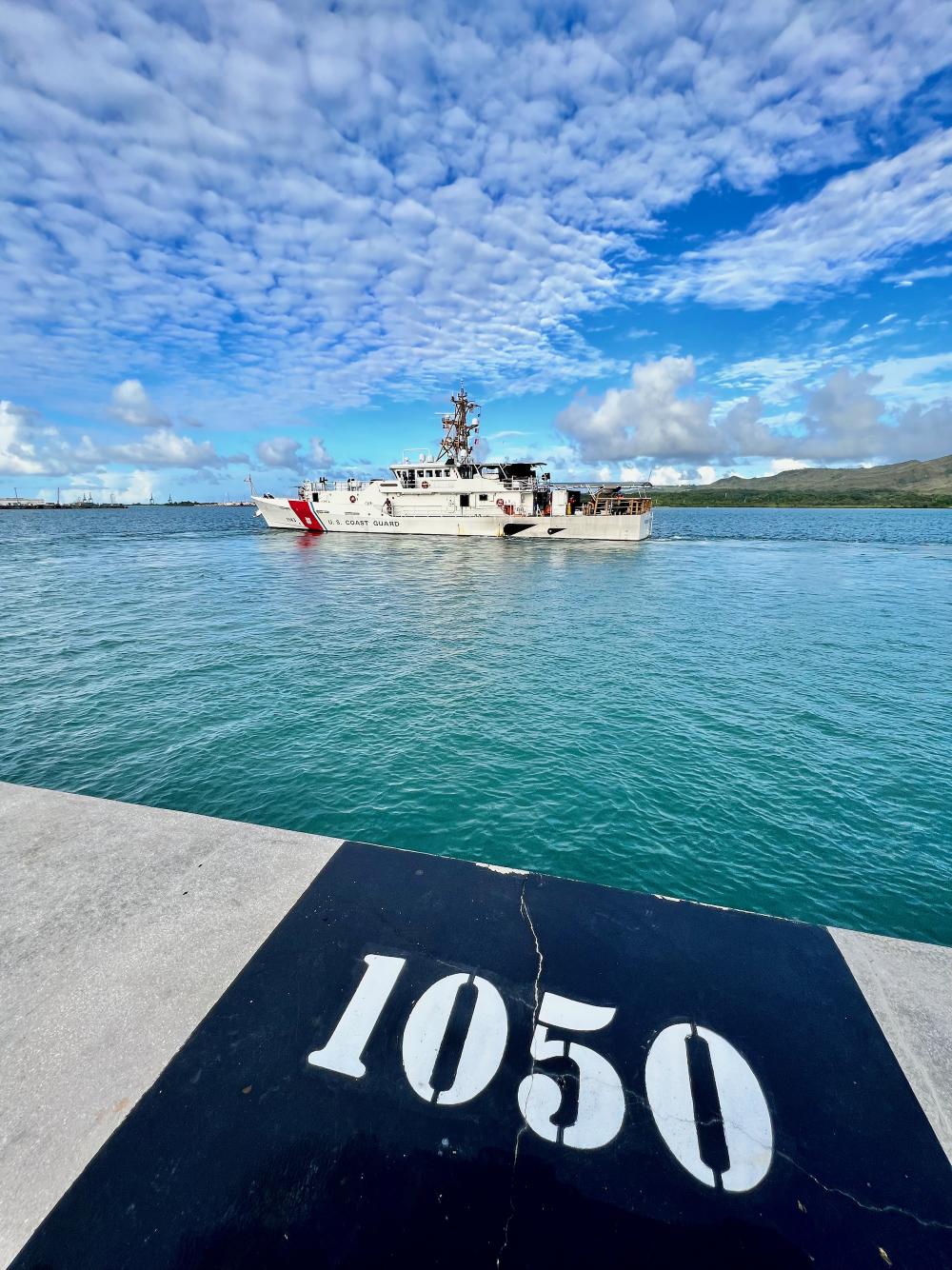
The USCGC Myrtle Hazard (WPC 1139) crew departs Guam for Honolulu on May 13, 2024, marking a significant milestone as the crew prepare for the first drydock maintenance period of approximately four and a half months. Commissioned in 2021, the Myrtle Hazard is the first of three Guam-based Fast Response Cutters to make the transit to Hawaii from Guam, traveling 3,743 miles to undergo this crucial maintenance phase. (U.S. Coast Guard photo by Chief Warrant Officer Sara Muir)

Below is a U.S. Coast Guard Forces Micronesia/Sector Guam news release (more photos there) that clarifies how Guam based Fast Response Cutters will be maintained. Just to provide a hint of how arduous this was, the distance from their base to Hawaii, 3743 nautical miles, would take 12 days at a 14 knot cruise speed, while the nominal range and endurance of ships of this class is 5 days and 2500 miles. Actually, she departed Guam on May 13 and arrived in Hawaii, May 28, 15 days later, presumably having stopped at least once to refuel and resupply. 

USCGC Myrtle Hazard arrived in Guam in September of 2020. This is her very first drydocking. Just getting to Hawaii required a transit equal to 16.3% of the miles she transited during the previous 42 months.

June 4, 2024

USCGC Myrtle Hazard (WPC 1139) enters first drydock maintenance in Honolulu

SANTA RITA, Guam — The USCGC Myrtle Hazard (WPC 1139) crew arrived in Honolulu on May 28, 2024, marking a significant milestone as it enters its first drydock maintenance period of approximately four and a half months. 

Commissioned in 2021, the Myrtle Hazard is the first of three Guam-based Fast Response Cutters (FRCs) to transit to Hawaii from Guam, traveling 3,743 miles to undergo this crucial maintenance phase.

In just the past two years, the Myrtle Hazard crew patrolled a vast 1.9 million square nautical mile area traveling as far south as Australia, accruing over 23,000 nautical miles steamed. The cutter crew enhanced regional maritime security and strengthened international cooperation by participating as the deputy commodore’s platform during a search and rescue exercise phase of Pacific Partnership 2022, the largest multinational humanitarian exercise in the Indo-Pacific. They also operationalized newly signed agreements by conducting historic bilateral boardings with Papua New Guinea, rescued mariners in dangerous sea conditions in the Northern Mariana Islands, and participated in critical operations escorting Department of Defense assets. The drydock maintenance is crucial for maintaining these high standards and ensuring the cutter’s continued ability to perform such missions.

“Throughout the transit east, as we leapfrogged through the Federated States of Micronesia and the Republic of the Marshall Islands to reach Hawaii, this crew demonstrated extraordinary resilience and skill. Despite several engineering challenges that tested our capabilities, their steadfast commitment and proficient handling of all casualties ensured our safe and timely arrival for drydock maintenance. I am immensely proud of their dedication and professionalism, which continue to ensure our readiness and effectiveness in fulfilling our missions,” said Lt. Emma Saunders, commanding officer of the USCGC Myrtle Hazard, on her first transit since assuming command.

Why Drydock is Essential

Drydock maintenance is vital for operational readiness, extending the cutter’s service life, and ensuring the safety of its crew. It involves a series of comprehensive inspections and repairs the crew cannot perform while the vessel is waterborne. These include hull preservation, mechanical overhauls, and technological upgrades, all of which are crucial for maintaining the cutter’s peak performance and safety standards.

Logistical Excellence and Risk Management

The logistical operation to transfer the cutter from Guam to Honolulu highlights the strategic planning and risk management necessary for this evolution. By proactively addressing maintenance needs, the team can meet operational commitments without compromising the safety or effectiveness of the fleet.

“Regular maintenance isn’t just about keeping our ships in shape; it’s about ensuring we’re always ready to meet the challenges we face at sea. Working closely with Coast Guard District 14 and our logistics teams, we schedule these critical maintenance periods to keep our missions running smoothly without missing a beat. This careful planning ensures we’re always there where we’re needed most, from safeguarding our shores to ensuring maritime safety and security across the Pacific. It’s a team effort, and every member of Team Guam plays a part in keeping our commitment strong and our presence steady in the waters we protect and the communities we serve.” said Capt. Robert Kistner, emphasizing the critical role of regular maintenance.

Next Steps for Guam-Based FRCs

Following the Myrtle Hazard, the other two Guam-based FRCs, USCGC Oliver Henry (WPC 1140) and USCGC Frederick Hatch (WPC 1143), will undergo their respective drydock periods. This systematic approach ensures that all vessels maintain their operational capabilities and readiness.

“We are committed to continuous improvement in maintenance practices, which is crucial for fulfilling our mission to protect and secure maritime interests in the Pacific,” said Kistner. “We look forward to Myrtle Hazard’s return this Fall.”

Future Outlook

As Base Guam continues to come online under the command of Cmdr. Dana Hiatt and operators employ the recently established Operational Logistics Command Expeditionary Team (LOG-X) more frequently; the U.S. Coast Guard is exploring enhancements in local maintenance capabilities and infrastructure in the Pacific. This includes potential investments in existing and new purpose-built facilities for Team Guam, which are crucial for minimizing downtime and ensuring a ready fleet capable of meeting future challenges.

Myrtle Hazard, the 39th 154-foot Sentinel-class FRC, is named in honor of the first enlisted woman in the U.S. Coast Guard who served as an electrician and radio operator. As part of the Guam-based cutters, it is a cornerstone for the U.S. Coast Guard’s ongoing commitment to the people of Oceania, focusing on maritime safety, security, and stewardship.

-USCG-

About U.S. Coast Guard Team Guam
Comprising over 350 members, this team is focused on maritime safety, security, and stewardship in Oceania. U.S. Coast Guard Forces Micronesia/Sector Guam, U.S. Coast Guard Base Guam, and their sub-units are staffed by dedicated active-duty, reserve, and civilian personnel. With a significant presence in Guam, Saipan, and the Micronesia sub-region, this integrated team focuses on operations and logistics to support maritime safety, security, and stewardship in Oceania and maintains close ties with local communities.

“How Fast Response Cutters Have Transformed Coast Guard Operations In Guam” –Naval News / What About Air Assets?

The crew of USCGC Oliver Henry (WPC 1140) arrives in Pohnpei, Federated States of Micronesia, on Feb. 1, 2024, to download supplies for delivery to the outer islands of the FSM to combat the effects of a current drought. The supplies included 2,000 lbs of rice, three medical kits, 70 gallons of bottled water, and boxes of paper products. (Photo courtesy of U.S. Embassy Kolonia)

Naval News has an excellent article reviewing the additional capabilities Webber class FRCs have provided. It also highlights the vast operating area and associated challenges including necessary maintenance.

U.S Coast Guard Forces Micronesia Sector Guam’s AOR is based on Guam Search and Rescue Region. (U.S Coast Guard Navigation Center) Around 3 million square kilometers or 1.9 million square miles and includes the entirety of Palau, the Federated States of Micronesia, and Republic of the Marshall Islands.

For scale, the distance from the bottom of the area above to the top is 1020 nautical miles. According to the post, “It’s [an area] two thirds the size of the continental United States that we patrol with three ships and 300 people,” (I suspect that was in reference to the Contiguous 48, but it’s a huge area.)

ASSETS:

Something that should not be missed is that the only normally available rotary wing assets in the area are a squadron of Navy MH-60S, and there are no fixed wing SAR or law enforcement assets in the region. If an extensive search is required for any reason, it usually means flying a C-130J over 3,400 nautical miles down from Coast Guard Air Station Barbers Point, Hawaii just to get to Guam.

Major Cutters do occasionally cruise these waters, but it is rare. There is also a 225 foot buoy tender homeported in Guam.

Hopefully these waters will see USCGC Harriet Lane frequently, but on her first Western Pacific patrol, it did not appear she deployed with a helicopter (I believe Barbers Point has only three). Being one of the first four 270s that were built by Tacoma Boat, her flight deck is not strong enough to support the Navy MH-60S so they could not even us her flight deck to extend their range, much less operate from the ship.

Most of the time, there will only be one Coast Guard surface vessel underway in this vast area. Assets are still too few to provide any degree of persistence as a deterrent to Illegal, Unreported, or Unregulated (IUU) fishing. Any vessels involved in IUU fishing would likely have a good idea where our cutters are operating and with no fixed wing search aircraft, our ability to search for IUU perpetrators is extremely limited.

In addition to more cutters, we really need good maritime domain awareness, probably meaning some kind of long-range search aircraft, manned or unmanned, operating routinely in this area. We might consider basing C-27Js in Guam. It is a long way from USCG support, but the Australian Air Force also flies C-27Js, so there might be some synergy there.

“U.S. Coast Guard formally establishes Base Guam” –CG News

APRA HARBOR, Guam (Aug. 11, 2021) – An aerial view of U.S. Naval Base Guam shows several vessels moored in Apra Harbor, including vessels from the United Kingdom Carrier Strike Group 21, Aug. 9. The deployment is the U.K.’s first by a carrier strike group in the Indo-Pacific for almost 25 years and marks a historic achievement in the bilateral partnership between the U.S. and U.K. The Arleigh Burke-class guided missile destroyer, USS The Sullivans (DDG-68) is deployed with the strike group, as are F-35B Lightning II Joint Strike Fighters of Marine Fighter Attack Squadron 211, HMS Queen Elizabeth (R08), HMS Kent (F78), HMS Defender (D63), RFA Fort Victoria (A387), RFA Tidespring (A136), Royal Netherlands Navy frigate HNLMS Evertsen (F805). French Ship Dupuy de Lome (A759), USNS Rappahannock (T-AO 204), USNS Salvor (T-ARS 52), USS Jackson (LCS 6), USS America (LHA 6), along with the 31st Marine Expeditionary Unit (MEU), were also in Guam for a scheduled port visit. (U.S. Navy photo by Mass Communication Specialist 3rd Class Naomi Johnson)

Below is a news release from Coast Guard News. This is another step in the growing Coast Guard presence in the Western Pacific. We have gone from a WLB and two 110s in Guam to a WLB and three FRCs and occasional CG helicopter presence. (A Navy MH-60S squadron normally provides SAR coverage.) I think we may see additional resources in the near future. Coast Guard Base Guam is a tenant command of Naval Base Guam. (Thanks to Bob for bringing this to my attention.)

Nov. 7, 2023

U.S. Coast Guard formally establishes Base Guam

U.S. Coast Guard Base Guam

SANTA RITA, Guam — The U.S. Coast Guard is proud to announce the establishment of U.S. Coast Guard Base Guam on Nov. 8, 2023, in a ceremony presided over by Rear Adm. Carola List, commander of Operational Logistics Command.

Led by Cmdr. Dana Hiatt, Base Guam, will be pivotal toward enhancing the U.S. Coast Guard’s mission support logistics in the region. This strategic move aligns with the Service’s commitment to increase mission support throughout Oceania. Given Guam’s vital importance to national security, this initiative takes center stage.

The establishment of Base Guam is part of the Consolidated Appropriations Act of 2023 and expands the U.S. Coast Guard’s mission support in the Indo-Pacific region. The establishment will shift current facilities engineering, naval engineering, comptroller and base operations, health, safety, and work life, personnel support, information technology, and procurement billets and responsibility from the existing U.S. Coast Guard Forces Micronesia/Sector Guam to a new Base Guam command structure. The establishment of Base Guam will consist of 17 additional personnel billets and will rely on the realignment of existing elements to provide logistical efficiencies improving U.S. Coast Guard mission support on Guam.

U.S. Coast Guard Base Guam will operate under the direction of the Operational Logistics Command, responsible for mission support logistics across the entire U.S. Coast Guard enterprise while coexisting with U.S. Coast Guard Forces Micronesia/Sector Guam. The base is taking on the role of the lead logistics and support command, a strategic decision aimed at better serving the needs of the operational community and partners. Forces Micronesia/Sector Guam retains the role of operational authority for U.S. Coast Guard activity in the Western Pacific.

The Base crew’s responsibilities encompass contingency logistics planning for joint operational plans, integration of logistics services, and support for tactical logistics needs for deployed operational assets. Additionally, the enterprise maintains a national-level logistics common operating picture and commands the Coast Guard’s 22 existing bases, ensuring the execution of assigned tasking through each of the U.S. Coast Guard’s Logistics and Service Centers.

The establishment of Base Guam marks a significant milestone in strengthening the U.S. Coast Guard’s presence and capabilities in the region. The unit is physically located on the existing U.S. Coast Guard footprint within U.S. Naval Base Guam.

-USCG-

About the DOL commander:
Rear Adm. Carola List currently serves as the commander of Operational Logistics Command in Norfolk, Virginia, overseeing the delivery of mission support logistics and administering procurement policy, guidance, and advocacy while also providing operational procurement and contracting services for all supported commands and units.

About Forces Micronesia/Sector Guam:
U.S. Coast Guard Forces Micronesia/Sector Guam comprises more than 300 dedicated members based in Guam and the Commonwealth of the Northern Mariana Islands. Capt. Nicholas Simmons currently leads Forces Micronesia and serves as the U.S. Coast Guard Captain of the Port for Guam and the CNMI. The U.S. Coast Guard is committed to maritime safety, security, and stewardship in Oceania, operating under the U.S. Coast Guard 14th District umbrella, which oversees Central and Western Pacific operations.

“U.S. Coast Guard Forces Micronesia Sector/Guam’s Fast Response Cutters bolster Pacific Partnership Strategy and strengthen Pacific Island Country relations” –USCG Forces Micronesia/Sector Guam

The Sentinel-class fast response cutter USCGC Oliver Henry (WPC 1140) crew arriving in Port Moresby for a port visit on Aug. 23, 2022, following a patrol in parts of the Coral Sea, the Solomon Islands and PNG Exclusive Economic Zones. The U.S. Coast Guard was conducting a routine deployment in Oceania as part of Operation Blue Pacific, working alongside Allies, building maritime domain awareness, and sharing best practices with partner nation navies and coast guards. (U.S. Coast Guard photo by USCGC Oliver Henry)

Below is a news release from U.S. Coast Guard Forces Micronesia/Sector Guam. Webber class cutters there are developing a new norm for Coast Guard assistance to Pacific Island nations. It is not clear if this is now the norm, or if this was an unusual period, but from June 21 to August 3, there was only one day (June 17) that they did not have an FRC underway for at least part of the day. This is what I believe should be the norm and probably the reason FRCs are so frequently based in groups of three or six. Typically three ships would be, one underway, one in maintenance, and one in workup/standby (I don’t know if they are employing standby). 

On the other hand, none of these patrols was more than 16 days long and the shortest only five, which suggest why, given the long transit distances, we need some cutters with greater endurance in the Western Pacific (I would say three to have one underway at all times and be able to surge two when needed).

Thanks to Paul for bringing this to my attention.

Aug. 18, 2023

U.S. Coast Guard Forces Micronesia Sector/Guam’s Fast Response Cutters bolster Pacific Partnership Strategy and strengthen Pacific Island Country relations

SANTA RITA, Guam — In a robust display of maritime commitment, U.S. Coast Guard Forces Micronesia/Sector Guam’s Fast Response Cutters conducted four patrols over 44 days, enhancing safety and prosperity in the Pacific Islands region while combatting illicit maritime activity, including illegal, unregulated, and unreported fishing and the illegal and unsafe transport of passengers.

The crews of USCGC Frederick Hatch (WPC 1143), USCGC Myrtle Hazard (WPC 1139), and USCGC Oliver Henry (WPC 1140):

– Conducted seven boardings and five observation reports.
– Completed over 20 training evolutions.
– Qualified 18 new shipboard members.
– Supported the investigation into the transport of 11 people aboard an overloaded vessel transiting to Guam from the Commonwealth of the Northern Mariana Islands on an illegal charter following their rescue by DoD partners.
– Supported operations such as Operation Blue Pacific, Operation Rematau, Operation Nasse, and Operation Koa Moana.

“Our Fast Response Cutter crews exhibit both efficacy and presence as a consistent and trusted partner in the region. Our Pacific Island Country partners’ warmth and regard for the Coast Guard is a testament to the strong connections we have nurtured over the years. It is our commitment to the people of the Pacific Island Countries to protect Oceania and its resources for them from undue strategic competition that would undermine those relationships and destabilize the region,” said Cmdr. Greg Sickels, deputy sector commander of U.S. Coast Guard Forces Micronesia/Sector Guam.

Operational Achievements and Highlights

– USCGC Frederick Hatch (June 21 – July 2 and July 18 – Aug. 3): Enhanced international relations, streamlined boarding processes, qualified new personnel, and improved communication with FSM Maritime Police.

– USCGC Myrtle Hazard (July 3 – 16): Strengthened connection with CNMI, ensured maritime law enforcement presence in less patrolled areas, and enhanced collaboration with customs and public safety departments.

– USCGC Oliver Henry (July 18 – 23): Increased U.S. presence, enforced fishing regulations, and fostered crew readiness with weapons proficiency and collaboration.

These accomplishments underscore the U.S. Coast Guard’s pivotal role in promoting maritime governance, ensuring good relations, and fostering strategic competition in the Pacific Islands region. The U.S. Coast Guard remains a consistent and reliable partner, working collaboratively with Pacific Island Countries to achieve shared objectives and bolster regional security.

Operation Rematau, an integral part of Operation Blue Pacific, is spearheaded by the U.S. Coast Guard Forces Micronesia/Sector Guam. This initiative fosters security, safety, sovereignty, and economic prosperity throughout Oceania. Rematau translates to “people of the deep sea” and embodies the Coast Guard’s unwavering commitment to safeguarding the people of this region.

The U.S. Coast Guard actively exercises 12 bilateral maritime law enforcement agreements with Pacific Island Countries, reinforcing maritime law enforcement operations and domain awareness in the region. In October 2022, the Service, on behalf of the U.S., signed the first enhanced bilateral agreement with the Federated States of Micronesia. This landmark agreement builds on the existing shiprider arrangement, allowing the U.S. Coast Guard to conduct boardings in the FSM’s exclusive economic zone with prior approval working with the FSM National Police, but without an FSM officer physically present. This expansion significantly amplifies the FSM’s capacity to protect its sovereignty and resources across an area spanning 1 million square miles and more than 600 islands. Boardings have already been conducted under this enhanced shiprider agreement, attracting interest in similar arrangements from other nations in the area.

In May 2023, the U.S. signed a new bilateral agreement with Papua New Guinea, richly endowed with natural resources like gold, copper, oil, and natural gas. While its formal sector focuses on exports of these commodities, most of its people rely on subsistence agriculture. As of 2020, agriculture, forestry, and fishing reportedly account for nearly 19 percent of PNG’s GDP. The agreement aligns with the PNG government’s efforts to safeguard their islands and 1.2 million square miles of EEZ, which are vital to their economic well-being. Recently ratified by their parliament, this partnership, at the request of the Papua New Guinea government, further extends the reach and impact of maritime law enforcement efforts. In line with this initiative, a U.S. Coast Guard cutter from Guam will be collaborating with Papua New Guinea to enact their new agreement shortly, continuing to foster security and collaboration across the Pacific.

U.S. Coast Guard Forces Micronesia/Sector Guam comprises more than 300 members based in Guam and the Commonwealth of the Northern Mariana Islands spread across shoreside and afloat units committed to maritime safety, security, and stewardship in Oceania.

For more information on the U.S. Coast Guard Forces Micronesia Sector/Guam’s operations and achievements, please visit the official DVIDS account at https://www.dvidshub.net/unit/USCG-FMSG.

“Probing Palau’s Waters: Chinese Ships Are Increasingly Active in the Pacific” –Real Clear Defense

The Republic of Palau on a map of the Pacific. Credit: Encyclopaedia Britannica/Universal Images Group via Getty Images

Real Clear Defense reports on Chinese incursions into Palau’s Exclusive Economic Zone.

None of the actions sighted appear to be illegal or that much different from what the US does in the South China Sea, but they are movements we want to watch. A more detailed understanding of what they are doing might reveal illegality such as tapping into undersea cables.

Seems like the Chinese are telling us we need to station some cutters in Palau, and maybe some land based UAS.

The nearest cutters are based in Guam. It is 700 nautical miles from Guam to Palau, further than the distance between Atlanta and New York City, 50 hours at 14 knots, so Guam really isn’t in the neighborhood.

The nearest Coast Guard fixed wing search aircraft are based in Hawai’i at Barbers Point, 4500 nautical miles away. Even the new C-130J would require two fuel stops just to get to Palau.

“Coast Guard Cutter Kimball returns home following Western Pacific patrol” –CG News

Following is from the Coast Guard News Page. Not only does this show the increasing cooperation between the US and Japan coast guards, it also explains how a Barbers Point H-65 made it to Guam. (“U.S. Coast Guard, Guam Fire Department conduct rescue hoist training in Guam” –Forces Micronesia / Sector Guam)

March 14, 2023

Coast Guard Cutter Kimball returns home following Western Pacific patrol

HONOLULU — The Coast Guard Cutter Kimball (WMSL 756) and crew returned to their Honolulu homeport, Friday, following a 42-day, 10,000 nautical mile Western Pacific patrol.

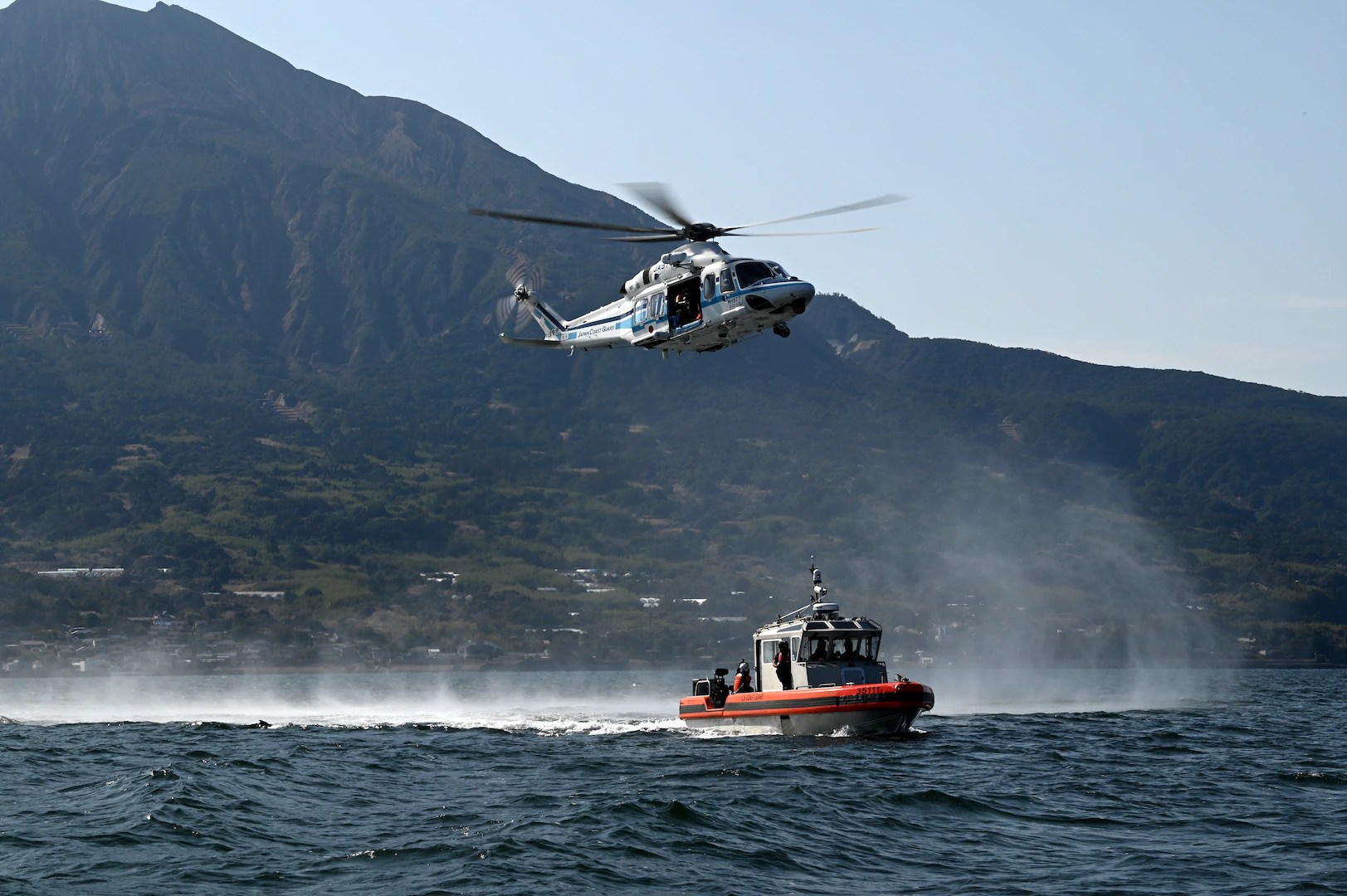
Kimball was the first U.S. military ship in recent history to visit the port city of Kagoshima, Japan, where the crew partnered with servicemembers from Japan Coast Guard’s 10th District to plan and conduct combined operations and search-and-rescue exercises.

Kimball’s crew met with Japan Coast Guard senior leadership and hosted Japan Coast Guard servicemembers, U.S. Consulate Fukuoka staff, community leaders and local media aboard the cutter during the port visit in support of Operation SAPPHIRE.

Operation SAPPHIRE is a joint agreement between the U.S. and Japan Coast Guards signed in 2022 for enhancing cooperation between the two sea services. SAPPHIRE is an acronym for the ‘Solid Alliance for Peace and Prosperity with Humanity and Integrity on the Rule of law-based Engagement.’

“By collaborating with Japan Coast Guard members and conducting evolutions that enhanced communication and inter-operability during the patrol, the crew continued to strengthen a solid foundation for the positive and productive relationship with the maritime service of a like-minded nation,” said Captain Tom D’Arcy, Kimball’s commanding officer.

Kimball’s crew demonstrated proficiency in the ship’s aviation program by working with an air operations inspection team to conduct a biennial Shipboard-Aviation Standardization Inspection (AVSTAN). By achieving their AVSTAN certification, Kimball can continue deploying with aviation detachments during future patrols.

Kimball also supported U.S. Coast Guard efforts to increase its presence in the Indo-Pacific. Kimball’s crew delivered a MH-65 Dolphin helicopter from Air Station Barber’s Point to Santa Rita, Guam, to enable forward operations that extend the service’s air coverage in the region.

During the patrol, the cutter’s engineering department was presented with the Rear Admiral R. S. Lucas Plaque Award for their outstanding contributions to the Coast Guard’s naval engineering program. Members from Kimball’s engineering department were cited for excellence and ingenuity during recent patrols and for completing three extensive industrial periods encompassing significant maintenance, contractual repair projects, and casualty repairs valued at over $4.4 million.

“I am extremely proud of our crew’s accomplishments,” said D’Arcy. “Kimball continues to remain on the front lines of the Coast Guard’s strategic plan. Our engagements in Japan strengthened our existing relationships with international partners who uphold good maritime governance. Kimball’s patrol re-affirmed the U.S. Coast Guard’s commitment to facilitating a free and open Indo-Pacific.”

Commissioned in 2019, Kimball is the Coast Guard’s seventh national security cutter and one of two homeported in Honolulu. National security cutters are 418-feet-long, 54-feet-wide and have a displacement of 4,500 long-tons. With a range of 12,000 nautical miles, the advanced technologies of Legend-class national security cutters are designed to support the national objective to maintain the security of America’s maritime boundaries and provide long range search-and-rescue capabilities.

“U.S. Coast Guard, Guam Fire Department conduct rescue hoist training in Guam” –Forces Micronesia / Sector Guam

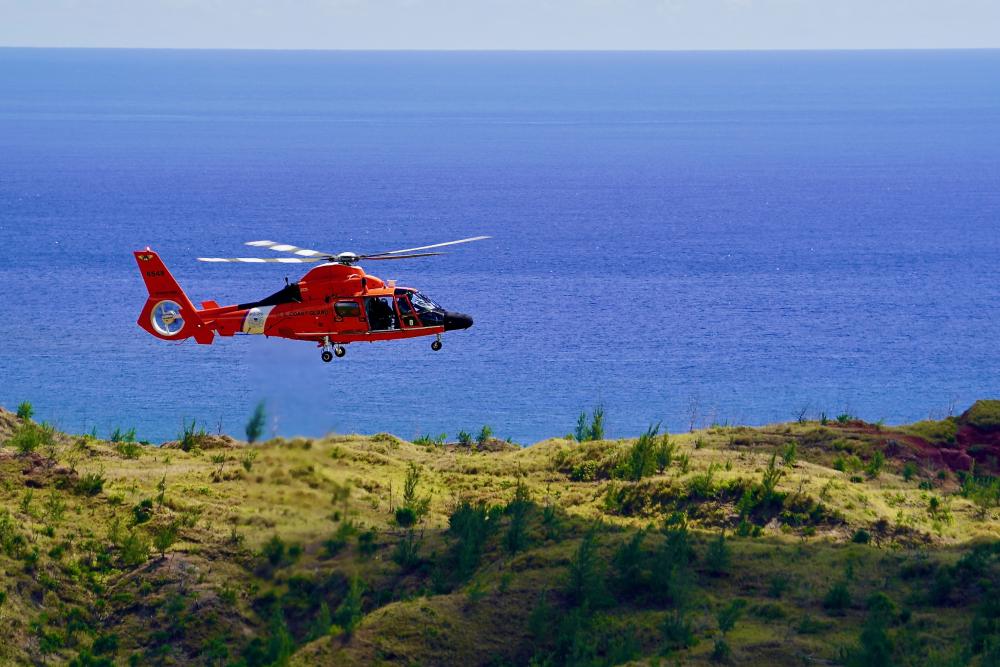
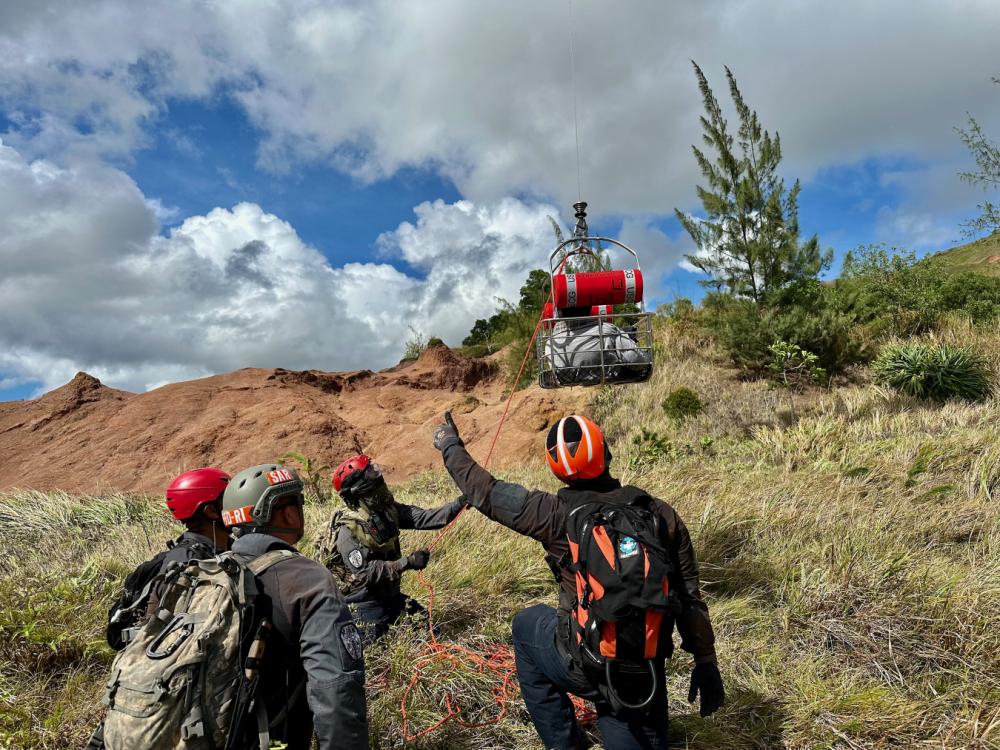
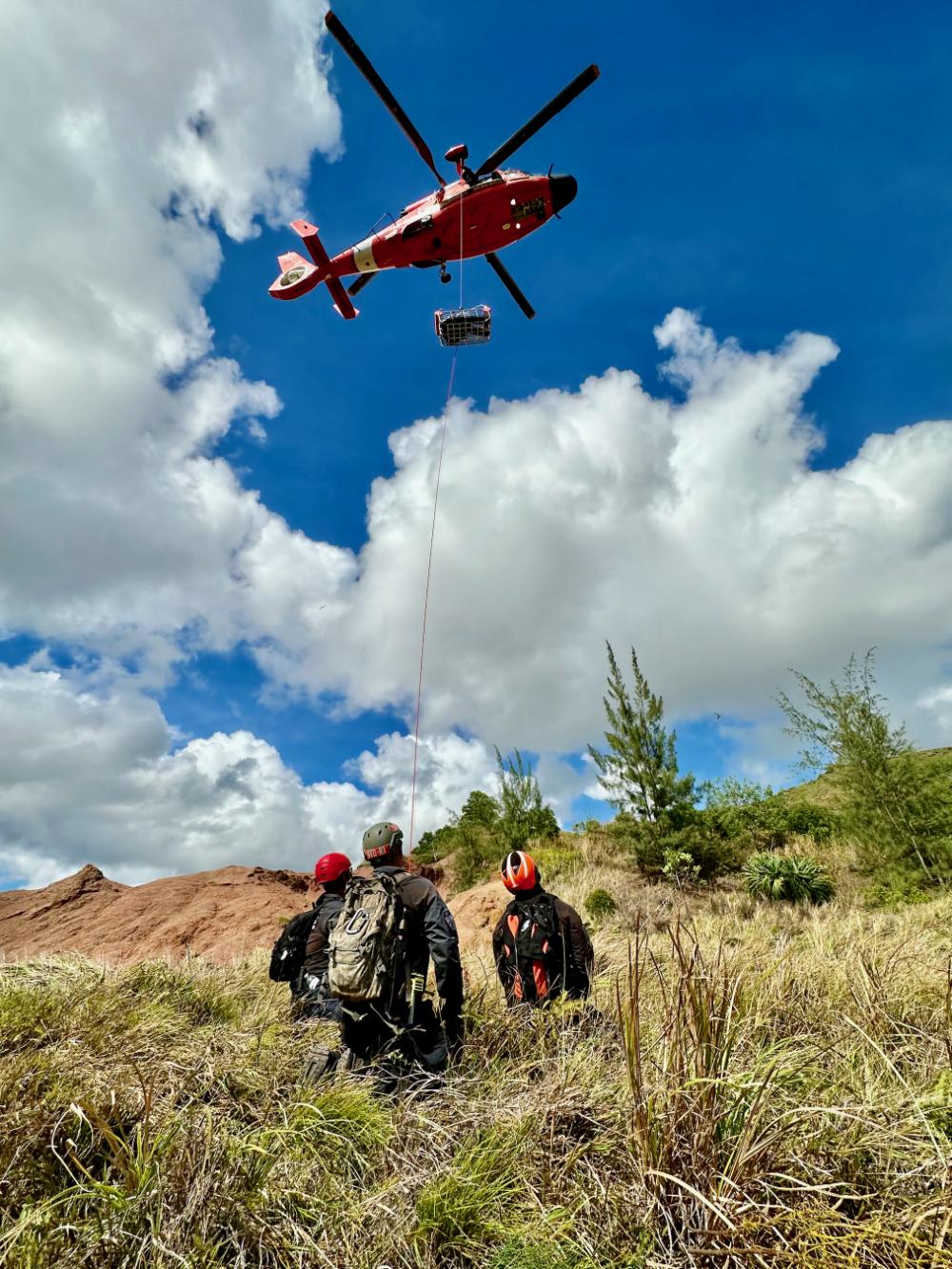
Guam Fire Department and U.S. Coast Guard members conduct rescue hoist training at Sella Bay Overlook in Guam on March 8, 2023. The exercise allowed the crews to assess the procedures each agency is familiar with and practice hoisting a rescue basket and a rescue swimmer from the aircraft. For the aircrew, it also served as an area familiarization to better understand the terrain and winds common on Guam’s southwest coast. (U.S. Coast Guard photo by Petty Officer 2nd Class Ethan Bray)

The news release below is surprising and raises some questions. A helicopter from Barbers Point, Hawaii conducts training with the Guam Fire Department. How did the Helicopter get there? There is currently no Coast Guard airstation in Guam. A Navy helicopter squadron provides SAR coverage for Guam, so what was the point? Is the Coast Guard going to establish an aviation facility of some kind in Guam?

News Release

U.S. Coast Guard Forces Micronesia / Sector Guam

U.S. Coast Guard, Guam Fire Department conduct rescue hoist training in Guam

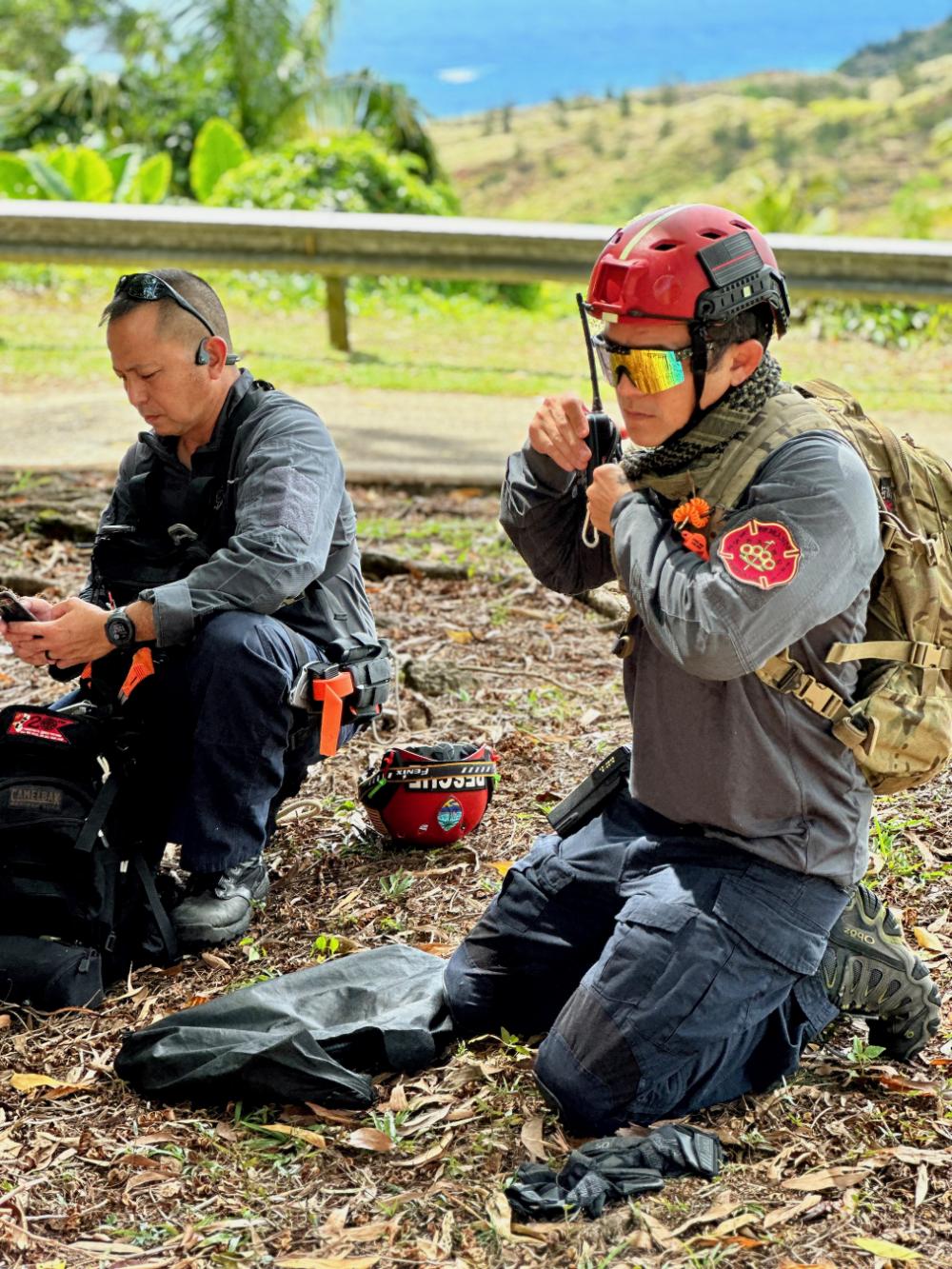
An MH-65 Dolphin helicopter crew deployed to Guam from U.S. Coast Guard Air Station Barbers Point in Hawaii flies patterns to assess winds and terrain before conducting rescue hoist training at Sella Bay Overlook in Guam on March 8, 2023. Members of the Guam Fire Department prepare to hike down from Sella Bay Overlook for rescue hoist training in Guam with a deployed MH-65 Dolphin helicopter crew from Hawaii on March 8, 2023.  Guam Fire Department and U.S. Coast Guard members conduct rescue hoist training at Sella Bay Overlook in Guam on March 8, 2023.  Guam Fire Department and U.S. Coast Guard members conduct rescue hoist training at Sella Bay Overlook in Guam on March 8, 2023.

Editor’s Note: Click on the images above to view more or download high-resolution photos and b-roll videos.

SANTA RITA, Guam — Guam Fire Department and U.S. Coast Guard members conducted rescue hoist training at Sella Bay Overlook in Guam on March 8, 2023.

“We appreciate the ongoing strong relationship with Guam Fire and are eager to bring any capability to bear that benefits the people of Guam and our partners,” said Capt. Nick Simmons, commander of U.S. Coast Guard Forces Micronesia/Sector Guam. “As the U.S. Coast Guard continues to adapt our approach to service in the region, we are working closely with U.S. Coast Guard District 14 and the team from the Air Station at Barbers Point to find the best ways to employ our aircrews and increase the amount of organic aviation support we have for search and rescue and law enforcement missions here.”

Eight members of GFD’s Battalion A worked with the aircrew of an MH-65 Dolphin helicopter deployed to Guam from U.S. Coast Guard Air Station Barbers Point in Hawaii and personnel from the U.S. Coast Guard Forces Micronesia/Sector Guam response department. Guam Fire Department crews execute the majority of on-land search and rescue operations. They also maintain the best capability for on-land response with a wealth of experience regarding the terrain and conditions.

“Our partnership with the U.S. Coast Guard on Guam has expanded dramatically over the years. The increase in U.S. Coast Guard assets assigned to Guam extends our potential for positive outcomes in search and rescue missions benefiting our island community,” said Battalion Chief Roderick Meno, GFD rescue commander. “The opportunity to train together provided an avenue to test capabilities and share best practices. The U.S. Coast Guard helicopter’s availability gives us another valuable resource to conduct the diverse array of missions we perform here on Guam.”

The training allowed the crews to assess the procedures each agency is familiar with and practice hoisting a rescue basket and a rescue swimmer from the aircraft. For the aircrew, it also served as an area familiarization to better understand the terrain and winds common on Guam’s southwest coast. This training occurred near the location of a recent case of a missing hiker, a common place for foot traffic. The trail quickly descends from the trailhead into the jungle with steep ravines and many trip hazards, and it is very hot whether people are under tree cover or exposed to the sun. The conditions may easily overcome inexperienced hikers.

The MH-65 Dolphin helicopter is a short-range recovery helicopter used by the crew to perform search and rescue, law enforcement, and homeland security missions. It is certified for all-weather and night-time operations, except for icy conditions, and it routinely deploys aboard certified cutters providing manned airborne surveillance and interdiction capabilities. The airframe was first added to the Coast Guard inventory in 1984 and has undergone several upgrades.

In recent memory, these operations mark the first deployment of a Dolphin helicopter crew to Guam. The District 14 assigned aircraft are primarily used as a search and rescue platform in the Main Hawaiian Islands and as an augment aboard major cutters on deployment to extend their range for search and rescue, law enforcement, and surveillance while at sea. The aircrews frequently participate in community relations events and subject matter exchanges to build awareness for service capabilities and encourage interest in the aviation career field.

“This asset is not a replacement for any other agency but another resource to help us accomplish our missions and serve the people of Guam and the Commonwealth of the Mariana Islands,” said Simmons. “They are currently here on a six-week deployment as we field test the feasibility of their operating here in a greater capacity. This approach is an innovative way to employ aircrews in the Indo-Pacific for increased presence and value. We hope to get them out here more frequently and are pleased to have the support of the Air Station and the District 14 command.”

The operations have precedent. In 1947 the service established a Coast Guard air detachment consisting of one PBY-6A Catalina, an amphibious aircraft, and crew at the Naval Air Station in Agana, Guam, to provide aerial logistics support for LORAN stations in the southern Marianas and Western Caroline Islands. The Catalina was well suited to operations in the islands, able to haul cargo but also land in the shallow lagoons and offload to skiffs. The primary mission of the air detachment was to resupply the Marianas section LORAN stations, although they did assist in search and rescue missions when needed. The need for Coast Guard air support decreased as the LORAN mission shifted over time and commercial aviation services became more readily available. The Coast Guard air detachment, by then called an air station, was disestablished in 1972.

U.S. Coast Guard Forces Micronesia/Sector Guam comprises nearly 300 personnel throughout the response, prevention, administrative, and logistics departments supporting the Joint Rescue Sub-Center, three fast response cutters, a small boat station, and a marine safety detachment in Saipan. The unit provides a significant portion of the U.S. Coast Guard’s enduring regional presence serving the people of the Pacific by conducting our six major operational mission programs: maritime law enforcement, maritime response, maritime prevention, marine transportation system management, maritime security operations, and defense operations.

For more U.S. Coast Guard Forces Micronesia/Sector Guam news, visit us on DVIDS or subscribe! You can also visit us on Facebook or Instagram at @USCGForcesMicronesia or Twitter @USCGFMSG. 

“U.S. Coast Guard leverages aviation workhorse to overcome challenges in cutter logistics in Oceania” –Forces Micronesia / Sector Guam

The crew USCGC Oliver Henry (WPC 1140) visit Ulithi Atoll on Oct. 31, 2022, the first time a fast response cutter visited the atoll and delivered 20 boxes of supplies, 50 personal floatation devices, and sporting equipment donated by the cutter crew, the extended U.S. Coast Guard Guam family, Ulithi Falalop Community Action Program, Guam Island Girl Power Foundation, and Ayuda Foundation. Ulithi was a central U.S. staging area during World War II, and home to a U.S. Coast Guard Loran-C communications station from 1944 to 1965 before operations relocated to Yap and ultimately shuttered in 1987. (U.S. Coast Guard photo by Petty Officer 3rd Class Zena Suzuki)

Below is a press release that highlights some changes in the way the Coast Guard is operating in the Western Pacific, the employment of Webber class Fast Response Cutters for long periods at great distances from homeport and the much greater reach of the J model C-130s.  

Feature Story

U.S. Coast Guard Forces Micronesia / Sector Guam

U.S. Coast Guard leverages aviation workhorse to overcome challenges in cutter logistics in Oceania
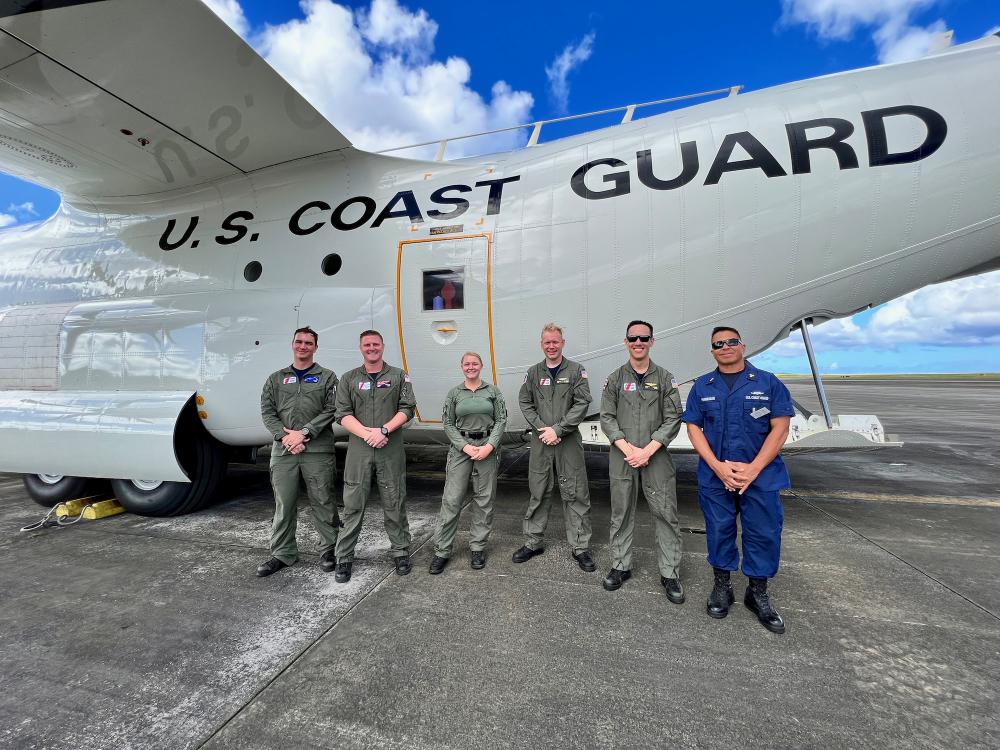
Group photo CGAS Barbers Point and CGFMSG EO FN200 offload from HC-130 Technical installs FN200 bottle  Frederick Hatch departs Guam for patrol

Editor’s Note: Click on the images above to view more or download high-resolution versions.

SANTA RITA, Guam — Guam is home to three 154-foot fast response cutters commissioned in 2021. These ships are built in Lockport, Louisiana. After initial workups, they sailed from Key West through the Panama Canal, more than 10,000 miles to Guam. In the time since the crews have stayed busy conducting the U.S. Coast Guard’s core missions in Micronesia and supporting our Blue Pacific partners.

The Operations Area

For many of the Nation’s fast response cutters, the transit to homeport from Key West is one of the most extended trips they make. Those stateside remain close to most essential services needed to maintain the vessels, designed to operate within 200 nautical miles of homeport. In the case of the Guam-based fleet, they routinely go more than 200 nautical miles to get to the operations area. U.S. Coast Guard Forces Micronesia/Sector Guam has one of the largest areas of responsibility of any sector at 1.9 million square miles. Like its other overseas counterparts, the region can be austere and presents unique challenges.

U.S. Coast Guard Forces Micronesia/Sector Guam (CGFM/SG) differs. The USCGC Oliver Henry (WPC 1140) undertook a more than 6,000-mile expeditionary patrol south through Oceania with inaugural FRC port calls in Papua New Guinea and Australia. Their sister ship, the USCGC Frederick Hatch (WPC 1143), just concluded a similar patrol in support of Operations Rematau and Blue Pacific, the southeast of Guam. The patrol countered illegal, unreported, and unregulated fishing off the Federated States of Micronesia, the Republic of the Marshall Islands, and the Republic of Nauru by enforcing regulatory schemes and individual countries’ sovereignty while strengthening partnerships through shiprider operations, subject matter exchanges, and community engagements.

“What often goes unsaid is the logistics piece enabling the operations,” said Chief Warrant Officer Manny Pangelinan, engineering officer for CGFM/SG. The Oliver Henry required a last-minute shipment of fuel injectors while underway, a package coordinated by the CGFM/SG logistics department with some support from the Surface Force Logistics Center in Baltimore. The package was shipped via a commercial carrier and met them in Australia.

But more oversized items and hazardous materials can present a more complex challenge. Guam is a strategic location, and as a U.S. territory, it is the first line of defense against regional competitors. Logistically, it is remote and depends on maritime cargo for most items. Nearly 90 percent of imports come through the Port of Guam, and travel by sea varies in cost and takes time. Commercial air freight requires less time but can be very expensive.

The Logistics Challenge

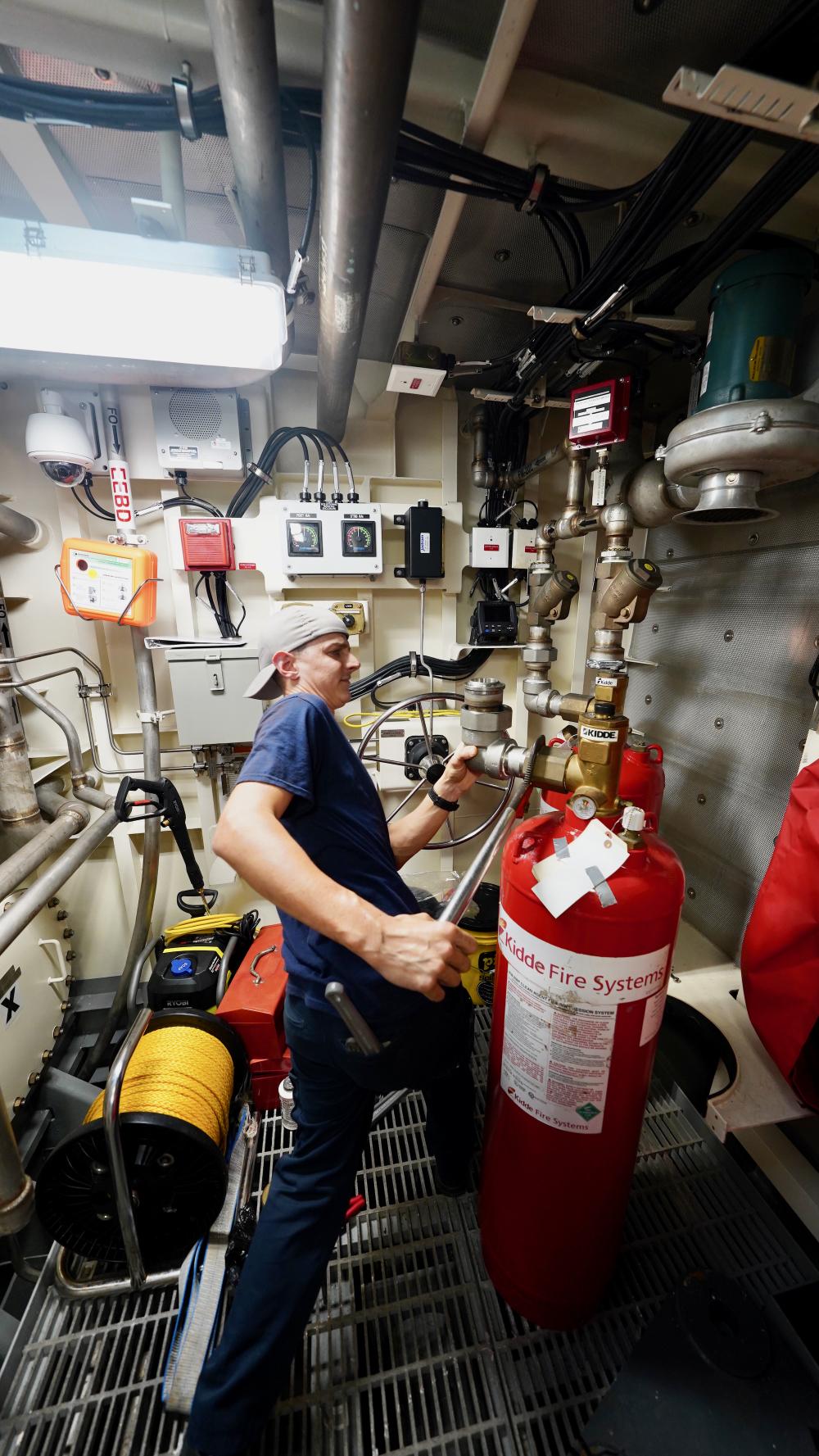
Each FRC has four bottles of compressed gas onboard as part of the fire suppression system. The current design of the FRCs uses FN200 powder and nitrogen gas. Over time these bottles lose nitrogen and need to be recharged, the same as any fire extinguisher. If an extinguisher or system loses its prime, it may malfunction and not adequately suppress a fire. Stateside servicing this equipment is a simple endeavor, but service providers in Guam still need to be created. To further complicate matters, if a local provider converted existing equipment to service this system, it could only be used on FN200 to prevent cross-contamination. The U.S. Coast Guard is currently the only FN200 client on the island.

As the Frederick Hatch prepared for their patrol, the crew noted one of the four bottles was borderline between yellow and red on its pressure. No one wants to be over a thousand miles from shore, with a fire, and risk a system malfunction. But how do you get a 277-pound replacement bottle, considered a hazardous material, shipped from the mainland United States to the territory of Guam? And how do you do it in time to meet the ship’s schedule and enable the crew to fulfill their mission requirements in Micronesia? You keep it in-house and leverage the naval aviation community.

Coast Guard Aviation in Oceania

U.S. Coast Guard Air Station Barbers Point in Hawaii conducts search and rescue, maritime domain awareness and surveillance, law enforcement, and cargo and transportation operations throughout Oceania. They are currently the only U.S. Coast Guard air station in the U.S. Coast Guard 14th District, with the next closest aviation unit in California. Still, from 1947 until 1972, they operated an air detachment in Guam known as Naval Air Station Agana to provide LORAN support for Western Pacific stations.

Today, the Barbers Point team operates four MH-65 Dolphin helicopters and four HC-130 Hercules airplanes. The Hercules airframes were recently upgraded from the H model to the J model. For Guam, this is significant. The J is more capable as a long-range surveillance aircraft providing heavy air transport and long-range maritime patrol capability. Each plane can serve as an on-scene command and control platform or as a surveillance platform with the means to detect, classify, and identify objects and share that information with operational forces. It also has “long legs.” Where the H crews needed to stop for fuel en route to Guam from Hawaii, the J could make the trip in one leg if necessary. This advantage matters when time is of the essence, particularly in search and rescue cases.

Capt. John Rivers, CGAS Barbers Point commanding officer, recently visited Guam. He met with the CGFM/SG team to discuss options for more aviation support to Western and Central Pacific operations. Those ideas include more hours of Hercules activity in this region and possible use of the Dolphin helicopters outside Hawaii.

The Workhorse

Regarding transporting equipment, the aircrew, particularly the loadmaster, has the final say on what goes aboard the plane. The Barbers Point team and the loadmaster were crucial to keeping the Frederick Hatch on schedule.

The team flew the HC-130 Hercules CG 2009 to Sacramento to pick up the shipment of fire bottles, then returned to Hawaii to rest and refuel. Subsequently, they flew to Majuro and landed in Guam on Nov. 9 at the A.B. Won Pat Guam International Airport. The CGFM/SG engineering team and environmental contractors met them to further transport the bottles to the pier.

All told, the movement cost flight hours and personnel time – but that is the nature of logistics. Per Commandant Instruction 7310.1V Reimbursable Standard Rates, the inside government rate for an HC-130J is $19,782 per hour. This includes Direct Costs like labor, employee benefits, fuel, maintenance, etc.; Support Costs: Costs allocated to a particular asset class for the support received from Coast Guard support activities, including but not limited to Area Commands, Districts, Sectors, Sector Field Offices, Bases, etc.; and General and Administrative: Costs allocated to a particular asset class to represent benefit received from Coast Guard general and administrative activities such as legal services, payroll processing, etc.

However, our aircrews make the most out of every flight, coupling logistics with other missions and training whenever possible. Flight crews must also fly a certain number of monthly hours to maintain currency and proficiency.

The personnel hours, in this case, include the coordination and research by the CGFM/SG Engineering Team to enable the technician from the fire services company to come out, install and certify the new bottle. The team kept the cost down by more than $16,000 by flying out one technician instead of two and doing all the manual labor of removing and replacing the existing bottle with the ship’s force. Transporting a 277-pound bottle across the pier, onto the cutter, and into the space with a tripod and chain fall in 90-degree heat with 90 percent humidity is quite an undertaking. According to Reimbursable Standard Rates, the inside government cost of a CWO2 is $79 per hour, a Chief Petty Officer is $71, and a Petty Officer 2nd Class is $55. Still, these personnel, like the aircrew, are salaried. The figures come into play if the Service seeks reimbursement from another branch or outside entity for services. The outside government rate is higher.

One might ask how to avoid this challenge in the future, as this won’t be the last time these bottles need to be recharged. One possible alternative was building a facility to support the maintenance of these systems in Guam to the tune of more than a million dollars. Ultimately, this option was deemed unrealistic. Instead of a new facility, the engineering team procured a larger bottle of FN200 and equipment to be kept onsite to recharge the FRCs’ systems. The team will do the heavy lifting and fly out a technician for the final assembly and certification. Two complete sets of bottles were procured at the same time. The first set came aboard the Hercules, and the second will come by cargo ship at a fee of just under $4,000. However, as of Christmas, the second set of bottles are still in transit and will take around 75 days total to arrive, emphasizing the importance of the Engineering Team’s efforts and choices.

Forecast

“This team continues to deliver on the Commandant’s mandate to be creative and innovative to craft solutions to the challenges we face as a service,” said Capt. Nick Simmons, commander of CGFM/SG. “I am impressed by their commitment and resolve to consistently deliver superior engineering support, keeping us operational in a remote environment.”

In the Fiscal Year 2022, the three Guam-based FRCs spent 324 days away from homeport, with 243 of those days physically underway conducting missions at sea. The other days away from homeport account for port calls, community engagements, and maintenance away from the home station. They worked 25 patrols throughout the region, enforcing the rule of law and strengthening partnerships. Guam’s sister sector in Honolulu also has three FRCs doing local and long-range missions. By comparison, they spent 202 days at sea for roughly the same number of patrols. This underscores the distances and demands Team Guam is covering.

“We have better platforms to help our crews get after the ever-growing mission demand here. But we must not lose sight of the demand on the crews and what is necessary to maintain our availability and effectiveness as a preferred partner in the region,” said Simmons. “That means putting steel on target, remaining flexible, and ensuring our crews have the support they need to succeed in a dynamic operational environment. I thank the CGAS Barbers Point team for ensuring our success and enabling the Frederick Hatch crew to work with our partners in Oceania and protect the Nation.”

This fire bottle transport is an excellent example of integrated logistics across the U.S. Coast Guard enterprise and innovation to find a timely cost-reasonable solution to keep the ship operational and on schedule. It is also a model for expanded Coast Guard aviation support to Guam.

For more U.S. Coast Guard Forces Micronesia/Sector Guam news, visit us on DVIDS or subscribe! You can also visit us on Facebook or Instagram at @USCGForcesMicronesia or Twitter @USCGFMSG.