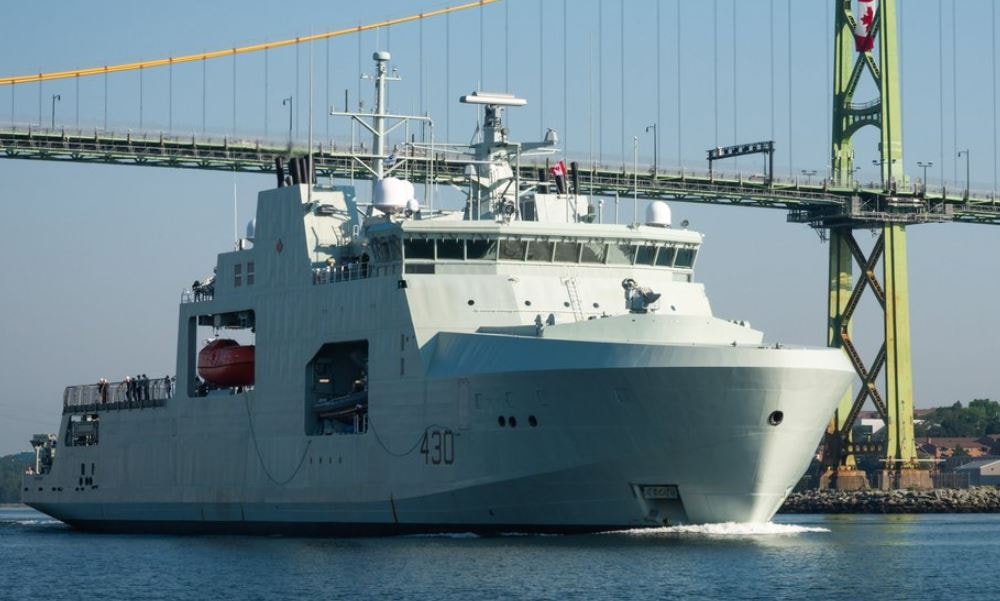
“MAN ES to provide propulsion systems for Canadian Coast Guard’s AOPSs” –Naval Today

Three AOPSs at pier before the commissioning ceremony for HMCS Margaret Brooke (AOPV-431). Canadian Navy photo

Naval Today reports,

“German manufacturer MAN Energy Solutions (MAN ES) has received a contract to provide propulsion systems for two Arctic offshore patrol ships (AOPSs) for the Canadian Coast Guard.”

The Coast Guard versions of the Arctic Offshore Patrol Ships apparently have the same propulsion system as the preceding six Navy versions, but there are details about the propellers in this announcement that I had not heard before.

“Finally, MAN Energy Solutions will deliver 2 × MAN Alpha-branded five-bladed, bolted propellers that meet PC5 rules and which can even be exchanged underwater. These cater for higher cavitation inception speeds, possible shock impacts, and mission-critical conditions requiring additional redundancy, silent operation with minimal hydro-acoustic signatures, and suppressed underwater-radiated noise, the company highlighted.”

I don’t know what a “bolted propeller” is, but the idea that they can be changed without dry docking sounds like it might be useful, particularly on a vessel that operates in ice where we have had some experience with damaged propellers.

“Arctic Security: Patrolling NATO’s High North” –YouTube

Thought I would share this video. Found it on a SeaWaves post, Patrolling Greenland on Denmark’s HDMS Triton. HMDS Triton a Thetis class patrol frigate. These ships do Coast Guard type work in or near the Arctic. It is a type of ship that you will not find in the Coast Guard fleet, but one that we may want to add in the future. It is ice strengthened. As a ship that operates in an area where icing is common. its ground tackle (anchor handling equipment) is below the foc’sle deck, and its boats and boat handling gear can be enclosed. The crew is relatively small (I think they are double crewed to get more underway time), but additional berthing is available, and weapons can be added using the Stanflex system.

Arctic (orthographic projection) with national borders and land highlighted. Credit Heraldry, Isochrone, via Wikipedia, 23 July 2023.

The Thetis class ships are now over 30 years old. They are to be replaced by a new class, currently referred to as MPV-80 (multi-purpose vessel, 80 meter).

OMT MPV-80 technical specifications

Below is the narrative that accompanied the YouTube video.


The Arctic region is the gateway to the North Atlantic. For NATO and its Allies, maintaining a strong presence here is vital to protect trade, transport and communication links between North America and Europe.

As climate change causes the polar ice caps to melt and the sea levels to rise, new sea routes are beginning to emerge, which could present a threat to Euro-Atlantic security. Greenland is considered by scientists to be ground zero for climate change. Along with the Faroe Islands, it forms part of the Kingdom of Denmark and is therefore under Danish military protection. That protection falls to the Joint Arctic Command, or JACO, a Danish-led operational command with a central headquarters in Nuuk, Greenland’s capital.

Join the Danish Armed Forces in Greenland, at sea, in the air and on land, to discover more about how security might be affected in this region and learn about the capabilities and experience NATO Ally Denmark has in the North Atlantic area.

“As Arctic ice melts, NATO plots northern defense tactics” –Video

Wanted to pass along the video above, if for no other reason, for the scenes of the Danish Patrol Frigate HDMS Triton operating in the ice. Notice her ground tackle (equipment used to anchor the ship) is not exposed on the foc’sle, where it would be quickly encrusted with ice. It is well below the main deck.

Triton’s routine peacetime missions and those of her Thetis class sister ships are much the same as US Coast Guard cutters. They do SAR, fisheries, marine environmental protection, and support scientific research. They are ice strengthened and can reportedly operate in 31 inches (80 cm) of ice. They use the STANFLEX modular weapon system, with one slot forward and two slots aft, allowing rapid addition or change out of weapon systems. They have a hull mounted sonar, torpedo tubes, and can support a MH-60R ASW helicopter. They are 3,500 tons full load and 112.3 m (368 ft 5 in) in length with a speed of 22 knots and a range of 8,700 nautical miles at 15 knots and a 60 day endurance. My Combat Fleets of the world reported that they had seven crews to operate the four ships. Perhaps surprisingly, they have only a single shaft, but it is probably well out of the way of ice. The ships of the class are all over 30 years old and the Danes have probably started thinking about replacement.

The Royal Danish Navy (RDN) Thetis-class patrol ship HDMS Triton is pictured operating a Seahawk helicopter during Canada’s Operation ‘Nanook’ exercise in the Arctic in 2022. One element of RDN Arctic capability development is to improve tactical datalinks between the Seahawks and their host frigates and patrol ships. (Canadian Armed Forces)

Antarctic Support Ship “Almirante Saldanha” for Brazil

SeaWaves reports,

After research and studies conducted by the Brazilian Navy (MB), the future Antarctic Support Ship (NApAnt) had its name chosen: “Almirante Saldanha”. TheNApAntwill reduce the refueling time of the Comandante Ferraz Antarctic Station (EACF), due to cranes with greater load and maneuverability, and will be better equipped for the launch of camps and will have greater autonomy to expand support for research.

The new ship will replace the Oceanographic Support Ship “Ary Rongel” and will have more modern technical resources such as the navigation and control system, which will allow closer approach of the ship to the beach for landing personnel and material, safely.

There is no indication that the ship is an icebreaker, but it will certainly be ice strengthened. According to Janes, the ship will be delivered in 2025 and,

“The ship will displace approximately 5,880 tonnes for a length of 93.9 m, a width of 18.5 m, a draught of 6 m, cruising speed of 12 kt, endurance of 70 days, and a crew of 95, including 26 researchers.”

This is the ship being replaced:

Oceanographic support vessel ‘Ary Rongel’. Marinha do Brasil picture


“New Royal Canadian Navy Offshore Patrol Vessel Visits Norfolk After Circumnavigating North America” –USNI

HMCS Harry DeWolf in ice (6-8 second exposure)

We have talked about the Canadian Navy’s Arctic Offshore Patrol Ship (AOPS) before (more here). It is, in many ways an Offshore Patrol Vessel, that would seem right at home in the US Coast Guard. In fact, in addition to the six being built for the Royal Canadian Navy, two are being built for the Canadian Coast Guard.

I would not be surprised if the US Coast Guard opts to build something similar. This US Naval Institute News Service story provides a bit more insight into its operations and how it is being used.

The AOPS, like the Offshore Patrol Cutter (OPC), is a VARD design. It is based on the Norwegian Coast Guard Cutter Svalbard, that was capable enough to reach the North Pole on 21 August 2019. Svalbard also completed a scientific mission for the US in the Beuford Sea in 2020, when CGC Healy had a fire in one of its main propulsion motors and was unable to recover data contained in buoys she had deployed earlier.

Most surprising for me were the comments the ship’s use of containers,

At the briefing to press in Norfolk, which was broadcast online, he noted that sea-shipping containers aboard Harry DeWolf, not usually carried on warships, can be used as laboratories for science and researchers studying changes in the Arctic.

Gleason added that at all times the ship will have two containers loaded for humanitarian assistance and disaster relief to respond to emergencies when called upon.

Gleason said early on there was a key training scenario of responding in a mass casualty scenario. In it Harry De Wolf  worked with the U.S. and Canadian coast guards and naval vessels in treating and evacuating the injured aboard and taking them ashore.

On this mission to the North, Gleason said the containers had a real-time military mission. They “were used as underwater listening devices” for submarines. “Fortunately, we didn’t find any.”

I suspect the “underwater listening devices” for submarines was the Towed Reelable Active Passive Sonar, TRAPS system, (more here).

“Royal Canadian Navy HMCS Harry DeWolf Departs On Her Maiden Operational Deployment” –Naval News

HMCS Harry DeWolf, leaving HMC Dockyard in Halifax and steaming under Angus L. Macdonald
suspension bridge crossing Halifax Harbour in Nova Scotia, Canada

Naval News reports the first of Canada’s planned eight Arctic Offshore Patrol Ships (AOPS) (six for their Navy and two for their Coast Guard) departed on its first operational deployment on August 3. The deployment is expected to take four months and will include participation in the annual Nanook Exercise with partners including the USCG, transit of the North West Passage, counter clockwise circumnavigation of North America, and drug operations in the Eastern Pacific transit zone and the Caribbean again in cooperation with the USCG.

USCGC Healy departed for a clockwise circumnavigation of North America on July 10. Presumably these two will arrange to say hello as they pass. Hopefully both crews will be home by Christmas.

Canada’s HMCS Harry DeWolf Class AOPS

HMCS Harry DeWolf in ice (6-8 second exposure)

The Harry DeWolf class is an almost unique type of ship. Canada is building eight, six for their Navy and two for their Coast Guard. It is derived from the similar and perhaps slightly more capable Norwegian Coast Guard vessel Svalbard, which has made it to the North Pole and recently undertook a mission the Healy was unable to complete due to a machinery casualty.

They are classified as “Artic and Offshore Patrol Ships” or AOPS, rather than icebreakers, but they are clearly designed to operate in ice and are rated Polar Class 5 (Year-round operation in medium first-year ice, which may include old ice inclusions). In many ways they approximate the similarly sized and powered old Wind Class icebreakers. (2012 post on the class with updates in the comments here.)

Below are another photo and a couple of videos, but first the specs.

  • Displacement: 6,615 t (6,511 long tons)
  • Length: 103.6 m (339 ft 11 in)
  • Beam: 19 m (62 ft 4 in)
  • Draft: 6.5 m (21 ft 4 in) (estimate based on that of Svalbard)
  • Propulsion Generators: Four 3.6 MW (4,800 hp)
  • Propulsion Motors: 2 × 4.5 MW (6,000 hp)
  • Speed: 17 knots
  • Endurance: 6,800 nautical miles
  • Crew: 65 (accomodations for 85)
  • Armament: one 25mm Mk38 remote weapon system modified for Arctic Conditions and two .50 cal. machine guns (I do feel this is inadequate.)

HMCS Harry DeWolf looking forward, bow and 25mm Mk38 remote weapon system.


Norway’s Coast Guard Jan Mayen-class vessel

Norway’s Coast Guard Jan Mayen-class vessel (Picture source: Vard)

We have some new information on Norway’s three new very large ice capable Arctic patrol ships. Naval News reports they will be equipped with inertial navigation systems and we have the artist’s concept above I had not seen previously.

“We’re very proud to be supporting the Norwegian Coast Guard in securing Norway’s exclusive economic zone (EEZ), internal and territorial waters.”, states Regis Blomme, Sales Director at iXblue. “The arctic zone, in which the new vessels will operate, is a very challenging environment and our Fiber-Optic Gyroscope (FOG) based INS and Netans NDDCS have already proven to offer highly accurate, resilient, and secure navigation in such Northern latitudes. We particularly want to thank Vard for their strong vote of confidence in our technology and look forward to our collaboration with them.”

As we noted earlier,

“Deliveries of the three vessels are scheduled from Vard Langsten in Norway in 1Q 2022, 1Q 2023 and 1Q 2024 respectively. The hulls will be built at Vard’s Tulcea, Romania, shipyard…”

Specifications are:

  • Displacement: 9,800 tons
  • Length: 136.4 meters (447.4 ft) loa
  • Beam: 22 meters (72.16 ft)
  • Draft: 6.2 meter (20.3 ft)
  • Speed: 22 knots.

Note–VARD is also the designer for the Offshore Patrol Cutters.

“Arctic Operations: We Really, Really Need the Right Equipment and an Arctic Port” –EagleSpeak

Conceptual illustration, Finland’s squadron 2020 corvette

Naval blog “EagleSpeak” decries our inability of operate surface warships in the Arctic, but this is his bottom line

“Fault finding will get us nowhere, the need is to look to our allies who operate in these waters and see if, among the hull types we need they have some ice-hardened ships whose designs we can obtain. Now.”

If we do want to do that, there is really only one choice, Finland’s new ice capable corvette we talked about here. The original post is now more than five years old, but updated information is in the comments, much of which I have linked below.

Fortunately they are already designed to us a great deal of familiar equipment much of it from US manufacturers.

They will use the same 57mm gun used by the NSC, OPC, and both classes of LCS.

They will use the Sea Giraffe radar common to the OPC and Independence class LCS.

They will use ESSM surface to air missiles, a standard item on most US surface combatants, apparently to be launched from Mk41 VLS.

The Finns will be using the Israeli Gabriel V as their surface to surface missile, but it should be relatively easy to substitute a standard US surface to surface missile, particularly the Naval Strike Missile, which is considerably smaller.

The sonars currently planned are from Kongsberg Maritime AS. If not replaced by US sourced units, they would be unique in the US fleet but the hull mounted “SS2030 sonars will be delivered to the Finnish Navy complete with hoistable hull units and ice protection to ensure safe and efficient operation in the often harsh conditions of the Baltic Sea.”  The variable depth “SD9500 is a light and compact over-the-side dipping sonar with outstanding horizontal and vertical positioning capabilities for diver detection, ASW duties and volumetric survey assignments in shallow, reverberation-limited waters.”

They would be unique among US warships in being able to both lay and counter mines.

Propulsion is CODLAG, combined diesel electric and gas turbine. Four diesel generators producing 7,700 KW (10326 HP) provide power for cruise (probably about 20 knots). A GE LM2500 gas turbine provides over 26 knot sprint speed. This is the same gas turbine that powers the NSC, Burke class destroyers, the new FFG, and numerous other ships. It is the most common gas turbine in the world.

The propellers were developed with the help of the US Navy.

“The propellers are a minor project on their own, and are set to be of a highly advanced design. This is due to the somewhat conflicting demands of high top-speed, small diameter (due to overall draught requirement), and low noise (and high cavitation margin). All this, while at the same time being strong enough to cope with ice.”

Its primary characteristics are reported to be:

  • Length: 114 m (374 ft)
  • Beam: 16 m (52 ft)
  • Displacement: 3,900 tonnes (3,800 long tons; 4,300 short tons)
  • Crew: 70 to 120 sailors
  • Speed: 26+ knots

This makes about 13% smaller than the OPC or NSC, but 30% larger than the 378s. First of class is expected to be completed 2024.

We could buy the plans and then compete procurement in a US shipyard. These might be built concurrently with the OPCs, possibly replacing some of them. Ten units could give a two squadrons, one for the Atlantic and one for the Pacific. In wartime that would almost guarantee the ability to keep three underway in either ocean.