No country has been given greater impetus to maintain Maritime Domain Awareness than India. CIMSEC has a short report on their progress.
Maritime Domain Awareness–in India
1

No country has been given greater impetus to maintain Maritime Domain Awareness than India. CIMSEC has a short report on their progress.
The MarineLog has reported that Canada has issued a Request for Proposal (RFP) for seven 19 meter motor lifeboats, with an option for three more.

Photo credit: NavyRecognition, Model of the P18N OPV on the CSOC stand during AAD 2014. Click to enlarge.
NavyRecognition reports delivery of another cutter similar in concept to Cutter X. This time it is first of two being built in China for Nigeria.
P18N Offshore Patrol Vessels have a displacement of 1,700 tons, a length of 95 m, width of 12.2 m and beam of 3.5 m. It is powered by two MTU 20V 4000M diesel engines (I believe this is essentially the same engine as in the Webber class WPCs–Chuck). The maximum speed is 21 knots. The endurance of the vessel is 20 days at sea (range 3000 nautical miles at 14 knots) for a crew of 70 sailors.
The range and speed are certainly adequate for their purposes, but “nothing to write home about,” and the hangar is only suitable for UAVs, but it is actually better equipped in some ways than the proposed Cutter X with a 76mm gun and two 30mm. This probably contributes to the size of its 70 member crew.
Nigeria is modernizing their forces. The Nigerian Navy took over the former USCGC Chase in 2011, and they expect to get the Gallatin in 2015. Nigeria is the source of much of our imported oil, and they have an ongoing insurgency and a serious piracy problem.
If the helicopter on the model pictured above looks familiar, it is a Z-9, a Chinese license built version of the French helicopter that was the basis for the H-65. Chinese variants include both ASW and attack helicopter versions.
CIMSEC is taking a week to look at Ship Design and one of their first posts deals with Offshore Patrol Vessels. It is a two parter. You can read it here and here.
The posts include an extensive bibliography and notes that some might find interesting. This is the information on the author, “Dr. Alexander Clarke is our friend from the Phoenix Think Tank in the United Kingdom and host of the East-Atlantic edition of Sea Control.”

Photo: USCGC Adak, part of Patrol Forces, South West Asia, note extra machinegun mount behind the pilothouse. Click on the photo to enlarge.
Not long ago we talked about the need to preserve lessons learned from atypical (usually military) Coast Guard operations like participation in the Vietnam War or operations in South West Asia. Craig Allen Jr. brought to my attention a LANTAREA historian’s publication, “Guardians of the Gulf: A History of Coast Guard Combat Operations in Support of Operation Iraqi Freedom, 2002-2004” (pdf) by William H. Thiesen, PhD, June 2009
Regarding the deployment of WPBs the study noted, “Even though the Coast Guard served a similar mission in Vietnam, there existed no operational plan to provide guidance for OIF planning and preparations.”
If the Coast Guard does not yet have a contingency plan for deployment of patrol vessels there is enough detail to make a fair start on a checklist of things to be done. The experience of the WPBs deployed to the Mediterranean can leave little doubt of the Webber Class’ ability to go almost anywhere, given time to avoid bad weather.
“On May 14, the five cutters (one 378 and four 110s–Chuck) began the return trip; however, this time the smaller cutters followed Dallas across the Atlantic rather than riding on board an MSC vessel. The 5,000-mile voyage set a record as the longest transit ever completed by a 110-foot cutter. The PATFORMED fleet had performed its escort and MIO mission admirably. Moreover, the WPBs in the Mediterranean and the Arabian Gulf had set records for hours of operation with some of them deploying for over thirty days of operation.”
For the future, there might be some advantage in organizing at least a few of the Webber class in deployable divisions (3 units) and squadrons (six units) as discussed earlier, with or without augmentation since there will be several location with three or more WPCs.
Pakistan’s “TheNews” is reporting, “The State Department has made a determination approving a possible Foreign Military Sale to Pakistan for GRC43M Cutters and associated equipment parts training and logistical support for an estimated cost of 350 million.”
They are to be built by Westport Shipyard, Inc. (Westport, WA), a company best known as America’s largest yacht builder. We have seen an example of this 43 meter (143 foot) class before. They were demonstrated for the Coast Guard in 2011.
This composite construction vessel is closer to the original concept of the FRC than the Webber Class, and it appears that the cost is about three quarters that of the Webber class. Claims are also made of lower maintenance and longer hull life. They are also faster. Now that the initial contract for the Webbers has run its course, perhaps it would be a good time to reevaluate these as an alternative.
Thanks to Lee for bringing this to my attention.
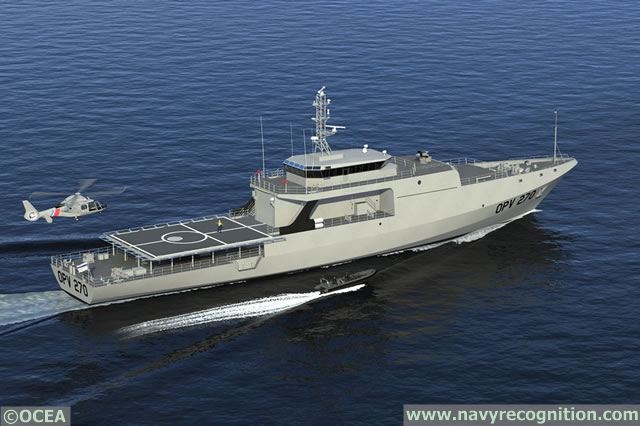
Janes360 is reporting that the Philippine Coast Guard has inked a 90M Euro ($113M) deal for the purchase of five vessels. One is to be an 82/83 meter (270 foot) aluminum hulled patrol vessel and the other four are 24 meter (79 foot) patrol boats.
NavyRecognition, reporting on OCEA participatin in the EuroNaval trade show, has some details on the OPV 270.
“OPV 270 is a 83 m (270 ft) long marine aluminum made ship. It carries 44 crew members and can take 3 to 6 VIP passengers on board, in addition to 20 ordinary passengers. 35 survivors can also be taken on board. It can travel over 4.500 to 8.000 km at 15 knots and its maximum speed, which depends of the load, can reach 26 knots. its endurance is from 30 to 45 days.”
This earlier report by DefenseStudies includes some photographs of the 24 meter patrol boat in service with the Nigerian Navy, and a short discussion of how they are expected to be used. (Incidentally the “West Philippine Sea” is the Philippine name for the South China Sea.)
gCaptain is reporting, “The United Nations Security Council authorized naval inspections of ships off Somalia’s coast and beyond suspected of carrying illegal weapons and charcoal, a commodity that generates millions of dollars a month in revenue for militants linked to al-Qaeda.”
Possibly there will be some Coast Guard involvement in the form of detachments on US Navy ships and conceivably with the 110 foot WPBs operating out of Bahrain.
Unfortunately, it appears, that if inspections are done, it will be in a haphazard fashion. The expectation is that the ships already in the Indian Ocean doing counter piracy will also do this. But really, the places the ships need to be to do these inspections is different from where they need to be to respond to piracy attacks, because innocent ships avoid the Somali coast. The place to intercept smugglers is close to the Somali coast.
This is the kind of operation the Coast Guard specializes in. It is essentially no different from drug or migrant interdiction. It is what the Coast Guard did in Vietnam as part of Markettime.
If the Coast Guard had some built in excess capacity to respond to contingencies, they could take on this sort of operation.
The entire US Navy is excess capacity to respond to contingencies. It is not built for routine peacetime operations. It would not be a bad thing for those that decide the budgets to see building a capable Coast Guard as the same sort of insurance.
CIMSEC has posted an interesting article, “A Feast of Cabbage and Salami: Part I – The Vocabulary of Asian Maritime Disputes” for anyone interested in the current maritime disputes in East Asia, and, in fact, for anyone interested in international maritime law. It is apparently the first of a series and includes a wealth of links for further study.
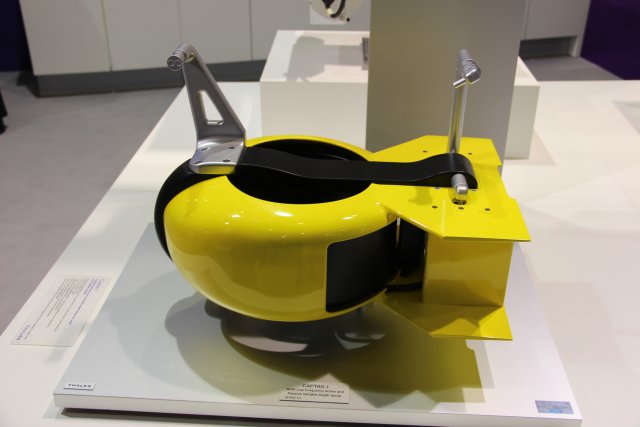
Photo credit: NavyRecognition. Thales CAPTAS 1
As expected, the EuroNaval 2014 trade show is offering some interesting products. This one might be of interest if the Coast Guard ever decides to get back into the ASW mission. Thales, maker of some of the most highly respected sonars in the world, is offering both hull mounted and towed active/passive sonars for vessels as small as 300 tons. The towed sonar is the CAPTAS 1, joining two previous members of a family of systems that share common technology. The Largest of these, the CAPTAS 4 is being evaluated for the ASW module for the LCS.
 Chuck Hill's CG Blog