Below is a news release from General Atomics Aeronautical Systems, Inc.
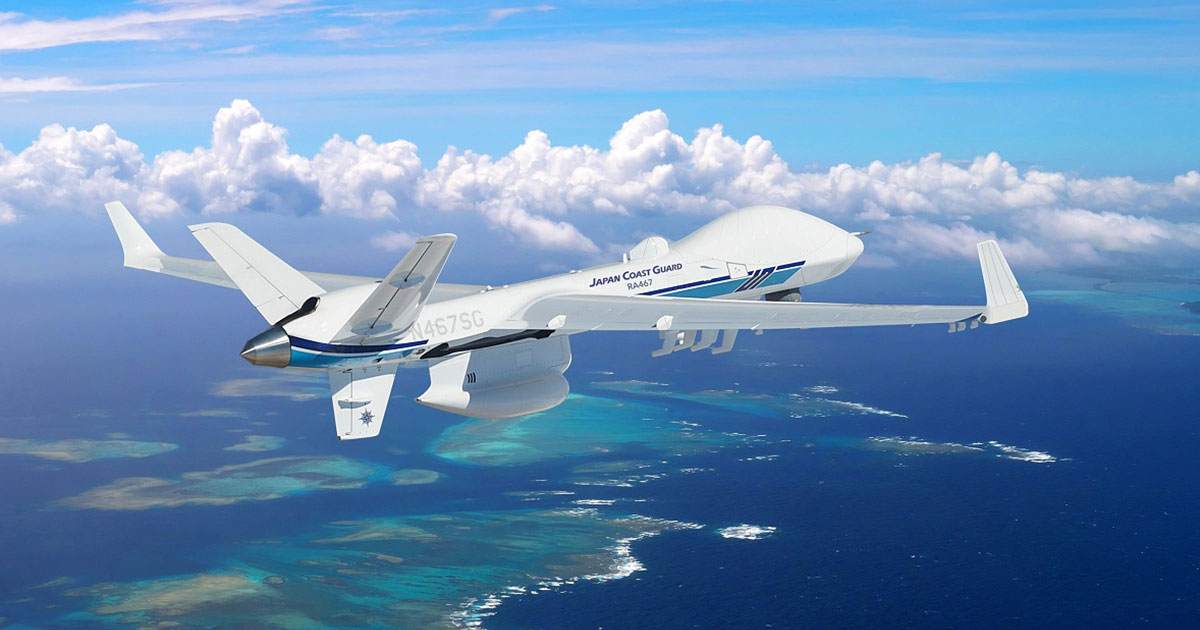
The SeaGuardian is a maritime variant of the MQ-9B that includes sense and avoid systems that allows it to operate safely in airspace with manned aircraft.
SeaGuardians are reportedly operated in a maritime role for Australia, Belgium, Canada, India, Italy, Japan, the Netherlands, and the UK.
Japan Buys Two SeaGuardians from GA-ASI
SAN DIEGO – 15 August 2024 – The Japan Coast Guard (JCG) has signed a contract for the purchase of two SeaGuardian® Remotely Piloted Aircraft (RPA) from General Atomics Aeronautical Systems, Inc. (GA-ASI), scheduled for delivery in 2025. This follows JCG’s ongoing Company-Owned, Contractor-Operated agreement with GA-ASI for operating SeaGuardian, which began in April 2022.
“Since JCG started operating SeaGuardians, they have been used for various JCG missions including supporting search and rescue and disaster response specifically during the 7.6 magnitude earthquake early this year near the Noto Peninsula of Ishikawa Prefecture and maritime surveillance during the 2023 G-7 Summit in Hiroshima, and the system has performed efficiently and effectively,” said GA-ASI CEO Linden Blue.
SeaGuardian is a medium-altitude, long-endurance RPA system that can fly for 24 hours or more, depending on the configuration.
GA-ASI has strengthened its Maritime Wide Area Surveillance (MWAS) for Japan with Optix+, which gathers information from the SeaGuardian sensors, as well as other data sources, displaying the full picture of surveillance information for its operator. This functionality makes it easy to task and direct its Intelligence, Surveillance and Reconnaissance (ISR) information in real time. GA-ASI’s Optix+ software suite rapidly correlates and exploits collected data into an easily shared common operational picture. Having multi-source correlated data enables automatic detection of anomalous behaviors over waters.
About GA-ASI
General Atomics Aeronautical Systems, Inc. (GA-ASI), an affiliate of General Atomics, is a leading designer and manufacturer of proven, reliable RPA systems, radars, and electro-optic and related mission systems, including the Predator® RPA series and the Lynx® Multi-mode Radar. With more than eight million flight hours, GA-ASI provides long-endurance, mission-capable aircraft with integrated sensor and data link systems required to deliver persistent situational awareness. The company also produces a variety of sensor control/image analysis software, offers pilot training and support services, and develops meta-material antennas.
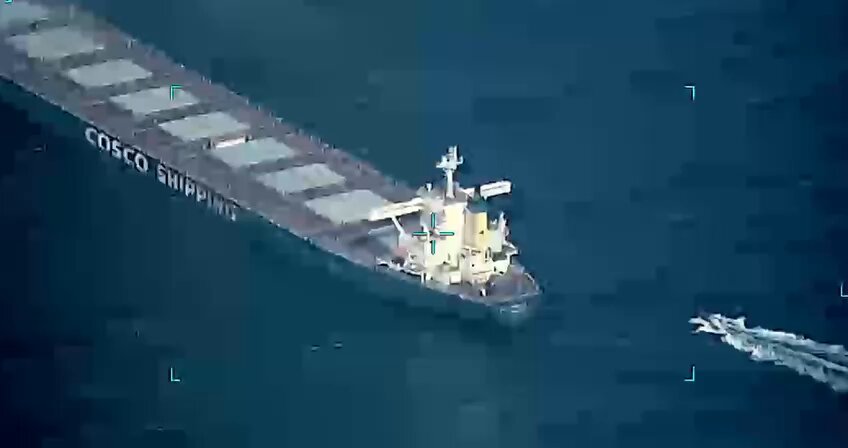
“An Indian Navy warship intercepted the MV Lila Norfolk on Friday afternoon, less than a day after the navy received news that it had been hijacked off Somalia’s coast in the North Arabian Sea.”
The crew of 21 had taken shelter in a citadel. By the time the Indian Navy destroyer, INS Chennai, had arrived, the pirates had fled.
The MV Lila Norfolk “was kept under continuous surveillance using MPA (Maritime Patrol Aircraft–Chuck), Predator MQ9B & integral helos.”
Notably, the Indian Navy is one of several users of the MQ-9B Sea Guardian Medium Altitude Long Endurance UAS including the Japan Coast Guard, the UK, Taiwan, and Greece. The US Coast Guard after years of observation of Customs and Border Protection’s use of earlier model MQ-9 Predators, the USCG has yet to procure or even experiment with a shore based long endurance UAS.
“Maritime domain awareness (MDA) in the Indo-Pacific is moving from an abstract aspiration to a functional collective security approach for managing the region’s dynamic offshore spaces,” noted an April 2023 article in PacNet, a publication of Pacific Forum, a Hawaii-based foreign policy research institute. “Much of the cost-savings in maritime enforcement activities is due to emerging technologies including access to satellites that provide clearer and more accurate images, as well as artificial intelligence and big data platforms dedicated to vessel tracking, prediction, and anomaly detection.”
There are fusion centers in India, Singapore and Vanuatu. These fusion centers would be useful in wartime, but they are essentially a cooperative exchange of information among maritime law enforcement agencies. In addition to its importance in countering IUU and drug smuggling, better maritime domain awareness may give warning of a terrorist attack. Shouldn’t the US Coast Guard have a fusion center in Alameda under Pacific Area? Probably should be one on the West coast of South America too.
New Minotaur operator workstations are being installed on all HC-144Bs. Minotaur provides dramatically improved data fusion and integrates installed sensors and radar. U.S. Coast Guard photo by Aviation Engineering Warrant Officer 3 Randy Jopp.
Below is a news release from HII (Huntington Ingalls). Minotaur is being installed on all USCG fixed wing search aircraft (C-130J, C-27J, and C-144). This seems to say cutters, as well as Navy floating units and Marine units, are also being fitted with elements of the system.
October 17, 2023
HII AWARDED $244 MILLION CONTRACT TO INTEGRATE MINOTAUR SOFTWARE PRODUCTS INTO MARITIME PLATFORMS
Contract Extends HII’s ISR Mission Support Across Domains
MCLEAN, Va., (Oct. 17, 2023) — HII (NYSE: HII) announced today that its Mission Technologies division was awarded a $244 million task order to integrate Minotaur software products into maritime platforms for the U.S. Navy, U.S. Marine Corps and U.S. Coast Guard.
HII was awarded this contract under the Department of Defense (DoD) Information Analysis Center’s (IAC) multiple-award contract (MAC) vehicle. IAC MAC task orders are awarded by the U.S. Air Force’s 774th Enterprise Sourcing Squadron to develop and create new knowledge for the enhancement of the Defense Technical Information Center repository and the research and development and science and technology community.
Under the Naval Air Systems Command task order, HII will perform research, development, test and evaluation to facilitate the integration of Minotaur Family of Services products into the services’ maritime platforms to meet intelligence, surveillance and reconnaissance warfighting requirements.
Minotaur products support the warfighter by enhancing sensor performance and presenting data from multiple types of sensors, including radar and C5ISR equipment, into a single common operating picture and transmitting that data to other platforms and units during operations.
HII has been the first and only industry prime developer of Minotaur since the program was first awarded to industry in 2020.
The contract has a five-year period of performance, with work conducted at contractor facilities in various U.S. locations.
“HII has been at the forefront of Minotaur software development for nearly a decade,” said Andy Green, executive vice president of HII and president of Mission Technologies. “It’s a privilege to continue this mission-critical work and to concurrently deliver the advantage to three branches of the Armed Forces.”
“We are pleased that the Navy has selected this proven technology to meet the combined requirements of next-generation Navy, Marine Corps and Coast Guard ISR platforms,” said Todd Gentry, president of Mission Technologies’ C5ISR business group. “We have assembled an outstanding team and look forward to expanding our longstanding partnership with the Navy and supporting the tri-service maritime strategy.”
C5ISR
Find more information about HII’s C5ISR capabilities.
The DoD IAC, sponsored by the Defense Technical Information Center, provides technical data management and research support for DoD and federal government users. Established in 1946, the IAC program serves the DoD science and technology and acquisition communities to drive innovation and technological developments by enhancing collaboration through integrated scientific and technical information development and dissemination for the DoD and broader science and technology community.
This material is based upon work supported by the DoD Information Analysis Center Program (DoD IAC), sponsored by the DTIC under Contract No. FA807523F0049.
Approved for Public Release, Distribution Unlimited. Any opinions, findings and conclusions or recommendations expressed in this material are those of the author(s) and do not necessarily reflect the views of the DoD.
About HII
HII is a global, all-domain defense provider. HII’s mission is to deliver the world’s most powerful ships and all-domain solutions in service of the nation, creating the advantage for our customers to protect peace and freedom around the world.
As the nation’s largest military shipbuilder, and with a more than 135-year history of advancing U.S. national security, HII delivers critical capabilities extending from ships to unmanned systems, cyber, ISR, AI/ML and synthetic training. Headquartered in Virginia, HII’s workforce is 44,000 strong. For more information, visit:
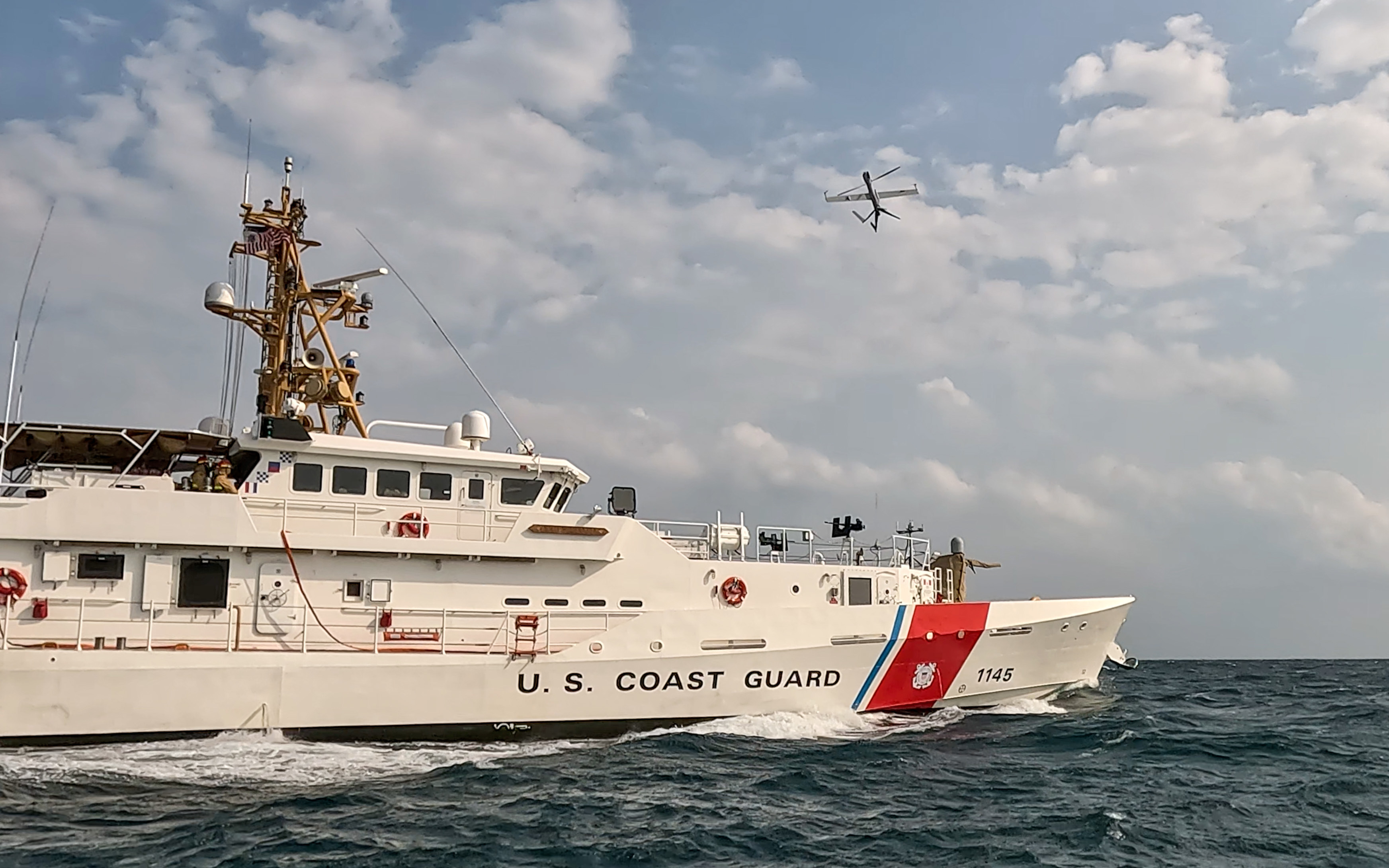
221207-N-NO146-1001 ARABIAN GULF (Dec. 7, 2022) An Aerovel Flexrotor unmanned aerial vehicle (UAV) takes off from U.S. Coast Guard fast response cutter USCGC Emlen Tunnell (WPC 1145) transiting the Arabian Gulf, Dec. 7. U.S. 5th Fleet’s Task Force 59 launched the UAV during Digital Horizon, a three-week event focused on integrating new unmanned and artificial intelligence platforms, including 10 that are in the region for the first time. (U.S. Navy photo)
We have begun to see very capable, vertical takeoff and landing (VTOL) unmanned air systems that fall into the DOD Group Two standard.
Weight: 21 to 55 pounds (10 to 25 kg)
Nominal operating altitude: <3500 feet or 1 km above ground level.
Speed: <250 knots
Recently Elbit Systems reported they would be providing a Group 2 VTOL to the Israeli Army, and we have the photo above of an Aerovel Flexrotor taking off from a Webber class patrol craft,
These small, unmanned air systems (UAS), which can combine sophisticated sensors and endurance of four to over 24 hours, may be better search platforms than our H-65 helicopters.
Group 2 UAS are even smaller than the Martin V-Bat. It appears, they might be able to operate from Webber class cutters. Operating UAS from the Webber class on a regular basis would provide them much of the air search advantage of larger flight deck equipped cutters.
Below is a news release on another aircraft in this class, the Edge Autonomy VXE30. The VIDAR sensor referred to in the news release, is also used on the Scan Eagle (a catapult launched Group 2 UAS) used on National Security Cutters. There is more on the unmanned VXE30 here.
Edge Autonomy’s VXE30 UAS. The VXE30 vertical take-off and landing (VTOL) solution is the latest and most advanced version of the “Stalker” series of small uncrewed aerial systems (sUAS) from Edge Autonomy.
Sentient’s AI-enabled ViDAR optical sensors soar on Edge Autonomy’s VXE30 “Stalker” UAS in successful live demonstrations
ViDAR – Sentient’s AI-enabled wide area motion imagery deployed for real-time maritime surveillance at the edge
VIRGINIA BEACH, Va. (Aug 29, 2023) – Sentient Vision Systems (Sentient) has successfully completed live demonstrations of its AI-enabled ViDAR (Visual Detection and Ranging) payload deployed on Edge Autonomy’s VXE30 UAS. The VXE30 vertical take-off and landing (VTOL) solution is the latest and most advanced version of the “Stalker” series of small uncrewed aerial systems (sUAS) from Edge Autonomy. When coupled with Sentient’s ViDAR, the VXE30 provides a passive, wide area search capability, enabling it to serve a myriad of maritime operations. The joint capability will be on display at DSEI 2023, 12-15 September in London.
ViDAR, developed by Sentient, utilizes AI; Computer Vision, and Machine Learning integrated with Electro-Optic and Infrared (EO/IR) sensors to passively detect objects that are difficult to spot by the human eye or recognize on a conventional radar. With these enhanced capabilities, Stalker will be more capable of accurately detecting and locating people, objects, and vessels (day and night) far from the operator.
ViDAR has been deployed on intelligence, surveillance, and reconnaissance missions (ISR), maritime patrol and border protection, as well as search and rescue missions since 2015. ViDAR is proven to be effective in challenging maritime conditions up to Sea State 6 (very rough with waves 13 to 20 feet high/ 4 to 6 meters).
Sentient has successfully evolved ViDAR into a compact, lightweight, low power form factor—low SWaP (size, weight, and power) — suitable for deployment on small Group 2 / NATO Class 1 UAS such as the VXE30. Its successful integration onto the VXE30 demonstrates its broad operating envelope and ability to provide unprecedented long-endurance imaging capability in contested environments all around the world.
Joshua Stinson, Edge Autonomy’s Chief Growth Officer said, “The integration of ViDAR onto the VXE30 is an essential part of our UAS deployment program. ViDAR’s passive detection system will further the VXE30’s capabilities to remain undetected in a contested environment while carrying a powerful maritime detection sensor that provides a real-time picture of the maritime domain. This capability could make all the difference in a mission’s success.”
Paul Harris, Sentient’s VP of Business Development agreed and said, “We are delighted to be working with Edge Autonomy to demonstrate how effective ViDAR is at increasing the utility of the small and agile VXE30 for the challenges of the modern battlespace. We look forward to displaying our joint capabilities at DSEI.”
With close to 4,500 systems deployed, Sentient’s AI-enabled sensor edge solutions for wide area motion imagery are proven for detection in missions worldwide.
Sentient Vision Systems specializes in passive, modular optical sensors for persistent, wide area motion imagery. Sentient’s artificial Intelligence (AI)-enabled edge solutions better detect and identify small objects in real time, on land and at sea. With more than 20 years of development in moving target indication, AI computer vision and machine learning, Sentient has deployed thousands of systems worldwide in the field of Intelligence, Surveillance, Search and Rescue, enhancing situational awareness, accelerating informed decisions, and saved numerous lives. Follow Sentient on LinkedIn , Vimeo, YouTube and Twitter
Edge Autonomy is a leader in providing innovative autonomous systems, advanced optics, and resilient energy solutions to the U.S. Department of Defense, the U.S. Federal Civilian Agencies, allied governments, academic institutions, and commercial entities. Edge Autonomy draws on a 34+ year history of aerospace engineering, advanced manufacturing expertise, and technologically advanced manufacturing. With headquarters in San Luis Obispo, CA, and key production capabilities abroad, Edge Autonomy’s 400+ team members deliver results in multiple markets. Follow Edge Autonomy on LinkedIn, Facebook and Twitter.
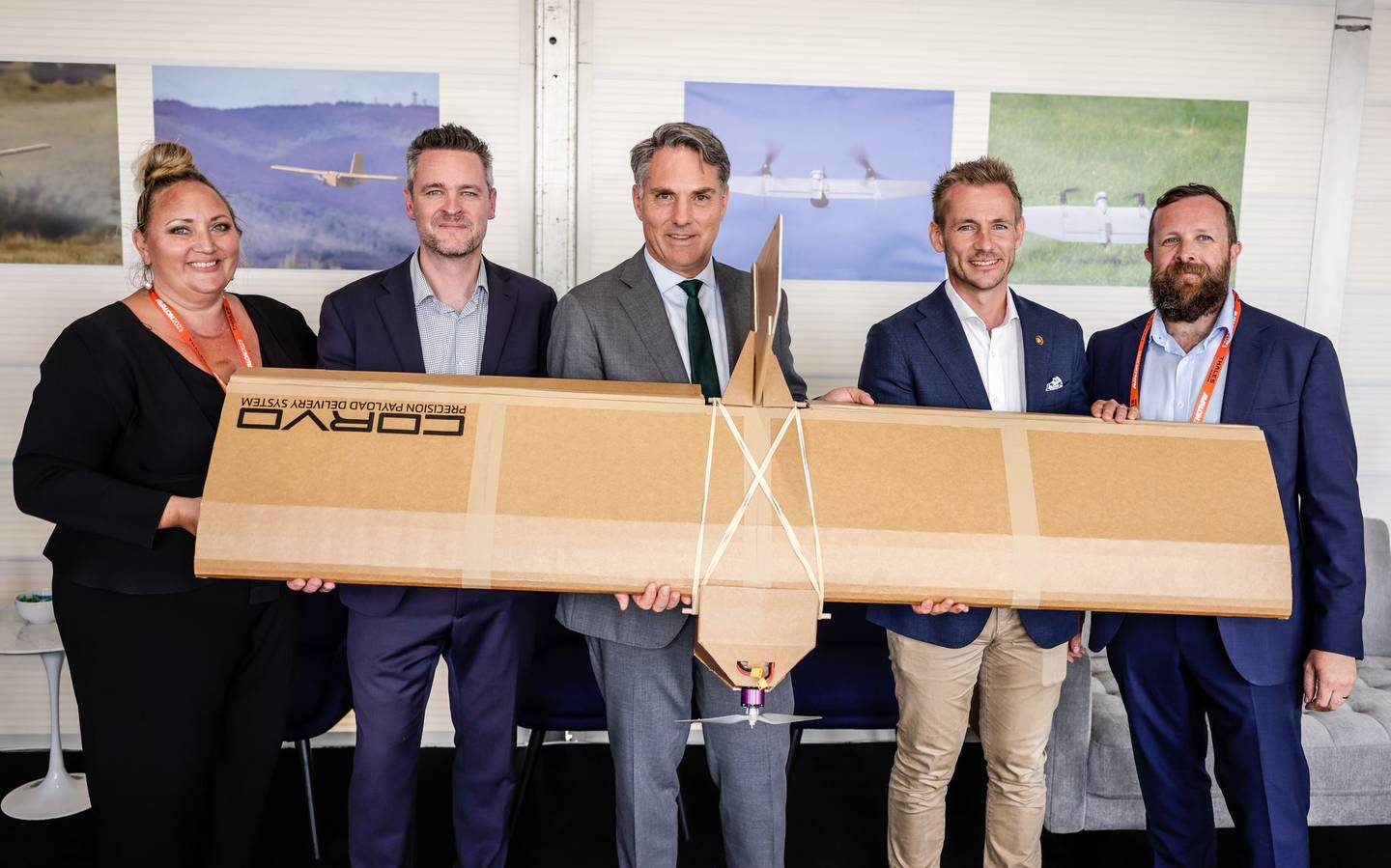
SYPAQ company officials host Australian Deputy Prime Minister Richard Marles and the Ukrainian ambassador to Australia, Vasyl Myroshnychenko, during a March 2023 event following Australia’s donation of 600 Corvo Precision Payload Delivery System drones to Ukraine. (SYPAQ photo)
Ukrainian soldiers have received hundreds of drones, gifted to them by Australia, to capture surveillance video crucial for preparing missions to retake ground from Russian forces.
The data comes from GoPro cameras strung from holes punched into disposable cardboard drones.
This shows just how simple it can be to get an Unmanned Air System ISR capability, or perhaps a weapons delivery capability.
A Coast Guard C-27J Spartan crew, assigned to Coast Guard Air Station Sacramento, flies over San Francisco, California, during area of responsibility familiarization training, Monday, Feb. 6, 2018. Coast Guard photo by Lt. Scott Handlin
Below is a news release from the Acquisitions Directorate (CG-9):
Looking at the Coast Guard’s fixed wing fleet, this is the first of the 14 C-27Js to be equipped with Minotaur, but 14 of the 18 HC-144s are so equipped as are 15 C-130Js. A contract has been awarded for conversion of C-130J numbers 17 and 18 with options for conversion of numbers 19 to 22.
The Coast Guard successfully performed the first flight of the newly missionized HC-27J prototype aircraft, CGNR 2712, today at Naval Air Station (NAS) Patuxent River, Maryland. The milestone flight is part of the Coast Guard’s effort to enhance its fixed-wing surveillance aircraft fleet with improved capabilities to gather, process and transmit information during maritime patrol aircraft joint operations.
The flight was a culmination of efforts by the Coast Guard’s Aviation Projects Acquisition Center and Medium Range Surveillance Aircraft program office along with Naval Air Systems Command’s Naval Air Warfare Center Aircraft Division AIRWorks Team and the original equipment manufacturer, Leonardo Aircraft Division (LAD). The first flight of the HC-27J was a modified functional check flight and was tailored to exercise the program’s Safety of Flight and Safety of Test systems prior to fully proceeding into the flight test phase. The initial flight tests will be performed by the Naval Air Systems Command Test and Evaluation Squadron (VX-20) HC-27J test team with support from the Coast Guard and LAD at NAS Patuxent River.
The Coast Guard is in the process of missionizing 14 C-27J aircraft that were transferred from the U.S. Air Force under the National Defense Authorization Act of 2014. As originally delivered, the C-27Js were outfitted with weather radar and communications equipment. Missionization refers to the process of integrating specialized equipment, such as radar, sensors and processors, that enhance the aircraft’s effectiveness in carrying out Coast Guard missions. The Coast Guard is using Minotaur mission system architecture developed by the Navy across its fixed wing fleet to integrate the specialized components such as surface search radar and electro-optical/infrared sensors because it offers significant increases in speed and memory capability.
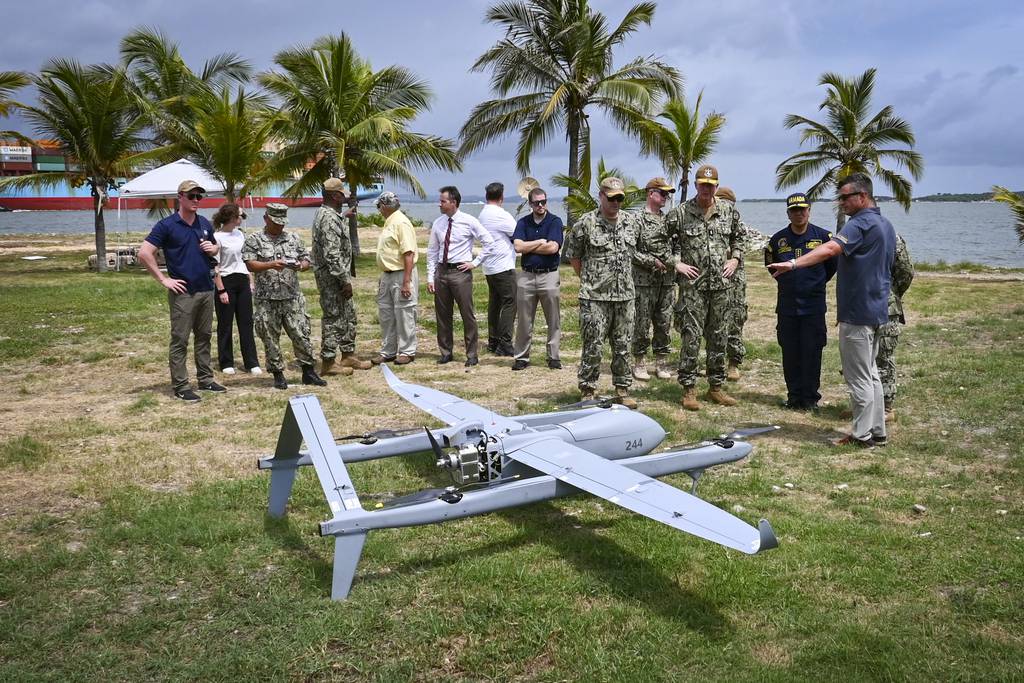
Personnel from the U.S. and Colombian navies attend a demonstration of Aerosonde MK4.7 Hybrid Quad drone during UNITAS on July 16, 2023. (MC1 Hunter Harwell/U.S. Navy)
“The U.S. Navy leveraged air and surface drones throughout its two-week UNITAS 2023 naval exercise near Latin America, the first major event since service leadership announced the region would host the sea service’s second unmanned operations hub.”
The Coast Guard certainly has an interest in 4th Fleet’s use of unmanned systems since their area of responsibility (AOR) includes the Eastern Pacific drug transit zones and the Caribbean.
Apparently, not all the systems are in place yet.
“Some of the same systems will return this fall for operations and exercises in the Caribbean and Eastern Pacific Ocean, he added.”
Importantly 4 Fleet is developing a “mesh network that compiles a detailed common operating picture of the region — then AI tools could help flag areas where potentially problematic activities are happening.”
Hopefully we will see video of the SINKEX as recorded by the UAS.
MyCG reports the completion of a Coast Guard UxS Strategic Plan,
“,,,the Coast Guard will find ways to use unmanned systems to improve our mission execution. Second, the Coast Guard will prepare to defend against threats from unlawful use of unmanned systems. Finally, the Coast Guard must establish and enforce a regulatory framework for the safe and lawful use of unmanned systems and automation in the Marine Transportation System.”
Using Unmanned air systems (UAS) and surface systems (USV) for increased Maritime Domain awareness is a no brainer.
Unmanned systems will certainly impact crewing requirements for the marine transportation system, with things like remote watch standers, market forces will make that happen.
The most challenging part of this will be “to defend against threats from unlawful use of unmanned systems.” This should include criminals, terrorists, and malevolent state actors.
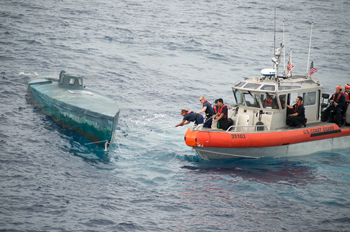
A team aboard Coast Guard Cutter Stratton’s long range interceptor-II cutter boat participates in the interdiction of a self-propelled semi-submersible vessel in the Eastern Pacific Ocean July 18, 2015. U.S. Coast Guard photo by Petty Officer 2nd Class LaNola Stone.
For criminals, shipping drugs without using crewmembers that might provide intelligence on their operations if captured, has to seem like a good idea.
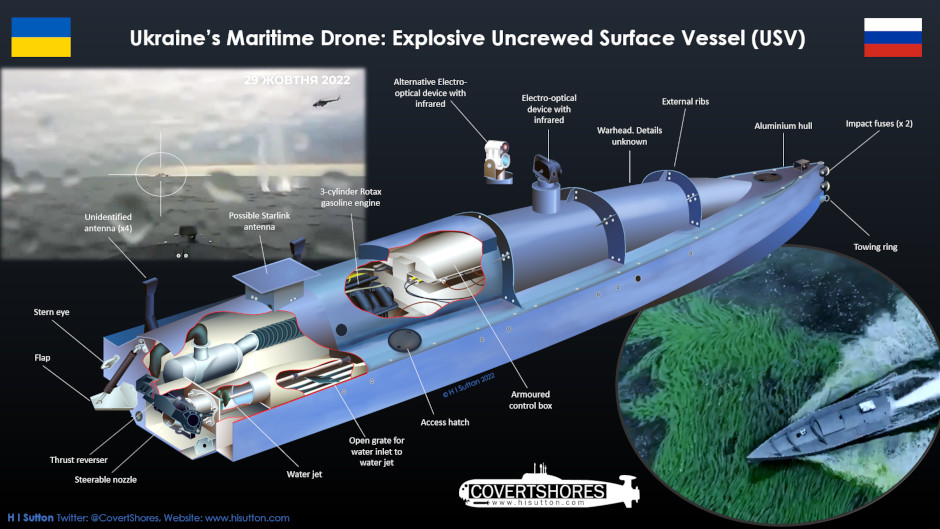
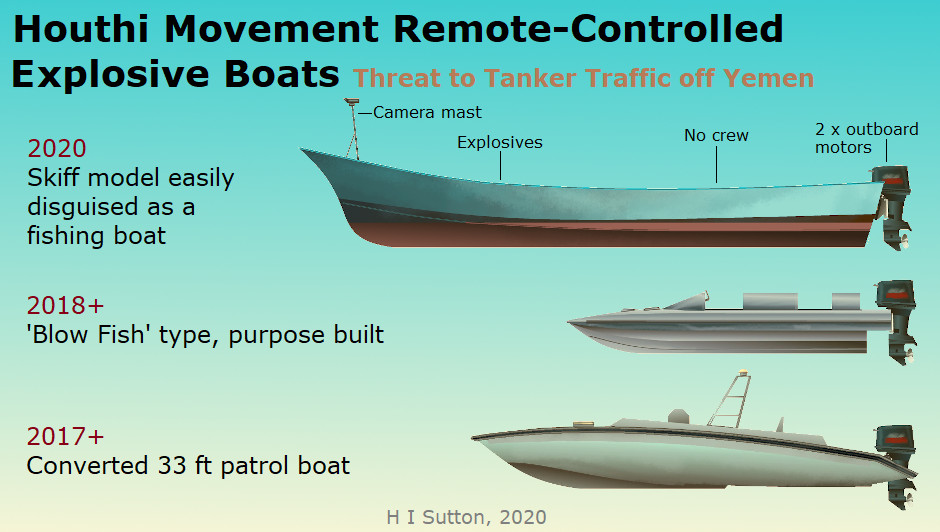
The wars in Yemen and Ukraine have already shown us what terrorists or a nation state might do with unmanned surface vessels.
The US Navy and many others are working on unmanned undersea vehicles (UUVs) as weapons platforms.
Snakehead Large Displacement Unmanned Undersea Vehicle (LDUUV)
Will the Coast Guard include countering UUVs as part of its mission?
Will this prompt a return of the Coast Guard’s ASW mission?
It’s likely unmanned surface vessels will be required to counter unmanned undersea vessels.
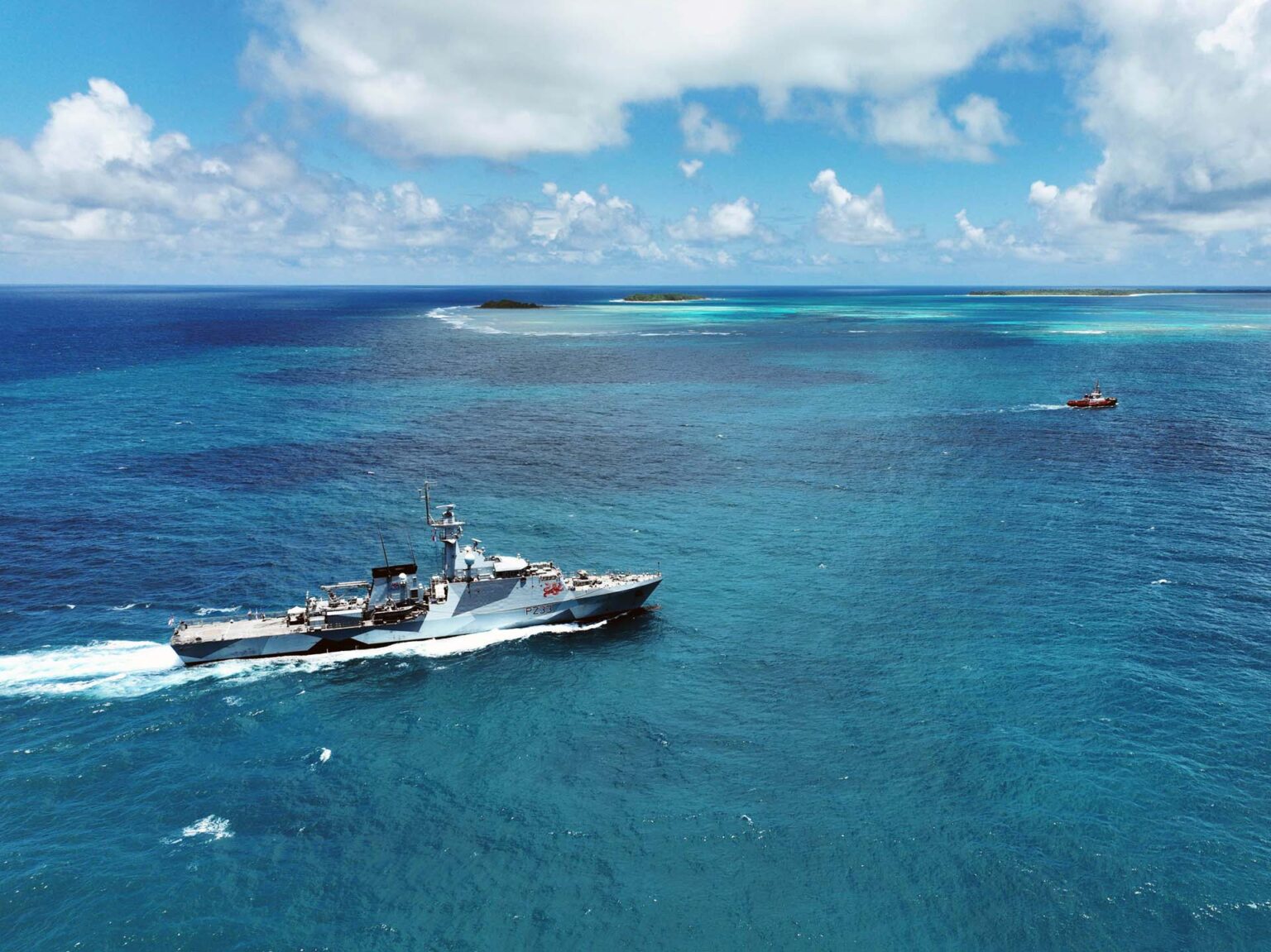
SeaWaves Magazine reports on a visit by Royal Navy Offshore Patrol Vessel Tamar to the Island of Diego Garcia, an important US and Allied base in the Indian Ocean.
“Crew of the patrol ship concentrated on safeguarding the environment in the British Indian Ocean Territory, ensuring the remote island chain’s rare wildlife was not disturbed by the illegal actions of humanity.
“They found its shores littered with tonnes of rubbish and fishermen flouting international law, trawling the territory’s expansive, protected waters – roughly the size of Texas – for its rich stocks of rare fish.”
I would note two things, first this visit is much too rare and second that while HMS Tamar has a flight deck, it virtually never has an embarked helicopter or capable UAS.
The UK has a vast overseas EEZ. They have never had a large number of OPVs. Generally, they have kept one ship in the Western North Atlantic/Bermuda/Caribbean and one ship in the South Atlantic/Falklands/New Georgia regions, not always an OPV. Their overseas territories in the Indian, Pacific, and Mid Atlantic Oceans seldom, if ever, see a patrol vessel. It does seem the British are starting to recognize the utility of these little ships, but I don’t expect them to build any more.
When operating in these overseas EEZs, patrol vessels are generally not supported by land based maritime patrol aircraft.
The River class Batch 2 are large enough to support a helicopter but have no hangar. A helicopter can help search over the horizon, but they are not as helpful as might be thought, because it is difficult to get more than four hours a day search time (two, two hour sorites). While on WHEC-726 I once calculated the embarked helicopter was increasing our effective area searched by about 40%.
Though it would lack some of the operational flexibility of an embarked helicopter, a robust UAS detachment could provide an even better search capability at a relatively low cost.






 Chuck Hill's CG Blog