USCGC Midgett Visits Australia

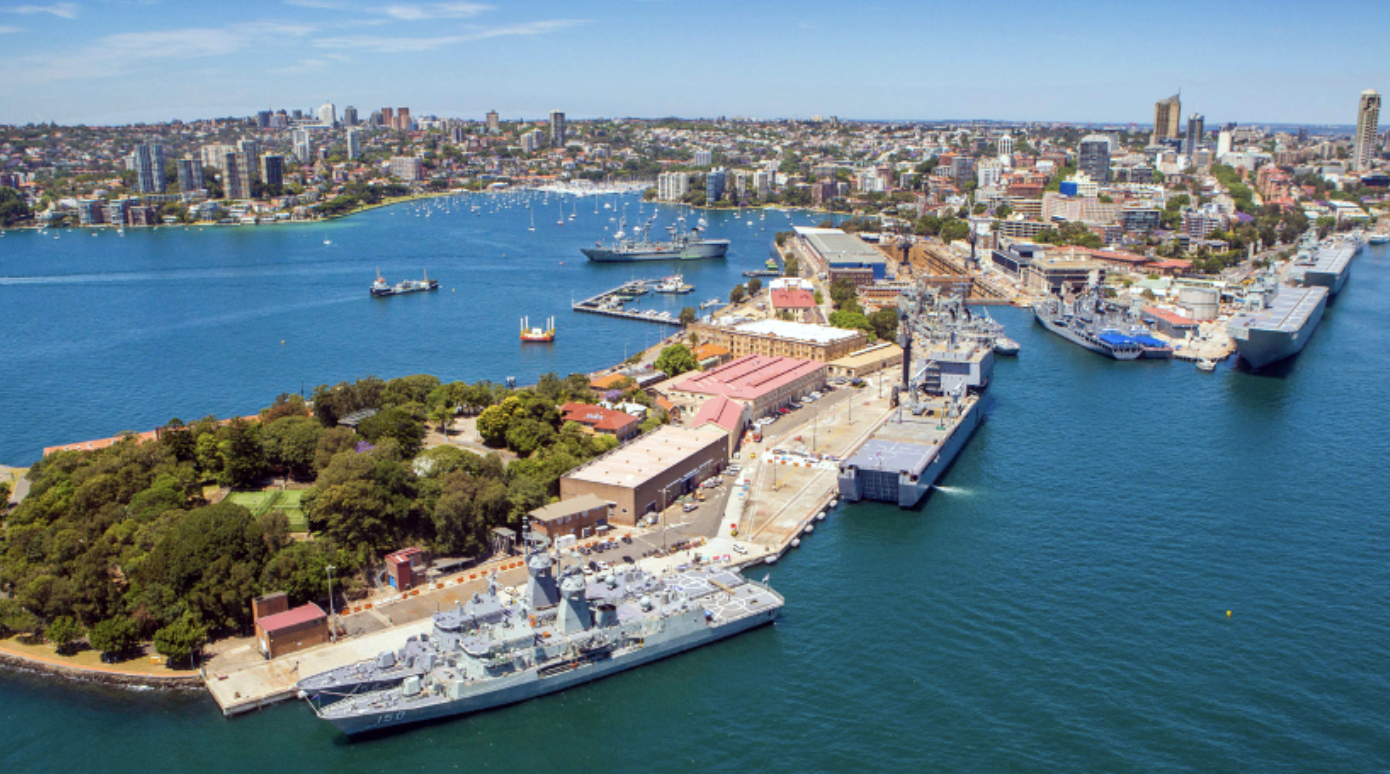
Aerial view of His Majesty’s Australian Station, HMAS Kuttabul. Note the very large dry dock between the island and the city. I was not able to identify all the Australian Navy ships in the photo, but there appear to be eleven Visible in the photo are both Canberra class helicopter dock landing ships (LHD, uppep right); two ANZAC class frigates (FFG, foreground), HMAS Choules (L100, center fight). The photo was probably taken between 2015 and 2018–the ship anchored in the center appears to be HMAS Tobruk which was scuttled in 2018.
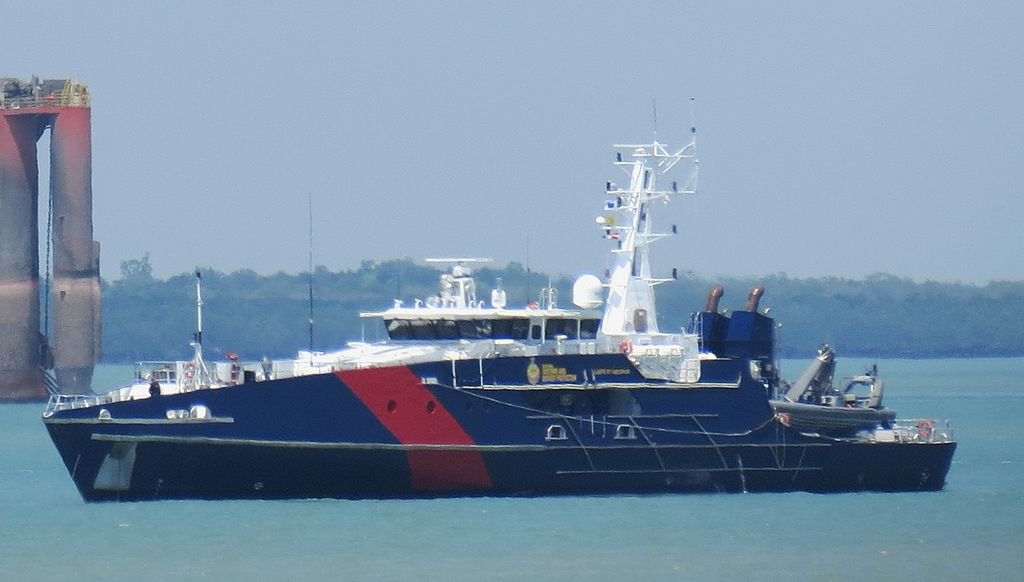
The Australian Customs patrol boat ACV Cape St George on Darwin Harbour in 2014, Photo by Ken Hodge

Below is a news release. The linked news release includes several photos of the people involved. Midgett was hosted by the Australian Navy but also interacted with the Marine Unit of the Australian Border Force, which performs some Coast Guard type missions. The Border Force was formed in 2015, the Marine Unit having come from their Customs service. Currently the Marine Unit includes one large former Offshore Support Vessel and eleven patrol craft.

There are suggestions that they may be given the Arafura class OPVs being built for the Australian Navy.

The Australian Border Force also has an aviation Coast Guard component operating a fleet of ten privately contracted Dash 8 aircraft which operate alongside the Royal Australian Air Force (RAAF) in the Maritime Border Command (a joint Border Force, Navy, and Air Force command under a Navy flag officer–Chuck).

Notably the Marine Unit of the Australian Border Force is not a SAR agency, but given the nature of their assets and patrols, they will be doing some SAR, just as the Revenue Cutter service did.

It seems probable the Marine Unit of The Australian Border Force will evolve in the direction of the USCG model.


March 4, 2025

U.S. Coast Guard cutter visits Australia, furthers collaboration and maritime security

SYDNEY – The U.S. Coast Guard Cutter Midgett (WMSL 757) recently completed a port call in Sydney, Feb. 25, 2025, conducting several engagements with Australian partners that strengthened ties and furthered collaborative maritime security throughout Oceania. Reflecting the spirit of the Pacific Quadrilateral Defense Coordinating Group (Australia, India, Japan, and the US–Chuck), the U.S. Coast Guard continues its vital collaboration with Australian law enforcement to identify maritime vulnerabilities and cooperate on solutions that reduce risks to safety, health, and security throughout the region.

While in Sydney, Midgett hosted a law enforcement partnership event with Australian and United States stakeholders. Participants, including U.S. Consul General in Sydney Christine Elder, U.S. Coast Guard Attaché Capt. Amanda Ramassini, representatives from U.S. Homeland Security Investigations, U.S. Secret Service, and Australian law enforcement and maritime security partners, joined the crew for breakfast and roundtable discussions in the wardroom, followed by a tour of the cutter. Law enforcement partners received a briefing on Midgett’s capabilities and its current mission in the Pacific. Highlighting the close bond between the two nations and their agencies, Midgett’s Lt. Jake Behne recently deployed to the Torres Strait as an observer with the Australian Border Force (ABF) Fast Response Boat unit, and now an ABF Officer in Charge is set to sail aboard Midgett as an observer.

Separately, Sydney media outlets were invited aboard with the assistance of U.S. Consulate Sydney; the subsequent reporting on partnerships reached more than a million Australians.

Beyond official engagements, the crew of Midgett embraced the opportunity to experience Australian culture and history during a visit to the Australian National Maritime Museum.

“This visit to Sydney was more than just a port call; it was a chance to reinforce the vital link between the U.S. Coast Guard and our Australian counterparts,” said Capt. Matthew Rooney, Midgett’s commanding officer. “The support we received from HMAS Kuttabul was first rate and the warm welcome from our Royal Australian Navy shipmates made our time here truly memorable.”

The United States’ alliance with Australia remains a cornerstone of peace and stability in the Indo-Pacific region. The U.S. Coast Guard looks forward to continuing partnerships with Australia’s maritime and border forces to ensure a connected, prosperous, secure, and resilient Pacific.

Midgett, commissioned in 2019 and homeported in Honolulu, is the eighth Legend-class national security cutter. These 418-foot vessels are equipped with advanced technology, making them ideally suited to support a wide range of missions, including maritime security, law enforcement, and search and rescue operations.
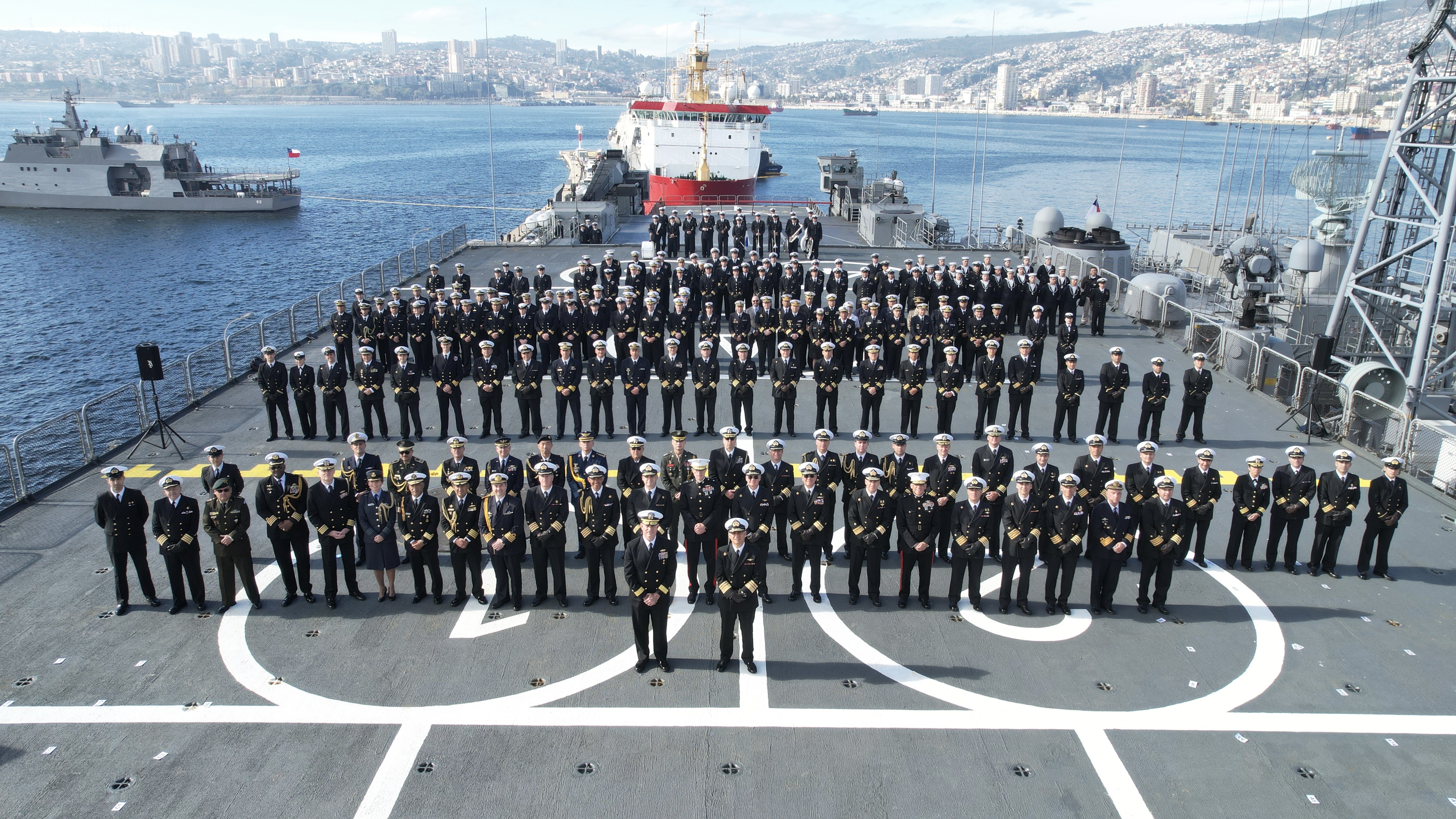
“UNITAS LXV Begins in Valparaiso, Chile” –SOUTHCOM

UNITAS LXV commenced today in Valparaiso, Chile, with 17 ships, two submarines, and 23 aircraft operated and supported by more than 4,300 Sailors and Marines from 24 nations. UNITAS is the world’s longest-running multinational maritime exercise, conceived in 1959 and executed without fail since 1960.

Below is a U.S. Naval Forces Southern Command / U.S. 4th Fleet Public Affairs news release. 

Notably there are no Coast Guard floating units or aircraft participating this year but U.S. Coast Guard (USCG) Tactical Law Enforcement Team (TACLET) Pacific Law Enforcement Detachment (LEDET); and USCG Maritime Security Response Team East (MSRTE) Direct Action Section are providing their special expertise.

This exercise is about disaster response and law enforcement as much as war fighting.

The ship visible in the upper left hand of the photo is a Fassmer designed 80-meter Offshore Patrol Vessel (OPV). It is the Chilean Navy’s Comandante Policarpo Toro (OPV-82). Chile has four ships and Colombia three ships built to this design.

The ship immediately astern (red hull and white superstructure) appears to be an icebreaker, but I don’t recognize it.


Sept. 2, 2024

UNITAS LXV Begins in Valparaiso, Chile

VALPARAISO, Chile – Navy and Marine forces arrived in Valparaiso in support of UNITAS LXV (65), the world’s longest-running multinational maritime exercise in the world, which officially commenced September 2, 2024. 

The Chilean navy is hosting this year’s UNITAS, which will feature 17 warships/vessels, two submarines, 20 aircraft (fixed wing/helicopter), and more than 4,300 personnel from 24 partner nations. Forces will conduct operations off the coast of Valparaiso, Chile, and ashore in the vicinity of Puerto Aldea, Chile, through September 12.

Rear Adm. Rich Lofgren provided opening remarks as U.S. Naval Forces Southern Command/U.S. 4th Fleet Deputy Commander, addressing the opportunities to build relationships ashore, including subject matter exchanges, operations briefs, and a Women, Peace, and Security symposium. Creating these spaces to build relationships on shore will pay dividends at during the at-sea phase of the exercise and beyond.

“Sailors go to sea,” Lofgren added. “I look forward with great excitement to joining you at sea, as we conduct combined and joint operations. We will enhance our capabilities and improve our interoperability in these maritime events – together. Make no mistake, all of us will work hard the next 12 days. But we will communicate effectively – together. We will operate effectively – together. And we will overcome obstacles – together.”

UNITAS, which is Latin for unity, united, or oneness, was conceived in 1959 when representatives at the first Inter-American Naval Conference in Panama agreed to conduct an annual maritime exercise with one another. Prior to UNITAS I in 1960, U.S. Chief of Naval Operations Adm. Arleigh Burke reviewed preparations for the multinational exercise. He commended planners for their progress, especially in building compatible communication systems among navies, and predicted that UNITAS would build strong relationships among Sailors of the Western Hemisphere.

UNITAS I took place in 1960 with forces from Argentina, Brazil, Chile, Colombia, Ecuador, Peru, Uruguay, the United States, and Venezuela. This year marks the 65th iteration of the world’s longest-running annual multinational maritime exercise.

Including the United States, UNITAS LXV will bring together 24 nations from all over the world to train forces in joint maritime operations that enhance tactical proficiency and increase interoperability. Participating nations include Argentina, Brazil, Canada, Chile, Colombia, Dominican Republic, Ecuador, France, Germany, Guatemala, Honduras, Italy, Jamaica, Japan, Mexico, Paraguay, Peru, Portugal, South Korea, Spain, Trinidad and Tobago, United Kingdom, United States, and Uruguay.

Following the UNITAS LXV Opening Ceremony on September 2, the in-port phase of the exercise will feature subject matter expert exchanges, professional symposia, ship rider exchanges, and operations meetings. During this time, Marines and Sailors will conduct training events in Valparaiso to include medical, cyber defense, and diving and salvage operations.

During the UNITAS LXV Underway Phase, forces will participate in events testing all warfare operations, to include live-fire exercises such as a SINKEX and an amphibious ship-to-shore landing and force withdrawal.

Unmanned and hybrid fleet systems will return for a second year to UNITAS with the presence of unmanned undersea vehicles. As part of the U.S. Navy’s future hybrid fleet, the Chief of Naval Operations has tasked U.S. 4th Fleet to scale unmanned platforms to the fleet level.

There are many U.S. forces participating in UNITAS LXV, including USS Germantown (LSD 42), USS St Louis (LCS 19), and USS Hampton (SSN 767). Other U.S. participants include Patrol Squadron Five (VP 5); Mobile Diving and Salvage Unit (MDSU) 2; Explosive Ordnance Disposal Mobile Unit (EOD) 2; Mine Countermeasures Group 2 (MCMGRU TWO); Helicopter Maritime Strike Squadron 50 Detachment 4 (HSM 50 Det 4); 2nd Battalion, 7th Marines (2/7); 1st Battalion, 24th Marine Regiment (1/24); 4th Light Armored Reconnaissance Battalion (4th LAR); 4th Reconnaissance Battalion (4th Recon); Combat Logistic Regiment 4 (CLR 4); 2nd Battalion, 14th Marines (2/14); Marine Aerial Refueler Transport Squadron 234 (VMGR-234); Marine Wing Communications Squadron 48 (MWCS-48); Marine Aircraft Control Group – 48 (MACG-48); Marine Fighter Attack Squadron 112 (VMFA-112); U.S. Coast Guard (USCG) Tactical Law Enforcement Team (TACLET) Pacific Law Enforcement Detachment (LEDET); and USCG Maritime Security Response Team East (MSRTE) Direct Action Section. Operational and tactical level leadership will be provided by Commander, Destroyer Squadron 40, (COMDESRON 40); Commander, Amphibious Squadron Seven (COMPHIBRON SEVEN); U.S Marine Corps Forces South (MARFORSOUTH); USNAVSOUTH/FOURTHFLT; and U.S. Southern Command (USSOUTHCOM).

U.S. Naval Forces Southern Command/U.S. 4th Fleet supports U.S. Southern Command’s joint and combined military operations by employing maritime forces in cooperative maritime security operations to maintain access, enhance interoperability, and build enduring partnerships in order to enhance regional security and promote peace, stability and prosperity in the Caribbean, Central and South American region.

U.S. Marine Corps Forces, South is the Marine Corps component to U.S. Southern Command, is responsible for planning exercises, operations, and overall Marine Corps support for the SOUTHCOM assigned area of responsibility.

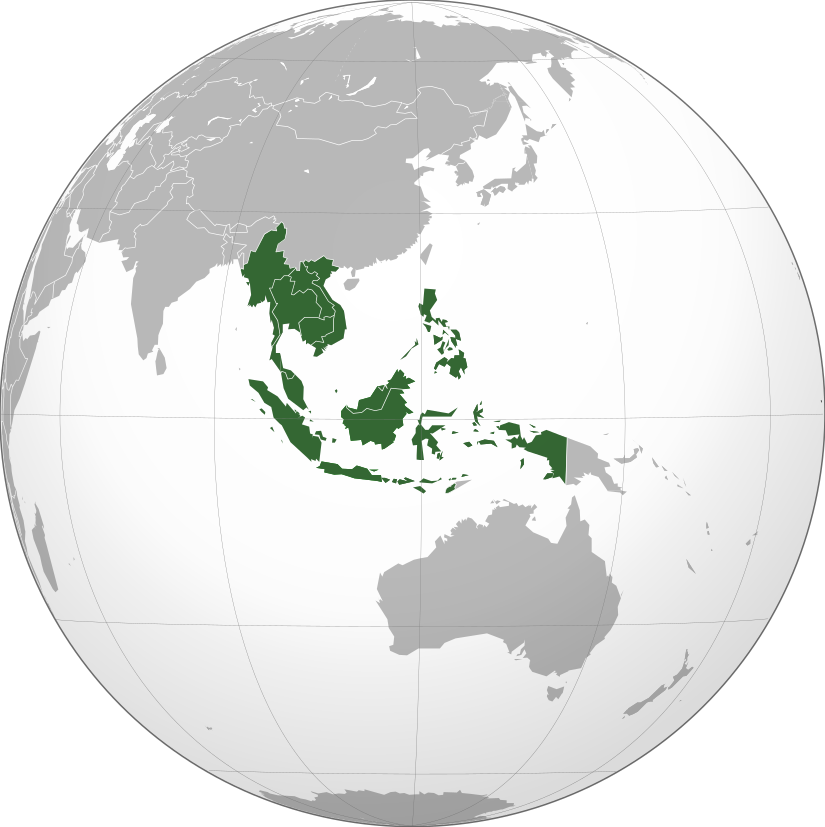
“ASEAN kicks off its first-ever joint military drills in Indonesia” –Reuters

Association of Southeast Asian Nations in orthographic projection. Credit: Addicted04

Reuters reports,

“Units from the countries of ASEAN began their first ever joint military drills in Indonesia’s South Natuna Sea amid rising geopolitical tensions between major powers and protests against China’s activities in the South China Sea…The five-day non-combat operation is aimed at developing military skills, including maritime security and patrols, and the distribution of humanitarian assistance and disaster relief, the Indonesian military said in a statement.”

This is a step toward establishment of recognized norms and cooperative law enforcement by ASEAN members in the South China Sea.

Significantly Indonesia is taking a leadership role. Indonesia seems to be the most aggressive nation in ASEAN with regard to protecting their EEZ assets.

“Indonesia, Malaysia, Philippines renew commitment to cooperation” –Indo-Pacific Defense Forum

Coast guard leaders and personnel from member states of the Association of Southeast Asian Nations participate in the June 2023 ASEAN Coast Guard Forum in Jakarta, Indonesia. IMAGE CREDIT: Indonesian Maritime Security Agency

The Indo-Pacific Defense Forum reports,

“Joint sea and air patrols conducted by Indonesia, Malaysia and the Philippines under the 2017 Trilateral Cooperative Arrangement (TCA) continue to demonstrate success and remain critical to Indo-Pacific maritime security, according to officials and analysts. The three countries agreed in June to build on their cooperative efforts going forward.

“Regular patrols, coordination and intelligence sharing established by the TCA are known as INDOMALPHI. The patrols have successfully countered threats including piracy and terrorism with no reported threat events in the first six months of 2023, according to Indonesia’s Ministry of Defense. This compares to 99 reports of piracy and armed robbery in 2017 in the patrol area.”

This sort of cooperation might lead to my proposed Combined Maritime Security Task Force. They don’t need the US Coast Guard to do it, but US participation might add some much-needed gravitas, if they have to face down the Chinese.

“Navy to establish additional unmanned task forces inspired by Task Force 59” –Defense Scoop

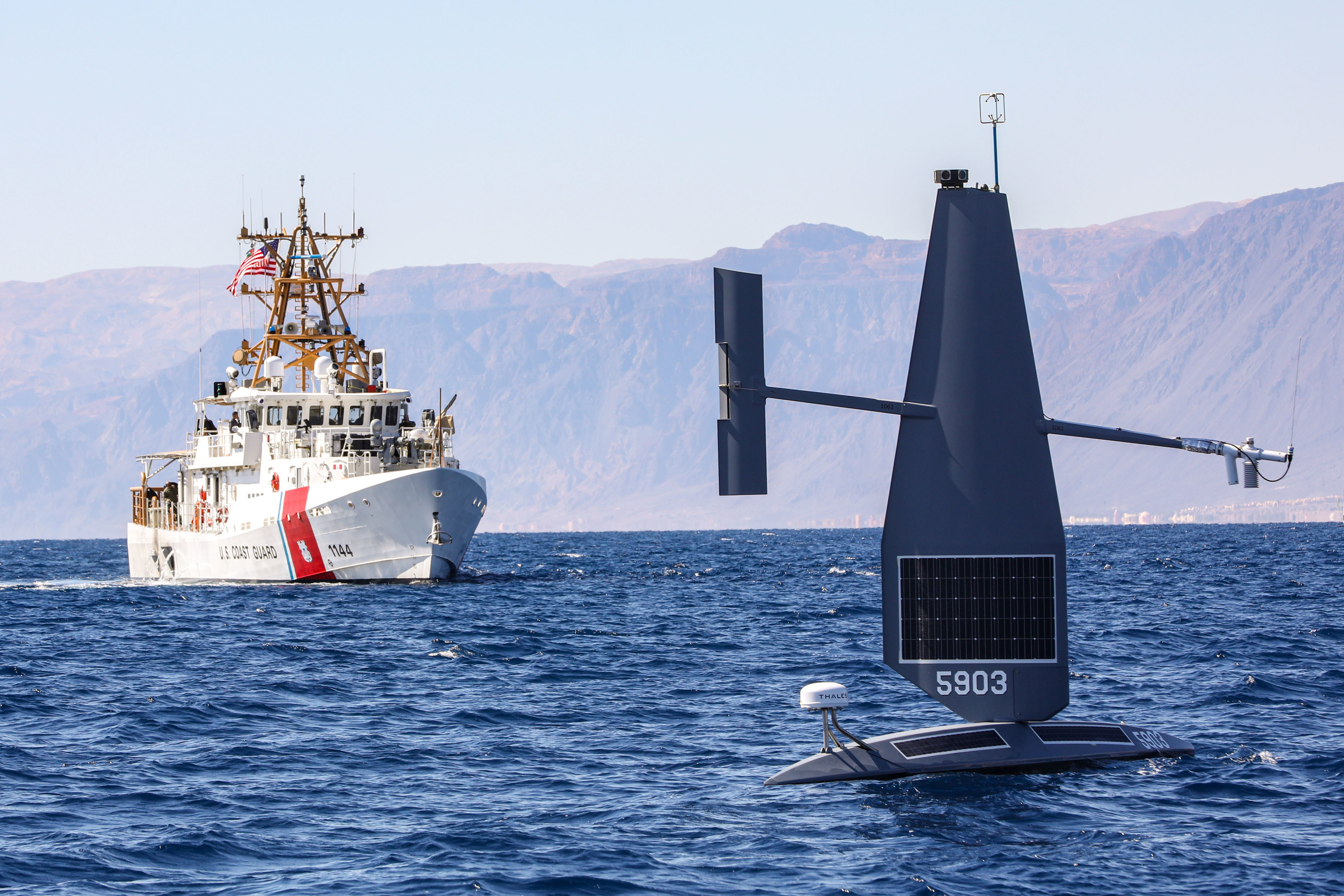
GULF OF AQABA (Feb. 13, 2022) The U.S. Coast Guard Sentinel-class cutter USCGC Glen Harris (WPC 1144) sails near a U.S sail drone explorer during the International Maritime Exercise/Cutlass Express (IMX) 2022, Feb. 13, 2022. IMX/CE 2022 is the largest multinational training event in the Middle East, involving more than 60 nations and international organizations committed to enhancing partnerships and interoperability to strengthen maritime security and stability. (U.S. Army photo by Cpl. DeAndre Dawkins)

Defense Scoop reports:

“The Navy plans to stand up additional unmanned task forces around the globe modeled after Task Force 59 in the Middle East, Navy Secretary Carlos Del Toro told reporters Saturday…“We’ve demonstrated with Task Force 59 how much more we can do with these unmanned vehicles — as long as they’re closely integrated together in a [command and control] node that, you know, connects to our manned surface vehicles. And there’s been a lot of experimentation, it’s going to continue aggressively. And we’re going to start translating that to other regions of the world as well,” Del Toro said during a media roundtable at the Reagan National Defense Forum.”

The report goes on to mention 4th Fleet and Oceana specifically, both regions of intense interest to the Coast Guard in regard to drug interdiction and Illegal, Unregulated, Unreported (IUU) fishing respectively.

This could be a big boost to our Maritime Domain Awareness. In the Eastern Pacific Drug Transit Zone we might need uncrewed surface vessels with passive acoustic sensors since the targets of interest are poor targets for radar and optical sensors. That could lead to practical experience that could improve our ASW capability.

“Coast Guard begins multi-month fisheries enforcement operation with Bermuda” –News Release

Below is a 5th District news release concerning a new level of cooperation between the USCG and Bermuda to counter Illegal, Unreported, Unregulated (IUU) fishing. This certainly makes sense, since the Bermuda and the US share the same fish stocks. No matter where overfishing of that stock occurs, it hurts both US and Bermudian fishermen and our economies.

This seems to be the latest in a trend toward pooling resources, using the ship-rider program and Law Enforcement Detachments, to enforce norms for mutual benefit. Bermuda is a British Overseas Territory that lies 559 nautical miles (1,035 km) ESE of North Carolina. Britain, along with Canada, the Netherlands, and France, has been helping the USCG’s drug interdiction efforts.

(Bermuda is a great liberty port. I have found memories. Took my family back recently. I am sure the crews will enjoy Bermudian hospitality.)

The Bermuda Coast Guard was formed in February 2020.

News Release

U.S. Coast Guard 5th District Mid-Atlantic

Coast Guard begins multi-month fisheries enforcement operation with Bermuda

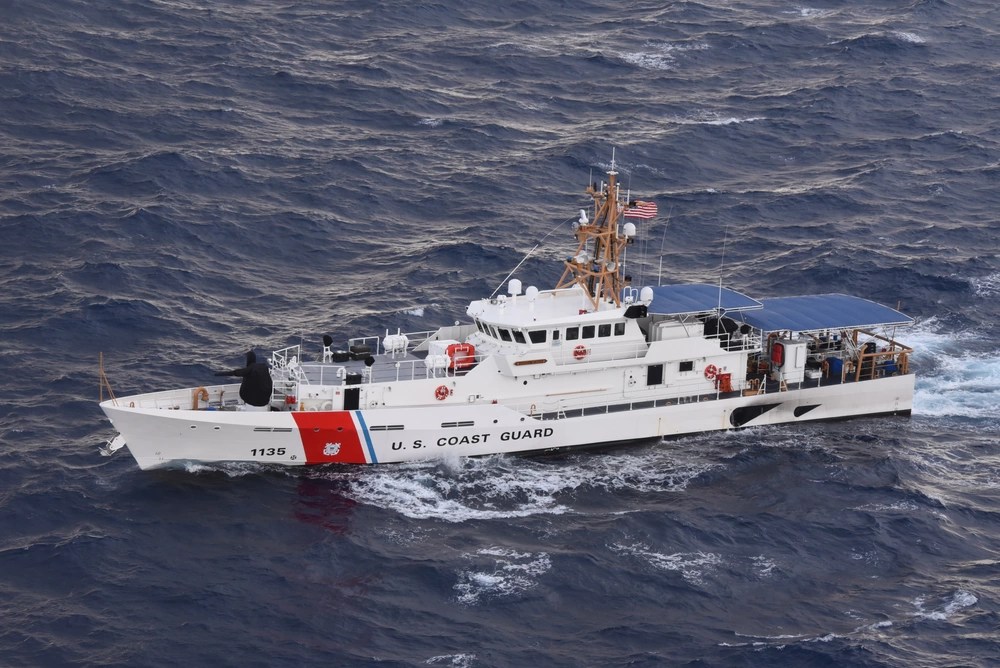
USCGC Angela McShan (WPC-1135)

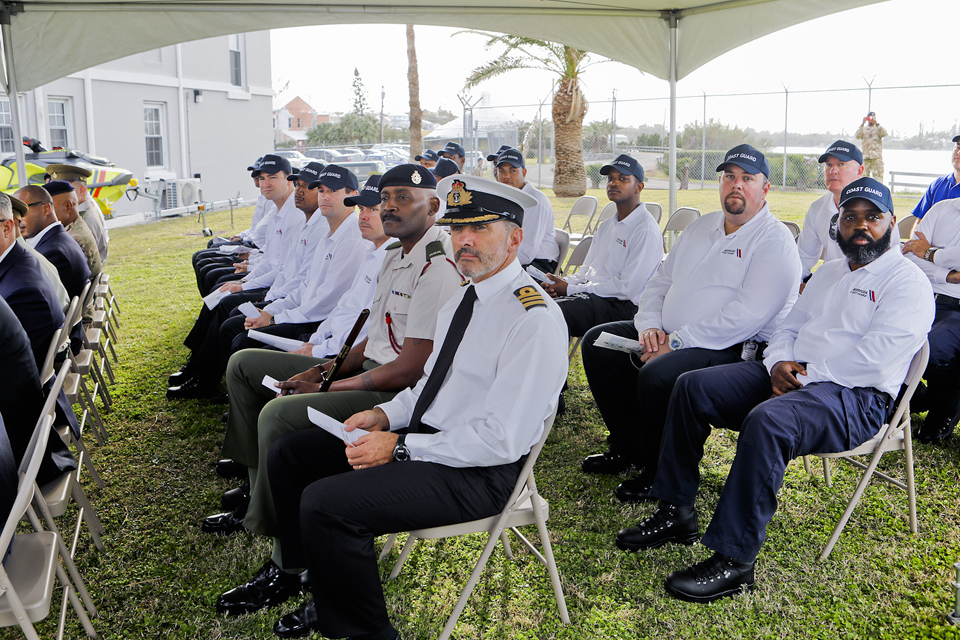
PORTSMOUTH, Va. — U.S. Coast Guard Cutter Angela McShan (WPC-1135) is scheduled to arrive in Bermuda on April 6 as part of a multi-month fisheries enforcement operation in concert with the Bermuda Department of Environment and Natural Resources, Royal Bermuda Regiment, Bermuda Coast Guard, and Bermuda Police Services. 

The cutter will be the first of four Coast Guard ships that will patrol seaward of the Bermuda Exclusive Economic Zone (EEZ), which extends 230 miles from shore. The joint operation will expand upon the long-standing U.S.-Bermuda partnership, as well as emphasize protection of the environment and living marine resources in this region. 

The operation is a result of recent meetings between Bermuda’s Deputy Governor Alison Crocket, Deputy Premier Walter Roban, Permanent Secretary in Bermuda’s Ministry of Home Affairs Rozy Azhar, United States Consul General in Bermuda Karen Grissette and Rear Admiral Laura Dickey, the U.S. Coast Guard Fifth District Commander.  The professional exchange focused on increasing efforts to counter illegal, unreported and unregulated (IUU) fishing, a global issue recently detected in the Mid-Atlantic.  

“It was an honor to meet Rear Admiral Dickey and her staff, along with the U.S. Consul and her staff,” noted Deputy Premier Roban.  “This operation begins a new chapter of cooperation with the U.S. Government in supporting illegal, unreported fishing and other unacceptable activity in our waters.  All is as a result of a meeting held with the National Climate Advisor to U.S. President Biden, Gina McCarthy, at COP26 where we discussed matters important to Bermuda and the United States.  The willingness of the United States to support Bermuda in our effort to oversee our EEZ is in step with our centuries’ long relationship as neighbors.  My gratitude on behalf of the people of Bermuda extends to the U.S. Consul’s Office in Bermuda for facilitating these meetings and the support we will get from the United States Coast Guard.”

As the worldwide demand for fish as a protein source continues to grow, IUU fishing will have a profound impact on the security of all countries with a maritime boundary. Left unenforced, IUU fishing will threaten global geo-political security, undermine maritime governance, and impact a nation’s ability to achieve domestic food security.

“We’re excited to join with Bermuda to help detect and monitor potential IUU fishing in the region,” said Rear Admiral Dickey.  “As we each work to safeguard our respective Exclusive Economic Zones, we’re fortunate to build on our long-standing relationship to partner together in this effort to protect global fish stocks and promote adherence to international rules.”

“The United States is proud to partner with Bermuda to promote security and lawful conduct in the Atlantic region,” added U.S. Consul General Karen Grissette.  “Reinforcing the United States’ security partnership with Bermuda is one of my top priorities, so I am proud to welcome these U.S. Coast Guard cutters to advance our shared interests.  This important operation is one more tangible demonstration of the close security collaboration between Bermuda and the United States.”  

The Sentinel-class fast response cutter (WPC) is a key component of the Coast Guard’s offshore fleet that is capable of deploying independently to conduct missions that include port, waterways and coastal security, fishery patrols, search and rescue, and national defense.

“Develop an Indo-Pacific Fishing Security Apparatus to Compete with Illegal Chinese Fishing Fleets and Maritime Militia” -USNI

Chinese fishing vessel fleet (Photo: The Maritime Executive)

The US Naval Institute Blog has a short post recommending,

“…the United States…should spearhead the establishment of an Indo-Pacific Fishery Security Cooperation (IPFSC) that includes nations from Asia, South America and Africa. This organization would enable the member states to ensure territorial and economic integrity through diplomatic pressure, the sharing of intelligence and the sharing of security forces…The ultimate goal of the IPFSC would be to combat illegal, unreported, and unregulated fishing throughout the Indo-Pacific region. As the majority infringer, the PRC would have a unified treaty organization economically and diplomatically pushing back against their illicit activities and enforcing international decisions such as the South China Seas Arbitration case… This would be somewhat similar to the North Atlantic Treaty Organization…except with an economic and law enforcement focus rather than a military focus.”

A law enforcement alliance would seem to be much easier to sell than a military one.

There are a few multi-national fisheries management organizations already, but to my knowledge none of them involve sharing of enforcement assets, though, I believe Australia, New Zealand, France, and the US have all aided smaller countries in fisheries enforcement.

The fishing fleets ravaging the worlds oceans are mobile and so large that when they move into an area, they overwhelm the local enforcement agencies. Like military organizations, you can be sure fishing fleets share information about the location and practices of their adversaries–the fisheries enforcement agencies. That is why enforcement agencies need to coordinate and share resources.

Earlier I proposed something like the sharing of security forces proposed here, “Combined Maritime Security Task Force, Pacific,” that could be implemented using an expanded multilateral “ship-rider” program–a multi-ship, multi-national, highly mobile law enforcement task force that can follow the fishing fleets from one nations EEZ to the next. The advantages of having third party witnesses when there is a contentious law enforcement action is undertaken should not be underestimated.

The afloat assets should be supported by shore based aviation and intelligence assets all in support of a multi-laterally developed fisheries management plan.

The USNI blog proposal refers to the Indo-Pacific, and my earlier post was in regard to the Western Pacific. Frankly, similar organizations could be organized in several areas, including the Gulf of Guinea, the South China Sea, the Western Pacific, the West coast of South America, and the Caribbean. It’s likely if we could form one such law enforcement alliance somewhere, and it worked, others would follow the example.


Coast Guard Special Purpose Craft Law Enforcement Generation II (SPC-LE II)

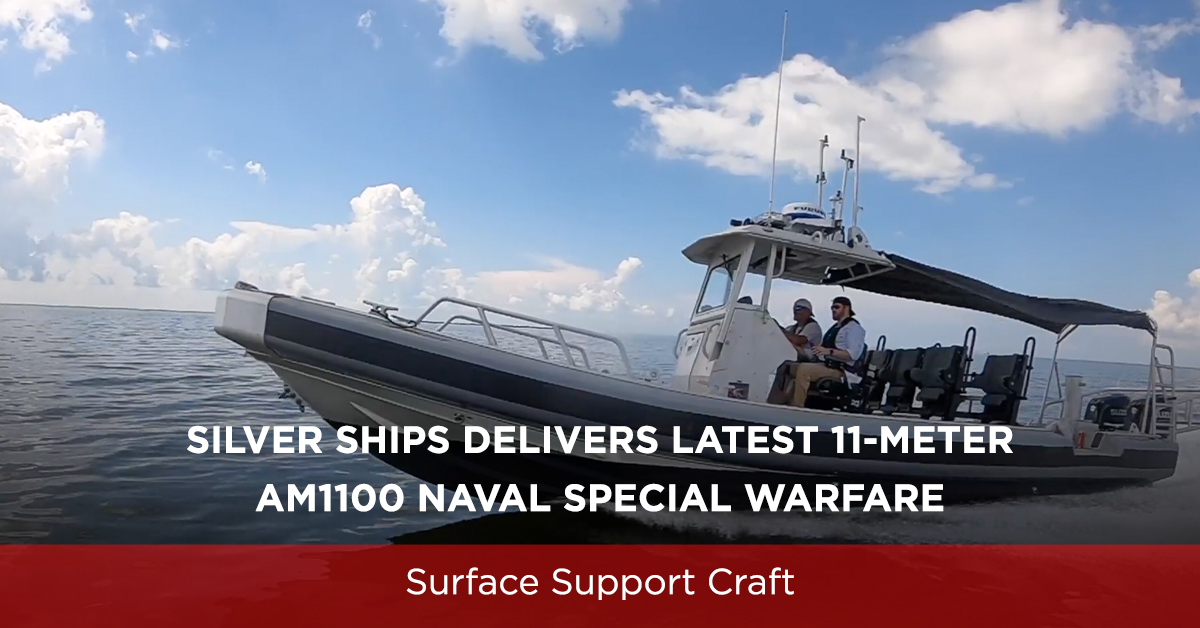
Photo: Not positive, but this seems to be the boat we are talking about. 

The DOD recently announced a boat contract, awarded through the Navy, that involves boats for the Coast Guard (you have to look pretty far down to find it).

Silver Ships Inc.,* Theodore, Alabama, was awarded an $8,239,095 firm-fixed price, indefinite-delivery/indefinite-quantity single award contract (N00024-21-D-2205) for design and construction of up to 110 Navy 8-meter and 11-meter Surface Support Craft and Coast Guard Special Purpose Craft Law Enforcement Generation II (SPC-LE II). Work will be performed in Theodore, Alabama, and is expected to be completed in August 2023. This contract includes options which, if exercised, would bring the cumulative value of this contract to $51,663,787. Fiscal 2020 other procurement (Navy) funds in the amount of $3,242,628 (39%); fiscal 2021 other procurement (Navy) funds in the amount of $3,187,680 (39%); and fiscal 2021 other procurement (Coast Guard) funds in the amount of $1,808,787 (22%) will be obligated at time of award and will not expire at the end of the current fiscal year. This contract is a small business set-aside. This contract was competitively procured via the beta.sam.gov website, with four offers received. The Naval Sea Systems Command, Washington, D.C., is the contracting activity. (Awarded Sept. 30, 2021)

This is Silver Ships’ announcement.

This appears to be the boat the Coast Guard will be getting. The Coast Guard will get the “Open Center Console (Open) variant.”

Each boat will use three outboards. These are the engines specified in the contract.

Thanks to Paul for bringing this to my attention. He also provided the following that gives more detail: 

C-1 PART 1 – GENERAL STATEMENT OF WORK

This Statement of Work (SOW) defines the effort required for the, design, construction, testing, configuration control, documentation, and program management for the acquisition of the 8m variant,11m variant of the Naval Special Warfare (NSW) Surface Support Craft (SSC) and the United States Coast Guard (USCG) 11m variant (Special Purpose Craft Law Enforcement).

C-1.1 BACKGROUND

The 8m variant and 11m variant NSW SSC boats operate from inshore littorals to blue water, over the horizon locations, in and up to moderate sea states (NSW) in widely diverse climatic conditions (tropical to arctic). They provide over-watch and coverage for diverse NSW waterborne operations, such as: transit for at sea personnel, water parachute jump, diving, surface swimmer support, medical evacuation and command, control, communications, computers, and intelligence duties. The SSCs also provide support for all NSW garrison locations and allow NSW to certify units for deployment in support of Navy and COMNAVSPECWARCOM requirements.

The USCG will use the 11m SSC variant to conduct counter-smuggling, search and rescue (SAR), recreational boating safety (RBS), and ports and waterways coastal security (PWCS) missions and will operate in higher sea states than the USN variants.

All boat variants are desired to provide comparable to enhanced performance of current capabilities while focusing on commonality to maintain reduction in Total Ownership Costs (TOC).

The NSW SSC requires two configuration variants of the 8m and 11m, Open Center Console (Open) and Enclosed Cabin (Cabin), to support mission needs.

The USCG requires the 11m Open Center Console (Open) variant to support mission needs.

C-1.2 QUANTITIES

The resulting contract will be a 5-year Indefinite Delivery, Indefinite Quantity (IDIQ) contract for an estimated one hundred and ten (110) total craft. The initial award is for an estimated fourteen (14) boats.

C-2.2.1 Boat – The Contractor shall provide the boat and trailer in accordance with the Specification

(Attachment 1).

C-2.2.2 UID – The Contractor shall provide UIDs for each boat in accordance with Attachment 6.

C-2.2.3 Boat Specific Technical Data Package (TDP) – The contractor shall provide for each boat one (1) hard copy and one (1) electronic copy (CD/DVD) of the Final 11m OPEN USCG Variant TDP developed under CLIN 1022 specific to each boat.

C-2.2.4 Mercury Verado Engines– The Contractor shall provide three (3) Mercury Verado engines per boat in accordance with the Specification (Attachment 1). The Contractor shall complete the engine break-in in accordance with the Specification (Attachment 1) as part of the boat CLIN.

C-2.14 CLIN 1014 AND IF EXERCISED, CLINs 2014, 3014, 4014 AND 5014 – SHIPPING – USCG

STATION SAN DIEGO, CA and also USCG STATION SOUTH PADRE ISLAND, TX;  USCG STATION MIAMI, FL; USCG MARITIME LAW ENFORCEMENT ACADEMY, CHARLESTON, SC.

The Contractor shall deliver the boat to the location specified in Section F (Deliveries or Performance) and in accordance with Section C, Part 3. Items not integrated into the boat shall be wrapped in protective packaging or container and shall be shipped to the same location either with the boat or via separate shipping.

C-2.18 CLIN 1018 AND IF EXERCISED CLIN 4018 – CREW FAMILIARIZATION (USCG) SAN DIEGO (and the locations listed above)

The Contractor shall provide crew familiarization and training for USCG personnel at San Diego, CA. Crew familiarization shall include craft operations, main equipment operations and maintenance. This shall include Contractor and/or OEM training and component change out for engines, electrical, and HM&E systems. At a minimum training shall be two (2) full days at End User‘s location for up to ten (10) students. The Contractor shall provide all training materials.

Britain Does Things a Little Differently

Royal Navy’s new patrol vessel HMS Tamar is ready for action and will be based in Portsmouth. An offshore patrol vessel, similar in many respects to a Coast Guard cutter. (Picture source: Royal Navy)

Many other countries do not have a coast guard that serves as a maritime law enforcement agency. Their solutions for maritime law enforcement frequently fall on their navies. Recently Great Britain has seen a need for a change.

Thanks to Brymar Consulting for bringing this to my attention.


Published 17 December 2020, from Ministry of Defence

Statutory Instrument on Royal Navy Police enforcement powers

A Regulation has been introduced to the Policing and Crime Act 2017 to provide Royal Navy Police with enforcement powers as the transition period for Britain’s exit from the EU comes to an end.

The Ministry of Defence has laid a Statutory Instrument in Parliament to introduce a Regulation under the Policing and Crime Act 2017. This will provide Royal Navy Police with additional law enforcement powers as the transition period for Britain’s exit from the EU comes to an end. Additional powers would come into effect on Thursday 07 January 2021 and will apply to England and Wales territorial waters only.

The Government is determined to ensure the security of UK waters from a range of threats under all circumstances. Contingency work for the end of the EU Transition Period has identified that there may be an operational requirement to extend law enforcement powers to Royal Navy Police.

Royal Navy personnel already routinely conduct enforcement activity in UK waters and Royal Navy Police are specially trained to conduct a range of enforcement activity safely and in line with civilian policing procedures. Currently, any interventions at sea are joint operations between the police and military. However, the deployment of civilian police officers to a maritime incident may be impractical in some circumstances. Providing extra powers will give greater flexibility to authorities to act effectively.

Royal Navy Police will only use these powers if requested to do so by civilian police forces. No decisions on the use of enforcement will be taken independently by military personnel, and the new powers are only extended to Royal Navy Police, a specific branch of the Royal Navy with trained military police officers.

The extension of enforcement powers to Royal Navy Police will be reviewed in six months.

“Closing the Gap at Home: The Future of Intel-Led Policing in the Coast Guard” –USNI Blog

A boarding team from the Coast Guard Cutter Mellon (WHEC 717) approach a fishing vessel on the high seas in January 2019 while patrolling in support of counter-Illegal, Unregulated and Unreported fishing and global security missions. Mellon’s crew is supporting international fisheries on the high seas and enforcement of the Western Central Pacific Fisheries Commission (WCPFC). (U.S. Coast Guard photo by Coast Guard Cutter Mellon)

The US Naval Institute blog has a post by Lieutenant Commander Jeff Garvey, USCG, with a whole raft of recommendations for how to improve Coast Guard law enforcement. It is mostly outside my wheelhouse, other than that I enjoyed a great relationship and enjoyed significant success working with PACAREA LE intelligence. They were a great team. Looks like he may know what he’s talking about.