“Navy’s 4th Fleet sets sights on command center upgrades for drone ops” –Defense Scoop

Commercial operators deploy Saildrone Voyager Unmanned Surface Vessels (USVs) out to sea in the initial steps of U.S. 4th Fleet’s Operation Windward Stack during a launch from Naval Air Station Key West’s Mole Pier and Truman Harbor, Sept. 13, 2023. (U.S. Navy photo by Danette Baso Silvers/Released)

Defense Scoop reports,

“We have the robots and we’re making lots of progress there, but in terms of what we have at the headquarters and how we actually manage the command for it [and] how we manage that data — it’s overwhelming,” Rear Adm. Jim Aiken said.
I have been a bit disappointed, we have heard so little from 4th Fleet about their effort to integrate uncrewed systems into their operations.
4th Fleet is particularly important to the Coast Guard since it manages drug interdiction operations in the Caribbean and Eastern Pacific. There are also a significant number of Coast Guard personnel on the 4th Fleet staff, so there is an opportunity to learn a lot from their experience with uncrewed systems.
From what we had heard, 4th Fleet has had a good picture of drug smuggling traffic but were short of surface assets to do the actual intercepts and boardings. The uncrewed assets are obviously not helping with that. While they almost certainly provide some good data, they are also introducing a lot of noise into the system that 4th Fleet was not ready to filter out.

“Indian Navy Commandos Retake Ship In Arabian Sea” gCaptain/Reuters

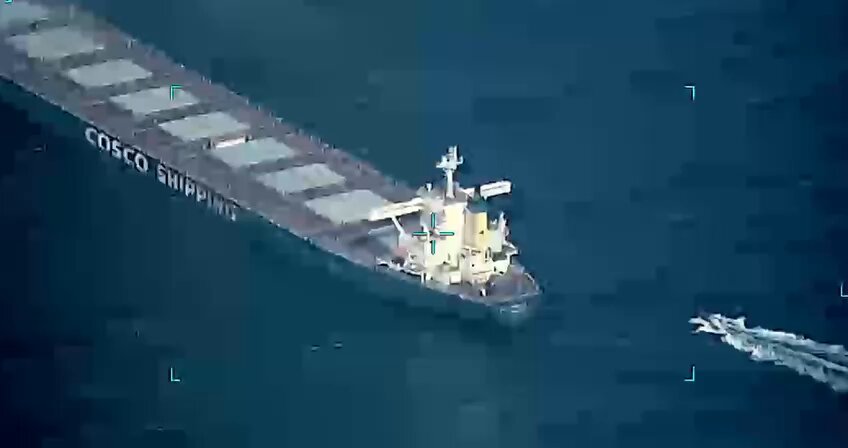
The Indian Navy approaches the M/V Lila Norfolk in the Indian Ocean, January 5, 2024. Photo courtesy Indian Navy

gCaptain reports,

“An Indian Navy warship intercepted the MV Lila Norfolk on Friday afternoon, less than a day after the navy received news that it had been hijacked off Somalia’s coast in the North Arabian Sea.”

The crew of 21 had taken shelter in a citadel. By the time the Indian Navy destroyer, INS Chennai, had arrived, the pirates had fled.

The MV Lila Norfolk “was kept under continuous surveillance using MPA (Maritime Patrol Aircraft–Chuck), Predator MQ9B & integral helos.

Notably, the Indian Navy is one of several users of the MQ-9B Sea Guardian Medium Altitude Long Endurance UAS including the Japan Coast Guard, the UK, Taiwan, and Greece. The US Coast Guard after years of observation of Customs and Border Protection’s use of earlier model MQ-9 Predators, the USCG has yet to procure or even experiment with a shore based long endurance UAS.

“Allies, partners tap into technology to monitor maritime domain” –Indo-Pacific Defense Forum

Winkel Tripel projection, WGS84 datum, central meridian : 150°E. Source Wikipedia Commons, Author: Eric Gaba

The Indo-Pacific Defense Forum reports,

“Maritime domain awareness (MDA) in the Indo-Pacific is moving from an abstract aspiration to a functional collective security approach for managing the region’s dynamic offshore spaces,” noted an April 2023 article in PacNet, a publication of Pacific Forum, a Hawaii-based foreign policy research institute. “Much of the cost-savings in maritime enforcement activities is due to emerging technologies including access to satellites that provide clearer and more accurate images, as well as artificial intelligence and big data platforms dedicated to vessel tracking, prediction, and anomaly detection.”

There are fusion centers in India, Singapore and Vanuatu. These fusion centers would be useful in wartime, but they are essentially a cooperative exchange of information among maritime law enforcement agencies. In addition to its importance in countering IUU and drug smuggling, better maritime domain awareness may give warning of a terrorist attack. Shouldn’t the US Coast Guard have a fusion center in Alameda under Pacific Area? Probably should be one on the West coast of South America too.

“C4F’s Hybrid Fleet Completes Target Detection Test” –4th Fleet

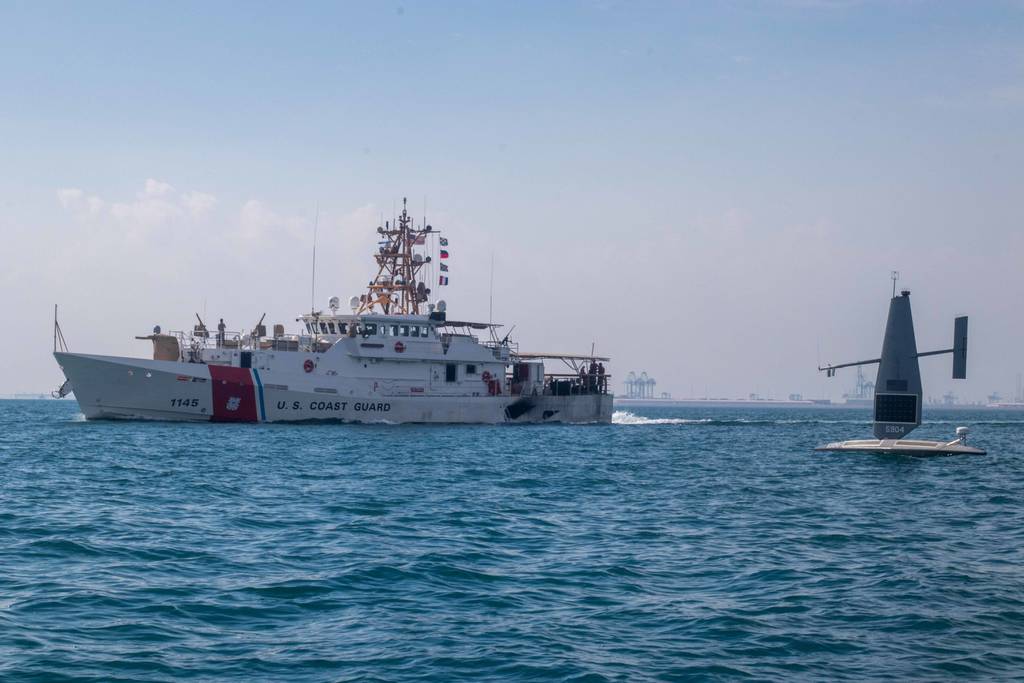
A Saildrone Explorer unmanned surface vessel operates alongside U.S. Coast Guard fast response cutter USCGC Emlen Tunnell (WPC 1145) in the Arabian Gulf, Nov. 29, during Digital Horizon 2022. (Sgt. Brandon Murphy/US Army)

Below is a 4th Fleet News Release. This development will have obvious impact on Coast Guard drug and alien migrant interdiction efforts. This is a result of extending experimentation with unmanned systems to 4th Fleet in much the same way it was done in 5th fleet.


 Oct. 17, 2023

C4F’s Hybrid Fleet Completes Target Detection Test

By USNAVSOUTH/4TH FLEET PUBLIC AFFAIRS

Joint Interagency Task Force South (JIATF-South) and Saildrone successfully completed an evaluation of the unmanned surface vessel Saildrone Voyager’s radar and electronic sensors against surface targets in the vicinity of Key West September 29, 2023.

Part of U.S. 4th Fleet’s campaign to inform the hybrid fleet, the evaluation looked at how many Saildrones the fleet would need to cover a given area of water and optimize the probability that the Saildrones would detect suspected drug runners at sea.

“This successful detection test is the completion of one small step in our campaign to inform the hybrid fleet,” said Capt. David Fowler, U.S. 4th Fleet’s Maritime Operations Center Director. “This is the type of testing and development that we can conduct even as we move toward continuous hybrid operations in the Caribbean.”

Right now continuous operations are underway with Operation Windward Stack. The U.S. 4th Fleet operation deploys long-dwell Saildrone unmanned surface vessels (USVs) to the Windward Passage in the Caribbean order to operationalize the combination of unmanned and manned systems in normal day-to-day operations.

In the coming months, other long-dwell USVs, interceptor USVs, long range UAVs, and VTOL UAVs will join the Saildrones in Operation Windward Stack. These systems will combine with traditional naval surface vessels to expand maritime domain awareness (MDA) and define combinations of unmanned and manned forces that work best for specific operations.

U.S. Naval Forces Southern Command/U.S. 4th Fleet supports U.S. Southern Command’s joint and combined military operations by employing maritime forces in cooperative maritime security operations to maintain access, enhance interoperability, and build enduring partnerships in order to enhance regional security and promote peace, stability and prosperity in the Caribbean, Central and South American region.

Learn more about USNAVSOUTH/4th Fleet at https://www.fourthfleet.navy.mil, https://www.facebook.com/NAVSOUS4THFLT and @NAVSOUS4THFLT.

“Ecuador combats Chinese fleet’s illegal fishing with Canadian satellite technology” –Indo-Pacific Defense Forum

Indo-Pacific Defense Forum reports,

The Ecuadorian government is using Canadian technology to monitor the Chinese fleet’s illegal, unreported and unregulated (IUU) fishing around the Galápagos Islands.  In early June 2022, the government detected 180 Chinese vessels near the islands’ exclusive economic zone (EEZ), fishing for large Humboldt squid and threatening the region’s biodiversity and economy.

The Ecuadorian Navy patrols to prevent illicit fishing in the protected zone. “As long as these vessels are far from the insular EEZ, more than 100 miles [more than 160 kilometers] away, we monitor them by satellite,” Ecuadorian Navy Rear Adm. John Merlo León, commander of naval operations, told Ecuadorian television network Teleamazonas.

Reportedly, Ecuador uses both space technology company MDA, based in Brampton, Ontario, to provice satellite tracking, remote sensing and the ability to synthesize large amounts of data and Global Fishing Watch, a Google-backed website that tracks commercial fishing and interprets vessel movements, including fishing in prohibited areas.

“U.N. campaign targets illicit fishing” –Indo-Pacific Defense Forum

A picture taken on November 16, 2011 from a South Korean helicopter shows Chinese fishermen wielding sticks to stop an attack by South Korean coastguard commandoes armed with clubs aboard rubber boats during a crackdown on alleged illegal fishing in South Korean waters in the Yellow Sea off the southwestern coast county of Buan. South Korea’s coastguard mobilised 12 ships, four helicopters and commandoes for a special three-day crackdown on illegal fishing by Chinese boats this week. REPUBLIC OF KOREA OUT AFP PHOTO / DONG-A ILBO (Photo credit should read DONG-A ILBO/AFP/Getty Images)

The Indo-Pacific Defense Forum reports that today is the United Nations’ “International Day for the Fight Against Illegal, Unreported and Unregulated Fishing.”

The humanitarian and economic fallout of illicit fishing is significant in the Indo-Pacific and elsewhere. Each year it deprives the world’s oceans of 11 million to 26 million metric tons of fish and other seafood worth an estimated U.S. $10 billion to $23 billion.

IUU fishing accounts for 1 in 5 fish caught worldwide, the U.N. Food and Agriculture Organization (FAO) reports.

The short report provides an overview of the problem, identifies the Chinese fishing fleet and the most agrediuous perpetrator, and discusses what is being done to address the problem.

One of the recent steps taken is the Indo-Pacific Partnership for Maritime Domain Awareness (IPMDA) discussed here. Perhaps an additional step could be something like my proposal for a Combined Maritime Security Task Force.

“Obangame Express 2022 Promotes Cooperation To Fight Sea Crime” –ADF Magazine

Members of the U.S. Navy share critical care techniques with the Senegalese Navy during Obangame Express 2022. U.S. NAVY

I got a reminder that the Obangame Exercise 2022 had concluded (Brazil sent an OPV), so I went looking for some information about possible Coast Guard participation. I found none, although I feel sure at least some special teams were involved.

This report from AFRICOM’s African Defense Forum does include an interesting note,

One important element of the exercise is practicing the use of SeaVision, a maritime domain awareness tool that helps professionals in the operations center track vessels at sea. Created in 2012 by the U.S., this tool is used by about 25 African countries to monitor their waters.

Is this system system something the Coast Guard uses? Is it used by our friends in Latin America? SE Asia? Sounds interesting.

“Predicting illegal fishing activity is tip of the iceberg for mature AI technology” –BAE

BAE Systems technology applies machine learning analytics to automate low-level detection of activities of interest, such as fishing, from available data streams.

Below is a company press release, but it is an interesting one, with relevance to Coast Guard missions. The Obangame Express Exercise is one the Coast Guard has participated in, in the past. More info on the exercise here and here.


BAE Systems technology applies machine learning analytics to automate low-level detection of activities of interest, such as fishing, from available data streams.

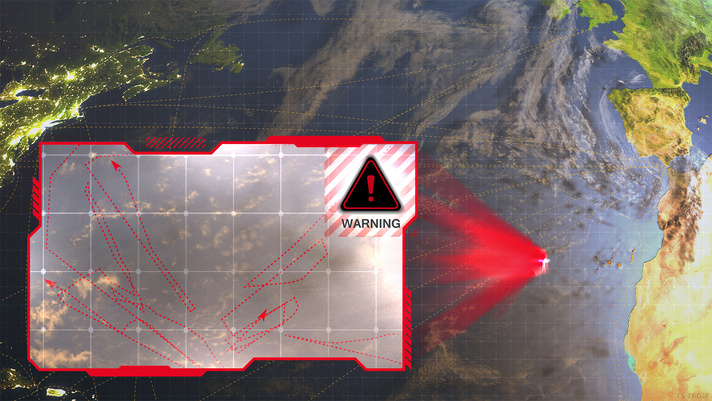
The old “finding a needle in a haystack” analogy doesn’t begin to articulate the challenge associated with illegal fishing detection and identification. While a ship may be larger than a needle, the ocean is certainly larger than your biggest haystack. Add the need to not only find the ship, but determine its recent activities, anticipate future movements, and compare them with all other ships in the area — and do it in near real-time using open source data feeds.

At the Obangame Express event, which is the largest multinational maritime exercise in Western Africa, BAE Systems’ Multi-INT Analytics for Pattern Learning and Exploitation (MAPLE) as a Service, MaaS for short, was integrated with SeaVision, the U.S. Navy’s premier tool for unclassified interagency and coalition maritime data sharing. SeaVision is a maritime situational awareness tool that ingests maritime vessel position data from various government and commercial sources and simultaneously displays them on the same screen in a web browser.

“Military organizations use illegal fishing as a model application due to the unclassified nature of the available data,” said Neil Bomberger, chief scientist at BAE Systems’ FAST LabsTM research and development organization. “Successful detection of illegal fishing activity helps address a serious challenge and highlights another use case for our mature artificial intelligence technology.”

Giving depth to data

While manual analysis of individual vessel tracks is possible, it gets exponentially more challenging and time-consuming for large numbers of vessels. BAE Systems technology applies machine learning analytics to automate low-level detection of activities of interest, such as fishing, from available data streams. This enables analysts to quickly answer time-sensitive questions, prioritize manual data analysis activities, identify higher-level trends, and focus on decision-making instead of manual data analysis.

During the event, BAE Systems’ MaaS technology processed streaming data and automatically detected vessel behavior events that SeaVision displayed as an additional data layer to support user-friendly and timely analysis. The technology provides full visibility into the data to allow the users to check whether the detected behavior warrants further investigation. This helps build trust in the automation and supports additional analysis.

Decades in the making

BAE Systems’ FAST Labs maritime sensemaking capabilities are rooted in artificial intelligence and machine learning algorithms. Backed by nearly two decades of development, their behavior recognition and pattern analysis capabilities continue to show significant utility in real-world environments.

The cloud-based artificial intelligence technology was matured via work on the Geospatial Cloud Analytics (GCA) program. In the months since the successful event, the FAST Labs organization has continued to develop and mature its autonomy portfolio. Elements of its autonomy technology have proven successful in multiple domains including air, land, and sea.

“This successful event delivers on the promise of mature artificial intelligence technology – easy to integrate, incorporating trust, and providing fast and actionable information in a real-world scenario,” continued Bomberger. “The event showcased how our artificial intelligence technology can be deployed in a cloud environment, integrated with a government tool, and used to address relevant maritime activities.”

“Coast Guard issues warning to mariners turning off AIS” –D13 News Release

Below is a D13 news release. In addition to the normal law enforcement and SAR aspects of AIS use, It is also an essential element of our Maritime Domain Awareness efforts. When a contact is detected without AIS, we may have to make an identification. If we want to know what is approaching our ports, we need vessels to use AIS, so we don’t have to physically sight every vessel. 

united states coast guard

News Release

U.S. Coast Guard 13th District PA Detachment Astoria
Contact: Coast Guard PA Detachment Astoria
Office: (503) 861-6380
After Hours: (206) 819-9154
PA Detachment Astoria online newsroom

Coast Guard issues warning to mariners turning off AIS

Petty Officer 2nd Class Enrique Lemos operates in the surf near Winchester Bay, Oregon

Editors’ Note: Click on image to download high resolution version.

ASTORIA, Ore. — The Coast Guard is issuing a warning to mariners and commercial fisherman about the dangers and legal consequences of disabling a vessel’s Automated Identification System.

The Coast Guard has seen an alarming increase of commercial fishing and crabbing vessels disabling their AIS, purportedly in an attempt to keep their fishing spots secret from competition.

“AIS is a vital tool in a host of Coast Guard missions including Search and Rescue and Port Security,” said Lt. Collin Gruin, boarding team supervisor at Coast Guard Sector Columbia River. “It’s not only illegal to turn it off but also incredibly dangerous.”

AIS is a maritime navigation safety communications system adopted by the international community to help save lives and facilitate safe transit of navigable waterways.

AIS automatically transmits vessel information to shore stations, other ships, and aircraft. That includes vessel identity, type, position, course, speed, navigational status, and safety-related information.

The regulation (33 CFR 164.46) in part states that all self-propelled vessels, at a length of 65-feet or more, engaged in commercial service and operating on the Territorial Seas (within 12-nautical miles of shore) must maintain AIS in effective operating condition, which includes the continual operation of AIS and its associated devices (e.g., positioning system, gyro, converters, displays) at all times while the vessel is underway or at anchor, and, if moored, at least 15 minutes prior to getting underway. Effective operation condition also includes the accurate input and upkeep of all AIS data fields; an AIS encoding guide has been provided to facilitate complying with this requirement.

Violators of this regulation can expect to receive a civil penalty up to a maximum of $35,486 per violation.

“Crabbers may think that they are protecting their businesses, but they are actually making search and rescue efforts more difficult if an emergency happens at sea,” said Gruin.