“Coast Guard Cutter conducts DPRK sanctions patrol” –News Release

A small unmanned aircraft system operator recovers an sUAS (Scan Eagle–Chuck) after a flight from Coast Guard Cutter Stratton in the South China Sea Sept. 16, 2019. The sUAS is capable of flying for more than 20 hours and has a maximum speed of about 60 mph. U.S. Coast Guard photo by Petty Officer 1st Class Nate Littlejohn.

Below is a news release regarding USCGC Stratton’s recent activities including those in support of UN sanctions against North Korea. For some time, I thought we might have a role in this. Apparently we still have not done an at sea boarding to enforce sanctions. Boardings have been authorized by the UN. That may be the next step. I have linked some previous posts for background.

In two of the photos below, the Stratton is being shadowed by China Coast Guard vessels. The one seen on the left, in the picture with Stratton’s 11 meter boat is one of the new Type 818 cutters are based on the Type 054 frigates, this class cutter is also discussed here. The China CG cutter seen in the photo right center is, I believe, one of their 12,000 ton cutters, the largest in the world. This class is discussed here, with updates in the comments. It appears to be missing the twin 76mm gun seen earlier on this class.

united states coast guard

News Release

Oct. 24, 2019
U.S. Coast Guard Pacific Area
Contact: Coast Guard Pacific Area Public Affairs
Office: (510) 437-3319
After Hours: (510) 333-6297
D11-DG-M-PACAREA-PA@uscg.mil
Pacific Area online newsroom

Coast Guard Cutter conducts DPRK sanctions patrol

Coast Guard Cutter Stratton arrives in Philippines after Yellow Sea UNSCR enforcement patrol
Coast Guard Cutter Stratton conducts Yellow Sea UNSCR enforcement patrol Coast Guard Cutter Stratton conducts Yellow Sea UNSCR enforcement patrol Coast Guard Cutter Stratton conducts Yellow Sea UNSCR enforcement patrol
Coast Guard Cutter Stratton crew conducts operations in South China Sea Coast Guard Cutter Stratton crew conducts operations in South China Sea Coast Guard Cutter Stratton conducts Yellow Sea UNSCR enforcement patrol
Coast Guard Cutter Stratton conducts Yellow Sea UNSCR enforcement patrol Coast Guard Cutter Stratton crew conducts operations in South China Sea Coast Guard Cutter Stratton crew conducts operations in South China Sea

Editors’ Note: Click on images to download high resolution version.

PUERTO PRINCESA, Philippines —The U.S. Coast Guard Cutter Stratton (WMSL 752) pulled into Puerto Princesa October 14, for Maritime Training Activity (MTA) Sama Sama following operations in the Yellow Sea where the crew supported United Nations Security Council Resolution (UNSCR) enforcement against illicit ship-to-ship transfers that violate sanctions against the Democratic People’s Republic of Korea (DPRK).

The operations are a part of the United States’ ongoing contribution to international efforts in combatting DPRK’s maritime sanctions evasion activity. Ship-to-ship transfers of fuel and goods, like coal, going to and from DPRK are prohibited under the UNSCR.

Stratton personnel captured imagery of suspected illicit ship-to-ship transfers and conducted routine activities to detect, deter, and disrupt activities in violation of UNSCR.

Maritime Training Activity (MTA) Sama Sama is a maritime exercise designed to promote regional security cooperation, maintain, and strengthen maritime partnerships and enhance maritime interoperability. This is the first year the Japanese Maritime Defense Force will participate alongside U.S. and Philippine navy counterparts.

The exercise will consist of both shore-based and at-sea activities designed to allow participating navies to advance the complex maritime training utilizing diverse naval platforms and operating areas.

The U.S. Coast Guard has an enduring role in the Indo-Pacific, going back over 150 years. The service’s ongoing deployment of resources to the region directly supports U.S. foreign policy and national security objectives in the Indo-Pacific Strategy and the National Security Strategy.

As both a federal law enforcement agency and an armed force, the U.S. Coast Guard is uniquely positioned to support combatant commanders on all seven continents. The service routinely provides forces in joint military operations worldwide, including the deployment of cutters, boats, aircraft and deployable specialized forces.

“All of Stratton’s operations are designed in accordance with international law and demonstrate that the United States will fly, sail, and operate wherever international law allows,” said Capt. Bob Little, Stratton’s commanding officer. “That is as true in the South and East China Seas, as in other places around the globe. Our efforts in support of enforcing U.N. Security Council Resolutions in the Yellow Sea demonstrate that commitment.”

-USCG-

“Coast Guard Cutter Procurement: Background and Issues for Congress” –CRS, October 16, 2019, A New Version Only Five Days After the Last

Congressional Research Service has again updated their review of the Coast Guard’s Cutter acquisition programs and the changes are significant. You can see it here.

Again the significant changes begin on page 8, with the section labeled “October 2019 Announcement of Contractual Relief and Follow-on Competition.” It looks at the authority for contract relief. It goes on to discuss the “60-Day Congressional Review Period That Started on October 11” on page 9. This is followed by quotation of various press reports about the decision through page 11. Discussion of the OPC resumes on page 14 in the “Issues for Congress” section under the title, “Contractual Relief and Follow-on Competition for OPC Program.” These include questions that might be asked during the 60 day Congressional Review period. This continues through page 16

It quotes the Commandant as saying, “the first ship now delayed 10 to 12 months and the three subsequent ships about nine to 10 months each from that point,” and that “If DHS decided to reopen the competition immediately, that would probably mean a three year delay before a new vendor delivers the first OPC.” (I expect a minimum of four years.) and “If another vendor is selected through a re-competition, it’s unlikely the new shipbuilder would be tasked with building multiple ships per year immediately, Schultz said.”

The Coast Guard’s rights to Eastern’s OPC design data are discussed. My position would be that relief should be granted only if Eastern conveyed rights to all design data to the Coast Guard upon final grant of contract relief. 

The possibility of procuring a twelfth National Security as a means of ameliorating the effects of the delays to the OPCs program was discussed on page 17. (It is not addressed here, but delays in the OPC program also argue strongly for fully funding the FRC fleet to 64 units.)

The form of the follow-on contract, either annual or multi-year, was discussed on page 17 and 18. (A block buy could encourage more competition, offering stable work and to a degree offsetting Eastern’s learning curve edge in a re-compete, possibly resulting savings that might approach $1B.)

OPC procurement rate is addressed on pages 18 and 19. This question was raised in all previous editions of the report, but may gain additional urgency because of the delays associated with contract relief and because the program was supposed to transition from one ship per year to two ships per year with OPC #4 and #5 in FY2021.

If I had my druthers, we would fund NSC#12 in addition to OPC#3 in FY2020, then in FY2021 award two block buy contracts for ten ships each over five years (1, 2, 2, 2, 3) to two different shipyards. Assuming award near the end of FY2021 we might have all 20 plus the four currently planned from Eastern by the end of FY2029, five years earlier than previously planned. That could mean the last 270 would only be 38 years old when decommissioned, and we might not need to do as much work on old ships to keep the operational. That would give us 36 large ships (12 NSCs and 24 OPCs), more than the original Program of Record. That would mean funding three OPCs in FY2021, one to Eastern and one to each of the two new shipyard contracts.

“Appendix E. Impact of Hurricane Michael on OPC Program at Eastern Shipbuilding Group (ESG)” provides additional background on the decision to provide contract relief.

Incidentally, on page 20, the House Appropriations Committee is reported to have recommended funding five FRCs in FY2020 and on page 21 the Senate Appropriations Committee is reported to have recommended funding four FRCs instead of the two requested by the administration.

“Coast Guard Cutter Procurement: Background and Issues for Congress” –CRS, October 11, 2019

Busy as always, the Congressional Research Service has already updated their examination of the Coast Guard’s cutter procurement program to reflect the results of the contract relief extended to Eastern Shipbuilding Group (ESG) and the intention to re-compete for contracts to construct OPC#5 and later. You can see the new report here. 

Significant changes are found on pages 8-10 under the title “October 2019 Announcement of Contractual Relief and Follow-on Competition,” and pages 13-15 under the title “Issues for Congress–Contractual Relief and Follow-on Competition for OPC Program.”

Delays in the execution of the OPC program might be seen as justification for NSC#12 particularly if it is seen as a trade-off for a future OPC.

Not new to this edition, but looking at “Table 1. NSC, OPC, and FRC Funding in FY2013-FY2020 Budget Submissions” on page 13, raises a question about how many Webber class FRCs are to be built. The Program of Record is 58, but this did not include replacements for the six vessels assigned to Patrol Forces SW Asia. Adding six for PATFORSWA should bring the total to 64. So far 56 Webber class have been funded, including four to replace 110 foot patrol boats assigned PATFORSWA. There is $140M in the FY 2020 budget request, which would fund two more, but there are insufficient funds in the out years to fund even a single additional FRC. This appears to mean the program will end with a total of 58 vessels unless Congress steps in.


Coast Guard Commander Craig Allen talks about challenges with national security cutter connectivity.

HMAS Success (AOR-304) refuelling probe goes in for a hook-up with the US Coast Guard Cutter USCGC Waesche (WMSL-751) as the Royal Australian Navy Auxilliary Oiler Replenishment Ship conducts a dual RAS (Replenishment at Sea) off the coast of Hawaii during the Sea Phase of Exercise RIMPAC 2014, 19 July 2014. (RAN Photo by Leading Seaman Brenton Freind RAN)

The 8 Aug. 2019 US Naval Institute podcast features Cdr. Craig Allen, currently XO of USCGC Waesche discussing the topic of his winning USNI Coast Guard Essay contest.

Despite the title, connectivity on other Coast Guard platforms was also discussed.

The discussion on cutter connectivity doesn’t actually start until about time 10:05. Earlier in the podcast they talk about the Midshipmen and Cadets Essay Contest (deadline 31 Oct. 2019).

He mentions specifically difficult to share UAS data and images. Even so it sounds like the most significant difficulty is that operational data is crowding out administrative data that now can no longer be done offline. 

Sounds like there are three paths that might be pursued that might ease the situation.

First of course is to increase band width, but if that were easy I presume it would have already been done.

There was not discussion of tactical data links, like Link 16, but this is one way to a common shared tactical picture. Reportedly Link16 “supports the exchange of text messages, imagery data and provides two channels of digital voice (2.4 kbit/s and/or 16 kbit/s in any combination).” I am pretty sure the NSC has Link 16, but most Coast Guard units including Webber class, aircraft, and District and Area Commands do not. Moving the tactical information to data links could free bandwidth for administrative tasks. In addition if we ever want our district and area commands to be able to call on DOD assets to respond to a terrorist attack, having access to data link could make it a lot easier.

Third, it sounds like we may have shot ourselves in the foot by eliminating previously acceptable ways to handle administrative matters. Sounds like we are forcing operational units to make it easy for administrative support units, instead of the other way around, as it should be. The extreme measures he describes as required to get the job done should be an embarrassment to the Coast Guard. The administrative system worked before internet. It can work without it. There are ways around these problems.

“Coast Guard Ramps Up in Hawaii with 2 New Ships” –Military.com

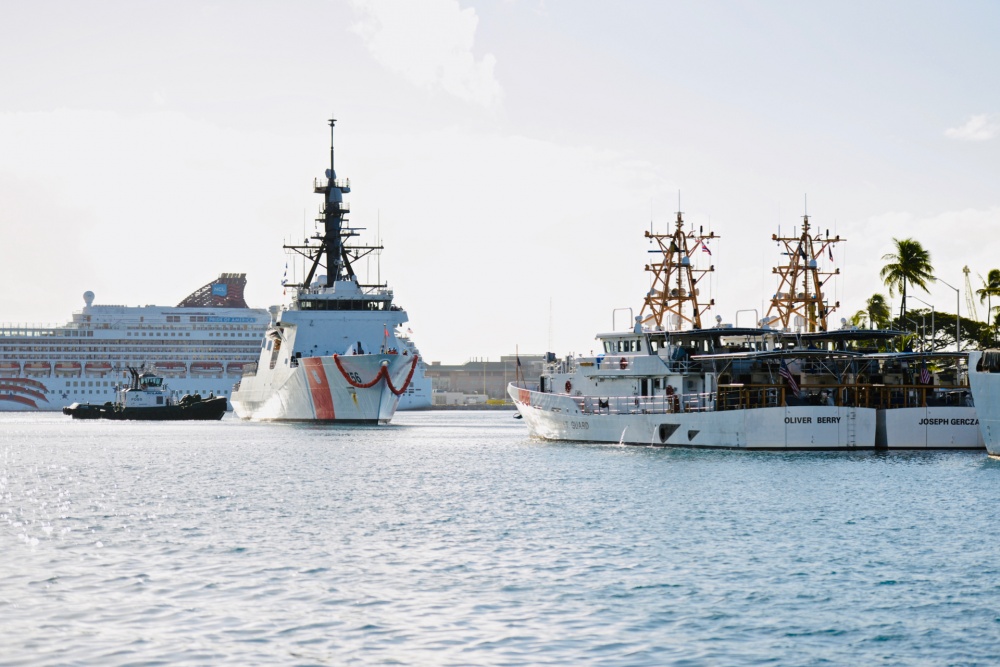
The crew of USCGC Kimball (WMSL 756) arrive in Honolulu for the first time Dec. 22, 2018. Known as the Legend-class, NSCs are designed to be the flagships of the Coast Guard’s fleet, capable of executing the most challenging national security missions, including support to U.S. combatant commanders. (U.S. Coast Guard photo by Chief Petty Officer Sara Muir/Released)

Military.com reports that 14th district is getting a second National Security Cutter, the Future USCGC Midgett arriving on Friday, Aug. 16 (to be commissioned along with Kimball Aug. 24 in a rare dual commissioning) and a third Webber class, the William Hart.

It also discusses the Coast Guard’s increased activity in the Western Pacific and Oceana.

NSC #11 to Go to Charleston

USCGC Stratton moored in San Diego, California. Photo by BryanGoff

The following is a Coast Guard HQ news release. It appears the final laydown for the NSC fleet is Charleston five, Alameda four, Honolulu two. I am a bit surprised more did not go to the Pacific but Charleston is closer to the Eastern Pacific drug transit zones than Alameda.

U.S. Coast Guard announces homeport of newest National Security Cutter

WASHINGTON – The U.S. Coast Guard today announced that Charleston, South Carolina will be the home of the Service’s newest National Security Cutter.

“I am pleased to announce that Charleston, South Carolina will be the home of the Coast Guard’s 11th National Security Cutter,” said Admiral Karl L. Schultz, Commandant of the Coast Guard. Construction on the 11th National Security Cutter is scheduled to begin by Spring of 2020. Charleston is already home to two of the Coast Guard’s National Security Cutters, the JAMES and HAMILTON. In 2017, the Coast Guard announced that the ninth and tenth National Security Cutters, currently under construction at Huntington Ingalls Shipyard in Pascagoula, Mississippi, will join the Charleston-based National Security Cutter fleet in the coming years. Admiral Schultz further noted: “I am confident that the Charleston community is the right place for our Coast Guardsmen and their families to base these highly capable National Security Cutters with the global reach to respond to complex maritime threats and challenges.”

National Security Cutters are the most technologically-advanced vessels in the Coast Guard. They are capable of supporting maritime homeland security and defense missions. They safeguard the American people and promote our security in a complex and persistently-evolving maritime environment.

Grouping cutters of the same class is one critical variable in selecting homeports. Grouping cutters in the same location improves maintenance proficiency, streamlines logistics, and provides increased personnel flexibility.

The cutter is scheduled to arrive in 2024; its name has not yet been selected. This will be the fifth National Security Cutter assigned to Charleston.

Stratton Goes To 7th Fleet, Waesche Goes South, All Four Alameda NSCs Underway

The Coast Guard Cutter Stratton passes underneath San Francisco’s Bay Bridge as Stratton and the crew depart on a months-long deployment to the Western Pacific in support of the U.S. Indo-Pacific Command, June 12, 2019. Operating under the tactical control of the U.S. 7th Fleet commander, Stratton and crew are scheduled to engage in professional exchanges and capacity-building exercises with partner nations in the Western Pacific and to patrol and operate as directed. U.S. Coast Guard photo by Petty Officer 1st Class Matthew S. Masaschi.

The following is a PACAREA press release 

ALAMEDA, Calif. – The Coast Guard Cutters Stratton and Waesche set sail Wednesday for months-long deployments to opposite ends of the Pacific. With their departure, all four of the national security cutters homeported in Alameda are currently on patrol.

The crew aboard the Waesche departed for a months-long deployment to the Eastern Pacific Ocean to conduct counterdrug operations. Earlier this year, Waesche returned to Alameda following a 95-day counterdrug patrol where the crew had two at-sea interdictions, seizing more than 6,300 pounds of cocaine.

Stratton deployed to the Western Pacific Ocean where the Alameda-based Coast Guard Cutter Bertholf has been since departing the Bay Area in January. Stratton will operate in support of U.S. Indo-Pacific Command, which oversees military operations in the Western Pacific.

Operating under the tactical control of U.S. 7th Fleet, Stratton is scheduled to engage in professional exchanges and capacity-building exercises with partner nations and to patrol and operate as directed.

“The Coast Guard’s deployment of resources to the Indo-Pacific directly supports the United States’ goal to strengthen maritime governance, safety, and security across the region, and we do that by working with, and learning from, our many partners and partner nations in the region,” said Vice Adm. Linda Fagan, commander, Coast Guard Pacific Area, who oversees the cutter.

“The United States is a Pacific nation, and the Coast Guard has been operating in the pacific for over 150 years. We have developed long-standing partnerships with nations in the region, and we share a strong commitment to a free and open Indo-Pacific governed by a rules-based international system that promotes peace, security, prosperity, and the sovereignty of all nations.”

As both a federal law enforcement agency and an armed force, the Coast Guard is uniquely positioned to conduct defense operations in support of combatant commanders on all seven continents. The service routinely provides forces in joint military operations worldwide, including the deployment of cutters, boats, aircraft and deployable specialized forces.

“We are a military service, we are also a law enforcement organization, a regulatory agency, a first response agency, and a member of the intelligence community,” said Fagan. “We are at all times a military force and at all times a law enforcement force. This duality of our authorities provides an incredible degree of flexibility and access and authority. The Coast Guard’s distinct authorities and missions means that we provide a mix of expertise and capabilities that no other U.S. agency can.”

Coast Guard Island in Alameda is the homeport to four Coast Guard legend class national security cutters. NSCs are 418-feet long, 54-feet wide, and have a 4,600 long-ton displacement. They have a top speed in excess of 28 knots, a range of 12,000 nautical miles, endurance of up to 90 days and can hold a crew of up to 170. These multi-mission cutters and crew are capable of operating from the Bering Sea to the Eastern Pacific Ocean to the South China Sea.

National security cutters feature advanced command and control capabilities, aviation support facilities, stern cutter boat launch and increased endurance for long-range patrols enabling the crews to disrupt threats to national security further offshore.

The Coast Guard is scheduled to commission its seventh and eighth national security cutters, the Coast Guard Cutters Kimball and Midgett, in August. Both cutters will be homeported in Honolulu and enhance the Coast Guard’s presence throughout the Indo-Pacific region.

Future USCGC Midgett Underway

Just wanted to pass this along because the ship looked so good in the video. Future USCGC Midgett (WMSL-757) is headed to her planned homeport in Honolulu. She is to be commissioned in August.

This does not mean the current USCGC Midgett (WHEC-726) will be decommissioned before the new Midgett is commissioned. In fact WHEC-726 has already been renamed USCGC John Midgett. We had a similar situation when the new USCGC Munro was commissioned while USCGC Munro (WHEC-724) continued to serve.

(Incidentally there was a Navy destroyer escort named after Munro, USS Douglas A. Munro (DE-422).)

Thanks to Lee for bringing the video to my attention. 

MAD-FIRES –Multi-Azimuth Defense Fast Intercept Round Engagement System

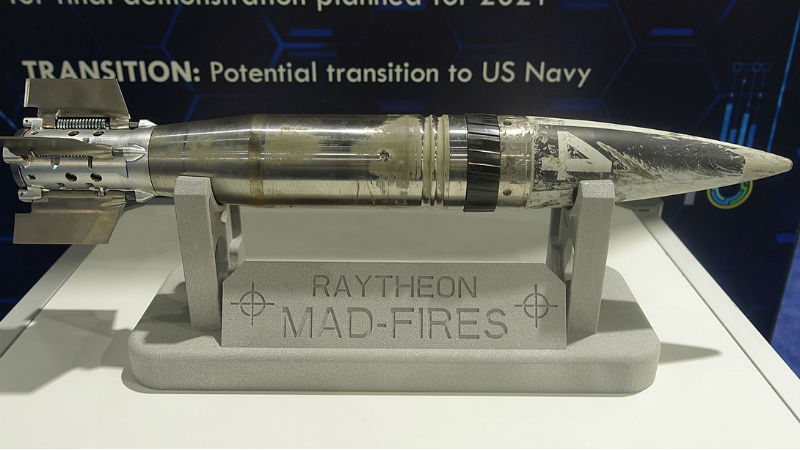
DARPA is working on what is essentially a gun launched guided missile, and reading their description or this report of testing of the rocket motor, you would not know that it is intended for the 57mm Mk110 gun currently mounted on the National Security Cutters (NSC) and planned for the Offshore Patrol Cutter (OPC). Fortunately the video above makes that clear. The portion related to MAD-FIRES is time 6:30 to 7:35. (I have seen some indications they plan to use the same technology on different size rounds, but the 57mm looks like the first beneficiary.)

“Envisioned benefits of MAD-FIRES for future systems include:

  • “Improved real-time defense against evolving air and surface combat threats, facilitated by:
    • “Extreme precision
    • “An ability to defend against greater numbers of simultaneous and diverse attacks
  • “Decreased per-engagement costs by a factor of 10 or more
  • “Potential future applicability to air and ground platforms”

MAD-FIRES Projectile. Photo by Dederot

Coast Guard Cutter Procurement: Background and Issues for Congress, Updated May 22, 2019

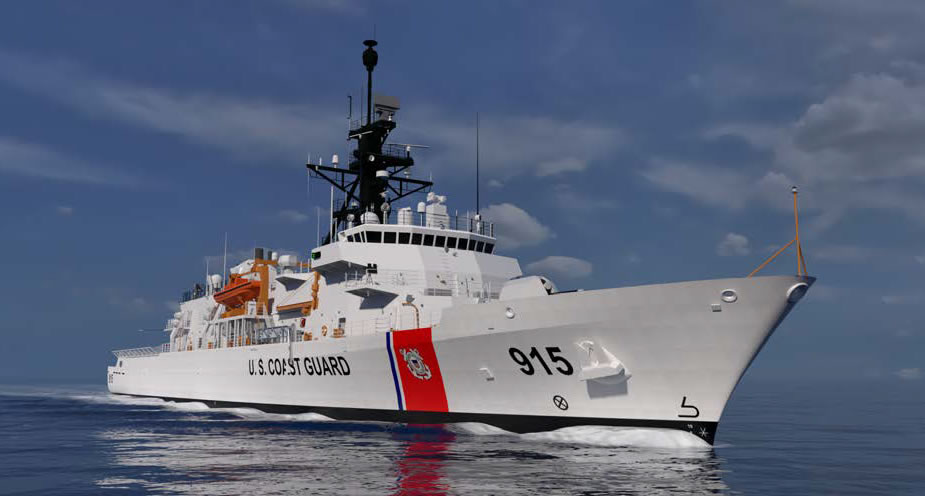
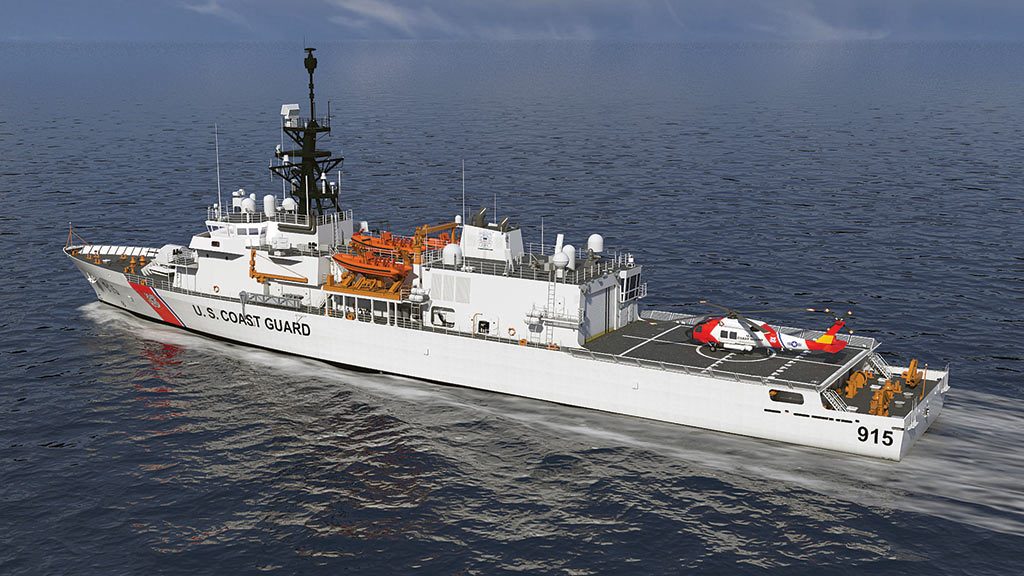
Offshore Patrol Cutter future USCGC ArgusThe Congressional Research Service has once again updated their look at Coast Guard Cutter procurement.

I have quoted the summary below and will comment on some of the questions.

The Coast Guard’s program of record (POR) calls for procuring 8 National Security Cutters (NSCs), 25 Offshore Patrol Cutters (OPCs), and 58 Fast Response Cutters (FRCs) as replacements for 90 aging Coast Guard high-endurance cutters, medium-endurance cutters, and patrol craft. The Coast Guard’s proposed FY2020 budget requests a total of $657 million in procurement funding for the NSC, OPC, and FRC programs.

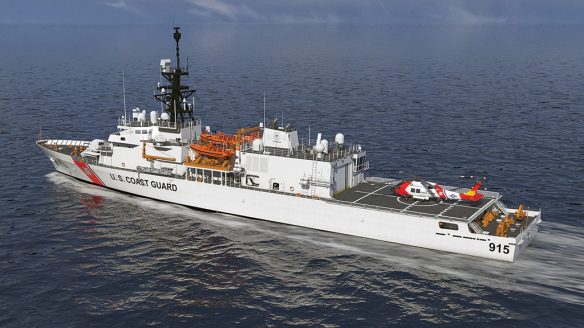
NSCs are the Coast Guard’s largest and most capable general-purpose cutters; they are intended to replace the Coast Guard’s 12 aged Hamilton-class high-endurance cutters. NSCs have an estimated average procurement cost of about $670 million per ship. Although the Coast Guard’s POR calls for procuring a total of 8 NSCs to replace the 12 Hamilton-class cutters, Congress through FY2019 has funded 11 NSCs, including the 10th and 11th in FY2018. Six NSCs have been commissioned into service. The seventh was delivered to the Coast Guard on September 19, 2018, and the eighth was delivered on April 30, 2019. The ninth through 11th are under construction; the ninth is scheduled for delivery in 2021. The Coast Guard’s proposed FY2020 budget requests $60 million in procurement funding for the NSC program; this request does not include funding for a 12th NSC.

OPCs are to be smaller, less expensive, and in some respects less capable than NSCs; they are intended to replace the Coast Guard’s 29 aged medium-endurance cutters. Coast Guard officials describe the OPC program as the service’s top acquisition priority. OPCs have an estimated average procurement cost of about $421 million per ship. On September 15, 2016, the Coast Guard awarded a contract with options for building up to nine OPCs to Eastern Shipbuilding Group of Panama City, FL. The first OPC was funded in FY2018 and is to be delivered in 2021. The second OPC and long leadtime materials (LLTM) for the third were funded in FY2019. The Coast Guard’s proposed FY2020 budget requests $457 million in procurement funding for the third OPC, LLTM for the fourth and fifth, and other program costs.

FRCs are considerably smaller and less expensive than OPCs; they are intended to replace the Coast Guard’s 49 aging Island-class patrol boats. FRCs have an estimated average procurement cost of about $58 million per boat. A total of 56 have been funded through FY2019, including six in FY2019. Four of the 56 are to be used by the Coast Guard in the Persian Gulf and are not counted against the Coast Guard’s 58-ship POR for the program, which relates to domestic operations. Excluding these four, a total of 52 FRCs for domestic operations have been funded through FY2019. The 32nd FRC was commissioned into service on May 1, 2019. The Coast Guard’s proposed FY2020 budget requests $140 million in acquisition funding for the procurement of two more FRCs for domestic operations.

The NSC, OPC, and FRC programs pose several issues for Congress, including the following: 

  •     whether to provide funding in FY2020 for the procurement of a 12th NSC;
  •  whether to fund the procurement in FY2020 of two FRCs, as requested by the Coast Guard, or some higher number, such as four or six;
  •  whether to use annual or multiyear contracting for procuring OPCs;
  •  the annual procurement rate for the OPC program;
  •  the impact of Hurricane Michael on Eastern Shipbuilding of Panama City, FL, the shipyard that is to build the first nine OPCs; and
  •     the planned procurement quantities for NSCs, OPCs, and FRCs.

Bertholf Class National Security Cutters (NSCs):

If there is going to be a 12th NSC, it almost certainly has to be funded this year. Future years will see the Polar Security Cutters and OPCs further crowding the budget. Frankly I see little to choose between the NSC and OPC for peacetime missions, but the replacement of the legacy fleet is becoming urgent and the price of the NSCs has decreased as funding became more regular, so a 12th might be reasonable. If we had started the OPC program earlier, it might have offered a lower cost alternative to additional NSCs, but we will not be ready to start multi-ship procurements of the OPCs until FY2021 and then only at the rate of two per year if we follow current planning.

Argus Class Offshore Patrol Cutters (OPCs):

There is probably good reason to accelerate the OPC program beyond the two per year currently planned to begin in FY2021. If we maintain that rate, the last 210 foot WMEC will not be replaced until 2028, the last 270 not until 2034. I expect we may see some catastrophic failures that will result in either sidelining ships or unacceptably high repair costs, before the program of record is complete.

The Coast Guard should plan on expediting testing of the first OPC so that production could move from the current contract with options to a true Multi-Year contract as soon as the design has proven successful.

We probably will need more than 25 OPCs. The Coast Guard has operated more than 40 cutters of more than 1,000 tons for decades. It seems likely we are going to need more than 36 total NSCs and OPCs. (See the discussion about the Fleet Mix Study below.)

Webber Class Fast Response Cutters (FRCs):

We are nearing the end of the Webber class program with 52 of the 58 program of record vessels, plus four additional vessels for Patrol Forces South West Asia (PATFORSWA), already funded. Buying only two for FY2020 raises the unit costs of these vessels. Congress has consistently increased purchases to four or even six per year when only two have been requested. Adding the final two additional FRCs intended to replace the 110s assigned to PATFORSWA would bring the total buy to four. That would leave only four to be purchased in FY2021 which could wrap up the funding. The question is, will Congress stop the program at the 64 vessels total when there may be justification for more?

Impact of Hurricane Michael: 

The Coast Guard budget is not the place to provide disaster relief for businesses. Maybe they have insurance. Maybe the state or Federal Government wants to provide aid, but renegotiating the contract for OPCs is not the way to do it. No way should it come out of the Coast Guard budget.

If on the other had we do renegotiate the contract, it is not to late to make it a “Block Buy.”

One solution might be for the contract to be converted to a block buy, using purchase amounts no more than current contract with options. That would assure the contractor and its creditor that they would have a steady stream of work. The contract might even have options for production of additional ships at rates higher than two per year.

We Need a New Fleet Mix Study:

The number of OPCs and FRCs actually required to fulfill Coast Guard statutory missions was examined in a fleet mix study (see pages 19 and 20 of the report) that found that the Program of Record (8 NSCs, 25 OPCs, and 58 FRCs) fell far short of the number of vessels required to meet all statutory requirements. Phase One of the study (2009) found that the total “objective” requirement was 9 NSCs, 57 OPCs, and 91 FRCs. Phase Two found that only 49 OPCs would be required but found the same requirements for NSCs and FRCs (see page 22).

The problem is that the analysis is getting pretty old and its assumptions were wrong. The Coast Guard will have at least 11 NSCs. The FRCs appear to be more capable than anticipated. Perhaps most importantly, the study assumed the NSCs and OPCs would use the “Crew Rotation Concept,” resulting in an unrealistic expectation for days away from homeport. From my point of view, the study failed to even consider the requirement to be able to forcibly stop a medium to large size ship being used as a terrorist weapon. None of our ships are capable of doing that reliably, and even our ability to stop small fast highly maneuverable ships under terrorist control is far from assured, even if the objective fleet were available.

The Procurement, Construction, and Improvements FY2020 budget request is about $1.2B. Adding NSC #12 and a pair of FRCs using the costs in the CRS report ($670M/NSC plus 2x$58M/FRC) which are probably high for the current marginal costs, would still leave the PC&I budget under the $2B/year the Coast Guard has been saying they need and about $250M less than the FY2019 PC&I budget.

For the Future:

While we are thinking about cutters, with the FRC program coming to an end, it is not too early to think about the 87 foot WPB replacement. I think there might be a  window to fund them after the third Polar Security Cutter if we have our requirements figured out. That means preliminary contracts such as conceptual designs have to be done during the same period we are building PSCs, e.g. FY2022 and earlier. .

To avoid always being constantly behind the power curve, as we have been for the last two decades, we really need a 30 year shipbuilding plan. The Navy does one every year. There is no reason the Coast Guard should not be able to do one as well. The Congress has been asking for a 25 year plan for years now, but so far no product.

Thanks to Grant for bringing this to my attention.