“India Rescues Iranian Fishing Vessel Hijacked By Pirates Off Somalia” –gCaptain

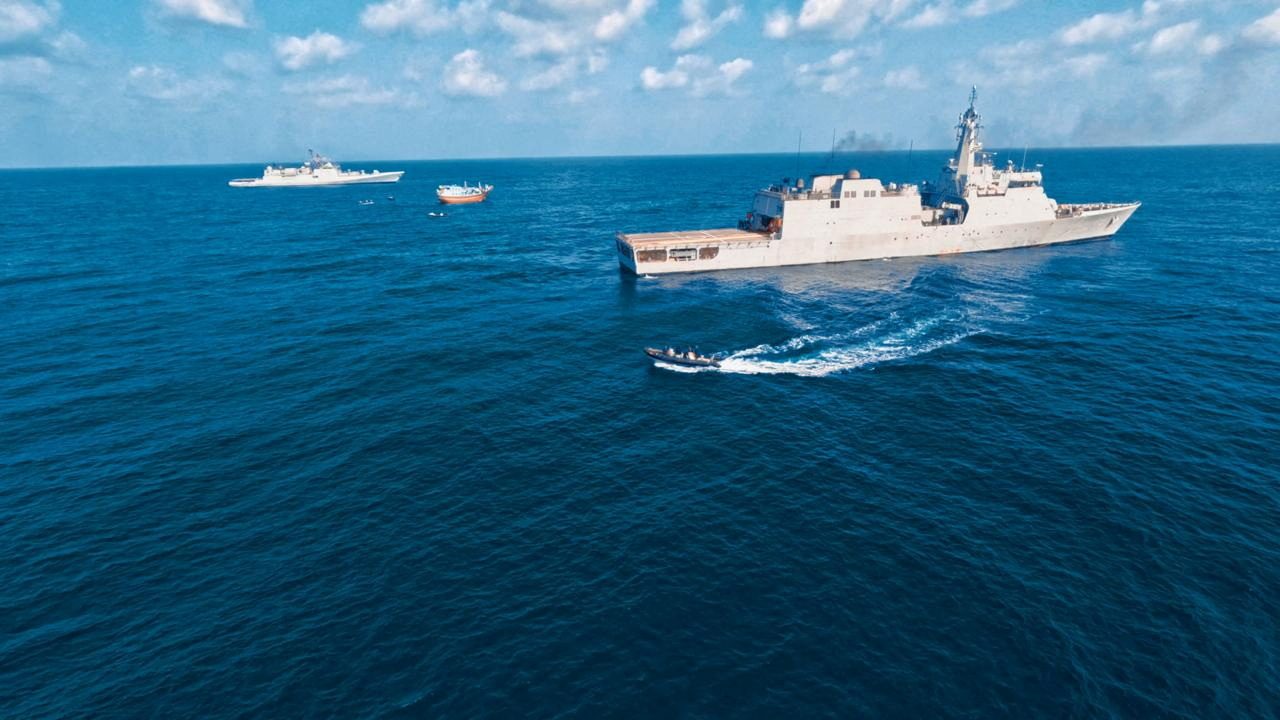
An Indian Navy carries out a rescue operation of an Iranian fishing vessel Al-Kambar 786 after it was seized by armed pirates off Somalia, in the Arabian Sea, according to a naval statement, in this handout photo released on March 30, 2024. SPOKESPERSONNAVY VIA X/Handout via REUTERS

gCaptain reports,

The Indian Navy said it had freed the 23-strong crew of an Iranian fishing vessel which was seized by armed pirates off Somalia….The vessel was intercepted by the navy’s INS Sumedha and INS Trishul, leading to “over 12 hours of intense coercive tactical measures” forcing the pirates to surrender…”

INS Sumedha (foreground in the photo above) is a Saryu-class 105 meter (344′) offshore patrol vessel, and was the first Indian vessel on scene.

Interestingly, the 23 member crew of this Iranian fishing vessel were all Pakistani nationals.

“Indian Navy Repels 3 Somali Pirate Hijackings” –USNI

INS Sumitra during her trials, 27 August 2014, Indian Navy photo.

The US Naval Institute News Service reports.

The Indian Navy thwarted three hijackings by Somalian pirates in a two-day period from Sunday to Monday, with one warship rescuing separately two hijacked ships off the east coast of Somalia, while a second ship participated in a multinational operation with Sri Lanka and the Seychelles to rescue a hijacked ship, according to releases by the service.

So, what was this hero warship? — An Indian Navy counterpart of a USCG medium endurance cutter, like a WMEC 270 but a little larger, faster. and a lot newer.

INS Sumitra (P-60) is one of six Saryu class offshore patrol vessel, four for the Indian Navy and two for the Sri Lanka Navy.

(It is not the Indian Navy OPV pictured in the X report included in the USNI report. That is INS Sharda (P-55) commissioned in 1991, which participated in the third rescue. Also much like a WMEC270, only slightly larger, faster, and newer.)

Ships of the Saryu class displace 2,230 tons full load, are 344′ (105 m) in length, with a beam of 42′ (12.9 m), a draft of 16′ (4.9 m). They have two engines producing 21,428 HP (15,979 kW) (1,908 HP more than the OPC) for a speed of 25 knots. They have an endurance of 6,000 nmi at 16 knots, with a crew of 118. They are armed with a 76mm gun and two 30mm guns.

We seem to be seeing a reemergence of Somali pirates. When Somali piracy was at its height, the US Navy was using Burke class destroyers, about four times larger, to do the same sort of thing INS Sumitra did. Even the National Security Cutters and OPCs are twice as large.

I suspect that the new Fleet Mix Study, which has not been made public (why?) would show that the Coast Guard needs more patrol cutters with aviation facilities and more endurance than the FRCs. Currently, we have 38 large patrol cutters, 1000 tons and larger. The program of record will leave the Coast Guard with 36, all 4,500 tons or larger.

This is, I believe, the smallest number of large patrol cutters the Coast Guard has had since at least 1948. Yes, we might build more than 25 OPCs, but we might do well to trade off some of the out year OPC construction for more numerous smaller vessels about the size of INS Sumitra. It would be especially useful if we could start getting them ASAP, at least before 2038 when the last OPC is due. We might be able to build one OPC and two MECs annually for about the same cost as two OPCs. Of course, total operating costs would probably be higher.

“U.S. Navy Seizes Attackers Who Held Israel-Linked Tanker” –Real Clear Defense

In an undated photo released by Zodiac Maritime, the tanker Central Park is seen. Attackers seized the tanker linked to Israel off the coast of Aden, Yemen, on Sunday, Nov. 26, 2023, authorities said. While no group immediately claimed responsibility, it comes as at least two other maritime attacks in recent days have been linked to the Israel-Hamas war. (Zodiac Maritime via AP)

Real Clear Defense reports,

“Armed assailants seized and later let go of a tanker linked to Israel off the coast of Yemen on Sunday before being apprehended by the United States Navy, officials said. Two ballistic missiles fired from Houthi-controlled Yemen then landed near a U.S. warship aiding the tanker in the Gulf of Aden, raising the stakes amid a series of ship attacks linked to the Israel-Hamas war.”

“Indonesia, Malaysia, Philippines renew commitment to cooperation” –Indo-Pacific Defense Forum

Coast guard leaders and personnel from member states of the Association of Southeast Asian Nations participate in the June 2023 ASEAN Coast Guard Forum in Jakarta, Indonesia. IMAGE CREDIT: Indonesian Maritime Security Agency

The Indo-Pacific Defense Forum reports,

“Joint sea and air patrols conducted by Indonesia, Malaysia and the Philippines under the 2017 Trilateral Cooperative Arrangement (TCA) continue to demonstrate success and remain critical to Indo-Pacific maritime security, according to officials and analysts. The three countries agreed in June to build on their cooperative efforts going forward.

“Regular patrols, coordination and intelligence sharing established by the TCA are known as INDOMALPHI. The patrols have successfully countered threats including piracy and terrorism with no reported threat events in the first six months of 2023, according to Indonesia’s Ministry of Defense. This compares to 99 reports of piracy and armed robbery in 2017 in the patrol area.”

This sort of cooperation might lead to my proposed Combined Maritime Security Task Force. They don’t need the US Coast Guard to do it, but US participation might add some much-needed gravitas, if they have to face down the Chinese.

“Global Piracy Incidents Fall to Lowest Level in Decades” –gCaptain

USCGC Mohawk sails alongside a Nigerian navy ship in the Atlantic Ocean, Aug. 22, 2022. Mohawk was on deployment in the U.S. Naval Forces Africa area of operations. (Jessica Fontenette/U.S. Coast Guard)

gCaptain reports,

“Incidents of maritime piracy and armed robbery attacks last year fell to the lowest recorded level in almost three decades…”

While incidents are up in Southeast Asia, there has been a notable drop in incidents in the Gulf of Guinea, where the Coast Guard has been actively engaged in capacity building.

“The Gulf of Guinea saw a continued and much needed reduction is attributed to an overall decrease of pirate activity, with the number of incidents falling from 35 in 2021 to 19 in 2022.”

Off Somalia there has been both a sustained counterpiracy effort and allied patrols to interdict arms bound for rebels in Yemen.

“For a fourth year in row, there were no incidents of piracy or armed robbery by Somali-based pirates…”


“Southeast Asian partners enhancing trilateral maritime patrols” –Indo-Pacific Defense Forum

Law Breakers frequently attempt to exploit divisions of jurisdiction. How to deal with this? The Indo-Pacific Defense Forum contributor Gusty Da Costa reports from Indonesia (reproduced in full below),

IMAGE CREDIT: INDONESIAN DEFENSE MINISTRY

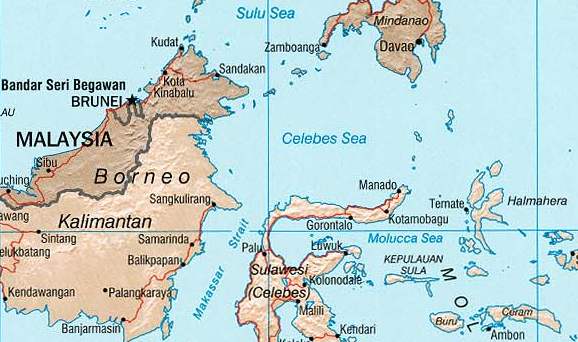
The launch about five years ago of maritime patrols in the Sulu and Celebes seas involving the armed forces of Indonesia, Malaysia and the Philippines have corresponded with a sharp drop in piracy and terrorism, officials and analysts said. The three nations plan to enhance the patrols with improved surveillance, intelligence and communication to boost security and economic stability.

The INDOMALPHI patrols, a moniker that combines the names of the partner nations, began in 2017 as a result of the Trilateral Cooperative Arrangement (TCA) signed a year earlier by the three governments. Security challenges are “especially daunting” in the seas, where the three nations’ maritime borders converge in an area “with a complex political history and a long legacy of illicit maritime activity,” according to Stable Seas, a nonprofit research initiative.

“The main objective is to enhance security in the Sulu and Sulawesi [Celebes] seas,” Indonesian Army Col. Kurniawan Firmizi, a senior official at the Indonesian Defense Ministry, told FORUM. “A high level of protection with all parties can be beneficial. It can increase the economy, facilitate traffic flows between countries adjacent to the Sulu Sea area, and improve border security and international cooperation. The goal is to secure the Sulu Sea and maritime border waters for all three countries.”

Since their launch, the INDOMALPHI patrols have deterred and defended against attacks on vessels at sea by pirates and violent extremist organizations such as the Abu Sayyaf Group, Kurniawan said. According to Indonesia’s Defense Ministry, known as Kemhan, there were no reports of piracy for ransom in the patrolled waters in 2021. As recently as 2017, there were 99 reports of piracy and armed robbery in the area, according to the Regional Cooperation Agreement on Combating Piracy and Armed Robbery against Ships in Asia.

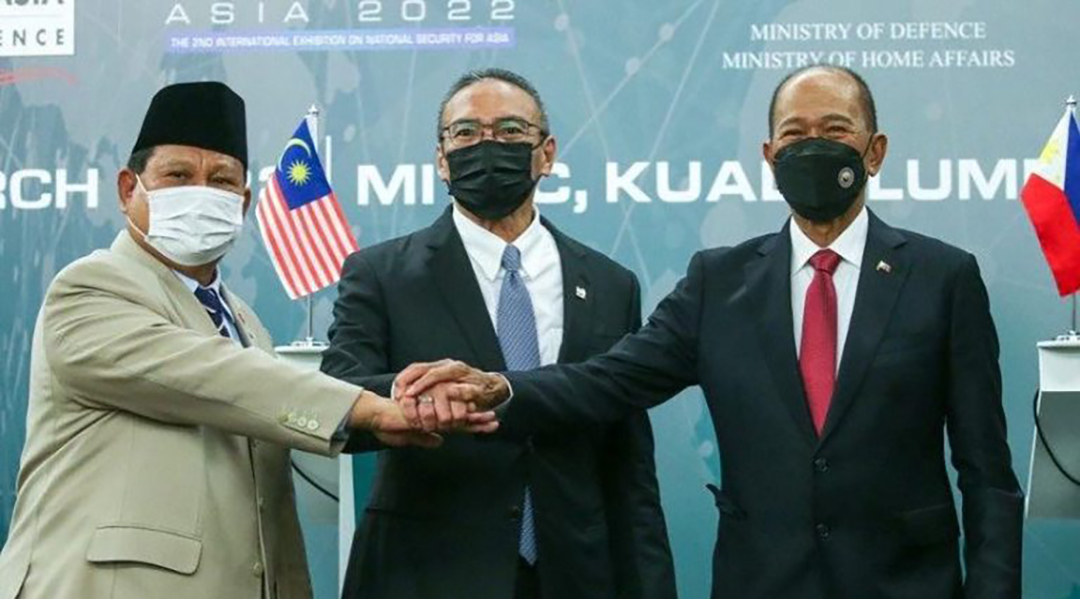
Four categories of patrol enhancements were announced at the TCA Ministerial Meeting in Kuala Lumpur, Malaysia, in late March 2022, Kemhan reported. They are: optimizing communication by deploying a liaison officer from each partner nation to each country’s maritime command center; conducting trilateral maritime exercises; adopting an intelligence-led approach to surveillance operations; and improving the TCA structure, communication and coordination to increase partners’ participation and commitment. (Pictured, from left: Indonesian Defense Minister Prabowo Subianto, Malaysian Senior Defence Minister Hishammuddin Tun Hussein and Philippine National Defense Secretary Delfin Lorenzana attend the Trilateral Cooperative Arrangement Ministerial Meeting in Kuala Lumpur, Malaysia, in March 2022.)

“There has been an increase in surveillance technology, including drones and satellite systems,” Kurniawan said.

The INDOMALPHI patrols demonstrate the expansive benefits of multilateralism, Connie Rahakundini Bakrie, a defense analyst and the author of “Defending Indonesia,” told FORUM.

“These countries will undoubtedly increase their cooperation with other regions, such as Europe, by securing their maritime areas,” she said. “The reason is that trading traffic will be smoother since it is safe, so the risk-cost will be lower.”

She recommended two additional improvements: increase patrol frequency in the Sulu Sea; and supplement patrols with “additional aircraft such as reconnaissance aircraft, close air support or attack aircraft, commandos from helicopters, etc.”

“French Navy’s 2021 Report On Global Maritime Security” –Naval News

In reading this, note the difference between piracy and maritime robbery is that, the first occurs on the high seas, while maritime robbery takes place within a nation’s territorial sea or internal waters. 

Naval News reports publication of a report by the French Navy’s

“The Maritime Information Cooperation and Awareness Center (MICA Center) of the French Navy released its 2021 annual report on maritime piracy and robbery acts that impacted worldwide maritime security.”

For me, there were two surprises in the Naval News report. First there was the surprisingly good news, that incidents were much reduced in the Gulf of Guinea, but then there seemed to be the bad news, that the Caribbean was one of the two worst areas for piracy and maritime robbery.

But looking at the complete original report, Sec. 3.4, it finds that the “Caribbean Sea is an area where the threat of piracy or robbery is considered low.” I presume this apparent conflict between a high number of incidents and low probability, is due to the high traffic in the Caribbean.

Most of the “piracy/maritime robbery” reported in the Caribbean was non-violent theft from anchored yachts. This is very different from the Gulf of Guinea, where kidnappings and attacks on ships are still relatively common.

The report also comments on immigration, drug trafficking, and illegal, unregulated, and unreported (IUU) fishing.

“Danish Navy Frigate Kills 4 Pirates in Gulf of Guinea Anti-Piracy Mission” –USNI

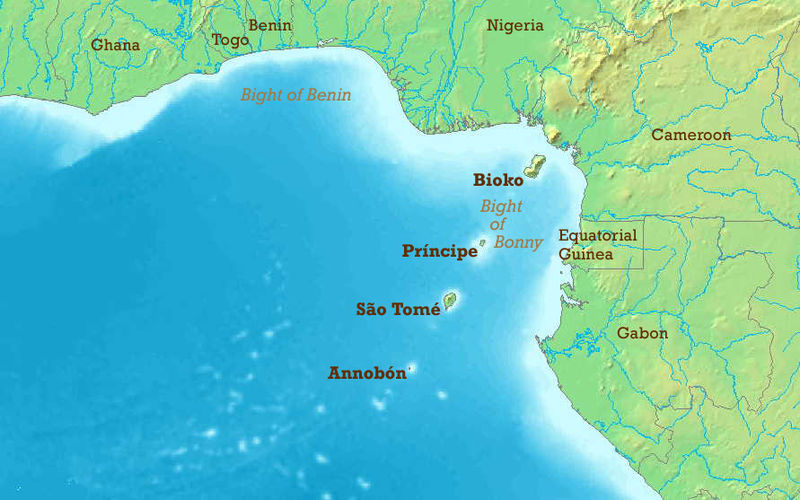
Gulf of Guinea, from Wikipedia

The US Naval Institute reports an incident off the West African Coast in which a Danish Frigate, the HDMS Esbern Snare (F342), while engaged in a counter piracy operation, observed a suspicious vessel and attempted to investigate. This led an exchange of gunfire.

“By the evening, Esbern Snare was close enough to launch rigid-hulled inflatable boats (RHIBs) carrying Danish naval special forces personnel and called on the boat to halt and permit boarding, the news release said. When the boat refused to respond to the call, warning shots were fired, with the pirates responding by firing directly at the personnel in the RHIBs. A brief firefight then ensued, in which no Danish personnel were hit but five pirates were shot, with four of them killed and one wounded.”

The USCG cutter operate in this area periodically, doing “capacity building.” Its not impossible a cutter will find itself in a similar situation.

The imbalance of the results of the firefight, 5-0, which probably would have looked fairly even on paper, speaks volumes for the equipping and training of the Danish boat crew and boarding party.

“NIGERIA RECORDS LOWEST LEVEL OF PIRACY SINCE 1994” –Baird Maritime

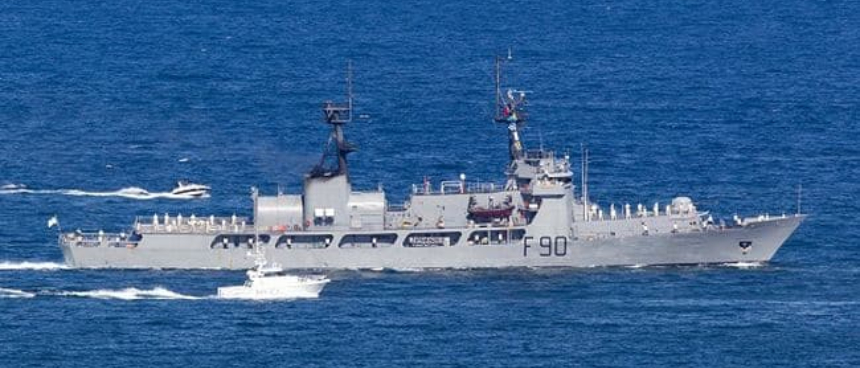
The Nigerian Navy frigate NNS Thunder, former USCGC Chase (Photo: International Chamber of Shipping)

Baird Maritime gives us some good news out of Nigeria,

The trend of reduction in piracy and armed robbery in Nigerian waters has continued, with the International Maritime Bureau (IMB) reporting in its third quarter 2021 account a 77 per cent decrease in the first nine months of the year, compared to the same period last year.

Nigeria reported four incidents in the first nine months of 2021, in comparison to 17 in 2020 and 41 in 2018. This represents a 77 per cent decrease in incidents between 2021 and 2020, and a 95 per cent reduction from 2018. The IMB also reported a 39 per cent reduction in piracy and armed robbery incidents in the Gulf of Guinea.

I think perhaps the US Coast Guard may have had something to do with this. They now have two former USCG WHECs, Chase and Gallatin, transferred in 2011 and 2014 respectively. USCGC Thetis was there in 2019 for Exercise Obangame Express. Coast Guard teams also operated from Navy vessels.

“Republic Of Singapore Navy Stands Up New Maritime Security And Response Flotilla” –Naval News

Note the graphic may be distorted here, click on it for a better view. 

Naval News reports that the Singapore Navy has formed a new “Maritime Security and Response Flotilla.”

“As part of the restructured Maritime Security Command, the new MRSF is set up to better trackle evolving maritime threats that have grown in scale and complexity, particularly in the Singapore strait area. According to a recent French Navy report on worldwide maritime piracy and robbery, robbery is on the rise in South East Asia, particularly in the Straits of Singapore and Malacca.”

Aside from a pair of tugs, the primary assets of the new flotilla are four renovated and renamed Fearless Class patrol craft that will fill the function until a new class is completed (expected in 2026).

Perhaps most interesting, are the changes made to the vessels for their new role. These include enhanced communications equipment, a long range acoustic device and laser dazzler system, installation of a fender system, and modular ballistics protection–and a red racing stripe.

The Fearless Class patrol craft: Twelve vessels commissioned 1996-98. All out of service by the end of 2020, replaced by eight Littoral Missions Ships.

  • Displacement: 500 tons fl
  • Length: 55 m (180 ft)
  • Beam: 8.6 m (28.2 ft)
  • Draft: 2.2 m (7.2 ft)
  • Speed: 36 knots
  • Propulsion: 16,860 HP, two KaMeWa waterjets
  • Range 1,800@15 knots

Singapore also has a Police Coast Guard as part of its Police Force with patrol craft of up to 35 meters in length.