State of the Coast Guard Address–2015

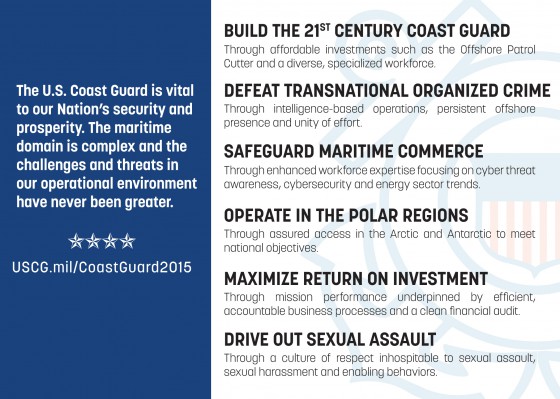
Coast Guard Commandant Adm. Paul Zukunft delivers his first State of the Coast Guard Address and outlines how America’s Coast Guard will meet the challenges of today while preparing for complexities that remain ahead. U.S. Coast Guard video by Telfair. H. Brown, Sr.

The Commandant has issued his State of the Coast Guard address, and I think you will find it well said, even inspiring. You can watch it above or read more here.

State-of-the-Coast-Guard-2015-560x399

“A Cooperative Strategy for 21st Century Seapower: Forward, Engaged, Ready” Kickoff, 13 March

There is an upcoming event some of you might be interested in. It is the introduction of the new Navy/USCG/USMC strategy, “A Cooperative Strategy for 21st Century Seapower: Forward, Engaged, Ready”, slated for roll-out on March 13. Speakers include the Commandant, the Chief of Naval Operations, and the Commandant of the Marine Corps.

It will likely fill up quickly, so sign up soon if you want to go.

When: 3/13/2015 11:30 AM – 12:30 PM
Where: 1616 Rhode Island Avenue, N.W. Washington, DC 20036
Registration: http://my.csis.org/csis/CSIS1700/CSISEventRegistration.aspx?eventcode=2015_065
Cost: Free

Anyone want to be my on-scene reporter?

Ready, Fire, Aim

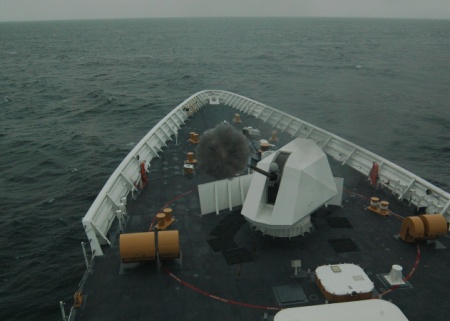
NSCfires57mm

Cdr. Salamander is reporting that Vice Admiral Thomas S. Rowden, Commander, Naval Surface Forces has issued a requirement that every surface force unit conduct live fire exercises every day underway. If exercises are not conducted he wants to know why.

The directive is very specific in including all weapon systems and providing an allowance for training rounds. Sounds like he is very serious.

1. ALL COMNAVSURFOR SHIPS WILL ENSURE THE HIGHEST LEVEL OF COMBAT READINESS. YOUR MAIN BATTERY, ALL CREW SERVED WEAPONS, SHIP/AREA DEFENSE SYSTEMS, AND ATFP WATCH STANDER QUALIFICATIONS AND PROFICIENCY WILL BE CAPABLE OF ENGAGING THE ENEMY AND DEFENDING YOURSELF AS WELL AS THE HIGH VALUE UNIT AT ALL TIMES. THE NAVY PROVIDES SUBSTANTIAL NCEA TO ENSURE WEAPON SYSTEM OPERABILITY, CREW PROFICIENCY, AND COMMAND AND CONTROL PROWESS IN ACCORDANCE WITH REFERENCES A THRU G. SO SHOOT, ASK FOR MORE, AND CONTINUE TO SHOOT IAW REFERENCES A THRU D IN ORDER TO MEET VALID TRAINING REQUIREMENTS. YOU, YOUR CREWS, AND ALL YOUR WEAPON SYSTEMS MUST BE READY TO FIGHT!
2. ALL SURFOR SHIPS ARE REQUIRED TO CONDUCT LIVE FIRE EXERCISES DAILY WHILE UNDERWAY UNLESS FOR SAFETY, OPERATIONAL, OR ENVIRONMENTAL REASONS YOU ARE NOT ABLE TO FIRE. SHORT OF THE REASONS LISTED ABOVE, I WILL ASSUME IF YOU ARE NOT SHOOTING EVERY DAY WHILE UNDERWAY IT IS BECAUSE YOUR WEAPON SYSTEMS ARE BROKEN OR THERE ARE SPECIAL CIRCUMSTANCES ON WHICH YOU HAVE PRE-BRIEFED YOUR ISIC AND IN TURN YOUR ISIC HAS BRIEFED MY CHIEF OF STAFF AND FORCE GUNNER.
3. IF FOR ANY REASON YOU CANNOT CONDUCT LIVE FIRE EVENTS ON ANY UNDERWAY DAY, A REPORT VIA E-MAIL IS DUE TO YOUR ISIC BY THE END OF THE DAY ON WHICH YOU DID NOT SHOOT. ISICS WILL CONSOLIDATE REPORTS AND SEND MY CHIEF OF STAFF ([redacted](AT)NAVY.MIL) AND FORCE GUNNER ([redacted](AT)NAVY.MIL) A BRIEF SUMMARY OF WHY THE SHOOT DID NOT OCCUR THAT DAY. IF YOUR OPERATIONAL COMMANDER LIMITS LIVE FIRE EVENTS, WE WILL COORDINATE SEPARATELY AND ACCORDINGLY IN ORDER TO SUPPORT HIS/HER INTENTIONS. A SUMMARY OF ROUNDS FIRED BY WEAPON TYPE WILL BE INCLUDED IN YOUR WEEKLY REPORT.
4. PER CIWS PACFIRE MIP 7112 MRC R-2M, FOR EACH PACFIRE EVENT YOU ARE REQUIRED TO SHOOT AT BOTH HIGH AND LOW BURST (ONCE EACH). THE PARAMETER IS FOR THE PAC BIAS (CODE 68 AND 69) TO BE 0 +/- 1 FOLLOWING EACH RATE OF FIRE. IF YOU ARE NOT WITHIN THOSE PARAMETERS, YOU ARE TO RE-SHOOT AT THAT RATE OF FIRE, NOT TO EXCEED
3 TIMES AT ONE RATE OF FIRE. PREVIOUS PACFIRE OFFSET VALUES ARE REQUIRED TO BE ENTERED PRIOR TO START, AND WILL RESULT IN PAC BIAS BEING WITHIN 0 +/- 1.
5. PER REFERENCES E, F AND G, CNSF WILL SUPPORT 300 ROUNDS PER MONTH PER MOUNT IN AIR MODE. AN ADDITIONAL 100 ROUNDS PER MONTH PER MOUNT FOR SHIPS WITH SURFACE CAPABLE (BLK 1B) GUNS TO FIRE IN SURFACE MODE. 1500 ROUNDS PER MOUNT PER YEAR FOR CE-12 AND AW-21, WHICH WILL ALLOW FOR THE PROPER EXECUTION OF THE PACFIRE REQUIREMENTS EXPLAINED ABOVE. YOU MUST REQUEST THIS NCEA AUGMENT 45 DAYS IN ADVANCE.
6. SHIPS THAT ARE EQUIPPED WITH TOWED ARRAY SONARS WILL HAVE THE ARRAY RIGGED FOR TOW AT EVERY AVAILABLE OPPORTUNITY. YOUR SONAR SUITE WILL BE MANNED AND TRACKING SURFACE AND SUBSURFACE CONTACTS BOTH PASSIVELY AND ACTIVELY WHEN THE TACTICAL AND ENVIRONMENTAL SITUATIONS ALLOW. NIXIE WILL BE STREAMED WHEN REQUIRED AND ALL SETTINGS WILL BE IAW THE TACTICS, TECHNIQUES AND PROCEDURES PROMULGATED WITHIN NTTP 3-21.33.
7. AS SPECIFIED ABOVE, THE COMMITMENT TO CONDUCTING LIVE FIRE EXERCISES ADDRESSED HEREIN IS APPLICABLE TO YOUR MAIN BATTERY, ALL CREW SERVED WEAPONS, AND ALL SHIP/AREA DEFENSE SYSTEMS. AS SUCH, IN ADDITION TO ALL MAIN BATTERY AND CREW SERVED WEAPONS AMMUNITION AND ORDNANCE, I EXPECT INCORPORATION OF THE FOLLOWING MUNITIONS INTO YOUR LIVE FIRE AND NCEA AUGMENT PLANNING: MK 214 SEDUCTION, AND MK
46 REXTORP.
8. RANGE CLEARANCE AND OVERALL WEAPONS SAFETY IS PARAMOUNT AS YOU TUNE YOUR WARFIGHTING SKILLS.
9. NCEA AUGMENTATION AND REQUISITIONING GUIDANCE. REFERENCES E, F, AND G GOVERN NCEA MANAGEMENT. NCEA AUGMENT REQUESTS MUST BE SUBMITTED NO LATER THAN 45 DAYS PRIOR. ENSURE YOUR WEAPONS OFFICER, GUNNERY OFFICER, LEADING GM, AND AMMO ACCOUNTANT HAVE READ AND UNDERSTAND THE NCEA PROMULGATION MSGS AND ARE IN COMPLIANCE.
10. THIS ORDER IS DESIGNED TO ENHANCE THE ACCURACY, PRECISION, SAFETY, EFFICIENCY AND CONFIDENCE WITH WHICH YOU PLACE ALL TYPES OF ORDNANCE ON TARGET. YOUR ABILITY TO MASTER THE MATERIAL, TACTICAL, AND WATCH TEAM PROFICIENCY REQUIREMENTS ASSOCIATED WITH CONDITION ONE WEAPONS SYSTEMS OPERATION IS FULLY IN LINE WITH OUR WARFIGHTING FIRST PHILOSOPHY. THE TACTICAL PROFICIENCY DEVELOPED THROUGH REPEATED LIVE FIRE EXERCISES FAR OUTWEIGHS ANY POTENTIAL MATERIAL CHALLENGES ASSOCIATED WITH INCREASED USE OF YOUR MAIN BATTERY, CREW-SERVED WEAPONS, AND SHIP/AREA DEFENSE WEAPONS.
11. COMMODORES AND COMMANDING OFFICERS ARE WELCOME TO CONTACT MY STAFF AT ANY TIME REGARDING THIS, OR ANY OTHER ISSUE.
11. WARFIGHTING WILL REMAIN OUR #1 PRIORITY.
12. VICE ADMIRAL ROWDEN SENDS.//

I still suggest looking at Cdr. Salamanders blog post and the comments you will find on it.

Makes me wonder how much live fire training the CG is getting (other than .50 cal.) and how ready we are to put steal on target.
\1280px-USCG_Gallatin_Mk_75_firing

The Old (Coast) Guard Was Tougher

Recently saw this on Bill Wells FaceBook page and thought it might be worth opening a discussion. I am republishing it here with his permission.

The current Coast Guard, and that of the immediate past, has relieved officers and enlisted men from command for any number of reasons. The “Relief for Cause,” or the “Loss of Confidence” reasons can mean anything and usually do. However, there is no legal process, the officer or enlisted man has little recourse and their careers as over. Many of the cases have devolved into using the “failure to abide by the Core Values.” It must be remembered that Core Values were implanted as part of the now defunct Total Quality Management System. The initial use of the values were to provide a guide for organizational conduct as shown in the Business Dictionary that defines Core Values as, “A principle that guides an organization’s internal conduct as well as its relationship with the external world. Core values are usually summarized in the mission statement or in a statement of core values.”

However, since inception the Core Values have been used as a hammer for punitive, extra-legal functions. The Coast Guard’s Core Values of Honor, Respect, and Devotion to Duty are claimed to have come from the Coast Guard’s history, but no one has pointed to that source. It is more faith and a belief system gone wrong. When first adopted no one could define just what the three words meant to the Coast Guard at large. So, explanatory paragraphs became additions to the words but these only confused the issue because the additional wording contained more core values, rules, and philosophical sloganeering. Still seeing the troops did not understand the additions, the Coast Guard added Twenty-Eight Competencies of leadership that all circled back to the Core Values providing more confusion.

So, how was the Old Guard tougher? They followed the prevailing rules. For example, in 1913 the Treasury Department charged Captain Horace B. West, USRCS, at a General R. C. S. Court with:

Neglect of Duty with six specifications.
Violating lawful regulations with eight specifications.
Conduct unbecoming an officer and gentleman with four specifications.

All these charges sound series until the reasons for the charges are known. West was found guilty on ‘neglect of duty’ and violating regulations and not guilty for unofficer-like conduct. His crimes consisted solely of his apparent dislike for paper work. West failed, according to the New York Times, to make “reply to several reports and communications transmitted to him from the Treasury Department. Although, the USRCS had had a service motto, “Semper Paratus,” since 1896, he was not charged being in violation of it and all it could have referenced was he was not ready to do paper work. The charges were not his first brush with not filing paperwork. In 1905, while in command of the cutter Woodbury at Portland, ME., he failed to submit assistance reports and for not having officers comply with a General Order. The assistance reports were more important because they provided the statistical data the Treasury Department used to justify the existence of the USRCS.

His sentence consisted of a suspension from the service for six months on half pay. A vacation of sorts and he resumed full service and his command with no real adverse effect on his career. Of course, West understood it all. He was an 1880 graduate of the Revenue Cutter School of Instruction (later the Coast Guard Academy).

The Treasury Department of West’s era would have never relieved him for cause. If they had specific charges and proof they brought the person to a legitimatize trial to exact that pound of flesh. Using the sloganeering of core values does little to inspire confidence in the ability of the Coast Guard’s leadership to address situations in a fair and military manner. Perhaps it is time to look at the Core Values and see that they do represent the Service beyond being a punitive cat o’ three tails.

Commandant Remarks and Q&A–USNI/CSIS on CSPAN

Earlier we talked briefly about the Commandant’s address to the USNI and CSIS Maritime Security Dialog. This is the entire address.

It is about 53 minutes, of which the first half is prepared remarks and the second half Q&A.

I think you will find it worth the time.

Thanks again to James WF for pointing me to this.

Navy Rethinking Ship Designations–Time for the CG to do so too?

cropped-uscgc_waesche_by_yerba_buena_island2.jpg
Photo: Doesn’t this look like a Patrol Frigate?

The USNI is reporting that, “The modified Littoral Combat Ship (LCS) class will be redesigned as frigates, Secretary of the Navy Ray Mabus announced on Thursday at the Surface Navy Association 2015 symposium on Thursday.”

Mabus noted, ““It’s not an ‘L’ class ship,” he said. “When I hear ‘L’ I think amphib, so does everybody else.”

The FF designation for the LCS will be the first of a planned set of nomenclature changes for other ships classes as well that will come in the coming weeks, Mabus said.

Apparently he also intends to address the designations of the Afloat Forward Staging Base (AFSB), the Mobile Landing Platform (MLP), and the Joint High Speed Vessel (JHSV).

I will repost something I quoted in a comment to a previous post regarding an article by Norman Polmar in the US Naval Institute Proceedings “US Navy-LCS, JHSV, MLP…What?”

Quoting his conclusion: “Unquestionably, the LCS, JHSV, and MLP designations must be changed—it is logical and sensible to do so. It can be done with the stroke of a pen by a Secretary of the Navy notice. At the same time, two other ship classes should have their hull numbers changed: The three ships of the Zumwalt (DDG-1000) class and the three submarines of the Seawolf (SSN-21) class should be assigned realistic hull numbers within their respective types, and thus be in accord with the 90-year-old directive that stated ships were to be designated in sequential order within their designation types…“The U.S. Navy’s basic ship-designation system is excellent and deserves to be carried out professionally and logically.”

Perhaps it would be a good time for the Coast Guard to take another look at their designation system too, and bring them back into line with the Navy system. I talked about this earlier, “Ship Type Designations–The Bertholfs are Minesweepers?”

The designations currently chosen for the Bertholf class (WMSL) and the Offshore Patrol Cutter (WMSM) are do not fit within the established and customary designation conventions of either the US Navy or NATO.

I would suggest, W-PFL (CG Patrol Frigate, Large) for the Bertholfs and W-PFM for the Offshore Patrol Cutters or more simply W-PL (CG Patrol, Large) and W-PM (CG Patrol, Medium). We might also apply the new designations to existing WHECs and WMECs as well.

We might also want to take a look at icebreakers and AtoN vessels, but those designations are really less problematic.

More Lessons Learned, “Guardians of the Gulf: A History of Coast Guard Combat Operations in Support of Operation Iraqi Freedom, 2002-2004”

1024px-USCGC_Adak

Photo: USCGC Adak, part of Patrol Forces, South West Asia, note extra machinegun mount behind the pilothouse. Click on the photo to enlarge.

Not long ago we talked about the need to preserve lessons learned from atypical (usually military) Coast Guard operations like participation in the Vietnam War or operations in South West Asia. Craig Allen Jr. brought to my attention a LANTAREA historian’s publication, “Guardians of the Gulf: A History of Coast Guard Combat Operations in Support of Operation Iraqi Freedom, 2002-2004” (pdf) by William H. Thiesen, PhD, June 2009

Regarding the deployment of WPBs the study noted, “Even though the Coast Guard served a similar mission in Vietnam, there existed no operational plan to provide guidance for OIF planning and preparations.

If the Coast Guard does not yet have a contingency plan for deployment of patrol vessels there is enough detail to make a fair start on a checklist of things to be done. The experience of the WPBs deployed to the Mediterranean can leave little doubt of the Webber Class’ ability to go almost anywhere, given time to avoid bad weather.

“On May 14, the five cutters (one 378 and four 110s–Chuck) began the return trip; however, this time the smaller cutters followed Dallas across the Atlantic rather than riding on board an MSC vessel. The 5,000-mile voyage set a record as the longest transit ever completed by a 110-foot cutter. The PATFORMED fleet had performed its escort and MIO mission admirably. Moreover, the WPBs in the Mediterranean and the Arabian Gulf had set records for hours of operation with some of them deploying for over thirty days of operation.”

For the future, there might be some advantage in organizing at least a few of the Webber class in deployable divisions (3 units) and squadrons (six units) as discussed earlier, with or without augmentation since there will be several location with three or more WPCs.

PATFORSWA Lessons Learned, Expeditionary WPCs

We have had some discussion recently about how lessons of expeditionary deployment of patrol craft are lost and must be relearned. I’m opening this post in hopes it will be a temporary repository for discussion of what went well and what needed improvement. There are a number of possible topics that come to mind.

Augmentation
Command Relationships
Communications
Equipment
Logistics
Medical
Orientation
Personnel policies
Rules of Engagement
Spares
Training
Weapons

For starters I will quote Craig Allen Jr.’s comments on an earlier post:

“…the Coast Guard not capturing it’s lessons-learned from Vietnam–I agree! There is very little to document that extraordinary expeditionary USCG operation. I fear the same hard-won knowledge from 12+ years of USCG OCO mission in the AG will also fade into obscurity unless there is an effort made to preserve it. The skillsets for MIP/MIO/SFA and operating in semi-permissive environments should not have to be reinvented every time they’re required.

“There are some organizational obstacles to internalizing the PATFORSWA lessons-learned though. One is that the mission is tied to OCO funding, which the USCG does not know whether it will get or not. (Every year the rumor is that the new P4 crew will be the ones to turn out the lights and lock up when the mission stands down.) Investing the effort/$ into making long-term organizational improvements in training, equipment, tactics, etc. when the future of the mission is so uncertain can be a tough sell. Second obstacle is the one-year tour length. Makes it difficult to gain the experience/knowledge required to internalize lessons-learned. By the time a P4 team adjusts to the battle rhythm and can start to see where improvements can be made, its already time to start preparing for handoff to their reliefs. Does the CG have 12 years of recent OCO experience or 1 year of experience repeated 12 times?

“Right now there are a few hundred PATFORSWA vets with recent first-hand knowledge of an important niche mission for the CG (and some at LANTAREA who have managed the program and know how its evolved over time.) So… are there lessons worth capturing to better prepare the CG to fulfill similar missions in the future? Have they been adequately discussed and recorded? If not, how do we ensure that they are?

“One hopes that, ten years from now, we’re not trying to figure out how to do these kinds of missions all over again. My suggestion that the USCG and USN establish an expeditionary PC training facility was one idea for how we might keep the skills sharp in anticipation of their likely demand in the future.”