South Africa to Build Damen Design Offshore and Inshore Patrol Vessels

Damen 85 meter Offshore Patrol Vessel, 1800

Damen 85 meter Offshore Patrol Vessel, 1800

Naval today reports, 

On February 15, Armscor (the acquisition agency for the South African Department of Defence–Chuck) announced Damen Shipyards Cape Town as the preferred bidder for the construction of offshore and inshore patrol boats…”

Reportedly the project includes three Offshore Patrol Vessels (OPVs) and three Inshore Patrol Boats (IPBs) for the South African Navy.

The OPVs will be Damen’s Offshore Patrol Vessel 1800 Sea Axe, illustrated above, 85 meters in length, with a beam of 13.7 meters, and a speed of 26 knots.

The IPBs will be Damen’s FCS (STAN PATROL) 5009 design, illustrated below, which is also used by the Ecuadorian and Trinidad and Tobago Coast Guards. These are 50.2 meters (165 ft) in length, 9.32 meters (30.6 ft) of beam. The South African vessels are expected to make 30 knots. An unusual feature (aside from the bow) is the use of four propellers.

I talked to someone who has ridden on a 5009 patrol vessel and he reported that it did indeed significantly reduce pitching. The tradeoff was that it was very wet forward. This should not be surprising since the design minimizes the rise of the bow when it encounters a wave.  You can see that they have attempted to counter this tendency by making the bow high and providing high bulwarks.

On the second page of this description of the design you will see a diagram of the ship which indicates that it can be fitted with up to three boats and a twin 40mm mount.

The long and slender Sea Axe hull offers exceptionally low resistance, delivering excellent fuel efficiency at all speeds


UAE’s New, and very well Armed OPV

UAE offshore patrol vessel Arialah

UAE offshore patrol vessel Arialah (note the concept above is incorrect in that the gun is a BAE 57mm rather than the 76mm illustrated).

DefenseNews reports first impressions of a new Offshore Patrol Vessel (OPV) built for UAE’s Critical Infrastructure and Coastal Protection Agency (CICPA) shown at the NAVDEX (naval) portion of the IDEX international Defense Exposition in Abu Dhabi.

The ships are 67 meters (220 feet) in length, 11 meters (36 feet) of beam, and 5.4 meters (18 feet) of draft, with a speed of 20+ knots provided by four MTU engines driving four propellers.

Most of the armament is typical OPV, a 57 mm gun and two 30mm auto-cannon in remote weapon stations. What really sets it apart, is the Mk49 Rolling Airframe Missile launcher.

On the other hand, the UAE is just across the Straits of Hormuz from Iran and their shore based anti-ship cruise missiles.

https://i0.wp.com/upload.wikimedia.org/wikipedia/commons/2/2c/RIM-116_Rolling_Airframe_Missile_Launcher_3.jpg

Photo: Mk49 guided missile launch system for Rolling Airframe Missile

An earlier post provides a bit more detail on the program but it appears to have a couple of errors regarding the weapon systems (indicates a 76mm as seen in the first illustration vice 57mm and says the Mk49 launcher has 11 cells rather than the actual 21). There are to be two of this class, both to be delivered this year.

“The ships themselves will be delivered from Damen’s Galati shipyard in Romania in 2017; they will then go to ADSB’s facility in Abu Dhabi’s Mussafah industrial area for combat systems installation and integration prior to delivery to the CICPA.”

This looks like a straight forward adaptation of one of Damen’s designs for Offshore Industry Support Vessels with boats, helo deck, ESM/ECM, weapons and sensors added.

According to this older source, the Coast Guard was involved in the development of the SEA AXE Bow.

“Damen … has developed the sea axe bow design in partnership with the University of Delft, Royal Netherlands Navy, US Coast Guard and the Maritime Research Institute Netherlands.”

How Does the Program of Record Compare to Historic Fleets

 The U.S. Coast Guard cutter USCGC Morgenthau (WHEC-722) heads out to sea from its home port in Alameda, California (USA), passing under the Golden Gate Bridge.


The U.S. Coast Guard cutter USCGC Morgenthau (WHEC-722) heads out to sea from its home port in Alameda, California (USA), passing under the Golden Gate Bridge.

A question from a reader prompted me to look at how the “Program of Record” (POR) compares with Coast Guard patrol fleets of the past.

The program of record is
8 NSCs
25 OPCs
58 FRCs
—————

91 vessels total

1990: Looking back at the “Combat Fleets of the World 1990/1991” the Fleet was:
12 WHEC 378′
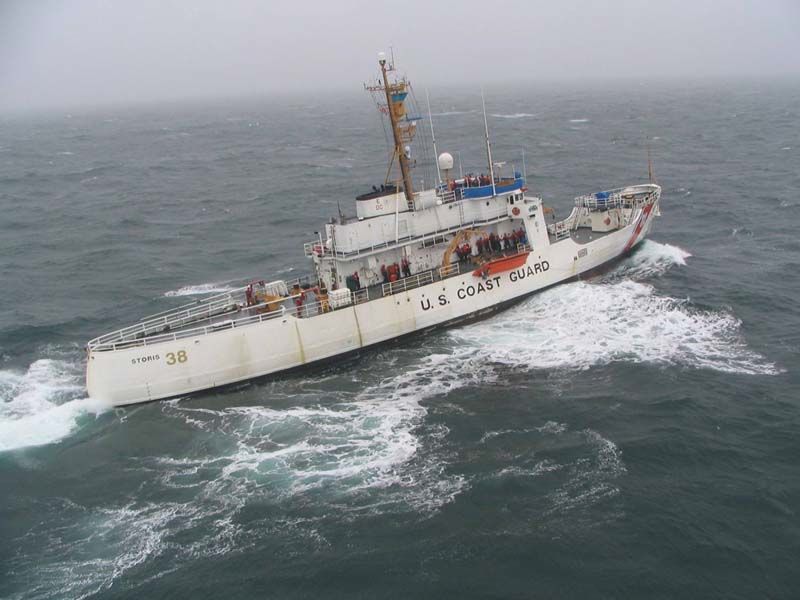
32 WMECs (16×210′, 10×270′ (three building), Storis, 3×213′, 3×205′)
34 WPB 110′ (plus 15 building)
3 WSES 110′ surface effects ships
4 WPB 95′
——————-
85 vessels total
(There were also five Aerostat Radar Balloon tenders.)
 –
2000: “The Combat Fleets of the World 2000-2001” showed
 –
12 WHEC 378′
32 WMEC (13×270′, 16×210′, Alex Haley, Storis, Acushnet)
49 WPB 110′
——————-
93 vessels total.
 –
2013: “The Combat Fleets of the World, 16th Edition,” copyright 2013 listed:
 –
3 NSCs
8 WHEC 378′
28 WMEC (13×270′, 14×210′, Alex Haley)
4 FRCs
41 WPB 110′
——————–
84 vessels total
 –
Comparing the Program of Record (plus NSC #9) to the fleet of 2000: You can look at it this way,
  • 9 NSCs and 3 OPCs is more than adequate replacement for the 12 WHEC 378s
  • 49 of the FRCs is more than adequate replacement for 49 WPB 110s (and we have only had 41 anyway since the WPB 123 screw up)
  • That leaves 22 OPCs and 9 FRCs to cover for the 32 WMECs.
Conclusion: 
I think we would all be pretty happy, if we had the Program of Record fleet in place right now. It really would be a substantial improvement, but while the NSCs and the FRCs are well on the way, the first of the long-delayed OPCs will not be delivered until 2021, and, if everything goes according to plan, the last probably not before 2034, at which time even the newest 270 will be 44 years old. A lot can happen between now and then.
The 2000 fleet was, I believe, the benchmark against which the program of record was measured in the Fleet Mix Study. By 2013 we were already down nine vessels. By my estimate, by the time the last 210 is replaced it will probably be 60 years old. That is expecting a lot. Can we possibly expect that none of these ships will become unserviceable before they are replaced? Building no more than two OPCs a year is really too slow. Once the first ship is built, tested, and approved for full rate production, we should accelerate construction to the maximum. That can’t happen until at least FY2022, probably FY 2023.
By the end of FY2022 we should have already funded 7 ships. The remaining 18 would take nine years, if we buy them at the currently projected schedule. Instead we could fund the entire remaining program from FY2023-2027 by doing a single Multi-Year Procurement of 18 ships. If Eastern alone could not do it, Marinette, which like the designer VARD, is also a Fincantieri company, would probably be more than willing to build an additional couple a year, particularly if the Navy stops building Freedom class LCS/frigates.
 –
We could have the program complete by FY2030, four years early.
 –
Thanks to Peter for initiating this line of thought. 
uscgc_citrus_1984

USCGC Citrus (WMEC-300), USCG photo

storisfoam

USCGC Storis WMEC-38)

USCGC Acushnet

USCGC Acushnet (WMEC-167), USCG photo


OPC to Have Hybrid Propulsion

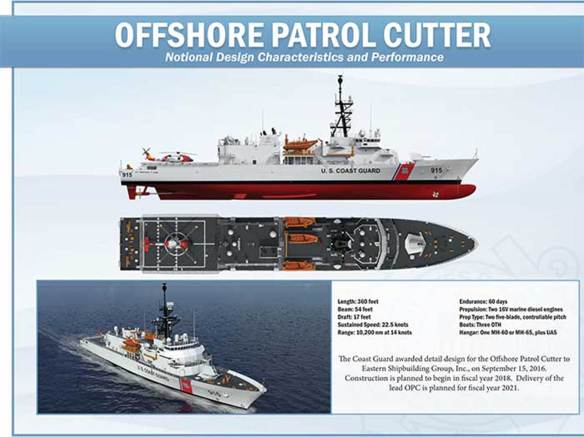
OPC "Placemat"

OPC “Placemat”

We have confirmation that the Offshore Patrol Cutter will have a hybrid propulsion system.

Shephard Media is reporting that, “DRS Technologies, a Leonardo Company, has been selected to provide the hybrid-electric drive propulsion system for the US Coast Guard Offshore Patrol Cutter.”

As to the exact configuration, we have this. Clive Wilgress-Pipe, director of business development and strategic programs at DRS Power Technology said,

“…that the new Offshore Patrol Cutter design solution uses the gearbox mount configuration.”

This suggests to me that the electric propulsion motors (EPM) will be physically close to the main diesel engines (MDE). Assuming the ship will retain redundant machinery spaces, I will speculate and say, this probably means the ship will have two machinery spaces each with a complete propulsion set (MDE, clutch, gearbox, and EPM) for one shaft, plus one or two generators. Previously I had expected one engine room with both main diesel engines, and a motor room with both electric motors.

We don’t have a speed capability for the ship on electric propulsion alone. I had assumed it would provide at least 14 knots to give the long endurance (10,400 n.mi.) claimed for that speed, which might have required only a pair of 1,500 HP motors, but Mr. Wilgress-Pipe’s remarks suggest it might be more.

“Typically you rate it up to about 17 or 18 knots.”

That would require something more like a total of 6,000 HP. As noted, in the linked post, some configurations (COmbined Diesel Electric And Diesel, CODLAD) allow the power of the electric motors to suppliment the main propulsion engines. If that is the case, and we could add something like 6,000 HP to the two 16V 28/33D diesel engines, each rated at 9,763 bhp, then the ship would almost certainly have a 25 knot max speed. (This is of course speculation, so we can only be sure of the 22.5 knots sustained previously reported.)

Giving these ships the option of cruising on electric power, provided only by the ship’s service generators, makes these ship potentially more useful as ASW ships. In this mode, they will be quieter and, in noisy littoral environments, more difficult for a submarine to distinguish from other traffic.

Thanks to Luke for bringing this to my attention. 

A Little More on the Offshore Patrol Cutter

OPC "Placemat"

OPC “Placemat”

MarineLink has a story on the OPC, and it includes a bit more detail, and it raises some questions. I’ve also seen a couple of stories about how they will be equipped that will be referred to below.

There is this:

“Zukunft’s budget suggests at least one cutter, or an immediate separate order, will be arctic capable, and Vard and Canadian engineering consultancy BMT Fleet are already understood to be working on project documents for a Canadian “arctic offshore patrol ship” of Vard 7 100 type.”

VARD 7-100 ICE, the Canadian AOPS

VARD 7-100 ICE, the Canadian AOPS

Vard actually has two designs designated “7-100,” an offshore patrol vessel (pdf) very similar to the OPC and the 7-100 ICE. Apparently, it is the 7-100 ICE they are referring to here. The VARD 7-100 ICE (pdf) is also known as the Canadian Navy’s Arctic Offshore Patrol Ship (AOPS). Does that mean the Coast Guard is looking at the Canadian AOPS as a possible Arctic Patrol Vessel, perhaps filling the role of one or two of the three medium icebreaker? They do have power similar to the old Wind class icebreakers.

We also have this indication the standard OPCs are still expected to patrol the Arctic. (Var refers to the OPC as the Vard 7 110.)

“…the Vard 7 110’s will also patrol the “increasingly accessible Arctic”, a theatre which might require a more closed superstructure, more akin to the Vard 7 100.”

The Vard 7 100 ICE has its ground tackle below the foc’sle deck to protect it from freezing. Perhaps that is what this means. This has also been done on some European Frigates.

Then there is this little bit of speculation about who will build follow on ships”

“Owned by the Italian state via Fintecna, Fincantieri doubled after its acquisition of Vard to become the fourth largest shipbuilder in the world and the largest in the Med. As we wrote these words, Financtieri’s Trieste-based minds were making a friendly offer for the 44 percent of Vard they don’t own. It’s worth noting that in January 2009, Fincantieri bought Manitowoc Marine Group and its two yards in Wisconsin, including the Marinette Marine that built the first Freedom Class littoral combat ship. So, Eastern, it seems, has a rival and a friend in Fincantieri, another maker of mid-sized vessels for the U.S. Navy. So, who knows what may be next from U.S. military-industrial strategists keen to share financial resources with capable NATO allies while also creating jobs at home. For now, all eyes will be on those remaining OPVs.

They are pointing out that there may be competition for the follow on contract. That is good for the Coast Guard.

I would also point out that it also means Marinette might make modified OPCs for the Navy, if the Navy ever realizes that the LCS is not going to make a very good “small surface combatant.”

Northrop Grumman Corporation reports they have been awarded a contract for the design of the C4ISR and machinery control systems (MCS).

“The systems being supplied include integrated bridge systems, command and control consoles, navigation and combat data distribution systems, ship-wide computer network systems, machinery control systems and propulsion control systems

“Included in the design phase of the OPC program is a MCS land-based test facility, as well as a C4ISR test and integration facility, both of which will be located in Charlottesville. Additional work will be conducted at company facilities in San Diego, and Ocean Springs, Mississippi. Northrop Grumman will also provide key C4ISR and MCS integration roles during production testing and shipboard trials to be held in Panama City, Florida.”

MarineLog identified the engines to be used.

Each 360 foot-long vessel will be powered by two FM-MAN 16V 28/33D diesel engines, each rated at 9,763 bhp at 1,000 rpm.

We have consistently seen the speed quoted as 22.5 knots sustained or 22 or more. I suspect they are being conservative. With almost 20,000 HP, the ship ought to make 24 or even 25 knots, in all but the most adverse conditions of load and bottom fouling.

I would have preferred the 20,000 KW (26820 HP) engines advertised for the VARD 7 1000 which would have assured 25 knots, but it’s not bad. If the 7 110 follows the pattern of the 7 100 OPV, than there will be hybrid propulsion, with electric motors on the shaft in addition to geared diesel drive from the main engines. For a cruising speed of 14 knots, that would require two electric motors of about 1,500 HP each.

 “In order to provide fuel efficiency and greater range, this vessel is powered by CODELAD (combined diesel and electric) which allows for instantaneous changeover.”

This would make a lot of sense, in that in addition to the fuel economy benefits it would improve the ships survivability. It could lose both main diesel engines and still have propulsion.

“Congress Must Re-Set Department of Homeland Security Priorities: American Lives Depend on It”–Heritage Foundation

US Capital West Side, by Martin Falbisoner

US Capital West Side, by Martin Falbisoner

The influencial Conservative think tank, Heritage Foundation, has issued a report on the Department of Homeland Security that will likely strongly influence the incoming administration and Congress.

It does not call for any radical increase in the Coast Guard budget for FY2017 ($10.85B). In fact it calls of less funding than was enacted in 2016 ($11.112B), but more than the current administration has requested ($10.322B).

It does support the Offshore Patrol Cutter (OPC) and Polar Icebreaker (PIB) programs and continued procurement of six Webber class (FRC) rather than the four currently requested.

For the future, it appears they support a more stable AC&I budget of at least $1.5B. To me it appears likely the AC&I budget will go higher as both the OPC and PIB enter the construction phase, and they spoke against imposition of a defacto ceiling.

The most significant new direction, seemed to be strong support for Unmanned Air Systems.

Unmanned Aerial Systems. The Coast Guard would also benefit greatly from procuring UASs to support NSC operations. According to the GAO, “Coast Guard officials acknowledged that the lack of [cutter-based] unmanned aircraft would create a gap between the NSC’s actual and planned capabilities.” Dr. William Posage, program manager for the Coast Guard Research and Development Center, explained that the lack of cutter-based UAS technologies “left the NSC with an enormous surveillance gap in her ability to perform her mission.” Notably, the operational effectiveness of the NSC without a UAS component would “be comparable to that of the 378-foot Hamilton class high-endurance cutter,” the very program it was designed to replace with capability enhancements.

The Coast Guard has successfully tested the FireScout and ScanEagle UAS platforms, both of which would significantly amplify the NSC’s surveillance, detection, classification, and prosecution capabilities. Widely used for similar naval operations, they have successfully contributed to a handful of at-sea Coast Guard demonstrations. According to an assessment by the Coast Guard Office of Aviation Forces, the presence of two vertical take-off FireScout UASs aboard an NSC would enable the cutter to cover three times the presence radius of an NSC without them. Similarly, according to a Senate Appropriations Committee report, “[t]he Coast Guard has reported…that its long standing plan to add vertical take-off unmanned aircraft systems to the National Security Cutters would result in an estimated 95- to 225-percent increase in surveillance coverage within an 800 nautical mile radius of the cutter and an estimated 95-percent increase in the number of prosecutions achieved by the cutter.”

The Coast Guard’s FY 2017 budget justification states that funding for the NSC program will in part “establish sUAS [small UAS] capability aboard one NSC, to include engineering analysis, non-recurring engineering, procurement and installation of sUAS components, and system testing and certification.” Admiral Zukunft testified before the House Transportation Committee in March 2016 that this activity would involve a “down select” for a sUAS capability “that will go on board” the NSC. The NSC will amplify its aerial ISR capabilities dramatically with the longer-term integration of sUAS, while the sea service should continue to evaluate the vertical unmanned aerial vehicle (VUAV) platform.

This seems to indicate a two pronged approach, first a small UAS (Scan Eagle or something similar) in the near future and a continued interest in evaluating a vertical takeoff unmanned system like Firescout or potentially DARPA’s TERN.

All the UAS discussion centers on the National Security Cutters. There is no discussion of the possibility of using UAS on any other classes.

Acquisition Update: Coast Guard Requests Quotes For Heavy Polar Icebreaker Industry Studies

USCGC Polar Sea

USCGC Polar Sea

The following is copied directly from the CG-9 web site.

“The Coast Guard issued a request for quote (RFQ) on Dec. 22 for industry studies to identify solutions for the heavy polar icebreaker that minimize cost, schedule, production and technology risk. The request can be found here.

“The Coast Guard expects to award multiple industry study contracts early next year. This will be followed by a request for proposal for detail design and construction of heavy polar icebreakers in 2018.

“The deadline to submit responses to the industry studies RFQ is Jan. 20, 2017.

“This request is part of a larger industry engagement strategy supporting the Coast Guard’s effort to expedite the recapitalization of the heavy polar icebreaker fleet. In addition to the industry studies request, the Coast Guard has sponsored industry day events to promote communication on mission and design requirements and solicited input from industry on acquisition approach and schedule.

 “For more information: Polar Icebreaker program page

Navy Boosts Target Fleet Size to 355. What is the CG Target?

The Coast Guard might learn something from the way the Navy plows the ground ahead of their budget requests. The Navy creates a “Force Structure Assessment” and from this, they derive a 30 year ship building plan. the Coast Guard has neither.

The nearest thing the Coast Guard has had to a “Force Structure Assessment” (FSA) is the now seven year old, one time, Offshore and Aviation Fleet Mix Study.

Rather than a 30 year shipbuilding plan, the Coast Guard has only the now 10 year old, “program of record” that came out of the Deepwater program updated after 9/11 and a five year budget projection which is not statement of future requirements, rather it is a statement of what the administration thinks they will ask for. In short there is no comprehensive spending plan.

The Navy has announced their 2016 Force Structure Assessment only two year after the previous FSA. It adds 47 ships to the 308 that had been included in the 2014 FSA.

The new total adds 16 large surface combatants (cruisers or destroyers), 18 attack submarines and an additional carrier over the 2014 plan. There was no increase in the number of Small Surface Combattants (LCS and frigates), but they did maintain the previous requirement at 52 despite SecDef’s instruction to limit them to 40. Perhaps we will see some of them in the East Pacific transit zone.

Also of potential importance to the Coast Guard is that they want six Expeditionary Support Base (formerly called the Afloat Forward Staging Base).  Assuming they will put one in SOUTHCOM’s AOR, it might be used as a mothership. for forward deployed Webber class WPCs.

The 355 ship fleet is not an all inclusive wish list.

According to the summary, the service determined the 355 total was the “minimum force structure to comply with [Pentagon] strategic guidance” and was not “the “desired” force size the Navy would pursue if resources were not a constraint, read the summary.

“Rather, this is the level that balances an acceptable level of warfighting risk to our equipment and personnel against available resources and achieves a force size that can reasonably achieve success,” according to the summary, which notes it would take a 653-ship force to meet all global requirements with minimal risk.

This is has parallels to the results of the Fleet Mix study, in that the optimum Coast Guard fleet is about twice the size of the program of record.

The Coast Guard really needs to do something similar. We should revisit the Offshore and Aviation Fleet Mix Study at least every five years and we need a 30 year ship building plan. Additionally I believe we should parallel the Navy’s documents to the extent of using the same titles with only a “Coast Guard” modifier. Congress is familiar with the Navy’s products and it would ease acceptance and interpretation of the Coast Guard’s products.

Allow me to repeat the purported advantages of the Navy’s system from an earlier post.

  • “identifying and evaluating cost growth and schedule delays in the execution of shipbuilding programs;
  • “understanding the relationship between annual procurement rates and unit procurement cost;
  • “evaluating whether programs are achieving satisfactory production learning curves over time;
  • “evaluating whether proposed sequences of annual procurement quantities for programs would be efficient to execute from an industrial standpoint;
  • “evaluating stability in Navy shipbuilding planning by tracking year-to-year changes in the five-year shipbuilding plan;
  • “identifying potential financial and industrial-base linkages between shipbuilding programs that are being funded in overlapping years;
  • “identifying and evaluating Navy assumptions concerning service lives and retirement dates for existing ships;
  • “evaluating whether ship procurement needs are being pushed into the future, potentially creating an expensive ship procurement “bow wave” in coming years; and
  • “understanding when the Navy will achieve its ship force level goals, and whether the Navy will experience ship inventory shortfalls relative to those goals that could affect the Navy’s ability to perform its missions in coming years.”

We should also dovetail our plan with that of the Navy to remind the Congress we are part of the National Fleet. We need to show how we fit in the National Defense Organization because we are a military service at all times.

Related:

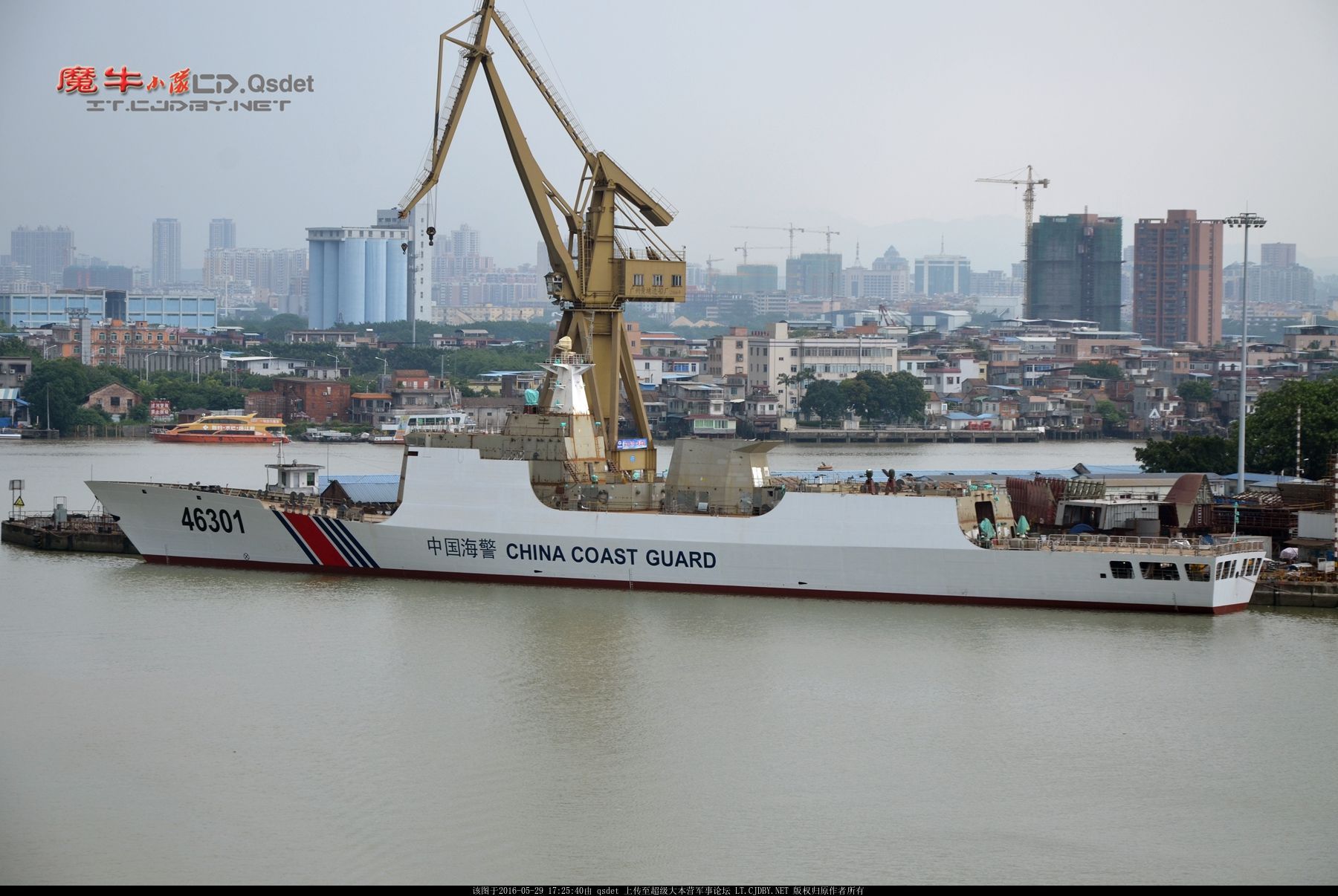
China Acknowledges Building Cutter to be Upgraded to Frigate in Crisis

type818ccgc

The National Interest reports that the Chinese have openly acknowledged that their newest Coast Guard cutter is being built with provision for upgrading to frigate status should a need arise.

Moreover they were apparently influenced by the example of the USCG during WWII.

In the same issue of this magazine, published by the major Chinese shipbuilding conglomerate China State Shipbuilding Corporation (CSSC), builder of the Type 818, there is not coincidentally a very detailed article about U.S. Coast Guard cutters in combat during the Second World War. That article explains that both USCGC Campbell and also USCGC Spencer were able to sink German U-boats (U-606 and U-175 respectively) during the pivotal Battle of the Atlantic. Most of the article examines the operations of 10 American USCG cutters that were 76.2 meters in length and built between 1928 and 1932. These ships were transferred to the hard pressed Royal Navy (RN) during 1941-42 and achieved an enviable war record in RN service, sinking both U-522 and U-954 – the latter with Germany Navy Commander Karl Donitz’s son aboard. The analysis notes that, according to UK naval records, the American cutters were viewed so favorably as to be rated as “surpassing each kind of comparable British designed frigate.” These ships are labeled as an “ideal anti-submarine escort ship” [理想的反潜护航舰] and the implications for the CCG going forward are obvious.

They actually sold the cutters a bit short. The 327s actually sank at least three and probably four U-boats and the ten 76.2 meter cutters, the 250 foot Lake Class, sank three submarines (two U-boats and an Italian). Six subs sunk by 17 ships may not sound particularly impressive, but in fact by comparison, it was spectacular.

The new Type 818 cutters are based on the Type 054 frigates. Its not too much of a stretch to expect them to be upgunned with the same weapons found on the “parent craft,” but if the time ever comes, there may be better systems available for upgrading the cutters or they might be given different capabilities to support emerging missions. That can be an advantage of having ships with unused upgadability.

The Type 054 are only slightly smaller than the Bertholf class, displacement 4,053 tons full load, length 134.1 m (440 ft), beam 16 m (52 ft), 30,400 HP, 27 knots, compared to the Bertholf’s 4,500 tons, 127.4 m (418 ft), 16.46 m (54 ft), 49,875 HP, and 28 knots. They actually appear to be the same size as the Offshore Patrol Cutters, but their design leans more toward higher speed. Their range is not as great as the OPC at about 8,000 miles compared to the OPCs’ 10,200, but it is a greater range than USN frigates enjoyed.

The Chinese have learned a lesson from USCG experience in World War II. I wonder if it is a lesson we may have forgotten.

Thanks to Luke for bringing this to my attention. 

OPC–Eastern Wins the Contract


opc-eastern

The Coast Guard’s Acquisitions Directorate (CG-9) is reporting Eastern Shipbuilding Group has been awarded the contract for detail design and construction of the first of 25 Offshore Patrol Cutters (OPC) expected to replace the Coast Guard’s overage Medium Endurance Cutter Fleet.

“The Coast Guard today selected Eastern Shipbuilding Group Inc. of Panama City, Florida, to continue to the detail design and construction phase (Phase II) of the offshore patrol cutter acquisition program. The award is worth $110.29 million.

“The full Phase II award covers detail design and production of up to nine OPCs and has a potential value of $2.38 billion if all options are exercised.

Eastern Shipbuilding Group’s notional design is 360 feet long, with a beam of 54 feet and a draft of 17 feet. The OPCs will have a sustained speed of 22.5 knots, a range of 10,200 nautical miles (at 14 knots), and an endurance of 60-days. It is expected to “conduct missions including law enforcement, drug and migrant interdiction search and rescue, and other homeland security and defense operations. Each OPC will feature a flight deck and advanced command, control, communications, computers, intelligence, surveillance and reconnaissance equipment.” It’s hangar will accommodate one MH-60 or an MH-65 and a Unmanned Air System (UAS).

WJHG.com reports, “At a cost of around $484 million per ship, it’s the largest contract the Coast Guard has ever awarded in its 226-year history.”

I’m not sure how that works out because “production of up to nine OPCs and has a potential value of $2.38 billion if all options are exercised” equals $264.4M/ship. If that is the actual shipyard building costs and the remaining $220M is Government Furnished Equipment (GFE) and other costs the ships may be a real bargain.

Hopefully additional details of the design will surface in the near future.

Thanks to Luke for bring this to my attention. 

opcplacemat