“Head of Royal Canadian Navy Outlines Ottawa’s Pacific Strategy” –USNI

This is starting to get a little old, but I am trying to catch up.

US Naval Institute reports on a Center for Strategic and International Studies (CSIS) interview with Vice Adm. Angus Topshee, Commander, Royal Canadian Navy, Chief of the Naval Staff, that discusses their Navy’s increased emphasis on the Pacific.

I have included the video of the interview above.

Three AOPSs at pier before the commissioning ceremony for HMCS Margaret Brooke (AOPV-431). Canadian Navy photo

He discusses operating with the Coast Guard for drug interdiction, icebreaking, and fisheries beginning about time 9:00. The new Arctic Offshore Patrol Ships are expected to play important roles in these activities.

Map of the Arctic region showing shipping routes Northeast Passage, Northern Sea Route, and Northwest Passage, and bathymetry, Arctic Council, by Susie Harder

He explains why he does not see the NW Passage (which includes Alaskan waters) as a future international trade route (12:30).

He anticipates an end to the moratorium on fishing in the Arctic (14:30).

Discusses response to “Gray Zone” threats to undersea infrastructure (15:30).

Discussed war in Ukraine (19:00). Re sinking of Moskva, “Cruise missiles should not sink ships” (20:30). Drones (21:00). AI (24:50).

Where will they concentrate their efforts–Indo-Pacific (27:00). AOPS will be used for Fisheries in the Western Pacific.

Artic is an expeditionary theater, you have to bring everything with you, because there are no port facilities (29:00). Looking to create dual use facilities.

Recruiting (31:30). National Shipbuilding program (35:30), Technology sharing.

“Coast Guard cutter program’s third phase could see rematch between Austal, Eastern Shipbuilding” –Breaking Defense

Future USCGC Pickering (Image: Austal USA)

Breaking Defense Reports,

A senior Coast Guard officer overseeing the Offshore Patrol Cutter program indicated he’d be open to working with either Austal or Eastern Shipbuilding Group for the third phase of the program, potentially setting up a rematch between the two companies with billions of dollars in work on the line.

For the first time, this report seems to reflect a sense of urgency on the part of the Coast Guard procurement team,

“All I want is ships as fast as I can get them,” said Rear Admiral Chad Jacoby when asked about maintaining two shipbuilders for the Offshore Patrol Cutter Program.

It’s about time. Replacement of the WMECs has been dragged out about two decades longer than it should have been.

The current situation is that Eastern was awarded a contract with options for up to nine Offshore Patrol Cutters in September 2016.  That should have kept the company busy into at least 2026. Now it looks like they will not be finished with the first four before 2026. The program was seriously delayed at least partly due to a hurricane that hit the shipyard. Eastern asked for extraordinary relief and relief was granted in the form of higher prices and delayed delivery, but the Coast Guard decided they would only exercises options with Eastern for ships one through four. They embarked on a second competitive bid for up to eleven ships, 5 through 15 which was awarded to Austal in June 2022. That contract should keep Austal busy until 2032 with the last contract to be awarded (I believe) in 2029.

The Coast Guard now says the Offshore Patrol Cutter and Polar Security Cutter are the services highest priority programs, but it has taken too long for the OPC to become a priority. We should have been building them in parallel with the National Security Cutter, just as we built WHECs and WMECs in parallel in the 1960s. The National Security Cutters were funded at a rate averaging about one every two years, so there were several years after the first NSC was funded when no major cutter was funded. At the very least we should have at least been funding one in those years. We might have been able to fund two WMEC replacements in years when we were not funding NSCs. In fact, both programs should have been begun in the 1990s. Why didn’t we? Our operational analysis, contracting, and naval engineering staffs had been gutted and atrophied. We can’t let that happen again.

Phase 3? Are we talking about an award in the near future or perhaps as a follow on to Austal’s contract for OPCs #5 through 15, e.g. about 2030?

If phase 3 is in the near future, would Austal even be able to build additional ships while also completing phase 2? I don’t really think we are ready to award a contract for ten additional ships in the near future.

If phase 3 is to begin following the last Fiscal Year of funding for phase two (about 2030) then Eastern will no longer have a hot production line.

If it is not Eastern or Austal, in the two contracts so far, the contractor was expected to build do a detail design and then begin building one ship each year for the first three years and only then begin building two ships per year. I don’t think we want a third subclass. I don’t think we want to go back to funding a new detail design or funding only one ship per year. Other shipyards probably would not be competitive anyway since Eastern and Austal will have both gone through the learning curve and would have substantial advantages over competitors.

Take another look at Eastern’s Contract. 

If as I believe, we will not be ready to contract for ten more ships in the near future, but we don’t want to wait until after OPC#15 when Eastern’s production line will be cold, to award phase 3, there may be another option.

If we are now confident that Eastern is competent and competitive, maybe we could revisit and renegotiate the original contract to provide at least two and potentially up to five additional OPCs.

Thanks to Lee for bringing this to my attention. 

“Coast Guard Polar Security Cutter (Polar Icebreaker) Program: Background and Issues for Congress” –CRS, Updated Dec. 12, 2023

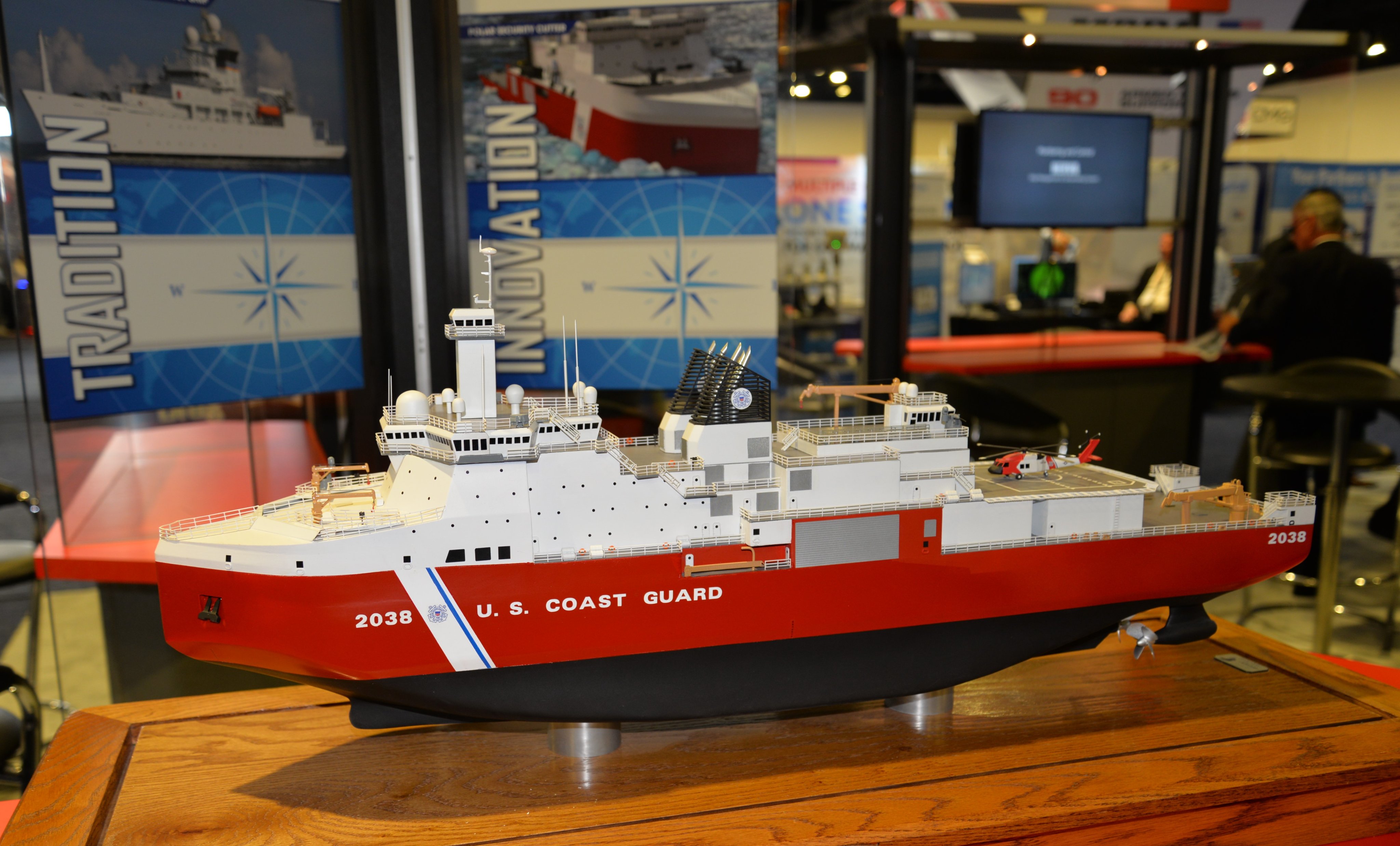
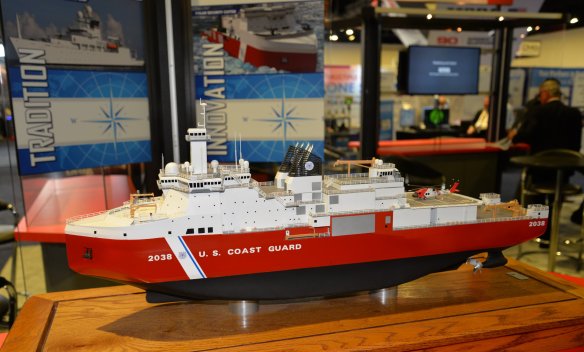
Photo of a model of Halter Marine’s Polar Security Cutter seen at Navy League’s Sea-Air-Space Exhibition have surfaced. Photo credit Chris Cavas.

The Congressional Research Service has once again updated their look at the Polar Security Cutter (heavy icebreaker) program. (See the latest version here.)

I have reproduced the one page summary below.

For me the most important new information is that somewhere there is a new Coast Guard Fleet Mix Study. It has not been made public, but I would sure like to see the results. The last one goes back to 2009. Ever since it was published. it has been an important part of every Congressional Research Service report on the cutter procurement plan and apparently, it has been expanded to include Icebreakers as well as patrol cutters and aircraft. It is an important planning tool. Let’s hope they don’t take three years to make it public like they did the last time.


Summary

Required number of polar icebreakers. The Coast Guard testified in April, June, and November 2023 that a new Coast Guard fleet mix analysis concluded that the service will require a total of eight to nine polar icebreakers, including four to five heavy polar icebreakers and four to five medium polar icebreakers, to perform its polar (i.e., Arctic and Antarctic) missions in coming years. Prior to this new fleet mix analysis, the Coast Guard had stated that it would need at least six polar icebreakers, including three heavy polar icebreakers.

Current operational polar icebreaker fleet. The operational U.S. polar icebreaking fleet currently consists of one heavy polar icebreaker, Polar Star, and one medium polar icebreaker, Healy. In addition to Polar Star, the Coast Guard has a second heavy polar icebreaker, Polar Sea. Polar Sea, however, suffered an engine casualty in June 2010 and has been nonoperational since then. Polar Star and Polar Sea entered service in 1976 and 1978, respectively, and are now well beyond their originally intended 30-year service lives. The Coast Guard plans to extend the service life of Polar Star until the delivery of at least the second Polar Security Cutter (PSC).

Polar Security Cutter (PSC). The Coast Guard Polar Security Cutter (PSC) program is a program to acquire at least three new PSCs (i.e., heavy polar icebreakers), to be followed at some later point by the acquisition of additional new Arctic Security Cutters (ASCs) (i.e., medium polar icebreakers). The Navy and Coast Guard in 2020 estimated the combined total procurement cost of the first three PSCs in then-year dollars as $2,673 million (i.e., about $2.7 billion). The procurement of the first two PSCs is fully funded. The Coast Guard’s proposed FY2024 budget requests $170.0 million in continued procurement funding for the PSC program, which would be used for procurement of long leadtime materials (LLTM) and government-furnished equipment
(GFE) for the PSCs, and for other program expenses. (GFE is equipment that the government purchases and then provides to the shipbuilder for incorporation into the ships.)

On April 23, 2019, the Coast Guard-Navy Integrated Program Office for the PSC program awarded a fixed-price, incentive-firm contract for the detail design and construction (DD&C) of the first PSC to Halter Marine Inc. of Pascagoula, MS, a shipyard that was owned by Singapore Technologies (ST) Engineering. On December 29, 2021, the Coast Guard exercised a fixed price incentive option to its contract with Halter Marine for the second PSC. In November 2022, ST Engineering sold Halter Marine to Louisiana-based Bollinger Shipyards. The former Halter Marine is now called Bollinger Mississippi Shipbuilding.

Commercially available polar icebreaker (CAPI). The Coast Guard’s proposed FY2024 budget also requests $125.0 million in procurement funding for the purchase of an existing commercially available polar icebreaker (CAPI) that would (be) modified to become a Coast Guard polar icebreaker, so as to help augment the Coast Guard’s current polar icebreaking capacity until the new PSCs enter service, and to continue augmenting the Coast Guard’s polar icebreaking capacity after the PSCs enter service.

Great Lakes icebreaker (GLIB). The Coast Guard’s proposed FY2024 budget also proposes to initiate a new procurement program for procuring a new Great Lakes icebreaker (GLIB) that would have capabilities similar to those of Mackinaw, the Coast Guard’s existing heavy Great Lakes icebreaker. The Coast Guard’s proposed FY2024 budget requests $55.0 million in initial procurement funding for the ship, whose total acquisition cost, the Coast Guard estimates, might be roughly $350 million, depending in part on the exact design that is developed for the ship. The Coast Guard’s FY2024 Unfunded Priorities List (UPL) includes an unfunded priority for an additional $20.0 million for the ship that would be used for accelerating initial procurement of LLTM for the ship.

“GAO denies bid protest of waterways commerce cutter award” –Marine Log

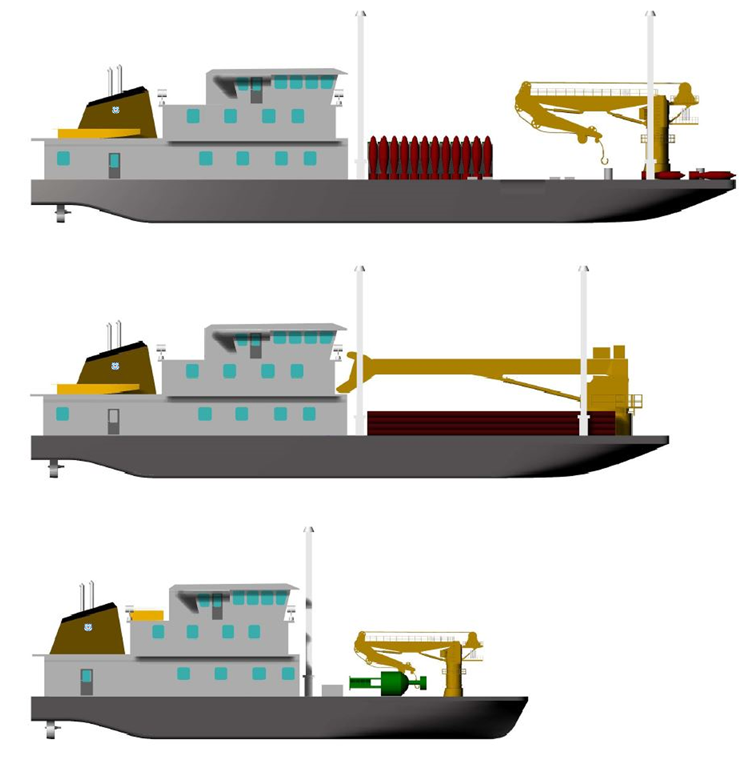
Shown above are Coast Guard indicative designs of a river buoy tender, inland construction tender and inland buoy tender.

Marine Log reports,

The Government Accountability Office (GAO) has rejected a bid protest filed by Steiner Construction Company, Inc., a small business of Bayou La Batre, Alabama, against the continued performance of a contract awarded to Birdon America, Inc. under solicitation No. 70Z02321RPRT00300, issued as a small business set-aside by the Department of Homeland Security, United States Coast Guard (USCG) for the design and production of 27 vessels for its waterways commerce cutter program.

“France’s DGA Orders 7 New OPV For The French Navy” –Naval News

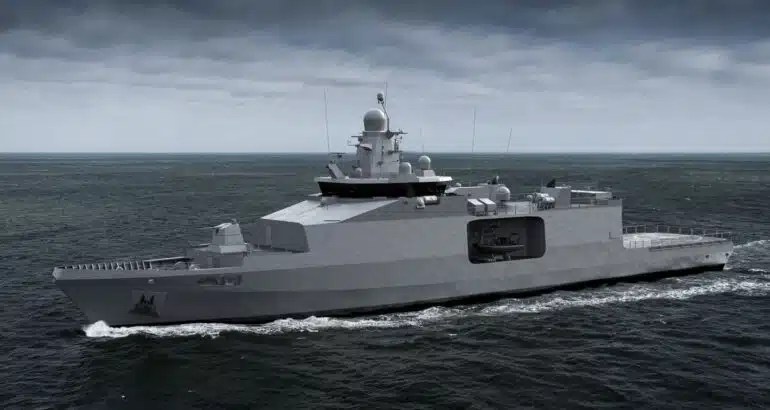
Artist impression of the Patrouilleur Hauturier OPV underway. Naval Group image.

Naval News reports,

The French defense procurement agency (DGA) ordered on 17 November 2023 seven new offshore patrol vessels (OPV) as part of the “Patrouilleurs Hauturiers” program for the French Navy (Marine Nationale).

These “second rank” ships will have missions similar to USCG cutters. We heard about the requirement for these ships and the vessels they would replace three years ago. At that time ten ships were expected. Since then, the requirement was reduced to six and now seven. France has been building several different classes of large patrol vessels (here, here, and here).

This new class of Patrouilleurs Hauturiers (offshore patrol vessels) are expected to displace 2400 tons full load, have a range of 6,000 miles, and have accommodations for up to 84 personnel (passengers and crew). They are expected to mount the new 40mm gun.

“Singapore orders four offshore patrol vessels from Fassmer” –Naval Today

Photo credit: German Federal Police

Naval Today reports,

Singapore’s Ministry of Defence (MINDEF) has signed a contract with German company Fassmer to acquire four new offshore patrol vessels (OPVs)…The ships are based on an OPV design operated by the German Bundespolizei (Federal Police). Furthermore, they are designed with high maneuverability to operate in Singapore’s congested waters.

In a comment, a reader, Katoult, who I see provided the photo above, pointed me to an even better article on the topic at Naval News, thanks.

I have a lot of respect for Singapore’s decision makers. They are very tech savvy and, like the US, cannot depend on cheap labor in large numbers. I am a bit surprised they did not use a version of their Littoral Missions Vessel design for this mission. This is the fourth nation to choose a Fassmer OPV design. It does appear to be a bit more seaworthy and incorporates a hangar that the Littoral Missions Vessel does not include. I think we will see unmanned systems operating from these ships.

“Navy secretary convenes first cross-department shipbuilders meeting” (at the Coast Guard Yard) –Defense News

Secretary of the Navy Carlos Del Toro, left, visits the Coast Guard Academy on Oct. 13, 2023. (Petty Officer 2nd Class Taylor Bacon/U.S. Coast Guard)

Defense News reports the Secretary of the Navy has initiated an attempt to improve commercial shipbuilding in the US by coordinating the efforts of all the federal agencies that fund ship construction including the Navy, Army and Department of Defense, the Coast Guard, the Maritime Administration, and the National Oceanic and Atmospheric Administration.

“He said the council will meet quarterly but that staff-level meetings will take place more regularly. The group will first establish metrics to measure their success and write and sign a charter to explain their mission.”

There are potentially many topics of interest, hopefully shipbuilders will be asked for their input as well. “How can we streamline the process?” Survivability requirements that drive up size and cost should be looked at for at least some classes.

I would propose a pilot project, development of a true small surface combatant, optimized as an ASW escort to protect sea lines of communication, that could be built in second line shipyards, in large numbers if required for mobilization and that could be a dual service ship, used by both the Navy and Coast Guard in peacetime with perhaps different weapons outfits. It might also serve as a design for foreign military sales.

Such a ship should be capable towing a towed array ASW sensor and operating an ASW helicopter like the MH-60R and a VTOL UAS capable of complimenting ASW search functions of both the ship and helicopter.

It should be possible to keep the size of such a ship under 4,000 tons. The Gibbs and Cox proposal for a light frigate for Australia might be a good starting point.

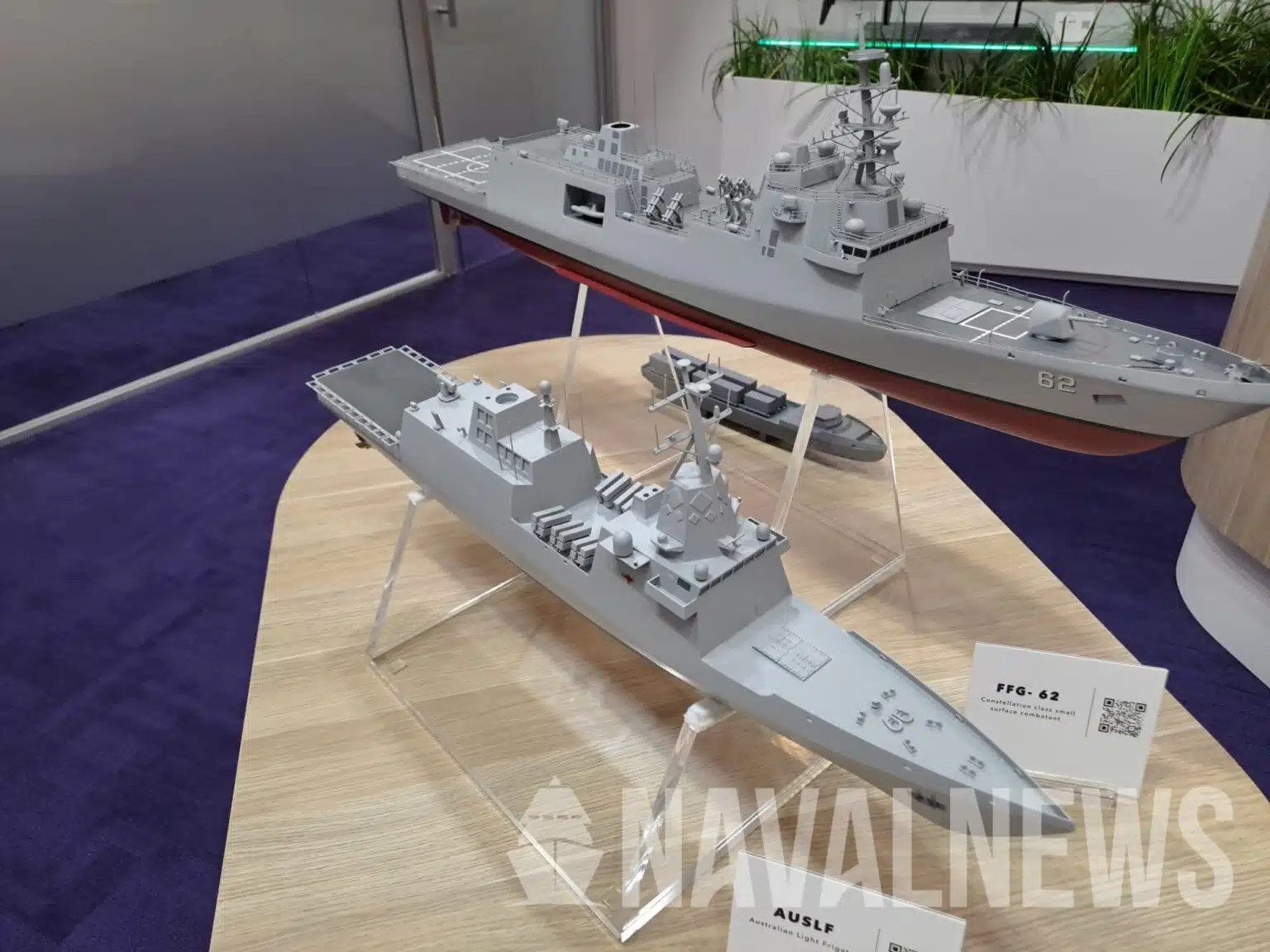
The Australian Light Frigate (foreground) and Constellation class (background) on the Gibbs and Cox stand during Indo Pacific 2023.

Cutter Size Combatants for Australia

Australia is seeing an urgent need to augment the Strike capability of their Navy. This is reflected in a requirement for light frigate/corvette sized combatants with strong anti-surface (ASuW) and self-defense as well as ASW capability.

The resulting ships are about the size of the latest large US Coast Guard patrol cutters, the 4,600 ton Bertholf class National Security Cutter (NSC) and the 4,500 ton Argus class Offshore Patrol Cutter (OPC), in fact two are smaller. While this may not be an exhaustive list of potential competitors, all three proposals I have seen, are discussed in the video above and outlined below. Each includes 16 to 32 vertical launch system (VLS) cells for a variety of missile types and 16 to 24 deck launchers for Anti-Ship Cruise Missiles (ASCM, presumably Naval Strike Missiles). (As these designs are about a decade newer than the OPC, the winning design might form the basis for a future cutter class.)

Navatia’s offer, the Tasman class corvette, is the same length as the Argus class Offshore Patrol Cutters (110 meters / 360′), but considerably lighter at 3,600 tons full load (vs 4500 tons). This class is to be based on a class built for Saudi Arabia, which is in turned based on a class of Offshore Patrol Vessels built for Venezuela. The proposal includes 16 VLS and 16 ASCM launch tubes. Presumably they will be diesel powered with a speed about the same as the parent designs, 25 knots.

The Australian Light Frigate (foreground) and Constellation class (background) on the Gibbs and Cox stand during Indo Pacific 2023.

Gibbs and Cox proposal (pictured above), at 117 meters in length and 3,800 tons, this design is also smaller than the OPC by 700 tons. It takes the novel approach of deleting the usual main gun entirely in favor of 32 VLS and 24 ASCM launch tubes. CIWS would be provided by Phalanx or SeaRAM and close-in anti-surface and “shot across the bow” signaling would be provided by Mk38 gun mount or equivalent. (This may be taking the trend to smaller main guns to its logical conclusion.) Speed will be at least 30 knots using CODELAG GE LM2500+ propulsion.

TKMS offers MEKO A210 Frigate. This is a bit larger, at 4700 tons, 200 tons larger than the OPC and 100 tons larger than the National Security Cutter. The proposal includes 32 VLS and 16 ASCM. It is powered, like the earlier A200 frigates, by two diesels each driving conventional propellers and a gas turbine driving a central water jet, a system TKMS calls CODAG-WARP (WAter jet and Refined Propellers). Speed is likely 28-29 knots.

“Coast Guard Cutter Procurement: Background and Issues for Congress, Updated Oct 19, 2023” –CRS

US Capital West Side, by Martin Falbisoner

The Congressional Research Service has again updated their “Report to Congress on Coast Guard Cutter Procurement”. (This link will always take you to the most recent edition of the report.) My last post on this evolving document was in reference to a August 30, 2022 update. I have reproduced the one-page summary in full below. It gives a good picture of where we are.

I will try to provide a little more detail after I get a chance to read the full report. Until then, remember that the full price of the ships includes much more than just the shipyard’s building costs. In addition to government furnished equipment, it includes the crew cost before the ship is accepted, their accommodations at the building site, and their training and travel. It may also include supporting shoreside infrastructure.


Summary
The Coast Guard’s program of record (POR), which dates to 2004, calls for procuring 8 National Security Cutters (NSCs), 25 Offshore Patrol Cutters (OPCs), and 65 Fast Response Cutters (FRCs) as replacements for 90 aging Coast Guard high-endurance cutters, medium-endurance cutters, and patrol craft.

National Security Cutters are the Coast Guard’s largest and most capable general-purpose cutters; they are replacing the Coast Guard’s 12 Hamilton-class high-endurance cutters. NSCs have an estimated average procurement cost of about $670 million per ship. Congress has fully funded the procurement of 11 NSCs—three more than the 8 in the Coast Guard’s POR—including the 10th and 11th in FY2018, which (like the 9th NSC) were not requested by the Coast Guard. The Coast Guard’s proposed FY2024 budget requests $17.1 million in procurement funding for the NSC program for post-delivery activities for the 10th and 11th NSCs, and for class wide activities. Nine NSCs have entered service; the Coast Guard accepted delivery of the 10th on October 13, 2023, and plans to commission it into service in 2024. The 11th is under construction.

Offshore Patrol Cutters are intended to replace the Coast Guard’s 29 aged medium-endurance cutters. Coast Guard officials describe the OPC program and the Polar Security Cutter (PSC) program (which is covered in another CRS report) as the service’s highest acquisition priorities. The first four OPCs are being built by Eastern Shipbuilding Group (ESG) of Panama City, FL. The Coast Guard held a full and open competition for a new contract to build the next 11 OPCs (numbers 5 through 15). On June 30, 2022, the Coast Guard announced that it had awarded a fixed-price incentive (firm target) contract to Austal USA of Mobile, AL, to produce up to 11 offshore patrol cutters (OPCs). The Coast Guard’s proposed FY2024 budget requests $579.0
million in procurement funding for the construction of the sixth OPC, the procurement of Long Lead Time Materials (LLTM) for the seventh OPC, and other program costs.

One oversight issue for Congress concerns substantial cost growth and schedule delays in the OPC program. A June 2023 Government Accountability Office (GAO) report on the OPC program states “The OPC’s total acquisition cost estimate increased from $12.5 billion to $17.6 billion between 2012 and 2022. The program attributes the 40 percent increase to many factors, including restructuring the stage 1 contract [for OPCs 1 through 4] and recompeting the stage 2 requirement [for OPCs 5 through 15] in response to a disruption caused by Hurricane Michael, and increased infrastructure costs for homeports and facilities, among other things. In addition, the program incurred a 1.5-year delay in the delivery of the first four OPCs due to Hurricane Michael and issues related to manufacturing the cutter’s propulsion system. GAO also found indicators that the shipbuilder’s significant level of complex, uncompleted work may lead to further delays.”

Fast Response Cutters are considerably smaller and less expensive than OPCs; they are replacing the Coast Guard’s 49 aging Island-class patrol boats. The Coast Guard’s FY2020 budget submission estimated the total acquisition cost of the 58 cutters intended for domestic use at $3.748 billion, or an average of about $65 million per cutter. A total of 65 FRCs have been procured through FY2023. As of August 10, 2023, 53 FRCs have been commissioned into service. The Coast Guard’s proposed FY2024 budget requests $20.0 million in procurement funding for the FRC program; this request does not include funding for procuring any additional FRCs. The Coast Guard’s FY2024 Unfunded Priorities List (UPL) includes, as one of its items, an unfunded priority for procuring four more FRCs (which would be the 66th through 69th in the program) for a combined procurement cost of $400.0 million, or an average of $100 million per
cutter, to provide increased Coast Guard presence and engagement with allied and partner countries in the Indo-Pacific region