Chuck Hill's CG Blog

Chuck Hill's CG Blog

“The Christening and Launch of U.S. Coast Guard Offshore Patrol Cutter ARGUS” –Video

Above we have a video of the christening and launch of the future USCGC Argus. Below my comments is Eastern’s news release.

The video is just over an hour. Preliminaries are over at about minute 10.

  • 17:30 Remarks by RAdm. Chad Jacoby, CG-9
  • 23:00 Admiral Fagan, Commandant
  • 31:45 Sponsor, Capt. Beverly Kelley, USCG (ret.)
  • 40:00 Christening
  • 56:00 Launch

Between the christening and the launch there is some explanation of the launch process.

It is a very large cutter and a good looking ship, but she is still months from delivery. Just to review how we got this far.

As to the follow-on ships:


EASTERN SHIPBUILDING GROUP CHRISTENS AND LAUNCHES U.S. COAST GUARD’s FIRST HERITAGE CLASS OFFSHORE PATROL CUTTER

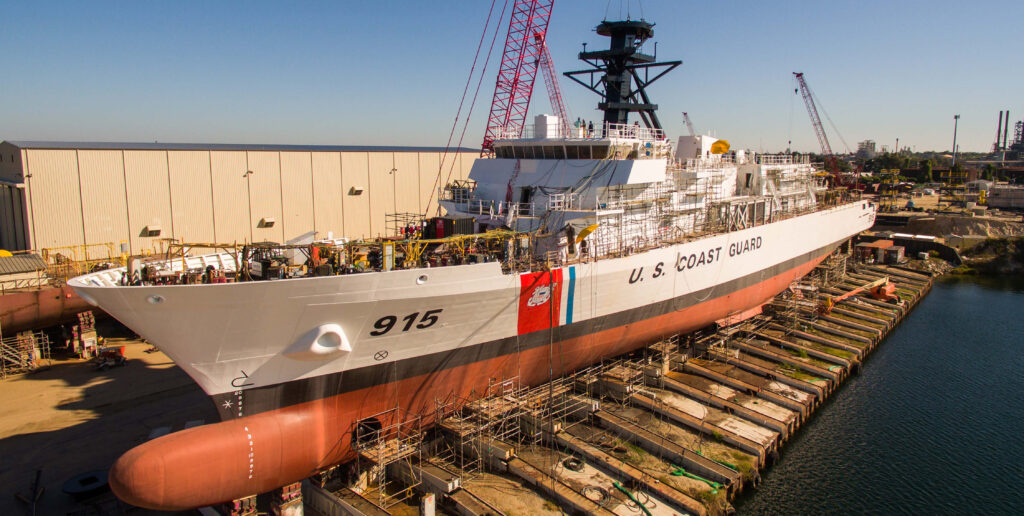
PANAMA CITY, FL – Today, Eastern Shipbuilding Group christened and launched USCGC ARGUS (WMSM-915), the U.S. Coast Guard’s first Heritage-class Offshore Patrol Cutter (OPC). The ceremony was held at Eastern’s Nelson St. Shipyard in front of more than 3000 dignitaries and guests. Admiral Linda Fagan, Commandant of the U.S. Coast Guard, delivered the keynote address.

Ship Sponsor, Captain (Ret.) Beverly Kelley, had the honor of Christening the vessel. In her distinguished military career, Captain (Ret.) Kelley was the first woman to command a U.S. military vessel as the Commanding Officer of the 95-foot patrol boat, USCGC CAPE NEWAGEN and was the first woman to command both a medium endurance cutter and a high endurance cutter in USCGC NORTHLAND and USCGC BOUTWELL respectively.

“We are proud to christen this first of class national security asset in front of her crew today,” said Joey D’Isernia, CEO of Eastern Shipbuilding Group, Inc. “With each milestone we reach, our employees are constructing the most advanced and capable ship the U.S. Coast Guard has ever seen.”

“The Offshore Patrol Cutter (OPC) is one of the Service’s highest acquisition priorities and is absolutely vital to recapitalizing the capability provided by our legacy fleet of 210-foot and 270- foot Medium Endurance Cutters (MEC),” said Adm. Linda Fagan.

“We have overcome unprecedented challenges to arrive at this pivotal moment to witness this spectacular vessel enter the water for the very first time. People are only just beginning to see what this vessel is truly capable of and like the steel forged on her, we will not compromise,” said Joey.

Senator Rick Scott said, “It’s truly a monumental occasion in enhancing our national security as Eastern Shipbuilding Group’s Nelson Shipyard officially christens and launches the U.S. Coast Guard Offshore Patrol Cutter ARGUS (WMSM-915). Over the past few decades the need for our Coast Guard as grown globally with operations spanning the Artic, Antarctic, Middle East and Indo-Pacific, all while it continues to protect our valuable United States shoreline. This first-in-its-class vessel is a testament to the great coordination between Eastern Shipbuilding and the Coast Guard that now gives the service a much needed upgrade with the tools and capabilities needed for the great women and men of the Coast Guard to take the service even further in the future. As Florida’s U.S. Senator, I am fighting every day to support the continued success of Florida businesses and our Coast Guard as they work to ensure to safety and wellbeing of Americans across the nation.”

“The story of Offshore Patrol Cutter Argus is one of perseverance. Eastern Shipbuilding started working on Argus prior to Hurricane Michael. In the days that followed the storm, the Eastern Shipbuilding team returned to their yard ready to do their part,” said Congressman Dunn. “Despite the challenges of recovering from a catastrophic hurricane, this team stuck together to see this project through. This offshore patrol cutter means so much more than many realize. Argus is a reminder of not only how proud Eastern Shipbuilding and Florida’s Second Congressional District should be of their hard work and determination, but it is also a crucial asset to maintaining national security dominance.”

Over 1500 highly skilled craft employees and program professionals at Eastern Shipbuilding Group and 200 businesses from over 25 states are supporting the production of the first four Offshore Patrol Cutters in Panama City. The OPC is designed to conduct an array of missions including law enforcement, drug and migrant interdiction, search and rescue, disaster relief, and other homeland security and defense operations in support of the nation’s maritime security and border protection. The OPC design includes the capability of carrying an MH-60R or MH-65 helicopter and three operational over-the-horizon small boats.  The vessel is also equipped with a highly sophisticated Command, Control, Computers, Communications, Cyber, Intelligence, Surveillance, and Reconnaissance (C5ISR) suite that will greatly enhance the U.S. Coast Guard’s mission capabilities.

The first OPC is named for the Revenue Cutter Argus, which was one of the first 10 ships assigned to the U.S. Revenue Cutter Service, a predecessor service to the U.S. Coast Guard. Revenue Cutter Argus began 13 years of service to the newly formed United States of America in 1791.

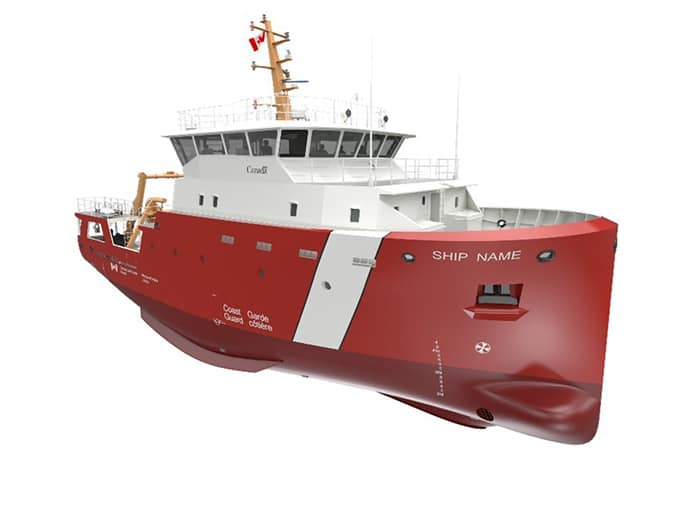
“Canada orders first hybrid Coast Guard vessel” –Marine Log

Canada’s first hybrid Coast Guard vessel. [Image: Robert Allan Ltd.]

Marine Log reports,

“Public Services and Procurement Canada has awarded Gaspé, Quebec, shipbuilder Chantier Naval Forillon a CAD 55.5 million (about US$40.5 million) contract to build Canada’s first hybrid Coast Guard vessel: the new Near-Shore Fishery Research Vessel (NSFRV). The vessel is among those that was listed when Canada announced plans, back in May, to invest about US$1.8 billion in renewing the Canadian Coast Guard’s small vessel fleet.

Its primary job is not something the US Coast Guard does. It’s not large, 32 meters (105′), and it’s not cheap, but it does incorporate a lot of interesting technology that should cut fuel costs. It gets by with a very small crew, five plus six Fisheries and Oceans scientists, but then it is not expected to do law enforcement or a lot of boat ops or boardings.

“Christening and Launch Ceremony for U.S. Coast Guard’s First Offshore Patrol Cutter Friday, October 27, 2023” –Eastern Shipbuilding

Future USCGC Argus building at Eastern. Eastern Shipyard photo.

Below is a news release from Eastern Shipbuilding. Good to see. 

MEDIA ADVISORY

Tuesday, October 17, 2023

Eastern Shipbuilding Group to Host Christening and Launch Ceremony for U.S. Coast Guard’s First Offshore Patrol Cutter

Friday, October 27, 2023

What:  Christening and Launch Ceremony for USCGC ARGUS (WMSM – 915)

Who:

Joey D’Isernia, CEO, Eastern Shipbuilding Group, Inc.

Admiral Linda Fagan, Commandant, USCG

Captain (Ret.) Beverly Kelley, Sponsor

Rear Admiral Chad L. Jacoby, Assistant Commandant for Acquisitions & Chief Acquisition Officer, USCG

Where: Eastern Shipbuilding Nelson Facility

2200 Nelson Street, Panama City, FL

When: Friday, October 27, 2023 – 1:00 PM central set up / 2:00 PM central event

The Christening and Launch of U.S. Coast Guard Offshore Patrol Cutter ARGUS (WMSM-915) is scheduled to take place at Eastern Shipbuilding Group’s Nelson Shipyard on October 27, 2023. The christening of the lead vessel of the Heritage Class Offshore Patrol Cutters is a historic event for the Coast Guard and marks the beginning of a new fleet of national security assets that will support critical missions at sea for decades to come. The christening ceremony is a time-honored tradition in shipbuilding that will recognize the history and significance of ARGUS and her sponsor, Capt. Beverly Kelley.

Request Media Credentials:
Please email Jessica Ditto at jditto@easternshipbuilding.com by Tuesday, October 24, 2023 to request media credentials and parking instructions.

FRC #54, “Fifth New England-based Fast Response Cutter to be commissioned in New Castle” –D1

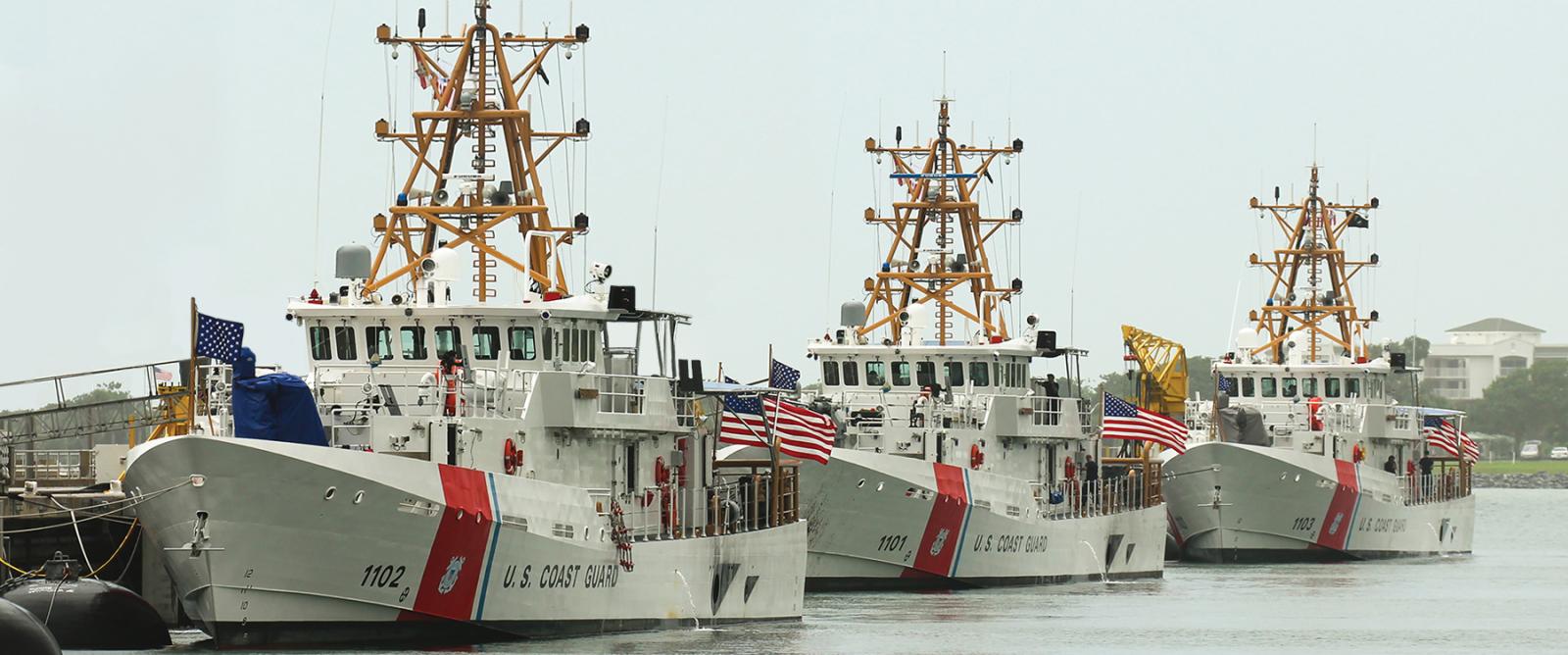
Sister ships. The first three fast response cutters—the USCGC Richard Etheridge (WPC-1102), Bernard C. Webber (WPC-1101), and William Flores (WPC-1103). U.S. COAST GUARD

Below is a news release from District 1. This is #54 with 11 more in the pipeline. The last will probably arrive in 2026 unless more are added.


Oct. 16, 2023

CORRECTED MEDIA AVAILABILITY: Fifth New England-based Fast Response Cutter to be commissioned in New Castle

Editors’ Note: This correction notes updated time for the ceremony and arrival, as well as ship information.
Media interested in attending the ship’s commissioning ceremony are requested to RSVP with d1publicaffairs@uscg.mil no later than 4 p.m. Wednesday, October 18th. Media are requested to arrive by 8:30 a.m. to clear security and be escorted to the event, and must provide media credentials and government-issued photo ID.

WHO: Lt. Jacklyn Kokomoor, commanding officer of Coast Guard Cutter William Sparling (WPC-1154), Caroline S. Sparling, the cutter’s sponsor, along with additional Sparling family members

WHAT: Commissioning ceremony for the Coast Guard Cutter William Sparling

WHEN: Thursday, October 19th, at 9 a.m.

WHERE: 25 Wentworth Rd New Castle, NH 03854

BOSTON — The Coast Guard Cutter William Sparling (WPC-1154) is scheduled to be commissioned during a ceremony Thursday at 9 a.m.

The Coast Guard’s newest cutter was accepted by the Coast Guard on July 20, 2023 and will be the fifth of six Fast Response Cutters homeported in Boston.

The Sentinel-class fast response cutter (FRC) is designed for multiple missions, including drug and migrant interdiction; ports, waterways and coastal security; fishery patrols; search and rescue; and national defense. The Coast Guard has ordered a total of 65 FRCs to replace the 1980s-era Island-class 110-foot patrol boats. The FRCs feature advanced command, control, communications, computers, intelligence, surveillance and reconnaissance equipment; over-the-horizon cutter boat deployment to reach vessels of interest; and improved habitability and seakeeping.

William Sparling was one of the first Coast Guard enlisted members to be awarded the Silver Star Medal, one of the nation’s highest military awards for valor in combat. Sparling served as a landing craft coxswain during the Battle of Tulagi, a strategically important island in the Pacific theater, during World War II. The island was captured by enemy forces in May 1942, and Allied forces were concerned that the occupation of Tulagi would be used to threaten Allied units and supply routes in the region. Allied forces arrived at Tulagi on August 7, 1942, to reestablish control of the island.

The amphibious assault, supported by the landing craft piloted by Sparling and other coxswains, was the first U.S. offensive of World War II and was one of the first in a series of battles that defined the Guadalcanal campaign. During the invasion, Sparling and other coxswains landed the first wave of U.S. Marines from USS McKean on the beaches of Tulagi. Over the next three days of fighting, Sparling and others made repeated trips between the Navy destroyer and Tulagi to deliver equipment, ammunition and other supplies to Marines as they engaged a determined occupying force of 800 troops. On August 9, the remaining enemy forces surrendered, and the Allies successfully secured Tulagi.

NSC #10 Delivered

Former Master Chief of the Coast Guard, Vince Patton, reported his attendance at the delivery ceremony for the tenth National Security Cutter on the Coast Guard Retired Veterans Facebook page,

“An enjoyable day with the crew of the USCGC CALHOUN as it has officially been signed over to the USCG today. The CALHOUN will be officially commissioned on April 20, 2024 in Baltimore, MD.”

The ship is expected to be homeported in Charleston, SC.

OSK Design for Proposed Danish Arctic Frigate

Below the break, you will find an OSK Design news release regarding their proposal for Arctic frigates to replace the four ship Thetis class, which performs many of the functions of coast guard cutters. Earlier reports had seemed to indicate the Thetis class would be replaced by a different design, OMT’s MPV-80, but apparently the Danish government has not yet made a choice.

The OSK Design’s Arctic frigate proposal is featured in the video above, beginning at time 5:00.

The two designs look very different. The MPV-80 is short (84 meters) and portly (17.6 meters of beam). The OSK “Arctic Frigate” has more conventional proportions but is larger than the OPC in every dimension and may be larger than the NSC.

Still, they do share some characteristics. Both feature the SH Defence “CUBE” modular system. Both are ice class designs. Both appear to be equipped with two Rheinmetall Oerlikon 35mm Millennium Guns as CIWS. 

The Danes have created some widely admired designs lately, including the Absalon class and the Iver Huitfeldt class which has evolved into the British Type 31 “Arrowhead 140” frigate also being built for Indonesia and Poland. There are not many Arctic frigate designs out there. This will be interesting. We might want to reconsider our Arctic Security Cutter requirements.


Danish naval architects OSK Design unveils latest concept for an Arctic frigate

Leaders in maritime innovation, OSK Design, is proud to introduce their latest design, the Arctic frigate, an exceptional vessel meticulously crafted for operations in the North Atlantic, High North, and Greenland regions. This multi-purpose Arctic frigate is set to redefine maritime capabilities with its significant features and capabilities. One of the notable features of the Arctic frigate is its fully operational helicopter, ready to take on a key role in its missions. This helicopter is a critical asset for Arctic operations, allowing for airborne scouting, transport, and search and rescue missions in the challenging Arctic environment.

Mission-ready versatility, arctic-ready and an exceptional mobility
The Arctic frigate is a true workhorse, designed to excel in a wide range of missions.
The Arctic frigate is classed for year-round operation in the arctic, capable of withstanding the most challenging ice conditions while maintaining optimal performance. With a length of 125 meters, a beam of 18.0 meters, a maximum draught of 6 meters, and a top speed of 23+ knots, this frigate is built for swift and agile navigation in the most unstable waters.

Equipped to handle any situation, the Arctic frigate boasts an impressive arsenal, including a gun, missile launcher, and overhead weapon systems, ensuring readiness for both offensive and defensive maneuvers. Operating in one of the harshest environments on Earth demands extraordinary capabilities.

Mission flexibility redefined
The Arctic frigate is powered by a state-of-the-art diesel-electric system (PODs), offering both efficiency and maneuverability. A crew capacity of 60-125+ depending on the task, a fully equipped helicopter, and a drone capacity for air, surface, and underwater operations ensure that the Arctic Frigate is ready for any mission. With two RHIBs (Rigid-Hulled Inflatable Boats) up to 9 meters in length and one stern-launched boat up to 12 meters, the vessel is equipped for swift and effective search and rescue missions.

The mission bay is designed to accommodate various modular systems and stores, such as the ACTAS ASW system, mine-laying modules, oil spill booms and equipment for the Arctic Standby Force, allowing for mission-specific adaptability. With its large, modularized mission bay, this vessel is adaptable for Anti-Submarine Warfare (ASW), surface and air surveillance, maintenance of sovereignty, search and rescue, disaster relief and enhanced self-defense.

With the Arctic frigate, OSK Design has designed a vessel that represents the pinnacle of maritime engineering and innovation. It is uniquely prepared to meet the demands of operations in the Arctic, offering a combination of versatility, power, and adaptability.

For more information about the Arctic frigate and OSK Design’s commitment to pushing the boundaries of maritime design, please contact Lars Povl Jensen, Head of Defence at OSK Design, Phone: +45 31 43 75 60 or mail: lpj@oskdesign.com

VARD’s “Vigilance” 75 meter OPV Design

Naval News provides a bit more information on VARD’s proposal of a 75 meter OPV using the CUBE system of replaceable modules for the Canadian Navy. The discussion of the OPV begins in the video at time 3:26.

If these are to replace the 12 ship Kingston class, now 24 to 27 years old, this could be a significant program.

We talked about this proposal earlier. Canada apparently intends to deploy these well beyond the Canadian EEZ. The flight deck appears to be small and perhaps capable of operating only UAS. I still think the design generally is a little too tight, that it should be 5 to 15 meters longer and have a flight deck capable of operating a helicopter. I would also like to see a gun larger than 30mm.

Nevertheless, the CUBE system looks promising, possibly permitting an OPV to be quickly converted to meet emerging needs.

There is no indication Canada has accepted this design, but I have seen no information about competing designs.

Thanks to Lee for bringing this to my attention. 

Three Articles About the Webber Class FRC

The first three fast response cutters—the USCGC Richard Etheridge (WPC-1102), Bernard C. Webber (WPC-1101), and William Flores (WPC-1103).
U.S. COAST GUARD

The September issue of US Naval Institute Proceedings has two articles about the Webber class WPCs that are currently featured articles online.

MSN shared a 1945 article by James Holmes, J. C. Wylie Chair of Maritime Strategy at the Naval War College, that seconds Cdr. Hulse proposal, “The U.S. Navy Needs Sentinel-Class Cutters to Serve as Missile Patrol Craft,

These are the right ships to help carry out U.S. maritime strategy in congested coastal terrain such as the Western Pacific, in wartime and times of tense peace alike. Denying an antagonist like China’s navy access to waters around and between Pacific islands is the strategy’s beating heart. Swarms of small, cheap, lethal surface and subsurface warships working with aircraft overhead and troops on the islands can close the straits along the first island chain, laying fields of overlapping fire that imprison Chinese sea and air forces within the island chain and bar the return home to units plying the Western Pacific. For self-defense, small surface combatants can mingle with merchant traffic amid East Asia’s cluttered maritime geography. In so doing they obscure their whereabouts and turn ambient conditions to tactical advantage. Let Chinese rocketeers try to distinguish friend from foe.

The first article by Lt. Chan suggests, 

Continuing production of fast response and national security cutters and transferring early hulls to regional allies would improve deterrence and interoperability.

This may not seem to make sense from the Coast Guard’s point of view in that USCGC Bernard C. Webber was commissioned in 2012 and the last of the 65 funded vessels of the class will be commissioned in about three years at which point the Webber will be only about 14 years old, still pretty new for a Coast Guard vessel. But looking at this from a whole of government perspective it looks a bit different. State Department hopes to gain or maintain influence with friendly nations that may not be able to afford adequate resources to patrol their waters. We also have an interest in the health of our ship building industry. There is presidency for this. Australia has twice built new patrol boats for their Western Pacific neighboring island nations. The Coast Guard would, of course, be much more receptive to the idea if funding for the replacement craft came out of someone else’s budget.

If the Navy did choose to build vessels of this class, and keep the production line going, then transfers of early model FRCs might be more readily accepted as they reach 20 or more years old.

The Second Article by Cdr. Hulse suggests,

“…the FRC’s Mk IV over-the-horizon cutter boat weighs 8,700 pounds and is stored in a notch near the stern. While this boat is highly capable for a variety of Coast Guard missions, it would not play a role for the Navy in conflict. Instead, a Navy FRC could mount a Naval Strike Missile box launcher with four tubes (8,600 pounds) at the stern, making it a formidable surface combatant. In addition, the deck forward of the pilothouse has considerable space for launching and recovering unmanned aerial vehicles (UAVs), enabling aerial surveillance and targeting. In fact, a Coast Guard FRC launched and recovered an Aerovel Flexrotor UAV while operating with the U.S. Navy’s Task Force 59 in Bahrain…with the current production line delivering four new FRCs per year to the Coast Guard at $65 million each. At that rate, the Navy could field 20 FRCs in just five years for the price of one Constellation-class frigate, which is projected to cost $1.3 billion per hull.”

The article goes into considerable detail about how the class has exceeded expectations along with cautions about what was required to make them succeed. It also suggests that the FRC could be the basis for an unmanned surface vessel.

Boots on the Ground, Navy Style:

City police forces have found they need patrolmen walking the beat who know the neighborhood and the people who live there to effectively fight crime. Armies need infantry to control and hold territory.

High end combatants can defeat their hostile counterparts to make sea control possible, but effective sea control is not possible without craft that can get into shallow water and enter every port. As Julian Corbett would said, Naval Control is not exercised by battleships.

The US Navy, forever focused on winning the big battle, has never had much enthusiasm for the craft that are the “boots on the ground” of a naval war. They tend to assume that allies and/or the Coast Guard will fill that role, or if not, they can build them when they need them and to some extent it has worked. Even so, it might have worked better if we had built and operated more of the vessels of the type before the shooting started.

In World War I, the US built hundreds of subchasers and 1000 ton destroyers. In WWII it was hundreds of PT boats that proved largely ineffective as torpedo boats but essential for the destruction of coastal traffic in both the Pacific and the Mediterranean. They were supplemented by the original LCS, Landing Craft Support, heavily armed shallow draft landing craft, nearly the same size as the FRCs. For Vietnam the Navy called on the Coast Guard and also built 170 Swift Boats and 718 Patrol Boat, River.

The U.S. Navy destroyer USS William D. Porter (DD-579) sinking after she was near-missed by a “Kamikaze” suicide aircraft off Okinawa, 10 June 1945. USS LCS(L)(3)-86 and McCool‘s LCS(L)(3)-122 are alongside, taking off her crew. Though not actually hit by the enemy plane, William D. Porter received fatal underwater damage from the near-by explosion.

Why would the Navy want these Patrol Craft?:

  • To enforce blockades
  • To counter kamikaze UAS and USV.
  • To support UAS, USV, and UUVs
  • To counter covert mine laying, arms smuggling, and intelligence agent or special forces transportation by boat.
  • To escort landing craft into an amphibious objective area. To rescue personnel from craft that are sunk. To tow disabled craft to safety. If properly equipped, to provide short range direct Naval fire support.

    Strait of Hormuz, august 6, USS Thomas Hudner, the Navy’s Lewis and Clark class cargo ship USNS Amelia Earhart and the U.S. Coast Guard’s Sentinel class cutter USCGC Charles Moulthrope, L3Harris Arabian Fox uncrewed surface vessel (USV)

If assigned to 5th Fleet, it would be logical to equip them with Hellfire/JASM or APKWS to counter Iranian drones and swarm tactics. In the Western Pacific arming with Naval Strike Missile is logical as would using the same air-search radars being used on the FRCs based in Bahrain. It might be possible to fit a Sea RAM forward, but if not, one or two remote weapon stations with an AAW capability might be enough.

A Final Note:

There is another reason we might want to have other nations to have FRCs. Since my cell phone has facial recognition, I think US Navy ships will have a hard time hiding among the traffic, particularly at the start of a conflict when their satellites are operational, and their fishing boats and merchant ships seem to be everywhere. But telling a USN FRC from a Vietnamese, Philippine, or Malaysian FRC would be quite difficult. It would complicate targeting.

Canadian Coast Guard Bay Class Motor Lifeboats–MLB and WPB Replacement?

Canadian Coast Guard vessel CCGS Garbarus Bay | Photo credit: Mel & Jer Creative

Recent reports of the delivery of CCGS Garbarus Bay prompted me to look again at the Canadian Coast Guard Bay class motor lifeboats. They are considerably larger than the USCG 47 foot MLBs. I was also reminded; we have not heard anything recently about replacements for the now retired 52 foot MLBs. The 87 foot WPBs are also nearing the end of their useful life. A large, reasonably fast MLB like the bay class could replace the 52 foot MLBs and some of the WPBs. (In other places we may need a different kind of WPB replacement.) With their smaller crew, be less expensive to operate than the WPBs. These could be the true “Fast Response Cutters” capable of responding in extreme weather when a Response boat medium or even an 87 footer could not. Might even call them Response Boat, Large.

The Canadians are procuring 20 of these large MLBs. The vessel’s particulars are as follows:

  • Displacement: 62.5 tons (47 foot MLBs are 18 tons; 87 footers are 91 tons)
  • Length overall: 19.0 meters (62′)
  • Length DWL: 17.5 meters (57.4′)
  • Beam: 6.3 meters (21′)
  • Depth at midship: 2.58 meters
  • Hull draft, nominal: 1.67 meters (5.5′)
  • Power: 2,400 kW (about 3,200 HP, more than the 2,950 HP of the 87 foot WPBs and more than three times the power of the 47 footers)
  • Speed: 23.5 kts

According to Wikipedia,

They are capable of operating in 12-metre (39 ft) waves, and in wind conditions at 12 on the Beaufort scale. The vessels’ hulls will be aluminum, not FRC (fibre reinforced composite), as with the original Severn design.

Canadian Coast Guard vessel CCGS Chedabucto Bay | Photo credit: Chantier Naval Forillon

“While Eastern Shipbuilding Thrives, New Coast Guard Cutter Lags Behind” –Forbes

Eastern Shipbuilding Group, Inc. photo

Forbes reports,

The U.S. Coast Guard’s “highest investment priority,” the $17.6 billion Offshore Patrol Cutter (OPC) program, faces additional delay. After blowing through a contractual delivery date of June 2023, governmental auditors are already suggesting that the new delivery estimate of late 2024, coming as Panama City-based OPC shipbuilder Eastern Shipbuilding Group inks an array of new commercial and governmental contracts, is optimistic.

The Coast Guard, in an emailed statement, now estimates that Eastern Shipbuilding Group will deliver the future Coast Guard Cutter Argus, the first of the Coast Guard’s much-needed OPCs, by September 30, 2024. The revised delivery target for the 360-foot vessel comes almost six years after the yard first cut steel for Argus back in January 2019.

There is a lot of additional analysis in the post.

As you may remember, Austal was awarded a contract in June 2022 that included options to build up to eleven OPCs, while Eastern’s contract for up to nine OPCs was truncated at four ships.

Thanks to Robert Cullison for bringing this to my attention.