Precision Machine Guns?

DefenseTech is reporting that the Coast Guard is looking for means of making its general purpose machine guns into precision weapons, so that if they have to use the weapons, the possibility of collateral damage can be minimized.

“The Coast Guard wants to make its deck-mounted machine guns accurate enough for crowded American harbors.

“To do that, Coast Guard gunners need a weapon mount that’s stable enough to turn an M240 machine gun – a weapon designed to kill area targets on the battlefield – into a precision tool capable of putting every round on target.”

Gratifying to see that the Coast Guard is thinking though how situations might develop where they will need to use deadly force in situations where there is a danger of collateral damage. Its easy to understand that using a machinegun on an unstabilized mount on a boat that is bouncing around might endanger the local population as well as the intended target.

The Navy may have already selected a stabilized machine gun mount: http://www.kongsberg.com/en/kps/news/2013/september/the-sea-protector-mk50-supporting-the-us-navy/

More here: http://en.wikipedia.org/wiki/Protector_(RWS)

But even that may be too large for some of our smaller boats.

There are smaller alternatives. Thanks to RStoner for bringing this option to my attention:

Looks like this might have trouble accurately firing bursts, but apparently it could accurately fire single shots and give boats some of the disabling fire accuracy of the airborne use of force units without the extensive training.

Still I hope the Coast Guard will look beyond simply making a more accurate machine gun. Any gun is likely to have a percentage of its rounds go astray, possibly endangering the innocent.

Perhaps the Coast Guard should continue this train of thought, applying the same concern on a larger scale. After all, we may need to stop much larger vessels inside US internal waters. Shooting 25mm or even 57mm inside Puget Sound or Chesapeake Bay is a poor option, but given the way cutters are currently equipped, it may be the only option available and ultimately they may be ineffective even for small targets.

Looking at true precision weapons, there are a whole range of options:

Griffin can be used for relatively small targets, here and here.

For larger targets Longbow Hellfire is already in the US Navy inventory or perhaps the largely American made BAE Brimstone/Sea Spear which appears to offer even more target selectivity.

Once the target gets larger than about 1000 tons it is going to be very difficult to stop. As noted earlier I think the answer to this problem is a light weight torpedo that can target a ship’s propellers.

Frankly I doubt we will have a major cutter (WMSL/WHEC/WMSM/WMEC) in the area if the Coast Guard ever suddenly finds itself needing to stop a maritime terrorist threat. They do not hang around US ports when they are underway, and when they are in port, they take too long to go from cold iron to underway. If this ever happens the largest Coast Guard vessel likely to respond is a Webber Class WPC. They are large enough to mount weapons capable of stopping even the largest ship. They really need to be properly equipped for the possibility.

Related:

Why Arm Coast Guard Assets?

New Light Weight Launcher

Tenth Webber Class WPC, Raymond Evans, Delivered

Some progress on recapitalization. MarineLog is reporting delivery of the tenth Webber class WPC (Fast Response Cutter) named for Raymond Evans. Evans was with Munro when largely Coast Guard manned boats pulled a Marine detachment out of a trap. More information:

http://www.uscg.mil/history/weboralhistory/EvansOralHistory.asp

http://www.uscg.mil/history/WEBORALHISTORY/Ray_Evans_Video_Interview.asp

Underway Time–Navy

Navy Times reports that eight types of surface ships including aircraft carriers, amphibs, command ships, cruisers, destroyers, frigates, and LCSs averaged 33.1% of the time underway during the years 2011 to 2013.

Wonder how figures for the Coast Guard compare? The Navy figure is almost certainly different from “Days Away From Homeport” although the article seems to equate it when they say, “Sailors…have seen more of the sea than they have of their families in the past three years.” How are they counting yard periods away from homeport (probably a rare event for them), or in port time way from homeport? Is a day underway for only a few hours counted the same as a 24 hour day?

No matter how these are counted, my impression is that the Coast Guard’s average would be higher in spite of the numerous mechanical breakdowns we are hearing about. If so, shouldn’t more people know it?

More Info on the Eastern OPC Proposal

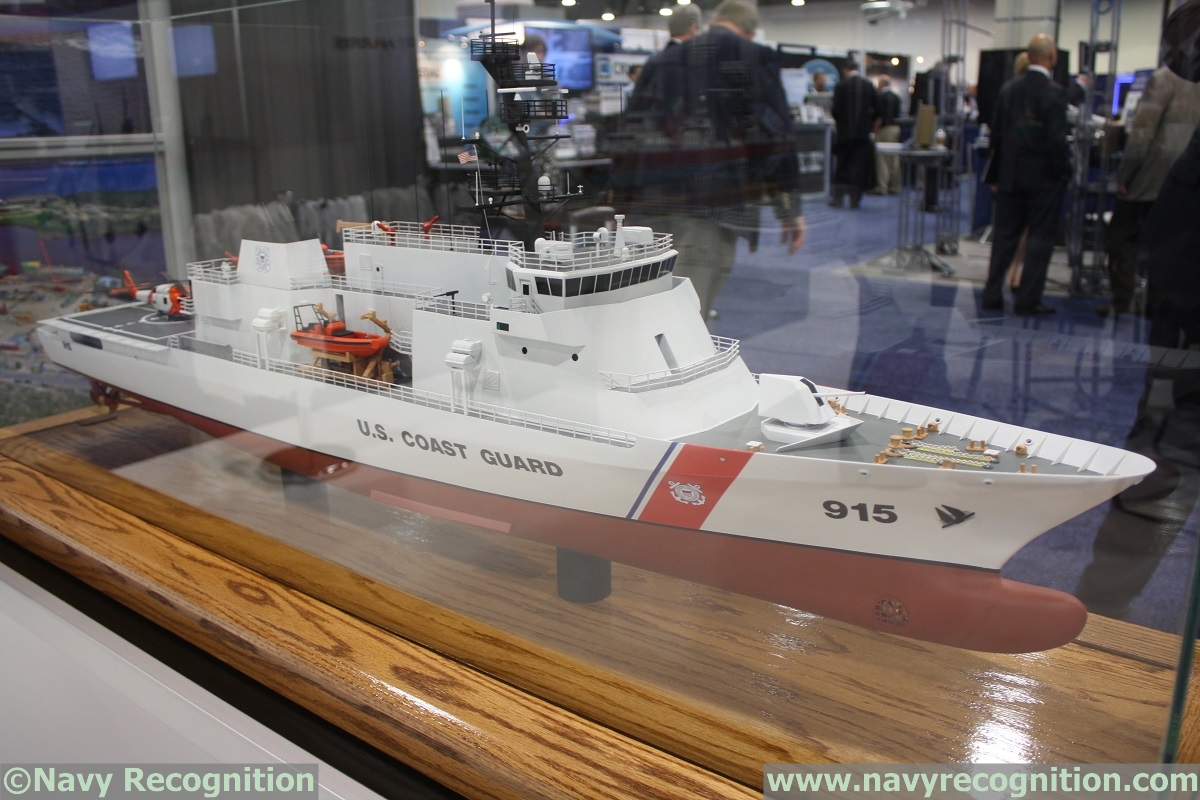
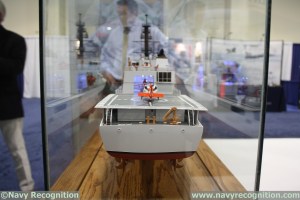
IMG_4134

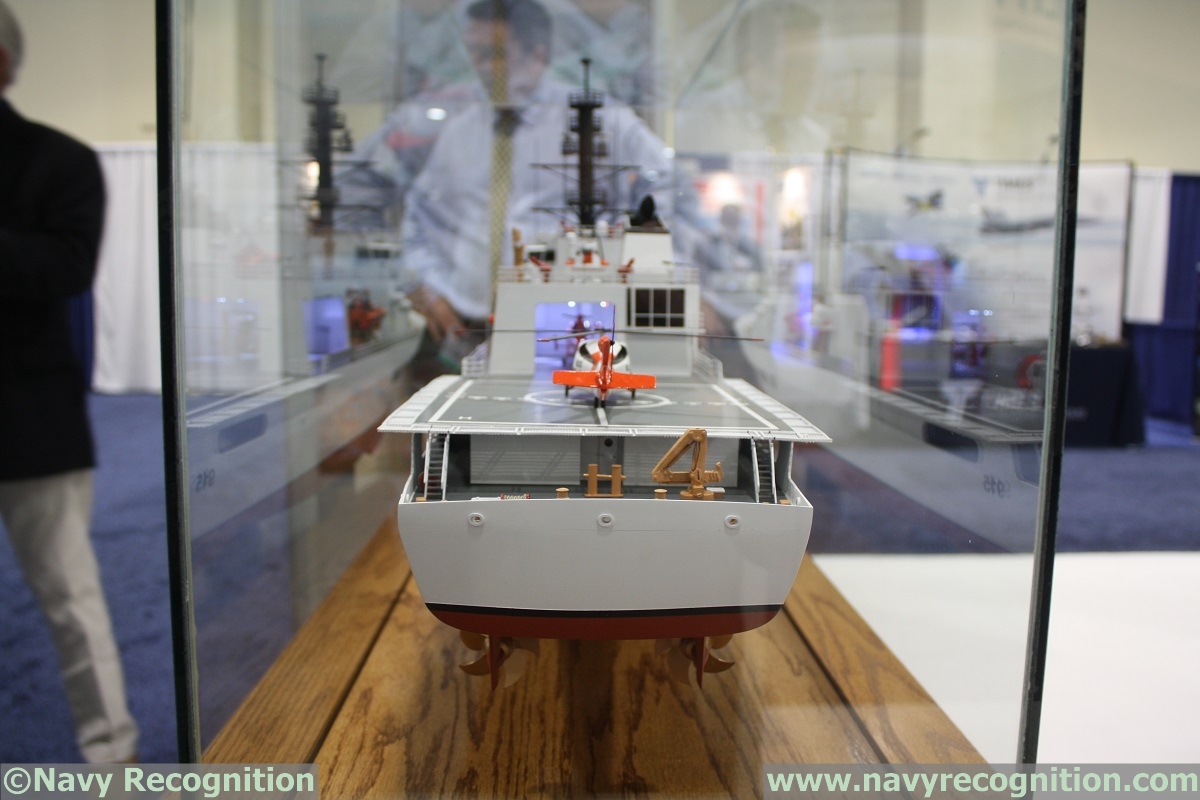
All photos credit Navy Recognition

Recently found a brochure for Eastern’s OPC reportedly from last year’s Sea, Air, Space Conference. Credit FCNoVA from this discussion group. We have discussed this class before and here, the comments may still be of interest.

Relative to the question does the design meet the “objective” criteria or only the minimums it looks like relatively good news, meeting or exceeding the objectives in terms of endurance, speed, aviation facilities, and accommodations. I presume since this design meets most of the objective criteria, the other two designs will also similarly exceed the minimums. I will provide some of the information provided in the brochure and then provide my comments.

You can read the brochure here: http://www.mnvdet.com/Other/Eastern%20OPC%20Scan.pdf

DIMENSIONS:
Length overall: 328ft
Length between perpendiculars: 297ft
Beam overall: 52ft
Beam waterline: 48.67ft
Depth: 24.5ft
Draft: 16.1ft

Commentary: Compared to the Treasury Class (327 ft) cutters, this is, of course only one foot longer, but the beam and draft are both substantially greater, greater in fact than the beam and draft of the 378s, so we can expect the full load displacement to be considerably greater than the 327s’ approximately 2500 tons, and close to the over 3,000 ton full load displacement of the 378s. Unless the vertical weight distribution is messed up, these are likely to be good riding, very seaworthy ships, a notable improvement on the 270s and 210s.

Accommodations:
126 total
20 commissioned officers
12 CPOs
94 E-6 and below
Also included are a 466 sq ft physical fitness area, a 20 seat training room, and a 48 seat crew’s lounge.

Commentary: Note these are the accommodations, not the expected crew which will be 15 officers, 89 enlisted, and detachments totalling 12 for a total of 116. The Coast Guard is avoiding the mistake made on the Littoral Combat Ship of assuming a small crew, limiting accommodations, and then finding they need a larger crew than the ship was designed for.

Performance:
Range 9,500 nmi @ 14 knots
Sustained speed: 24 knots
Sprint speed: 26 knots.

Commentary: This is an area I was afraid we would see the design compromised. For similar speeds, this range is comparable to the that of the 378s. At speeds above 18 knots, its all diesel power plant will give it greater range than the 378s.

Main Propulsion/Auxiliary Prop and thruster/Electrical:

Main Prop: Two 12,204 HP MAN geared diesels
Ship Service Generators: 4,1044 kW
Auxiliary Prop/thruster: 750 kW, 1005 HP

Commentary: I interpret this to mean four generators of 1044 kW or 4,176kW total. That is a lot of power generation potential. By comparison a 378’s total capacity is 1500 kW, the 270s have 1425 kW. This suggest that the ship will have a hybrid power plant with the generators used for driving electric cruise motors. Running only three generators, one could probably supply routine electrical requirements and the other two could propel the ship. Two generators would supply the equivalent of approximately 2800 HP, this might be enough to drive the ship at 14 knots. Certainly three generators supplying 4200 HP would be more than enough. This will allow the ship to cruise with the Main Diesel Engines shut down.

The combined horsepower of the main diesels, 24,408 HP is more power than the diesel engines of the National Security Cutters which we know provide a high cruising speed, and it is about three and a half times the power of those on the 378s or the 270s.

The thruster is apparently of the drop down trainable type, allowing it to be used as an emergency or loiter propulsion system. The available power is relatively high meaning the ship could probably make seven or eight knots on the thruster alone.

I expect what we will see is two main engine spaces, each with one main diesel and one or two generators. Hopefully the main spaces will be separated by more than a single bulkhead, perhaps by the engineering control room, so that damage at a single point cannot effect both engine rooms. Hopefully also, at least one generator will be outside the two main machinery spaces. If so, these ships will have extraordinary main propulsion redundancy with at least three different spaces and five different systems capable of moving the ship–two MDE, two motors on the main shafts, and the bow thruster.

Construction: Steel Hull with an Aluminum Superstructure. Commentary: No surprise, although I would have liked to see steel superstructure, but it is a reasonable compromise.
IMG_4132

Aviation Facilities:

Hangar: H-65/H-60R+UAS/UAV
Flight Deck: 3725 square feet

Commentary: Good news that the hangar will be large enough to accommodate both a Navy MH-60R and a UAS although I am a bit concerned that since the Navy has moved to a larger airframe for their Firescout, there is a chance that the UAS may not include the latest version of what is likely to become a standard system.

Apparently the Flight Deck is at least as large and probably larger than that of the 378s.

IMG_4129

Weapons:

57mm Mk110 mod X
Electro-Optic Sensor System
25mm Mk38 mod2
two .50 cal. ROSAM (stabilized mount) plus two .50 cal. in soft mounts
ESM system
Mk53 mod X ASCM decoy system

Commentary: No surprise in what was mentioned. The radar fire control system that was included in previous specifications was not mentioned. This may have been simply an omission, but the Electro-Optic System might also serve as a firecontrol system, although it would be decidedly inferior to a radar system against surface targets in low visibility and against air targets in all situations. Consequently I am a bit concerned that this system has been compromised in the interest of simplifying the design.

The excess generator capacity may make these ships suitable for use of energy intensive weapons that may be developed in the future.

Warship Tour–Frigate Normandie

NavyRecognition has a video tour of the newly constructed French Frigate European Multi-Mission (FREMM) NORMANDIE. This is a relatively large frigate, a third again larger than the BERTHOLF class. It uses a single LM2500 gas turbine for high speed and electric motors for cruise up to 15 knots.


Early in the video you can see that the foc’sle deck looks very clear, no ground tackle or bollards, and no handrails. Frankly, it looks dangerous to walk around up there except in the most favorable conditions. At time 3:26 you see the foc’sle below the deck where these the fittings are located.

At time 5:06 you see the Combined Active and Passive Towed Array Sonar (CAPTAS)4. This system is being evaluated for the ASW module for the Littoral Combat Ship, and if we revived an ASW capability in the Coast Guard, it is likely this would be the sensor system used. There is a similar but smaller CAPTAS 2 by the same manufacturer.

At minute 5:55 you will see the MU-90 torpedo in the hangar and at minute 6:00 the surface vessel torpedo tubes that also launch the same torpedo. the MU-90 unlike US light weight ASW torpedoes (at least last I knew) has an anti-surface capability. I think is desirable.

At minute 6:58 you see the NATO frigate helicopter, NFH-90, a helicopter in the same class as the H-60 but with the advantages, relative to the existing shipboard versions of the H-60, of a cargo ramp in the rear and a shorter overall length without the complication of a folding tail.

Let’s Give the OPC a Class Name–USCGC Newcomb (WMSM-915)

The procurement process for the Offshore Patrol Cutters is well underway. Three conceptual designs have been selected for further development. Challenges to the selection process have been rejected. There should be decision on the final design and contractor about the end of next year.

Perhaps the ships might feel closer to reality if there were a class name. I like the fact that we have been naming ships for notable figures in the history of the Coast Guard and its predecessor services as was done for the Bertholf and Webber Class cutters. Lets continue that with the Offshore Patrol Cutters.

Newcomb02

Frank H. Newcomb

Our friend Bill Wells tells the story of First Lieutenant, Frank H. Newcomb (Captain Commandant upon retirement), CO of the Hudson when it towed the Navy torpedo boat Winslow to safety from under Spanish guns in the port of Cardenas, Cuba during the Spanish American War.

uss_winslow_cardenas_text

Revenue Cutter Hudson towing USS Winslow while underfire from Spanish guns.

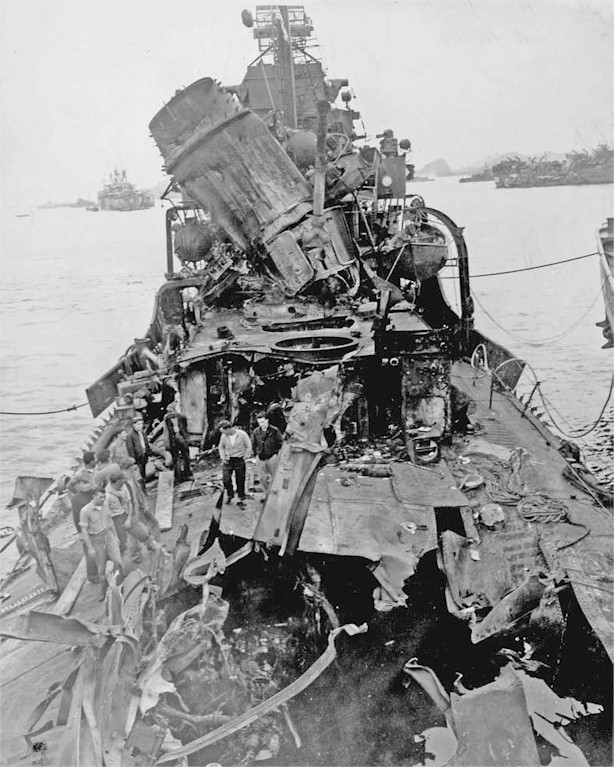
Newcomb was honored by the Navy as namesake for a Fletcher class destroyer, DD-586, USS Newcomb. She had a short but eventful history. In spite of not being commissioned until November 1943. She and another ship sank the Japanese submarine, I-185. She provided naval gun fire support at Saipan, Leyte, Iwo Jima, and Okinawa. As flagship of destroyer squadron 56, she lead a night torpedo attack on a Japanese Fleet during the Battle of Surigao Strait. She scored at least one torpedo hit on the Battleship Yamashiro, which was sunk in the battle, and like her namesake, while under fire, she towed a damaged ship, USS Albert W. Grant (DD-649), to safety. Off Okinawa she survived five (or six) Kamikaze hits.

USS_Newcomb_Damage_1945
USS Newcomb, DD-586, after taking at least four and possibly as many as six kamikaze strikes

Newcomb’s career was not limited to his time on the Hudson. This short biography (pdf) by Atlantic Area Historian William H. Thiesen also talks about his peacetime leadership, and how Admiral Waesche personal chose Newcomb as namesake for a destroyer as the best representative of the Coast Guard.

http://www.uscg.mil/lantarea/ExternalAffairs/humanstories/FrankNewcomb.pdf

“While Newcomb distinguished himself commanding a cutter in battle, he spent much of his career working as a field officer and inspector for the United States Life-Saving Service. Throughout his career, Newcomb championed the rights of those whose efforts merited recognition and promotion. For example, when he had received the medal for his wartime exploits, he insisted that Hudson’s crew receive specially struck medals as well, and the cook and stewards mate became the first African Americans to receive such recognition.

“Many in the Coast Guard as well as the general public have heard the story of the service’s only African American Live-Saving Service crew, which manned North Carolina’s Pea Island Life-Saving Station beginning in 1880. Few may realize that it was locally assigned U.S. Life-Saving Service inspector, Lieutenant Frank Newcomb, who worked diligently behind the scenes to institute an African American crew at that station. In fact, the local community opposed the establishment of an African American manned lifesaving station and arsonists burned down the original station. Newcomb had to camp out at the remote site of the burned out Pea Island station during construction of a new building to prevent sabotage a second time. While no one should diminish the accomplishments of the Pea Island Station’s courageous African American crew, it was Newcomb who risked his career and reputation to institute Pea Island’s African American crew in the racially-charged South following the Civil War.”

There has never been a Coast Guard vessel named for Newcomb. I think it is about time.

If you have any other suggestions for namesakes for the class, please add them in the comments section.

CG issues Draft RFP for Second Phase of FRC Procurement

page1-640px-USCG_Sentinel_class_cutter_poster_pdf

The Acquisition Directorate is reporting that they have issued a draft Request for Proposal (RFP) for a new contract to build Webber class WPCs.

It will provide for options of either four or six cutters per year for seven years. If all options were exercised the maximum number of cutters that could be built would total 42, but this probably will not be the case.

In February 2012, the Coast Guard exercised a $27.2M option to purchase the “Procurement and Data License Package” for the Webber class Fast Response Cutters, so the Coast Guard can allow other shipyards to bid to build follow-on ships of the same class.

25 September 2013, the Coast Guard exercised an option for six more cutters. This resulted in a total 24 Webber class built or under contract. I believe this was FY2013 money and we will see another contract to exercise the final option on the existing contract bringing the total to 30, which leads to a question. There is a statement in the RFP that I find difficult to understand, B.2.(b) “The total number of cutters obtained under this contract will be limited to twenty-six (26).” All along the program of record has been 58 of these vessels. The maximum number of vessels that can be funded under the phase one contract is 30 cutters so why limit this second contract to 26 when we have a stated requirement for 28 more? Does the Coast Guard plan on making a sole source buy of two ships in FY2015 and award this contract in FY2016?

Why preemptively limit the buy to less than the total of the options anyway. There might be a change of plans that would increase the Coast Guard requirement. The Navy might want to buy some using our existing contract, or the Coast Guard might want to make a Foreign Military Sale purchase on behalf of a friendly foreign government.

Despite being probably the best candidate we will ever see (a mature program with a proven product, approved by the Department for full rate production, that will continue for at least another five years), I saw no indication that a multi-year procurement was considered. I would hope that savvy ship builders would offer this as an additional option. It is still not too late for the Coast Guard to obtain Congressional permission to award a Multi-year Procurement for these ships. Or for Congress to direct this money saving procurement method.

Russia Builds an OPC

NavyRecognition is reporting the launch of the first for a class of ships being built for the Maritime Border Guards of the Federal Security Service of the Russian Federation (FSB, successor of the KGB). The ship is similar in many respect to the projected Offshore Patrol Cutter.

Named “Ocean,” she is reportedly ice strengthened with a displacement of 2,700 tons, a speed of 20 knots, a range of 12,000 miles, and a 60 day endurance. She has a hangar and flight deck, at least two RHIBs, and a 76mm gun. Unlike previous classes used by the Maritime Boarder Guards this is not an adaptation of a Navy design.

South Korea Disbands Coast Guard?

Versions of the following quotation are frequently mis-attributed to Petronius.
We trained hard … but it seemed that every time we were beginning to form up into teams we would be reorganized. I was to learn later in life that we tend to meet any new situation by reorganizing; and a wonderful method it can be for creating the illusion of progress while producing confusion, inefficiency, and demoralization.
In fact it is from the magazine article “Merrill’s Marauders” (Harper’s Magazine, 1957) that earned Ogburn (Charlton Ogburn) his book contract. In full, it reads thus:
We trained hard, but it seemed that every time we were beginning to form up into teams we would be reorganised. Presumably the plans for our employment were being changed. I was to learn later in life that, perhaps because we are so good at organising, we tend as a nation to meet any new situation by reorganising; and a wonderful method it can be for creating the illusion of progress while producing confusion, inefficiency and demoralization. http://en.wikipedia.org/wiki/Charlton_Ogburn

After the sinking of the ferry Sewol with the loss of over 300, South Korea’s President Park Geun-hye is vowing to dismember the South Korean Coast Guard.

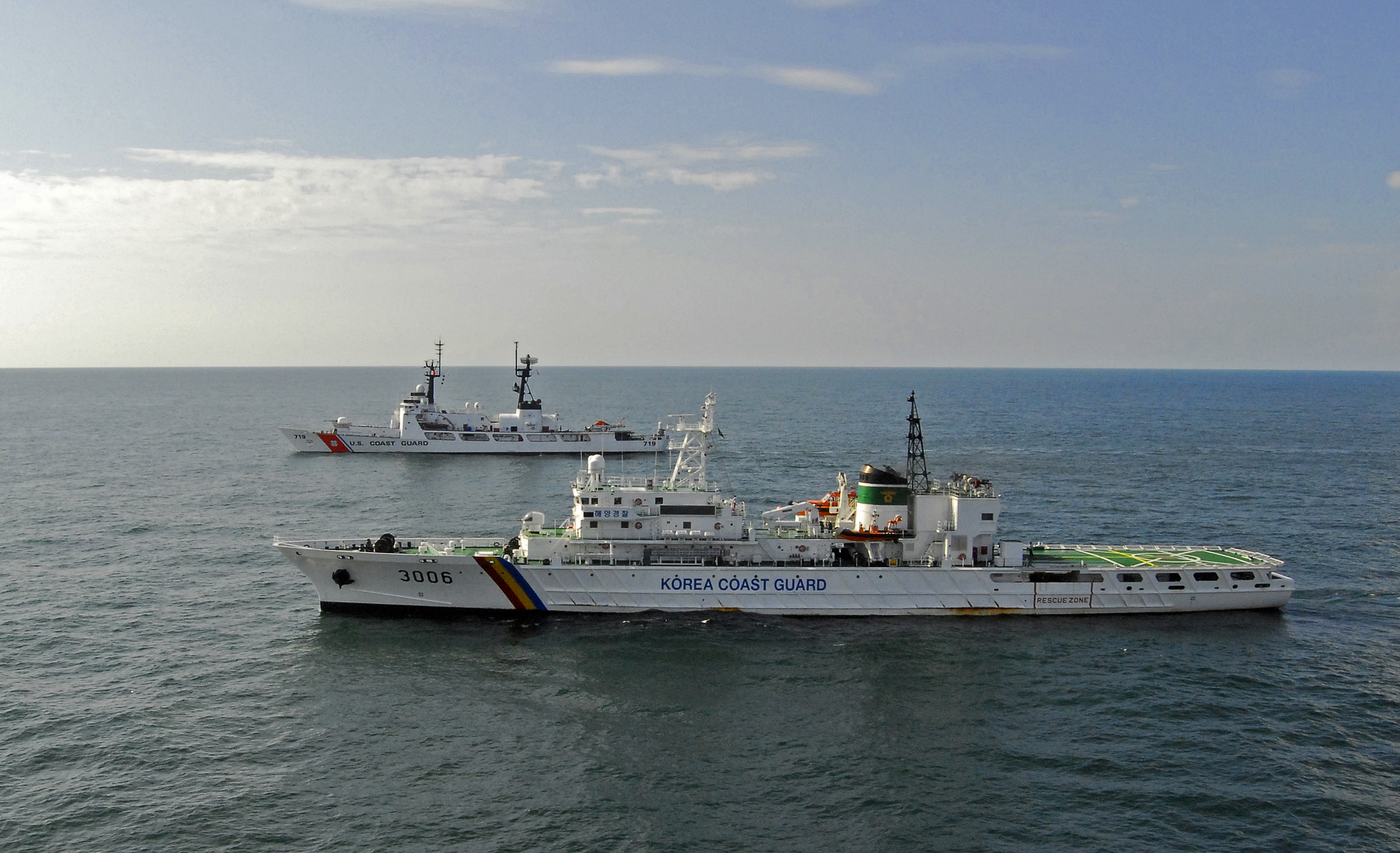
South Korea’s EEZ is only about three percent that of the US’s but their Coast Guard is relatively large with about 4,500 personnel (according to my Combat Fleets of the World). Wikipedia indicates they have six fixed wing and 18 helicopters (not a lot, but proportionately more than the USCG). Most surprisingly, they have 33 ships of over 1000 tons with a total displacement greater than that of all USCG WMECs, WHECs, and WMSLs combined. They also have 39 WPCs of 250 to 500 tons. I don’t see any evidence that they have any responsibility for Aids to Navigation, Alien Migrant Interdiction (although that might be a subset of another mission} or ice operations, otherwise their mission set seems to parallel that of the USCG, but their priorities are shaped by the proximity of North Korea, China, and Japan.

The New York Times reports their President sees the problem as a cozy relationship between regulators and the regulated, something all regulatory organizations must guard against.

With that, she declared a war against what she called her country’s deeply entrenched culture of “kkiri kkiri,” or collusive ties between businesses and government regulators that she said had spawned lax regulatory enforcement and an easy acceptance of poor safety standards throughout the society.

The BBC reports,

Ms Park added that in its current form, the coastguard would be unable to prevent another large-scale disaster.

“The coastguard continued to get bigger in size but did not have enough personnel and budget allocated for maritime safety, and training for rescue was very much insufficient,” she said, according to Reuters.

Stars and Stripes has some very revealing statistics regarding the experience of South Korean Coast Guard Personnel.

Eleven out of the 13 coast guard chiefs named since 1996 have been land-based police officers, not coast guard officers; the top 14 current coast guard officers have no experience working as captains for 1,000-ton-class ships or bigger vessels; and about 25 percent of its top 67 officers have had less than one month of experience working on patrol ships, the coast guard said, confirming reports published by lawmakers.

It really appears that the problem is not the fact that they have a Coast Guard, but that it has been mismanaged and unprofessional. Clearly their Coast Guard is big enough, but it suffers from a leadership that does not understand the Marine environment and that will not be helped by the proposed reorganization. I am afraid the proposed reorganization will only provide the appearance of action while failing to address the very real problems.

They might benefit from more time spent with the US Coast Guard.