“China’s bullying won’t deter Philippines’ South China Sea sovereignty, Coast Guard says” –Indo-Pacific Defense Forum

I haven’t published much about China’s bullying of the Philippines lately. That doesn’t mean it has stopped. Rather it has become routine.

This report from the Indo-Pacific Defense Forum may serve as an update.

The video above does suggest why having a reinforced hull or at least an extra turn of speed might be desirable.

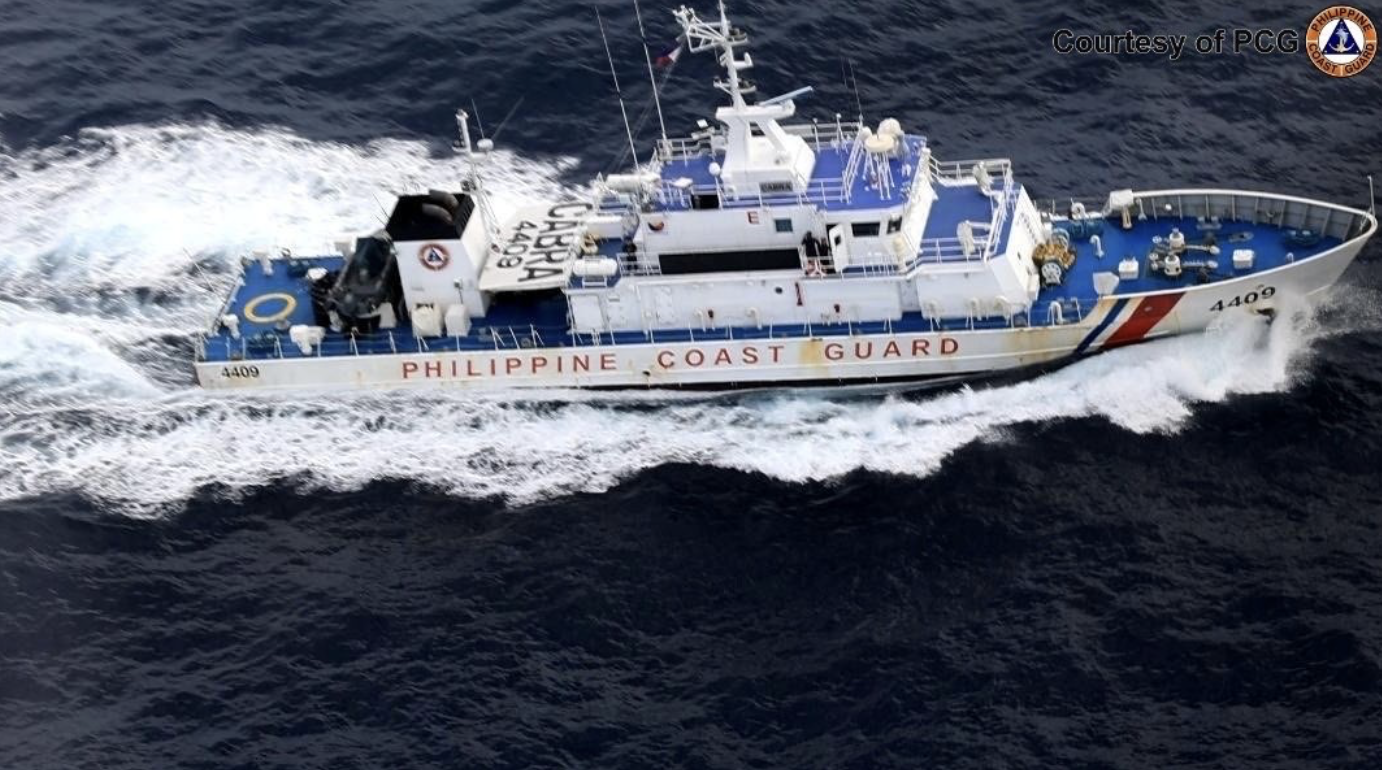
BRP Cabra (Philippine Coast Guard photo)

BRP Cabra is one ten 44.5 m (146 ft), 25 knot Japanese built Parola-class cutters commissioned 2016-2018.

The China CG vessel in pursuit is a 98 meter Shucha II class OPV.

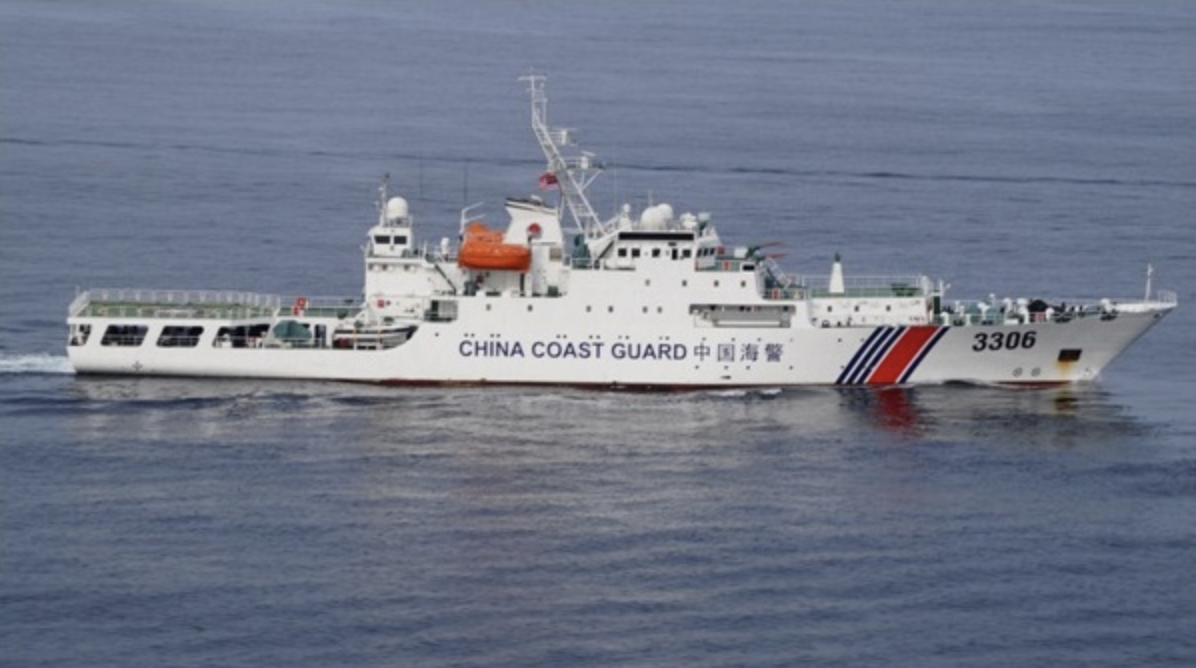
China Coast Guard Shucha II-class cutter Haijing 3306 (renamed to Haijing 3301). A sister ship of the China CG vessel in the video.

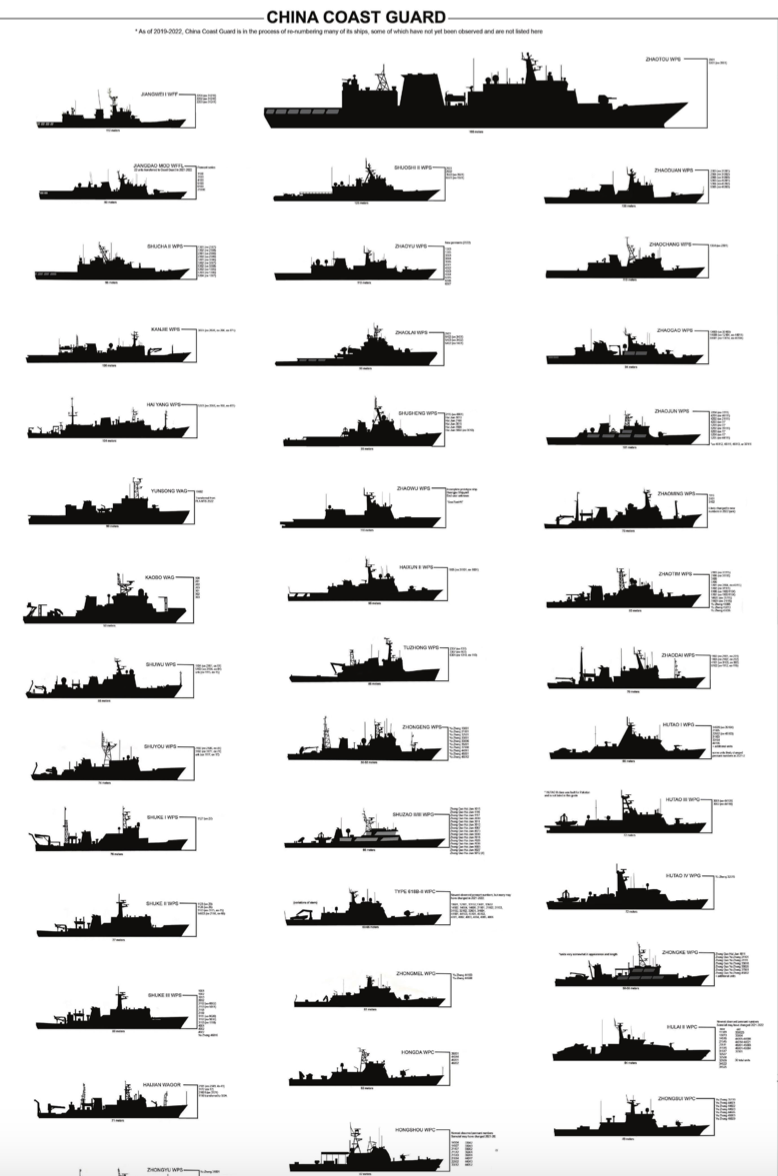
Just a partial listing of China Coast Guard from “Office of Naval Intelligence’s Chinese People’s Liberation Army Navy, Coast Guard, Ship Identification Guide


“Indonesia-Vietnam EEZ deal upholds international law, sends message to China” –Indo Pacific Defense Forum

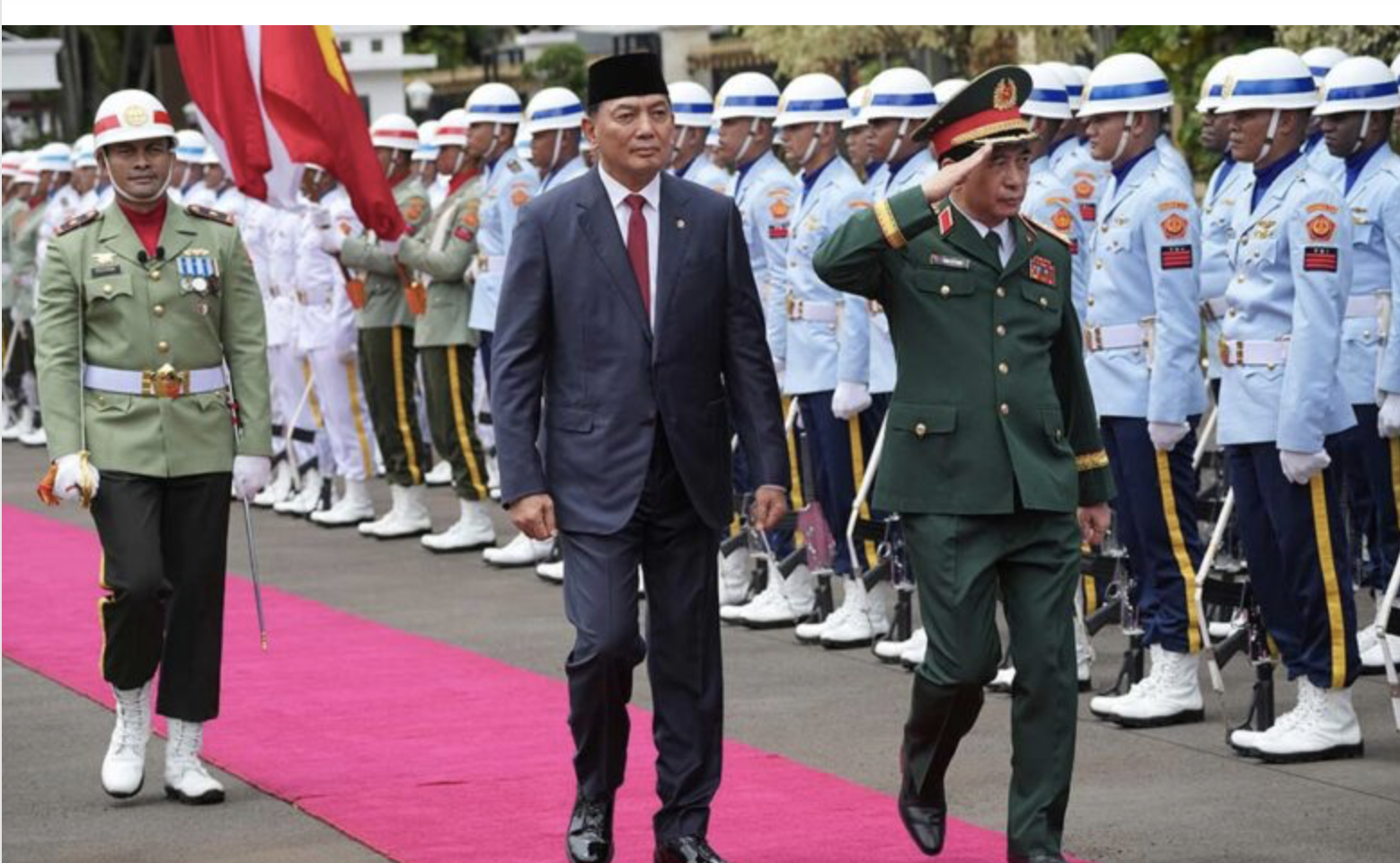
Indonesian Defense Minister Sjafrie Sjamsoeddin, left, and Vietnamese Defense Minister Gen. Phan Van Giang inspect honor guards before their meeting in Jakarta, Indonesia, in March 2025. IMAGE CREDIT: THE ASSOCIATED PRESS

INDOPACOM’s on-line magazine, Indo-Pacific Forum reports,

Indonesian and Vietnamese leaders said their countries expect to formally agree in 2025 on exclusive economic zone (EEZ) boundaries. The move not only settles a long-standing debate on the countries’ overlapping maritime territories, but it also presents a united front to oppose China’s expansive and illegal claims on the South China Sea.

This is the way it should be. All the claimants to the South China Sea should settle their disputes by arbitration or submitting the dispute to the international tribunal set up under UNCLOS. This will expose the Chinese claims as unreasonable and illegal.

Other similar settlements are in the works.

Meanwhile, Philippine and Vietnamese officials have said they are ready to negotiate overlapping claims to the continental shelf in the South China Sea. “Both the Philippines and Vietnam agree that the way to move forward … is for dialogue and consultation,” Jonathan Malaya, the Philippine National Security Council’s assistant director general, said in July 2024, according to The Philippine Star newspaper.

Settling these disputes will also facilitate cooperation in search and rescue, fisheries management, and pollution response.

“Coast Guard to send 3 more cutters to Guam, has no plans to escort Philippine ships” –Stars and Stripes

A U.S. Coast Guard boat crew and boarding team from U.S. Coast Guard Cutter Oliver Berry (WPC 1124) approaches a foreign fishing vessel to conduct a joint boarding inspection with members of the Western and Central Pacific Fisheries Commission on the high seas in Oceania, Sept. 22, 2024. U.S. Coast Guard Cutter Oliver Berry’s crew recently completed a 45-day patrol in Oceania in support of Operation Blue Pacific, promoting security, safety, sovereignty, and economic prosperity in the region.

Stars and Stripes reports,

The Coast Guard will double its Guam fleet to six cutters but doesn’t plan to accompany the Philippine coast guard as it struggles to maintain territorial claims in the South China Sea, the service’s Pacific-area commander said Friday.

This is based on a video news conference by Pacific Area Commander Vice Adm. Andrew Tiongson speaking from Japan.

“The Coast Guard will not escort Philippine resupply missions to the BRP Sierra Madre, a grounded warship garrisoned by Filipino troops at the Second Thomas Shoal in the South China Sea, according to Tiongson.”

The Philippines has not asked for escorts, Tiongson said. “We do advise, and we do assist,” he said. “We provide what we would do in this situation.”

He also said, “It’s possible we may get another Indo-Pacific support cutter,” using the description applied to USCGC Harriet Lane, recently arrived in the Pacific Area to support operations in the Western Pacific.

There is more in the article.

“USCG Pacific Comments Latest Chinese Ramming of Philippine Coast Guard Vessel” –Naval News

USCGC Waesche accompanies the PCG’s Melchora Aquino (sister ship of BRP Teresa Magbanua (MRRV-9701) during a search-and-rescue exercise in the South China Sea in July 2024. (USCG)

Naval News reports on the comments of Rear Admiral Andrew M. Sugimoto, Deputy Pacific Area Commander, about the US Coast Guard’s position regarding Chinese attempts to intimidate the Philippine Coast Guard. Read it. It is excellent reporting.

I will just note a couple of things.

What is this? I think it is a can opener, meaning this tactic was premeditated in the construction of this class.

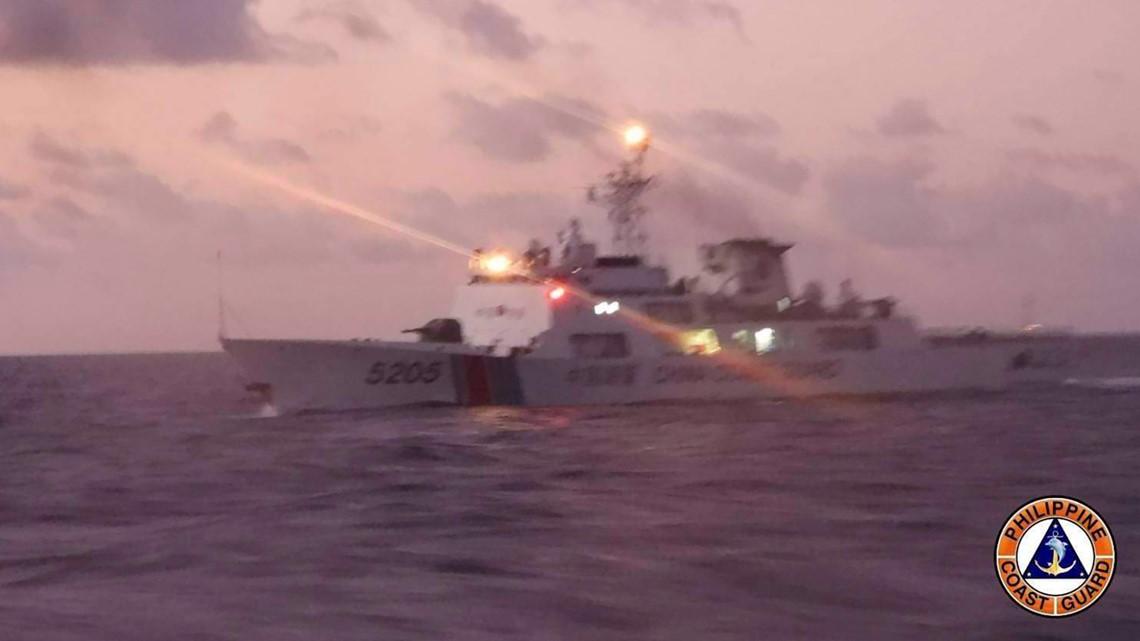
China Coast Guard cutter 5205 was the same ship that used a laser against the Philippine Coast Guard in February 2023.

I would also note that while the Chinese cutter involved has both a 76mm gun and 30mm auto cannon, the 97-meter (317′) Japanese built Philippine cutter is armed with nothing larger than .50 caliber machine guns, so the China Coast Guard cutter could be confident, the Philippine cutter would not respond to the attack with gun fire.

The Philippine Cutter may have been marginally faster than the Chinese cutter, but she may have also been boxed in by other Chinese vessels on scene.

“The Philippines opens a new monitoring base on a remote island in the disputed South China Sea” –AP

Thitu Island, where the Philippine Coast Guard recently opened a monitoring station. AP photo/Aaron Favila

AP reports,

“THITU ISLAND, South China Sea (AP) — The Philippines inaugurated a new coast guard monitoring base Friday on an island occupied by Filipino forces in the disputed South China Sea and plans to expand joint patrols with the United States and Australia to counter China’s “pure bullying” in the strategic waterway, a Philippine security official said.”

The AP story includes 17 additional photos.

Thitu is the second largest of the naturally occurring island in Spratly Islands and has a civilian population of about 200.

Spratly Islands military settlements. Source: Cartothèque Spiridon Manoliu, via Wikipedia.

Thitu lies about 500 kilometers (310 mi) west of Puerto Princesa on the larger Island of Palawan so it is outside the larger contiguous Philippine EEZ.

Ownership of the Spratly Islands is disputed, not only between the Philippines and China, but also by Taiwan, Vietnam, Malasia, and Brunei.

Thanks to David S. for bringing this to my attention.  

“Philippine Armed Forces Resupply Mission Hit with Chinese Coast Guard Water Canons” –Video

Thought it worthwhile to pass this video along.

First thing, the Chinese are devoting a lot of resources to isolating this particular outpost, an ancient, badly corroded, grounded, but still commissioned former US LST.  There are three large modern China Coast Guard cutters visible in the video, 5201, 5305, and 4203. All three are about 100 meters in length or larger, all equipped with 76mm guns. We have seen 5201 before.

CRASH AVERTED This photo taken on April 23, 2023 shows BRP Malapascua (right) maneuvering as a Chinese coast guard ship cuts its path at Second Thomas Shoal in the Spratly Islands. AFP PHOTO

Second, the Philippines would have known what they were up against. Couldn’t they have used something faster and more maneuverable that could have gotten around these large cutters to make this supply run. I hope I am wrong, and I may not understand what it takes to reach this grounded LST, but it is almost as if they are failing on purpose.

The US has warned the Chinese against targeting the Philippine Coast Guard.

US Sends a “Warning” to China Against Targeting the Philippine Coast Guard

CRASH AVERTED This photo taken on April 23, 2023 shows BRP Malapascua (right) maneuvering as a Chinese coast guard ship cuts its path at Second Thomas Shoal in the Spratly Islands. AFP PHOTO

A Reuters report, “U.S. issues guidelines on defending Philippines from South China Sea attack” indicates the US would consider an attack on the Philippine Coast Guard grounds for invoking the Mutual Defense Treaty between the US and the Philippines.

There was more to it than that, but certainly the recent confrontations between the Philippine CG and China CG and maritime militia must have prompted this clarification.

Perhaps less obvious, is that, apparently, it would also activate the treaty if a US Coast Guard vessel were attacked in the South China Sea.

“The guidelines said the bilateral treaty commitments would be invoked if either is attacked specifically in the South China Sea and also if coast guard vessels were the target.”

“FLOODING THE ZONE: CHINA COAST GUARD PATROLS IN 2022” –CSIS

The Asia Maritime Transparency Initiative of Center for Strategic and International Studies provides a report showing the extent of China Coast Guard patrols of five features of the South China Sea, Second Thomas Shoal, Luconia Shoals, Scarborough Shoal, Vanguard Bank, and Thitu Island, in 2022 and comparing that to 2020. (There was no explanation for why no information regarding 2021 was included.)

The report also indicated that China Coast Guard is using automatic identification system (AIS) in a deceptive manner.

Thanks to Paul for bringing this to my attention.

USNI Proceedings Coast Guard Issue

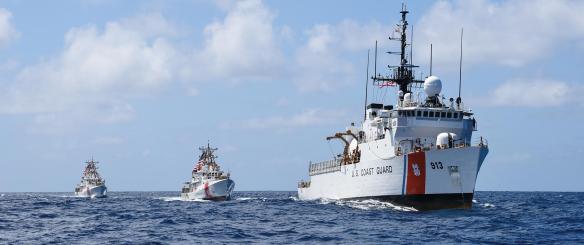
USCGC Mohawk (WMEC-913), Clarence Sutphin Jr. (WPC-1147), and John Scheuerman (WPC-1146)

Sorry this post is going to ramble a bit.

The Prize Winning Essays: 

The August issue of the U. S. Naval Institute Proceedings is again the “Coast Guard Issue,” and includes the three winning essays in their Coast Guard Essay contest.

First prize went to prolific author and repeat winner, Cdr. Craig Allen, Jr., USCG for his “Expeditionary Cutter Deployments Should Not Be a Mission to Mars.” It talks about some of the logistical difficulties encountered. His comments about the integrated C5ISR, navigation, and engineering systems and “controlled parts exchanges (taking working parts from one cutter and installing them in another) to deploy on schedule and/or remain underway” are partiuclarly troubling.

He offered three suggestions about how to make the Coast Guard more deployable.

  • Improved cutter self-sustainability.
  • Forward operating bases
  • Mission support cutter.

I would note that large cutters are probably already have more self-sustainability than their Navy counterparts making extended single ship deployments with minimal support easier for cutters than for Navy ships, but it does sound like we have made some choices that may put those capabilities at risk.

It is probably diplomatically easier to establish a Coast Guard forward operating base than one for the Navy, particularly in Latin America. Realistically we are probably only talking about a base in the Eastern Pacific, near the drug transit zone. To make that happen would probaby require some initiative from SOUTHCOM.

Elsewhere we could probably ride the coat tails of the Navy and our allies including Australia, New Zealand, Japan, the United Kingdom, France, and the Netherlands.

The mission support cutter, or, more generally, a floating base might be addressed in a number of ways. Presumably SOUTHCOM will get their own Expeditionary Sea Base. Wherever it is moored will become a defacto forward operating base. There should be room aboard for priority Coast Guard unique support requirements. Unfortunately I understand, dispite their tanker origins, they don’t carry fuel for tranfer to other ships. That is unfortunate, but probably something that could be fixed. Any kind of forward operating base could make Webber class deployments to the Eastern Pacific drug transit zones much more productive.

Effectively the Coast Guard has already been using buoy tenders as mission support cutters for Webber class in the Western Pacific.

One might think that a Navy owned MSC vessel might make a good mission support vessel, but the underway replenishment vessels they have currently, are far too large to be dedicated to supporting routine Coast Guard operations.

Something  to consider might be a routine teaming of Charleston based National Security Cutters (NSC) with District 7 Webber class Fast Response Cutters (FRCs). A NSC and a pair of FRCs could make a very effective team, with the NSC providing underway replenishment for the FRCs. There are three NSC in based in Charleston now and there are expected to be five when the program is completed. There are currently 20 FRCs based in district 7. These ships are the closest of their type to the Eastern Pacific Drug Transit Zones.

Second prize went to “The World’s Fishermen as a Maritime Sensor Network,” by Lieutenant Holden Takahashi, USCG, that suggest a cell phone based reporting system could provide additional eyes to Maritime Domain Awareness systems.

Third prize went to “Lost At Sea: Teaching, Studying, and Promoting Coast Guard History,” by Lt. Christopher Booth, USCG, and Mark Snell, U.S. Coast Guard Auxiliary contending,

“To foster pride in its heritage and promote its historic accomplishments to the public, the Coast Guard cannot continue to ignore its past. It must make a major shift in how it approaches, teaches, promotes, and preserves its history. The Coast Guard must rescue the history and heritage of “that long line of expert seamen” and their contributions to the nation, so they are no longer lost at sea.”

Other Posts of Interest:

There are also other posts that directly address the Coast Guard or at least would involve the Coast Guard.

A Campaign Plan for the South China Sea,” by Captain Joshua Taylor, U.S. Navy advocates for persistent low-end presence.

A South China Sea campaign that translates these principles into action in a resource- and diplomatically constrained—but feasible and effective—manner should be organized around the following lines of effort and accompanying messages:

  • Beat Cop. Persistent low-end presence—“The United States has skin in the game.”
  • Neighborhood Watch. Build a regional coalition— “We are stronger together.”
  • Vigilance. Information sharing—“We are always watching.”

ln terms of information sharing, also mentioned was this Maritime Domain Awareness program that I was not aware of.

Since 2016, the United States has invested more than $425 million through the Maritime Security Initiative to help Indo-Pacific countries develop the ability to “sense, share, and contribute” to a regional recognized maritime picture (RMP). While some of these funds have purchased secure communication systems, the standout success story has been the U.S. Department of Transportation’s unclassified web-based SeaVision maritime domain awareness and coordination tool. Drawing on government and commercially contracted datastreams, SeaVision fuses information from terrestrial and satellite Automated Identification System data, the satellite Visible Infrared Imaging Radiometer Suite, satellite synthetic aperture radar, and—soon—satellite electronic signal detection to form a high-quality unclassified RMP that could support a countercoercion campaign in the South China Sea. Indeed, naval services throughout Southeast Asia already use it—with the notable exception of the U.S. Navy.

(My own ideas for a persistent low-end presence are here, Combined Maritime Security Task Force Pacific.)

The Coast Guard’s Firefighting Fiction,” by Chief Boatswain’s Mate Phillip Null, U.S. Coast Guard (Retired) suggests the Coast Guard should take a more active role in marine fire fight.

“Recent tragedies have shown the need for the Coast Guard to revisit its stance on firefighting, not to supplant municipalities or absolve them of their responsibilities, but to support them with real capabilities and expertise and to provide capability in unprotected waters to avert tragedy. The Coast Guard trains and equips its cutter crews to combat fires on board their own vessels, the success of which was recently demonstrated on board the cutter Waesche (WMSL-751) during a Pacific transit.8 Now it needs only to increase the capacity and foam-delivery capability of the pumps carried on its boats, expand the training and equipment available to its boat crews who operate in coastal regions where fire poses the greatest threat, and revise policies that limit involvement and inhibit on-scene decision-making even in unprotected waters.

While on the topic of maritime firefighting, take a look at this post by Cdr Sal, “How Many Fireboats Can You Buy for $1.2 Billion?” that discusses the Navy’s lack of fireboats. In so many cases, a less than optimal resourse on scene in a timely manner is far better that the perfect resource arriving late. Perhaps Coast Guard assets could have helped.

Some people in the Coast Guard are thinking about major ship fires, “Coast Guard, Long Beach and LA fire departments train for maritime fires.

“Use the Coast Guard for Freedom of Navigation Operations” –USNI

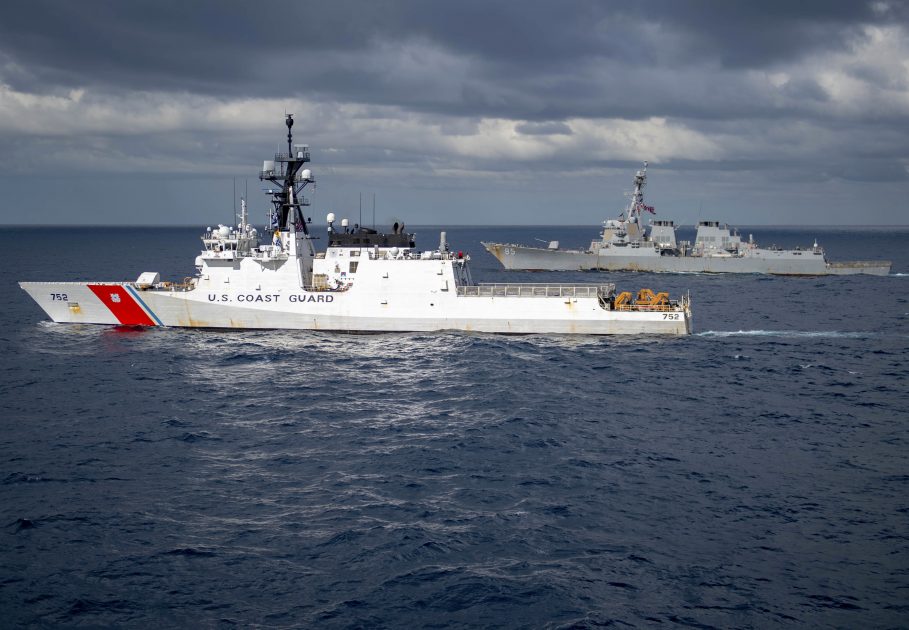
USCGC Stratton (WMSL-752), left, and the U.S. Navy Arleigh Burke-class guided-missile destroyer USS McCampbell (DDG-85) maneuver in formation during Talisman Sabre 2019 on July 11, 2019. US Navy Photo

The December 2021 issue of US Naval Institute Proceedings has an article that suggests, “NSCs and OPCs are ideal vessels to take over FONOPs.”

Why do the authors, two Navy LCdr. and a Marine Capt., think this? They contend:

  • Their destroyers are overworked.
  • The Navy is having a hard time keeping their ships maintained.
  • Cutters are less intimidating
  • and less expensive
  • If the Chinese start playing bumper boats with Destroyers, they might damage expensive equipment. “…if a ship from the Chinese Navy, Coast Guard, or maritime militia were to ram a U.S. vessel conducting a FONOP, the ensuing visuals, narratives, and potential loss of combat capability would be starkly different between a Navy gray hull and a Coast Guard white hull.”

They talk about using LCS as an alternative, but then denigrate the possibility,

The Navy has rightfully used littoral combat ships (LCSs) to conduct limited FONOPs in the South China Sea, somewhat relieving overworked destroyers like the USS John S. McCain. However, the smaller LCS’s myriad of problems, curtailed acquisition numbers, and early retirement of the first four hulls mean the Navy will soon have to lean even more heavily on larger and generally older ships. With only 10 to 14 cruisers and destroyers available to Seventh Fleet at any given time, the Navy can ill-afford to use these high-demand, low-density, Aegis ships for FONOPs.

This, in spite of the fact, that LCS have only recently begun making regular deployments to the Western Pacific and LCSs are being added to the fleet at a rate of four per year.

First, I have no problem with Cutters doing FONOPs when they are in the Western Pacific, but that should not be the only reason, they are there.

US Navy ships are not overworked. That is a fiction. Having looked at the “USNI News Fleet and Marine Tracker” over many years, I can say, Navy ships are typically deployed about one third of the time, and they are underway only about 25% of the time, far less than Coast Guard cutters. That is not to say the people are not overworked, by burdensome administrative and overly broad qualification requirements for their junior officers. The ships are behind in maintenance because of lack of support, not time underway. Ships don’t need to spend 75% of their time, tied up in maintenance, to remain effective.

In war time, well over half the navy should be underway and forward deployed. The fact that they cannot support a much smaller forward presence, of which much of the time is not underway, in peacetime, points to a serious deficit in the Navy’s support structure. Where are the repairs ships, the tenders, the floating dry docks that allow a navy to be truly expeditionary?

If the Navy does not want to use carriers, cruisers, or destroyers for FONOPs because they are afraid of having them damaged, there are other alternatives. They could use amphibs: LHAs, LHDs, LPDs, and LSDs. They could use Military Sealift Command ships. MSC ships are clearly not as intimidating as carriers, cruisers, and destroyers. Were they to be damaged “the ensuing visuals, narratives, and potential loss of combat capability would be starkly different…” 

I would suggest using the new Navaho class tug and salvage ships. They are an excellent choice for playing bumper boats. They have strong steel hulls and are powerful enough to tow a nuclear-powered carrier. Their hulls are reinforced to allow hull to hull contact with other ships. Plus, they are a lot less expensive. Even less expensive than a Coast Guard cutter.

But really, using tugs or cutters to do FONOP kind of misses the point. The Chinese and the Russians are not upset because foreign ships are transiting waters they claim. They are upset because foreign warships are transiting the waters the claim. If we stop sending warships into the waters they claim, we are creating a defacto case that they have a right to such exclusion. That Coast Guard cutters may not be considered warships would weaken our case that, foreign warships in these waters is the norm.