Is the Eagle Eye UAV Making a Come-Back?

X-247 armed drone model

BreakingDefense is reporting the Marines are looking for a large tilt rotor UAV with Reaper MQ-9 like capabilities.

This might sound familiar because a big part of the DeepWater program was a tilt rotor UAV called the Eagle Eye.

Reaper is a relatively large UAV with a  max. takeoff weight of 10,494 lb (4,760 kg). That is about a thousand pounds more than an MH-65 and more than four times the size of the Eagle Eye. Still, if the Marines do succeed in creating a vertical take-off UAV, it may be something the Coast Guard will want to use.

Bell Eagle Eye tiltrotor UAV

USCG Contracts for Scan Eagle UAS

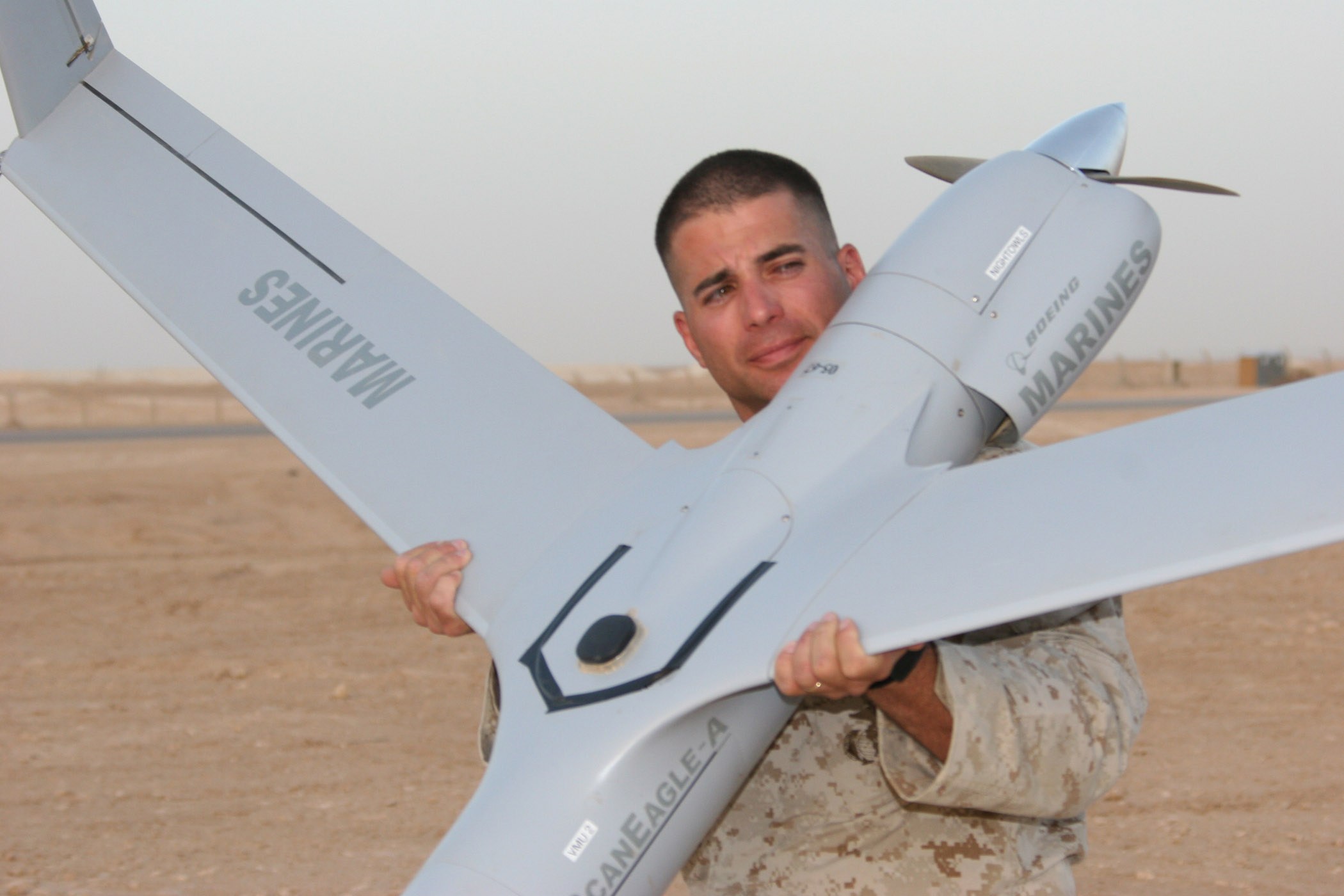
ScanEagleIraq

It is a small step, but NavyRecognition is reporting that the Coast Guard has contracted with Insitu to provide one Bertholf class National Security Cutter with Scan Eagle UAS.

The Coast Guard procured the necessary services through a pre-existing multiple award contract executed by Naval Air Systems Command. The initial $4.5-million task order includes operation, integration, maintenance and sparing of a contractor-owned sUAS on one NSC for one year. The task order has a total potential value of $12.3 million that includes options for deployment of and data from prototype sUAS capability for up to three additional years beyond the base year. The Coast Guard will have full ownership of the surveillance data obtained.

This is a system suggested here five years ago. Additional details on the system were included in my earlier post. There are also comments regarding our experience with the system in the intervening years.

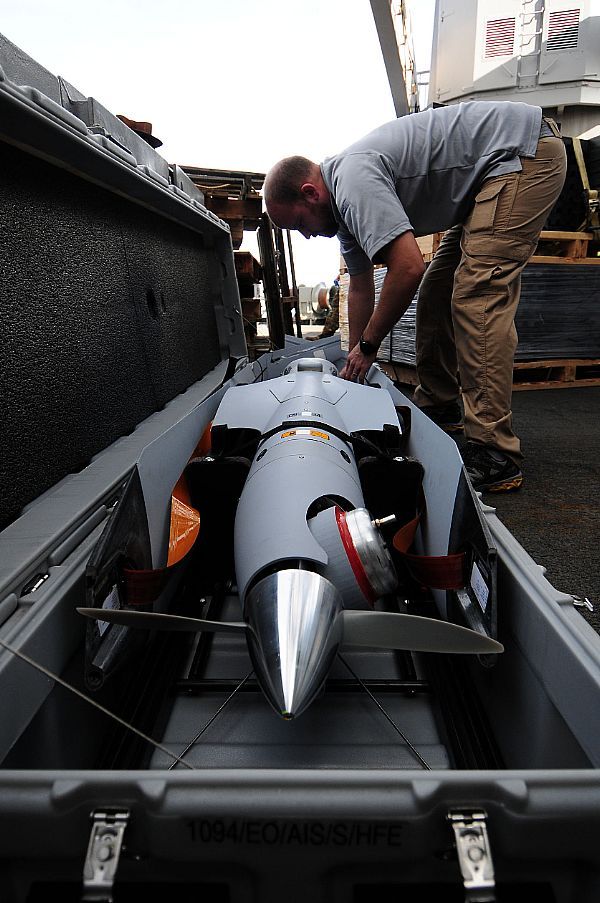
110225-N-RC734-011 PACIFIC OCEAN (Feb. 25, 2011) Guy Mcallister, from Insitu Group, performs maintenance on the Scan Eagle unmanned aerial vehicle (UAV) aboard the amphibious dock landing ship USS Comstock (LSD 45). Scan Eagle is a runway independent, long-endurance, UAV system designed to provide multiple surveillance, reconnaissance data, and battlefield damage assessment missions. Comstock is part of the Boxer Amphibious Ready Group, which is underway in the U.S. 7th Fleet area of responsibility during a western Pacific deployment. (U.S. Navy photo by Mass Communication Specialist 2nd Class Joseph M. Buliavac/Released)

110225-N-RC734-011
PACIFIC OCEAN (Feb. 25, 2011) Guy Mcallister, from Insitu Group, performs maintenance on the Scan Eagle unmanned aerial vehicle (UAV) aboard the amphibious dock landing ship USS Comstock (LSD 45). Scan Eagle is a runway independent, long-endurance, UAV system designed to provide multiple surveillance, reconnaissance data, and battlefield damage assessment missions. Comstock is part of the Boxer Amphibious Ready Group, which is underway in the U.S. 7th Fleet area of responsibility during a western Pacific deployment. (U.S. Navy photo by Mass Communication Specialist 2nd Class Joseph M. Buliavac/Released)

Malaysia’s New Patrol Boat–UAS Ready

MalaysiaNewGenerationPatrolCraft

IHS Jane’s 360 is reporting on Malaysian Coast Guard’s six projected “New Generation Patrol Craft (NGPC).”

“The NGPC has been based on a design by Germany-based Fassmer Shipbuilding Company. According to specifications provided by Destini, the platform features an overall length of 44.25 m an overall beam of 7.7 m and a design draught of 1.95 m. Powered by two 1920 kW MTU engines, the vessel can attain a top speed of 24 kt and a standard range of 2,000 n miles at 12 kt. The ship displaces 297 tonnes and can accommodate a crew of 41.”

This means they will be similar to, but slightly smaller than the Webber Class WPCs.

The unique thing about this class is that they are built to use a mini-Unmanned Aerial System, in this case the Thales Fulmar. NavalToday reports the purchase of these systems. Fulmar looks similar in size and capability to the Scan Eagle.

This certainly suggest that we could probably operate Scan Eagle, or something similar from the Webber class.

Photo: The Thales Fulmar

A Combined Air/Surface Search Radar for Boats

Saabs-Sea-Giraffe-small-boat-radar-debuts-in-USA-320x179

The illustration here appears to show the system on a Combat Boat 90 (CB90) which is only a 52 foot long boat. 

I don’t see an immediate need for this, but it is an interesting new type of radar sensor.

Naval Today reports Saab is offering, “…a 3D, active electronically scanned array (AESA) radar offering simultaneous surface and air surveillance capabilities,” and “…the entire system weighs less than 650 pounds (294 kilograms) in total, which makes it suitable for smaller patrol ships.”

Apparently they are thinking UAVs, “To combat the growing UAV (Unmanned Aerial Vehicle) threat, Sea Giraffe 1X features Saab’s Enhanced Low, Slow and Small (ELSS) surveillance function. This feature allows the radar system to detect and classify small, low-flying, slow-moving air targets.”

I suppose this might also be used to control small UAVs, putting them over surface targets of interest. The Coast Guard is looking at small UAVs.

Common (Unmanned Unit) Control System

It now seems obvious that Unmanned Systems (air and possibly surface and subsurface) will play a part in the Coast Guard’s future, but the service has been, perhaps understandably hesitant to commit to any particular system.

Because of the variety of proprietary systems, integrating the control systems into the organization of the controlling unit, particularly ships and aircraft, and then integrating the resulting information into a common operating picture has been problematic.

Eaglespeak reports, it looks like DOD, through the Office of Naval Research, is moving in the direction of a platform agnostic software application that will permit common hardware to control different unmanned system.

This might permit Coast Guard units which commonly control small unmanned aicraft (sUAS) to be quickly adapted to

  • Control a much more capable UAS.
  • Hunt for mines using unmanned surface (USV) or subsurface (UUV) systems.
  • Control optionally manned surface craft to search for smugglers or enhance asset protection.
  • Control UUVs towing acoustic arrays, searching for submarines.
  • Direct a USV equipped with AIS, lights, and signals into position to serve as a temporary aid-to-navigation.


New ISR Sensor

Australia's Maritime Safety Authority will induct new search and rescue aircraft in the near future, with enhanced capabilities. Four Bombardier Challenger 604 jet aircraft will enter service from August 2016 and onwards.

Navy Recognition reports installation of a new type of sensor on four Australian medium range search aircraft. (Looks a lot like an HU-25 doesn’t it? It is a contracted SAR resource.)

This new sensor, Sentient Vision’s Kestrel Maritime ViDAR (Visual Detection and Ranging), is apparently a computer aided visual recognition system intended to detect objects as small as people in the water. A claimed advantage over human lookouts is that system performance does not degrade due to fatigue like human observers.

Apparently this technology is being tested on Scan Eagle and Firescout Unmanned Air Systems too. It is claimed that the system improves the search function on these UAS as much at 80 times that of unaided Electro-Optic systems.

It was reportedly tested by the USCG  “in 2014 and managed to detect small targets at a distance of more than 20nm.” I tried to find out a little bit more about the Coast Guard test, and apparently it was associated with the experiments with an aerostat deployed from the Healey.

Anyone know if this system has a future in the USCG?

Unmanned SAR Assets

sUAS

MarineLink has a short post about a European effort to use networked Unmanned Air and Surface Vehicles (UAVs and USVs) to do SAR. I don’t find their particular scenario persuasive, but there probably are roles for these systems.

Unmanned systems have some potential advantages over Manned assets although they are unlikely to ever replace them.

  1. It may be possible to have UAVs more widely distributed than manned CG Air assets.
  2. UAVs operating from SAR stations might also be able to get into the air more quickly  than manned aircraft because they do not have to contend with other air traffic that may be operating on the field.
  3. At least for some applications they may be cheaper to operate.

Frankly, I had thought of unmanned systems as primarily Law Enforcement assets, but the Coast Guard is looking as the possibility of locating personnel in the water using small UAVs.

USVs:

I have a hard time visualizing a use for Unmanned Surface Vessels (USV), but perhaps there might be a benefit in dropping a USV to a distressed vessel or person(s)  in the water either from a fixed wing or a UAV.

UAVs might be used:

  1. For communications relay.
  2. To deliver medication or medical equipment.
  3. Small UAVs might be used to confirm the location of vessels in distress before other units arrive.
  4. To deliver pumps, communications equipment, or other even inflatable liferafts.

Any Other Ideas?

Any other potential uses?

Small Unmanned Aerial Systems (sUAS)

sUAS

An AeroVironment Puma All-Environment small unmanned aircraft system is launched from Coast Guard Cutter Chock as part of the Research and Development Center’s Robotic Aircraft for Maritime Public Safety (RAMPS) project. U.S. Coast Guard photo by Petty Officer 2nd Class Luke Clayton.

The Acquisitions Directorate reports that the Coast Guard is at least looking at small UAS (UAVs for us traditionalists).

“The demonstrations are part of the RDC’s Robotic Aircraft for Maritime Public Safety project, which aims to determine the risks, benefits and limitations of operating commercial off-the-shelf sUAS technology in conjunction with Coast Guard cutters other than the national security cutter.”

Tests of seven systems were conducted on USCGC Chock (WYTL 65602), a 65 foot tug, so you know the systems had to be small. In fact, I have radio controlled airplanes bigger than these. Still, hopefully these are smarter.

An interesting aspect of the trials is that it included test specifically intended to determine if the sUAS would be useful in finding a person in the water. To do this they used a dummy with an enhanced IR signature comparable to that of a person they refer to as a “thermal Oscar.”

While UAVs of this size may have uses, ultimately, I think they will find that the system we need will be something with a radar that will fit on a Webber class, that means something similar to Scan Eagle. Smaller vessels don’t actually need their own UAS, they can be supported by UAS from ashore. Perhaps every SAR station should be able to launch their own UAS to get to scene before the boat arrives. That would require SAR stations to coordinate with Air Traffic Control. USCGC Chock’s sistership, 65 foot tug, USCGC Swivel, by Windwork50

Towed Airborne Lift of Naval Systems (TALONS)

DARPA’s Towed Airborne Lift of Naval Systems (TALONS) effort seeks to develop a low-cost, fully automated parafoil system to extend small ships’ long-distance communications and improve their maritime domain awareness. DARPA developed TALONS as part of Tern, a joint program between DARPA and the U.S. Navy’s Office of Naval Research that seeks to enable forward-deployed small ships to serve as mobile launch and recovery sites for medium-altitude, long-endurance unmanned aerial systems.

Navy Recognition reports on two initiatives that are part of the TERN,  “a joint program between DARPA and the U.S. Navy’s Office of Naval Research that seeks to enable forward-deployed small ships to serve as mobile launch and recovery sites for medium-altitude, long-endurance unmanned aerial systems.”

We have talked about TERN before, it is intended to allow the LCS and similar sized ships to have persistent overhead surveillance by Unmanned Air Systems (UAS). The post talks about a launch and recovery system for fixed wing UAS, “SideArm,” but there is also this discussion of a towed system that looks like it might be applicable to units as small as WPBs and give them many of the advantages of a UAS with far less overhead.

DARPA’s TALONS effort seeks to develop a low-cost, fully automated parafoil system to extend small ships’ long-distance communications and improve their maritime domain awareness. Towed behind boats or ships, TALONS could carry ISR and communications payloads of up to 150 pounds between 500 and 1,500 feet in altitude—many times higher than current ships’ masts—and greatly extend the equipment’s range and effectiveness. Following successful ground-based tests, DARPA will conduct at-sea testing this year and potentially transition the technology to the U.S. Navy.

Why is this important? With a mast head height of say 36 feet the horizon distance is only about 7 nautical miles. Go to 500 feet and it is over 26 miles. Go to 1500 feet and it is over 45 miles. Effectively search widths could be multiplied several times over.

It doesn’t take much power to keep a parafoil up. In my neighborhood, there is a good sized man who flies a powered foot launched version out of our local open space. He has the engine and prop on his back, launches into the wind with just a short walk or run. Landings are frequently at walking speeds. That people (admittedly braver than I) are willing to entrust their lives to these things has to say something about their reliability.

(Historical note: During WWII, the Germans used an manned unpowered autogyro, the Focke-Achgelis FA-330, that was towed behind U-boats in an effort to extend their visible horizon.)

Coastal Patrol Boats Boost Naval Presence–NDIA

WPC Kathleen_Moore

National Defense Magazine has published an article about the Navy’s Coastal Patrol Craft, primarily focusing on those based in Bahrain, but also discussing how those in the US might be used. The Coast Guard’s Patrol Boats in the Gulf are also mentioned.

Perhaps the most interesting item in the article was that two of the PCs are now equipped with unmanned aerial systems (UAS). If it fits on the Cyclone class it will almost certainly fit on the Webber class WPCs.

Because the Navy no longer rotates crews between the US and the Persian Gulf the three Navy PCs still based in the US have been moved to Jacksonville and may be made available to support CG drug enforcement missions.

They talk about the addition of Griffin missile system to the Cyclone class which we have discussed previously.

For me the topic inevitably raises some questions. Both the Navy’s Cyclone class and the CG 110s at Bahrain will need to be replaced at some point.

The Navy has done extensive service life extensions on the Cyclone class in hopes of giving them a 30 year service life. All of these boats except one entered service between 1993 and January 1996. Meaning they have to start funding their replacements in approximately FY2019. The LCS were officially their replacements, but reading the article, it is apparent the LCS can’t do many of the things the Cyclone class are currently doing simply because they are too big. Might the Navy be interested in their own version of the Webber class?

All the 110s will be 30 years old by 2022. The earliest the 58 planned Webber class could be finished would be 2022 assuming building six per year, but it is much more likely to be 2026 or later.

It would probably be in the Coast Guard’s interest for the Navy to also build Webber class PBs. Probably the only way that could happen is if they saw it in operation in the Persian Gulf. Replacing the six WPBs in Bahrain with Webber class by the end 2017 would give the ships a chance to demonstrate their capabilities.

Webber class WPCs assigned to the 5th Fleet should be upgraded in ways similar to the changes made to the Cyclone class, including the addition of Griffin missiles. It would be an opportunity to see if the Webbers could fulfill the missions of the Cyclone class. It would also be an opportunity to see how the other Webbers might be upgraded.