“U.S., U.K. Navies Conduct Unmanned Exercise in Arabian Gulf” –Seapower / and the Coast Guard is There

Naval forces from the United States and United Kingdom conducted a bilateral exercise in the Arabian Gulf, Oct. 7. U.S. NAVY (That is USCGC Robert Goldman (WPC 1142) at the end of the column.)

The Navy League’s on-line magazine, Seapower, reports,

Naval forces from the United States and United Kingdom conducted a bilateral exercise in the Arabian Gulf, Oct. 7, which featured the use of unmanned systems and artificial intelligence to enhance maritime monitoring by crewed ships and operators ashore, U.S. Naval Forces Central Command Public Affairs said in an Oct. 7 release.

The one-day exercise, called Phantom Scope, occurred in international waters off the coast of Bahrain with forces from U.S. 5th Fleet and the UK Royal Navy. Three Saildrone Explorer unmanned surface vessels (USVs) participated alongside guided-missile destroyer USS Delbert D. Black (DDG 119), fast response cutter USCGC Robert Goldman (WPC 1142) and Royal Navy mine countermeasures vessels HMS Chiddingfold (M37) and HMS Bangor (M109).

US Naval Forces, Central Command, has been very actively pushing and experimenting with unmanned systems and the Coast Guard’s PATFORSWA has been actively involved in these experiments. Hopefully some of the experience will help the Coast Guard with its own exploitation of unmanned systems.

Two MANTAS T-12 unmanned surface vessels operate alongside a U.S. Coast Guard patrol boat during exercise New Horizon in the Arabian Gulf. (U.S. Navy photo by Mass Communication Specialist 2nd Class Dawson Roth)

“Sea Serpent ASW system successfully used by US Navy” –Navy Recognition

Sea Serpent system deployed from a boat (MIND photo)

Navy Recognition reports,

“On September 27, 2022, MIND Technologies Inc., a Texas/U.S.-based company providing underwater research solutions, announced the successful demonstration of its Sea Serpent ASW system during the U.S. Navy’s Coastal Trident 2022 exercise.”

The Sea Serpent system is described by Mind Technologies as,

  • “…based on COTS Seismic Arrays, applicable for Anti-Submarine Warfare (ASW), Maritime Domain Awareness (MDA), and Waterside Security (WSS) applications.
  • “…designed for rapid deployment from USV platforms or as a ‘clip-on’ capability to existing light- and medium-weight Coast Guard (emphasis appkied–Chuck) or Naval vessels
  • “…modular and scalable, with lengths from 50 m to over 12,000 m acoustic aperture available
  • “Processing uses a scalable, app-based architecture and includes multiple beamforming options,  as well as broadband, narrowband/LOFAR, and DEMON processing
  • “Other apps will include Automatic Detection and Tracking (ADT) and Target Motion Analysis (TMA)
  • “The architecture is fully open to allow third-party/government processing and supports private cloud operation for distributed tracking, multi-static processing, and data fusion.”

All the reports I have seen were based on the company’s news release so we don’t have an independent evaluation of its success.

An exercise with the United States Coast Guard’s Maritime Security Response Team-West was leveraged to conduct Advanced Naval Technology Exercise experiments with wearable sensors and remote physiological monitoring.

Coastal Trident is a series of annual exercises conducted by Naval Surface Warfare Center’s Port Hueneme Division. Apparently the Coast Guard has participated in the exercise in the past. It certainly seems to be something the CG should be interested in.


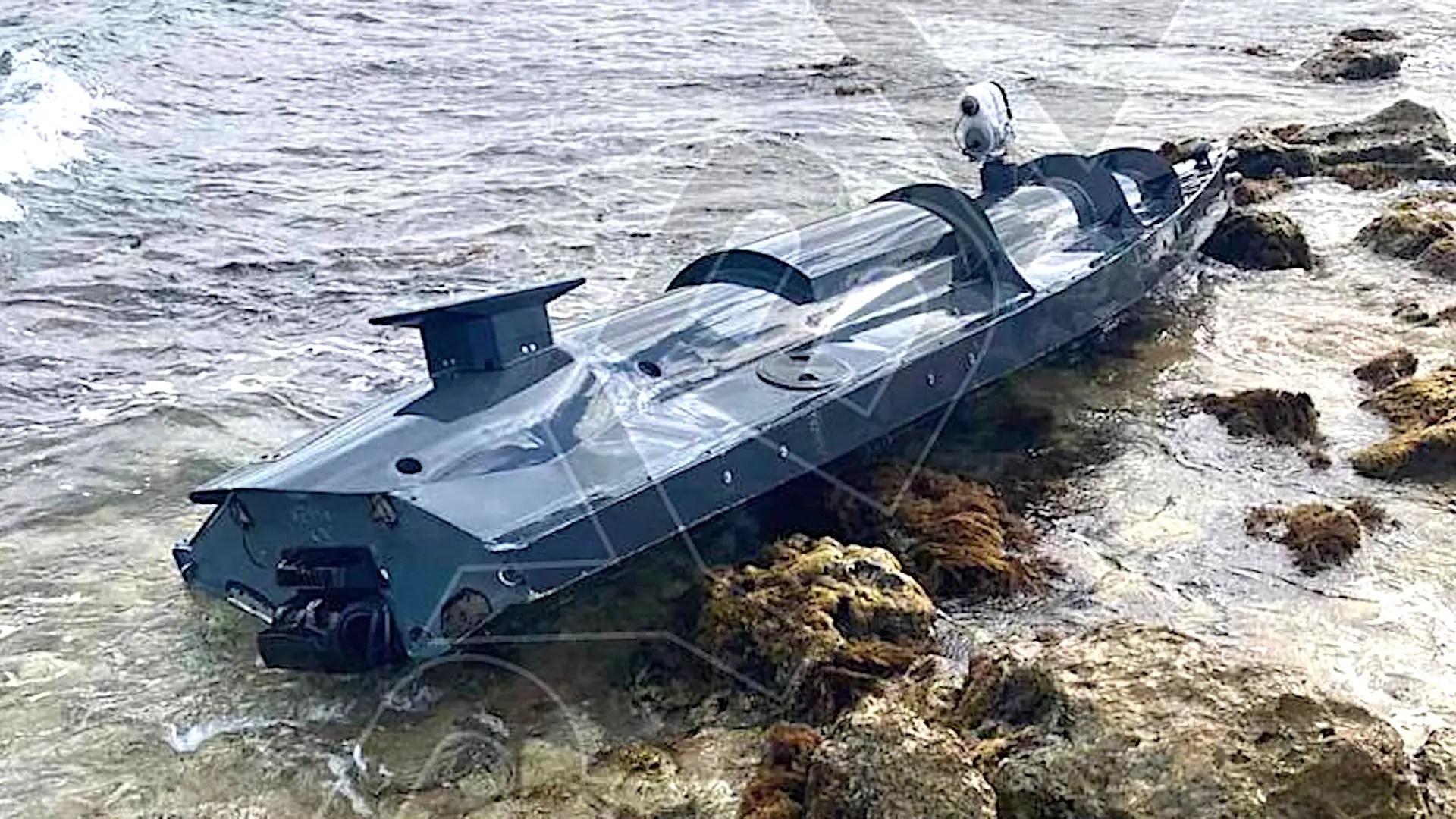
“Mystery Drone Boat Washes Up Near Home Of Russia’s Black Sea Fleet” –The Drive

See the linked post for more photos

The Drive/The War Zone discusses reports of a possible suicide drone surface vessel. This looks more sophisticated than the unmanned explosive motor boats that were used by Yemen’ Houthi faction, possibly using satelite communications to allow it to be operated over much greater distance from the control station.

“Iranian ship intercepted while trying to detain American drone” –Breaking Defense

USS Thunderbolt, seen here in both Coast Guard and Navy markings during its period of service in the USCG. U.S. Coast Guard photo by David Schuffholz

Breaking Defense reports,

The US Navy’s 5th Fleet today announced it thwarted an attempt by an Iranian ship to seize an American unmanned surface vessel operating in the Arabian Gulf.

(See the video below.)

The unit that stopped this Iranian vessel from making off with the Saildrone was USS Thunderbolt (PC-12), supported by a helicopter of Helicopter Sea Combat Squadron 26, presumably an MH-60S. Vessels of this class are in the process of being decommissioned from the US Navy. Most of their functions will be performed USCG Webber class WPCs of Patrol Forces SW Asia.

This incident does seem to highlight a, not unexpected, aspect of Unmanned Surface Vessel (USV) deployment. Rogue nations and even non-state actors may try to steal them. As we see here, there may be little or no consequences if they are caught in the act, so there is little to deter a repeated attempt.

Next time it happens, it is likely that a Coast Guard cutter will be sent to retrieve it.

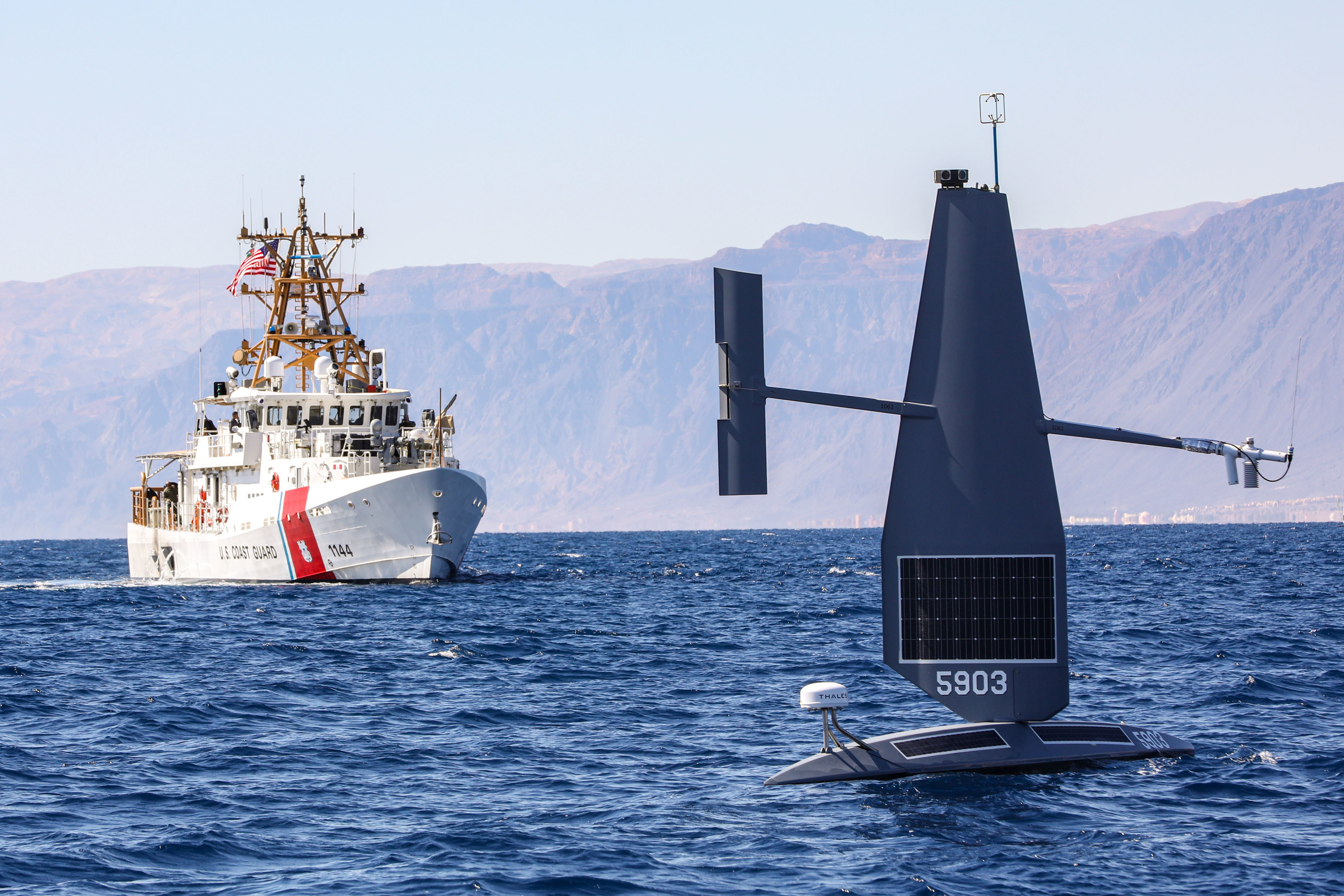
Wikipedia provides this information on the Saildrone Explorer.

“The Saildrone Explorer is a 23-foot-long (7.0 m) USV that can sail at an average speed of 3 knots (5.6 km/h; 3.5 mph) (depending on the wind) and stay at sea for up to 365 days. The Explorer is designed for fisheries missions, metocean data collection, ecosystem monitoring, and satellite calibration and validation missions.”

Bigger, more expensive and more capable Saildrones are on the way.

The US Coast Guard has been experimenting with Seadrones of this class, and has supported 5th Fleets experiments with them.

GULF OF AQABA (Feb. 13, 2022) The U.S. Coast Guard Sentinel-class cutter USCGC Glen Harris (WPC 1144) sails near a U.S sail drone explorer during the International Maritime Exercise/Cutlass Express (IMX) 2022, Feb. 13, 2022. IMX/CE 2022 is the largest multinational training event in the Middle East, involving more than 60 nations and international organizations committed to enhancing partnerships and interoperability to strengthen maritime security and stability. (U.S. Army photo by Cpl. DeAndre Dawkins)

Thanks to Walter for bringing this to my attention.

Contracts For “Continued Studies of a Large Unmanned Surface Vessel”

MetalCraft Marine 7 meter “The Watcher” Autonomous Surface Vessel (ASV)

I have to believe that the Navy’s efforts in Unmanned Surface Vessels will ultimately have a significant implact on the way the Coast Guard does its business, so a recent series of contract awards reported in “The US Department of Defense Daily Digest Bulletin, Contracts for July 29, 2022” is of interest. 


Marinette Marine Corp., Marinette, Wisconsin, is awarded a $10,212,620 firm-fixed-price modification to previously awarded contract N00024-20-C-6317 for continued studies of a large unmanned surface vessel. Work will be performed in Marinette, Wisconsin, and is expected to be completed by September 2024. Fiscal 2022 research, development, test and evaluation (Navy) funds in the amount of $149,841 will be obligated at time of award and will not expire at the end of the current fiscal year. The Naval Sea Systems Command, Washington, D.C., is the contracting activity.

Bollinger Shipyards Lockport LLC, Lockport, Louisiana, is awarded a $9,428,770 firm-fixed-price modification to previously awarded contract N00024-20-C-6316 for continued studies of a large unmanned surface vessel. This contract modification includes options which, if exercised, would bring the cumulative value of this contract modification to $13,958,770. Work will be performed in Lockport, Louisiana, and is expected to be completed by September 2024. If all options are exercised, work will continue through September 2024. Fiscal 2022 research, development, test and evaluation (Navy) funds in the amount of $149,933 will be obligated at time of award and will not expire at the end of the current fiscal year. The Naval Sea Systems Command, Washington, D.C., is the contracting activity.
Austal USA LLC, Mobile, Alabama, is awarded a $9,115,310 firm-fixed-price modification to previously awarded contract N00024-20-C-6315 for continued studies of a large unmanned surface vessel. This contract modification includes options which, if exercised, would bring the cumulative value of this contract modification to $13,285,309. Work will be performed in Mobile, Alabama, and is expected to be completed by September 2024. If all options are exercised, work will continue through September, 2024. Fiscal 2022 research, development, test and evaluation (Navy) funds in the amount of $149,878 will be obligated at time of award and will not expire at the end of the current fiscal year. The Naval Sea Systems Command, Washington, D.C., is the contracting activity.
Gibbs & Cox Inc., Arlington, Virginia, is awarded an $8,981,231 firm-fixed-price modification to previously awarded contract N00024-20-C-6318 for continued studies of a large unmanned surface vessel. This contract modification includes options which, if exercised, would bring the cumulative value of this contract modification to $15,071,231. Work will be performed in Arlington, Virginia, and is expected to be completed by September 2024. If all options are exercised, work will continue through September 2024. Fiscal 2022 research, development, test and evaluation (Navy) funds in the amount of $149,899 will be obligated at time of award and will not expire at the end of the current fiscal year. The Naval Sea Systems Command, Washington, D.C., is the contracting activity.

“Sea Air Space 2022” –Naval News Video Coverage

Below I have posted two videos by Naval News, along with the breakdown of topics that accompanied the videos on YouTube. The video of the 30mm Mk38 Mod4 with its included electro-optic fire control system is probably of most immediate interest to the Coast Guard, but the increasing tendency to containerize weapon systems is appears ready to make any cutter (and almost any other ship) a missile carrier.

  • 01:06 – Constellation-class frigate program with Fincantieri Marinette Marine
  • 04:30 – MSI Defence Mark 38 Mod 4 30mm naval gun system
  • 07:53 – Lockheed Martin’s Expeditionary Launching System
  • 09:21 – BAE Systems E-Launcher
  • 09:52 – Kongsberg NSM-HL helicopter launched naval strike missile
  • 00:43 – Kongsberg Hugin Edge UUV
  • 02:27 – General Dynamics Tethered Unmanned Aerial Systems
  • 03:36 – Shield AI’s Hivemind (V-BAT also –Chuck)
  • 05:23 – Saildrone Explorer USV
  • 06:48 – PennState’s 54″ Large Test Vehicle UUV


“Unmanned and on Guard: A New Approach to Coast Guard Operations” –USNI Blog

The US Naval Institute Blog has a post by LCdr John H Walters, USCG, who is the MQ-9A platform manager within the CG Office of Unmanned Aircraft Systems.

It pleads the case for unmanned systems (and satellite systems). The author is obviously a true believer (as am I to an extent).

The thing that I find encouraging is that there is a Coast Guard Office of Unmanned Aircraft Systems. What I find discouraging is that the Coast Guard has yet to procure its own shore based UAS and is still riding the coat tails of the Customs and Border Protection program that is still operating old versions of the MQ-9 that are not optimized for the Marine environment and do not have the “see and avoid” capability that would allow them to operate in airspace where mid-air collision is a possibility. There may be operational reasons to continue a relationship with the CBP unit, but as a learning experience, it has served its purpose. DBP has been operating their MQ-9s for 16 years. It is time for the Coast Guard to field its own land based unmanned air systems.


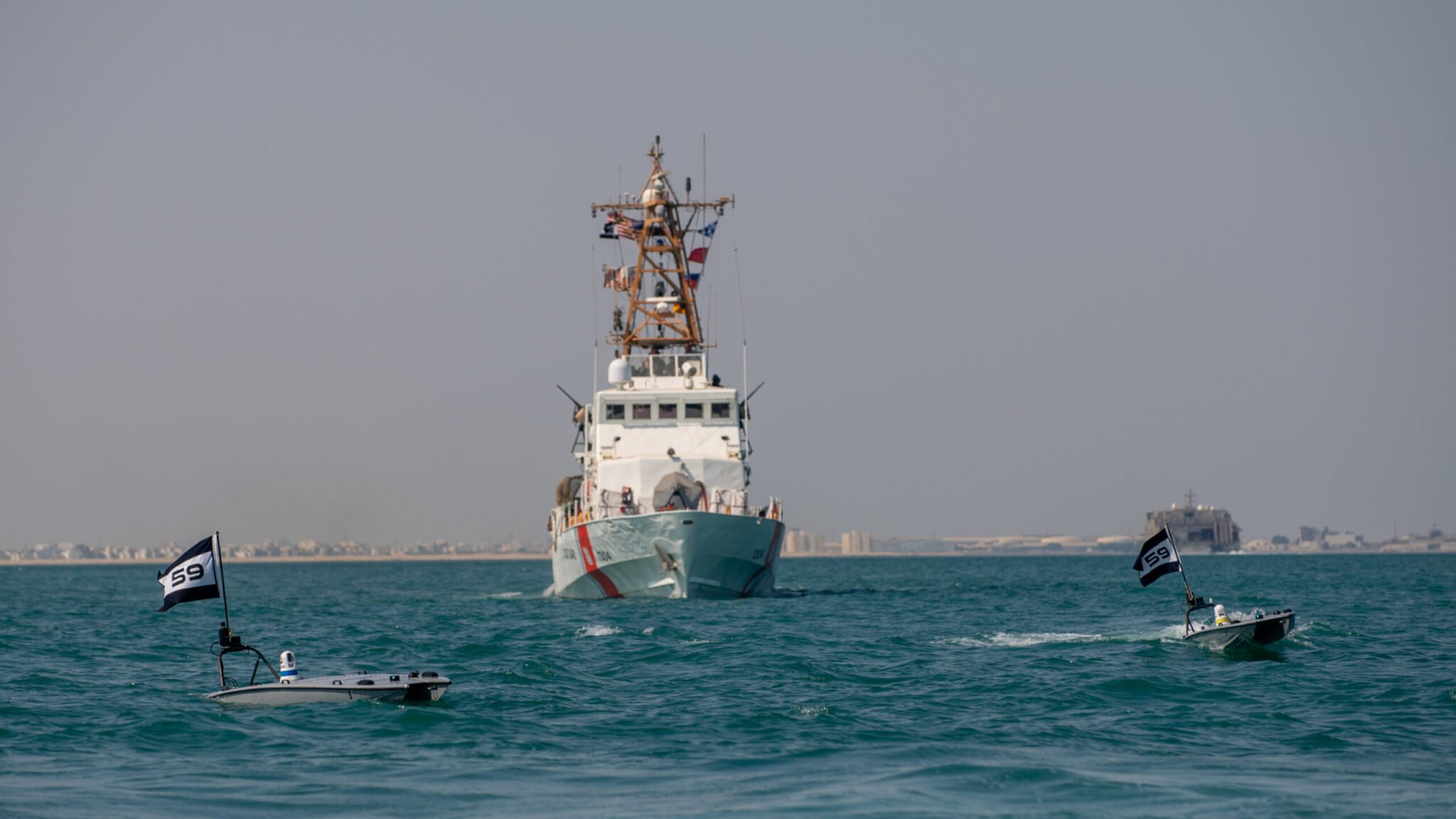
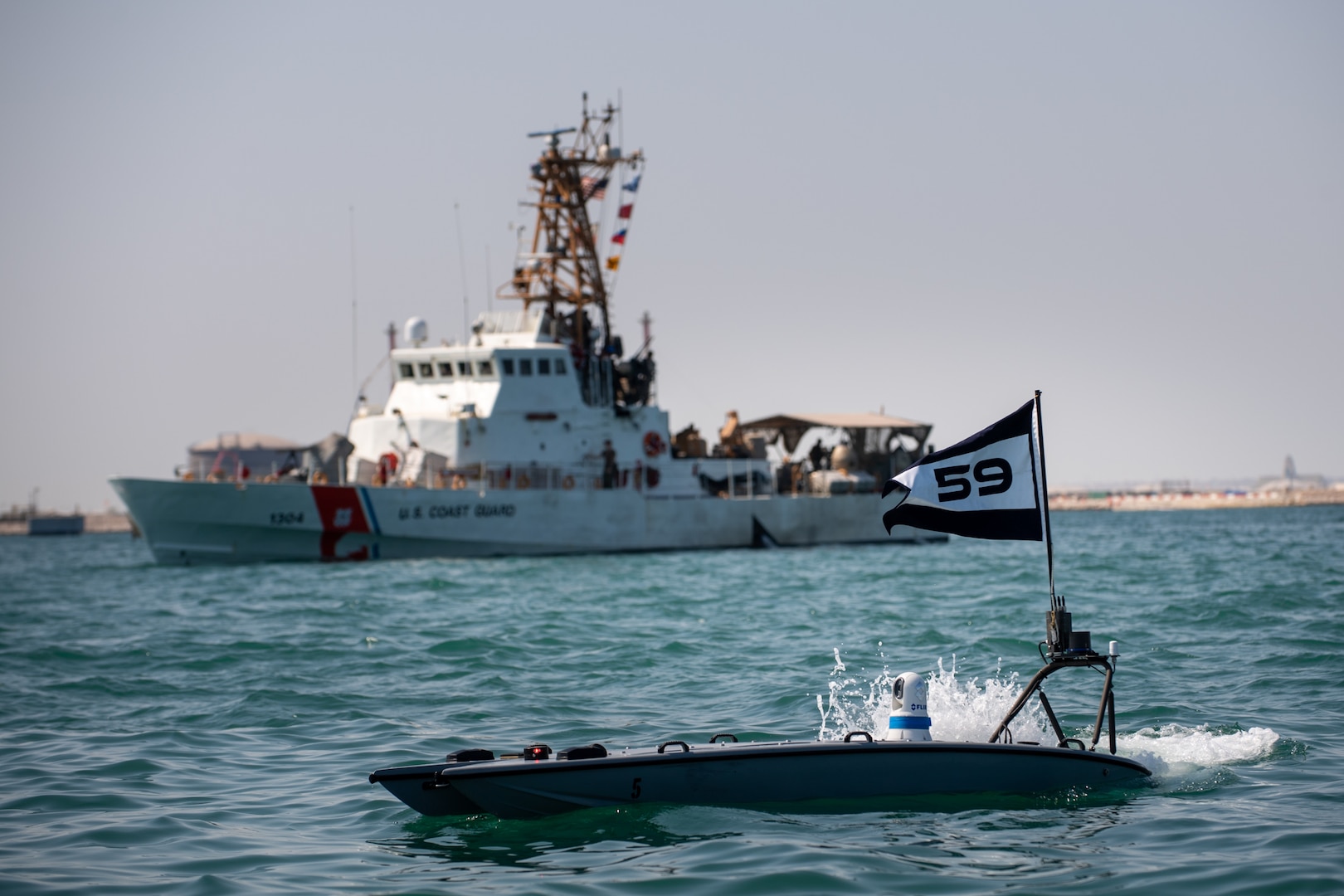
Task Force 59 Unmanned Surface Vessels Operate With PATFORSWA Cutter

US Navy TF59 Integrates MANTAS USV with Patrol Vessels

Two MANTAS T-12 unmanned surface vessels (USV), front, operate alongside U.S. Coast Guard patrol boat USCGC Maui (WPB 1304) during exercise New Horizon in the Arabian Gulf, Oct. 26. Exercise New Horizon was U.S. Naval Forces Central Command Task Force 59’s first at-sea evolution since its establishment Sept. 9. (U.S. Navy photo by Mass Communication Specialist 2nd Class Dawson Roth)

Naval News reports an exercise conducted by Task Force 59, Fifth Fleet’s Unmanned systems development group. As I thought they might, they have been working with Coast Guard Patrol Force South West Asia (PATFORSWA) as well as Navy Cyclone class and allied navies.

“Autonomous vessels can help the Coast Guard safeguard our waters” –Work Boat

S&T, USCG, Ocean Aero, CNSP, NRL, ARL, HSSEDI, and USM’s evaluation team monitors a Triton autonomous vessel during performance testing. DHS photo. Note here the mast is folded down. 

Work Boat has a short report from DHS’s Science and Technology Directorate about experiments with an unmanned system.

First, its good to see the Department supporting R&D efforts on behalf of the Coast Guard, because the Coast Guard R&D budget is miniscule.

Second, this unmanned surface system is a bit unique, in that it is submersible, unlike the SeaDrones that the Coast Guard had previously experimented with. It is not primarily expected to operate underwater, because it is powered by wind and solar, but it does have the capability to submerge.

There are already several autonomous vessels in the field utilized for both commercial and military applications. However, the Tritons are a unique technology. At 14 feet long, they are the size of a small rowboat—making them easy to deploy from any port or USCG vessel. They are environmentally friendly and rely solely on wind and solar power at sea. The Tritons’ solar arrays are positioned atop their hulls, along with retractable 8-foot wind sails—both designed to charge the Tritons’ batteries whenever they are on the surface of the ocean. The Tritons also perform surface and underwater surveillance activities; navigate while submerged; dive to about 100 feet; and accommodate state-of-the-art sensor packages that utilize electro-optical and infrared cameras, sonar, and other specialized sensors. All of these characteristics and abilities make them useful for long-term USCG maritime protection and law enforcement operations at sea.

The ability to submerge opens up some interesting options. This might be used to avoid collision. It might be used to sample the water column. It might be used to put acoustic sensors below the surface layer. Or it might be used to take a closer look at mine-like objects below the surface.

Thanks to Paul for bring this to my attention. 

“Elbit Systems To Supply ASW Capabilities To An Asian-Pacific Navy” –Naval News

Naval News Reports, Israeli defense contractor, Elbit Systems has been awarded contracts totaling about $56M to provide ASW capabilities to an unnamed Asia-Pacific country (my guess, the Philippines).

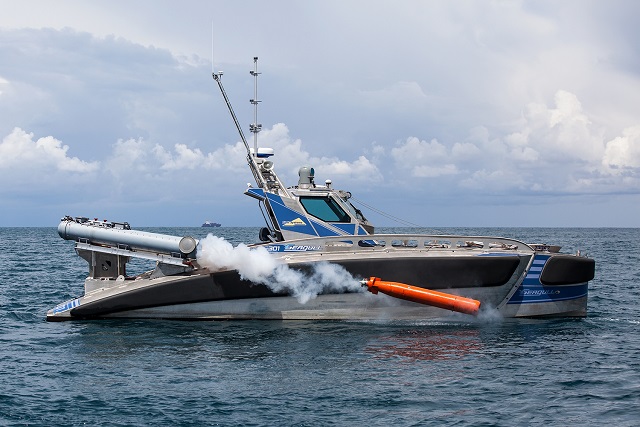
Elbit Systems will provide the Seagull™ USVs (Unmanned Surface Vessels) configured to perform ASW missions and the Towed Reelable Active Passive Sonar (TRAPS) systems. The Seagull USVs will integrate Helicopter/Ship Long-Range Active Sonars (HELRAS) and will be equipped with the Company’s autonomous suite, Combat Management System and Satellite Communication capability. The TRAPS systems, which will be installed onboard the customer’s corvettes, are low frequency variable-depth-sonars intended for detection, tracking and classification of submarines, midget submarines, surface vessels and torpedoes.

I love to see this stuff because it means there are ASW systems out there that are appropriate for cutters from the largest down to relatively small.

Using helicopter style dipping sonars on surface vessels is not new. The Soviets built a number of corvettes that used this approach (Petya, Mirka, and Koni classes), but the dipping sonars have gotten much better since then.

We have talked about TRAPS before:

HELRES, Helicopter Long Range Active Sonar, is a product of L3Harris, headquartered in Melbourne, FL.

Elbit Systems’ Seagull unmanned surface vessel. I do love this photo because it shows that even a very small vessel can launch light weight torpedoes.