NavalDrones reports on the latest demonstration of Office of Naval Research (ONR)’s platform-agnostic system CARACaS (Control Architecture for Robotic Agent Command and Sensing).
Thanks to Mike R. for bringing thi to my attention.

NavalDrones reports on the latest demonstration of Office of Naval Research (ONR)’s platform-agnostic system CARACaS (Control Architecture for Robotic Agent Command and Sensing).
Thanks to Mike R. for bringing thi to my attention.

There is an interesting bit of technology here, with implications for Maritime Domain Awareness.
The Wave Glider began its mission on November 27, 2015 in the South Pacific, where it helped the UK FCO protect the Pitcairn Island Marine Sanctuary against illegal fishing activities. After successfully completing its mission, the Wave Glider was remotely piloted more than 2,808 nautical miles (5200 km) — through strong equatorial currents, doldrums, and challenging sea states — back to port in Hawaii. Along the way, it collected 9,516 measurements of meteorological, oceanographic, and marine biodiversity data over expanses rarely traveled. This data was recently used to support the worldwide Fishackathon, a program sponsored by the U.S. Department of State to promote innovative ways to stop illegal and unregulated fishing. Altogether, the Wave Glider was continuously at sea, untouched, for 213 days while traveling a total of 7,205 nautical miles (13,344 km).
There is more about the Pitcairn Island mission here, but its potential is not limited to fisheries. Check out the segment of the video below beginning at 4m24s to 5m20s.
Thanks to Mike for bringing this to my attention.

DefenseNews is reporting the Israeli Navy is taking seriously the potential use of the same types of smuggling craft the Coast Guard has been dealing with to “transport more than just narcotics, [but] the movement of cash, weapons, violent extremists or, at the darkest of the spectrum, weapons of mass destruction.”
Among the defensive measures they are taking is the use of unmanned surface vessels.
DefenseNews reports the Israeli company Elbit has been working on developing an unmanned surface vessel system, and they have gone beyond simply patrolling the surface and employing remotely controlled machine guns. They are attempting to use it for Anti-Submarine Warfare and mine countermeasures.
In a separate post, Navy recognition reports that this system has successfully test launched a light weight torpedo.
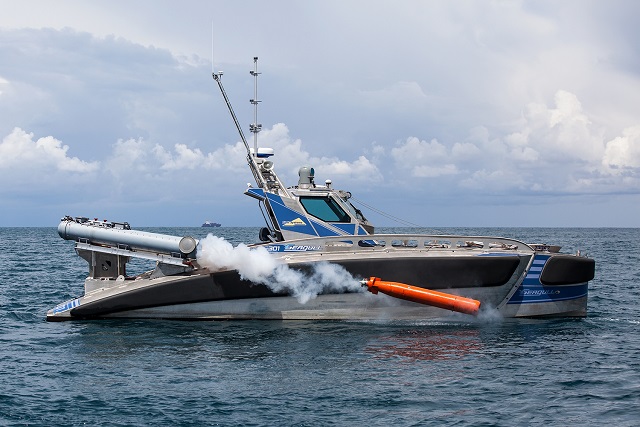
If you compare the vessel in the video and the one in the photo above, it is apparent that the equipment has been changed and that the craft probably could not carry both the sonar sensor and the light weight torpedoes, but it is possible multiple units might operate in groups.
Using small vessels for ASW and MCM has a long history, although not always particularly successful. As ASW assets they do offer the advantage that they are too small to be good targets for a submarine’s torpedoes. On the other hand their ability to support sensors and weapons is severely limited, and the crews’ limited ability to deal with adverse weather has always been problematic. Making them unmanned will at least help with that.
Thanks to Jim for suggesting the topic.
These little Unmanned Surface Vehicles (USVs) may be one way to enhance our Maritime Domain Awareness. They have already traveled a million nautical miles.
NavyRecognition has the story.
I could see a line of these in the Eastern Pacific, used to detect drug smuggling semi-submersibles.
Perhaps we will also see them used to cue Anti-Submarine Warfare Continuous Trail Unmanned Vessels.(ACTUV) or maritime patrol aircraft to the presence of submarines. It might not be too expensive to provide a line of them covering an entire trans oceanic route.
There will almost certainly be a war time role for launching these or something similar. Maybe a role for our buoy tenders.
It now seems obvious that Unmanned Systems (air and possibly surface and subsurface) will play a part in the Coast Guard’s future, but the service has been, perhaps understandably hesitant to commit to any particular system.
Because of the variety of proprietary systems, integrating the control systems into the organization of the controlling unit, particularly ships and aircraft, and then integrating the resulting information into a common operating picture has been problematic.
Eaglespeak reports, it looks like DOD, through the Office of Naval Research, is moving in the direction of a platform agnostic software application that will permit common hardware to control different unmanned system.
This might permit Coast Guard units which commonly control small unmanned aicraft (sUAS) to be quickly adapted to
Looks like sooner or later we are going to see unmanned surface vessels transiting the oceans. Both MarineLog and MarineLink report on a Chinese Study. The odd thing about these reports is that apparently, among other things, they were applying this technology to SAR. This from MarineLog:
The Unmanned Multifunctional Maritime Ships Research and Development Project, says MSA, realizes all-day networked sea supervision, intelligent search and rescue, motorized multipoint coverage by shore-vessel based detection and control platform managing unmanned search and rescue vessels on a low-cost basis, which effectively improved the ability and efficiency in maritime search and rescue.
(MarineLink apparently working from the same press release consistently substitutes the phrase “maritime cruise and rescue.”)
Frankly I have a hard time visualizing what unmanned surface vessels could do for search and rescue.

MarineLink has a short post about a European effort to use networked Unmanned Air and Surface Vehicles (UAVs and USVs) to do SAR. I don’t find their particular scenario persuasive, but there probably are roles for these systems.
Unmanned systems have some potential advantages over Manned assets although they are unlikely to ever replace them.
Frankly, I had thought of unmanned systems as primarily Law Enforcement assets, but the Coast Guard is looking as the possibility of locating personnel in the water using small UAVs.
USVs:
I have a hard time visualizing a use for Unmanned Surface Vessels (USV), but perhaps there might be a benefit in dropping a USV to a distressed vessel or person(s) in the water either from a fixed wing or a UAV.
UAVs might be used:
Any Other Ideas?
Any other potential uses?
 Chuck Hill's CG Blog