Greek Island Class Cutters to be Armed With Lionfish 20mm Remote Weapon Station

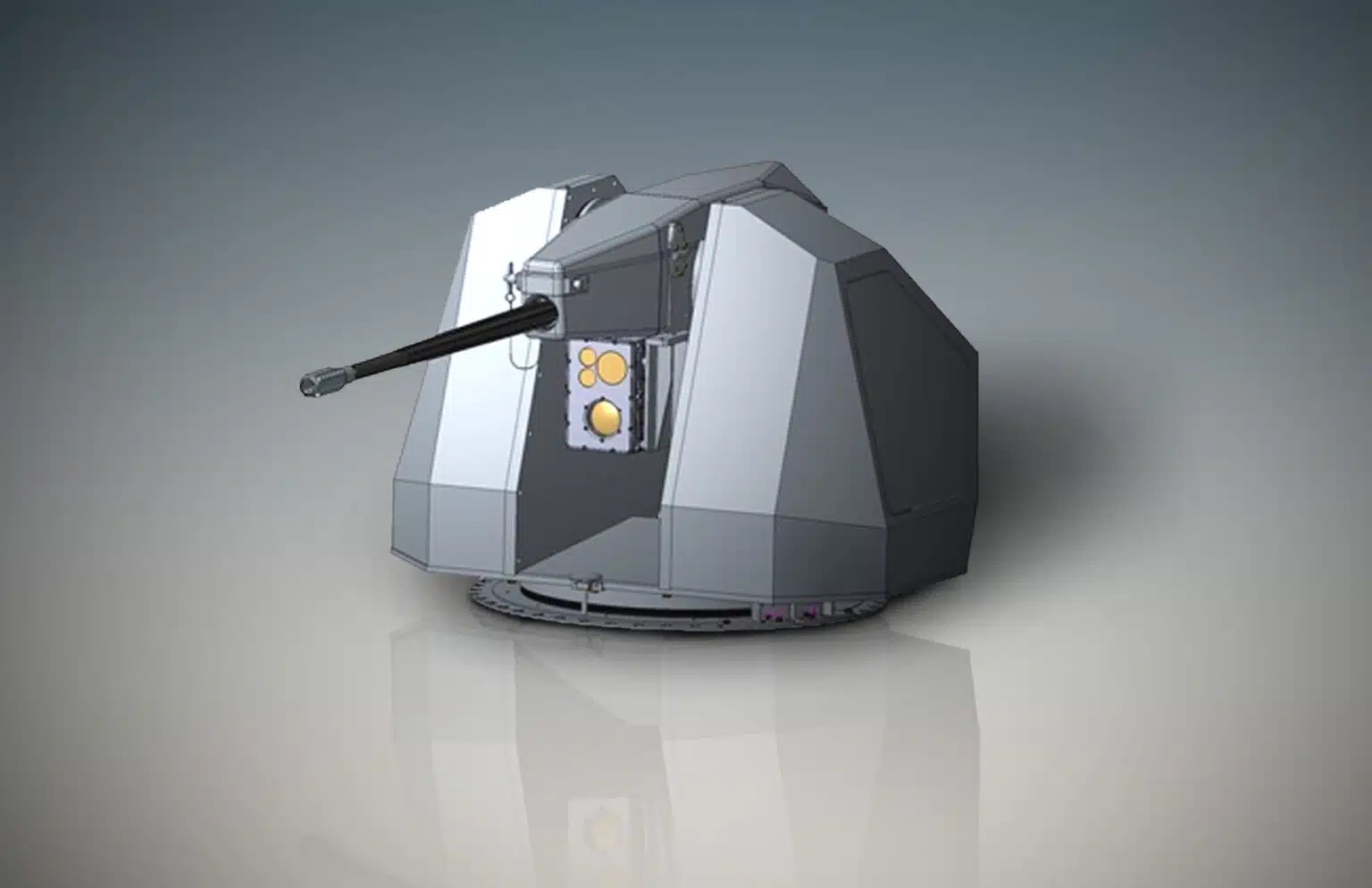
LIONFISH 20 RWS (Leonardo image)

Two separate reports from Naval News (here and here) that four Island class cutters being transferred to the Greek Navy will be equipped with the Leonardo Lionfish 20mm Remote Weapon Station.

The weapon has a reported rate of fire of up to 1000 rounds per minute with 250 rounds on the mount, and an effective range of at least 2000 meters.

Unlike the Mk38 Mod2/3/4 mounts, traversing the electro-optics also requires training the gun.

Guns for Ukrainian Island Class Patrol Boats.

Ukrainian Navy Island-class patrol boats, formerly of the U.S. Coast Guard, conduct maritime security operations in the Black Sea off the coast of Odesa, Ukraine.
UKRAINIAN NAVY

This was on the U.S. Department of Defense Daily Digest Bulletin for Aug. 7, 2023.

Safe Boats International LLC,* Bremerton, Washington, is awarded a $22,271,829 firm-fixed-price modification to previously-awarded contract N00024-21-C-2201 for the exercise of options for procurement and installation of six Gun Weapon Systems onto the Island Class patrol boats with spares. Work will be performed in Tacoma, Washington, and is expected to be completed by October 2024. Foreign Military Financing (Ukraine) funds in the amount of $22,271,829 will be obligated at time of award and will not expire at the end of the current fiscal year. The Naval Sea Systems Command, Washington, D.C., is the contracting activity. (Awarded Aug. 3, 2023)

Five Island class 110 foot patrol boats were transferred to Ukraine.  One of them has been sunk.

Previously vessels of this class were armed with crew served Soviet era 25 mm guns.

This is reported as modification of an existing contract, so I presume at least one vessel has already been rearmed. Thinking two guns per vessel, then six gun systems will go on three additional vessels. So, at least four ships with two guns each. Presumably, they would be 25 or 30 mm guns, hopefully the new 30mm Mk38 Mod4.

The announcement does say, “Work will be performed in Tacoma, Washington, and is expected to be completed by October 2024.” If this is true, these are additional boats. The Coast Guard still has many available for transfer. It is also possible there might be only one gun per vessel. All we know for sure is in the quote above.

In Dec. 2019 there was a suggestion that these vessels might be fitted with anti-ship cruise missiles, but there has been nothing further to indicate it has or will happened.

“Greece Receives First Island Class Patrol Vessels From The U.S.” –Naval News

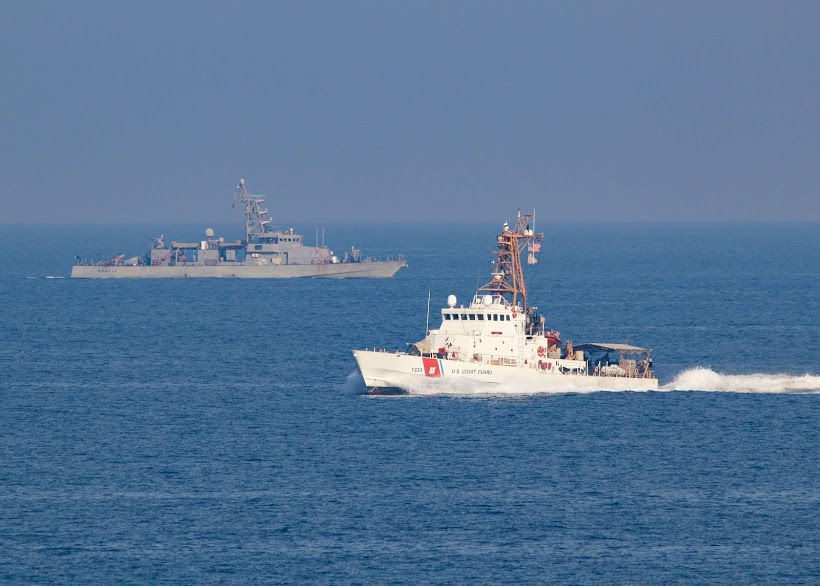
(Since today is the 4th of July) As part of 5th Fleet’s PATFORSWA, crewmembers aboard the U.S. Coast Guard cutter USCGC Adak (WPB-1333) raised the American flag.  U.S. Coast Guard photo by Seaman Frank Iannazzo-Simmons

Naval News reports that four of the six PATFORSWA 110 foot Island Class WPBs are being transferred to the Greek Navy, and it goes on to speculate they may ultimately get all six.

“The four Island-class boats that will join soon the Greek naval fleet are the former Wrangell (WPB-1332), Adak (WPB-1333), Monomoy (WPB-1326) and Aquidneck (WPB-1309).”

The boats are to be refurbished and are expected to be equipped with a 20mm remote weapon station (RWS), the LIONFISH 20 by Leonardo, new “surveillance radar, electro-optical sensor (Naval News verified that it will be a Miltech Hellas product), communications equipment and machine guns will be installed as well.”

The post notes that former US Coast Guard Island class cutters now also serve with Pakistan (Pakistan Maritime Security Agency), Georgia (Georgian Coast Guard), Costa Rica (Costa Rican Coast Guard), and Ukraine (Ukrainian Navy) in addition to the Greek Navy.

Additional transfers can be expected in the future.

“U.S. Looks To Transfer 4 Patrol Boats To The Philippines” –Naval News

Ukrainian Navy Island-class patrol boats, formerly of the U.S. Coast Guard, conduct maritime security operations in the Black Sea off the coast of Odesa, Ukraine. UKRAINIAN NAVY

Naval News reports,

“On Monday, the U.S. announced its intention to transfer four patrol boats to the Philippine Navy. The transfer intends to support the Armed Forces of the Philippines’ modernization plan, specifically the Philippine Navy’s maritime capabilities.”

Note these are to go to the Philippine Navy, not their Coast Guard.

They will be getting two 110 foot (33.5 m) Island class and two 87 foot (26.5 m) Marine Protector class patrol boats.

This may just be the first such transfer. There are still quite a few Island class that may be available for transfer. The Coast Guard 2023 “Asset” poster indicates there were nine Island class cutters still in service when the poster was created. There are probably others that have been decommissioned but have not yet been transferred or otherwise disposed of.

The Marine Protector class now 14 to 25 years old. There is no direct replacement planned for this class but several have been decommissioned as their role has been taken by the 45 foot Response Boat, Medium and the 154 foot Webber WPCs. 

Since these boats are going into the Philippine Navy rather than the Philippine Coast Guard, there is a possibility they may be armed with something larger than .50 cal. (12.7mm) machine guns. The Island class, in US Coast Guard service, were armed with crew served manual early models of the 25mm Mk38 gun mount. It is not clear if the boats will be transferred with their guns in place. When the 378 foot WHECs were transferred to the Philippine Navy, their 25mm Mk38 gun mounts were removed before transfer. The Philippine Navy has 25mm Mk38s of several marks including the remote weapon stations. They also have 20, 30, and 40mm guns that might equip the cutters.

These cutters will have a significant speed advantage over most China Coast Guard and maritime militia vessels. Maximum speeds are 25 knots for the 87 footers and 29 knots for the 110 foot cutters. The Island class also has sufficient range (2,900 nmi (5,400 km) to go anywhere in the South China Sea.

“The Ukrainian Navy and the Fight for Democracy” –USNI

Ukrainian Navy Island-class patrol boats, formerly of the U.S. Coast Guard, conduct maritime security operations in the Black Sea off the coast of Odesa, Ukraine. UKRAINIAN NAVY

The US Naval Institute’s May 2023 issue of “Proceedings” includes an article by Vice Admiral Oleksiy Neizhpapa, Ukrainian Navy discussing the Ukrainian Navy’s role in the war with Russia.

Because the Ukrainian Navy used all available assets, including unmanned vehicles, it has achieved a strategic effect. We forced the enemy fleet to move east of the meridian of Cape Tarkhankut (Crimean Peninsula) and denied Russian operational activity in the northwestern part of the Black Sea, even near Crimean harbors. These Ukrainian Navy efforts created a gray zone and enabled the Grain from Ukraine Initiative, which ensures the export of Ukrainian grain to countries in need. In 2022, more than 24 million tons of agricultural products were exported from initially blocked Ukrainian ports.

He is obviously very proud of the accomplishments of their small navy. It is a good article, but I would have had to reference if for no other reason than to post the accompanying photo above.

Coast Guard in the Iraq War

USCGC Adak Persian Gulf

MyCG has two posts about the Iraq war and the Coast Guard’s part in it.

Thought it odd we would have two so closely related posts, by the same author. Actually, the first was done some time ago but internet access was lost when the Coast Guard changed servers.

Both are now linked on my Heritage page.

“U.S. Navy Intercepts More Than 2,000 Assault Rifles Shipped from Iran”

Thousands of AK-47 assault rifles sit on the flight deck of guided-missile destroyer USS The Sullivans (DDG 68) during an inventory process, Jan. 7. U.S. naval forces seized 2,116 AK-47 assault rifles from a fishing vessel transiting along a maritime route from Iran to Yemen. (Photo by U.S. Navy)

Below is a press release from U.S. Naval Forces Central Command reporting interdiction of an arms smuggling operation. The initial interception and boarding were done by, soon to be decommissioned, Cyclone class patrol ship USS Chinook. She was supported by another, soon to be decommissioned, Cyclone class USS Monsoon and destroyer USS The Sullivans.

At one time there were ten Cyclone class patrol ships based in Bahrain, along with six Island class patrol boats and for a while some MkVI patrol boats. Apparently, there are still five Cyclone class, based in Bahrain, doing useful work for the USN. Looks like soon, there will only be the six Webber class of Coast Guard Patrol Forces Southwest Asia.

Apparently, 5th Fleet expects the unmanned systems of Task force 59 to perform some of the patrol functions, but I have to wonder if six patrol craft are enough?


MANAMA, Bahrain —

U.S. naval forces intercepted a fishing vessel in the Gulf of Oman, Jan. 6, and discovered it smuggling 2,116 AK-47 assault rifles while transiting international waters along a maritime route from Iran to Yemen.

A U.S. Navy boarding team from patrol coastal ship USS Chinook (PC 9) initially discovered and seized the weapons with support from USS Monsoon (PC 4) and guided-missile destroyer USS The Sullivans (DDG 68). The intercepted vessel, which was sailing on a route historically used to traffic illicit cargo to the Houthis in Yemen, was crewed by six Yemeni nationals.

The direct or indirect supply, sale or transfer of weapons to the Houthis violates U.N. Security Council Resolution 2216 and international law. The transfer of the vessel and its crew for repatriation is in progress.

“This shipment is part of a continued pattern of destabilizing activity from Iran,” said Vice Adm. Brad Cooper, commander of U.S. Naval Forces Central Command, U.S. 5th Fleet and Combined Maritime Forces. “These threats have our attention. We remain vigilant in detecting any maritime activity that impedes freedom of navigation or compromises regional security.”

In the past two months, U.S. 5th Fleet has also intercepted two other fishing vessels in the Gulf of Oman smuggling lethal aid from Iran to Yemen.

Forces operating from expeditionary sea base USS Lewis B. Puller (ESB 3) seized more than 50 tons of ammunition rounds, fuses and propellants for rockets, Dec. 1. Weeks earlier on Nov. 8, The Sullivans, USS Hurricane (PC 3) and U.S. Coast Guard ship USCGC John Scheuerman (WPC 1146) intercepted more than 70 tons of ammonium perchlorate, a powerful oxidizer commonly used to make rocket and missile fuel, as well as 100 tons of urea fertilizer.

The U.S. 5th Fleet operating area includes 21 countries, the Arabian Gulf, Gulf of Oman, Red Sea, parts of the Indian Ocean and three critical choke points at the Strait of Hormuz, Bab al-Mandeb and Suez Canal.

Fast Response Cutter / Navy MkVI Patrol Boat –Peter Ong

Today we have a guest author, Peter Ong. This is Peter’s sixth post on this blog, and he is now a regular contributor to Naval News. In this post, he reports a conversation with Coast Guard Cutter Forces about why the success of the Coast Guard’s Fast Response Cutter program has allowed  the Navy to cancel their MkVI patrol boat program that at one time was expected to produce 48 patrol boats.

The MkVI had only very austere galley and messing facilities, a Microwave and MREs. They were not expected to be underway more than 24 hours. The FRCs endurance, allowing days, rather than hours, on station to intercept drug and arms smugglers and their abilitiy to support counter UAS systems may be providing capabilities the MkVI simply could not have.
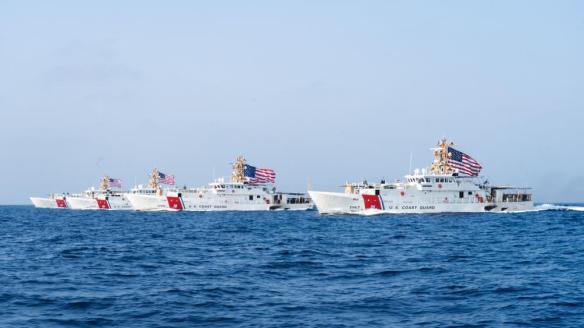
220822-A-KS490-1182 STRAIT OF HORMUZ (Aug. 22, 2022) From the left, U.S. Coast Guard fast response cutters USCGC Glen Harris (WPC 1144), USCGC John Scheuerman (WPC 1146), USCGC Emlen Tunnell (WPC 1145) and USCGC Clarence Sutphin Jr. (WPC 1147) transit the Strait of Hormuz, Aug. 22. The cutters are forward-deployed to U.S. 5th Fleet to help ensure maritime security and stability across the Middle East. (U.S. Army photo by Spc. Noah Martin)

When is a ship a boat and when is a boat a ship? When is an apple an orange and when is an orange an apple? Answer: they are not as these are two different and distinct things when it comes to comparing the warships of the U.S. Coast Guard to the MkVI patrol boats of the U.S. Navy.

A U.S. Navy Mark VI patrol boat with Maritime Expeditionary Security Squadron TWO moves through the water prior to a live fire exercise in the Philippine Sea, Feb. 27, 2021. (U.S. Marine Corps photo by 1st Lt. Stephanie Murphy).

The U.S. Navy is divesting of their 12 in-service Mark VI Patrol Boats, which at the Surface Navy Association 2021, Major General Tracy King, USMC, Director, Expeditionary Warfare (N95) stated that the twelve Mark VIs “Were very expensive to maintain.” However, many critics and pundits of the Mark VIs’ early retirement cite that the Mark VIs still have a lot of life left in them and that their high speeds and heavy armament makes them an asset to special forces, Marines, and Navy SEALs. Mark VIs also perform capital ship escort screenings and contribute to Distributed Lethality and Distributed Maritime Operations by having a smaller vessel signature that might help U.S. Marines move around and slip ashore undetected.

In a phone interview on September 29, 2022 with United States Coast Guard (USCG) Captain John J. Driscoll, Office of Cutter Forces (CG-751), the U.S. Coast Guard captain made a comment about the Sentinel-class Fast Response Cutters (FRC) substituting for the U.S. Navy’s Mark VI Patrol Boats in the Patrol Forces Southwest Asia (PATFORSWA) region and other parts of the globe.

The U.S. Navy plans to replace the Mark VIs and the aging Patrol Coastal boats in the PATFORSWA region with USCG FRCs. When asked how the cutter fleet is integrated with the U.S. Navy and the Department of Defense, the captain replied that the cutter fleet is built into different operational security plans within the U.S. Department of Defense, but these plans are not discussable.

Captain Driscoll said that the Coast Guard’s Fast Response Cutters and the Mark VI are different assets and have different capabilities. The 65 planned FRCs have much greater range and greater endurance (5 days, 2,500 nautical miles (4,600 km; 2,900 mi) and are designed to be on patrol 2,500 hours per year) than the U.S. Navy’s Mark VI Patrol Boats (750 nautical miles (860 mi; 1,390 km) at 25 knots; 690 nautical miles (790 mi; 1,280 km) at 30 knots).

The captain mentioned that the FRC is tremendously capable and different in how it integrates with the Department of Defense and one can’t make comparisons between the Navy’s Mark VI and the USCG’s Fast Response Cutters because the FRC is a commissioned warship of the United States with an assigned crew whereas the Mark VI is just a patrol boat—a ship versus a boat—the ship is larger. The FRC is 154-feet long (46.9 m) with a beam of 25-feet (7.6 m) whereas the Mark VI Patrol Boat is 84.8-feet (25.8 m) long with a beam of 20.5-feet (6.2 m).

Armament is about the same between the two vessels (a Mark 38 MOD 2 25mm autocannon forward with crew-served 12.7mm heavy machine guns and grenade launcher(s) aft) with the Mark VI sporting more armament (another potential Mark 38 25mm autocannon aft and potential crew-served 40mm automatic grenade launchers or 12.7mm heavy machine guns. Some PATFORSWA FRCs will receive the Mark 38 MOD 3 with a 7.62mm coaxial chaingun to the bow 25mm autocannon and a 40mm automatic grenade launcher).

Nonetheless, one can see the huge difference in operational range. Furthermore, the success of the 65 planned Coast Guard FRCs eclipses the 12 Mark VI U.S. Navy Patrol Boats in terms of production numbers. Furthermore, the Mark VI is propelled by waterjets to 45 knots (52 mph; 83 km/h) whereas the FRC has propellers that drive it at 28+ knots. Repeated requests to the U.S. Navy asking for explanation on “[The Mark VIs are] very expensive to maintain” were not answered, but one can assume that it takes a lot of time, labor, and money to clean out the Mark VI’s waterjet intakes and impellers compared to the more easily accessible external shaft and propellers on the Fast Response Cutters when operating in littoral waters potentially teeming with flotsam and seaweed.

FRC range and endurance are important. Captain Driscoll stated that the FRCs are working in the Papua New Guinea and Indonesian region to combat Illegal, Unreported and Unregulated (IUU) fishing and are working with partner nations to address the competition for maritime resources.

As for possible up-arming of the FRCs with the Mark 38 MOD 4 30mm autocannon, that is a retrofit possibility, noted the captain, although the upcoming Polar Security Cutter (PSC) heavy icebreakers will receive the 30mm autocannons first, two on each PSC. Captain Driscoll mentioned that the 30mm autocannon is in the U.S. Navy acquisition system and that the USCG and U.S. Navy both decide on future cutter armament. Programmable and airbursting 30mm ammunition options are not discussable although if the U.S. Navy has the specialized and advanced 30mm ammunition in its inventory, the USCG can also use it depending on the cutter’s mission parameters.

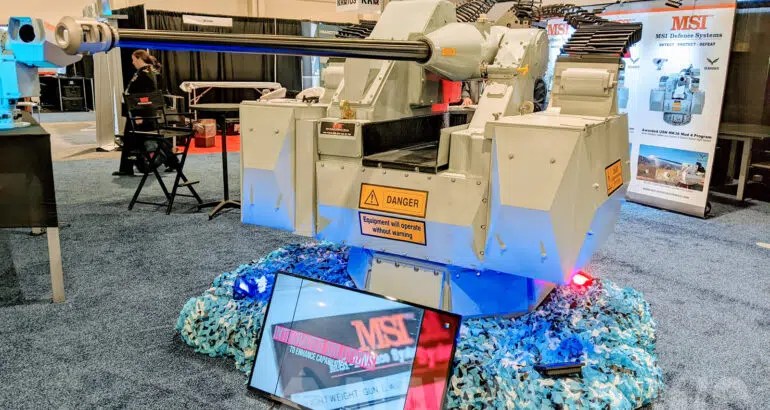
The new Mark 38 Mod 4 30mm naval gun system on display on MSI Defence stand at Sea Air Space 2022. It can, in theory and with funding, be retrofitted aboard existing USCG cutters if agreed upon between the U.S. Navy and the U.S. Coast Guard. Photo: NavalNews

“South Korea Unveils High-Speed Interceptor Craft – HSIC” –Naval News

Naval News reports,

South Korea’s Defense Acquisition Program Administration (DAPA) developed a “high speed interceptor craft” (HSIC) dubbed “Phantom” capable of reaching a top speed of 60 knots.

Specifications include:

  • Displacement: 20 tons
  • Length: 20 meters (65.6′)
  • Beam: 4 meters (13.1′)
  • Range: 300 nautical miles
  • Crew of up to 12 plus 2 ton payload

Apparently, the  high performance is made possible by carbon fiber composite construction. The US Coast Guard really doesn’t have anything of comparable length  that I can compare it to, but we have had much smaller 35 foot “Long Range Interceptor” alluminum hull cutter boats that displaced 12 tons and 45 foot “Response Boat, Medium” boats that displaced 18.4 tons (light). (I don’t have current specs. This information from my nine year old Combat Fleets of the World.)

Bet the Vampire APKWS guided rocket system would fit on the cabin roof in place of the remote weapon station with 12.7 to 30mm gun.

“U.S. Navy’s New 40-Foot Defiant Patrol Boat” –Naval News, Plus FMS Patrol Boat

The 40PB shows its speed in this photo and is armed with a .50cal M2 heavy machine gun at the bow, 7.62mm miniguns and acoustic devices amidships, and a M240B at the stern. The radar, electro-optical camera, and FLIR are visible on the short mast above the cabin. Metal Shark photo.

Naval News brings us a bit more informaton about the Navy’s new 40 foot force protection patrol boat. Most significantly,

NAVSEA: A total of 56 [40-foot Patrol] boats have been awarded to Metal Shark Boats and as of 9 May 2022, 20 boats have been delivered to the U.S. Navy.

In 2017 we discussed the program here and revisited it in 2019 here. The last indicated boats were being delivered at a rate of one every four weeks, meaning Metal Shark will likely be building these boats through early 2025.

Metal Shark calls this model the “40 Defiant” although it is actually 44 foot. Their description is here.

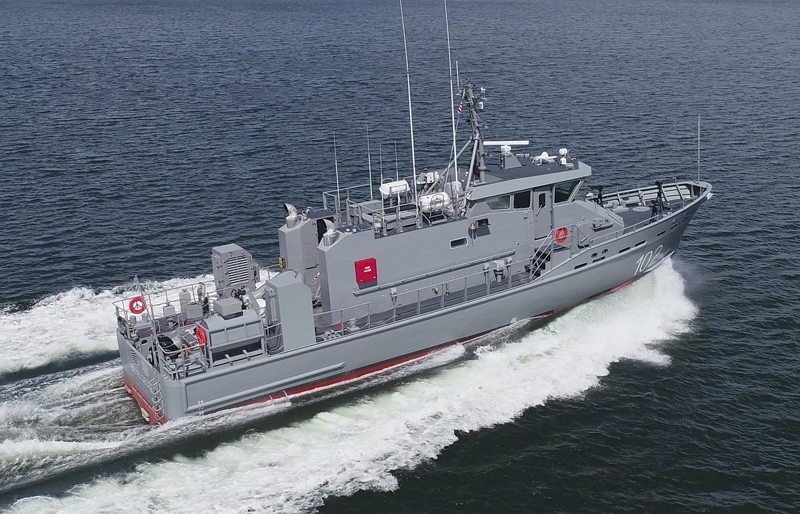
The 85-foot Defiant-class Near Coastal Patrol Vessel (NCPV) is being acquired by NAVSEA for Foreign Military Sales. Metal Shark photo.

There is also a some discussion of the Metal Shark “85 Defiant” patrol boat that is being produced for Foreign Military Sales. This is an evolution of the same design that gave the US Coast Guard its 87 foot “Marine Protector” WPBs (it too is actually 87 foot loa). The Navy calls this class Near Coastal Patrol Vessels or NCPV. We discussed this class in 2017. We noted at the time that Metal Shark had been award a contract,

“…potentially worth upwards of $54 million, Metal Shark will build up to thirteen 85-foot Defiant-class welded aluminum cutters for the Dominican Republic, El Salvador, Honduras, Costa Rica, Guatemala, and other United States partner nations. Additionally, Metal Shark will supply electro-optical infrared sensors, diagnostic equipment, in-country reactivation, crew familiarization, and test support to NCPV operators.

Metal Shark’s website has a description of the vessel here.