“TEXTRON SYSTEMS AWARDED UNCREWED AIRCRAFT SYSTEM (UAS) CONTRACTOR-OWNED/CONTRACTOR-OPERATED CONTRACT FOR THREE LITTORAL COMBAT SHIPS (LCS) BY U.S. NAVY” –Textron Systems

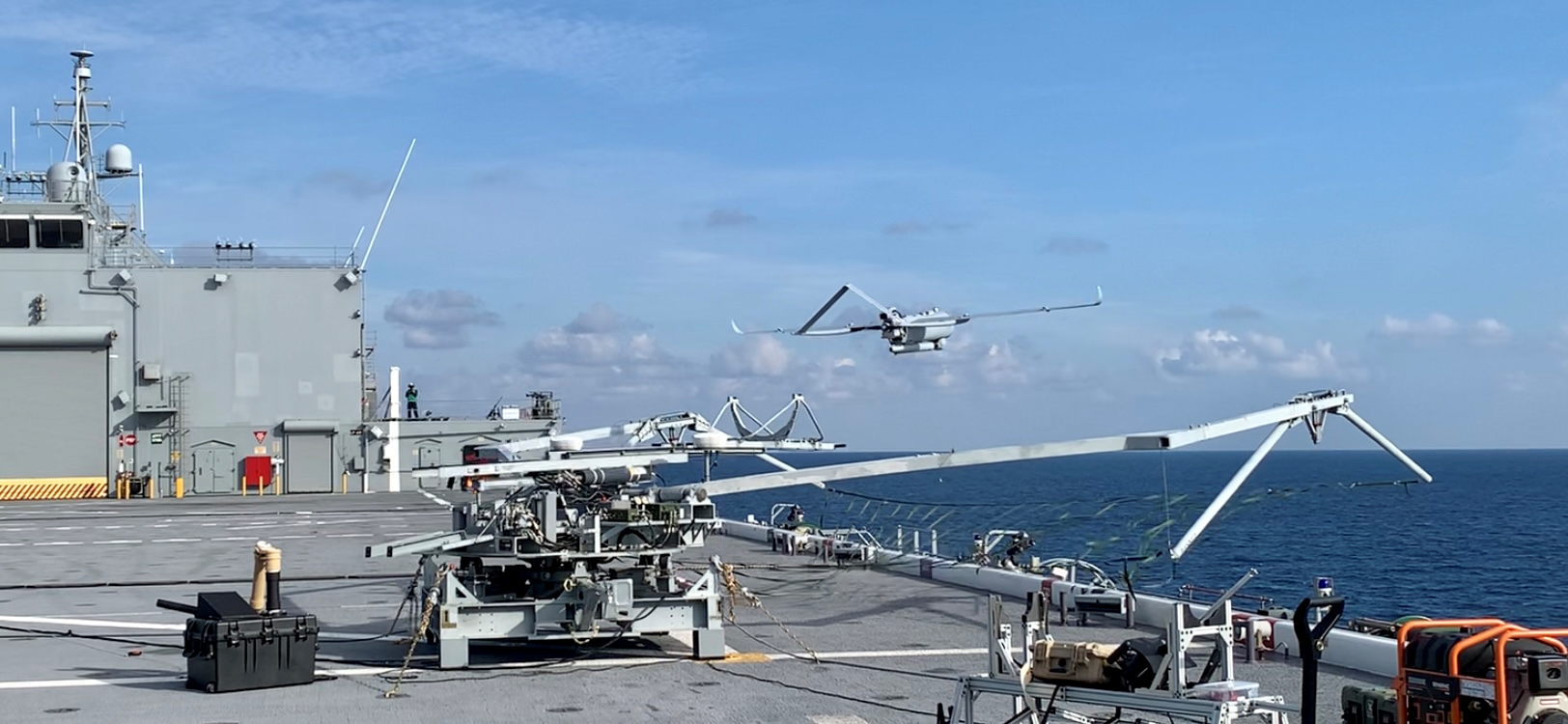
Aerosonde launch from USS Miguel Keith (ESB-5)

Below is a news release from Textron Systems.

It is not clear which version of Aerosonde is to be deployed on the LCSs. There are now hybrid quad versions that can take off and land vertically (see the video) without the supporting catapult and capture gear (top photo), but those with VTOL capability do sacrifice some endurance, speed, and payload as a result of greater weight and increased drag. It is likely the catapult launched version, which we know is on ESB-5, will also be used on the LCSs. Why did the Navy choose the Aerosonde over the Scan Eagle chosen by the Coast Guard? Let’s compare the two catapult launched UAS:

  • Type                                     Aerosonde Fixed Wing            Scan Eagle
  • Max Payload (pounds/kg):              20/9                                    11/5
  • Endurance (hours)                           14+                                     20+
  • Air Speed  (knots)                          45-65                                  60-80
  • Power (HP)                                        4                                        1.5

The Aerosonde’s only immediately apparent advantage is the greater payload. Perhaps the Navy has a sensor, or sensors that may be more capable but heavier that those included in the Coast Guard’s Scan Eagles, but if so, I can’t tell you what they are.

Incidentally, the payload capacity for the vertical takeoff and landing Hybrid Quad version of Aerosonde is 15 pounds, so it could presumably use the same sensor suite used on Coast Guard Scan Eagles.


AEROSONDE® UNCREWED AIRCRAFT SYSTEM (UAS) SUPPORTING SEVENTH U.S. NAVY SHIP WITH EXTENDED RANGE ISR SERVICES

Hunt Valley, Maryland, AUGUST 9, 2023 – Textron Systems Corporation, a Textron Inc. (NYSE:TXT) company, announced today that it has been awarded an initial contract valued at up to $19.5 million by the U.S. Navy’s Naval Air Systems Command (NAVAIR) to provide UAS operational support to two Independence Class LCS and one Freedom Class LCS variants. This award joins the Expeditionary Sea Base (ESB)-4 and ESB-5, as well as two DDG- class ships, bringing the total number of U.S. Navy ships supported by the Aerosonde® UAS system to seven.

Textron Systems will deploy its Aerosonde UAS to provide mission overwatch and extended intelligence, surveillance and reconnaissance (ISR) services with enhanced mission payloads as seen aboard the ESB-5.

“Contractor-owned/contractor-operated contracts like this support the Navy’s continued investments in uncrewed assets for their ships,” said Wayne Prender, Senior Vice President, Air Systems. “We’ve seen the benefits of our Aerosonde UAS for DDG and ESB- class ships already, and we’re honored to be expanding into this new ship class, allowing us to continue supporting maritime domain awareness and missions while delivering operational and logistical capabilities.”

The Aerosonde system continues to set the standard for mission readiness and ease of use, amassing more than 600,000 flight hours serving multiple U.S. customers and allies. It is designed for expeditionary land- and sea-based operations with both fixed-wing and vertical takeoff and landing (VTOL) options. Textron Systems has provided turnkey, UAS operations for customers around the world for more than 10 years.

NAVAIR Public Release 2023-538 Distribution Statement A – “Approved for public release; distribution is unlimited”

“Japan to supply 5 countries with free patrol boats to counter China” –Navy Recognition

Japanese Aso-class patrol vessel Dewa. (Picture source: Japanese government)

Navy Recognition reports,

For 2024, the OSA (Japan’s Official Security Assistance program–Chuck) has earmarked nations such as Vietnam, Indonesia, the Philippines, Papua New Guinea, Mongolia, and Djibouti. Notably, the first three have ongoing maritime disputes with China in the South China Sea…To strengthen its oversight of territorial waters and skies, Japan is considering equipping these nations with patrol boats, radar tech, drones, and communication tools.

While the US has transferred a lot of overage Coast Guard cutters, the Japanese generally supply new ships on very favorable financial terms. This helps maintain Japan’s shipbuilding capacity.

Japan has already supplied the Philippines with two large patrol cutters and ten smaller patrol craft. Japan has an agreement with Vietnam to build six cutters based on the Aso class pictured above. Japan has gifted at least one older cutter to Malaysia

It is not clear if the patrol boats mentioned in the title are actually free or if they refer to new or previously arranged programs.

Thanks to Lee for bringing this to my attention. 

“Shield AI Collaborates with Sentient Vision Systems to Offer AI-Enabled Wide Area Motion Imagery Capability” –News Release

The unmanned aircraft sensor payload capability is varied based on the Coast Guard’s desired mission and search conditions: MWIR 3.5 is a mid-wave infrared for thermal imaging capability, for use at night or periods of low visibility; EO-900 is a high-definition telescopic electro-optical (EO) imager to zoom in on targets at greater distance; and ViDAR is a visual detection and ranging wide-area optical search system that is a comprehensive autonomous detection solutions for EO video. Courtesy Photo.

I am passing along this vender’s news release. It references two systems we have discussed in the past, Vidar and the V-Bat UAS. The Coast Guard has a history with these systems.

 Shield AI Collaborates with Sentient Vision Systems to Offer AI-Enabled Wide Area Motion Imagery Capability

SAN DIEGO (Aug. 10, 2023) – Shield AI, an American defense technology company building the world’s best AI pilot, and Sentient Vision Systems (Sentient), an Australia-based leader in AI-enabled passive wide area search, are pleased to announce a strategic collaboration aimed at delivering a wide area motion imagery (WAMI) solution for Department of Defense (DoD), Australian Defense Forces (ADF) and other international customers.

The companies will jointly develop and integrate a ViDAR-enabled, wide-area-search capability onto Shield AI’s V-BAT unmanned aircraft, which will enable Shield AI’s V-BAT to intelligently classify, track, and read-and-react to targets in dynamic missions. Shield AI plans to fly the capability on V-BAT next year.

“This work with our Australian partner, Sentient, is a unique opportunity to fuse the innovation prowess of two companies from allied countries on opposite sides of the world. Together, we are shaping the future of defense technology,” said Brandon Tseng, Shield AI’s President, Co-founder, and former U.S. Navy SEAL.

ViDAR is Sentient’s AI system, which uses an Electro-Optic or Infrared (EO/IR) sensor to detect and classify targets in the imagery stream that would be invisible to a human operator or to a conventional radar. With these enhanced capabilities, V-BAT will be even more proficient in executing the most challenging missions, offering a level of capability that significantly bolsters threat deterrence, thereby reinforcing international peace and security.

“Sentient is excited and proud to be working with Shield AI on this truly breakthrough solution,” said Mark Palmer, Sentient’s Chief Technology Officer. “We look forward to combining the AI expertise and operational understanding of our two great teams to deliver superior ISR capabilities for today’s rapidly changing defense and security environment.”

About Shield AI 
Founded in 2015, Shield AI is a venture-backed defense technology company whose mission is to protect service members and civilians with intelligent systems. In pursuit of this mission, Shield AI is building the world’s best AI pilot. Its AI pilot, Hivemind, has flown a fighter jet (F-16), a vertical takeoff and landing drone (V-BAT), and a quadcopter (Nova). The company has offices in San Diego, Dallas, Washington DC and abroad. Shield AI’s products and people are currently in the field actively supporting operations with the U.S. Department of Defense and U.S. allies. For more information, visit www.shield.ai. Follow Shield AI on LinkedIn, Twitter, and Instagram.

Media contact: media@shield.ai

About Sentient Vision Systems                                                                                      Sentient Vision Systems specializes in passive, modular optical sensors for persistent, wide area motion imagery. Sentient’s artificial Intelligence (AI)-enabled edge solutions better detect and identify small objects in real time, on land and at sea. With more than 20 years of development in moving target indication, AI computer vision and machine learning, Sentient has deployed thousands of systems worldwide in the field of Intelligence, Surveillance, Search and Rescue, enhancing situational awareness, accelerating informed decisions, and saved numerous lives. For more information, visit www.sentientvision.com. Follow Sentient on LinkedIn, Twitter and YouTube.

Media contact: media@sentientvision.com

Editorial enquiries :

Shield AIMedia contact: media@shield.ai

Sentient Vision Systems Media contact: media@sentientvision.com

“Drone Boat Leading Navy Ships In The Strait Of Hormuz A Sign Of Things To Come” –The Drive

Strait of Hormuz, August 6, USS Thomas Hudner (DDG-116), Lewis and Clark class cargo ship USNS Amelia Earhart (T-AKE-6) and USCGC Charles Moulthrope (WPC-1141) with L3Harris Arabian Fox uncrewed surface vessel (USV) in the foreground.

The Drive has a post discussing 5th Fleet/NAVCENT’s pioneering work with Unmanned surface systems (UAS) and the creation of Task Force 59.

Coast Guard Webber class patrol craft are prominent in the operation as they have been in previous UAS operations. I suspect this is because the WPCs are readily available to the 5th Fleet commander. Their size and maneuverability make them easier to operate in close proximity to the small UAS (and in the vicinity of Iranian Revolutionary Guard Corp (IRGC) small craft). They are heavily armed enough to prevent the IRGC from stealing the UAS. They have tried to do it in the past

Specs on the 13 foot L3 Harris Arabian Fox (40 knot maximum speed and 36 hour endurance) lend credibility to the long-range reported for Ukrainian Kamikaze UAS, up to 450 nautical miles (approximately 833 km).

“Coast Guard detects 16 unauthorized drones during Seafair Weekend Festival” –CG News

Coast Guard members, in collaboration with the FAA, the Seattle Police Department (SPD), and Mercer Island Police Department (MIPD), employ Counter-Unmanned Aircraft Systems (UAS) capabilities to enforce the FAA-issued Temporary Flight Restrictions on Lake Washington during the 2023 Seafair Weekend Festival in support of the Airshow August 3, 2023. This was the first year Coast Guard Counter-UAS has been employed at Seafair. (U.S. Coast Guard courtesy photo)

Below is a news release from Coast Guard News.

We have seen counter UAS equipment added to the Webber class cutters in Southwest Asia, but this is the first time I have seen public acknowledgement of domestic counter UAS operations by the Coast Guard.

As a drone operator myself, I was happy to see that the effort was primarily educational, but the Coast Guard does need a robust domestic counter UAS capability for contingencies.


Aug. 9, 2023

Coast Guard detects 16 unauthorized drones during Seafair Weekend Festival

SEATTLE — The Coast Guard employed Counter-Unmanned Aircraft Systems (UAS) capabilities in collaboration with the Federal Aviation Administration (FAA), Seattle Police Department (SPD), and Mercer Island Police Department (MIPD) to enforce the FAA-issued temporary flight restrictions on Lake Washington during the 2023 Seafair Weekend Festival in support of the airshow.

This is the first year Coast Guard counter-UAS has been employed at Seafair.

The Coast Guard detected 16 UAS operators violating airspace restrictions during the H1 Unlimited Hydroplane Races and Boeing Air Show. Officers from SPD and MIPD were able to contact eight UAS operators and provide education on airspace restrictions as well as safe UAS operations.

One operator was cited for reckless endangerment by the Seattle Police Department.

“Unauthorized UAS can be extremely dangerous to airshow pilots, as well as spectators,” said Cmdr. Scott McGrew, the Coast Guard incident commander for SeaFair. “Our robust partnership with the FAA, Seattle Police and Mercer Island Police Department is vital to ensure unauthorized UAS operators are intercepted and educated on safe operations and reminded of the FAA Temporary Flight Restrictions in place to support the airshow.”

UAS operators are reminded to check tfr.faa.gov or the b4ufly app to verify the airspace is authorized for UAS flight.

Guns for Ukrainian Island Class Patrol Boats.

Ukrainian Navy Island-class patrol boats, formerly of the U.S. Coast Guard, conduct maritime security operations in the Black Sea off the coast of Odesa, Ukraine.
UKRAINIAN NAVY

This was on the U.S. Department of Defense Daily Digest Bulletin for Aug. 7, 2023.

Safe Boats International LLC,* Bremerton, Washington, is awarded a $22,271,829 firm-fixed-price modification to previously-awarded contract N00024-21-C-2201 for the exercise of options for procurement and installation of six Gun Weapon Systems onto the Island Class patrol boats with spares. Work will be performed in Tacoma, Washington, and is expected to be completed by October 2024. Foreign Military Financing (Ukraine) funds in the amount of $22,271,829 will be obligated at time of award and will not expire at the end of the current fiscal year. The Naval Sea Systems Command, Washington, D.C., is the contracting activity. (Awarded Aug. 3, 2023)

Five Island class 110 foot patrol boats were transferred to Ukraine.  One of them has been sunk.

Previously vessels of this class were armed with crew served Soviet era 25 mm guns.

This is reported as modification of an existing contract, so I presume at least one vessel has already been rearmed. Thinking two guns per vessel, then six gun systems will go on three additional vessels. So, at least four ships with two guns each. Presumably, they would be 25 or 30 mm guns, hopefully the new 30mm Mk38 Mod4.

The announcement does say, “Work will be performed in Tacoma, Washington, and is expected to be completed by October 2024.” If this is true, these are additional boats. The Coast Guard still has many available for transfer. It is also possible there might be only one gun per vessel. All we know for sure is in the quote above.

In Dec. 2019 there was a suggestion that these vessels might be fitted with anti-ship cruise missiles, but there has been nothing further to indicate it has or will happened.

“Philippine Armed Forces Resupply Mission Hit with Chinese Coast Guard Water Canons” –Video

Thought it worthwhile to pass this video along.

First thing, the Chinese are devoting a lot of resources to isolating this particular outpost, an ancient, badly corroded, grounded, but still commissioned former US LST.  There are three large modern China Coast Guard cutters visible in the video, 5201, 5305, and 4203. All three are about 100 meters in length or larger, all equipped with 76mm guns. We have seen 5201 before.

CRASH AVERTED This photo taken on April 23, 2023 shows BRP Malapascua (right) maneuvering as a Chinese coast guard ship cuts its path at Second Thomas Shoal in the Spratly Islands. AFP PHOTO

Second, the Philippines would have known what they were up against. Couldn’t they have used something faster and more maneuverable that could have gotten around these large cutters to make this supply run. I hope I am wrong, and I may not understand what it takes to reach this grounded LST, but it is almost as if they are failing on purpose.

The US has warned the Chinese against targeting the Philippine Coast Guard.

“The Elephant in the Engine Room” –USNI

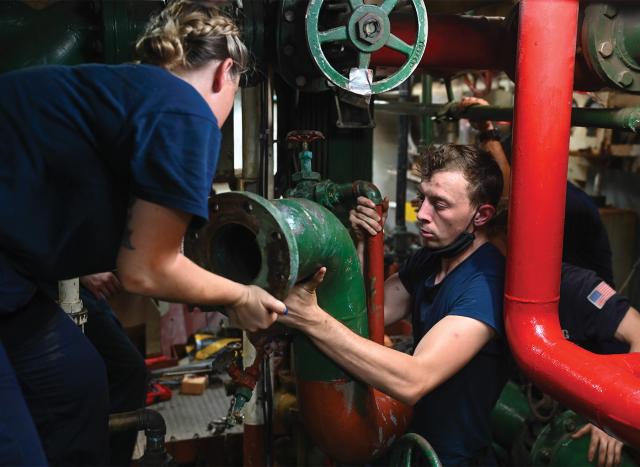
Engineers on board the USCGC Thetis (WMEC-910) work to replace a seawater pump to get the cutter fully mission capable. One way to increase skills and knowledge in the engine room would be platform specialization—having mechanics trained on specific engine models and continuing to work on those models in subsequent tours. U.S. Coast Guard (John Hightower)

The US Naval Institute Proceedings for August 2023 has what appears to be an important discussion of current problems with the way Coast Guard engineers are trained and treated. It was the first prize winner in this year’s Coast Guard essay contest.

The Coast Guard is aware that the surface asset classes coming online have roughly four times as many pieces of equipment installed as the classes they are replacing. The service is beginning to understand the effects of four times as many shipboard points of failure and orders-of-magnitude-more logistics support requirements. Senior leaders are hesitantly embracing the reality that the new ships also are more technically complex, with industrial IT systems connecting every pump, purifier, compressor, and propulsion component.

Some changes are proposed. I would only add that, maintainability and redundancy should be important considerations in ship design, and in regard to this,

 “Cutter crews avoid performing substantial planned maintenance on individual pieces of equipment while underway for fear of being anything less than fully mission capable when tasked with a new and urgent case.”

Most of our ships have redundancies. We need to keep maintenance current even if it means doing it underway and perhaps losing a few knots max speed. These limitations should of course be reported, but they should be expected. National security cutters for instance can take still make 22 to 24 knots even if their gas turbine is taken out of service. They are probably still capable of 26 knots if one of their diesels is down. The OPCs should still be capable of 18 knots if one of their diesels is down.

“Prototype work begins on the Coast Guard’s newest heavy polar icebreaker” –CG-9

A quarter and a dime are used to demonstrate the difference in the hull thickness of a PSC as compared to other Coast Guard cutters. U.S. Coast Guard Photo.

Below is a report from the Acquisitions Directorate (CG-9). Nice to see some movement now that Bollinger has taken over the project.


Bollinger Mississippi Shipbuilding began cutting steel July 24, 2023, on the first prototype module that will become the foundation of a new polar security cutter (PSC), the first heavy icebreaker to be built in the United States in 50 years. Up to eight modules will be constructed in Pascagoula, Mississippi, to prototype the shipbuilding processes and techniques that will be used when production of the first PSC begins in 2024.

“We’re relearning how to build this type of ship,” said PSC program manager Capt. Eric Drey, describing the construction approach being employed by Bollinger during the prototype phase.

The progressive crawl-walk-run approach consists of verifying the processes utilized during the build to ensure design completeness. This includes unit readiness reviews, ensuring engineering, computer aided design systems accurately transfer numerical control data to automated production machinery and slowing down early prototype module build times to maximize learning and enable improvements in the downstream production, engineering, and planning processes. Each module requires approximately four months of labor, during which time the shipyard will continue recruiting and training additional members of the workforce to manage the transition to production of the lead hull as the prototype modules are completed.

The hull of a heavy polar icebreaker is required to be much thicker than other Coast Guard cutters because of the pressure exerted on the ship by the surrounding ice. Deeper, more closely spaced structural stiffeners inside the hull ensure the ship doesn’t crumple when it encounters large ice floes, and the hull itself is constructed of 1 1/2-inch-thick steel alloy that remains flexible even in extremely low temperatures.

“It’s the first heavy icebreaker built by our nation in 50 years,” said Drey. “It’s not just a big day for the Coast Guard, but a big day for the nation.” The PSCs will be multi-mission cutters capable of supporting all Coast Guard statutory missions executed in the polar regions.

The Coast Guard’s operational polar icebreaking fleet currently consists of one heavy icebreaker, the 399-foot Coast Guard Cutter Polar Star that was commissioned in 1976, and one medium icebreaker, the 420-foot Coast Guard Cutter Healy that was commissioned in 1999.

Coast Guard mission demand in the polar regions is growing as environmental and economic activities continue to increase. The Coast Guard has identified a need for new polar icebreakers to assure year-round access to the polar regions and to provide self-rescue capabilities. PSCs enable the United States to maintain defense readiness in the Arctic and Antarctic regions; enforce treaties and other laws needed to safeguard both industry and the environment; provide ports, waterways and coastal security; and provide logistical support – including vessel escort – to facilitate the movement of goods and personnel necessary to support scientific research, commerce, national security activities, and maritime safety.

For more information: Polar Security Cutter Program page.

“CUTTER 37: THE LAST SHIP STANDING” –Coffee or Die

USCGC Taney, probably early 1944, equipped with four 5″/38s. She was in this configuration less than a year before being converted to an amphibious force flagship.

Coffee or Die has an article published on Coast Guard Day about the former USCGC Taney (WPG/WHEC-37), the last US warship to have survived Japan’s December 7, 1941 attack on Hawaii (there may still be a tug as well). It may not be the most accurate history (“USS Constellation…one of the original six frigates of the US Navy” –no that was a different ship, there are minor errors as well), but it is entertaining, including some first-person accounts that convey why ships of this class were so loved.

Since we are now seeing long delays in our ship building, it’s worth noting that she was built in the Philidelphia Navy Ship Yard. Four 327 foot cutters, Campbell (32), Duane (33), Ingham (35), and Taney (37), were laid down in a dry dock on 1 May 1935. All four were launched simultaneously 3 June 1936, 13 months later. All four were commissioned less than 18 months after the keels were laid, Taney taking the longest. Campbell was commissioned only 412 days after being laid down.

About a thousand years ago (1982-84) I was XO on the Duane. I loved that ship. Twelve years ago, I did a post on the class: 327s–Why Were They So Successful?

There is also this post about a sister ship: How Spencer Became the Coast Guard’s Top U-Boat Killer, Thank You Royal Navy