“U.S. Looks To Transfer 4 Patrol Boats To The Philippines” –Naval News

Ukrainian Navy Island-class patrol boats, formerly of the U.S. Coast Guard, conduct maritime security operations in the Black Sea off the coast of Odesa, Ukraine. UKRAINIAN NAVY

Naval News reports,

“On Monday, the U.S. announced its intention to transfer four patrol boats to the Philippine Navy. The transfer intends to support the Armed Forces of the Philippines’ modernization plan, specifically the Philippine Navy’s maritime capabilities.”

Note these are to go to the Philippine Navy, not their Coast Guard.

They will be getting two 110 foot (33.5 m) Island class and two 87 foot (26.5 m) Marine Protector class patrol boats.

This may just be the first such transfer. There are still quite a few Island class that may be available for transfer. The Coast Guard 2023 “Asset” poster indicates there were nine Island class cutters still in service when the poster was created. There are probably others that have been decommissioned but have not yet been transferred or otherwise disposed of.

The Marine Protector class now 14 to 25 years old. There is no direct replacement planned for this class but several have been decommissioned as their role has been taken by the 45 foot Response Boat, Medium and the 154 foot Webber WPCs. 

Since these boats are going into the Philippine Navy rather than the Philippine Coast Guard, there is a possibility they may be armed with something larger than .50 cal. (12.7mm) machine guns. The Island class, in US Coast Guard service, were armed with crew served manual early models of the 25mm Mk38 gun mount. It is not clear if the boats will be transferred with their guns in place. When the 378 foot WHECs were transferred to the Philippine Navy, their 25mm Mk38 gun mounts were removed before transfer. The Philippine Navy has 25mm Mk38s of several marks including the remote weapon stations. They also have 20, 30, and 40mm guns that might equip the cutters.

These cutters will have a significant speed advantage over most China Coast Guard and maritime militia vessels. Maximum speeds are 25 knots for the 87 footers and 29 knots for the 110 foot cutters. The Island class also has sufficient range (2,900 nmi (5,400 km) to go anywhere in the South China Sea.

US Sends a “Warning” to China Against Targeting the Philippine Coast Guard

CRASH AVERTED This photo taken on April 23, 2023 shows BRP Malapascua (right) maneuvering as a Chinese coast guard ship cuts its path at Second Thomas Shoal in the Spratly Islands. AFP PHOTO

A Reuters report, “U.S. issues guidelines on defending Philippines from South China Sea attack” indicates the US would consider an attack on the Philippine Coast Guard grounds for invoking the Mutual Defense Treaty between the US and the Philippines.

There was more to it than that, but certainly the recent confrontations between the Philippine CG and China CG and maritime militia must have prompted this clarification.

Perhaps less obvious, is that, apparently, it would also activate the treaty if a US Coast Guard vessel were attacked in the South China Sea.

“The guidelines said the bilateral treaty commitments would be invoked if either is attacked specifically in the South China Sea and also if coast guard vessels were the target.”

“Confronting All Ten Modalities of Maritime Terrorism” –Real Clear Defense

Taj Mahal Palace hotel, Mumbai Terrorist Attack,

Real Clear Defense has a post explaining ten modalities of maritime terrorism including some examples you may not be aware of. They are:

  1. An Attack on the Water from the Water
  2. An Attack on the Water from the Land
  3. An Attack on the Land from the Water
  4. A Precursor Attack in the Maritime Domain
  5. A Maritime Activity Related to Terrorist Financing
  6. Money Laundering of Terrorist Funds Through Maritime Activity
  7. Maritime Activity Related to Terrorist Logistics, Intelligence and Sustainment
  8. Cyberattacks by Terrorists Targeted at Maritime Activity
  9. Indirect Attacks on the Maritime Domain
  10. Hybrid Aggression

You may find the explanations interesting. The author summarizes,

“These ten modalities of maritime terrorism are not necessarily exhaustive, but they do provide a somewhat parsimonious taxonomy to assist security professionals in identifying and countering terrorist activity in the maritime domain. As a practical reality, most states have limited maritime law enforcement capacity, and the same agency is often tasked with countering everything from fishing without a license to oil spills to drug trafficking to piracy. Understanding how terrorists may be engaging in the maritime space can help sensitize analysts and operators to terrorist activity that may otherwise be obscured. At the same time, that understanding can help inform policy makers how to create a national-level approach that limits opportunities for terrorists to engage in any of the ten modalities. A state’s national security may be significantly impaired by any one of these terrorist activities, so every state should proactively strive to make itself as inhospitable as possible to all ten modalities of maritime terrorism.”

“The National Coast Guard Museum” –Real Clear Defense

NEW YORK, New York (Sept. 11)–A Coast Guard rescue team from Sandy Hook, NJ, races to the scene of the World Trade Center terrorist attack. USCG photo by PA2 Tom Sperduto

Real Clear Defense reminds us why we need a National Coast Guard Museum and ask for additional help in building it.

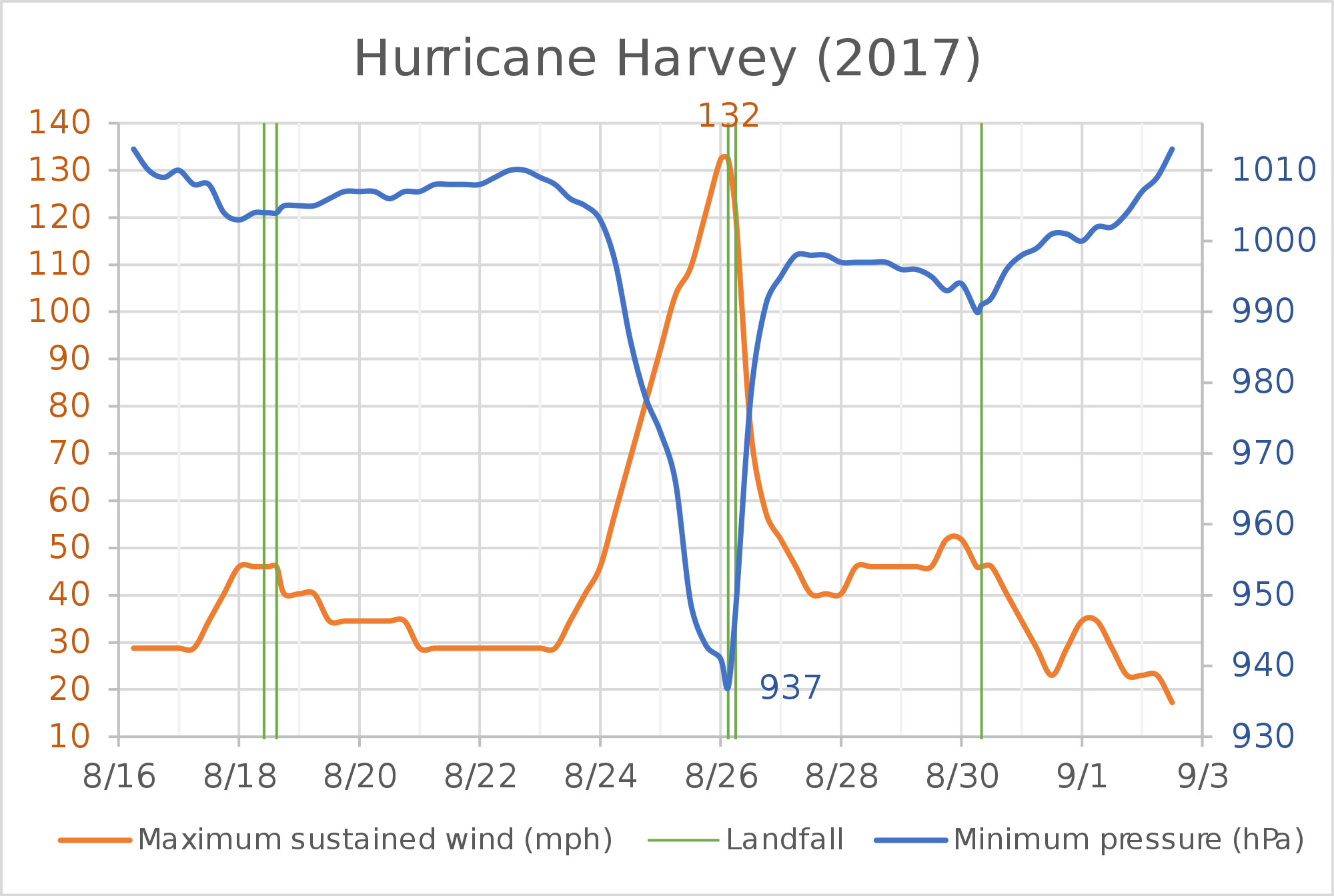
  • Maximum sustained wind speed and minimum pressure of Hurricane Harvey (2017), Data source: NATIONAL HURRICANE CENTER, TROPICAL CYCLONE REPORT, HURRICANE HARVEY, NOAA

How Much Time Should a Cutter be Expected to be at Sea?

USCGC MUNRO

How much time should we reasonably expect a cutter to be at sea? It is a reasonable question, since, generally, time spent in port is not mission time.

How do we compare with similar services?

The Coast Guard standard for large cutters has been 185 days away from homeport annually, but that includes times in port or being repaired if it is done “away from homeport.”

We get a pretty regular readout on US Navy ships from the US Naval Institute’s Fleet and Marine Tracker that indicates US Navy ships are underway about a quarter of the time, but this includes both combatants (USS) which tend to be more complex and maintenance intensive than large cutters and auxiliaries (USNS) that are much simpler than combatants. While the USNI does not provide a specific breakdown the USNS ships clearly spend much more time underway than the combatants. That is not necessarily bad since a combatant’s primary mission is to prepare for war and that can happen inport as well as underway, but the Navy constantly complains that their combatants are overworked while on average, cutters do spend much more time underway annually than Navy combatants.

The Royal Navy OPVs rotate crews and appear to spend very long periods deployed and apparently a high number of days per year underway.

SeaWaves recently reported on the “thirtieth anniversary of its armament and its first colors ceremony” of the French Frigate La Fayette. (It was commissioned in 1996) Classed as a frigate, this class, of 25 knot, diesel powered ships was built without any ASW capability, and was in many ways comparable to Hamilton class WHECs. They also performed many of the same functions.

“… La Fayette has taken part in all the operational missions of the Navy, distinguishing herself in particular in the fight against piracy in the Indian Ocean and the fight against drug trafficking.”

The SeaWaves report provides a data point on how much time this particular ship spent underway.

“In 30 years, the La Fayette has thus carried out 3,107 days at sea and the equivalent of 21 round-the-world trips, carried out 33 operational deployments on all the seas of the world, visited 55 countries in 266 stopovers or even contributed to the seizure of more than 10 tons of drugs.”

That is 103.6 days/year underway. Even if we only count the 27 years since her commission and include the underway time prior to commissioning that would be 115 days per year. Sounds like cutters probably compare favorably.

How much time do large cutters spend underway? Congress has asked this question and I don’t think it was ever answered. It is certainly a statistic we should know. The Coast Guard has nothing to be ashamed of and much to be proud of.

“GAPPED BILLET SQUALL ON THE HORIZON: THE USCG OFFICER CORPS COULD BE IN TROUBLE” –CIMSEC

CIMSEC has an interesting article by a serving officer, Lt. Joseph O’Connell.

He starts off talking about gapped billets in the Coast Guard in general, 200 in 2021, but then concentrates on gapped afloat billets, 11 in 2021.

” This shortage grows more acute when considering the critical billets O3 and O4 officers fill aboard Coast Guard cutters: Operations Officers, Engineer Officers, Executive Officers, and Commanding Officers, depending on the cutter class.”

I am sure his observations are accurate, as far as they go, but I think he may have missed an important aspect of the Coast Guard’s assignment policies that has resulted in many officers, with sea going ambitions, making the choice to leave the service at the O-3/4 level. If we don’t do something differently, the problem is going to get worse.

As the Coast Guard continues to bring new hulls online while operating legacy assets the demand for afloat officers will far outstrip the limited and dwindling supply, with projections anticipating a 25% increase in cutter billets from current levels.

A change in personnel assignment policy could make a big difference.

I am long out of the service, so it is best if you check to see if my assumptions are correct.

Assumptions:

  • The ambition of most seagoing officers is ultimately to have a command afloat.
  • Being a department head or XO is not an end in itself. It should be seen as a step toward command.
  • Assignment officers are more likely to select an officer to command if they have had a previous successful command tour.
  • If an O-3 sees that it is extremely unlikely he will ever get a command, he is unlikely to seek a department head or XO job and may very well leave the service.

Effects:

Coast Guard personnel policies have created a situation where if you have not gotten a command as an E-3, it is unlikely you ever will.

The service is procuring 65 Webber class WPCs. At least 51 have already been commissioned. While a few are commanded by warrants or O-4s, generally they are commanded by O-3s. These and the few other O-3 afloat command billets create a large pool of potential future COs to choose from.

Those that have been or expect to be O-3 COs are unlikely to seek billets as department heads or XOs.

Those who miss the opportunity to command at the O-3 level, will see little chance they will be an afloat CO in the future.

Proposal:

Make command of a Webber class an O-4 billet.

Require that those selected to command Webber class WPCs will have completed a successful department head or XO afloat tour.

Rationale:

While some may feel command of a patrol craft requires only a junior officer, consider that these little ships, unlike WPBs, are doing all the same missions as an MEC (except the aviation component) with a smaller crew and fewer senior personnel to advise and support the CO. These ships generally operate independently, unlike Navy patrol craft which generally operate in groups under a squadron commander. We are seeing some of them embark on voyages of thousands of miles, operating outside US waters.

This policy would provide an incentive for officers to seek department head or XO tours as O-3s.

The Officers chosen to be COs at the O-4 level will be more experienced and more mature.

The service will have had more time to evaluate the officers prior to assignment including direct observation by a CO afloat, who should make a recommendation for or against a future command afloat.

Ultimately some officers will determine that they really have no chance of getting a CO afloat tour, but it will happen later in their career, when they may have found other rewarding work and they are less likely to leave the service.

New Units for Alaska, the Haley, and Nome

Northeast Russia and Alaska. Photo: Shutterstock

One of our readers sent me an article from the Alaska Beacon about the need for additional housing for the military that includes some insight into the Coast Guard’s future in Alaska.

The information about the Coast Guard is toward the end of the article. This seems to be confirmation that the two FRCs in Ketchikan will be joined by four more, two in Kodiak and one each in Sitka and Seward, and that their additional supporting infrastructure is being provided.

We already knew the third and fourth OPCs, Ingham (917) and Rush (918), will be going to Kodiak.

What About USCGC Alex Haley?:

The crew of the USCGC Alex Haley (WMEC 39) transfers custody of the detained fishing vessel Run Da to a People’s Republic of China Coast Guard patrol vessel in the Sea of Japan, June 21, 2018. The Alex Haley and PRC Coast Guard crews detained the Run Da suspected of illegal high seas drift net fishing. U.S. Coast Guard photo. Petty Officer 1st Class William Colclough

The Alex Haley is currently homeported in Kodiak. When I saw that two OPCs were to be homeported in Kodiak, my first assumption was that they would replace the Haley as well as USCGC Douglas Munro also based there, but perhaps that assumption was unwarranted.

Alex Haley is nominally a medium endurance cutter, but with a 10,000 nautical mile range and a 3,484 tons full load displacement, she is more of a high endurance cutter with the crew of a 270 foot WMEC.

She is an old ship, having been originally commissioned in 1971, but still younger than any of the 210 and considerably more capable. She is well suited to the Alaskan environment, so I don’t see her being moved outside the 17th District (Alaska). She is simple, meaning she is relatively easy to maintain, but with twin shafts and four engines, she also has redundancy.

She was extensively renovated, and her engines replaced before she was recommissioned into the Coast Guard in 1999, more than eight years after the last 270 was commissioned.

The second OPC to be based in Kodiak probably will not arrive before 2028. The last 210 will probably not be decommissioned until about 2033.

If the intention is to ultimately have three OPCs in Kodiak, as I believe may be the case, there is a good possibility that the Haley could hang on until that ship arrives.

What about Nome?:

USCGC Alex Haley moored in Nome, AK.

There is also mention of the planned port expansion in Nome with a suggestion that the Coast Guard may have units there.

One tight spot may be Nome, where there are plans to expand the city port into a deepwater, Arctic-service port which Moore called a “fantastic opportunity” for Coast Guard operations.

I don’t think we will see either large patrol cutters (unless it is the Alex Haley) or FRCs based there, but moving one of the Juniper class seagoing buoy tenders there, with its light icebreaking capability might make sense. I suppose a medium icebreaker might be a possibility, but that is a very long shot.

There will probably be a seasonal air detachment stationed in Nome.

Thanks to Paul for bringing this to my attention.

“The Ukrainian Navy and the Fight for Democracy” –USNI

Ukrainian Navy Island-class patrol boats, formerly of the U.S. Coast Guard, conduct maritime security operations in the Black Sea off the coast of Odesa, Ukraine. UKRAINIAN NAVY

The US Naval Institute’s May 2023 issue of “Proceedings” includes an article by Vice Admiral Oleksiy Neizhpapa, Ukrainian Navy discussing the Ukrainian Navy’s role in the war with Russia.

Because the Ukrainian Navy used all available assets, including unmanned vehicles, it has achieved a strategic effect. We forced the enemy fleet to move east of the meridian of Cape Tarkhankut (Crimean Peninsula) and denied Russian operational activity in the northwestern part of the Black Sea, even near Crimean harbors. These Ukrainian Navy efforts created a gray zone and enabled the Grain from Ukraine Initiative, which ensures the export of Ukrainian grain to countries in need. In 2022, more than 24 million tons of agricultural products were exported from initially blocked Ukrainian ports.

He is obviously very proud of the accomplishments of their small navy. It is a good article, but I would have had to reference if for no other reason than to post the accompanying photo above.

China Coast Guard in the Russian Arctic?

Chinese Coast Guard officials observed the April 25 anti-terror exercise conducted by FSB Coast Guard in the Kola Bay north of Murmansk. Photo: Murmanski Vestnik

The Barents Observer has an interesting article, “Russia’s Coast Guard cooperation with China is a big step, Arctic security expert says,” that seems to portend a China Coast Guard presence in the Arctic, perhaps shepherding their fishing vessels.

“The Russia-China memorandum signed in Murmansk opens for joint efforts to combat terrorism, illegal migration, fighting smuggling of drugs and weapons, as well as stopping illegal fishing. The deal was signed by top leaders with FSB Border Guards and the Chinese Coast Guard.”

It may be noteworthy that this meeting was not in Asia, in one of Russia’s Pacific ports. It was in Europe, in Murmansk, on the Kola Peninsula, home of the Russian Arctic Fleet.

This agreement may turn out to be a first step toward joint China and Russia exploitation of Russia’s, as yet unrecognized, extensive continental shelf claims in the Arctic extending all the way to the North Pole and beyond into areas also claimed by Canada and Denmark (from Greenland).