“USS Jackson Deployment Used Manned/Unmanned Teaming with Fire Scout, Seahawk” –Seapower

SOUTH CHINA SEA (May 19, 2022) An MH-60S Sea Hawk and MQ-8C Fire Scout unmanned aerial vehicle, assigned to Helicopter Sea Combat Squadron (HSC) 23, conduct concurrent flight operations as a manned-unmanned team (MUM-T) while embarked on the Independence-variant littoral combat ship USS Jackson (LCS 6). Jackson, part of Destroyer Squadron (DESRON) 7, is on a rotational deployment, operating in the U.S. 7th Fleet area of operations to enhance interoperability with partners and serve as a ready-response force in support of a free and open Indo-Pacific region. (U.S. Navy photo by Lt. j.g. Alexandra Green)

The Navy League’s on-line magazine, Seapower, reports,

The USS Jackson, based in San Diego, deployed on July 11, 2021, to the Western Pacific for 15 months in support of the Oceania Maritime Security Initiative (OMSI). Both the ship’s Blue and Gold crews each participated in two on-hull patrols during the deployment, which took the LCS to the South China Sea and Oceania. The Jackson, with a Coast Guard law-enforcement detachment embarked, operated with the armed forces of Brunei, France, Germany, Indonesia, Thailand and Japan, and made port calls to several island nations including Palau, Tahiti and Fiji. The ship returned to its homeport on Oct. 15, 2022.

We did employ the manned/unmanned teaming tactic and concept with our aviation detachment from Helicopter Sea Combat Squadron 23 Detachment 6. We executed that approximately one dozen times and we saw over 100 hours of MQ-8C operations while deployed to the 7th Fleet area. While conducting those manned/unmanned teaming operations what we found was that having an unmanned aircraft that had many capable sensor payloads was really a force multiplier that we could use to develop our recognized air and maritime picture beyond the horizon while using the MH-60S to conduct positive identification of things that we detected with the MQ-8C.
Looks like USS Jackson was doing some useful work, but–

This was a 15 month deployment. 461 days by my calculations so, “over 100 hours of MQ-8C operations while deployed to the 7th Fleet area” does not really sound that impressive, not compared with the extended endurance we are told UAS can do (15 hours max for the MQ-8C). Does it mean they only launched 12 time in 15 months?
I think the Coast Guard can get about 100 hours flight out of a single H-65 in a typical 60 day patrol. We used to do two two hour flights a day with some regularity. I have not seen how much search time we are getting out of the Scan Eagles on the National Security Cutters, but it should be a lot more than that.
There was no indication that the Fire Scout was used for anything other than surface search,
While conducting those manned/unmanned teaming operations what we found was that having an unmanned aircraft that had many capable sensor payloads was really a force multiplier that we could use to develop our recognized air and maritime picture beyond the horizon while using the MH-60S to conduct positive identification of things that we detected with the MQ-8C.
Seapower also recently reported, “Navy to Consolidate Fire Scout UAVs on West Coast,” which indicated that of the three detachments currently operating MQ-8s, the LANTFLT detachment will be de-activated, while the one of two PACFLT Fire Scout detachments that still operates the “B” model will upgrade to the “C” model. The report went on to report, “Currently, there are no plans to expand Fire Scout operations to other helicopter sea combat (HSC) squadrons.”
That indicates to me, that the Navy is not all that enthusiastic about Fire Scout. Though they are certainly planning to continue to pursue unmanned systems. Presumably it has been a “learning experience,” but it does not look like Fire Scout, in its present form, will be a growing program.


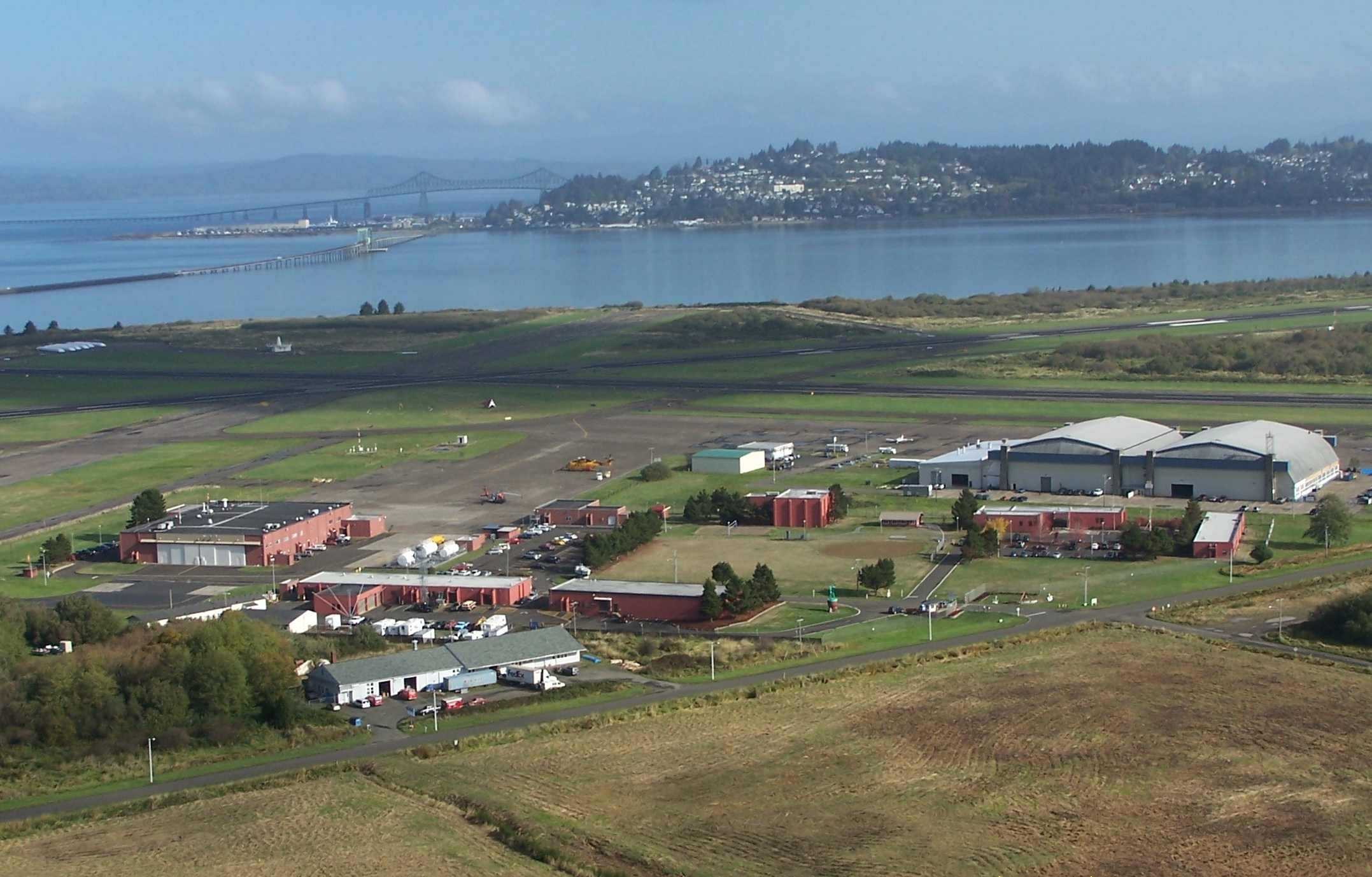
Just Established–Base Astoria, Warrenton, OR

Coast Guard Air Station Astoria

District 13 is getting a new base in Warrenton, Oregon, on the NorthWest corner of Oregon. Warrenton is also the location of CG Air Station Astoria.  A couple of WMECs are (or at least have been) based there. It has been reported at least two Webber class WPCs will be based there in 2024. I suspect, ultimatedly, it will be at least three. Presumably the 210s will leave when the first two OPCs are stationed in Long Beach.

News Release

U.S. Coast Guard 13th District PA Detachment Astori

Coast Guard establishes new unit in Warrenton, OR

Editors’ Note: Click on images to download high resolution version.

ASTORIA, Ore. – The Coast Guard held an establishment ceremony Wednesday in Warrenton to formally establish Coast Guard Base Astoria.

During the ceremony, Cmdr. Todd Wimmer assumed command of the new unit.

Rear Adm. Jon Hickey, the Director of Operational Logistics, presided over the ceremony.

Wimmer previously served as Chief of Facilities at Coast Guard Training Center Petaluma, California, from 2019-2022.

Base Astoria is located in Warrenton and will provide operational logistics support for Coast Guard units across the Thirteenth Coast Guard District’s Oregon and southern Washington regions. 

“Coast Guard halts illegal use of “paper captains” in WA-based tuna fishing operation” –D13 News Release

Source NOAA: Albecore, Bluefin, Skipjack, Yellowfin, and Bigeye Tuna

News Release

U.S. Coast Guard 13th District Pacific Northwest

Coast Guard halts illegal use of “paper captains” in WA-based tuna fishing operation

ASTORIA, Ore. – The Coast Guard ceased the use of illegal foreign nationals on a commercial fishing vessel that operated out of the State of Washington, Wednesday, Oct. 19.

A Coast Guard Sector Columbia River law enforcement team inspected an 89-foot fishing vessel and determined that the vessel was in violation of the Jones Act – specifically, they were in violation for utilizing a “paper captain.”

Paper captain is a term applied to an individual listed on documents as a U.S.-flagged vessel’s captain but in actuality serves as a deckhand or in a similar lower-level capacity. It is the law (46 USC §12131) that a documented vessel be under the command of a U.S. citizen.

Many fishing vessels have engaged in a pattern and practice of hiring foreign nationals to serve on U.S. commercial fishing vessels in the capacity of captain, while U.S. nationals identified as captains on paper serve in subordinate roles. 

Many of these violations have been supplemented by underlying fraudulent documents designed to avoid detection and mask the illegal operation.

“The employment of a foreign national as captain aboard a U.S.-flagged commercial fishing vessel is illegal,” said Lt. Cmdr. Colin Fogarty. the enforcement chief at Coast Guard Sector Columbia River in Warrenton, Oregon. “The practice of utilizing paper captains subverts U.S. laws and regulations designed to protect hard-working American fishermen and mariners.”

In addition to violating the Jones Act, the vessel had several safety violations including: expired Firefighting equipment; expired. degraded immersion suits; an inoperable Emergency Position Indicating Radio Beacon (EPIRB) hydrostatic release: and failure to conduct safety drills.

The Coast Guard issued a Notice of Violation for $3,000.00 and the vessel’s Certificate of Documentation was rescinded for violating the Jones Act.

Since 2020, the Coast Guard has detected a total of 10 Paper Captain Violations, primarily in the tuna fleets that operate throughout the Pacific Ocean. In total, Sector Columbia River and sister units have issued nearly $40,000 in fines directly linked to employment of foreign nationals as captains.

“USCG selects KVH for new 5-year small cutter satcom connectivity contract” –Marine Log

“Coast Guard Cutter John F. McCormick (WPC 1121) crew transits through the San Francisco Bay, Saturday, March 4, 2017, during their voyage to homeport in Ketchikan, Alaska. The cutter was named after McCormick who received the Gold Lifesaving Medal in 1938 for his exceptional skill in maintaining control of the 52-foot motor lifeboat Triumph while responding to a vessel in need near the Columbia River Bar under treacherous conditions, allowing the crew to recover a crewmember that had been washed overseas. Coast Guard photo by Petty Officer 2nd Class Loumania Stewart”

Marine Log reports,

Middletown, R.I., KVH Industries, Inc., (Nasdaq: KVHI), has been awarded a U.S. Coast Guard contract worth a potential $69 million that will see it supply the next-generation satellite communications solution for the service’s small cutter fleet of more than 140 vessels/platforms. Chosen in a full and open competitive procurement process, KVH’s TracPhone V7-HTS Ku-band satellite communications system and mini-VSAT broadband service will be the U.S. Coast Guard’s Small Cutter Connectivity (SCC) Ku-band System and Airtime Support Services solution. The USCG also anticipates that approximately 20 new cutters will join the small cutter fleet over the next five years, requiring the same level of support that KVH will provide to the already deployed vessels.

I presume the additional “approximately 20 new cutters” are the remaining Webber class Fast Response Cutters.

Royal Navy OPV Does Mine Countermeasures With USN Team

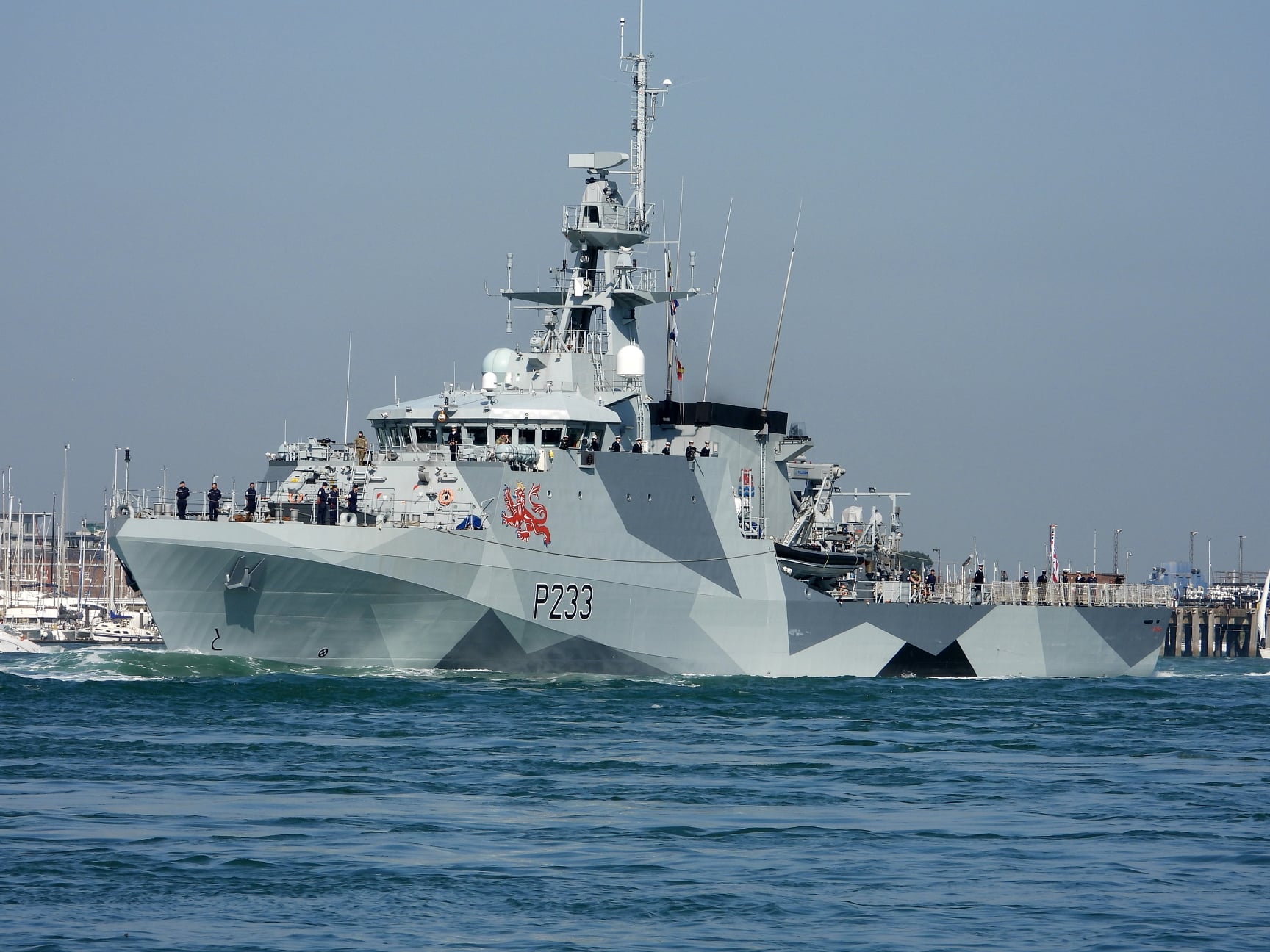
HMS TAMAR

The Royal Navy reports that HMS Tamar participated in an exercise off S. Korea, providing a platform for a US Navy diving/explosive ordnance disposal team equipped with Remus 100 uncrewed underwater vehicles to do mine countermeasures.

Virtually any large Coast Guard cutter could do the same thing, maybe even the Webber class FRCs. HMS Tamar would be an MEC if operated by the Coast Guard.

The Remus 100 would also be useful in reopening ports after a natural disaster, looking for changes in the underwater topography or obstructions.

This goes along with the way I think the Coast Guard should plan to do the Defense readiness mission, that is, that the Coast Guard would provide the platform and USN teams would come aboard, bringing the naval capability, whether it be mine hunting equipment, an ASW towed array and helicopter, or special ops team.

“Coast Guard delivers upgraded multi-mission helicopters to Air Station Atlantic City” –D5 News Release

MH-65E interior.

While you may have heard the Coast Guard is headed for an all H-60 rotary wing fleet, it seems we will continue to have H-65a for some time.

The upgrades comply with the Federal Aviation Administration’s Next Generation Airspace Transportation System requirements, and extends the aircraft service life to the late 2030s.

The Coast Guard plans to convert all 98 of its Dolphin helicopters to the MH-65E configuration by the end of 2024.

News Release U.S. Coast Guard 5th District Public Affairs North
D5 Public Affairs North, Baltimore, Md

Coast Guard delivers upgraded multi-mission helicopters to Air Station Atlantic City 

ATLANTIC CITY, N.J. — Coast Guard Air Station Atlantic City received its first upgraded MH-65E Dolphin helicopter Monday to replace the legacy MH-65D helicopters that serve out of the Coast Guard’s largest MH-65 helicopter unit. 

The avionics upgrade to the Echo or “E” configuration will provide enhanced search and rescue capabilities including modern “glass cockpit” technology that increases pilot and aircrew situational awareness. 

The Dolphin upgrades also include reliability and capability improvements for the automatic flight control system, enhanced digital weather and surface radar, and multifunctional displays with more accurate fuel calculations.

The upgrades comply with the Federal Aviation Administration’s Next Generation Airspace Transportation System requirements, and extends the aircraft service life to the late 2030s.

The transition of Air Station Atlantic City’s 12 MH-65D helicopters to the upgraded “E” configuration is expected to take approximately 10 months. 

During the upgrade period, the unit’s 62 pilots and 104 aircrew members will undergo a three-week transition course at the Aviation Training Center in Mobile, Alabama. Aircrew and mechanics will undergo formal training specific to their roles and duties during this course.

“The upgrades and advanced training will enhance the situational awareness of our aircrews and improve mission planning capabilities aboard the Coast Guard’s most prolific rotary-wing asset,” said Cmdr. Christian Polyak, engineering officer at Air Station Atlantic City. “The replacement and inspection of key aircraft components as a part of the upgrade are also expected to extend the aircraft’s service-life and enable us to continue safeguarding and securing our coasts for years to come.”

Air Station Atlantic City Dolphin helicopter crews perform search and rescue, provide aids to navigation support, and maritime law enforcement and marine environmental protection to the mid-Atlantic region from Long Island, New York, to the Maryland/Virginia border. 

Air Station Atlantic City helicopters and aircrews also provide continuous support for the North American Aerospace Defense Command’s airspace security mission in Washington, D.C., and throughout the country as necessary.

Additionally, the upgrades also include advanced navigation capabilities that will allow pilots to safely maneuver through highly congested, complex air traffic that can be encountered in situations such as disaster response.

The Coast Guard plans to convert all 98 of its Dolphin helicopters to the MH-65E configuration by the end of 2024.

For more information visit the MH-65 Program page at SRR – MH-65 (uscg.mil) .

EURONAVAL 2022

Below is video coverage of the EURONAVAL 2022 trade show, done by Naval News. Below each video is text that accomanied the video on its Youtube page. The highlight for me, was the new 95 meter (312 foot) S. Korean Hundai OPV design, six of which are to be built for the Philippine Navy, discussed in the fourth video.

  • 01:09 – Interview with Admiral Vandier, Chief of Staff of the French Navy
  • 02:48 – PANG next generation aircraft carrier
  • 05:25 – OCEA OSV 315 seabed warfare vessel
  • 06:59 – BAE Systems Adaptable Strike Frigate
  • 10:00 – BAE Systems XLUUV
  • 10:36 – EPC European Patrol Corvette
  • – Nexter new Narwhal RWS fitted with 2 Akeron MP missiles
  • – BAE Systems Kingfisher Stand Off ASW shell
  • – MBDA Exocet MM40 Block 3c and Teseo Mk 2/E
  • – Lacroix new SEAMOSC decoy launcher
  • – Rohde & Schwarz new electronic warfare mast
  • – Thales CAPTAS-4 VDS for the U.S. Navy Constellation-class Frigate
  • 01:04 – General Atomcis’ EMALS and AAG for France’s future aircraft carrier (PANG)
  • 03:18 – General Atomics MQ-9B SeaGuardian for the French Navy’s AVSIMAR Phase 2 MALE UAV requirement
  • 06:54 – Schiebel’s new S-300 CAMCOPTER VTOL UAV
  • 07:24 – TKMS MEKO A-200 EN
  • 08:21 – TKMS MEKO A-300
  • 09:50 – TKMS MEKO A-100 10:15 – TKMS Type 212CD
  • 10:36 – TKMS Advanced Submarine Fuel Cell (ASFC) and Li-Ion battery for submarines
  • 11:20 – Alseamar’s Seaexplorer glider with new ASW payload

K. S. Woo, Senior Vice President of marketing, Naval & Sepcial Ship Business Unit, introduced HHI as the #1 shipbuilder in the world. We then focused on two ongoing programs for the Philippine Navy:

  • – HDP-2200 OPV
  • – HDF-3100 Corvette

Hyundai Heavy Industries signed a contract with the Philippine Department of National Defense on June 27, 2022 for six new 2,400 ton Offshore Patrol Vessels (OPV). In December 2021, HHI announced it won an order to build two 3,200 ton class corvettes for the Philippine Navy.

Coast Guard Cutter Stratton crew visits Kaktovik, Alaska during Arctic patrol

The Coast Guard Cutter Stratton passes underneath San Francisco’s Bay Bridge as Stratton and the crew depart on a months-long deployment to the Western Pacific in support of the U.S. Indo-Pacific Command, June 12, 2019. Operating under the tactical control of the U.S. 7th Fleet commander, Stratton and crew are scheduled to engage in professional exchanges and capacity-building exercises with partner nations in the Western Pacific and to patrol and operate as directed. U.S. Coast Guard photo by Petty Officer 1st Class Matthew S. Masaschi.

Below is a District 17 news release. This is a bit unusual, that a cutter–not an icebreaker, would be that far into the Arctic. This is about the time of minimum ice coverage in the Arctic. Read about Kaktovik, Alaska here.

News Release

U.S. Coast Guard 17th District Alaska
Contact: alexander.j.mastel@uscg.mil

Coast Guard Cutter Stratton crew visits Kaktovik, Alaska during Arctic patrol

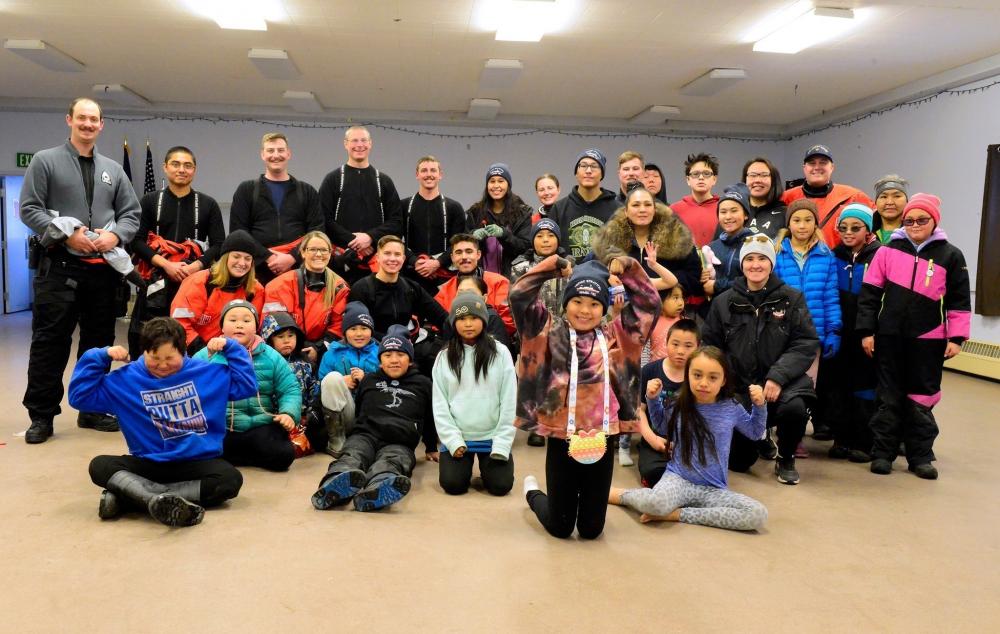
Members from Coast Guard Cutter Stratton visit Kaktovik, Alaska, Oct. 1, 2022, and participate in a question-and-answer session with approximately 45 community members, including roughly 30 children. Discussion centered on life in the Coast Guard, job opportunities within the organization, motivations for joining, as well as the Coast Guard’s role in the Arctic region. (U.S. Coast Guard photo courtesy of Coast Guard Cutter Stratton)

Editors’ Note: Click on images to download high resolution version.

KAKTOVIK, Alaska — Crew members from Coast Guard Cutter Stratton (WMSL 752) met with key leaders October 1 in Alaska’s most northeastern tribal community, while on a patrol in the Arctic Ocean.

Members from Stratton visited Kaktovik, where they met with Mayor Flora Rexford. Stratton members also participated in a question-and-answer session with approximately 45 community members, including roughly 30 children. Discussion centered on life in the Coast Guard, job opportunities within the organization, motivations for joining, and the Coast Guard’s role in the Arctic region.

Community members offered samplings of muktuk and expressed interest in more Coast Guard engagement in the community, most notably in their schools.

“We are so fortunate to have had this opportunity,” said Lt. Augustus Manzi, combat systems officer aboard Stratton. “We were met with overwhelming generosity from the community. Tribal members spent time getting to know us better and educated us on their customs and way of life. It was an incredible experience.”

The Stratton team presented a plaque to the mayor, delivered hand-knitted blankets gifted by the Alameda Navy League, and offered personalized etched glasses, knit hats and ship memorabilia to community members and their children.

Kaktovik is on the northern edge of the Arctic National Wildlife refuge and home to approximately 300 year-round residents.

CGC Stratton is a 418-foot national security cutter (NSC) capable of extended, worldwide deployment in support of homeland security and defense missions. NSCs routinely conduct operations from South America to the Arctic, where their unmatched combination of range, speed, and ability to operate in extreme weather provides the mission flexibility necessary to conduct vital strategic missions.

“FACT SHEET: U.S.-ASEAN Special Summit in Washington, DC” –The White House, May 12, 2022

Indonesian Maritime Security Agency vessel KN Tanjung Datu, left, sails alongside U.S. Coast Guard Cutter Stratton during joint exercises in the Singapore Strait in August 2019. IMAGE CREDIT: PO1 LEVI READ/USCG

Below is an excerpt from a May 12, 2022 White House Fact Sheet. Notably there is some significant new tasking for the Coast Guard here.

Here is a link to the “ASEAN Outlook on the Indo-Pacific’s Maritime Pillar” referred to in the excerpt. See particularly V. Areas of Cooperation, Maritime Cooperation, paragraphs 14 and 15 on page 3.

Presumably, this is being implemented, at least in part, as a result of NOAA’s “National Five Year Strategy for Combating Illegal, Unreported, and Unregulated Fishing (2022-2026) which designated Vietnam as one of five “Priority States.”

EXPANDING MARITIME COOPERATION

The United States is committed to supporting implementation of the ASEAN Outlook on the Indo-Pacific’s Maritime Pillar. Today we are announcing $60 million in new regional maritime initiatives, most of which will be led by the U.S. Coast Guard (USCG).

  • Personnel and Presence: The USCG will deploy assets and assign additional personnel to the Indo-Pacific to help meet partners’ requests for maritime training and capacity-building, to include a USCG attaché at the U.S. Mission to ASEAN.
  • Countering Illegal, Unreported, and Unregulated Fishing: The Department of State, Department of Labor, and USCG will launch new initiatives to help ASEAN counties counter illegal, unreported, and unregulated fishing and strengthen the capacity of ASEAN sectoral bodies to prevent forced labor in the fishing industry.
  • Indo-Pacific Support Platform: The USCG will deploy a cutter to Southeast Asia and Oceania for security cooperation and to operate as a training platform. This cutter will deploy throughout the region providing multinational crewing opportunities, conduct training missions, and participate in cooperative maritime engagements.
  • Excess Defense Articles: As USCG decommissions cutters, the service will prioritize the transfer of ships to Southeast Asian countries to increase the coastal nations’ maritime law enforcement capacity and promote a free and open Pacific.
  • Southeast Asia Training Team: The Department of State and USCG will expand USCG support to maritime law enforcement agencies in Southeast Asia by placing a training team in the region for the first time with additional dedicated support from U.S.-based trainers. These technical experts will provide capacity-building for the regional partners’ maritime law enforcement agencies in the areas of institutional development, readiness, sustainment of equipment, and workforce professionalization.
  • Emergency Training: The USCG and the Department of State will provide new trainings on energy safeguards, protection of critical maritime infrastructure, and all-hazards response.

“SHARK SMART WEAPON STATION FOR LIGHT BOATS” –Joint Forces / Counter UAS

Joint-Forces reports,

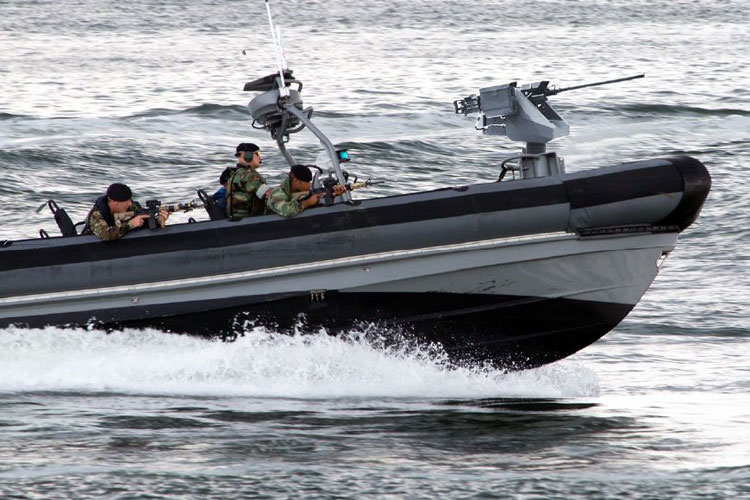
General Robotics of Israel, an advanced systems developer, has unveiled the SHARK Naval RCWS smart weapon station for light boats.

Not only is it light (85 kg without weapon and ammunition), but it also has a unique fire control system,

When the operator presses the trigger, the AI-driven fire control runs a target prediction algorithm to align the projectile’s path and the target’s expected location and points the weapon in that direction. Only then is a burst fired. This technique has demonstrated hit accuracy of about 70 percent. This unique capability enables SHARK to be used as a naval Counter-UAS weapon.

Looks like something the Coast Guard might be interested in.

A pair of these mounted on opposite corners of the PATFORSWA Webber class, replacing two of the crew served .50 cal., might come in handy.