“Coast Guard Cutter Polar Star reaches southernmost navigable waters on Earth” –News Release

USCGC Polar Star, despite her age is still doing the job.

News Release

March 1, 2022
U.S. Coast Guard Pacific Area


Coast Guard Cutter Polar Star reaches southernmost navigable waters on Earth
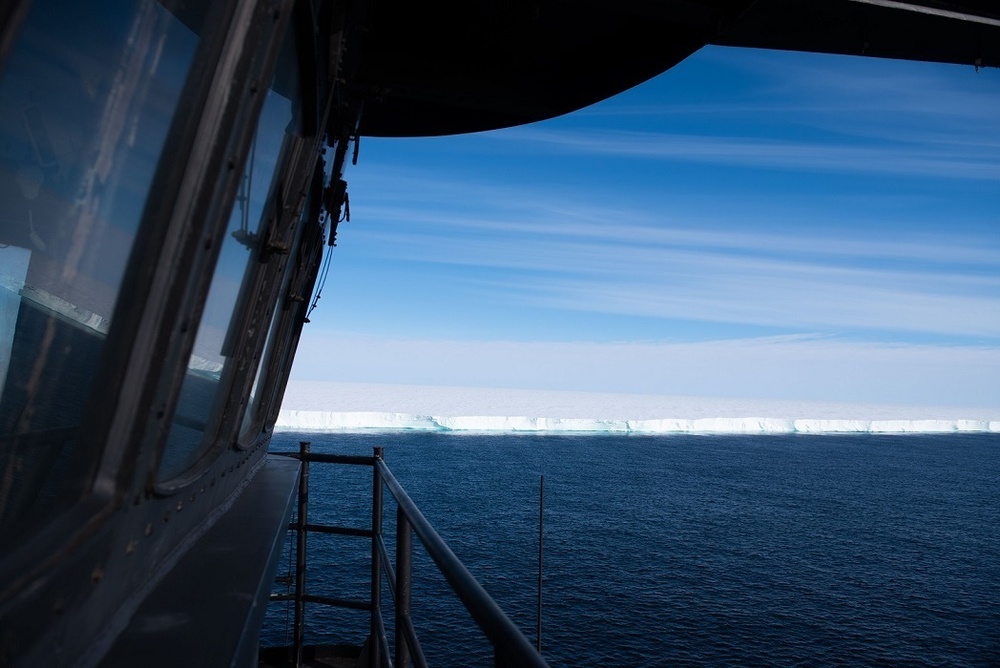
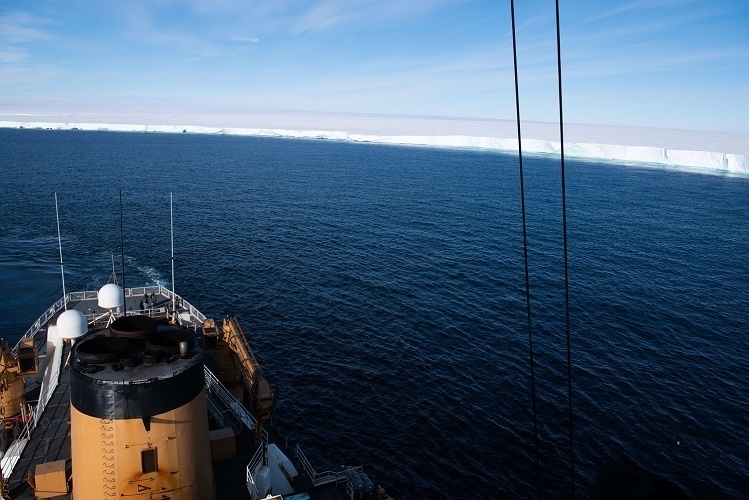
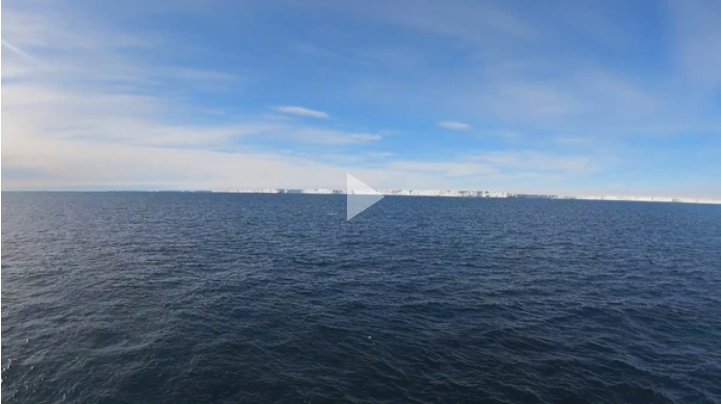
Photo of Ross Ice Shelf Photo of Ross Ice Shelf Video of Ross Ice Shelf

Editors’ Note: Click on images above to view and download photos and video.

MCMURDO STATION, Antarctica — U.S. Coast Guard Cutter Polar Star (WAGB 10) reached the southernmost navigable waters on the planet Feb. 17 while underway in the Bay of Whales, Antarctica.

Polar Star reached a position of 78 degrees, 44 minutes, 1.32 seconds south latitude at 12:55 p.m. New Zealand time, holding a distance of approximately 500 yards from the edge of the Ross Ice Shelf, further south than the current Guinness World Record holder.

While underway, Polar Star sailed in waters previously charted as part of the ice shelf that are now navigable waters. Today, portions of the Ross Ice Shelf deviate approximately 12 nautical miles from the positions depicted on official charts.

During Polar Star’s transit to and from the Bay of Whales, Polar Star surveyed 396 nautical miles of the ice shelf for potential future navigational use.

Crewmembers aboard the cutter are working with the staff at Guinness World Records to officially become the new record holders.

Feb. 7, 1997, U.S. Coast Guard Cutter Polar Sea (WAGB 11), Polar Star’s sister ship, reached 78 degrees, 29 minutes south latitude.

In 1908, Ernest Shackleton gave the Bay of Whales its name during the Nimrod Expedition on the basis of the numerous whales he and his crew sighted. Three years later, Roald Amundsen established a base camp in the bay, from which he set out on his successful endeavor to become the first person to reach the South Pole. Years later, U.S. Navy Rear Adm. Richard E. Byrd established Little America in the Bay of Whales during his first, second, and third Antarctic Expeditions, exploring more than 60% of the Antarctic continent.

“The crew of Polar Star is proud to follow in the footsteps of legendary Antarctic explorers like Shackleton, Amundsen, and Byrd,” said Capt. William Woityra, commanding officer of Polar Star. “Even today, more than a century later, we carry on that legacy of exploration, reaching new places, and expanding human understanding of our planet.”

Ukraine Conflict Related Incidents

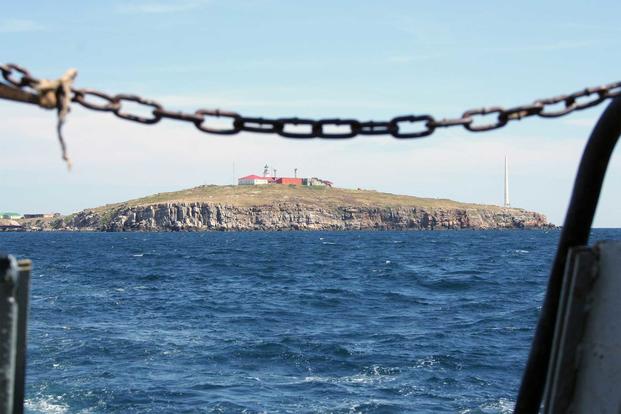
Cormoran (P677), a French navy ship. Brest, Finistère, Bretagne, France. Photo by Gary Houston

I really would like to know the basis of this seizure: French Navy Flamant-class OPV Cormoran seizes Russian cargo ship.

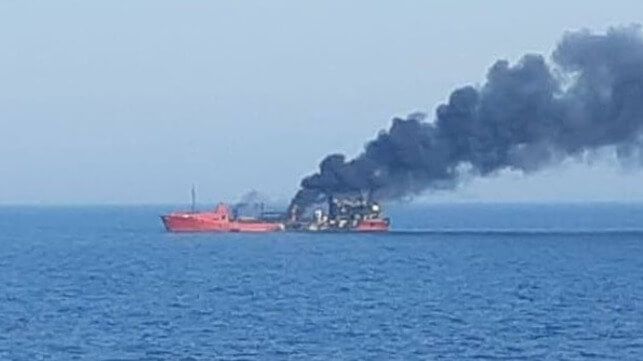
And then there are these seizures of Ukrainian flag ships by the Russians: Russian Navy seized two Ukrainian civilian vessels near Snake Island. If one or both of these ships was seized in Romania’s territorial sea, it would be a violation of international law

“U.S. Coast Guard Patrols EEZ in partnership with Samoa” –News Release

Below is a D14 news release regarding another South Pacific patrol by a pairing of a buoy tender and a Webber class WPC, both based in Honolulu. The pairing is necessary because we don’t have bases in the vicinity that can provide support for the WPC. This pair may in some respects be better than sending a single larger cutter, but the notable missing element is air support, e.g., no embarked helicopter or Unmanned Air System.

News Release

U.S. Coast Guard 14th District Hawaii and the Pacific

U.S. Coast Guard Patrols EEZ in partnership with Samoa

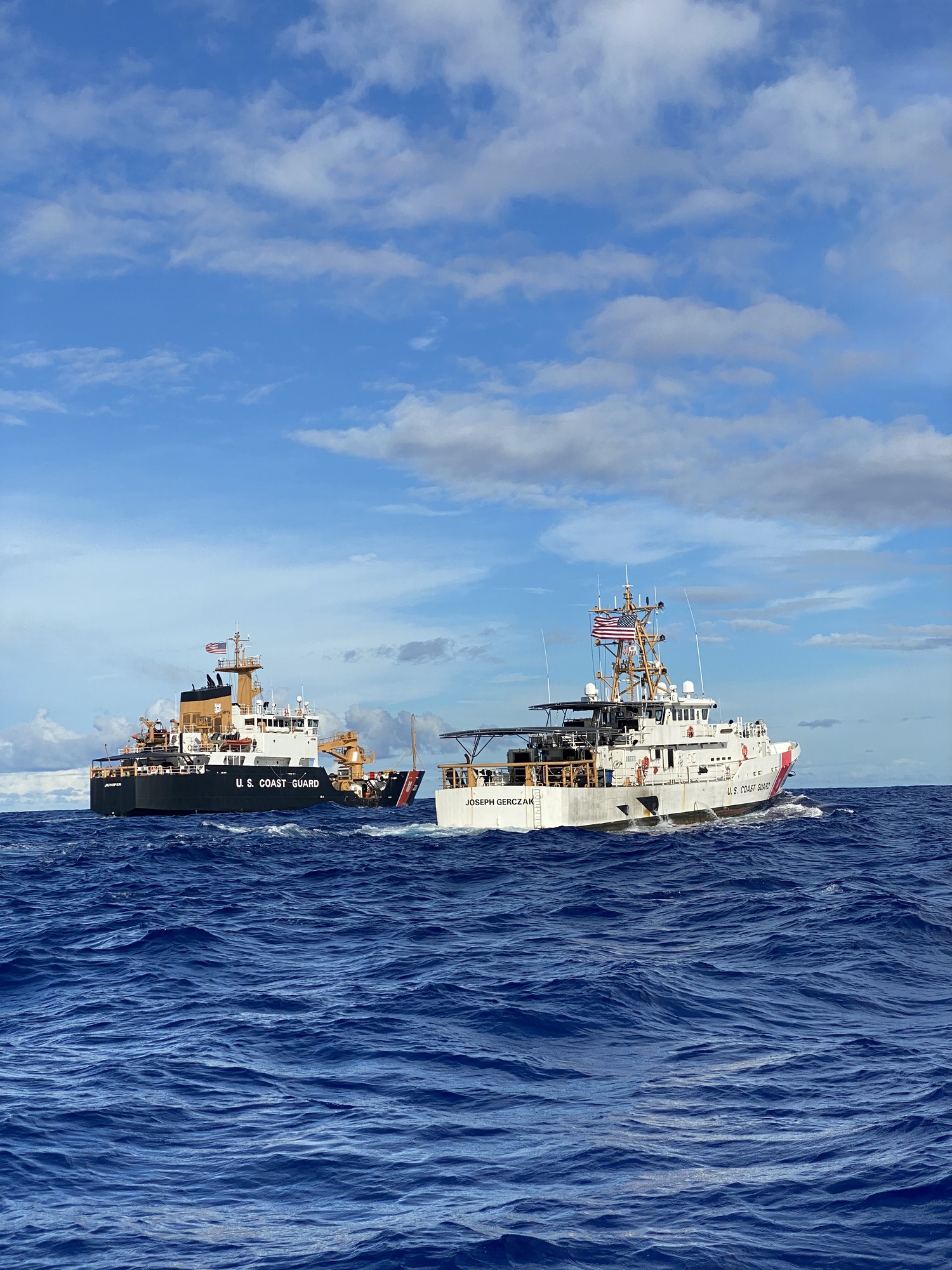
JG and Juniper

Editors’ Note: Click on images to download a high-resolution version.

HONOLULU — Working with the Government of Samoa, crews from the U.S. Coast Guard Cutter Juniper (WLB 201) and USCGC Joseph Gerczak (WPC 1126) conducted security patrol operations in Samoa’s exclusive economic zone throughout February 2022, to protect fisheries and other natural resources.

The Juniper and Joseph Gerczak crews helped fill the operational presence needed to deter illegal, unreported, and unregulated fishing while Samoa’s Nafanua II patrol boat is down.

“We always look forward to assisting our partners in the region,” said Cmdr. Jeff Bryant, the 14th District’s chief of enforcement. “The United States offered to assist the government of Samoa by providing security and sovereignty operations in Samoan waters due to the absence of their patrol boat.”

The cutters have been underway in Oceania supporting Operation Aiga, designed to integrate Coast Guard capabilities and operations with the United States’ Pacific Island Country partners in order to effectively and efficiently protect shared national interests, combat IUU fishing and strengthen maritime governance on the high seas.

As a trusted partner in the Pacific, the Coast Guard employs 11 bilateral shiprider agreements with Pacific Island Forum nations, like Samoa, to support resource security and fisheries enforcement. These agreements enabled the Coast Guard to aid host-nation sovereignty while patrolling Samoa’s EEZ.

The United States Coast Guard and the Government of Samoa have a history of partnership; in 2019, the Coast Guard cutters Walnut and Joseph Gerczak visited Apia Harbor and conducted patrol operations with officials from Samoa’s Ministry of Police and Ministry of Fisheries on board. In 2021, the crew of the CGC Oliver Berry conducted similar patrols while Samoa’s patrol boat underwent repairs.

“Operation Aiga is named that for a reason. Aiga means family in Samoan and that’s how we view our Pacific neighbors,” says U.S. Ambassador to Samoa, Ambassador Udall. “This is real partnership. Together we can stop those who seek to steal valuable resources that simply don’t belong to them.”

With a population of approximately 40 million people covering an area of 3.3 million square miles, the Coast Guard and its international partners regularly patrol Oceania to protect and support those who call it home.

“Commandant Names Future Polar Security Cutter ‘Polar Sentinel’ ” –Seapower

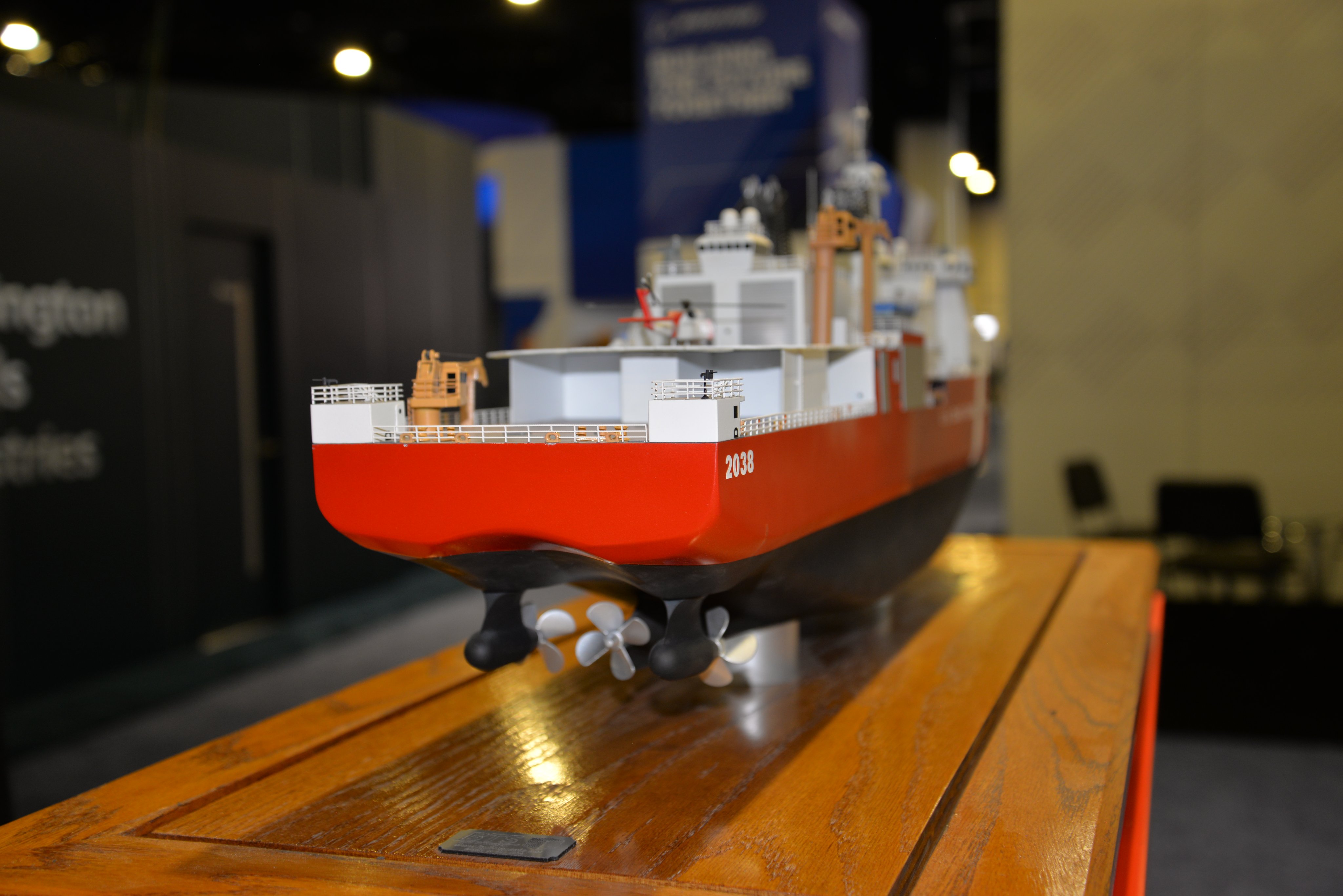
Photo of a model of Halter Marine’s Polar Security Cutter seen at Navy League’s Sea-Air-Space Exhibition have surfaced. Photo credit Chris Cavas.

The on-line edition of the Navy League’s magazine “Seapower” provides another report on the Commandant’s State of the Coast Guard speech.

This post has emphasis on the shipbuilding program.

Looks like the Coast Guard is becoming frustrated with the delays in the Polar Security Cutter and Offshore Patrol Cutter programs. I have to wonder how this will affect the award of the second phase of the OPC program.

Commandant’s Remarks, USNI West 2022 -Sea Service Chiefs Town Hall, Feb 2022

There is a very good summary of the Commandant’s remarks reported by the US Naval Institute, “Coast Guard Weathering Cutter Production Delays as More Coasties Head to Sea.” There is really much more to the USNI post than the title would suggest.

The “big news” in the article, reflected in the title of the post, was this statement.

The Coast Guard is shifting some 2,000 billets in the coming years to sailing billets, largely to support the additional cutters. It might push the active force population somewhat beyond the 42,000 personnel currently, Schultz told USNI. “They’ll be some end-strength increase beyond that,” but it’s not clear yet how that will bear out.

I am not sure where this is coming from. The total number of afloat billets under the program of record is not significantly different from the number of afloat billets we had two decades ago. The additional icebreakers will make a small difference, but it would not approach 2000 billets. It is true we have seen some draw down since then, and the number of technical ratings afloat will certainly increase with the increasingly sophisticated ships.

The shift of billets from non-rates to highly technical ratings does mean we would be sending far fewer non-rates afloat. It maybe, we have seen the ill effects of this move and will be sending more non-rates afloat. I would applaud such a move. It would better prepare the non-rates for school and would increase the resilience of the ship’s crews. Below, I have linked previous posts that discuss the number of afloat billets.

A video of the “Town Hall” is above. There is nothing for about the first 47 minutes. If you would like to hear the Commandant’s remarks directly, the sections where he makes his remarks begin at approximately the following times. You may want to watch the whole thing. I was very impressed with the Marine Corps Commandant’s comments.

  • 47:30 Intros
  • 50:30 Readiness
  • 1:00:00 Recapitalization vs Operating expenses/maintenance & infrastructure
  • 1:07:30 Competition for personnel
  • 1:17:00 Specialty personnel
  • 1:26:00 What do we need from industry
  • 1:32:00 Civilian hiring. Need to speed up the process. Civilian career development
  • 1:34:30 What the CG got out of the infrastructure bill
  • 1:39:00 Contract shipyards
  • 1:42:30 Supporting old cutters
  • 1:49:00 Should the CG be forward? 2000 additional at afloat billets. Additional help for ships during inports. Reserve utilization. Additional mental health professionals.
  • 1:54:00 Strategic integration of sea services
  • 2:01:00 Long term/distant deployments

RELATED

Manning Requirements, New Fleet vs Old

“A Sea Service Gone Ashore” –USNI

“Demise of the Cutterman, Part II” USNI Proceedings

“Coast Guard Cutter Diligence returns to homeport after 60-day Eastern Pacific Ocean patrol” –News Release

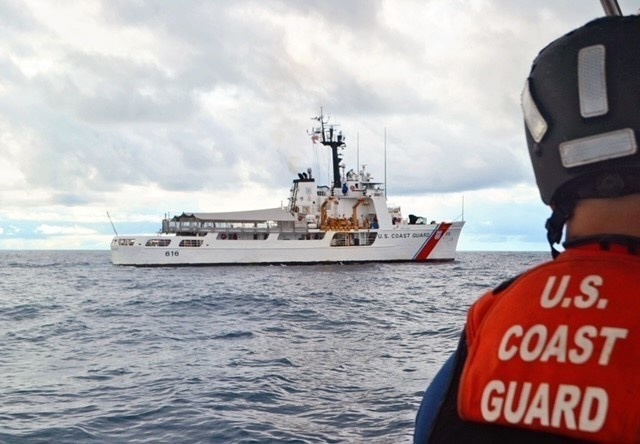
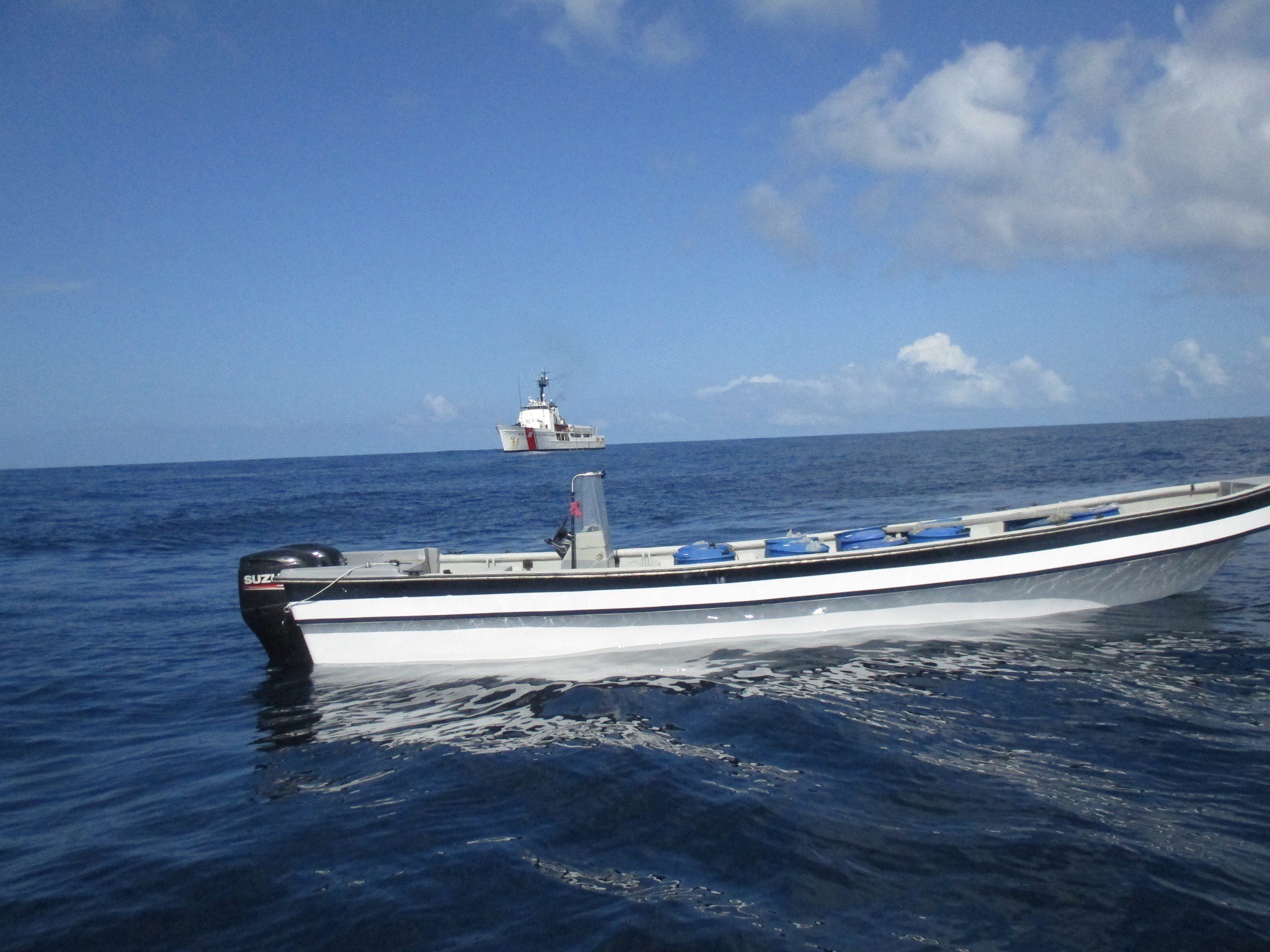
PHOTOS AVAILABLE: Coast Guard Cutter Diligence returns to homeport after 60-day Eastern Pacific Ocean patrol

09Feb22 DILIGENCE conducting small boat training in the Eastern Pacific Ocean. (Credit: BM3 Cayne Wattigney)

Below is a D8 news release. Sounds like a pretty typical WMEC Eastern Pacific patrol, but I would point out something I think is a bit unusual–they carried no helicopter. Awning over the flight deck and no mention of HITRON in the news release. Was this because of H-65 availability or because adequate air support was available from land bases? Maybe some other difficulty? Without a helicopter there is no armed overwatch and no way to chase down boats that may be faster than ship’s boats.

Looks like they left homeport a few days before Christmas.


News Release

U.S. Coast Guard 8th District Heartland

Coast Guard Cutter Diligence returns to homeport after 60-day Eastern Pacific Ocean patrol

Coast Guard Cutter Diligence returns to homeport after 60-day Eastern Pacific Ocean patrol 2/2 Coast Guard Cutter Diligence returns to homeport after 60-day Eastern Pacific Ocean patrol

Editor’s Note: Click on images to download high-resolution version.

PENSACOLA, Fla. — The crew of Coast Guard Cutter Diligence returned to their homeport of Pensacola Sunday following a 60-day counter-drug patrol in Eastern Pacific Ocean.

Partnering with three other Coast Guard cutters, Diligence interdicted three suspected drug-smuggling vessels resulting in the apprehension of 12 detainees and the interdiction of more than 4,321 lbs of cocaine with a street value of approximately $82 million.

“Diligence’s crew demonstrated professionalism, resilience and perseverance while conducting complex high-speed boat pursuits in the drug transit zone,” said Cmdr. Jared Trusz, Diligence’s commanding officer. “I am honored to serve with and proud of the crew’s superlative efforts that directly support the United States national security interests.”

Numerous U.S. agencies from the Departments of Defense, Justice and Homeland Security cooperated in the effort to combat transnational organized crime. The Coast Guard, Navy, Customs and Border Protection, FBI, Drug Enforcement Administration, and Immigration and Customs Enforcement, along with allied and international partner agencies, play a role in counter-drug operations.

The fight against drug cartels in the Eastern Pacific Ocean requires unity of effort in all phases from detection, monitoring and interdictions, to criminal prosecutions by international partners and U.S. Attorneys’ Offices in districts across the nation. The law enforcement phase of counter-smuggling operations in the Eastern Pacific Ocean is conducted under the authority of the Coast Guard 11th District, headquartered in Alameda, California. The interdictions, including the actual boardings, are led and conducted by members of the U.S. Coast Guard. 

The Diligence is a 210-foot medium-endurance cutter homeported in Pensacola with78 crewmembers. The cutter’s primary missions are counter-drug operations, migrant interdiction, enforcing federal fishery laws and search and rescue in support of Coast Guard operations throughout the Western Hemisphere.

“State of the Coast Guard 2022” (Updated)

Vice Adm. Karl L. Schultz, commander, Coast Guard Atlantic Area, speaks at the Coast Guard Cutter Benjamin Dailey commissioning ceremony in Pascagoula, Miss. Coast Guard Photo

ADM K.L Schultz delivered his “State of the Coast Guard 2022” at Air Station Clearwater, today, 24 February 2022.

You can read the prepared speech here.

There is an awful lot in the 13 pages. Much of it deals with how the Coast Guard hopes to provide a better life for its members and their families. I will not attempt to summarize. I will mention a couple of revelations that I think may be new.

Three FRCs will be homeported in Tampa Bay with Sector Saint Petersburg. This will bring the final number of FRCs in the 7th District up to at least 23. We repeatedly see these little ships doing fisheries and drug and migrant interdiction missions in the waters off Florida, the Gulf of Mexico and the Caribbean that would have previously been performed by WMECs. This frees the larger cutters to perform missions in more demanding environments.

We have seen a growing tendency to group long range assets. Apparently, this will continue.

We’re developing geographic centers of gravity, creating more Coast Guard hubs like Portsmouth and Alameda… These new or improved operating hubs will be in  Charleston, Seattle, Pensacola, Los Angeles, and Newport, Rhode Island… These operating hubs will allow us to better support our operational assets, and to further support the geographic stability of our workforce.

To some extent these centers of gravity exploit infrastructure built by the Navy but now considered excess. This applies to at least Charleston, Pensacola, and Newport.

These “centers of gravity” suggests expansion or creation of additional Support Centers. It may also suggest where Offshore Patrol Cutters (OPCs) will be homeported. We already know at least two OPCs each are going to San Pedro (Los Angeles), Kodiak, and Newport. Alameda already has four National Security Cutters (NSC) and Charleston will have five when all are completed. Seattle will most certainly be the homeport for three Polar Security Cutters. This suggest that at least Portsmouth, Pensacola, Los Angeles, and Newport will host large numbers of OPCs, perhaps as many as six. If that were to be the case, it would mean 14 large patrol cutters in Pacific Area (6 NSCs and 8 OPCs) and 22 in Atlantic Area (5 NSCs and 17 OPCs).

That would be close to the historic split of resources, but recent developments, including the success of the FRCs and IUU concerns in the Pacific, suggest we may have more large ships in the Pacific, perhaps a third OPC in Kodiak and up to three in Seattle or more likely Honolulu. That would make the split 18 in PAC Area and 18 in LANT Area.

(Updated: Corrected number of NSCs in each area.)

“FRCSW VRT Supports USCG Ship Repairs” –Sea Waves

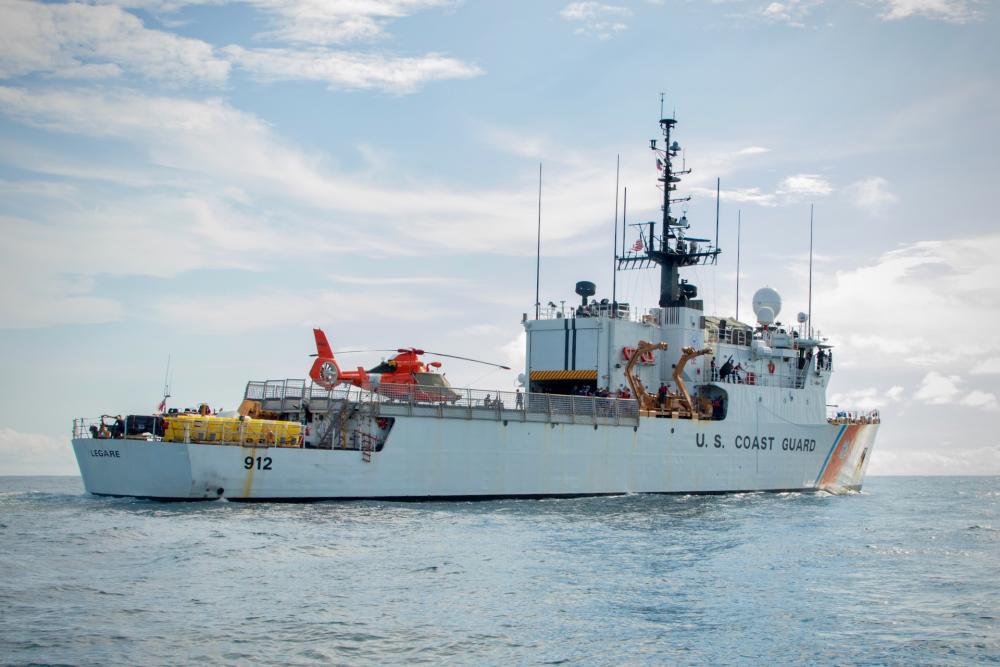
USCGC Legare (WMEC 912) as seen underway for Eastern Pacific patrol in late 2021. The Legare crew patrolled over 12,650 nautical miles through the heart of the Eastern Pacific Ocean in support of Campaign Martillo working in conjunction with Customs and Border Protection, the Drug Enforcement Administration, and other partnering nations. (U.S. Coast Guard photo by Petty Officer 3rd Class Trevor Hammack)

An interesting little post on the Coast Guard’s use of a Navy repair team, Fleet Readiness Center Southwest’s (FRCSW) Voyage Repair Team (VRT).

FRCSW’s VRT artisans repair at least one USCG vessel monthly. The next scheduled repair is in March to the USCG Legare (WMEC-912), also homeported at USCG Base Portsmouth.