“U.S. forges maritime technology collaborations to improve domain awareness” –Indo-Pacific Defense Forum

The Indo-Pacific Defense Forum brings us news of a Navy sponsored Maritime Domain Awareness program that may be very useful to the Coast Guard.

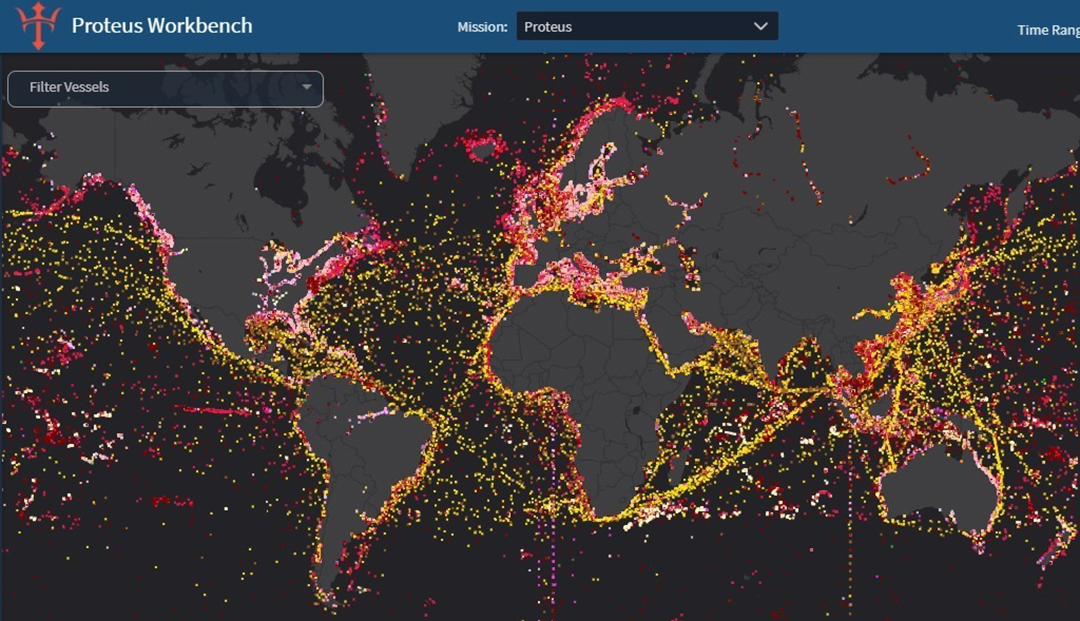
Recent successes include the U.S. Naval Research Laboratory’s (NRL’s) new program, called Proteus, to identify, query and filter maritime vessels based on user-defined criteria and the Defense Innovation Unit’s (DIU’s) international competition, known as xView3, to create machine learning models to locate and distinguish maritime vessels with synthetic aperture radar.

“Artificial intelligence combined with satellite imagery provides a new capability to detect suspected IUU fishing vessels that may otherwise elude U.S. and partner nations fisheries enforcement agencies. This increased maritime domain awareness can be shared with like-minded partner nations to enable them to protect their sovereignty.”

The NRL’s Proteus software, pictured, monitors sea vessels so stakeholders can “collaboratively discover and investigate suspicious and illegal maritime activity throughout the world in ways never before possible,” said Cameron Naron, the U.S. Maritime Administration’s maritime security director.

A description here by the US Naval Research Laboratory.

“PROTEUS is an exciting new U.S. government Maritime Domain Awareness (MDA) system providing a powerful array of MDA information and analysis tools,” said Cameron Naron, Director of Maritime Security, US Maritime Administration. “This system enables MDA stakeholders to collaboratively discover and investigate suspicious and illegal maritime activity throughout the world in ways never before possible.”

  • Additional actions supported by PROTEUS include: Counter Illegal, Unreported, and Unregulated Fishing (IUUF)
  • Maritime Protected Areas (MPAs)
  • Search and Rescue (SAR)
  • Critical Infrastructure Protection
  • Environmental Protection & Response
  • Maritime Law Enforcement
  • Counter smuggling (drugs, weapons, money, people)

This could be of assistance to any nation attempting to counter Illegal, Unregulated, Unreported fishing, including the island nations of the Western Pacific, who are desperately short on resources to monitor their ocean assets.

“Royal Bahamas Defence Force makes huge surge in migrant apprehensions” –The Watch

NorthCom’s online magazine, “The Watch,” reports,

The Royal Bahamas Defence Force (RBDF) announced that its migrant apprehensions increased dramatically in 2021 when compared with the previous year.

RBDF Commodore Raymond King said during a January 2022 news conference that detainments in the Bahamas increased by 456% in the past year, according to The Tribune, a Bahamian newspaper. King said the RBDF is faced with “people  smugglers” who are using more sophisticated methods to evade authorities.

This is really a success story with strong USCG involvement. There was also success reported in discouraging illegal fisheries poaching.

Related:

“MASTERING EXPEDITIONARY IUU FISHERIES ENFORCEMENT IN THE BAHAMAS” –CIMSEC

“U.S. upgrades Bahamas’ maritime security” –The Watch

Damen to Build New Patrol Boats for Bahamas

Indo-Pacific Strategy of the United States

U.S. Coast Guard Cutter Munro and Japan Coast Guard Patrol Vessel Large Aso, transit together in formation during a maritime engagement in the East China Sea Aug. 25, 2021. U.S. Coast Guard members aboard the Munro deployed to the Western Pacific Ocean to strengthen alliances and partnerships and improve maritime governance and security in the region. (Photo courtesy of Japan Coast Guard)

The Whitehouse has issued a new Indo-Pacific Strategy, and it specifically mentions the US Coast Guard.

The document calls out China for its aggressive behavior,

This intensifying American focus is due in part to the fact that the Indo-Pacific faces mounting challenges, particularly from the PRC. The PRC is combining its economic, diplomatic, military, and technological might as it pursues a sphere of influence in the Indo-Pacific and seeks to become the world’s most influential power. The PRC’s coercion and aggression spans the globe, but it is most acute in the Indo-Pacific. From the economic coercion of Australia to the conflict along the Line of Actual Control with India to the growing pressure on Taiwan and bullying of neighbors in the East and South China Seas, our allies and partners in the region bear much of the cost of the PRC’s harmful behavior. In the process, the PRC is also undermining human rights and international law, including freedom of navigation, as well as other principles that have brought stability and prosperity to the Indo-Pacific.

It recognizes the value and values of our allies and partners,

For centuries, the United States and much of the world have viewed Asia too narrowly—as an arena of geopolitical competition. Today, Indo-Pacific nations are helping to define the very nature of the international order, and U.S. allies and partners around the world have a stake in its outcomes. Our approach, therefore, draws from and aligns with those of our closest friends. Like Japan, we believe that a successful Indo-Pacific vision must advance freedom and openness and offer “autonomy and options.” We support a strong India as a partner in this positive regional vision. Like Australia, we seek to maintain stability and reject coercive exercises of power. Like the ROK, we aim to promote regional security through capacity-building. Like ASEAN, we see Southeast Asia as central to the regional architecture. Like New Zealand and the United Kingdom, we seek to build resilience in the regional rules-based order. Like France, we recognize the strategic value of an increasing regional role for the European Union (EU). Much like the approach the EU has announced in its Strategy for Cooperation in the Indo-Pacific, American strategy will be principled, long-term, and anchored in democratic resilience.

It calls for action in five areas:

  1. ADVANCE A FREE AND OPEN INDO-PACIFIC
  2. BUILD CONNECTIONS WITHIN AND BEYOND THE REGION
  3. DRIVE REGIONAL PROSPERITY
  4. BOLSTER INDO-PACIFIC SECURITY
  5. BUILD REGIONAL RESILIENCE TO TRANSNATIONAL THREATS

There is mention of the Coast Guard is in the section “BOLSTER INDO-PACIFIC SECURITY” on page 13.

We will also innovate to meet civilian security challenges, expanding U.S. Coast Guard presence, training, and advising to bolster our partners’ capabilities. We will cooperate to address and prevent terrorism and violent extremism, including by identifying and monitoring foreign fighters traveling to the region, formulating options to mitigate online radicalization, and encouraging counterterrorism cooperation within the Indo-Pacific. And we will strengthen collective regional capabilities to prepare for and respond to environmental and natural disasters; natural, accidental, or deliberate biological threats; and the trafficking of weapons, drugs, and people. We will improve cybersecurity in the region, including the ability of our partners to protect against, recover from, and respond to cybersecurity incidents.

Coast Guard roles presumably extend beyond interdiction and fisheries to include assistance with intelligence, port security, and maritime industry cybersecurity.

The strategy refers to ten lines of effort that are to be pursued in the next 12 to 24 months. The first is “Drive New Resources to the Indo-Pacific” (p.15),

Building shared capacity requires the United States to make new regional investments. We will open new embassies and consulates, particularly in Southeast Asia and the Pacific Islands, and increase our strength in existing ones, intensifying our climate, health, security, and development work. We will expand U.S. Coast Guard presence and cooperation in Southeast and South Asia and the Pacific Islands, with a focus on advising, training, deployment, and capacity-building. We will refocus security assistance on the Indo-Pacific, including to build maritime capacity and maritime-domain awareness.

Sounds like this may include Coast Guard attachés attached to diplomatic staffs and possibly some new basing.

There is a second line of effort that will undoubtably involve the Coast Guard, “Partner to Build Resilience in the Pacific Islands” (p.17),

The United States will work with partners to establish a multilateral strategic grouping that supports Pacific Island countries as they build their capacity and resilience as secure, independent actors. Together, we will build climate resilience through the Pacific Region Infrastructure Facility; coordinate to meet the Pacific’s infrastructure gaps, especially on information and communications technology; facilitate transportation; and cooperate to improve maritime security to safeguard fisheries, build maritime-domain awareness, and improve training and advising. We will also prioritize finalization of the Compact of Free Association agreements with the Freely Associated States.

A Maritime Executive post, New U.S. Indo-Pacific Strategy Singles Out China’s “Coercion”, notes,

In the security arena, the new strategy reiterates that the United States has maintained “a strong and consistent defence presence necessary to support regional peace, security, stability, and prosperity”, pointing to the South China Sea and the East China Sea as a priority. However, it is interesting that while the document underscores the importance of freedom of navigation in the Indo-Pacific, not a single paragraph mentions the US Freedom of Navigation Operations Program (FONOPS) carried out by the US Navy, which has stirred controversy. Conversely, the strategy emphasises the importance of the Coast Guard to lead maritime security cooperation in the region, in “advising, training, deployment, and capacity-building … including to build maritime capacity and maritime-domain awareness”. Indeed, in 2021, the US Coast Guard announced a joint maritime training centre with the Indonesian Coast Guard in Batam.

The emphasis on coast guard cooperation can be seen as a positive gesture since it will be less provocative and sensitive compared to a military presence in the region. And more importantly, coast guard operations in Southeast Asia are very much required to tackle maritime security threats such as illegal fishing.

Thanks to Paul for bringing this to my attention. 

“MEDIA AVAILABILITY: Coast Guard Commandant to Deliver State of the Coast Guard Address”

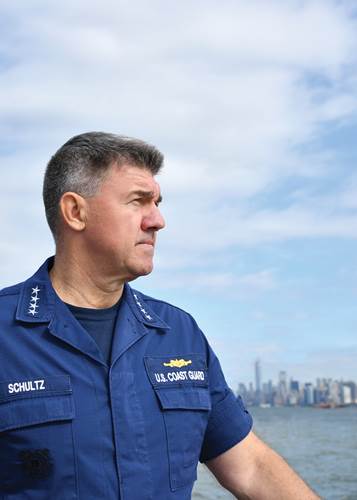
Coast Guard Commandant Adm. Karl Schultz visits with Coast Guard crews stationed in New York City. U.S. Coast Guard photo illustration by Petty Officer 1st Class Jetta Disco.

Passing this along for those who may want to see it live. This announcement is aimed at providing information for the media and general public. An earlier announcement was aimed more toward active-duty members.

Media Advisory U.S. Coast Guard 7th District PA Detachment Tampa Bay


MEDIA AVAILABILITY: Coast Guard Commandant to Deliver State of the
Coast Guard Address

Editor’s Note: Media attending must wear a mask and have a COVID vaccine card or negative test within the
last three days.

WHO: Adm. Karl L. Schultz, commandant of the United States Coast Guard
WHEN: 1- 3:30 p.m., Thursday, Feb. 24, 2022.
WHERE: Coast Guard Air Station Clearwater, 15300 Fairchild Dr., Clearwater, FL 33701
WHAT: Media must RSVP at (305) 607-6347 or padettampabay@gmail.com no later than Tuesday, Feb. 22, at 4 p.m. A
government-issued identification and media credentials are required for access to Air Station Clearwater. Media should arrive no later than 12:30 p.m. to set up for the event.

CLEARWATER, Fla.— The commandant of the United States Coast Guard is scheduled to deliver his annual State of the Coast Guard Address, Thursday, at Coast Guard Air Station Clearwater. 

This event will be live-streamed at https://www.uscg.mil/alwaysready/ and on Facebook at https://Facebook.com/USCoastGuard at 1:00 p.m. EST/10:00 a.m. PST.

Adm. Karl L. Schultz will outline the Coast Guard’s role in a time of transformational change within the maritime domain. He will provide his vision for how the Service will respond to meet the Nation’s needs now and in the future. Adm. Schultz will accentuate the dedication and sacrifice of Coast Guard members stationed across the country and deployed around the world.
Adm. Schultz will further highlight the partnerships across the Department of Homeland Security organization, with the Department of Defense Joint Forces, inter-agencies and with our international partners that allow the Coast Guard to meet the demands of today and tomorrow.

Additionally, Adm. Schultz is expected to feature stories of Coast Guard women and men who excelled in crisis, rescued mariners in distress, interdicted illicit narcotics, and responded to the Haiti Earthquake.

Media unable to attend may request a Zoom link to join the media call after the event. 

Detailed Schedule of Events:

1 – 2 p.m.: State of the Coast Guard address
2:15 – 2:30 p.m.: Adm. Schultz will be available for media interviews
2:30 – 3:30 p.m.: Displays and tours of Coast Guard assets will be available
3:45 – 4 p.m.: Media hub call for those unable to attend the event in-person

For more breaking news follow us on Twitter and Facebook.

-USCG-

“CHINA COAST GUARD: ON A TRAJECTORY FOR PEACE OR CONFLICT?” –CIMSEC

CIMSEC brings us a post about the dramatic growth of the China Coast Guard and the emergence of its Gray Zone Operations.

I don’t think you will find anything surprising here. The value of the piece is that it presents the views of knowledgeable bystander, without a vested interest in the South China Sea controversy, The author, “LTC Ahmed Mujuthaba was the Principal Director of the Maldives National Defense Force Coast Guard.”

“Coast Guard Struggling with Southern California ‘Coastal Awareness Gap’ as Maritime Smuggling Rises” –USNI

Aerial view of the Port of San Diego with two aircraft carriers moored at North Island and three cruise ships in Port, from Oct. 4, 2012. Port of San Diego photo

US Naval Institute reports the Coast Guard is looking for ways to deal with a problem unique to Sector San Diego, a combination of proximity of Mexico and heavy offshore traffic.

“We’ve faced a major increase in smuggling,” Capt. Tim Barelli, commander of Sector San Diego, told an audience on the first day of WEST, a three-day defense industry conference hosted by USNI and Armed Forces Communications and Electronics Association. Incidents of smuggling have doubled, year over year, in the past three years, “and I’m doing that with the same amount of people, same amount of helicopters and same amount of small boats. So that is my biggest challenge.”

They are hoping technology can help.

I would point, out this is not just a drug or human trafficking problem. Terrorists could use the same confusing conditions to cover a maritime attack on this major US port city and naval base.

“Want to stop a Drug Smuggling Boat? Try out a High Power Microwave Weapon Systems” –Marine Link

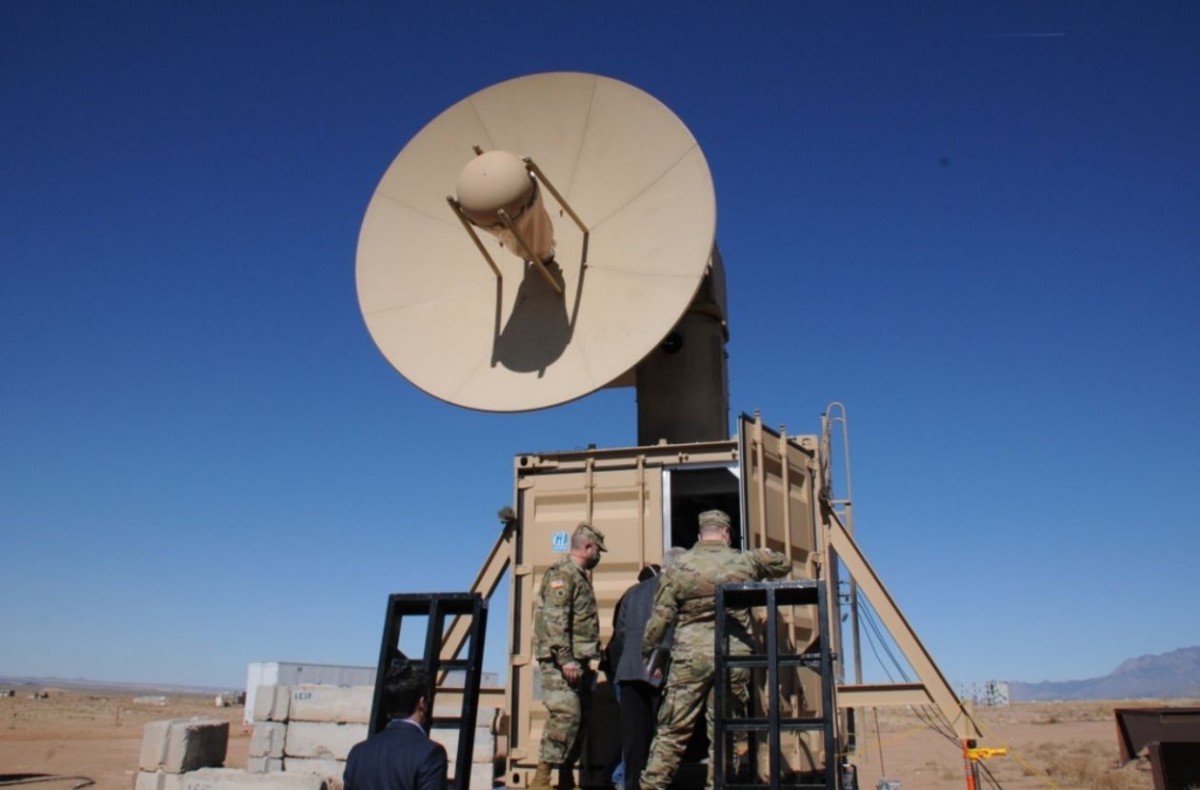
MarineLink reports that the Naval Surface Warfare Center Dahlgren Division has been working on high power microwave systems as a way to stop no compliant vessels, and they want the Coast Guard to try it out.

“We are looking to provide the U.S. Coast Guard with an HPM system for a one-year operational utility assessment,” said Pete Cacciola, a project lead for vessel stopping efforts in the HPM Weapon Systems Division. “Our goal is to give them another tool in their toolbox for noncompliant vessel interdiction.”…HPM weapon systems, a type of directed energy weapon system, operate by generating and transmitting extremely high electrical power levels, focused on specific frequencies and directed by steerable antenna systems. The result to a target is disruption or destruction of key components, rendering the target inoperable with little or no effect on personnel.

Such systems are also likely to be useful against unmanned air systems (drones), also an emerging Coast Guard concern.

Two New Classes of OPV in a Small Size

NavyClippings brings us two reports of new offshore patrol vessels (OPVs). These two are of a size between that of typical “Inshore Patrol Vessels” and OPVs. Neither has accommodations for a helicopter but both have two RHIBs. They are pretty close in size to USCG 210 foot WMECs, 210 ft 6 in (64.16 m) length over all (loa) with a 34 ft (10.36 m) beam.

First there is project Biro for the South African Navy. The three ships being built by Damen Shipyards Cape Town (DSCT) are 62×11 meter (203.4′ long, 36’1″ beam, Stan Patrol 6211 vessels), which have a maximum speed of 26.5 knots, a range of 4 000 nautical miles, endurance of 14 days, and a crew of up to 62 (core crew is 40).

Senegalese OPV 58S

The second class being built by French shipyard Piriou, will include three OPVs (with an option for a fourth).

The OPV 58S offshore patrol vessels for Senegal are 62 metres long, 9.5 metres wide and have a maximum draft of 2.9 metres. They have steel hulls and aluminium superstructures with a 360 degree panoramic bridge, a rapid deployment/recovery system for two boats and be each able to accommodate up to 48 people, including 24 crew members. Top speed is 21 knots with a range of 4 500 miles at 12 knots, for a 25 day endurance.

The MBDA Marte Mk 2Ns anti-ship cruise missiles which would be in the canisters visible between the 76mm gun and the bridge are a bit smaller than most missiles of this type.

A New Coast Guard Base In the Western Pacific?

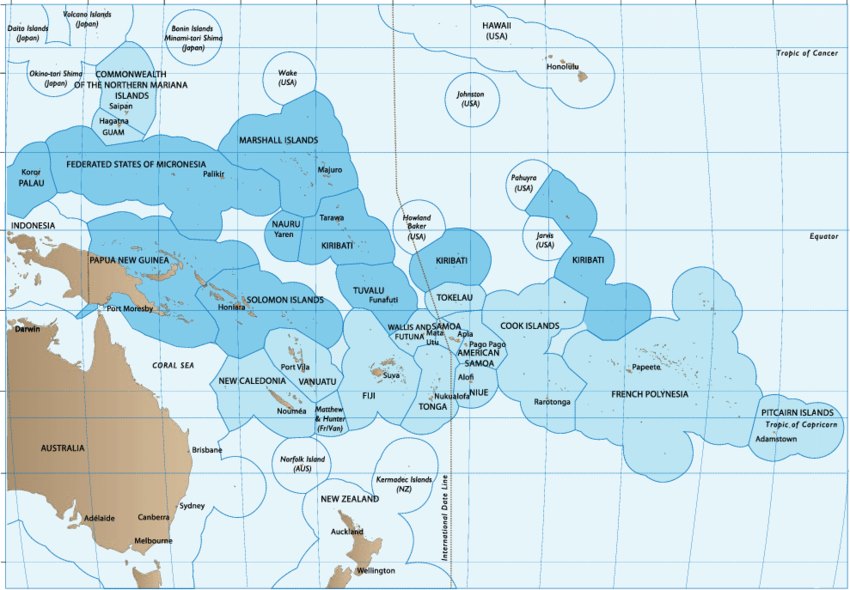
Estimated exclusive economic zones (EEZs) of Pacific Island countries and territories (PICTs). The EEZs of countries that are the Parties to the Nauru Agreement are shown in darker blue. Note that not all EEZs of PICTs have been officially delineated under the United Nations Convention on the Law of the Sea. Source: Patrick Lehodey

Recently there has been indicators that there may be more Coasties deployed to the Western Pacific, including perhaps a desire to replicate PATFORSWA somewhere in the Western Pacific in support of USINDOPACOM. There have also been suggestions that the Coast Guard should be based in Palau and in American Samoa

South and West of Hawaii, Why a New Base?

The US has a huge EEZ in the areas South and West of Hawaii. This area constitutes more than 29% of the entire US EEZ. By comparison the entire EEZ in Atlantic Area only constitutes a little over 16% of the total US EEZ. Despite the distortion of the map below, this Area is nearly as large as the US EEZ surrounding Alaska, and certainly larger than the parts of the Alaska EEZ we actually patrol with any regularity.
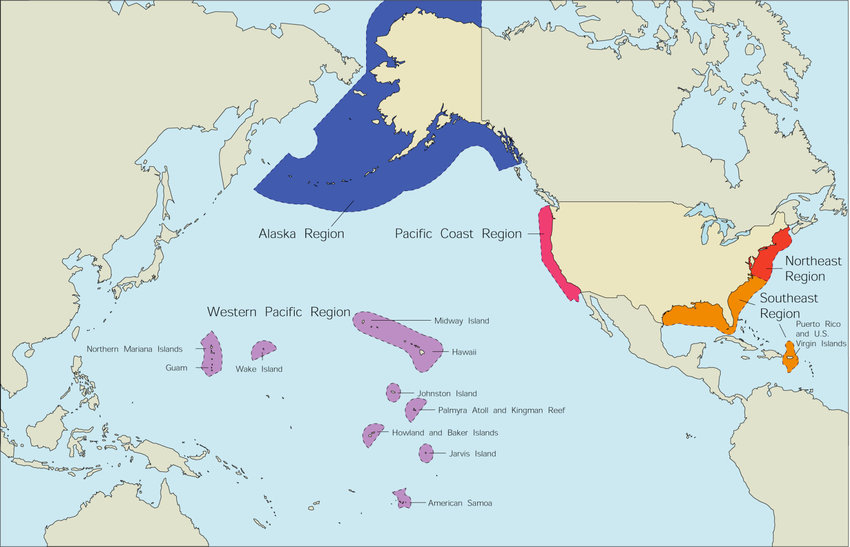
In the past this area has been given essentially only benign neglect, but things have changed. There has been the explosion of Illegal, Unregulated, and Unreported (IUU) fishing, primarily, but not exclusively by China. In addition to fishing in US waters, these activities undermine the economies of the three Pacific Island nations of the Compact of Free Association: the Federated States of Micronesia (FSM), the Republic of the Marshall Islands (RMI), and the Republic of Palau, to whom we have treaty obligations, as well as other Pacific Island nations including the Solomon Islands

Following on the heels of their fishing fleet, China seems to be seeking strategic basing in this area in the guise of loans and other forms of economic aid made necessary in part, at least, due to the devastation of local fishing. This has given rise to a general suspicion about Chinese intentions in the area.

Fortunately, the Coast Guard is generally seen as a welcomed partner in capacity building by many Pacific Island nations

In spite of the “tyranny of distance” in the Pacific, the only patrol assets we have in this area are three, relatively small Webber class patrol craft in Guam. There is not a single Coast Guard aircraft stationed in the area. In Guam a Navy helicopter squadron is used to provide SAR Response. From Guam, the nearest Coast Guard Airstation is 3440 nautical miles (6370 kM) away. It is over 2230 nmi (4129 kM) from Hawaii to American Samoa.

What Kind of Base?

Most of the talk has been about basing ships but there is also a need for supporting air reconnaissance. Air support might not require a full time Coast Guard Air Station, but a forward based rotating detachment might be appropriate. A mobile land based medium altitude long endurance unmanned air system might also serve us well. Even to base surface assets, we would need not only a port, but also a nearby airfield to provide access and support, so we will talk about airports. 

The Coast Guard is not going to want to spend a huge amount of money to create facilities where none currently exist, so there is probably no point in looking at locations that do not already have at least basic port or airport facilities. 

Since this is an attempt to help the local population, it makes sense to go where there is a local population. Happily, the people are where the sea and airports are.

These considerations limit the choices, eliminating places that might be good geographically, but don’t have even basic infrastructure. We are probably not going to establish a base on an uninhabited island. 

DOD is also interested in establishing additional bases to allow greater distribution of their assets, and we might ride their coattails. If the DOD base is on foreign soil, including a Coast Guard presence might be seen by the locals as sweetening the deal.

The Coast Guard would probably prefer to have the base on US territory, but if that were not to be the case, then proximity to currently under-served US territories, including uninhabited islands, would be a plus.

So Where?

As can be seen in the first chart, the area of the EEZs surrounding the various islands in the Pacific are very large. To give an idea of how large they are, I will use the area of the Atlantic Area EEZ (East Coast, Gulf Coast, Puerto Rico, and US Virgin Islands, 1,835,024 sq kilometers) as a benchmark. I will note percentage of Atlantic Area Exclusive Economic Zone (% AA EEZ)

US Territories

According to Wikipedia, the US has the following territory South and West of the Hawaiian Islands, their associated EEZ in square kilometers and EEZ size compared to that of Atlantic Area are in parenthesis: 

  • Northern Marianas Islands (749,268, 40.8% AA EEZ)
  • Johnston Atoll (442,635, 24.1% AA EEZ)
  • Howland and Baker Islands (434,921, 23.7% AAEEZ) 
  • Wake Island (407,241, 22.2% AA EEZ)
  • American Samoa (404,391, 22.0% AA EEZ)
  • Palmyra Atoll and Kingman Reef (352,300, 19.2% AA EEZ)
  • Jarvis Island (316,665, 17.3% AA EEZ)
  • Guam (221,504, 12.1% AA EEZ)

The total EEZ of these small islands is more than 81% greater that of the entire Atlantic Area EEZ. 

Pacific Remote IslandsBaker IslandHowland IslandJarvis IslandJohnston AtollKingman ReefPalmyra Atoll, and Wake Island are all included in the Pacific Remote Islands Marine National Monument, managed by the US Fish and Wildlife service and NOAA. These islands extend 717 to 2,298 nautical miles South and West from Honolulu. None of these islands has a permanent resident population. 

Johnston Atoll does have an airport and pier space. Palmyra has only an unpaved airstrip left over from WWII. Wake Island is administered by the USAF and has a 9,800-foot (3,000 m) runway used for refueling and emergency landings, “The island’s only harbor between Wilkes and Wake is too narrow and shallow for sea-going vessels to enter.”

None of the “Pacific Remote Islands” sound promising. That leaves only

  • American Samoa (404,391)
  • Guam (221,504)
  • Northern Marianas Islands (749,268)

Guam: Guam is 6,126 kilometers or 3,308 nautical miles West of Honolulu. We already have a Coast Guard presence in Guam. It is homeport to a buoy tender and three Webber class WPCs. There is, however, no Coast Guard air station closer than Honolulu. A Navy Helicopter squadron provides SAR response. 

American Samoa: “American Samoa consists of five main islands and two coral atolls. The largest and most populous island is Tutuila.” It has 95% of the population of American Samoa, 56,000 inhabitants, and includes a large natural harbor and airport as part of the capital, Pago Pago. Pago Pago is 4,179 kilometers or 2,256 nautical miles South of Honolulu.

Commonwealth of the Northern Mariana Islands (CNMI): “The CNMI includes the 14 northernmost islands in the Mariana Archipelago; the southernmost island, Guam, is a separate U.S. territory.” Of the approximately 53,883 people living there (2010 census), about 47,565 (2017 estimate) live in Saipan. Recently it was announced that an expeditionary sea base, USS Miguel Keith (ESB 5), would be homeported in Saipan. This may offer an interesting option for collaboration in capacity building. Saipan is only 217 kilometers or 117 nautical miles from Guam, so what might have been potential base seems less likely; however, it does offer an alternative for replenishment while operating in the Northern Marianas. 

Pacific Remote Islands Marine National Monument. The previous (2011) boundaries of the Pacific Remote Islands Marine National Monument are outlined in light blue.

Members of the Compacts of Free Association

Foreign Policy recently published a proposal for “After the Debacle: Six Concrete Steps to Restore U.S. Credibility.” The article claimed there was bipartisan support for each step. Perhaps surprisingly three of the proposed steps involved the Coast Guard. They included:

  •  Open embassies in the Pacific island nations of Kiribati, Nauru, Tonga, and Tuvalu and provide each with a Navy or Coast Guard attaché.
  • A permanent Coast Guard presence at Pago Pago in American Samoa.
  • Basing an icebreaker in Sydney or Hobart, Australia.

That does not constitute US policy but clearly there is pressure to put more Coast Guard West of Hawaii both to protect the huge US EEZ in the Western Pacific and to do capacity building and work with Pacific island nations, particularly those who are Compact of Free Association members (the Federated States of Micronesia (FSM), the Republic of the Marshall Islands (RMI), and the Republic of Palau).
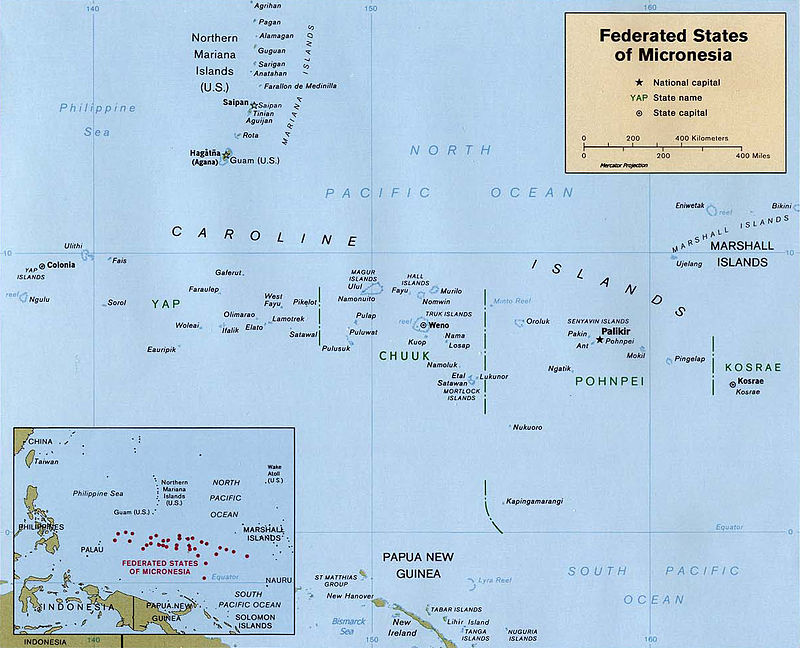
U.S. Central Intelligence Agency – Federated States of Micronesia (Political) 1999 from Perry-Castañeda Library Map Collection: Federated States of Micronesia Maps

Federated States of Micronesia (FSM, 163.3% AA EEZ)

The Federated States of Micronesia (FSM) consist of “around 607 islands (a combined land area of approximately 702 km2 or 271 sq mi) that cover a longitudinal distance of almost 2,700 km (1,678 mi) just north of the equator.”

The island of Pohnpei is the most developed in the FSM and has a population of 36,832 (2020) out of a total population of 104,468 (2019 estimate). It includes the capital Palikir. It is 1635 kilometers / 883 nautical miles SE of Guam. The most Easterly FSM State, Kosrae, lies 2186 kilometers / 1180 nautical miles from Guam. 

The possibility of a Coast Guard base in the Federated States of Micronesia has gotten a bit more likely. According to MSN and the Pacific Island Times,

“The United States and the Federated States of Micronesia have agreed on a plan to build a military base in the Pacific Island nation, in line with the Pentagon’s strategic ambition to increase its footprint in the Indo-Pacific region and keep China at bay.”

In all probability the “base” will be a port and an airfield, both dual-purpose, used for both commercial and military purposes. I would not expect DOD ships or aircraft to be based there permanently. There probably will be a small cadre of support personnel.

Republic of the Marshall Islands (RMI, 108.5% AA EEZ)

The 2020 population was projected to be 59,190. Total land area is only 70.05 square miles. The capital is on the atoll of Majuro, population 27,797 (2011). Majuro’s airport is 2984 kilometers / 1611 nautical miles ESE of Guam’s, and 1443 kilometers / 779 nautical miles East of Pohnpei in the Federated States of Micronesia.
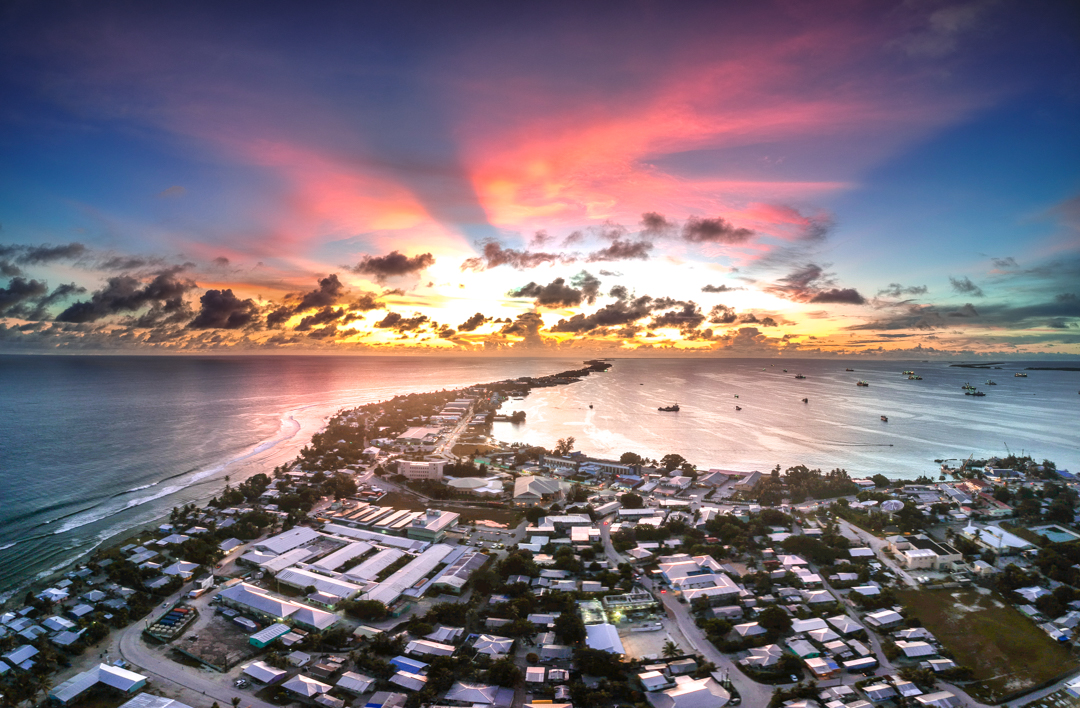
Sunset in Majuro, over Delap-Uliga-Darrit in the Marshall Islands from a drone. Jamison Logan photo.

At one point during WWII Majuro was the busiest port in the world. “Majuro Lagoon is…one of the busiest tuna transshipment ports in the world, with 306,796 tons of tuna being moved from purse seine vessels to carrier vessels in 2018.”
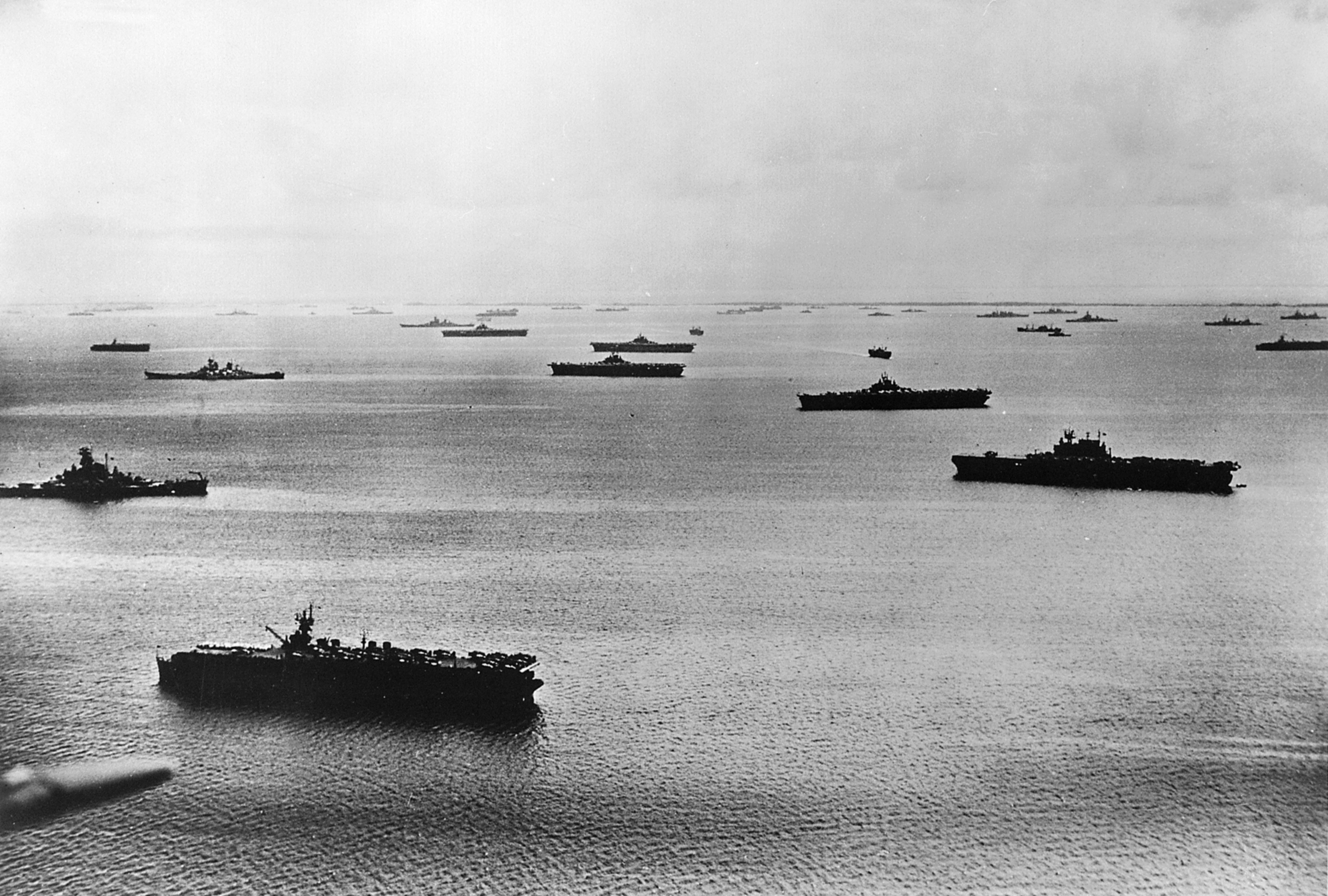
The U.S. fleet at Majuro Atoll in 1944. Visible (among many other ships) are three Independence-class light carriers, four Essex-class carriers, USS Enterprise (CV-6, right front), a South Dakota-class battleship, and two Iowa-class battleships. U.S. Navy photo 80-G-225251

Palau (32.9% AA EEZ)

Koror City is the largest city and its commercial center in Palau, home to about half of the country’s population, about 14,000 in the metropolitan area. It is served by an airport about four miles away. Koror, Palau is 704 nautical miles (1,304 kM) from Guam

Non-US, Non-Compact of Free Association Island Nations. 

There are eleven other small Island nations in the area.

  1. Kiribati (187.6% AA EEZ)
  2. Papua New Guinea (130.9% AA EEZ)
  3. Cook Islands (106.8% AA EEZ)
  4. Solomon Islands ((86.6% AA EEZ)
  5. Fiji (69.9% AA EEZ) 
  6. Tuvalu (40.9 % AA EEZ) 
  7. Vanuatu (36.1% AA EEZ) 
  8. Tonga (35.9% AA EEZ) 
  9. Niue (17.3% AA EEZ) 
  10. Nauru (16.8% AA EEZ) 
  11. Samoa (7.0% AA EEZ) 

These eleven have a combined EEZ more than 7.3 times that of the Atlantic Area EEZ. 

What I Think We Will Do

Putting two or three Webber class at Pago Pago appears likely. It would require we add to the currently planned and funded fleet of 64 Webber class FRCs. 

If the Navy does establish a base in the Federated States of Micronesia (FSM), then the Coast Guard might well provide a small support and advisory detachment to assist the local maritime authorities. Pohnpei, Federated States of Micronesia looks like it might be a good central location to operate Fixed Wing aircraft from. They have a 6,000 foot (1829 meter) runway

What We Should Do

If we have bases in Honolulu, Guam and American Samoa, they form the corners of a triangle that encloses most of the area of interest, but those bases are near the extremes. American Samoa is well South and East but it is at least surrounded by island nations. Guam is near the Western edge. Honolulu is in the Northeast corner. 

Another possible complementary, more central location is Manus Island, Papua New Guinea. Manus is 1,737.88 km (938 nautical miles) SSE of Guam. The population is reported to be 50,351 (2011). The US and Australia both see Manus as strategically significant

Current discussion seems to concentrate on where we might put additional cutters. This has gained a sense of urgency because we are at a decision point with regard to the Webber class FRC program and these little ships are seen as the likely assets to provide a Coast Guard presence in this underserved area. Will we let the program die at the currently planned 64 vessels or will we exercise all or part of an existing option for 12 more cutters that will expire in May 2023? 

This is prompted in part by the House Armed Services Committee’s report (H.Rept. 117-118 of September 10, 2021) on H.R. 4350 which states in part:

Given the successes of the U.S. Coast Guard’s Sentinel-class Fast Response Cutter in support of the Navy’s Fifth Fleet as a part of Patrol Forces Southwest Asia, the committee believes there are similar roles for Sentinel-class Fast Response Cutters in other areas of responsibility. Therefore, the committee directs the Secretary of the Navy to submit a report to the congressional defense committees not later than February 1, 2022, that details the current mission sets and operating requirements for the Sentinel-class Fast Response Cutter and expands on how successes in the U.S. Central Command area of responsibility would translate to other regions, including the U.S. Indo-Pacific Command. Further, the committee directs the Secretary of the Navy to assess the requisite upgrades to the Sentinel class Fast Response Cutter required to meet Navy standards and evaluate the concept of operations for employing these vessels in Southeast Asia. This report should be unclassified but may include a classified annex. (Page 21)

In addition to placing two or better yet three FRCs in American Samoa, it might be wise to also increase the number of FRC in Guam to emulate the success of PATFORSWA. This would allow two boats to be away from base almost continuously. This could allow significantly better coverage particularly in Palau and the Northern Marianas. 

Ideally these island nations should have their own enforcement mechanisms, capable of patrolling their own waters, but comprehensive coverage is probably beyond their means. It seems they all have some basic capabilities. We should complement rather than replace existing capability.  Local forces should be the point of the spear. To this end we can provide training and donate assets including perhaps excess 87 foot Marine Protector class patrol boats. 

Given the huge area, surface units are not enough. Satellites can help. but air surveillance is also required. The increased range of the “J” model C-130s will certainly help, but to provide any degree of persistence we will probably at least need to rotate crews and aircraft out of an advanced base. 

Our efforts should be coordinated with the already significant efforts of our allies Australia, New Zealand, and France, are doing in the area. 

The distances are great. The areas of concern are huge. The Coast Guard, our allies, and the Island nations themselves don’t have enough assets to patrol these waters effectively. In addition to patrol vessels and aircraft we need better Maritime Domain Awareness including use of satellites and artificial intelligence to cue the limited enforcement assets. 

A cooperative multi-national law enforcement intelligence exchange might be the most important addition we could make. 

“Coast Guard Cutter Stratton visits Fiji during Operation Blue Pacific patrol” –D14 News Release

The Coast Guard Cutter Stratton passes underneath San Francisco’s Bay Bridge, June 12, 2019. U.S. Coast Guard photo by Petty Officer 1st Class Matthew S. Masaschi.

Below is a D14 news release regarding a type of operation we now see more frequently. Stratton has been away from home for 50 days and is still heading West. At least the crew is getting to see some exotic places. Hopefully COVID restrictions are not keeping the from going ashore.

The ships mentioned in the release, that Stratton has been working with are of interest. HMNZS Aotearoa is an ice capable underway replenishment ship. HMS Spey is a Royal Navy Offshore Patrol Vessel, one of two sent into Pacific and Indian Oceans.


News Release

U.S. Coast Guard 14th District Hawaii and the Pacific

Coast Guard Cutter Stratton visits Fiji during Operation Blue Pacific patrol

Editors’ Note: Click on images to download a high-resolution version.

SUVA, Fiji — The crew of the Coast Guard Cutter Stratton visited Fiji in February after being underway for 50-days in the Pacific combating illegal, unreported, and unregulated (IUU) fishing.

During the visit, Capt. Stephen Adler, the Stratton’s commanding officer, met with members of the Fijian media to discuss the Coast Guard’s partnership with Fiji and their combined effort to protect fisheries resources.

“Our relationships with our partner nations are more important than ever in combating illegal, unreported, and unregulated fishing,” said Adler. “We are pleased to work with our Fijian partners to maintain maritime sovereignty and security throughout the region.”

While in the country, the Stratton’s crew welcomed aboard three Fijian ship riders who, with the assistance of Stratton’s law enforcement boarding teams, will ensure compliance with applicable Fijian fishing laws within Fiji’s exclusive economic zone.

The Coast Guard’s mission to combat IUU fishing is essential in protecting maritime governance and a rules-based international order to ensure a free and open Indo-Pacific.

Bilateral shiprider agreements are a force multiplier for both Fiji and the Coast Guard because they allow Fijian law enforcement personnel to observe, protect, board, and search vessels suspected of violating laws or regulations within Fijian waters with the support of Coast Guard personnel and vessels.

Speaking recently during a visit to Fiji, Secretary Antony J. Blinken, the U.S. Secretary of State, stated “On security, just this week three shipriders from Fiji are joining the crew of the U.S. Coast Guard Cutter Stratton to conduct patrols in support of maritime sovereignty and security. The United States is proud that several of Fiji’s future leaders are being trained in our military academies.”

The fisheries industry is a significant source of food and income throughout the Pacific. Protecting this renewable resource is a priority for the United States and Pacific Island Countries as IUU fishing in the Pacific has global impacts and effects.

Recently IUU fishing has replaced piracy as the leading global maritime security threat and has the potential to have a global effect if unchecked.

Prior to visiting Fiji, the Stratton’s crew had been working with British, Australian, New Zealand, and French allied naval forces as well as the U.S. Navy in support of the Tongan government following the volcanic eruption on Jan 15th.

The crew also conducted a number of drills and exercises with allied partners including helicopter operations with the Armed Forces in French Polynesia, fueling at sea with the Royal New Zealand Navy Ship Aotearoa, and multiple maneuvering exercises with the Royal Navy HMS Spey.

The Stratton’s crew plans to visit Papua New Guinea as representatives of the Coast Guard and United States. Both the United States and Papua New Guinea are interested in signing a bilateral agreement to codify the two states’ strategic partnership in the Pacific and enable the Coast Guard to better assist Papua New Guinea in protecting the island nation’s sovereignty over its EEZ against IUU fishing.

The Stratton is a 418-foot national security cutter capable of extended, worldwide deployment in support of homeland security and defense missions. NSCs routinely conduct operations throughout the Pacific and Atlantic oceans; their unmatched combination of range, speed, and ability to operate in extreme weather provides the mission flexibility necessary to conduct vital strategic missions.

Operation Blue Pacific is an overarching multi-mission Coast Guard endeavor, promoting security, safety, sovereignty, and economic prosperity in Oceania while strengthening relationships between partner nations in the Pacific.