“Schultz: U.S. Coast Guard in ‘Prolific’ Shipbuilding Period” –USNI

Vice Adm. Karl L. Schultz, commander, Coast Guard Atlantic Area, speaks at the Coast Guard Cutter Benjamin Dailey commissioning ceremony in Pascagoula, Miss. Coast Guard Photo

The US Naval Institute reports on the Commandant’s remarks at the Surface Navy Association Symposium.

There did not seem to be any surprises. The Commandant’s messaging has been very consistent. He did spend some time discussing the Coast Guard growing role in international affairs.

“Well, I think we really play a key role in shaping the diction of global maritime security, global maritime safety, and I suspect navies around the world are recognizing that the language and purpose of coast guards are well supported to their interests and their sovereign interests. And that’s why we’re adapting our operations abroad,” Schultz said.

There was discussion about the recapitalization of the fleet, which the Commandant called the Coast Guard’s “largest shipbuilding period since World War II.” The cost of the contracts has been unprecedented and the 34 year time span from acceptance of the “Program of Record” in 2004 until its projected completion in 2038 must be some kind of record. The FRC program has certainly been a success, but aside from them, we have only delivered the nine National Security Cutters in the almost fourteen years since Bertholf was commissioned. This does not look that intense compared to the nine-year period from 1964 to 1972 when the Coast Guard commissioned 28 major ships–12 WHEC378s and 16 WMEC210s–along with 35 WPBs.

By the time we expect to get the last OPC, the first NSC will be 30 years old. We need to change our mind set and that of Congress. If we are to maintain a fleet of 72 major ships, i.e. 36 Offshore Patrol Vessels, six icebreakers, and 30 seagoing and coastal buoy tenders, and I don’t think that is really enough, and we are to replace them in a timely fashion, building two ships a year needs to be the norm, not the exception.

We are not building at a high tempo; if anything, we are building too slow.

“From Chinese ambition to Saami tradition, an Arctic snapshot” –The Watch

A small-boat crew from the U.S. Coast Guard Cutter Alex Haley medevacs a man from the Chinese research vessel Xue Long, 15 nautical miles from Nome, Alaska, in 2017

NORTHCOM’s on-line magazine, “The Watch,” reports on a conference on the Arctic. This is a follow-on to an earlier post.

The Watch report looks at China’s interests and roles in the Arctic and a perspective from a representative of indigenous peoples in the European Arctic.

Coyote Counter UAS

The Drive reports on tests of the Coyote Block 2 counter to Unmanned Air Systems (cUAS). This is apparently derived from the earlier Coyote Block 1 system. I may be guessing, but I presume they use the same controls and the Block 2’s launcher would be backwardly compatible.

These are specs for the earlier Block 1 as reported in Wikipedia:

  • Airspeed: 55 knots (102 km/h) cruise, 70 knots (130 km/h) kts dash
  • Deployment altitude (air launch): up to 30,000 feet (9,100 m) MSL (in non-icing conditions)
  • Comms range: 50 nautical miles (93 km) (May 2016); 70 nautical miles (130 km) (ground test October 2016)
  • Endurance: 1 hr+ @ cruise (May 2016); 2h (2017)
  • Weight: 13 pounds (5.9 kg)
  • Length: 36 inches (0.91 m) [20]
  • Wingspan: 58 inches (1.5 m)

The Block 2 appears to be similar in length and probably in weight, but it is a very different kind of loitering munition since it is jet powered.  Reportedly it is four times faster than the propeller driven Block 1 meaning capable of at least 220 knots and perhaps as much as 280 knots. The block 2 is also claimed to have a longer loiter time and to be more maneuverable. There is also a block 3 version.

“Raytheon announced in August 2021 that a demonstration of the Block 3 in an air intercept test had used a non-kinetic warhead to defeat a swarm of 10 drones. This type of payload reduces potential collateral damage and enables the variant to be recovered and reused.”

The Coyote Block 2 is not a possible future system, it has already been cleared for foreign military sales and,

“According to the company, Raytheon expects to achieve full-rate production of Coyote Block 2 in 2020.”

Iranians and their proxies appear to be stepping up the use of UAS. Breaking Defense reports,

“What is different… is a dramatic uptick in the UAV activity in the region, both in terms of their capability, their profiles, and the density of activity,” Vice Adm. Brad Cooper said.

The July 2021 fatal UAS attack on the M/V Mercer Street provides ample evidence that defenses like the Coyote Block 2 are needed to protect shipping in the 5th Fleet Operating Area.

Having seen the upgrades to the Webber class FRCs going to PATFORSWA, it may be that they are being fitted with essentially the same systems as the Light Marine Air Defense Integrated System. If that is the case, they may be equipped with the Coyote counter UAS system.

I also have to wonder if such a system could provide a close in weapon system to intercept at least sub-sonic cruise missiles. As a self-defense system, it would not have to be as fast as the incoming missile, it would just have to affect an intercept at some distance from the targeted ship.

Presumably these might also be useful against swarming fast attack craft.

Updated: “U.S. Coast Guard Provides Information On The Offshore Patrol Cutter” –Naval News

OPC “Placemat,” Notice planned delivery has slipped considerably from 2021 to 2023. 

Naval News and writer Peter Ong bring us an update on the status of the Offshore Patrol Cutter Program.

I did not see any particular surprises, but there may be a hint of how the 30mm Mk38 Mod4 is viewed in this question and answer.

Naval News: Will the Mark 38 MOD2 be changed out now that the US Navy is planning for Mark 38 MOD4s with 30mm?

Brian Olexy: The OPC program includes each cutter receiving one MK 38 MOD 3 with 7.62 mm co-axial gun. There is no plan at this time to change to a MK 38 MOD 4d for UAS operations. (emphasis applied–Chuck)

My immediate reaction was–what did the gun have to do with UAS operations? There was nothing about UAS in the question. Then I recognized a possible connection. The 30mm has a demonstrated counter-UAS capability using air burst ammunition that the 25mm does not have. The response may reflect the author’s comments that were not recounted in the post, or it may be that the Coast Guard has recognized the use of the 30mm as a counter UAS weapon.


UPDATE: I was contacted by the author and informed that an error had occurred in the publication of his story and that the correct quotation included no reference to UAS. It should have read.

7. Will the Mark 38 MOD2 be changed out now that the US Navy is planning for Mark 38 MOD4s with 30mm?

A. The OPC program includes each cutter receiving one MK 38 MOD 3 with 7.62 mm co-axial gun. There is no plan at this time to change to a MK 38 MOD 4. 

“JUST IN: No Room to Accelerate Icebreaker Program, Coast Guard Chief Says” –National Defense

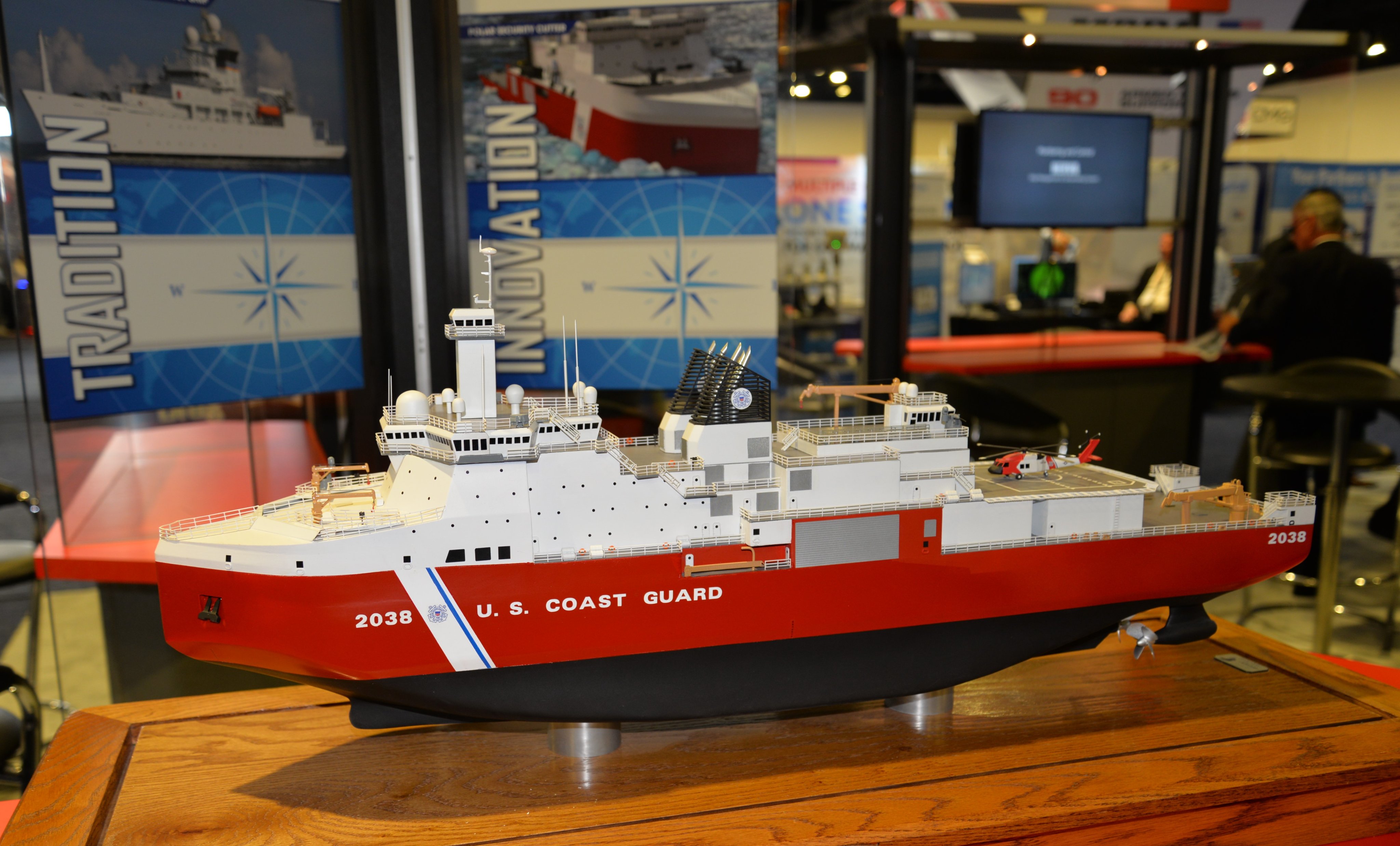
Photo of a model of Halter Marine’s Polar Security Cutter seen at Navy League’s Sea-Air-Space Exhibition have surfaced. Photo credit Chris Cavas.

National Defense reports,

“The commandant of the Coast Guard dashed hopes Jan. 12 that a much needed new icebreaker will be delivered any sooner than 2025.”

The projected delivery has already slipped a year to May 2025, but the Commandant’s remarks did not sound confident that there will be no further delays.

“The goal right now would be to continue to work with the Navy integrated project office, continue to work with the shipbuilder, finish up the complex detail design [work] and start cutting steel here in ’22,” Schultz said. “If we stay on that track line … I am guardedly optimistic we will take delivery of that ship in ‘25 and be off to the races.”

We are putting a lot on the crew of Polar Sea. They have been having extended yard periods away from home port every year. So far, they have met repeated challenges to keep the old girl running, but we cannot really expect our luck to hold.

“BAE Systems Delivers 50th Mk 110 Gun For U.S. Naval Operations” –Naval News

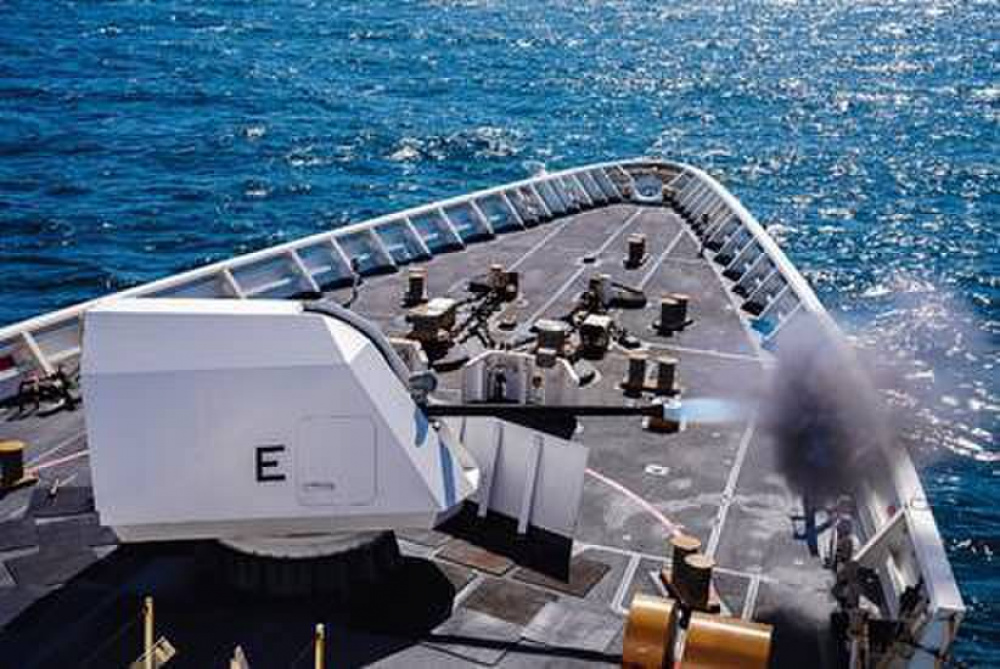
Coast Guard Cutter Stratton fires its MK 110 during a gunnery exercise in the Bering Sea April 28, 2021. Routine training and live-fire exercises provide opportunities to evaluate and improve procedures, test capabilities and maintain proficiency. U.S. Coast Guard photo courtesy Ensign Molly Dolan.

Naval News reports BAE has delivered their 50th 57 Mk110 gun system for use on US warships. In this case, that gun will go to a US Coast Guard Cutter, almost certainly OPC #3 or #4. Significantly the first US Mk110 installation was on USCGC Bertholf, commissioned Coast Guard Day, 2008, three months before the first Littoral Combat Ship, USS Freedom (now already decommission).

Fifty guns is really not a lot compared to the number of Oto Melara 76mm or the 5″ Mk 45, but it is on a lot of ships, and the fact that it is expected to equip 20 new FFGs and 25 OPCs in addition to, still yet to be delivered NSCs and LCSs, seems to guarantee long term US Navy interest in the system. Current plans call for a total of 87 ships equipped with the Mk110, 51 Navy and 36 Coast Guard (excluding the first four LCS which are being decommissioned).

We are seeing that interest in development of the ALaMO and MAD-FIRES rounds.

I still think, because of the Coast Guard’s missions and the lack of alternative anti-surface weapons on cutters, that our large cutter should have 5″ Mk45 weapon systems (even if only recycled 5″/54s).  After all, any improvements you could make to a 57mm round, you could also make to a 5″ (127mm) round, but it is encouraging to see new more capable and more accurate rounds being developed for the gun we do have.

“On the front lines against China, the US Coast Guard is taking on missions the US Navy can’t do” –Business Insider

US Coast Guard cutter Munro transits the Taiwan Strait with US Navy destroyer USS Kidd in August. US Navy

Business Insider reports on the increasing demand signal for Coast Guard assets in the Western Pacific and the necessary balancing act that results. They sum it up this way.

  • The US military has turned more of its attention to the Pacific amid competition with China.
  • The Coast Guard has been key, conducting missions other services aren’t equipped or allowed to do.
  • But it already has worldwide commitments, and higher demand in the Pacific could tax its resources.

None of this should come as a surprise to regular readers here, but it is a nice overview and there are some beautiful photos.

Perhaps more importantly these realities are being brought to a general audience.

Thanks to Mike B. for bringing this to my attention.

“Northrop looks to adapt electronic attack system for smaller ships” –Defense News

USS LSM-49 and USS LST-758 beached at Iwo Jima during the campaign to capture the island in February 1945. Photo Credit: Sandy Molenda for his father LT. Felix J. Molenda, USCG, Commanding Officer USS LST-758

Defense News reports,

Northrop Grumman is conducting research and development to adapt its electronic attack platform — built for the Arleigh Burke-class destroyer — to fit on smaller ships, a company official said.

“We’re also looking at opportunities to scale down the system for smaller ship classes — frigates and smaller — and looking at ways to make a scaled-down version of SEWIP that can be effectively employed and rapidly installed on the smaller ship classes,” Mike Meaney, vice president of land and maritime sensors at Northrop, told C4ISRNET.

Dealing with the Navy and defense contractors, you have to ask yourself what do they mean by “smaller?” Frigate and smaller could mean Littoral Combat Ships which are light on EW capability even compared to larger Coast Guard Cutters.

But I think they might also be considering application to the Light Amphibious Warfare (LAW) ships. These could be about the size of an Offshore Patrol Cutter, but they are expected to be simple and inexpensive, costing only about twice what the Coast Guard is paying for its Webber class Fast Response Cutters. In many ways these look like updates of the WWII Landing Ship Tank design. There is currently no intention to arm them with weapons that would protect against cruise missiles. Electronic Warfare might be their only organic defense against that threat.

Note there is currently no Navy program to build such systems, but if Northorp succeeds in getting Navy funding, it may offer a new EW capability for cutters.

Surface Navy Association, 34th National Symposium, 11-13 Jan. 2022

The crews of the Coast Guard Cutter Kimball (WMSL 756) and the USS Tulsa (LCS 16) conduct a passing exercise in the Pacific, April 3, 2021. The Kimball was underway conducting an expeditionary patrol which covered approximately 20,000 nautical miles. (U.S. Coast Guard photo courtesy of the Coast Guard Cutter Kimball)

The Surface Navy Association is holding their 34th National Symposium at the Hyatt Regency, Crystal City, January 11-13, 2022. The theme will be “The Competitive Edge.”

There does not seem to be too much Coast Guard specific content until Wednesday. The only Coast Guard representative I see on the schedule, prior to Wednesday is CMC Devin Spencer, USCG, Command Master Chief, Atlantic Area, scheduled for the Enlisted Roundtable on Tuesday, 0830-1015.

Wednesday, we have:

  • 0730-0850 Future of the Enlisted Sailor: A Leadership Conversation with MCPON Russ Smith, USN, Master Chief Petty Officer of the Navy and MCPOCG Jason Vanderhaden, USCG, Master Chief Petty Officer of the Coast Guard.
  • 1400 – 1450 Coast Guard Keynote with ADM Karl Schultz the Commandant.
  • 1500 – 1630 Coast Guard Cutterman’s Call, Moderators: VADM Steven Poulin, USCG, Commander, Coast Guard Atlantic Area (A) and MCPOCG Jason M. Vanderhaden, USCG, Master Chief Petty Officer of the Coast Guard

There should be lots of interesting exhibits.

Infrastructure Improvements

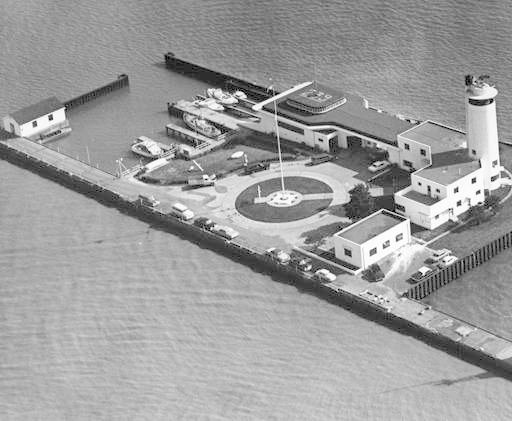
Historic former CG station on the mouth of the Cuyahoga River, at the end of a 1,000-foot pier.Photo: John Petkovic, The Plain Dealer

It looks like the Coast Guard starting to get a bit more money for infrastructure improvements.

I am not going to make a new post every time I see an announcement about an improvement, but I would like to start passing along any press releases, so I am going to use this post as a place to post them in the comments.