“Coast Guard Cutter Diligence returns to homeport after 60-day Eastern Pacific Ocean patrol” –News Release

PHOTOS AVAILABLE: Coast Guard Cutter Diligence returns to homeport after 60-day Eastern Pacific Ocean patrol

09Feb22 DILIGENCE conducting small boat training in the Eastern Pacific Ocean. (Credit: BM3 Cayne Wattigney)

Below is a D8 news release. Sounds like a pretty typical WMEC Eastern Pacific patrol, but I would point out something I think is a bit unusual–they carried no helicopter. Awning over the flight deck and no mention of HITRON in the news release. Was this because of H-65 availability or because adequate air support was available from land bases? Maybe some other difficulty? Without a helicopter there is no armed overwatch and no way to chase down boats that may be faster than ship’s boats.

Looks like they left homeport a few days before Christmas.


News Release

U.S. Coast Guard 8th District Heartland

Coast Guard Cutter Diligence returns to homeport after 60-day Eastern Pacific Ocean patrol

Coast Guard Cutter Diligence returns to homeport after 60-day Eastern Pacific Ocean patrol 2/2 Coast Guard Cutter Diligence returns to homeport after 60-day Eastern Pacific Ocean patrol

Editor’s Note: Click on images to download high-resolution version.

PENSACOLA, Fla. — The crew of Coast Guard Cutter Diligence returned to their homeport of Pensacola Sunday following a 60-day counter-drug patrol in Eastern Pacific Ocean.

Partnering with three other Coast Guard cutters, Diligence interdicted three suspected drug-smuggling vessels resulting in the apprehension of 12 detainees and the interdiction of more than 4,321 lbs of cocaine with a street value of approximately $82 million.

“Diligence’s crew demonstrated professionalism, resilience and perseverance while conducting complex high-speed boat pursuits in the drug transit zone,” said Cmdr. Jared Trusz, Diligence’s commanding officer. “I am honored to serve with and proud of the crew’s superlative efforts that directly support the United States national security interests.”

Numerous U.S. agencies from the Departments of Defense, Justice and Homeland Security cooperated in the effort to combat transnational organized crime. The Coast Guard, Navy, Customs and Border Protection, FBI, Drug Enforcement Administration, and Immigration and Customs Enforcement, along with allied and international partner agencies, play a role in counter-drug operations.

The fight against drug cartels in the Eastern Pacific Ocean requires unity of effort in all phases from detection, monitoring and interdictions, to criminal prosecutions by international partners and U.S. Attorneys’ Offices in districts across the nation. The law enforcement phase of counter-smuggling operations in the Eastern Pacific Ocean is conducted under the authority of the Coast Guard 11th District, headquartered in Alameda, California. The interdictions, including the actual boardings, are led and conducted by members of the U.S. Coast Guard. 

The Diligence is a 210-foot medium-endurance cutter homeported in Pensacola with78 crewmembers. The cutter’s primary missions are counter-drug operations, migrant interdiction, enforcing federal fishery laws and search and rescue in support of Coast Guard operations throughout the Western Hemisphere.

“State of the Coast Guard 2022” (Updated)

Vice Adm. Karl L. Schultz, commander, Coast Guard Atlantic Area, speaks at the Coast Guard Cutter Benjamin Dailey commissioning ceremony in Pascagoula, Miss. Coast Guard Photo

ADM K.L Schultz delivered his “State of the Coast Guard 2022” at Air Station Clearwater, today, 24 February 2022.

You can read the prepared speech here.

There is an awful lot in the 13 pages. Much of it deals with how the Coast Guard hopes to provide a better life for its members and their families. I will not attempt to summarize. I will mention a couple of revelations that I think may be new.

Three FRCs will be homeported in Tampa Bay with Sector Saint Petersburg. This will bring the final number of FRCs in the 7th District up to at least 23. We repeatedly see these little ships doing fisheries and drug and migrant interdiction missions in the waters off Florida, the Gulf of Mexico and the Caribbean that would have previously been performed by WMECs. This frees the larger cutters to perform missions in more demanding environments.

We have seen a growing tendency to group long range assets. Apparently, this will continue.

We’re developing geographic centers of gravity, creating more Coast Guard hubs like Portsmouth and Alameda… These new or improved operating hubs will be in  Charleston, Seattle, Pensacola, Los Angeles, and Newport, Rhode Island… These operating hubs will allow us to better support our operational assets, and to further support the geographic stability of our workforce.

To some extent these centers of gravity exploit infrastructure built by the Navy but now considered excess. This applies to at least Charleston, Pensacola, and Newport.

These “centers of gravity” suggests expansion or creation of additional Support Centers. It may also suggest where Offshore Patrol Cutters (OPCs) will be homeported. We already know at least two OPCs each are going to San Pedro (Los Angeles), Kodiak, and Newport. Alameda already has four National Security Cutters (NSC) and Charleston will have five when all are completed. Seattle will most certainly be the homeport for three Polar Security Cutters. This suggest that at least Portsmouth, Pensacola, Los Angeles, and Newport will host large numbers of OPCs, perhaps as many as six. If that were to be the case, it would mean 14 large patrol cutters in Pacific Area (6 NSCs and 8 OPCs) and 22 in Atlantic Area (5 NSCs and 17 OPCs).

That would be close to the historic split of resources, but recent developments, including the success of the FRCs and IUU concerns in the Pacific, suggest we may have more large ships in the Pacific, perhaps a third OPC in Kodiak and up to three in Seattle or more likely Honolulu. That would make the split 18 in PAC Area and 18 in LANT Area.

(Updated: Corrected number of NSCs in each area.)

“FRCSW VRT Supports USCG Ship Repairs” –Sea Waves

USCGC Legare (WMEC 912) as seen underway for Eastern Pacific patrol in late 2021. The Legare crew patrolled over 12,650 nautical miles through the heart of the Eastern Pacific Ocean in support of Campaign Martillo working in conjunction with Customs and Border Protection, the Drug Enforcement Administration, and other partnering nations. (U.S. Coast Guard photo by Petty Officer 3rd Class Trevor Hammack)

An interesting little post on the Coast Guard’s use of a Navy repair team, Fleet Readiness Center Southwest’s (FRCSW) Voyage Repair Team (VRT).

FRCSW’s VRT artisans repair at least one USCG vessel monthly. The next scheduled repair is in March to the USCG Legare (WMEC-912), also homeported at USCG Base Portsmouth.

“U.S. forges maritime technology collaborations to improve domain awareness” –Indo-Pacific Defense Forum

The Indo-Pacific Defense Forum brings us news of a Navy sponsored Maritime Domain Awareness program that may be very useful to the Coast Guard.

Recent successes include the U.S. Naval Research Laboratory’s (NRL’s) new program, called Proteus, to identify, query and filter maritime vessels based on user-defined criteria and the Defense Innovation Unit’s (DIU’s) international competition, known as xView3, to create machine learning models to locate and distinguish maritime vessels with synthetic aperture radar.

“Artificial intelligence combined with satellite imagery provides a new capability to detect suspected IUU fishing vessels that may otherwise elude U.S. and partner nations fisheries enforcement agencies. This increased maritime domain awareness can be shared with like-minded partner nations to enable them to protect their sovereignty.”

The NRL’s Proteus software, pictured, monitors sea vessels so stakeholders can “collaboratively discover and investigate suspicious and illegal maritime activity throughout the world in ways never before possible,” said Cameron Naron, the U.S. Maritime Administration’s maritime security director.

A description here by the US Naval Research Laboratory.

“PROTEUS is an exciting new U.S. government Maritime Domain Awareness (MDA) system providing a powerful array of MDA information and analysis tools,” said Cameron Naron, Director of Maritime Security, US Maritime Administration. “This system enables MDA stakeholders to collaboratively discover and investigate suspicious and illegal maritime activity throughout the world in ways never before possible.”

  • Additional actions supported by PROTEUS include: Counter Illegal, Unreported, and Unregulated Fishing (IUUF)
  • Maritime Protected Areas (MPAs)
  • Search and Rescue (SAR)
  • Critical Infrastructure Protection
  • Environmental Protection & Response
  • Maritime Law Enforcement
  • Counter smuggling (drugs, weapons, money, people)

This could be of assistance to any nation attempting to counter Illegal, Unregulated, Unreported fishing, including the island nations of the Western Pacific, who are desperately short on resources to monitor their ocean assets.

“Royal Bahamas Defence Force makes huge surge in migrant apprehensions” –The Watch

NorthCom’s online magazine, “The Watch,” reports,

The Royal Bahamas Defence Force (RBDF) announced that its migrant apprehensions increased dramatically in 2021 when compared with the previous year.

RBDF Commodore Raymond King said during a January 2022 news conference that detainments in the Bahamas increased by 456% in the past year, according to The Tribune, a Bahamian newspaper. King said the RBDF is faced with “people  smugglers” who are using more sophisticated methods to evade authorities.

This is really a success story with strong USCG involvement. There was also success reported in discouraging illegal fisheries poaching.

Related:

“MASTERING EXPEDITIONARY IUU FISHERIES ENFORCEMENT IN THE BAHAMAS” –CIMSEC

“U.S. upgrades Bahamas’ maritime security” –The Watch

Damen to Build New Patrol Boats for Bahamas

Indo-Pacific Strategy of the United States

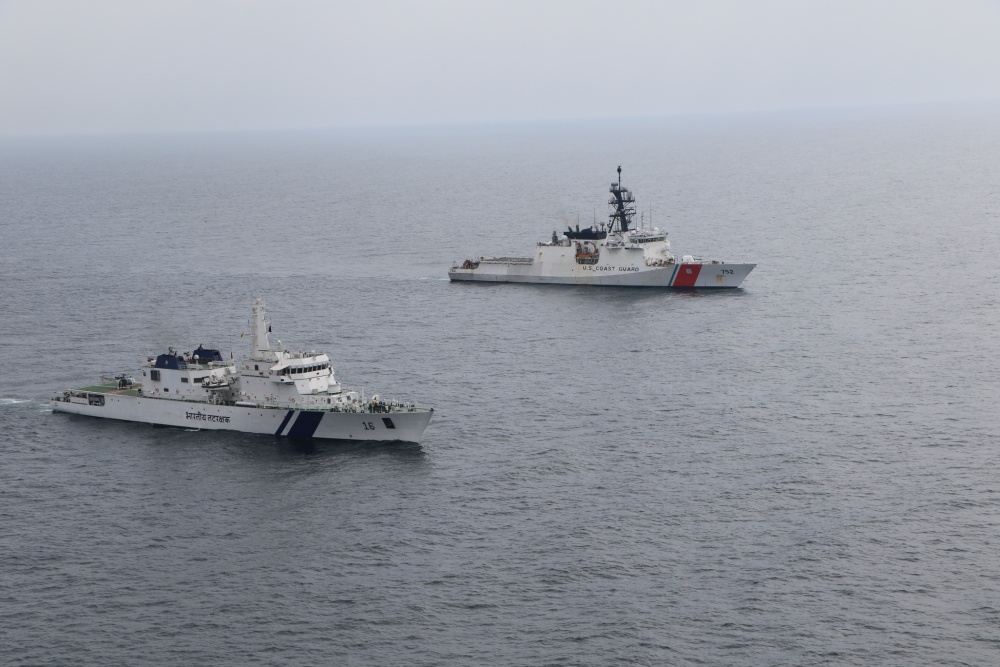
U.S. Coast Guard Cutter Munro and Japan Coast Guard Patrol Vessel Large Aso, transit together in formation during a maritime engagement in the East China Sea Aug. 25, 2021. U.S. Coast Guard members aboard the Munro deployed to the Western Pacific Ocean to strengthen alliances and partnerships and improve maritime governance and security in the region. (Photo courtesy of Japan Coast Guard)

The Whitehouse has issued a new Indo-Pacific Strategy, and it specifically mentions the US Coast Guard.

The document calls out China for its aggressive behavior,

This intensifying American focus is due in part to the fact that the Indo-Pacific faces mounting challenges, particularly from the PRC. The PRC is combining its economic, diplomatic, military, and technological might as it pursues a sphere of influence in the Indo-Pacific and seeks to become the world’s most influential power. The PRC’s coercion and aggression spans the globe, but it is most acute in the Indo-Pacific. From the economic coercion of Australia to the conflict along the Line of Actual Control with India to the growing pressure on Taiwan and bullying of neighbors in the East and South China Seas, our allies and partners in the region bear much of the cost of the PRC’s harmful behavior. In the process, the PRC is also undermining human rights and international law, including freedom of navigation, as well as other principles that have brought stability and prosperity to the Indo-Pacific.

It recognizes the value and values of our allies and partners,

For centuries, the United States and much of the world have viewed Asia too narrowly—as an arena of geopolitical competition. Today, Indo-Pacific nations are helping to define the very nature of the international order, and U.S. allies and partners around the world have a stake in its outcomes. Our approach, therefore, draws from and aligns with those of our closest friends. Like Japan, we believe that a successful Indo-Pacific vision must advance freedom and openness and offer “autonomy and options.” We support a strong India as a partner in this positive regional vision. Like Australia, we seek to maintain stability and reject coercive exercises of power. Like the ROK, we aim to promote regional security through capacity-building. Like ASEAN, we see Southeast Asia as central to the regional architecture. Like New Zealand and the United Kingdom, we seek to build resilience in the regional rules-based order. Like France, we recognize the strategic value of an increasing regional role for the European Union (EU). Much like the approach the EU has announced in its Strategy for Cooperation in the Indo-Pacific, American strategy will be principled, long-term, and anchored in democratic resilience.

It calls for action in five areas:

  1. ADVANCE A FREE AND OPEN INDO-PACIFIC
  2. BUILD CONNECTIONS WITHIN AND BEYOND THE REGION
  3. DRIVE REGIONAL PROSPERITY
  4. BOLSTER INDO-PACIFIC SECURITY
  5. BUILD REGIONAL RESILIENCE TO TRANSNATIONAL THREATS

There is mention of the Coast Guard is in the section “BOLSTER INDO-PACIFIC SECURITY” on page 13.

We will also innovate to meet civilian security challenges, expanding U.S. Coast Guard presence, training, and advising to bolster our partners’ capabilities. We will cooperate to address and prevent terrorism and violent extremism, including by identifying and monitoring foreign fighters traveling to the region, formulating options to mitigate online radicalization, and encouraging counterterrorism cooperation within the Indo-Pacific. And we will strengthen collective regional capabilities to prepare for and respond to environmental and natural disasters; natural, accidental, or deliberate biological threats; and the trafficking of weapons, drugs, and people. We will improve cybersecurity in the region, including the ability of our partners to protect against, recover from, and respond to cybersecurity incidents.

Coast Guard roles presumably extend beyond interdiction and fisheries to include assistance with intelligence, port security, and maritime industry cybersecurity.

The strategy refers to ten lines of effort that are to be pursued in the next 12 to 24 months. The first is “Drive New Resources to the Indo-Pacific” (p.15),

Building shared capacity requires the United States to make new regional investments. We will open new embassies and consulates, particularly in Southeast Asia and the Pacific Islands, and increase our strength in existing ones, intensifying our climate, health, security, and development work. We will expand U.S. Coast Guard presence and cooperation in Southeast and South Asia and the Pacific Islands, with a focus on advising, training, deployment, and capacity-building. We will refocus security assistance on the Indo-Pacific, including to build maritime capacity and maritime-domain awareness.

Sounds like this may include Coast Guard attachés attached to diplomatic staffs and possibly some new basing.

There is a second line of effort that will undoubtably involve the Coast Guard, “Partner to Build Resilience in the Pacific Islands” (p.17),

The United States will work with partners to establish a multilateral strategic grouping that supports Pacific Island countries as they build their capacity and resilience as secure, independent actors. Together, we will build climate resilience through the Pacific Region Infrastructure Facility; coordinate to meet the Pacific’s infrastructure gaps, especially on information and communications technology; facilitate transportation; and cooperate to improve maritime security to safeguard fisheries, build maritime-domain awareness, and improve training and advising. We will also prioritize finalization of the Compact of Free Association agreements with the Freely Associated States.

A Maritime Executive post, New U.S. Indo-Pacific Strategy Singles Out China’s “Coercion”, notes,

In the security arena, the new strategy reiterates that the United States has maintained “a strong and consistent defence presence necessary to support regional peace, security, stability, and prosperity”, pointing to the South China Sea and the East China Sea as a priority. However, it is interesting that while the document underscores the importance of freedom of navigation in the Indo-Pacific, not a single paragraph mentions the US Freedom of Navigation Operations Program (FONOPS) carried out by the US Navy, which has stirred controversy. Conversely, the strategy emphasises the importance of the Coast Guard to lead maritime security cooperation in the region, in “advising, training, deployment, and capacity-building … including to build maritime capacity and maritime-domain awareness”. Indeed, in 2021, the US Coast Guard announced a joint maritime training centre with the Indonesian Coast Guard in Batam.

The emphasis on coast guard cooperation can be seen as a positive gesture since it will be less provocative and sensitive compared to a military presence in the region. And more importantly, coast guard operations in Southeast Asia are very much required to tackle maritime security threats such as illegal fishing.

Thanks to Paul for bringing this to my attention. 

“MEDIA AVAILABILITY: Coast Guard Commandant to Deliver State of the Coast Guard Address”

Coast Guard Commandant Adm. Karl Schultz visits with Coast Guard crews stationed in New York City. U.S. Coast Guard photo illustration by Petty Officer 1st Class Jetta Disco.

Passing this along for those who may want to see it live. This announcement is aimed at providing information for the media and general public. An earlier announcement was aimed more toward active-duty members.

Media Advisory U.S. Coast Guard 7th District PA Detachment Tampa Bay


MEDIA AVAILABILITY: Coast Guard Commandant to Deliver State of the
Coast Guard Address

Editor’s Note: Media attending must wear a mask and have a COVID vaccine card or negative test within the
last three days.

WHO: Adm. Karl L. Schultz, commandant of the United States Coast Guard
WHEN: 1- 3:30 p.m., Thursday, Feb. 24, 2022.
WHERE: Coast Guard Air Station Clearwater, 15300 Fairchild Dr., Clearwater, FL 33701
WHAT: Media must RSVP at (305) 607-6347 or padettampabay@gmail.com no later than Tuesday, Feb. 22, at 4 p.m. A
government-issued identification and media credentials are required for access to Air Station Clearwater. Media should arrive no later than 12:30 p.m. to set up for the event.

CLEARWATER, Fla.— The commandant of the United States Coast Guard is scheduled to deliver his annual State of the Coast Guard Address, Thursday, at Coast Guard Air Station Clearwater. 

This event will be live-streamed at https://www.uscg.mil/alwaysready/ and on Facebook at https://Facebook.com/USCoastGuard at 1:00 p.m. EST/10:00 a.m. PST.

Adm. Karl L. Schultz will outline the Coast Guard’s role in a time of transformational change within the maritime domain. He will provide his vision for how the Service will respond to meet the Nation’s needs now and in the future. Adm. Schultz will accentuate the dedication and sacrifice of Coast Guard members stationed across the country and deployed around the world.
Adm. Schultz will further highlight the partnerships across the Department of Homeland Security organization, with the Department of Defense Joint Forces, inter-agencies and with our international partners that allow the Coast Guard to meet the demands of today and tomorrow.

Additionally, Adm. Schultz is expected to feature stories of Coast Guard women and men who excelled in crisis, rescued mariners in distress, interdicted illicit narcotics, and responded to the Haiti Earthquake.

Media unable to attend may request a Zoom link to join the media call after the event. 

Detailed Schedule of Events:

1 – 2 p.m.: State of the Coast Guard address
2:15 – 2:30 p.m.: Adm. Schultz will be available for media interviews
2:30 – 3:30 p.m.: Displays and tours of Coast Guard assets will be available
3:45 – 4 p.m.: Media hub call for those unable to attend the event in-person

For more breaking news follow us on Twitter and Facebook.

-USCG-

“CHINA COAST GUARD: ON A TRAJECTORY FOR PEACE OR CONFLICT?” –CIMSEC

CIMSEC brings us a post about the dramatic growth of the China Coast Guard and the emergence of its Gray Zone Operations.

I don’t think you will find anything surprising here. The value of the piece is that it presents the views of knowledgeable bystander, without a vested interest in the South China Sea controversy, The author, “LTC Ahmed Mujuthaba was the Principal Director of the Maldives National Defense Force Coast Guard.”