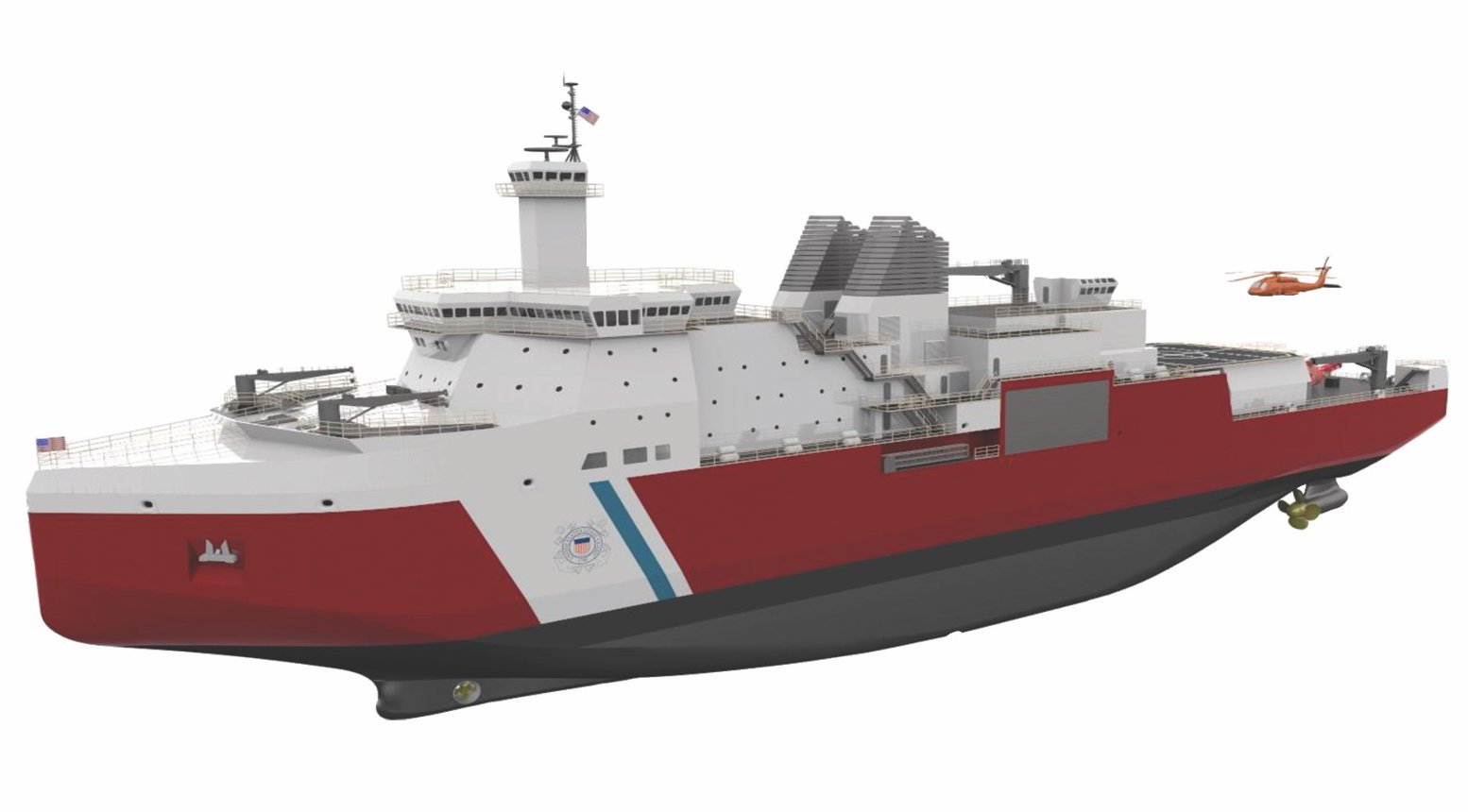
Contract Option for Second Polar Security Exercised

DOD reports a contract option for design and construction of the Second Polar Security Cutter has been exercised. Notably this is a Navy contract. Completion expected Sept. 2026.

VT Halter Marine Inc., Pascagoula, Mississippi, is awarded a $552,654,757 fixed-price incentive modification to previously awarded contract N00024-16-C-2210 to exercise an option for the detail design and construction of the second Coast Guard Polar Security Cutter. Work will be performed in Pascagoula, Mississippi (61%); Metairie, Louisiana (12%); New Orleans, Louisiana (12%); San Diego, California (4%); Mossville, Illinois (4%); Mobile, Alabama (2%); Boca Raton, Florida (2%); and other locations (3%), and is expected to be completed by September 2026. Fiscal 2021 procurement, construction, and improvement (Coast Guard) funds in the amount of 485,129,919 (80%); fiscal 2020 procurement, construction, and improvement (Coast Guard) funds in the amount of $100,000,000 (17%); and fiscal 2019 procurement, construction, and improvement (Coast Guard) funds in the amount of $20,000,000 (3%) will be obligated at time of award and will not expire at the end of the current fiscal year. The Naval Sea Systems Command, Washington, D.C., is the contracting activity.

Thanks to Paul for bringing this to my attention.

“This company’s drone set flight-time records. But what it really wants is more work with the Pentagon” –Defense News

A Vanilla ultra endurance land-launched unmanned aerial vehicle (UAV) operates during U.S. Pacific Fleet’s Unmanned Systems Integrated Battle Problem (UxS IBP) 21 at Naval Base Ventura County, Point Mugu, on April 24, 2021. UxS IBP 21 integrates manned and unmanned capabilities into challenging operational scenarios to generate warfighting advantages. (MC2 Michael Schutt/U.S. Navy)

Defense News report,

WASHINGTON — Small business Platform Aerospace continued to set records in 2021 with its Vanilla Unmanned family of drones, but the company says it’s working to ensure it’s building a relevant warfighting platform, not just an aerospace novelty.

The Vanilla UAV in its long-endurance configuration set a world record in September and into October, when it flew for eight days, 50 minutes and 47 seconds out of Edwards Air Force Base in California. The aircraft had previously demonstrated a five-day flight.

We talked about this UAS, from veteran-owned small business Platform Aerospace, when it set the earlier record. Since then, there have been some significant developments including a drug interdiction capability test with SOUTHCOM.

“… in July with U.S. Southern Command. The vehicle flew out of Key West with a mesh radio, satellite communications, a radar pod and an electro-optical/infrared camera, demonstrating what a multi-day drone with a complex payload package could accomplish.”

There is also this mention of a sensor, that might be applied to other UAS, that could come in handy for icebreakers.

“While the bulk of Platform Aero’s work has been with the military, and chiefly the Navy, Pappianou said the aircraft flew a mission with a proprietary radar designed by the University of Kansas to measure snow and ice depths in the Arctic Circle.”

“First Images Of New Inlay Class Warship For Myanmar Navy” –Covert Shores

Myanmar UMS Inlay (54), 12 March 2018, Indian Navy Photo

Covert Shores reports sighting of a second Inlay class, a locally built offshore patrol vessel. This prompted a look at this class and the Myanmar Navy, which turns out to be surprisingly strong, with an apparently capable domestic shipbuilding capability.

Myanmar seems to have been in the news a lot lately, and it has not been “good news.” Like many other nations in Asia, particularly SE Asia, they have been building Offshore Patrol Vessels. Reportedly the Myanmar Coast Guard was established only months ago, in Oct. 2021, but it appears these OPVs will serve with their Navy. Myanmar Coast Guard floating units appear to be limited to four very old patrol boats.

Reportedly these Inlay class Offshore Patrol Vessels displace 1500 tons, but I suspect that is not their full load displacement. They are similar in size to the 1.800 ton 270 foot WMECs, slightly shorter, 265’9′ (81 meters vs 82.3) and a bit broader of beam (41′ vs 38’/12.5 vs 11.6 meters). Speed is essentially the same at 20 knots. The bridge does seem surprisingly large.

Reportedly the Myanmar vessels can hangar a Eurocopter AS365 Dauphin, that is essential the same as an H-65. Also, reportedly there is a launch ramp for a RIB in the stern. There might be a boat davit on the starboard side, but I have not seen a good photo of the starboard side. There is a large opening on the starboard side superstructure aft, that mirrors the one visible on the port side.

Apparently, the weapon forward of the bridge is a Soviet era twin 57mm. The weapon might be ancient, but it is probably still very effective at short ranges.

The Myanmar Navy is more impressive than I would have expected, and many of their ships are built locally. As noted in the headline post, they just got their second submarine, one Russian built via India and now one from China. They have a 12,400 ton S. Korean built LPD. They are building their fourth domestically built frigate, to add to two overage Chinese built frigates. They have three domestically built 1,100 ton corvettes. They have twenty vessels similar in size to the Webber class but much more heavily armed, including five armed with Anti-Ship Cruise Missiles, and two slightly larger, 500 ton Fast Attack Craft also armed with ASCMs. These are in addition to six older Chinese built Houxin class missile boats.

All total, they appear to have 21 surface combatants armed with Anti-Ship Cruise Missiles, primarily the Chinese made C-802, which is roughly equivalent to the US made Harpoon.

Myanmar has also begun to build 600 ton, 63 meter, high speed “sub chasers” to replace eight, now overage, Chinese built Hainan class. The new ships are equipped with the same twin 57mm mount that also equips the new OPVs.


“MOL’s fuel saving PBCF sets Guinness World Record” –Marine Log

PBCF installed on a propeller

Marine Log reports,

Mitsui O.S.K. Lines, Ltd. (MOL) reports that the propeller boss cap fin (PBCF) sold by its group company MOL Techno-Trade, Ltd. has been certified as the “Best-selling Energy-Saving Ship Appendage Brand (Cumulative)” by Guinness World Records and received an official certificate on December 23, 2021.

On sale since 1987, the PBCF was the first device in the world to be commercialized to recover the energy wasted in the vortex that forms behind a rotating propeller and increase the thrust by breaking up this vortex. Analysis has shown that equipping a vessel with PBCF results in energy savings of 3% to 5%.

Such a device would not have much effect on speed, but it might improve range and fuel economy.

Old Fleet vs New Fleet, by the Ton, Revisited

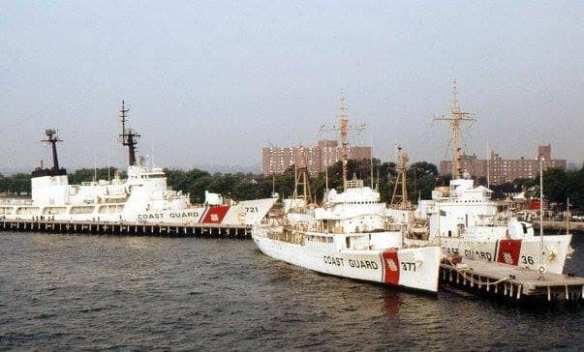
USCGC Gallatin WHEC -721 (378), USCGC Rockaway WHEC-377 (311), and USCGC Spencer WHEC-36 (327) moored at Governor’s Island, New York

Back in 2012, I did a little comparison between the Cutter Acquisition Program of Record and the Fleet it would nominally replace. Full replacement is still many years away (about 2038), but we do know a lot more now, than we did at that time, so here is an update.

The Benchmark Fleet: The fleet of 2000/2001 looked like this (displacement in tons full load, comparing only the larger patrol vessels):

Class       Displacement x Number = Total Displacement
378s          3050 tons      x      12    =     36,600 tons
270s          1780 tons      x      13     =    23,140 tons
210s          1050 tons       x      16    =    16,800 tons
Alex Haley 2929 tons     x         1     =      2,929 tons
Storis         1916 tons     x         1     =      1,916 tons
Acushnet   1746 tons     x         1     =      1,746 tons
110s            155 tons     x        49     =      7,595 tons

Total                                     93 vessels, 90,726 tons

(Three 180 foot WLBs of about 1,000 tons each, that had been converted to WMECs were also decommissioned about this time.)

The Fleet Today: Threre are perhaps as many as 27 Island class WPBs still in commission. At least 22 of the original 49 are no longer in USCG service. There are probably considerably fewer than 27 active USCG Island class. I would guess about 19 remain.

Looking only at the Webber class and larger cutters:

Class       Displacement x Number = Total Displacement
NSC          4500 tons       x        8      =  36,000 tons
270s          1780 tons       x      13      =  23,140 tons
210s          1050 tons       x      14      =  14,700 tons
Alex Haley 2929 tons       x       1       =    2,929 tons
FRC             353 tons       x      45      =  15,885 tons

Total                                     81 vessels, 92,654 tons

To this we might add however many 110s are still available, reportedly 15 vessels totaling 2,325 tons, so 96 vessels, 94,979 tons.

We are down to 36 large patrol cutters (=>1,000 tons full load), the same number expected to make up the future fleet, but they are individually less capable, and fewer than the 40 plus the Coast Guard has historically generally employed since WWII.

Looking back at my old Janes Fighting Ships and Combat Fleets of the World, the number of large patrol cutters were: 44 (82/83), 48 (86/87), 48 (90/91), 44 (2000/01), 39 (2013).

Fortunately, the Webber class have proven capable of performing some missions that previously would have been performed by larger cutters.

The Future Fleet (2038): 

Class       Displacement x Number = Total Displacement

NSC        4500 tons      x    11       =       49,500 tons
OPC        4500 tons      x    25       =     112,500 tons
FRC           353 tons      x   64       =       22,592 tons

Total                                  100 vessels, 184,592 tons

Implications: 

We will end up with more ships if the current plan is completed. In 2012 I expected the total displacement of the replacement fleet would exceed the displacement of the benchmark fleet by 34.44%, instead it is up an additional 65,618 tons, more than doubling displacement of the fleet in 2000. Only 15,618 tons of the increase was due to the three additional NSCs and six additional FRCs. Most of the increase was due to the surprisingly high displacement of the OPCs.

The large cutters (NSCs and OPCs) will be much more capable than those they replace, particularly compared to the 210s. They will handle rough weather better. Crews will be more comfortable and better rested, which can translate into better performance. In most respects, not only the NSCs, but also the OPCs, are more capable than the 378s.

The larger, more capable cutters will require larger, more expensive support facilities, more dock space, deeper berths, and larger dry docks for maintenance.

We have seen a tendency to base groups of the same class ships together. We will see fewer instances of ports with only one cutter homeported there. Fewer ports will be home to large cutters.

The fleet will still be much smaller than the last Fleet Mix analysis indicated it needed to be, to meet all the Coast Guard’s statutory obligations. Those obligations still seem to be growing.

36 ships, no matter how capable, are still only 36 ships. I still see a need for Cutter X, a simple but seaworthy ship of 1,500 to 2,500 tons that can be procured in quantity.

“A Sea Service Gone Ashore” –USNI

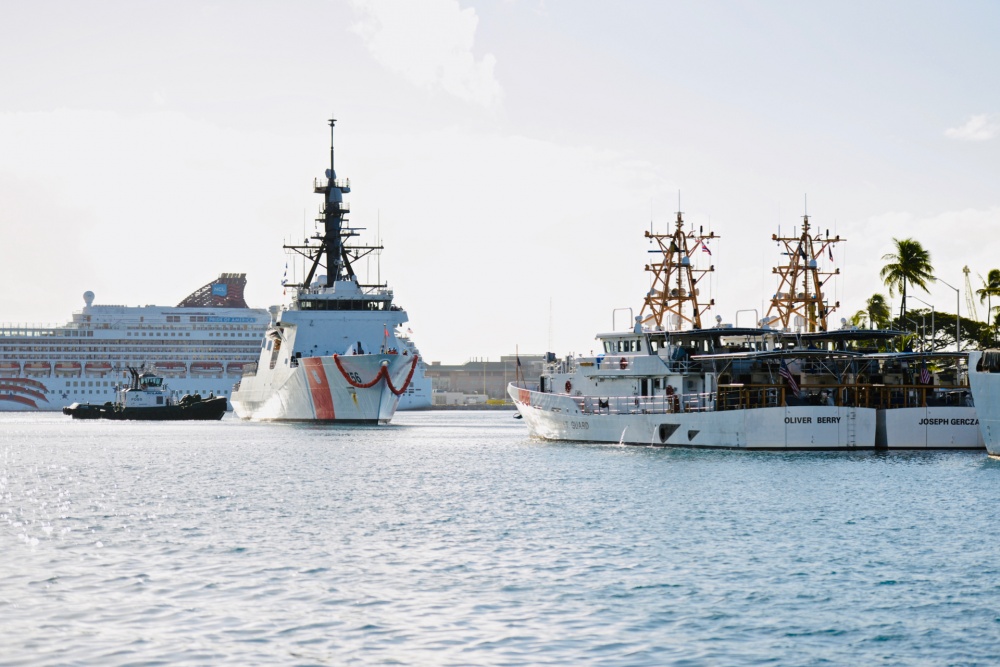
The crew of USCGC Kimball (WMSL 756) arrive in Honolulu for the first time Dec. 22, 2018. Known as the Legend-class, NSCs are designed to be the flagships of the Coast Guard’s fleet, capable of executing the most challenging national security missions, including support to U.S. combatant commanders. (U.S. Coast Guard photo by Chief Petty Officer Sara Muir/Released)

The US Naval Institute Proceedings’ December issue includes an article by LCdr. Karen Love Kutkiewicz, USCG, discussing the problems of motivating people toward sea duty, both now and in the future, when sea duty billets are expected to constitute a higher percentage of Coast Guard personnel.

The article has a couple charts that are particularly interesting. The first shows the growth in cutter billets and associated direct support.

The fleet has had some ups and downs and while we may be seeing a percentage rise currently, I suspect that there were periods in the past, when the Coast Guard was even smaller, when seagoing billets were at a higher percentage than currently projected for 2037 (really more like 2039 now). When I reported to the Academy in 1965, we had 36 WHECs and several icebreakers.

Still looking at the recent past, since we are adding both afloat billets and direct support billets, which will be in large part billets that require seagoing experience, while the rest of the service remains essentially stable, this does look like a substantial change in the overall percentage of coasties going to sea.

The second showing the assignment year 2021 command slots to be filled and number of applicants.

I would not think it surprising that there is more competition for Command Ashore positions because, while only officers with an afloat background compete for Command Afloat, those same officers, as well as essentially the rest of the officer corps, compete for command ashore billets, and at the O3/O4 level there are very few command ashore billets. Looking at the O3/O4 Afloat Command line, are 91 applicants for 53 positions adequately competitive? Could be.

The post seems to be most concerned about O3/O4 command billets, but really, I see more of a problem in motivating personnel to fill department head and XO billets in the O3-O5 level. Will they ever get a shot at command afloat when up against those who were given early command?

This is not the first article bemoaning the loss of sea going experience.

Apparently one thing we have done, is open O3 command billets to Warrant Officers. Maybe, if we are not doing so already, we should consider opening O3 department head billets to Warrants as well.

Something else we might do, is reorganize at least some support functions into squadron commands, staffed by experienced seagoing personnel, including post-command squadron commanders. These commands (Area commands for the largest ships and District commands for WPC and WPBs) could mentor the ships’ COs and crews. In addition, they would be in an excellent position, to make fair evaluations of their performance. Additionally, they could be the source to fill short term shortages in essential billets.

To keep things in perspective. I would note that, while the Coast Guard has only about an eighth of the number of active-duty military personnel as the Navy, the Coast Guard has almost as many military command afloat billets (excluding Military Sealift vessels commanded by civilians), and far more at a junior level.

“US Navy Seizes Weapons from Fishing Vessel in the Arabian Sea” –DVIDS

U.S. Navy Seizes 1,400 Assault Rifles During Illicit Weapons Interdiction

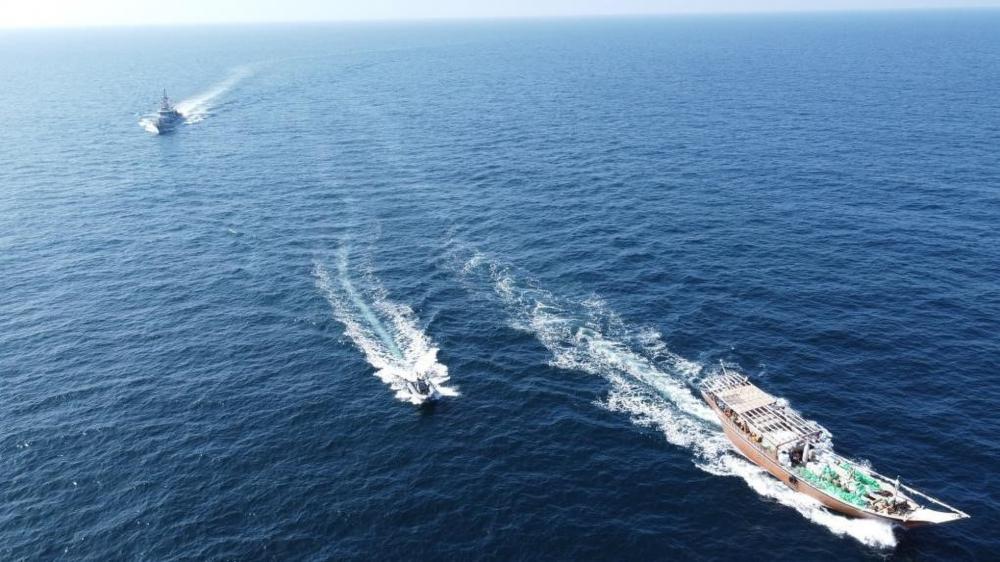
NORTH ARABIAN SEA (Dec. 20, 2021) U.S. service members from patrol coastal ship USS Typhoon (PC 5) interdict a stateless fishing vessel carrying illicit weapons while transiting international waters in the North Arabian Sea, Dec. 20. (U.S. Navy photo)

Below is a press release from Defense Visual Information Distribution Service (DVIDS). The boarding team was apparently Coast Guard. It’s likely the Webber class WPCs assigned to PATFORSWA will be doing this sort of work since the Navy PCs are being decommissioned.


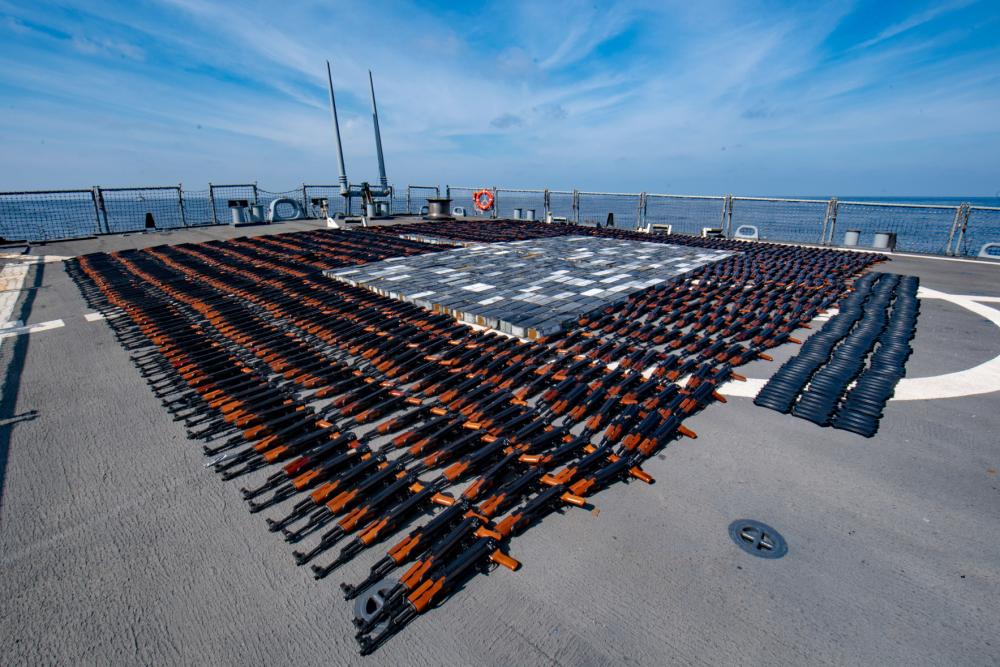
U.S. 5th Fleet ships seized approximately 1,400 AK-47 assault rifles and 226,600 rounds of ammunition from a stateless fishing vessel during a flag verification boarding in accordance with customary international law in the North Arabian Sea, Dec. 20.

U.S. Navy patrol coastal ships USS Tempest (PC 2) and USS Typhoon (PC 5) found the weapons during a search conducted by embarked U.S. Coast Guard personnel. The illicit weapons and ammunition were later transported to guided-missile destroyer USS O’Kane (DDG 77) where they await final disposition.

The stateless vessel was assessed to have originated in Iran and transited international waters along a route historically used to traffic weapons unlawfully to the Houthis in Yemen. The direct or indirect supply, sale or transfer of weapons to the Houthis violates U.N. Security Council Resolutions and U.S. sanctions.

The vessel’s five crew members identified themselves as Yemeni nationals and will be returned to Yemen.

After removing the crew and illicit cargo, U.S. naval forces determined the stateless vessel was a hazard to navigation for commercial shipping and sank it.

U.S. naval forces regularly perform maritime security operations in the Middle East to ensure the free flow of legitimate trade and to disrupt the transport of illicit cargo that often funds terrorism and other unlawful activity. U.S. Navy warships operating in the U.S. 5th Fleet region have seized approximately 8,700 illicit weapons in 2021.

Guided-missile cruiser USS Monterey (CG 61) seized dozens of advanced Russian-made anti-tank guided missiles, thousands of Chinese Type 56 assault rifles, and hundreds of PKM machine guns, sniper rifles and rocket-propelled grenade launchers from a stateless vessel transiting the North Arabian Sea in May.

In February, guided-missile destroyer USS Winston S. Churchill (DDG 81) seized a cache of weapons off the coast of Somalia, including thousands of AK-47 assault rifles, light machine guns, heavy sniper rifles, rocket-propelled grenade launchers and crew served weapons. The inventory also included barrels, stocks, optical scopes and weapon systems.

The U.S. 5th Fleet area of operations encompasses approximately 2.5 million square miles of water area and includes the Arabian Gulf, Gulf of Oman, Red Sea, parts of the Indian Ocean and three critical choke points at the Strait of Hormuz, Suez Canal and Strait of Bab al Mandeb.

U.S. Navy Seizes 1,400 Assault Rifles During Illicit Weapons Interdiction

NORTH ARABIAN SEA (Dec. 21, 2021) Illicit weapons seized from a stateless fishing vessel in the North Arabian Sea are arranged for inventory aboard guided-missile destroyer USS O’Kane’s (DDG 77) flight deck, Dec. 21. (U.S. Navy photo by Mass Communication Specialist Seaman Elisha Smith)

Cutters Albacore (WPB-87309), Cochito (WPD-87329), and Gannet (WPB-87334) Transferred to Uruguay

Russian Vyborg Shipyard laid the Purga ice class coastguard ship of project 23550 925 001

Navy of Uruguay to accept three Protector Class vessels as part of a grant from the United States Coast Guard as part of the Uruguayan Navy’s Fleet Modernization plan (Picture source U.S. Embassy of Uruguay)

Navy Recognition reports,

“According to information published by the U.S. Embassy in Uruguay, On December 15, 2021, Admiral Jorge Wilson, Commander of the Uruguayan Navy, signed a Letter of Acceptance (LOA) finalizing the government-to-government agreement between the United States and Uruguay, allowing Uruguay to accept three Protector-Class patrol vessels as part of a grant from the United States Coast Guard as part of the Uruguayan Navy’s Fleet Modernization plan.”

“China Transferring Navy Type 056 Corvettes To The Coast Guard” –Naval News

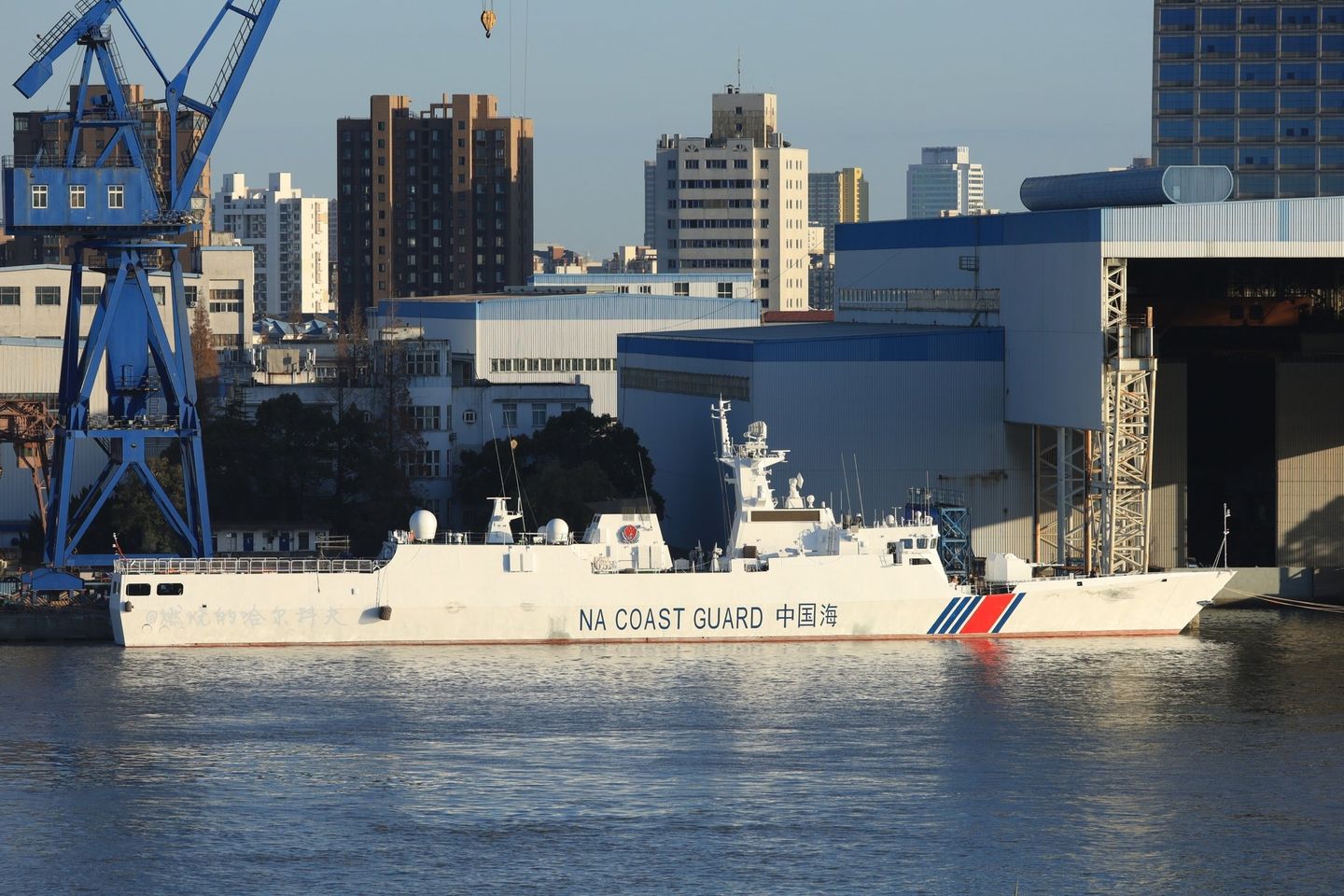
An ex-PLAN Type 056 corvette undergoing conversion for Coast Guard duties.

I reported transfer of 22 Type 056 covettes from the PLA Navy to the China Coast Guard back in November and discussed the implications, but now we have a better photograph and some commentary from Naval News.

The air-search radar, radar fire control, and 76mm gun remain. The ship is now equipped with fire-fighting monitors where the anti-ship cruise missiles were previously installed amidships, on the O-1 deck, above the letter “U” in GUARD.

For the first time, looking at the photo, I realized these ships are armed with an autocannon, I was not familiar with, the 30mm H/PJ-17, a single barrel optionally manned system, that is mounted on the O-1 deck aft of the bridge and below the fire control radar. As can be seen in the photo below, the bulwark can swing down to allow the gun to depress to a greater angle. This may have been in order to fire at targets at close range, or it may have been to allow the gun to continue to follow a target even when the ship is experiencing heavy rolls. I have not been able to find out much about these weapons.

Chinese H/PJ-17 30mm

Information on the Yinhe Incident referred to in the Naval News report is here.