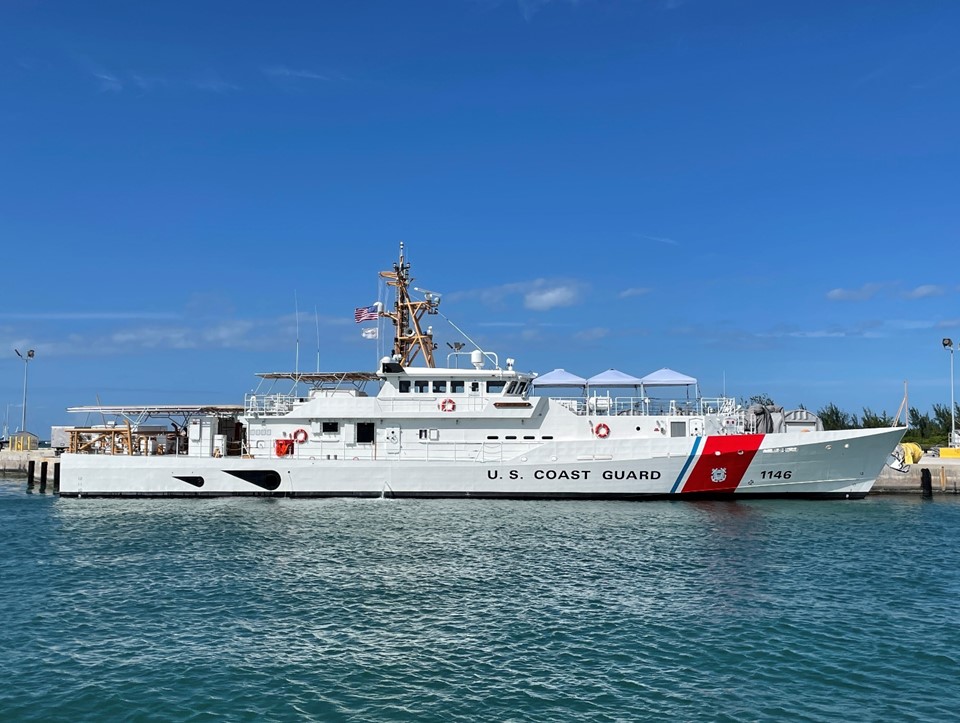
11 Island Class WPBs have been transferred to foreign partner nations, 15 Continue USCG Service

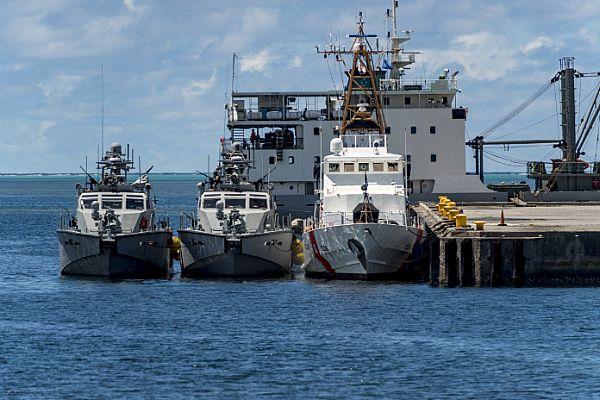
COLONIA, Yap (July 4, 2019) The U.S. Coast Guard Island-class patrol boat USCGC Kiska and Mark VI patrol boats assigned to Coastal Riverine Squadron (CRS) 2, Coastal Riverine Group 1, Detachment Guam, moored in the Micronesia port of Yap. CRG 1, Det. Guam’s visit to Yap, and engagement with the People of Federated States of Micronesia underscores the U.S. Navy’s commitment to partners in the region. The Mark VI patrol boat is an integral part of the expeditionary forces support to 7th Fleet, capability of supporting myriad of missions throughout the Indo-Pacific. (U.S. Navy photo by Mass Communication Specialist 2nd Class Jasen Moreno-Garcia/Released)

In the photo above we see the former USCGC Kiska in an earlier life. Foreign military sales and transfer of excess property seem to be a growing Coast Guard mission. This does to some extent justify earlier recapitalization than might otherwise be the case. It is part of our attempt to build capacity in like minded partners’ navies and coast guards.

Coast Guard celebrates completion of training as part of cutter transfer to Ukraine
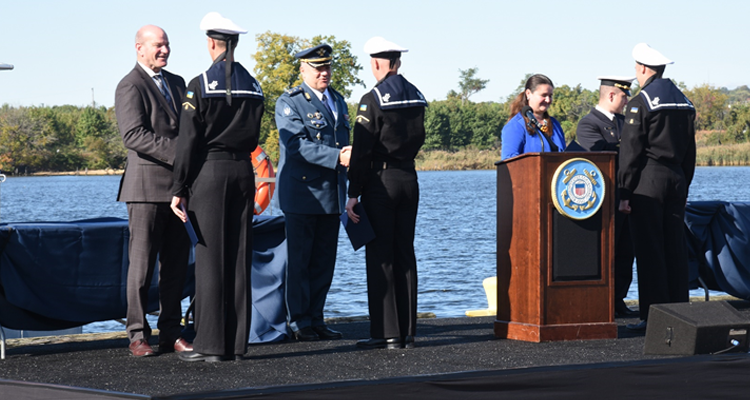
Members of the Ukrainian Navy receive congratulations following completion of Coast Guard training to operate and maintain a 110-foot Island Class patrol boat. These crewmembers will serve on Kubrak, the former Coast Guard Cutter Kiska, which will be delivered to Ukraine in early 2022. U.S. Coast Guard photo.


The Coast Guard Office of International Acquisition recognized 16 members of the Ukrainian Navy in a ceremony Oct. 22, 2021, at Coast Guard Yard in Baltimore. The Ukrainian crew just completed a rigorous six-week training program as part of the transfer of a 110-foot Island Class patrol boat to Ukraine.

The Coast Guard Cutter Transition Division Training Team helped the Ukrainian crew master the art of damage control, engineering maintenance, ship handling and watchstanding on Kubrak, which is the former Coast Guard Cutter Kiska. The Coast Guard officially transferred the title of the ex-Kiska Oct. 23, 2020. Since the title transfer, the cutter has been undergoing maintenance and upgrade work at Coast Guard Yard.

Kiska is the fifth patrol boat to be transferred to Ukraine under the Coast Guard Excess Defense Articles Program. Two cutters (ex-Drummond and ex-Cushing) were delivered to Ukraine in 2019, and two cutters (ex-Ocracoke and ex-Washington) will be transported to Ukraine later this month. Delivery of Kubrak to Ukraine is anticipated in early January 2022.

During its service as a Coast Guard cutter, the ex-Kiska was homeported in Hilo, Hawaii, and Apra Harbor, Guam, with primary missions of search and rescue, counter-drug activities and homeland security in addition to patrolling international and territorial waters as a humanitarian, law enforcement and Department of Homeland Security asset.

The ex-Kiska is the 11th 110-foot patrol boat transferred to a foreign partner nation; other patrol boats have been transferred to Pakistan, Georgia and Costa Rica. Congress has authorized transfer of two additional boats to Ukraine in fiscal year 2022. Recipients of former Coast Guard assets are determined by an interagency committee, led by the State Department.

Each 110-foot patrol boat transfer saves the Coast Guard money in remediation and disposal costs and helps build and sustain international maritime partnerships that foster greater global maritime security. One of the United States’ goals in this transfer is to help equip Ukraine with the means to project national sovereignty.

Coast Guard 110-foot patrol boats entered service in the mid-1980s; 15 of the 49 cutters originally in the class remain in service. The ships are being replaced with 64 154-foot fast response cutters, 45 of which are in service.

“Coast Guard Cutter Kimball returns to homeport after patrol in Bering Sea and Arctic” –D14

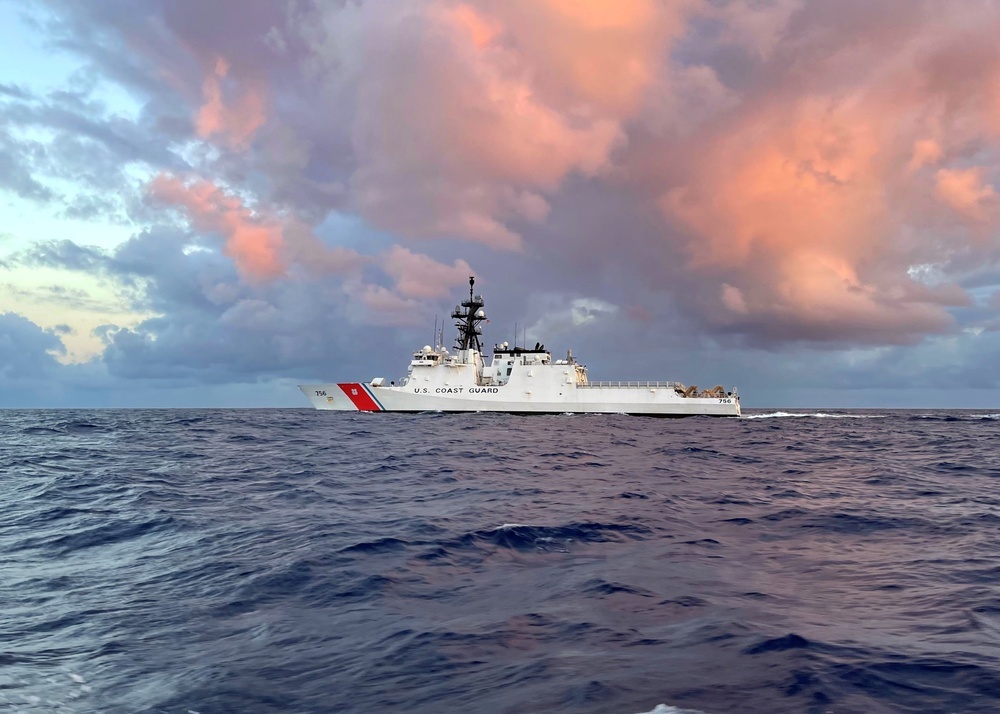
The crews of the Coast Guard Cutter Kimball (WMSL 756) and the USS Tulsa (LCS 16) conduct a passing exercise in the Pacific, April 3, 2021. The Kimball was underway conducting an expeditionary patrol which covered approximately 20,000 nautical miles. (U.S. Coast Guard photo courtesy of the Coast Guard Cutter Kimball)

USCGC Kimball seems to have had an unusual ALPAT (Alaska Patrol). They got up into the Chukchi Sea North of the Bering Strait that separates Alaska from Russian Siberia, interacted with vessels of our Canadian and Japanese allies, and shadowed Chinese warships transiting in the US EEZ off the Aleutians.

It may seem odd sending a Hawaii based cutter to Alaska, but Oahu is almost exactly due South of Kodiak. It is only about 520 nautical miles further away than Alameda, the only other Pacific base for Bertholf class cutters.

united states coast guard

News Release

U.S. Coast Guard 14th District Hawaii and the Pacific
Contact: 14th District Public Affairs
Office: (808) 535-3230

Coast Guard Cutter Kimball returns to homeport after patrol in Bering Sea and Arctic

Kimball

Editors’ Note: Click on stock image to download a high-resolution version.

JUNEAU, Alaska – The crew of Coast Guard Cutter Kimball returned to homeport in Honolulu, Hawaii Thursday following a 66-day patrol in the Bering and Chukchi Seas.

The crew traveled nearly 13,000 nautical miles since departing Honolulu Aug. 21, including through the Bering Strait and into the Arctic Ocean. With Arctic sea ice melting, these distant travels are important in helping the U.S. Coast Guard conduct a range of operations in the high latitudes as fish stocks and maritime traffic moves north.

The Kimball crew conducted 18 targeted living marine resources boardings; the most a national security cutter has completed during a single patrol in the 17th District area of responsibility.

“These law enforcement boardings maximized our presence in the Bering Sea,” said Petty Officer 1st Class Samuel Cintron, Kimball lead law enforcement petty officer. “Each boarding team member was instrumental to the success of the operation and reinforced the Coast Guard’s position on protecting national security and domestic fisheries.”

More than 65 percent of fish caught in the United States is harvested from Alaskan waters, generating more than $13.9 billion annually.

The Kimball crew conducted at-sea drills with key maritime partners including the Royal Canadian Naval Ship Harry DeWolf and Japanese Maritime Self-Defense Force training vessel Kashima. In each instance, the ships operated alongside one another and exchanged visual communications, followed by honors. This display of maritime cooperation and mutual respect emphasizes the United States’, Canada’s, and Japan’s continued commitment to one another and to partnership at sea.

During the deployment, Kimball crew observed four ships from the People’s Liberation Army Navy (PLAN) operating as close as 46 miles off the Aleutian Island coast. While the PLAN ships were within the U.S. exclusive economic zone, they followed international laws and norms and at no point entered U.S. territorial waters. All interactions between the Kimball and PLAN were in accordance with international standards set forth in the Western Pacific Naval Symposium’s Code for Unplanned Encounters at Sea and Convention on the International Regulations for Preventing Collisions at Sea.

The Kimball crew conducted astern refueling at sea with Coast Guard Cutter Oliver Berry, a fast response cutter also homeported in Honolulu. This capability significantly extends the operational range of FRCs.

Commissioned in 2019, Kimball is the Coast Guard’s seventh national security cutter.  These assets are 418-feet-long, 54-feet-wide and have a displacement of 4,600 long-tons. With a range of 13,000 nautical miles, the advanced technologies of this class are designed to support the national objective to maintain the security of America’s maritime boundaries and provide long range search and rescue capabilities.

For breaking news follow us on twitter @USCGHawaiiPac

“Autonomous vessels can help the Coast Guard safeguard our waters” –Work Boat

S&T, USCG, Ocean Aero, CNSP, NRL, ARL, HSSEDI, and USM’s evaluation team monitors a Triton autonomous vessel during performance testing. DHS photo. Note here the mast is folded down. 

Work Boat has a short report from DHS’s Science and Technology Directorate about experiments with an unmanned system.

First, its good to see the Department supporting R&D efforts on behalf of the Coast Guard, because the Coast Guard R&D budget is miniscule.

Second, this unmanned surface system is a bit unique, in that it is submersible, unlike the SeaDrones that the Coast Guard had previously experimented with. It is not primarily expected to operate underwater, because it is powered by wind and solar, but it does have the capability to submerge.

There are already several autonomous vessels in the field utilized for both commercial and military applications. However, the Tritons are a unique technology. At 14 feet long, they are the size of a small rowboat—making them easy to deploy from any port or USCG vessel. They are environmentally friendly and rely solely on wind and solar power at sea. The Tritons’ solar arrays are positioned atop their hulls, along with retractable 8-foot wind sails—both designed to charge the Tritons’ batteries whenever they are on the surface of the ocean. The Tritons also perform surface and underwater surveillance activities; navigate while submerged; dive to about 100 feet; and accommodate state-of-the-art sensor packages that utilize electro-optical and infrared cameras, sonar, and other specialized sensors. All of these characteristics and abilities make them useful for long-term USCG maritime protection and law enforcement operations at sea.

The ability to submerge opens up some interesting options. This might be used to avoid collision. It might be used to sample the water column. It might be used to put acoustic sensors below the surface layer. Or it might be used to take a closer look at mine-like objects below the surface.

Thanks to Paul for bring this to my attention. 

“Ecuadorian Navy Sailing Ship Interdicts Drug Smugglers in the Pacific” –USNI

Ecuadorian Navy Sailing Ship Interdicts Drug Smugglers in the Pacific

The US Naval Institute news service reports,

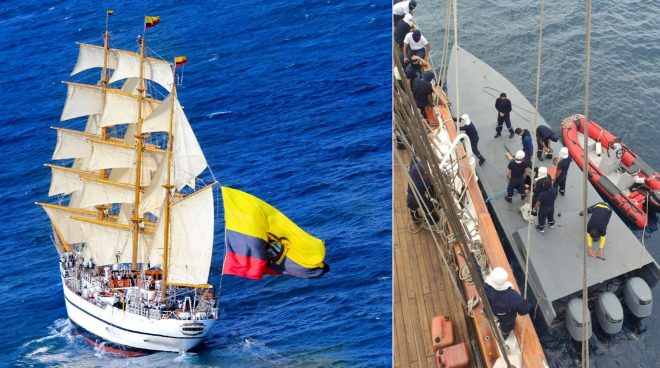
A three-masted training ship interdicted a drug-laden high-speed smuggling vessel off the coast of Colombia on Friday, the Ecuadorian Navy announced.

Sailing ship BAE Guayas caught the low-profile vessel within the 200-nautical miles of the Colombian exclusive economic zone, the service announced.

Maybe we should put Eagle to work.

“Ukraine to receive 3 more Island-class patrol boats from the U.S.” –Naval Post

180201-N-TB177-0211
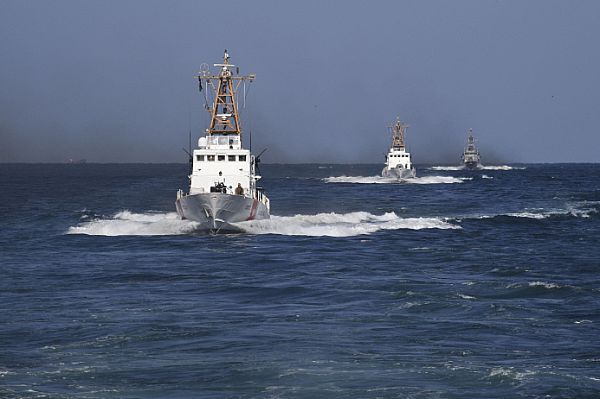
U.S. 5TH FLEET AREA OF OPERATIONS (Feb. 1, 2018) Island-class patrol boats USCGC Wrangell (WPB 1332), left, USCGC Aquidneck (WPB 1309), middle, and coastal patrol ship USS Firebolt (PC 10) patrol the open seas. Wrangell, Aquidneck and Firebolt are forward deployed to the U.S. 5th Fleet area of operations in support of maritime security operations to reassure allies and partners and preserve the freedom of navigation and the free flow of commerce in the region. (U.S. Navy photo by Mass Communication Specialist 2nd Class Kevin J. Steinberg/Released)

Naval Post reports,

According to Ukraine’s Washington Ambassador’s statements on Friday, the U.S. will hand over three Island-class patrol boats to Ukraine in November.

Thanks to Nicky for bringing this to my attention. 

“NIGERIA RECORDS LOWEST LEVEL OF PIRACY SINCE 1994” –Baird Maritime

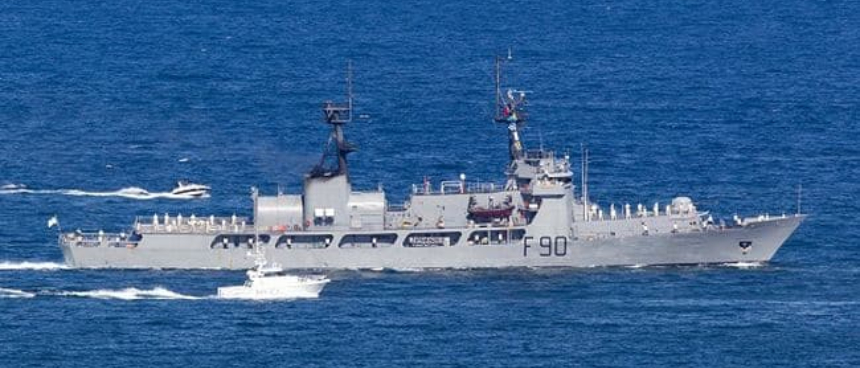
The Nigerian Navy frigate NNS Thunder, former USCGC Chase (Photo: International Chamber of Shipping)

Baird Maritime gives us some good news out of Nigeria,

The trend of reduction in piracy and armed robbery in Nigerian waters has continued, with the International Maritime Bureau (IMB) reporting in its third quarter 2021 account a 77 per cent decrease in the first nine months of the year, compared to the same period last year.

Nigeria reported four incidents in the first nine months of 2021, in comparison to 17 in 2020 and 41 in 2018. This represents a 77 per cent decrease in incidents between 2021 and 2020, and a 95 per cent reduction from 2018. The IMB also reported a 39 per cent reduction in piracy and armed robbery incidents in the Gulf of Guinea.

I think perhaps the US Coast Guard may have had something to do with this. They now have two former USCG WHECs, Chase and Gallatin, transferred in 2011 and 2014 respectively. USCGC Thetis was there in 2019 for Exercise Obangame Express. Coast Guard teams also operated from Navy vessels.

Cat 4 Hurricane, No Problem, Bollinger Delivers USCGC John Scheuerman Ahead of Schedule

USCGC John Scheuerman in Key West, Florida.

Below is a lightly edited Bollinger news release. The battle in which John Scheuerman lost his life, was the Invasion of Solerno. If you read the link I provided, you can see that the Luftwaffe response was so intense, it caused the naval task force commander shift his flag to a less conspicuous ship, USS Biscayne, a ship that would later serve as USCGC Dexter.


BOLLINGER SHIPYARDS DELIVERS 46th FAST RESPONSE CUTTER AHEAD OF SCHEDULE DESPITE DIRECT HIT FROM HURRICANE IDA 

LOCKPORT, La., – (October 21, 2021) – Bollinger Shipyards LLC (“Bollinger”) has delivered the newest Sentinel-class Fast Response Cutter (“FRC”), the USCGC John Scheuerman, to the U.S. Coast Guard in Key West, Florida nearly one week ahead of schedule despite a three week shutdown due to the significant damage sustained to Bollinger’s facilities during Hurricane Ida. The storm made landfall in late August near Port Fourchon, Louisiana as a powerful Category 4 storm. Bollinger’s facilities in Port Fourchon, Lockport, Houma and Larose suffered significant damage as a result of Hurricane Ida, which tied with last year’s Hurricane Laura and the Last Island Hurricane of 1856 as the strongest on record in Louisiana.

“While every delivery is meaningful, being able to deliver this vessel nearly a week early despite everything our crew has faced over the past month is nothing short of remarkable,” said Bollinger President & CEO Ben Bordelon. “We had folks who lost everything in that storm. Our yard where we build the FRCs took a beating and was shuttered for three weeks while we rebuilt. This vessel and this delivery is a win our folks really needed and it reflects the resilience, commitment and tenacity of the 650 skilled men and women that built it.”

On September 24th, following an extensive multi‐week recovery and rebuilding effort, Bollinger welcomed employees back to all 11 of its facilities across Louisiana. Bollinger’s Lockport facility is home to the FRC program, which directly supports 650 jobs. The USCGC John Scheuerman departed Lockport on Monday, October 11th for Bollinger’s Fourchon facility where it performed a shakedown excercise prior to dry docking for final inspection in preparation of its delivery. The Cutter departed Fourchon for Key West, FL on Sunday, October 17th. The USCGC John Scheuerman is the 169th vessel Bollinger has delivered to the U.S. Coast Guard over a 35-year period and the 46th FRC delivered under the current program. The USCGC John Scheuerman is the fifth of six FRCs to be home-ported in Manama, Bahrain, which will replace the aging 110’ Island Class Patrol Boats, built by Bollinger Shipyards 30 years ago, supporting the Patrol Forces Southwest Asia (PATFORSWA), the U.S. Coast Guard’s largest overseas presence outside the United States.

U.S. Coast Guard Commandant Adm. Karl Schultz has previously lauded the “enhanced seakeeping capabilities” of the PATFORSWA-bound FRCs, saying the ships are going to be “game changing” in their new theater of operations. Last week, at the commissioning ceremony for the USCGC Emlen Tunnell—another Bahrain-based FRC—Adm. Schultz noted that these ships will “conduct maritime security operations, theater cooperation efforts, and strengthen partner nations’ maritime capabilities to promote security and stability in the region, as well as thwart the increasingly aggressive and dangerous maritime activities of the Iranian Revolutionary Guard Corps.” He went on to say that these FRCs are “a perfect complement to the capabilities of both the Navy and Marine Corps. United, we bring a range of maritime capabilities to employ across the cooperation-competition-lethality continuum.”

PATFORSWA is composed of six cutters, shoreside support personnel, and the Maritime Engagement Team. The unit’s mission is to train, organize, equip, support and deploy combat-ready Coast Guard Forces in support of U.S. Central Command and national security objectives. PATFORSWA works with Naval Forces Central Command in furthering their goals to conduct persistent maritime operations to forward U.S. interests, deter and counter disruptive countries, defeat violent extremism and strengthen partner nations’ maritime capabilities in order to promote a secure maritime environment.

Each FRC is named for an enlisted Coast Guard hero who distinguished themselves in the line of duty. John Scheuerman, Seaman First Class, United States Coast Guard Reserve was posthumously presented the Silver Star Medal for service as set forth in the following citation:  “For conspicuous gallantry and intrepidity in action while serving on board the U.S.S. LCI (L) 319 during the amphibious invasion of Italy, September 9, 1943.  Observing an enemy fighter plane diving in for a strafing attack as his vessel approached the assault beaches in the Gulf of Salerno, SCHEUERMAN unhesitatingly manned his battle station at an exposed antiaircraft gun and, with cool courage and aggressive determination, exerted every effort to direct accurate gunfire against the hostile aircraft.  Although mortally wounded before he could deliver effective fire, he remained steadfast at his post in the face of imminent death, thereby contributing materially to the protection of his ship against further attack.  SCHEUERMAN’s fearless action, great personal valor and selfless devotion to duty under extremely perilous conditions were in keeping with the highest traditions of the United States Naval Service.” Scheuerman also posthumously received the Purple Heart Medal.

“Eastern Shipbuilding opens new C5I integration facility for offshore patrol cutter” –Defense News

Eastern Shipbuilding Group is on contract to build the first four offshore patrol cutters for the U.S. Coast Guard and is competing for the contract for the rest of the class. The first ship, Argus, is in construction and expected to deliver by the end of 2022. (Eastern Shipbuilding Group photo)

Defense News reports,

PANAMA CITY, Fla. — Eastern Shipbuilding Group, Northrop Grumman and their industry partners formally opened a test and integration center this week for the C5I systems at the heart of the U.S. Coast Guard’s new offshore patrol cutter program.

This OPC production facility is meant to reduce risk on what the Coast Guard calls its top acquisition priority. Within mockups of the bridge, the operations center and other key rooms, every piece of internal and external sensing and communications equipment will be networked together in this facility at Eastern’s Allanton yard first, tested for any integration hiccups and then sent up the road to the company’s Nelson Street yard where the OPC hulls are being constructed.

Northrop Grumman Vice President for Maritime Systems and Integration Todd Leavitt told Defense News this C5I system — command, control, communications, computers, cyber, intelligence, surveillance and reconnaissance — is more complex than even the Consolidated Afloat Networks and Enterprise Services (CANES) program the company worked on for the U.S. Navy.

That is only a small part of the report which includes information about the ship’s internal communications system. A shoreside facility is a great idea. It will likely eliminate post delivery teething problems that can be expensive and delay deployment.

We really need these ships to work right out of the box.