“Coast Guard cutter returns home following Western Pacific deployment” –News Release

Coast Guard Cutter Munro (WMSL 755) crewmember Petty Officer 2nd Class Kurt Chlebek, a boatswains mate, is greeted by his dog after Munro returned to their homeport in Alameda, California, Oct. 20, 2021, following a 102-day, 22,000 nautical mile multi-mission deployment. Munro’s crew departed Alameda in July for a Western Pacific patrol and operated in support of United States Indo-Pacific Command, which oversees military operations in the region. U.S. Coast Guard photo by Chief Petty Officer Matt Masaschi.

Wrap-up of USCGC Munro’s recent deployment to the Western Pacific.

united states coast guard

News Release

Oct. 20, 2021
U.S. Coast Guard Pacific Area

Coast Guard cutter returns home following Western Pacific deployment

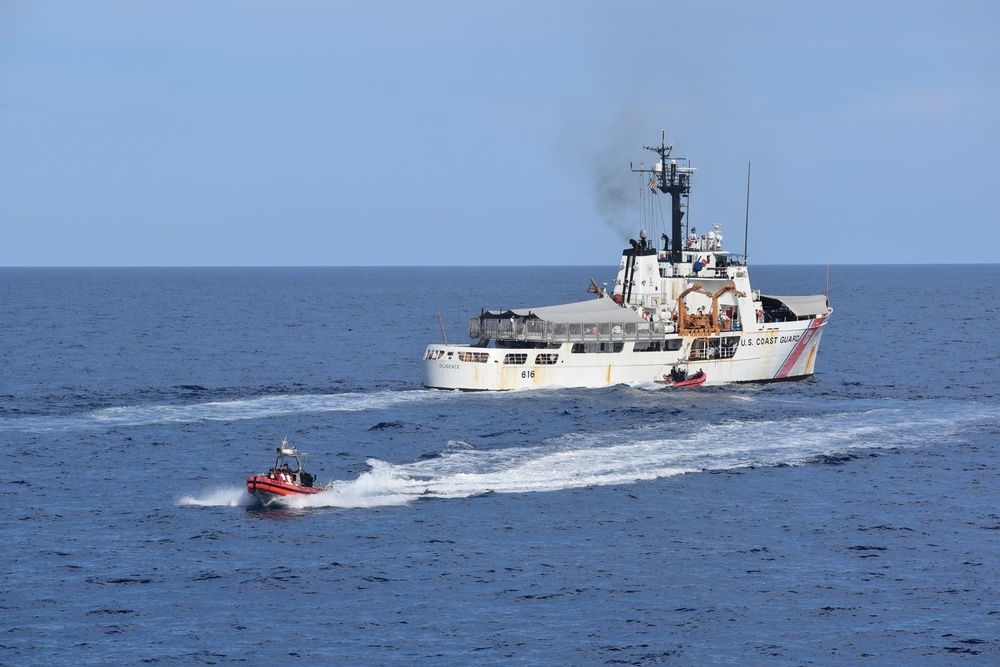
Photo of U.S. and Japan Coast Guard vessels
Coast Guard Cutter Munro crew returns home following 102-day, 22,000 nautical mile multi-mission Western Pacific deployment Coast Guard Cutter Munro crew returns home following 102-day, 22,000 nautical mile multi-mission Western Pacific deployment

Editors’ Note: Click on images to download high resolution versions.

Alameda, Calif. – The U.S. Coast Guard Cutter Munro (WMSL 755) and crew returned to their Alameda homeport Wednesday following a 102-day, 22,000-nautical-mile deployment to the Western Pacific.

Munro departed Alameda in July to the Western Pacific to operate under the tactical control of U.S. Navy 7th Fleet to promote a free and open Indo-Pacific.

“Munro’s deployment demonstrated the Coast Guard’s unique authorities in support of the Indo-Pacific command,” said Vice Adm. Michael F. McAllister, commander Coast Guard Pacific Area. “Joint operations help strengthen our partnerships through search and rescue, law enforcement, marine environmental response and other areas of mutual interest which preserve a stable and secure global maritime environment.”

Munro’s crew executed numerous cooperative engagements, professional exchanges and capacity building efforts with naval allies and partners, including the Japan Coast Guard, Japan Maritime Self Defense Force, Philippine Coast Guard and Bureau of Fisheries and Aquatic ResourcesRoyal Australian Navy, and Indonesia Maritime Security Agency.

“Our relationships in the Western Pacific are stronger today, and our partners are unified in their commitment to security,” said Capt. Blake Novak, commanding officer of Munro. “It was an incredible opportunity for our crew to participate alongside allies, sharing search and rescue and law enforcement concepts to promote peace, prosperity, and the sovereign rights of all nations.”

As both a federal law enforcement agency and an armed force, the U.S. Coast Guard is uniquely positioned to conduct defense operations in support of combatant commanders on all seven continents. The service routinely provides forces in joint military operations worldwide, including the deployment of cutters, boats, aircraft, and deployable specialized forces.

Munro is one of four 418-foot national security cutters homeported in Alameda. National security cutters like Munro feature advanced command and control capabilities, aviation support facilities, stern cutter boat launch, and increased endurance for long-range patrols, enabling the crews to disrupt threats to national security further offshore.

Photos from the Munro’s deployment are available here.

Deploying Lifeboat, A New Capability for European Maritime Safety Agency Drones –Naval News

Naval News reports,

“TEKEVER has signed a new contract with the European Maritime Safety Agency for maritime surveillance by remotely piloted aircrafts. This innovative contract includes the deployment of lifeboats and many new sensors.”

I have to wonder if the capability is worth the trade-off? Most UAVs are weight constrained. To carry an inflatable boat would mean either less fuel or fewer sensors. Is this a capability that will be carried at all times, or is it an option to be loaded when needed? How often is this needed? Coast Guard aircraft frequently drop pumps, but I don’t remember hearing of their dropping life boats recently. In the European environment this may have something to do with the influx of migrants using unseaworthy craft.

The UAV they are using appears large in the photo, but it is actually smaller than the MQ-1 Predator. “The AR5 “has a maximum take-off weight of 180kg. It can reach a cruising speed of 100km/h with an endurance of 20 hours,” and has a SATCOM capability. A 20 hour endurance is good, but a 100 km/h (54 knot) cruise is relatively low.

On the other hand, they at least have a shore based UAS capability, something the US Coast Guard still does not have.

“SEA Completes Successful Trials Of KraitArray In The English Channel” –Naval News

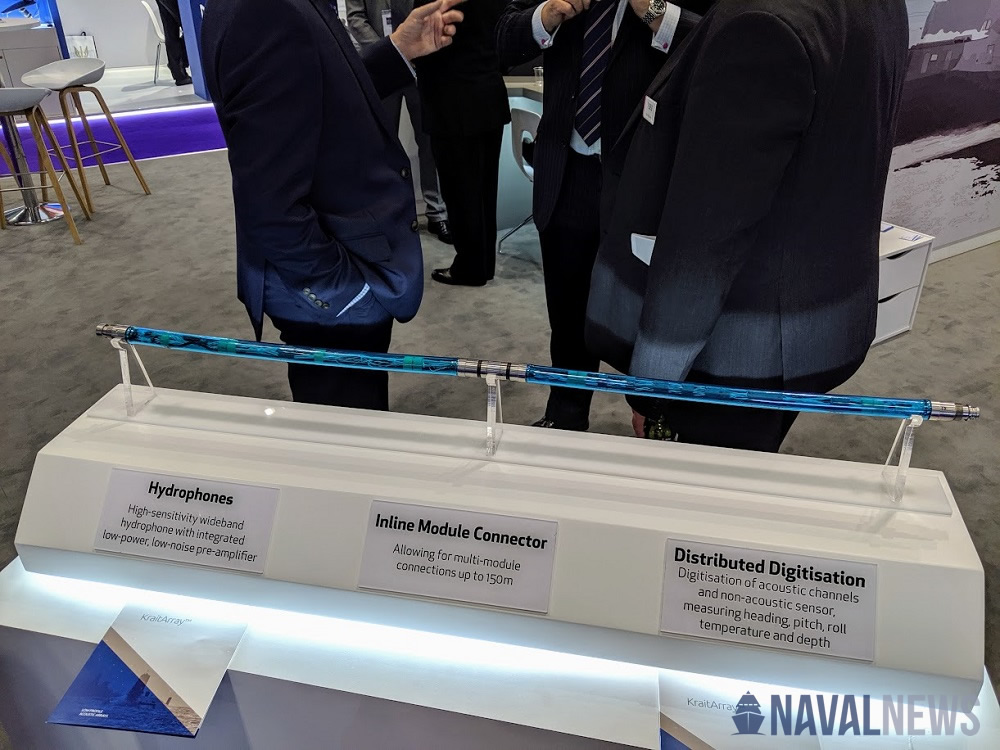
KraitArray (actual size) on SEA stand at DSEI 2019

Naval News reports,

“SEA, the UK’s defence and security electronic system specialist, has completed successful trials of its anti-submarine warfare (ASW) thin line towed array, KraitArray, in the English Channel – proving its exceptional sensing performance in small vessels.”

This seems to be another example of an ASW system being marketed for unmanned vessels that might also be used on cutters if the need should arise.

The company’s brochure does in fact specifically mention patrol craft and OPVs that are unable to accommodate full size towed arrays. In addition to the towed array, they also make active sonar systems, acoustic decoys, and light weight torpedo launchers.

A towed array might also be a good way to search for low profile smuggling vessels that have a minimal visual and radar cross section.

Coast Guard Commissions USCGC Emlen Tunnell (WPC-1145)

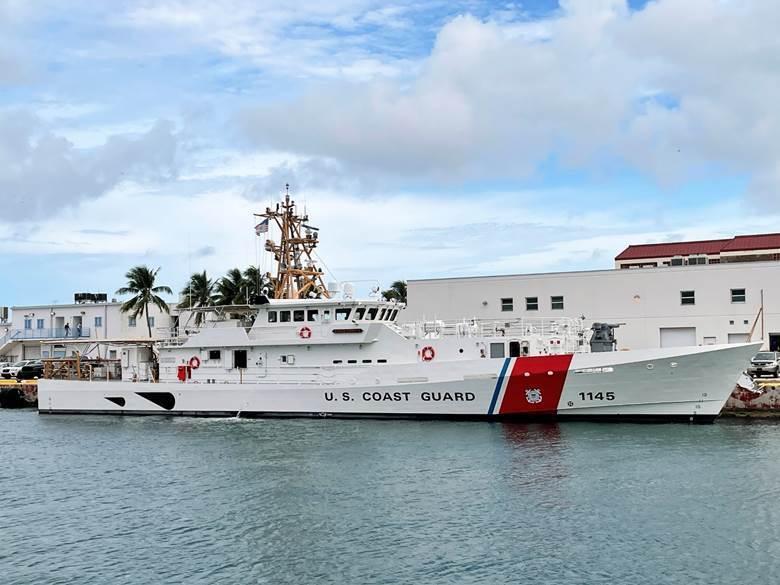
USCGC Emlen Tunnell in Key West, Florida.

Port News reports the commissioning of the 45th Webber class WPC. The commissioning was widely reported, but I found it interesting that a Russian news outlet would take note, including reporting on Tunnell’s football career. Other report here, here, and here.

Later this year, USCGC Emlen Tunnell will join her sister-ship USCGC Glen Harris (WPC 1144) and voyage to Bahrain as the second of three pairs of FRCs to replace the Island class cutter of Patrol Force South West Asia (PATFOSWA). Like the previous transit, the pair are likely to take the opportunity to conduct some training and joint operations along the way. Presumably there will also be a National Security Cutter along to provide support and also show the flag, conduct exercises, and build capacity.

“Iranian navy will be equipped with anti-ship missiles ranging 2,000 km in the near future” –Navy Recognition

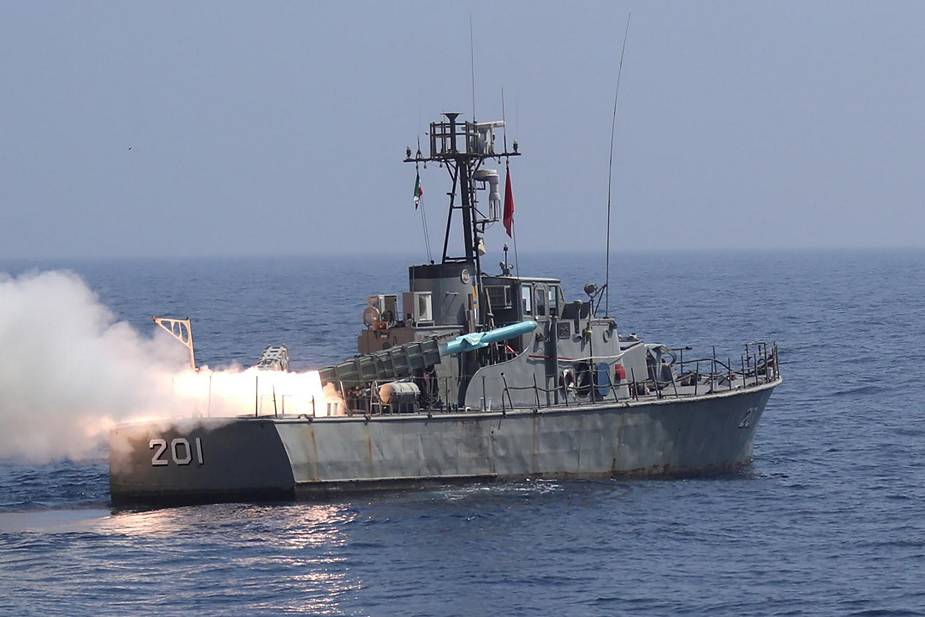
Original caption “Iran’s Revolutionary Guards fired long-range ballistic missiles into the Indian Ocean during a military exercise in January 2021.” (Picture source Egypt Independent) This is actually an anti-ship cruise missile. 

Had to post a link to this Navy Recognition post because I wanted to pass along the photo above, that accompanied it.

Lots of old timers will recognize the boat as the same class as the USCG 95 foot Cape class that were replaced by the 110 foot Island class. The US built a number of these for export. Four were given to Iran in the mid 50s. There were similar vessels derived from the design that followed. Iran got some of these as well.

For more information on the Iranian Navy and the Islamic Revolutionary Guard Corps Navy link here.

Shelter for Migrants

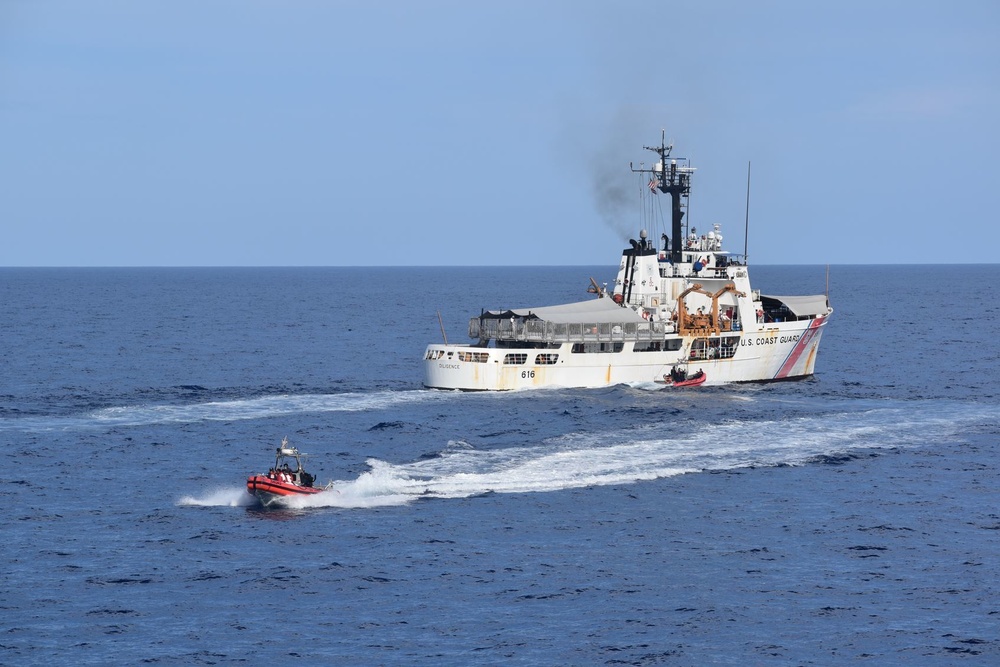
RESOLUTE conducts an at-sea transfer with CGC DILIGENCE. The transfer included a 77 Haitian migrants, their personal belongings, and a Creole interpreter. In total, RESOLUTE cared for 260 Haitian migrants. All migrants are given food, water, and medical attention once onboard a Coast Guard cutter. During a 56-day patrol, RESOLUTE provided overt presence in Northern Haiti to deter illegal and dangerous migration voyages. Photo by ENS Alex Cordes.

The photo above came with the press release below. I don’t normally publish these routine patrol reports, but I wanted to publish the picture to illustrate how the Coast Guard is sheltering large numbers of migrants on small cutters. You can see the awnings fore and aft. The migrants are sheltered there.

This does mean the cutter cannot operate a helicopter or its Mk38 gun mount. Access to sanitary facilities is limited.

united states coast guard

News Release  U.S. Coast Guard 7th District PA Detachment Tampa Bay


Coast Guard cutter Resolute returns home from 56-day deployment

Resolute conducts an at-sea transfer with Cutter Diligence.

Editor’s Note: Click on the images to download high resolution versions

ST. PETERSBURG, Fla. — The crew of Coast Guard Cutter Resolute returns home to St. Petersburg, Florida, Saturday, following a successful 56-day Joint Interagency Task Force-South (JIATF-S) and Coast Guard District Seven (D7) Patrol in the Caribbean Sea.

During the patrol, Resolute interdicted multiple suspected smugglers on a go-fast vessel obtaining 279.5 kilograms of cocaine, and rescued 260 Haitian migrants.

 Resolute, with the assistance from a Customs and Border Patrol (CBP) maritime patrol aircraft, tracked and pursued a drug smuggling vessel for eight hours, culminating in a successful intercept and seizure. The suspected smugglers were detained and later transferred for case disposition in the United States.

Due to increased political instability in Haiti, Resolute’s tasking shifted to Alien Migration Interdiction Operations in the Windward Pass; specifically to overtly patrol and discourage unsafe maritime migration voyages. On Sept. 24, Resolute conducted one of the largest single-unit repatriations into Cap Haitien, Haiti in recent history. Small-boat crews conducted 78 consecutive transfers safely returning all 260 migrants and their personal belongings back to Haitian authorities.   

On Sept. 22, Resolute interdicted an overcrowded sail freighter with 183 Haitian migrants including 17 children and infants aboard. Bound for the United States, the 55-foot vessel was dangerously overloaded and lacked sufficient navigation and safety equipment to make the journey. All 183 migrants were transferred safely to the cutter where they were provided food, water, shelter, and medical attention. In less than 24-hours, Resolute received an additional 77 migrants from another Coast Guard asset, raising the total count to 260.

“The migrant interdiction mission is always unique; while the migrants are attempting to escape the poor living conditions in Haiti, their unsafe voyages risk the lives of innocent people, including children,” said Petty Officer 1st Class Joseph Wooley, a maritime enforcement specialist. “It is unfortunate to see, but it makes us feel good knowing that we potentially saved 183 people from capsizing and drowning at sea.”

After a long and successful patrol, the crew is eager to return home and spend the holiday season with friends, family and loved ones.

“The crew’s actions during this patrol were heroic and inspiring. I am especially impressed with their professional dexterity and ability to shift from counter-drug operations to humanitarian missions in a moment’s notice, embracing our service motto: Semper Paratus-Always Ready,” said Cmdr. Justin Vanden Heuvel, commanding officer of Resolute.

Resolute is a 210-foot Reliance class cutter and has a crew of 72. Resolute was commissioned on December 8, 1966, and is homeported St. Petersburg, Florida.

For more information about Resolute’s patrol, please contact our Public Affairs Officer, Ensign Alex Cordes at

Alexander.N.Cordes@uscg.mil or visit our website at https://www.atlanticarea.uscg.mil/Area-Cutters/CGCRESOLUTE/. Follow us on Facebook at <\http://www.facebook.com/uscoastguardcutterResolute.

For more breaking news follow us on Twitter and Facebook.

Is There a Replacement for the M2 .50 caliber Machine Gun

Most of us are familiar with the M2 .50 cal. machine gun. It is found on most Coast Guard Cutters. Its familiar. Its simple. It is a stand alone weapon that requires no external power. It is frequently a Coast Guard vessel’s primary weapon, as on the 87 foot patrol boats, buoy tenders, and icebreakers. It is the secondary as on the FRCs and WMECs.

Modern-day air-cooled 0.50″ (12.7 mm) Browning Machine Gun. US Navy Photograph No. 020704-N-0156B-002.

Nominally it has an effective range of 2,200 yards, but I suspect that is only against advancing infantry formations. It is certainly not accurate at that range after the first round in full auto.

Aside from firing warning shots at close range, it is frankly not a very good weapon for use in the naval environment. The gunner is largely exposed, where he can be picked off by a sniper. Even terrorists or criminals can easily obtain weapons that equal or overmatch it range and hitting power. The damage it can do to anything beyond the smallest vessels is very limited.

When used in a crowded harbor, its range, combined with its inaccuracy, and the lack of a self-destruct feature for it projectiles, mean it may cause collateral damage.

It is almost totally useless against aircraft. During World War II, Navy experience was that it required an average of 11,285 rounds for a .50 caliber machine gun to bring down an aircraft. The .50 caliber weapons on ships were credited with 14.5 aircraft kills for 163,630 rounds expended, so it probably not going to be very useful against drones.

We should not expect it to provide an effective self defense capability.

There are things we could do to improve it. We could provide better sights. We could provide protection for the gun crew. We could mount it in a Remote Weapons Station (RWS), but really we could do a lot better.

Northrop Grumman seems to think they have a replacement, perhaps two. Most recent is the 20mm Sky Viper proposed to equip the Army’s planned Future Attack  Reconnaissance Aircraft (FARA) seen in the video above.

As with General Dynamics’ offering, specialty munitions for use against troops, unmanned aerial vehicles, ground vehicles and other helicopters, can be integrated with Sky Viper, flexibility which naturally suggests other applications.

While emphasizing that Sky Viper is a FARA-focused effort (with DEVCOM funding), Canole acknowledges that Northrop Grumman is looking beyond the platform to where it might offer a solution “with a lot more firepower than a .50 caliber”. That could include the Army’s new Mobile Protected Firepower light tank prototypes for which .50 caliber (12.7mm) auxiliary guns are already spec-ed.

“The low recoil and a relatively lightweight system really opens the door for [applications] where .50 calibers tend to be the mainstay,” Canole says.

From Back Left: 40mm grenade casing, 30x173mm (A-10/M44), 30x113mm (M230), 25x137mm (M242/Mk38 gun mount), 20x102mm (Phalanx), 50 BMG; Foreground: 300Blackout (typical rifle round), 9mmx19 (typical pistol round)

The Sky Viper, which uses the same 20x102mm round as the 20mm Vulcan Gatling gun, that equips the Phalanx CIWS, is evolved from the 30mm M230 that fires the 30x113mm. You can see in the photo above that the 20x102mm is a much smaller round than either the 30x113mm or the 25x137mm used by our current 25mm MK38 mounts, but it is substantially more powerful than the .50 caliber.

As the newest member of the chain gun family, we can expect some improvements. Compared to the M230 it has much lower recoil forces, a higher rate of fire, and is lighter, lighter in fact, than the .50 caliber M2.

Apparently earlier the M230 was also seen as a potential replacement for the .50 caliber M2. It still offers some advantages.

It is in service with the Marine Corps, so it is already in the Navy inventory and ammunition supply system. It is actually smaller, more compact, lighter, and has far less recoil than the 25mm M242 in the Mk38 mounts.

Compared to the .50 caliber, the 30x113mm projectile is far more effective against larger targets and is effective at a greater range.

Used in a remote weapon station, it is far more accurate than a .50 caliber M2, and anytime you add a remote weapon station, the ship benefits from the high quality optics that come with it.

Plus there is a programable air burst fuse already available for the 30x113mm round that is apparently effective against drones.

I would not suggest replacing the 25mm Mk38s with either of these, unless the remote weapon station also incorporated missiles like Hellfire/JAGM and/or Stinger, but as replacements for .50 caliber they offer great advantage.


After 79 Years, Finding a Final Resting Place at the Coast Guard Academy

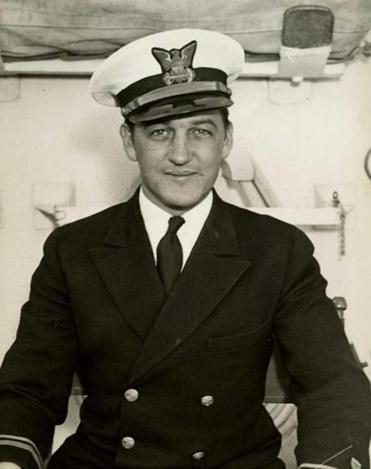
Lt. Crotty

We seem to be half masting the flag a lot lately, but this one has greater than the usual significance. Please read his story using the link below. Earlier post here.

united states coast guard

R 141500Z OCT 21
FM COMDT COGARD WASHINGTON DC
TO ALCOAST
BT
UNCLAS
ALCOAST 380/21
SSIC 5060
SUBJ: HALF MASTING OF NATIONAL ENSIGN
A. U.S. Coast Guard Regulations 1992, COMDTINST M5000.3B
B. COMDT COGARD WASHINGTON DC 290809 OCT 19/ALCOAST 335/19
1. By order of the Commandant and IAW REF (A), the National
Ensign shall be flown at half mast from sunrise until sunset
on Friday, 15 October 2021, in honor of LT Thomas James Eugene
“Jimmy” Crotty, an American and Coast Guard hero.
2. The National Ensign shall be flown at half mast on all
Coast Guard buildings, grounds, and vessels not underway.
3. As announced in REF (B), LT Thomas James Eugene “Jimmy”
Crotty, USCG, died as a prisoner of war of the Japanese at
the Cabanatuan Prisoner of War Camp on 19 July 1942. He was
buried in a common grave along with all those who died that
day. On 10 September 2019, as part of an exhaustive effort
by DoD to bring every service member home, LT Crotty was
positively identified from the remains exhumed in early 2018.
LT Crotty was returned home with honors on 01 November 2019
to Buffalo, NY.
4. LT Crotty will have his final inurnment on Friday,
15 October 2021, at the United States Coast Guard Academy
Columbarium in New London, CT, at 1400.
5. LT Crotty’s biography and additional information can be
found at:
(Copy and Paste URL Below into Browser)

https://compass.coastguard.blog/2019/09/18/the-long-blue-line
-lt-crotty-and-the-battle-for-corregidor/

6. RADM Eric C. Jones, Assistant Commandant for Human Resources
(CG-1), sends.
7. Internet release is authorized.

“Coast Guard cutter crews conclude Operation Aiga in Oceania” –News Release

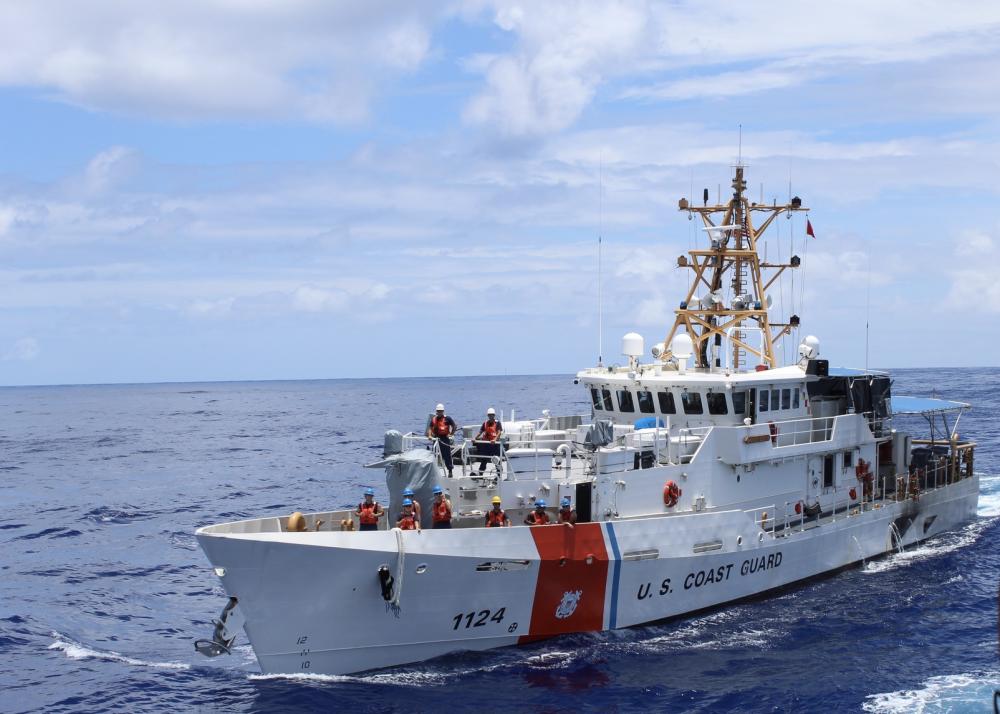
The Coast Guard Cutter Oliver Berry conducts a patrol in and around American Samoa, covering 8,169 nautical miles. The crew sought to combat illegal, unregulated, and unreported fishing and other maritime threats across the Pacific to protect the United States and our partner’s resource security and sovereignty. (U.S. Coast Guard photo courtesy of the CGC Juniper)

This is at least the second time the Coast Guard has done an “Operation Aiga.” It is a clear indication we are taking Illegal, Unregulated, Unreported (IUU) fishing in the remote Pacific more seriously.

Earlier I published the press releases of USCGC Juniper and USCGC Oliver Berry reporting their individual participation in this operation.

It appears this operation has as a second purpose, testing Pago Pago as a cutter operating base.

“Using Pago Pago, American Samoa as a forward operating base between patrol periods, we maintained a strategic presence in the region, reported fishing vessel activity, and cited multiple violations under the Western Central Pacific Fisheries Commission’s conservation management measures while still continuing domestic enforcement action of U.S. flagged fishing vessels.” 

united states coast guard

News Release

U.S. Coast Guard 14th District Hawaii and the Pacific

Coast Guard cutter crews conclude Operation Aiga in Oceania

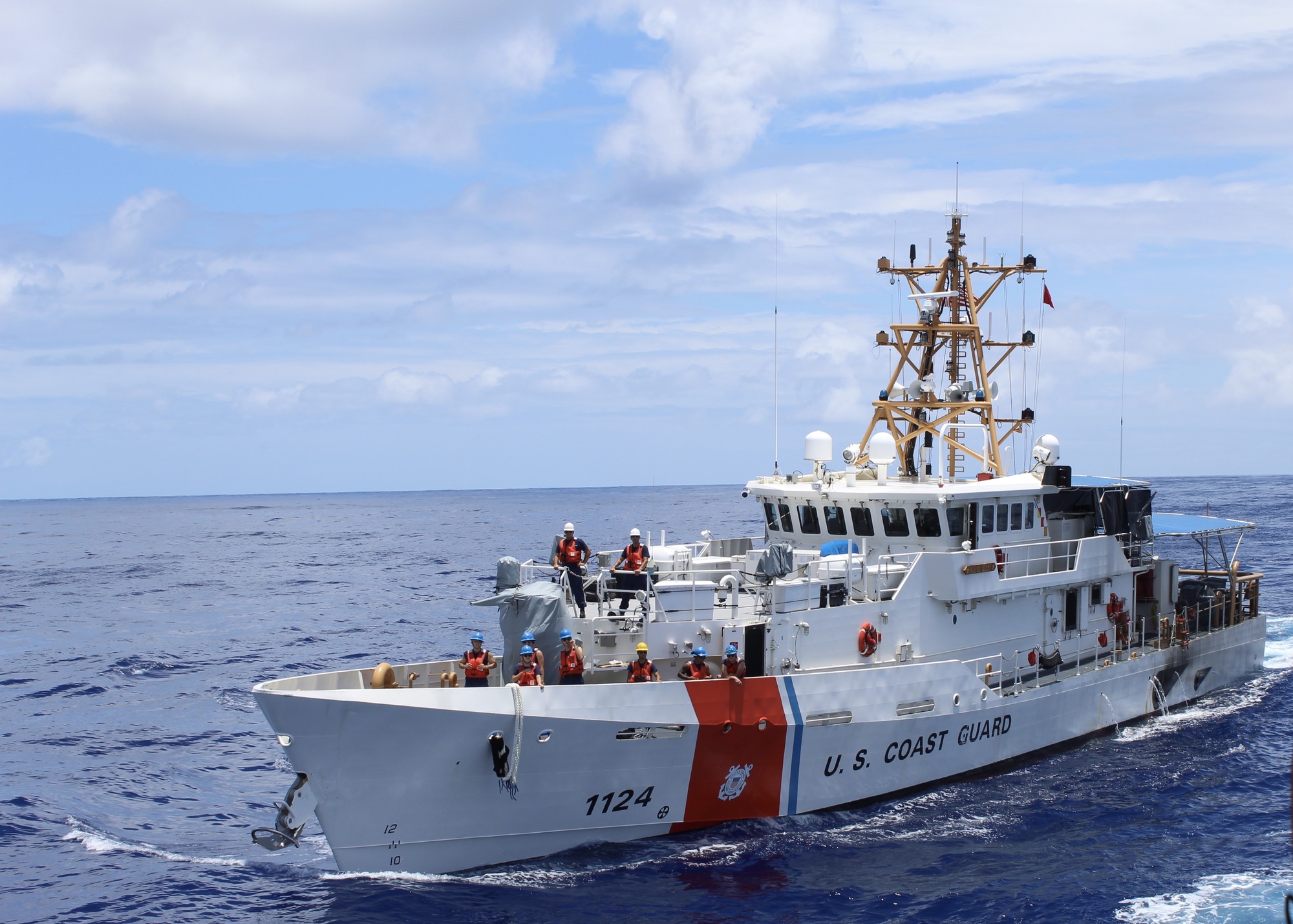
Oliver Berry

Editors’ Note: Click on image to download a high-resolution version.

HONOLULU — Coast Guard crews completed Operation Aiga, a 46-day patrol in support of the Samoan government maritime law enforcement efforts by providing patrol coverage in the Samoan and American Samoan exclusive economic zones.

The crews from the Coast Guard Cutter Oliver Berry (WPC 1124) and Juniper (WLB 201) deployed from Hawaii to Samoa to provide operational presence and conduct bilateral shiprider operations with the Government of Samoa, in coordination with New Zealand and Australia to combat illegal, unregulated, and unreported fishing and promote Samoan resource security and maritime governance in Oceania.

In the U.S. alone, the fishing industry employs about 1.3 million people and contributes $199 billion per year to the U.S. economy, according to a NOAA economic report. Combating IUU fishing is part of promoting maritime governance and a rules based international order that is essential to a free and open Indo-Pacific. 

“Fish stocks are a global food source and provide economic stability for many countries in the Pacific,” said Lt. Cmdr. Jason Holstead, the District 14 living marine resource officer. “Depleted fish stocks due to IUU could contribute to the destabilization of the region and leave small nations vulnerable to dangerous transnational organized crime networks.”

The crew of the Coast Guard Cutter Oliver Berry traveled 8,169 nautical miles while patrolling the EEZ of American Samoa and Samoa during their deployment. The Juniper crew serviced vital aids to navigation in Pago Pago Harbor and in neighboring islands during their 10,000 nautical-mile patrol in support of Operation Aiga. 

“While in the South Pacific, we patrolled the Samoan and American Samoan EEZs for a total of 380 hours,” said Lt. Micah Howell, the Oliver Berry’s commanding officer. “Using Pago Pago, American Samoa as a forward operating base between patrol periods, we maintained a strategic presence in the region, reported fishing vessel activity, and cited multiple violations under the Western Central Pacific Fisheries Commission’s conservation management measures while still continuing domestic enforcement action of U.S. flagged fishing vessels.” 

Coast Guard crews also conducted operations in and around American Samoa to enforce U.S. federal laws and regulations and maintain aids to navigation. 

“During the patrol, we serviced 12 aids that directly support safe navigation and the flow of commerce in the territory’s primary waterways,” said Lt. j.g. Ryan Burk, the Juniper’s operations officer. “We collaborated with local stakeholders to complete a waterway analysis and management system (WAMS) survey of the waterways which is the first WAMS completed for American Samoa since 2003 allowing the Coast Guard to assess and improve the safety and efficiency of the territory’s waterways.”

‘Aiga,’ the Samoan word for family, represents the bond between the United States and the rich Samoan culture with the common values that are shared. 

For breaking news follow us on twitter @USCGHawaiiPac

“U.S. Coast Guard Presents Some Aging Infrastructure Concerns and Fixes” –USNI

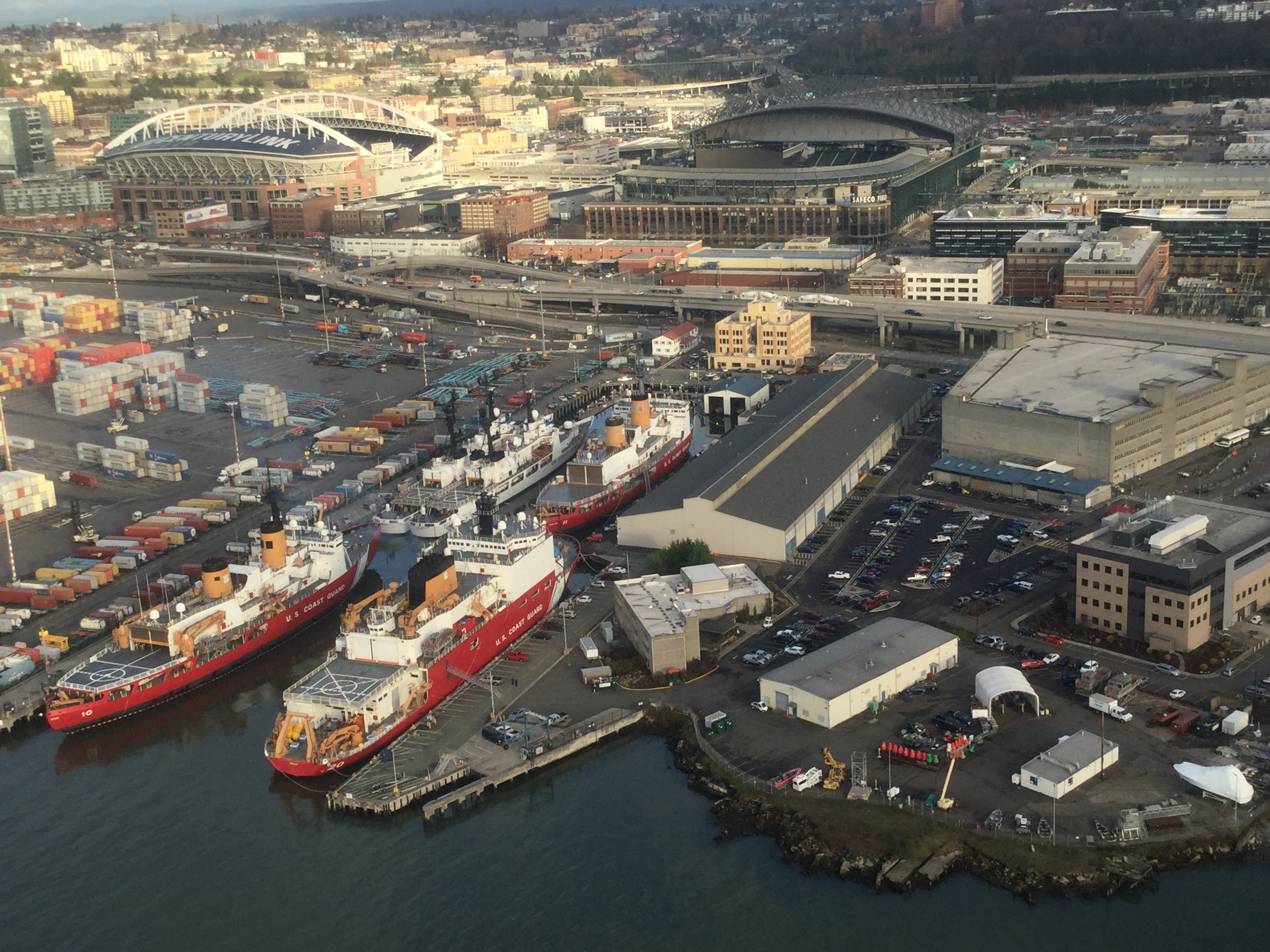
Coast Guard Base Seattle

The US Naval Institute Blog has a post looking at Coast Guard efforts to repair or replace its aging infrastructure. It is in the form of questions and answers.

I asked the U.S. Coast Guard’s Public Affairs Department in September 2021 on to shed some light as to what aging and unsatisfactory infrastructure issues they have. Lieutenant (junior grade) Sondra-Kay Kneen, Coast Guard media relations, replied with answers taken from various U.S. Coast Guard personnel and sources.