“French Navy’s 2021 Report On Global Maritime Security” –Naval News

In reading this, note the difference between piracy and maritime robbery is that, the first occurs on the high seas, while maritime robbery takes place within a nation’s territorial sea or internal waters. 

Naval News reports publication of a report by the French Navy’s

“The Maritime Information Cooperation and Awareness Center (MICA Center) of the French Navy released its 2021 annual report on maritime piracy and robbery acts that impacted worldwide maritime security.”

For me, there were two surprises in the Naval News report. First there was the surprisingly good news, that incidents were much reduced in the Gulf of Guinea, but then there seemed to be the bad news, that the Caribbean was one of the two worst areas for piracy and maritime robbery.

But looking at the complete original report, Sec. 3.4, it finds that the “Caribbean Sea is an area where the threat of piracy or robbery is considered low.” I presume this apparent conflict between a high number of incidents and low probability, is due to the high traffic in the Caribbean.

Most of the “piracy/maritime robbery” reported in the Caribbean was non-violent theft from anchored yachts. This is very different from the Gulf of Guinea, where kidnappings and attacks on ships are still relatively common.

The report also comments on immigration, drug trafficking, and illegal, unregulated, and unreported (IUU) fishing.

“U.S., Spain, Morocco collaborate to conduct rescue at sea” –LANT AREA News Release

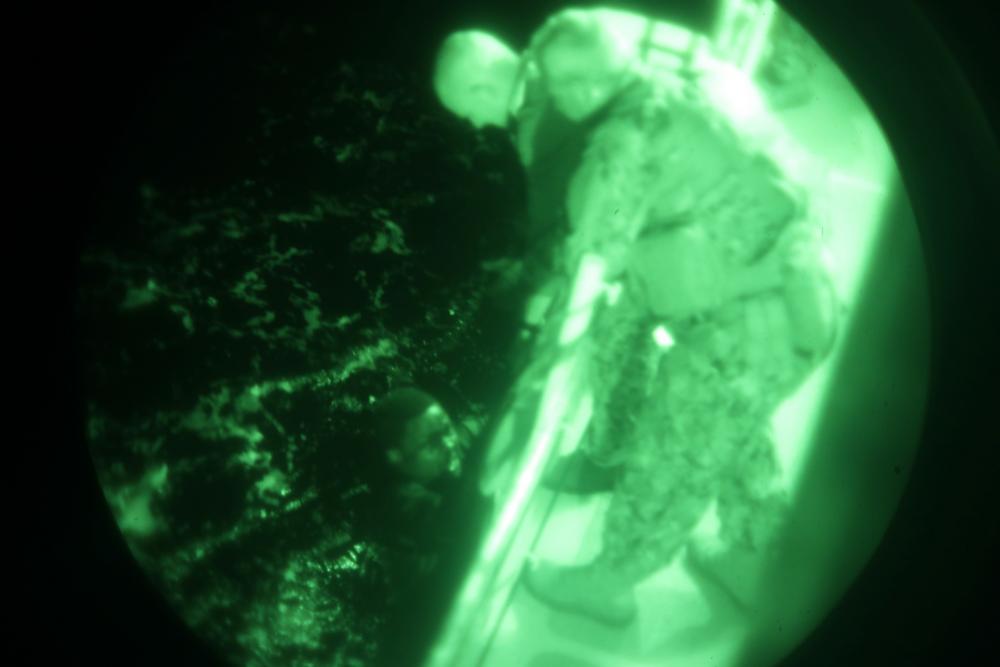
“The crew of the Sentinel-class USCGC Glen Harris (WPC 1144) prepares to receive migrants rescued from the water in the Atlantic Ocean on Jan. 4, 2021. The Glen Harris, with USCGC Emlen Tunnell (WPC 1145) and the USCGC Thetis (WMEC 901) are conducting a routine patrol in the U.S. Sixth Fleet area of responsibility while the Sentinel-class cutters transit from the U.S. to their new homeport of Manama, Bahrain. U.S. Sixth Fleet, headquartered in Naples, Italy, conducts the full spectrum of joint and naval operations, often in concert with allied and interagency partners, to advance U.S. national interests, security, and stability in Europe and Africa.” (U.S. Coast Guard photo by Petty Officer 2nd Class Ade Gills)

Earlier, we saw this from CG-9,

“Coast Guard cutters Glen Harris and Emlen Tunnell departed Sector Key West, Florida, for their new homeport in Manama, Bahrain, Nov. 18. They are the second pair of fast response cutters (FRCs) to be assigned to Patrol Forces Southwest Asia (PATFORSWA) as part of the Coast Guard’s effort to replace the region’s six existing 110-foot Island-class patrol boats. Glen Harris and Emlen Tunnell, accompanied by Coast Guard Cutter Thetis, arrived in San Juan, Puerto Rico, Nov. 24 and 25, respectively. The cutters are expected to complete their journey to PATFORSWA in late January 2022.”

Now we have this Atlantic Area news release below, regarding a rescue off the Moroccan coast.

Despite what the news release says, this is anything but routine, if not the mission, at least the location. They certainly were not on a “routine patrol.”

Here is a sample of a media report, this one from CNN.

Morocco has both an Atlantic and a Mediterranean coast. According to the CNN report, this occurred in the Atlantic.

The Moroccan warship would have been the Lieutenant-Colonel Errahmani, a Descubierta class corvette.

News Release

U.S. Coast Guard Atlantic Area

U.S., Spain, Morocco collaborate to conduct rescue at sea

migrants in the Atlantic  U.S. Coast Guard, partners conduct joint rescue of migrants in Atlantic USCGC Thetis (WMEC 910) and a Royal Moroccan Navy vessel are seen during the joint rescue of migrants in the Atlantic Ocean

Editors’ Note: To view more photos or download high-resolution imagery, click on the images above.

ATLANTIC OCEAN — On Jan. 5, 2022, the United States, Spain, and Morocco collaborated to rescue 103 migrants 40 nautical miles west of the Moroccan coast.

Late Tuesday evening, Spain’s Las Palmas Rescue Coordination Center received reports of two migrant rafts taking on water with people possibly in the water.

The Spanish center coordinated rescue efforts with the vessels closest to the reported location of the rafts. Three U.S. Coast Guard ships, Famous-class USCGC Thetis (WMEC 910), Sentinel-class USCGC Glen Harris (WPC 1144), and USCGC Emlen Tunnell (WPC 1145), and a nearby Royal Moroccan Navy frigate answered the call.

Working together, the crews rescued 103 migrants and recovered two deceased migrants by early Wednesday morning. Once safely aboard and stabilized, the U.S. Coast Guard crews transferred all migrants to the Moroccan Navy.

“While we are on an escort currently, the U.S. Coast Guard will always conduct our core mission of search and rescue and observe the international law of the sea and maritime custom to assist any mariners in distress,” said Cmdr. Justin Nadolny, commanding officer, USCGC Thetis (WMEC 910). “This demonstrates the capability of Thetis to work with partners and our ability to respond rapidly to any situation. I’m very proud of the team.”

The U.S. Coast Guard is conducting a routine deployment in the U.S. Sixth Fleet area of operations, working alongside Allies, building maritime domain awareness, and sharing best practices with partner nation navies and coast guards. These operations coincide with the escort of the Sentinel-class cutters across the Atlantic en route to their new homeport of Manama, Bahrain, and the cutters’ work for U.S. Patrol Forces Southwest Asia under U.S. Navy 5th Fleet and U.S. Central Command.

“The rescue of over 100 persons in the Atlantic demonstrates the agility and reach of U.S. Naval Forces throughout Africa and Europe,” said Capt. Kyle Gantt, Commander, Task Force 65. “U.S. Coast Guard’s timely coordination with Spanish authorities and the Moroccan Navy showcases the power of integration with our international partners at sea.”

The U.S. Coast Guard remains operational during COVID-19, following all COVID-19 safety precautions and regulations.

U.S. Sixth Fleet, headquartered in Naples, Italy, conducts the full spectrum of joint and naval operations, often in concert with allied and interagency partners, to advance U.S. national interests and security and stability in Europe and Africa. Based in Portsmouth, Virginia, U.S. Coast Guard Atlantic Area oversees all Coast Guard operations east of the Rocky Mountains to the Arabian Gulf. In addition to surge operations, they also allocate ships to work with partner commands.

At Least for This Blog, 2021 Was a Good Year, Thanks

Thanks to all of you who have come by and made the writing worthwhile. Special thanks to those who have contributed by your comments or by simply pointing me to articles of interest.

2021

In 2021, the blog had 244,089 views and 83,692 individual visits. This year we had 465 posts, totaling 165,836 words (both the most ever). There were 1250 comments (comments seem to have dropped off a bit). That is 2.86% more views than last year (237,298) and 16.9% more individual visits, more than any previous year with the exception of 2019 (255,335 views). Posts averaged only 357 words, (I am trying to be economical of your time.)

2019 was something of an anomaly, driven a couple of unusually popular posts. “Navy, this is Coast Guard, we need to talk,” had 18,245 views in 2019, making it the second most viewed post in the history of the blog. “An Offshore Patrol Vessel with Teeth” had 4,935 views in August alone. They made August, September, and October of 2019 the most viewed months so far. Sept. 30, 2019 alone, there were 7,302 views, the most ever in a single day.

29.7% of our readers were non-US. Aside from the US, 45 countries had 200 or more views. After the US, the five countries with the most views were the UK, Canada, Finland (Tups must have had something to do with this), Philippines, and Australia. All had more than 4200 views.

The top ten posts in 2021 were:

  1. 50mm Chain Gun, More Detail (2019)
  2. What Does It Take to Sink a Ship? (2011)
  3. Perhaps the Most Well Armed Cutter Sized Corvette in the World (2021)
  4. The Hamilton Class 378 foot WHECs, an Appreciation (2021)
  5. Guided Rounds for the 57mm Mk110, ALaMO and MAD-FIRES, an Update (2019)
  6. “Weapons Effectiveness Testing–25 vs 30mm” Revisited (2021)
  7. Philippines’ New 94 Meter Cutter and the Japanese Kunigami Class Cutters (2020)
  8. Norway’s Coast Guard Jan Mayen-class vessel (2021)
  9. Bahrain Bound FRC gets Upgrades, LRAD and Short-Range Air Search (2021)
  10. “Here Is What…Missiles Actually Costs” –The Drive (2020)

Blog History

The blog began in July 2012, after Dan Trimble decided to close down his “CGBlog” where I had contributed for a bit over two years. With Dan’s help, all the content I wrote during that period has been transplanted here along with the associated comments. That is why the archive includes posts dated before July 2012.

To date we have had 3,386 posts, 19,445 comments, and 1,996,169 views.

The top ten posts ever published on his blog, updated through the end of 2021 were:

  1. What Does It Take to Sink a Ship? (2011)
  2. Navy this is Coast Guard, we need to talk (2019)
  3. OPV to OPC (2012) (Since the OPC has been selected, now only of historical interest)
  4. The Navy’s New Patrol Boat (2012)
  5. Three Nations Share German OPV Design (2014)
  6. Case for the Five Inch Gun (2012)
  7. What Might Coast Guard Cutters Do in Wartime, Part 2, Coast Guard Roles (2012)
  8. Alternate Weapons for New Large Cutters? (2012)
  9. 50mm Chain Gun, More Detail (2019)
  10. An Offshore Patrol Vessel with Teeth (2019)

“BOLLINGER SHIPYARDS DELIVERS FINAL BAHRAIN-BOUND FAST RESPONSE CUTTER TO U.S. COAST GUARD” –News Release

USCGC CLARENCE SUTPHIN (WPC 1147) is the sixth and final Webber class FRC planned for assignment to PATFORSWA, Manama, Bahrain.

Below is a news release from Bollinger Shipyards, 


LOCKPORT, La., — January 6, 2021 – Bollinger Shipyards LLC (“Bollinger”) has delivered the USCGC CLARENCE SUTPHIN to the U.S. Coast Guard in Key West, Florida. This is the 170th vessel Bollinger has delivered to the U.S. Coast Guard over a 35-year period and the 47th Fast Response Cutter (“FRC”) delivered under the current program.

The USCGC CLARENCE SUTPHIN is the final of six FRCs to be home-ported in Manama, Bahrain, which will replace the aging 110’ Island Class Patrol Boats, built by Bollinger Shipyards 30 years ago, supporting the Patrol Forces Southwest Asia (PATFORSWA), the U.S. Coast Guard’s largest overseas presence outside the United States.

“Ensuring that the brave men and women of the U.S. Coast Guard have the most state-of-the-art, advanced vessels as they work to build and maintain the necessary regional alliances to ensure maritime security in the region is a top priority,” said Bollinger President & C.E.O. Ben Bordelon. “Bollinger is proud to continue enhancing and supporting the U.S. Coast Guard’s operational presence in the Middle East and ensuring it remains the preferred partner around the world.”

Earlier this year at the commissioning ceremony of the USCGC CHARLES MOULTHROPE, U.S. Coast Guard Commandant Admiral Karl Schultz lauded the “enhanced seakeeping” capabilities of the PATFORSWA-bound FRCs, saying “these ships are truly going to be game changing in their new theater of operations” and “offer increased opportunities for integrated joint operations with our Navy and Marine Corps colleagues” as the Coast Guard seeks to be part of the whole-of-government solution set in the region.

PATFORSWA is composed of six cutters, shoreside support personnel, and the Maritime Engagement Team. The unit’s mission is to train, organize, equip, support and deploy combat-ready Coast Guard Forces in support of U.S. Central Command and national security objectives. PATFORSWA works with Naval Forces Central Command in furthering their goals to conduct persistent maritime operations to forward U.S. interests, deter and counter disruptive countries, defeat violent extremism and strengthen partner nations’ maritime capabilities in order to promote a secure maritime environment.

Each FRC is named for an enlisted Coast Guard hero who distinguished themselves in the line of duty. Clarence Sutphin, Boatswain Mate First Class, USCG, was awarded the Bronze Star Medal for his courageous actions during the invasion of Saipan Island in 1944. His citation reads: “For heroic achievement in action against enemy Japanese forces during the invasion of Saipan, Marianas Islands, on June 15 and 16, 1944.  Swimming with a line through heavy surf to a tank lighter stranded on a reef, SUTPHIN remained aboard under mortar and artillery fire until the boat was salvaged.  Returning to the beach, he aided in salvaging another tank lighter under enemy fire and, when a mortar shell struck a group of eight Marines, promptly treated the wounded and moved them to a first aid station.  His courage and grave concern for the safety of others reflects the highest credit upon SUTPHIN and the United States Naval Service.”

About the Fast Response Cutter Platform

The FRC is an operational “game changer,” according to senior Coast Guard officials. FRCs are consistently being deployed in support of the full range of missions within the United States Coast Guard and other branches of our armed services.  This is due to its exceptional performance, expanded operational reach and capabilities, and ability to transform and adapt to the mission. FRCs have conducted operations as far as the Marshall Islands—a 4,400 nautical mile trip from their homeport. Measuring in at 154-feet, FRCs have a flank speed of 28 knots, state of the art C4ISR suite (Command, Control, Communications, Computers, Intelligence, Surveillance, and Reconnaissance), and stern launch and recovery ramp for a 26-foot, over-the-horizon interceptor cutter boat.

About Bollinger Shipyards LLC

Bollinger Shipyards LLC (www.bollingershipyards.com) has a 75-year legacy as a leading designer and builder of high performance military patrol boats and salvage vessels, research vessels, ocean-going double hull barges, offshore oil field support vessels, tugboats, rigs, lift boats, inland waterways push boats, barges, and other steel and aluminum products from its new construction shipyards as part of the U. S. maritime defense industrial base. Bollinger has 11 shipyards, all strategically located throughout Louisiana with direct access to the Gulf of Mexico, Mississippi River and the Intracoastal Waterway. Bollinger is the largest vessel repair company in the Gulf of Mexico region.

Top Ten Navies by Aggregate Displacement, 1 January 2022. Analysis and diagram by u/Phoenix_jz

You may need to click on this to make it readable. 

(There is an updated 2024 version of this post here)

Ran across this on Facebook, posted by Buddy Stewart, an administrator at the “Navy General Board” page. He found it here. Thought it might be of interest. I can’t vouch for the accuracy, but it looks credible to me.

The creator’s notes are below. 

I figured with all the discussion flying around over the past year over the sizes of various navies – particularly with regards to the greater-than-ever attention being paid to the growth of the PLAN – I would ‘publish’ some of the data from my own navy tracking spreadsheet to give everyone an idea of the relative sizes of the top ten navies, by aggregate displacement of commissioned ships, which I tend to find is a better way of measuring the sizes of navies than my mere ship counts. Figures are aggregates of full load displacement in metric tonnes.

To break down what each of these categories mean;

  • Surface Warships is an aggregate of all above-water warships and major aviation and amphibious assault platforms. This category includes CVNs, CVs, CVLs, LHDs, LHAs, LPDs, CGs, DDGs, FFGs, corvettes, OPVs, CPVs, lighter patrol craft, and MCM vessels.

  • Submarines is what it says on the tin – SSBNs, SSGNs, SSNs, SSKs, and for select nations where applicable (and where information is available), special purpose submarines.

  • AORs includes all major fleet replenishment vessels (coastal vessels do not count, however).

  • Other Auxiliaries is a very wide net that essentially captures everything else. Special mission ships, support vessels, minor amphibious assault vessels (LSDs, LSTs, LCAC’s, LCM’s, LCU’s), training vessels, tugs, coastal support vessels, hydrography ships – all essential parts of navies, but generally stuff that isn’t paid too much attention to as its far less flashy than the warships proper.

Interesting trends in data that I thought I would share for various navies;

Though much has been said about the PLAN ‘overtaking’ the USN in number of ships, the actual data is not so friendly. A large part of the PLAN’s numerical ‘edge’ comes from the larger number of smaller platforms they operate, be it corvettes like the Type 056/56A (50+22), or missile boats like the Type 22 (83). Much of this numerical strength was pre-existing relative to the last few years – what is really notable is the fact much of the PLAN’s growth is now driven by larger warships – such as the two LHDs, eight DDGs, and SSBN commissioned in 2021 (but nine Type 056A corvettes were still commissioned), as the PLAN is finding its pace with constructing large numbers of major surface combatants. However, they still have a long way to go in all categories before they really match the USN in size, if they ever do – as it stands the 22 cruisers and 69 destroyers of the American escort fleet clock in at 870,000 tons to the aggregate 474,000 tons of the PLAN’s destroyers and frigates – many of which are still older types of limited utility compared to even something as old as a Flight I Burke.

That said, the USN will see some notable contraction in tonnage over the next few years as many older Ticonderoga-class cruisers and several LCS’s are retired, while new frigates are still about five years away from seeing service. That said, given the availability issues of the Ticonderoga’s, this isn’t really much of a practical reduction in strength.

The VMF remains comfortably as the third largest navy. Though its surface fleet has seen better days, things are slowly improving as new frigates commission and older surface combatants get through their refits. It is worth noting that the VMF is still disproportionately powerful underwater with its large fleet of SSGNs, SSNs, and SSKs, though still somewhat smaller than the USN’s fleet in displacement (it appears larger here because of the significant special purpose submarine fleet). The PLAN may be the world’s second largest navy, but underwater, the VMF is on deck and the PLAN is in the hold.

The British Royal Navy remains in the number four spot, as we step down from the ‘million plus’ club of the top three navies. British aggregate displacement remains notable with regards to its low ratio of combatant tonnage to support fleet, a testament to the size of the RFA. This, combined with the large displacement of the Queen Elizabeth-class carriers (about 140,000t of carriers, temporarily second only to the USN’s 1.14 million tons of carriers) puts the British ahead of the JMSDF, which otherwise still has a significantly larger surface fleet, but is much shallower in terms of support ships (reflective of the different environments the two navies operate in).

There’s not much to say about the Indian Navy, other than to expect a significant increase this year when Vikrant commissions. Steady, if slow, construction has seen them replace older destroyers and frigates, though the true long-term challenge will be their SSN program. The Marine Nationale still comfortably holds its seventh-place position, though it is somewhat at an ebb given its AOR fleet is at an all-time low with just two Durance-class tankers in commission. This trend will continue through 2022, as the first Vulcano-class LSS for the Marine Nationale will not enter service until 2023. The MN can, however, boast of having one of the most modern surface combatant fleets anywhere – by the end of 2022, when the last Georges Leygues-class frigate leaves service and the new Lorraine commissions, it will have not a single ship commissioned before 2000 in its front-line escort fleet of Horizon and FREMM.

The ROKN is something of a rising star, though this year they’ve poked their head into the top eight briefly thanks to stagnation in the displacement of the normal number eight, the Marina Militare – the latter is down two frigates from a sale to Egypt, and a new ‘OPV’ due to delays brought on by Covid. The ROKN is an example of another navy heavy in combatant displacement but shallow in support ships, reflective of its operating environment. Though the Korean carrier program has so far stolen much of the attention of the ROKN’s development, that remains a long way off and for now the more notable areas of growth are the steady frigate program, and indigenous submarine program.

The Marina Militare, as mentioned before, is at something of a low ebb, though they will likely regain the number eight position as a new LHD and two OPVs will net them about 35,000 tons in 2022 (as the carrier Giuseppe Garibaldi will leave service this year). The first half of the 2020s will see the delivery of a significant number of surface combatants – two FREMM and six ‘OPVs’ of the PPA type – as well as another LSS of the Vulcano-class.

The Indonesian Navy is an unlikely tenth, but they are still very much present – albeit this is primarily the responsibility of their five Makassar-class LPDs that net them the 57,000 tons that, in combination with an unusually large fleet of LSTs and LSMs, puts them over the Turkish Navy (which just misses our list at 258,048 tonnes). That said, even if they were to fall out of their current ‘position’ in the short term, they are likely to remain in the top ten in the long term, due the large expansion planned for their surface fleet of at least ten frigates by the end of the decade.

“Unmanned and on Guard: A New Approach to Coast Guard Operations” –USNI Blog

The US Naval Institute Blog has a post by LCdr John H Walters, USCG, who is the MQ-9A platform manager within the CG Office of Unmanned Aircraft Systems.

It pleads the case for unmanned systems (and satellite systems). The author is obviously a true believer (as am I to an extent).

The thing that I find encouraging is that there is a Coast Guard Office of Unmanned Aircraft Systems. What I find discouraging is that the Coast Guard has yet to procure its own shore based UAS and is still riding the coat tails of the Customs and Border Protection program that is still operating old versions of the MQ-9 that are not optimized for the Marine environment and do not have the “see and avoid” capability that would allow them to operate in airspace where mid-air collision is a possibility. There may be operational reasons to continue a relationship with the CBP unit, but as a learning experience, it has served its purpose. DBP has been operating their MQ-9s for 16 years. It is time for the Coast Guard to field its own land based unmanned air systems.


“Use the Coast Guard for Freedom of Navigation Operations” –USNI

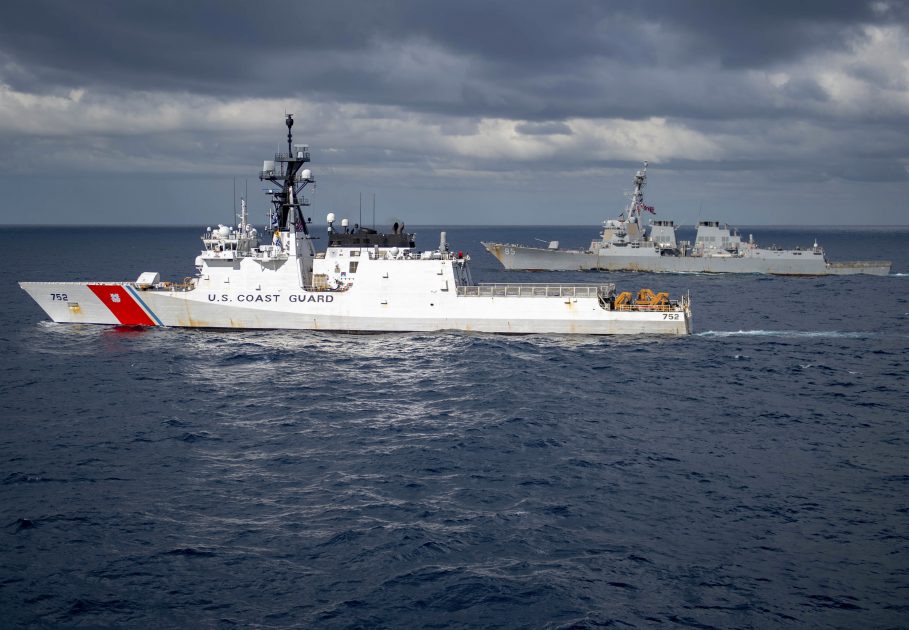
USCGC Stratton (WMSL-752), left, and the U.S. Navy Arleigh Burke-class guided-missile destroyer USS McCampbell (DDG-85) maneuver in formation during Talisman Sabre 2019 on July 11, 2019. US Navy Photo

The December 2021 issue of US Naval Institute Proceedings has an article that suggests, “NSCs and OPCs are ideal vessels to take over FONOPs.”

Why do the authors, two Navy LCdr. and a Marine Capt., think this? They contend:

  • Their destroyers are overworked.
  • The Navy is having a hard time keeping their ships maintained.
  • Cutters are less intimidating
  • and less expensive
  • If the Chinese start playing bumper boats with Destroyers, they might damage expensive equipment. “…if a ship from the Chinese Navy, Coast Guard, or maritime militia were to ram a U.S. vessel conducting a FONOP, the ensuing visuals, narratives, and potential loss of combat capability would be starkly different between a Navy gray hull and a Coast Guard white hull.”

They talk about using LCS as an alternative, but then denigrate the possibility,

The Navy has rightfully used littoral combat ships (LCSs) to conduct limited FONOPs in the South China Sea, somewhat relieving overworked destroyers like the USS John S. McCain. However, the smaller LCS’s myriad of problems, curtailed acquisition numbers, and early retirement of the first four hulls mean the Navy will soon have to lean even more heavily on larger and generally older ships. With only 10 to 14 cruisers and destroyers available to Seventh Fleet at any given time, the Navy can ill-afford to use these high-demand, low-density, Aegis ships for FONOPs.

This, in spite of the fact, that LCS have only recently begun making regular deployments to the Western Pacific and LCSs are being added to the fleet at a rate of four per year.

First, I have no problem with Cutters doing FONOPs when they are in the Western Pacific, but that should not be the only reason, they are there.

US Navy ships are not overworked. That is a fiction. Having looked at the “USNI News Fleet and Marine Tracker” over many years, I can say, Navy ships are typically deployed about one third of the time, and they are underway only about 25% of the time, far less than Coast Guard cutters. That is not to say the people are not overworked, by burdensome administrative and overly broad qualification requirements for their junior officers. The ships are behind in maintenance because of lack of support, not time underway. Ships don’t need to spend 75% of their time, tied up in maintenance, to remain effective.

In war time, well over half the navy should be underway and forward deployed. The fact that they cannot support a much smaller forward presence, of which much of the time is not underway, in peacetime, points to a serious deficit in the Navy’s support structure. Where are the repairs ships, the tenders, the floating dry docks that allow a navy to be truly expeditionary?

If the Navy does not want to use carriers, cruisers, or destroyers for FONOPs because they are afraid of having them damaged, there are other alternatives. They could use amphibs: LHAs, LHDs, LPDs, and LSDs. They could use Military Sealift Command ships. MSC ships are clearly not as intimidating as carriers, cruisers, and destroyers. Were they to be damaged “the ensuing visuals, narratives, and potential loss of combat capability would be starkly different…” 

I would suggest using the new Navaho class tug and salvage ships. They are an excellent choice for playing bumper boats. They have strong steel hulls and are powerful enough to tow a nuclear-powered carrier. Their hulls are reinforced to allow hull to hull contact with other ships. Plus, they are a lot less expensive. Even less expensive than a Coast Guard cutter.

But really, using tugs or cutters to do FONOP kind of misses the point. The Chinese and the Russians are not upset because foreign ships are transiting waters they claim. They are upset because foreign warships are transiting the waters the claim. If we stop sending warships into the waters they claim, we are creating a defacto case that they have a right to such exclusion. That Coast Guard cutters may not be considered warships would weaken our case that, foreign warships in these waters is the norm.

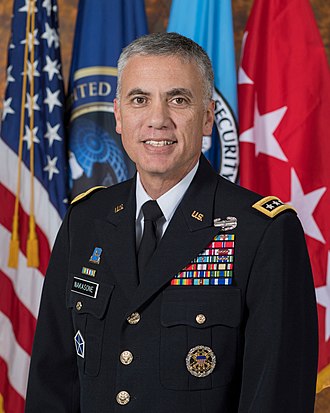
At CGA, 20 Jan., General Paul M. Nakasone, USA Commander, US Cyber Command, Director, NSA/Chief, Central Security Service

The US Naval Institute has announced a special event to be held at the US Coast Guard Academy on 20 January.

General Paul M. Nakasone, U.S. Army, Commander, U.S. Cyber Command and Director, National Security Agency/Chief, Central Security Service will be the featured speaker at an annual event hosted by the Naval Institute and the Loy Institute for Leadership at the U.S. Coast Guard Academy on Thursday, 20 January, in New London, CT. Admiral Charles W. Ray, U.S. Coast Guard (Retired),former Vice Commandant and current Tyler Chair in Leadership Studies at the U.S. Coast Guard Academy, will lead this engaging discussion with General Nakasone on all things cyber. This special event is made possible through support from the William M. Wood Foundation.

The link in the quote above notes:

Please contact conferences@usni.org with questions about this event.

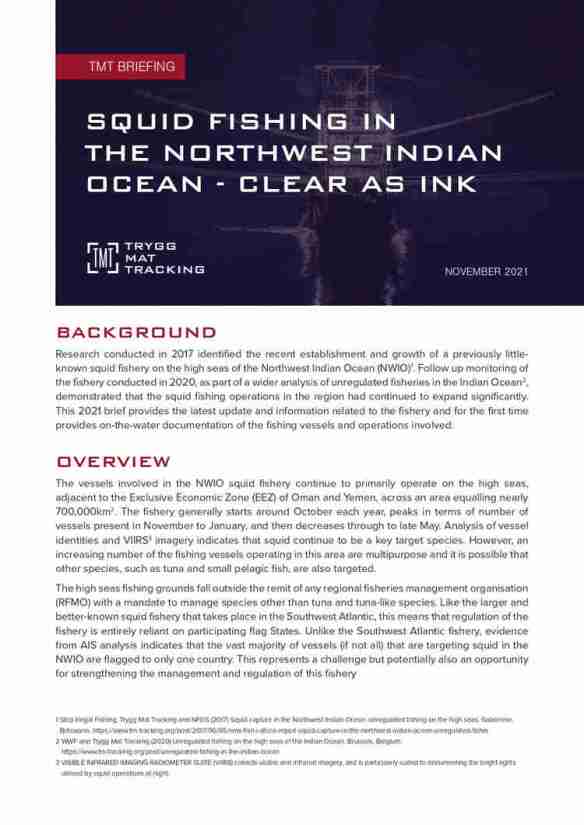
“New Analysis: Squid Fishing North West Indian Ocean: Clear as Ink” –Trygg Mat Tracking

Below is an announcement of publication of a brief from Trygg Mat Tracking (TMT), regarding Illegal, Unregulated, Unreported (IUU) fishing in the Northwest Indian Ocean.

I think this is something the Coast Guard units of PATFORSWA might become involved with, at least in a training and capacity building role.

This is a quote from the website explaining how TMT sees its mission.

“TMT provides national fisheries authorities and international organisations with fisheries intelligence and analysis, to assist enforcement actions and broader improvements in fisheries governance.  While TMT works with governments and organisations worldwide, particular focus is on targeting illegal fishing and associated fisheries crime in and near African waters and assisting coastal African States.”


New Analysis: Squid Fishing North West Indian Ocean: Clear as Ink

December 8th 2021: TMT has been monitoring the high seas squid fishery taking place in the northwest Indian Ocean since 2017. The fishery is currently unregulated and has seen significant expansion year on year.

Earlier this year we were able for the first time to ground truth and document the activities of some of the vessels involved at sea – rather than relying on AIS and other satellite sources only – and have produced a brief: Squid Fishing in the North West Indian Ocean: Clear as Ink.

The brief provides extensive images of the fishing activities taking place. This has provided us with extensive new understanding of this operation, but also raises many new questions and concerns.

Key findings of our analysis include:

·        There are very low levels of AIS transmission by some vessels – a significant number of vessels were identified which transmitted over AIS whilst en route to the region and then switched AIS off or transmitted only very intermittently whilst on the fishing ground. Further to this, the quality of identifying information transmitted over AIS was often poor, making it challenging to monitor the fishery.

·        Transshipment at sea was documented from fishing vessels to reefers, confirming that this is an important component of the operation.

·        There are indications of potential EEZ incursions into Oman and Yemen by vessels in the fleet, but no clarity if these are licensed or not.

·        The vast majority of the vessels were identified as Chinese. Equally the majority of relevant port calls by both fishing vessels and reefers are in China. Chinese research vessels have also been active in the area.

·        All vessels documented in the fishery are using a type of gear we have not previously observed, involving large ‘dip’ nets. Many of the vessels appear to be able to deploy multiple gear types. This is significant for several reasons, including that recent announcements by the Chinese Government to limit high seas squid fishing specified that this applies to squid jigging vessels only.

“Recently high seas squid fisheries in the Atlantic and Pacific have quite rightly received significant attention. Quietly however a major fishery in the northwest Indian Ocean has also been growing year on year, but was previously only visible using satellite data. Now we have a snapshot of the operations at sea for the first time – and while some of our questions about this operation have been answered, many more are raised. The vessels observed were not jiggers as expected, but are using a new type of net gear. As well as squid the vessels are taking on board bycatch, including tuna species, fish the vessels are not authorised to catch. We hope this new analysis will help to shape appropriate policies and inform further action that will have real and lasting impacts on the sustainability of the North West Indian Ocean squid fishery and all those that depend upon it” said Duncan Copeland, Executive Director Trygg Mat Tracking.

The fishery is now starting up again for the 2021-2022 fishing season. As they do so it is important to note that this northwest Indian Ocean squid fishery continues to be subject to very little management and limited regulatory oversight. This represents a threat, not only to the sustainability of squid stocks in the region but potentially also to other regional fisheries, given the key role that oceanic squid plays in the marine food chain.

There is a clear need to address the current management gap as this fishery falls outside the geographical scope of the Southern Indian Ocean Fisheries Agreement (SIOFA) and outside the species mandate of Indian Ocean Tuna Commission (IOTC). Positive engagement by China in this process is crucial, as flag state for the fleet and port state receiving the catches, and as the only party with relevant information on the species, catch levels and fishing operations.

This briefing has been produced by Trygg Mat Tracking (TMT), with data and analytical support from Global Fishing Watch. At-sea documentation of vessels and fishing operations conducted in cooperation with Greenpeace International.

Download the 2021 brief: Squid Fishing in the North West Indian Ocean: Clear as Ink.