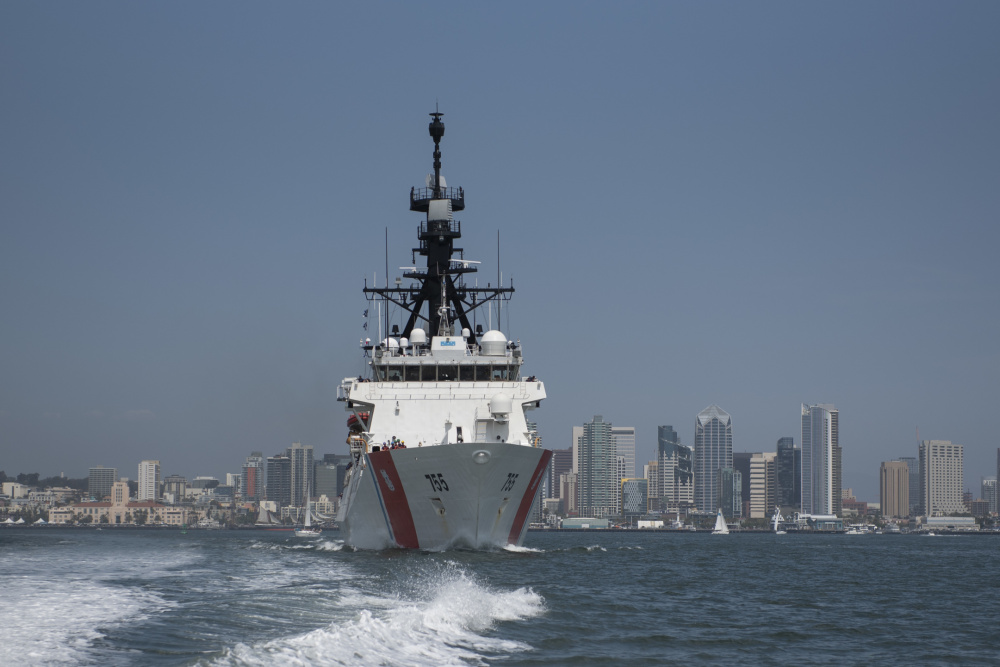
“Alameda-based Coast Guard cutter arrives in Western Pacific for months-long deployment”–PACAREA

Coast Guard Cutter Munro gets underway July, 23, 2021, for a scheduled deployment in the Western Pacific Ocean. An increased presence throughout the Indo-Pacific strengthens our alliances and partnerships through improved interoperability, which will enhance regional stability, promote rule-based order, and improve maritime governance and security in the region and globally. (U.S. Coast Guard photo by Marine Corps Sgt. Kevin G. Rivas)

Below is a Pacific Area news release. Another unusual deployment though it looks like it may be becoming more routine.

united states coast guard

News Release

U.S. Coast Guard Pacific Area

Alameda-based Coast Guard cutter arrives in Western Pacific for months-long deployment

Photo of USCGC Munro Photo of fast-roping Photo of training
Photo of boat crew Photo of training Photo of training

Editors’ Note: Click on images to download high resolution versions. Subscribe here to receive notifications when new photographs from the deployment are added to the DVIDS feature page.

ALAMEDA, Calif. – The Legend-class Cutter Munro (WMSL 755) arrived in the Western Pacific Sunday from its homeport in Alameda for a months-long deployment to the region.

The crew is operating in support of United States Indo-Pacific Command, which oversees military operations in the region.

Operating under the tactical control of Commander, 7th Fleet, the cutter crew plans to engage in professional exchanges and capacity-building exercises with partners and allies and will patrol and operate as directed.

“Forward-deployed Naval Forces routinely and seamlessly integrate as one maritime force with a proud heritage of serving and fighting together,” said Vice Adm. Karl Thomas, commander U.S. 7th Fleet. “It is a fitting nod to that heritage that Munro joins us following the U.S. Coast Guard celebration of its 231st birthday on August 4.”

The Coast Guard’s deployment to the Indo-Pacific theater aligns with the Integrated All-Domain Naval Power of the Naval Service and increases the traditional influence of sea power regionally.

“The U.S. Coast Guard’s unique authorities, capabilities, and missions position us to collaborate on maritime safety and security with partners around the world,” said Vice Adm. Michael F. McAllister, commander, Coast Guard Pacific Area. “An increased presence throughout the Indo-Pacific strengthens our alliances and partnerships through improved interoperability, which will enhance regional stability, promote rules-based order, and improve maritime governance and security in the region and globally.”

Coast Guard forces provide expertise within the mission sets of search and rescue; illegal, unreported, and unregulated fishing; maritime environmental response; maritime security; and humanitarian assistance and disaster relief. Deployable Coast Guard cutters, port security units, and advanced interdiction teams are also highly capable in augmenting naval operations in theater.

As both a federal law enforcement agency and an armed force, the Coast Guard is uniquely positioned to conduct defense operations and security cooperation in support of combatant commanders on all seven continents. The service routinely provides forces in joint military operations worldwide, including the deployment of cutters, boats, aircraft and deployable specialized forces.

The U.S. Coast Guard has a 150-year enduring role in the Indo-Pacific. The service’s ongoing deployment of resources to the region directly supports U.S. foreign policy and national security objectives in the Indo-Pacific Strategy and the National Security Strategy.

Commissioned in 2017, Munro is one of four Coast Guard legend class national security cutters homeported in Alameda. National security cutters are 418-feet long, 54-feet wide, and have a 4,600 long-ton displacement. They have a top speed in excess of 28 knots, a range of 12,000 nautical miles, endurance of up to 90 days and can hold a crew of up to 170. Munro is the second cutter named for Signalman First Class Douglas A. Munro, the only Coast Guardsman awarded the Congressional Medal of Honor.

National security cutters feature advanced command and control capabilities, aviation support facilities, stern cutter boat launch and increased endurance for long-range patrols to disrupt threats to national security further offshore.

Since 2018, three other Coast Guard Cutters – Bertholf, Stratton and Waesche – have deployed to the Western Pacific.

“U.S. Coast Guard patrols U.S. Arctic” –D17 News Release

The Coast Guard Cutter Midgett and the Canadian coast guard ship Sir Wilfrid Laurier conduct a joint maritime security patrol in the Chukchi Sea on July 20, 2021. US Coast Guard photo.

Below is a D17 news release. If Midgett is in the Chukchi Sea, which is North of the Bering Strait and all above the Arctic Circle, this is no normal Alaska Patrol. Midgett also got to rendezvous with USCGC Healy, which is conducting a circumnavigation of North America (more Healy photos here).  (I don’t recognize the type boat below, presume it is one of Healy’s boats, any info appreciated.)

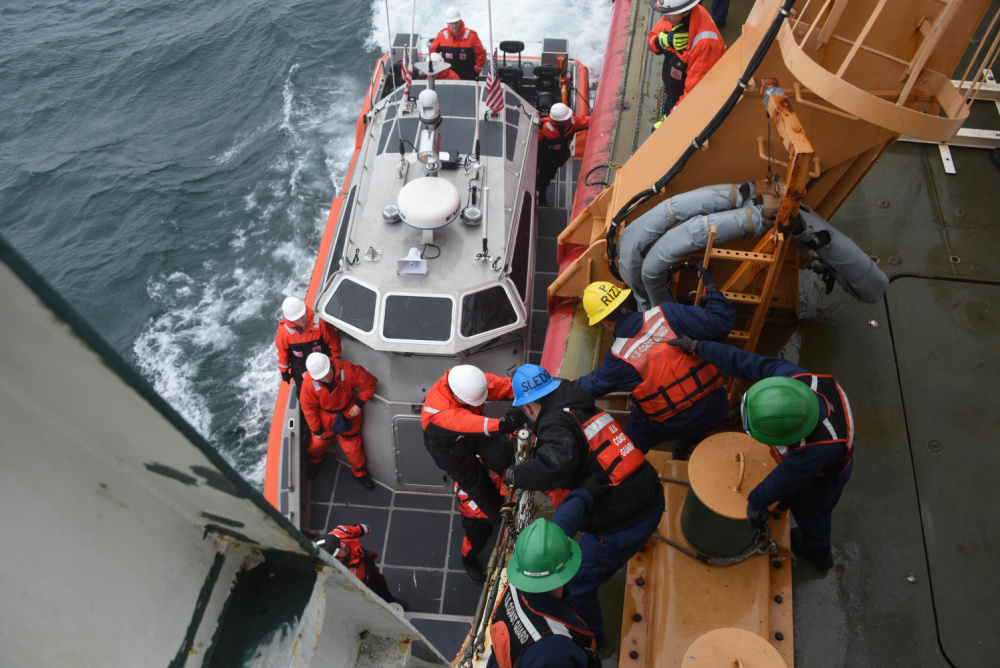
Coast Guard Cutter Healy crew members assist Coast Guard Cutter Midgett crew members while they climb aboard from the cutter boat in the Bering Strait, July 25, 2021. The Midgett is a national security cutter that ensures U.S. presence to assure U.S. sovereignty and resource security in remote Pacific regions. U.S. Coast Guard photo by Petty Officer 3rd Class Janessa Warschkow.

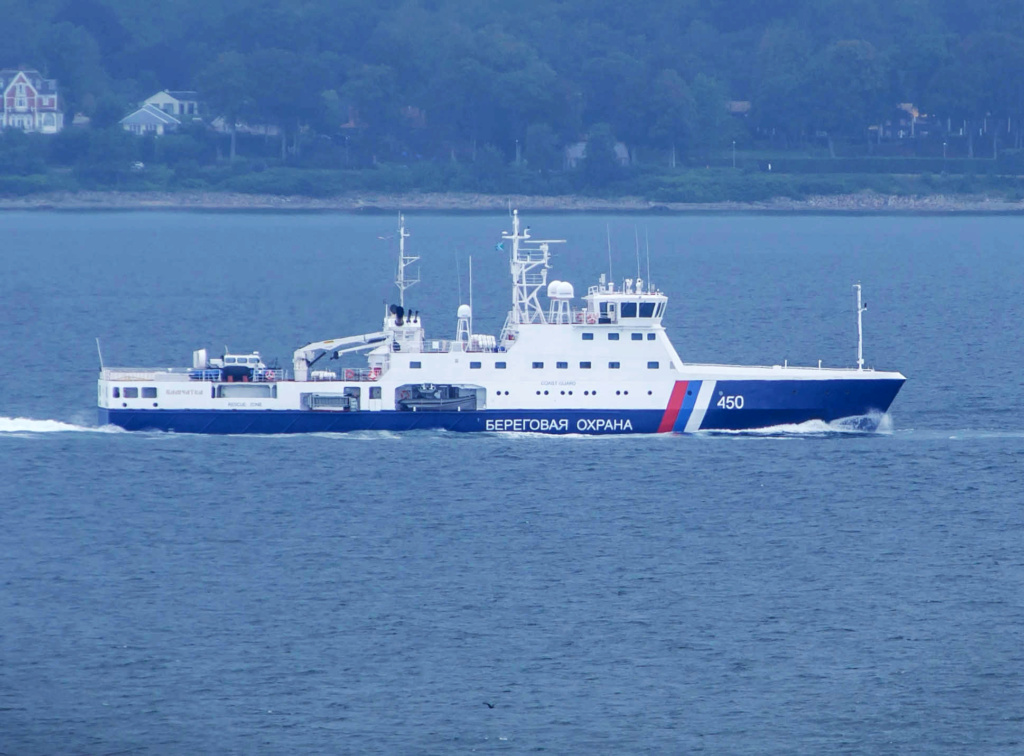
The Russian patrol ship Kamchatka, mentioned in the story, is pictured below. It is a member of the 1066 ton Purga class.

The Kamchatka border patrol ship (serial number 052) of project 22120 of the Coast Guard of the Russian Federal Border Guard Service crosses the Öresund Strait, heading from the Baltic Sea to the North, 08/20/2019 (c) frankmh

News Release

U.S. Coast Guard 17th District Alaska

U.S. Coast Guard patrols U.S. Arctic

JUNEAU, Alaska — Crews aboard Coast Guard Cutters Midgett and Healy patrolled the Bering and Chukchi Seas off the coast of Alaska this summer to demonstrate the Coast Guard’s commitment to ensuring a safe and secure Arctic and to work respectively with Canadian and Russian counterparts on shared maritime interests. 

In late July, the crew of Coast Guard Cutter Midgett, one of the Service’s National Security Cutters, conducted combined operations and training with the Canadian coast guard Ship Sir Wilfrid Laurier in the Chukchi Sea, a joint patrol of the U.S.-Russia maritime boundary north of the Diomede Islands with the Russian Border Guard vessel Kamchatka, and a joint transit of the Bering Strait with the Coast Guard Cutter Healy, one of the service’s two operational polar icebreakers. In each case, Coast Guard Air Station Kodiak crews forward-deployed to Kotzebue, Alaska in an HC-130J Hercules airplane supported the operations.

The simultaneous presence of Healy and Midgett in the Arctic region signals the increasing demand for the merged icebreaking and maritime security capability required of future Polar Security Cutters.

Midgett is the Coast Guard’s eighth National Security Cutter and is homeported in Honolulu. Featuring advanced command-and-control capabilities, national security cutters are the flagship of the Coast Guard’s fleet, deploying globally to confront national security threats, strengthen maritime governance, and promote economic prosperity. While National Security Cutters possess advanced operational capabilities, more than 70% of the Coast Guard’s offshore presence is the service’s aging fleet of medium endurance cutters, many of which are over 50 years old and approaching the end of their service life. Replacing the fleet with new Offshore Patrol Cutters is one of the Coast Guard’s top acquisition priorities. The first Offshore Patrol Cutter is scheduled to be delivered in 2022.

Healy is a medium icebreaker capable of conducting a wide range of Coast Guard operations including search and rescue, ship escorts, environmental protection, and enforcement of laws and treaties in the polar regions. Uniquely equipped to conduct scientific operations, Healy is also the Nation’s premiere high-latitude research vessel. Healy is the only U.S. military surface vessel that routinely deploys to the ice-covered waters of the Arctic to provide access and secure national interests related to our maritime borders and natural resources.  Check here for photo updates from Healy’s Arctic deployment or subscribe to receive updates in your inbox here.

Russian Coast Guard Website

Project 22460, new version of Rubin. Armed with one 57mm gun and two 30mm guns (in the turret of the Taifun-VDV).

If you are interested in the Russian Coast Guard, I ran across a website that seems to have a lot of information. It is definitely a pro-Russian site. You may want to be careful about clicking on any of the photos, my software stopped a “malicious download.”

“The U.S. Sea Services (Navy, Marines, Coast Guard) Are Preparing For Great Power War” –1945

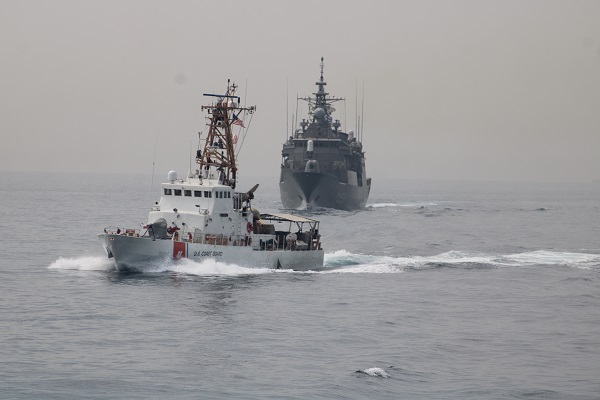
ARABIAN GULF (Feb. 25, 2021) The U.S. Coast Guard cutter USCGC Maui (WPB 1304) and the Greek navy guided-missile frigate HS Hydra (F452) participate in a passing exercise in the Arabian Gulf, Feb. 25, 2021. U.S. Coast Guard Patrol Forces Southwest Asia (PATFORSWA) is comprised of six 110-foot cutters, the Maritime Engagement Team, shore-side support personnel, and is the Coast Guard’s largest unit outside of the U.S. playing a key role in supporting Navy security cooperation, maritime security, and maritime infrastructure protection operations in the U.S. 5th Fleet area of operations. (U.S. Coast Guard photo)

James Holmes (a name worth remembering) discusses the Large Scale Exercise 2021 and war gaming in general.

This is the first indication I have seen that the Coast Guard was participating, though at least limited participation was expected. If anyone has any information about about Coast Guard’s actual participation, please provide a comment.

I’ve often thought we might learn a lot about drug interdiction by employing war gaming with an intelligent and aggressive “Red Cell.”

Finding someone who is trying not to be found is far different from doing SAR, finding someone who hopes to be found. I don’t know if we have begun to apply Operations Research developed search patterns for moving targets. I know when I was active duty it was an alien concept.

“Congress Rips Into OMB Over Coast Guard Budget And Unfunded Priorities List” –Forbes

US Capital West Side, by Martin Falbisoner

Forbes’ Craig Hooper gives us a look at the Coast Guard’s unfunded priority list for FY2022, with an push to fully fund it, and a suggestion how the Coast Guard and DHS could provide a clearer picture of our funding requirements.

It’s all true, but I would note that, actually having an unfunded priority list, is an improvement. Not many years ago the Coast Guard repeatedly failed to submit an unfunded priority list.

From almost his first day as Commandant, Admiral Schultz has been talking about the infrastructure shortfall. Previously all the emphasis had been on the recapitalization of the Afloat units. The push to replace all H-65s with H-60s is an even more recent initiative.

I suspect, as has happened the last few years, Congress will provide an increase over the Administration request.

Thanks to Paul for bringing this to my attention. 

“Coast Guard Station Scituate closure will have a ‘dire effect,’ South Shore officials warn” –WickedLocal

Obviously people like having the Coast Guard around. It seems the Coast Guard is again attempting to close “redundant” stations, in this case the seasonal station at Scituate, Massachusetts, situated between Boston and Plymouth. You can see the typical result here.

February 2020, we had a similar story.

Thanks to Paul for bringing this to my attention. 

“The US Coast Guard urgently needs help” –Senator Roger Wicker (R-Miss) in Defense News

The original boathouse for the Toms River Life Saving Station in 1898. Image from Norman McClure of Toms River.

Defense News brings us an editorial in support of increased funding to reduce the Coast Guard’s $3B maintenance and infrastructure backlog, by Roger Wicker, R-Miss., a member of the Senate Armed Services Committee and ranking member of the Committee on Commerce, Science, and Transportation.

“What often goes unreported, however, is the woeful lack of resources supporting the Coast Guard’s missions.

“In too many cases, the Coast Guard operates out of trailers in parking lots, uninhabitable buildings and crumbling piers. It is time to give this branch of our armed forces its rightful attention and support.”

The commentary points out how Coast Guard funding for operations and support has fallen behind.

Since 2010, the Coast Guard has seen only a modest 8 percent increase in operation and support funding. By comparison, all other services have seen increases between 28 and 42 percent. Having the Coast Guard clearly identify its needs will inform Congress about how to modernize and recapitalize our Coast Guard fleet to meet its mission requirements.

That does also seem to suggest, that the Coast Guard has been remiss in identifying what it needs. The old habits of “doing more with less,” which ultimately result in either doing less or pushing the limits of safety, die hard.

“Royal Canadian Navy HMCS Harry DeWolf Departs On Her Maiden Operational Deployment” –Naval News

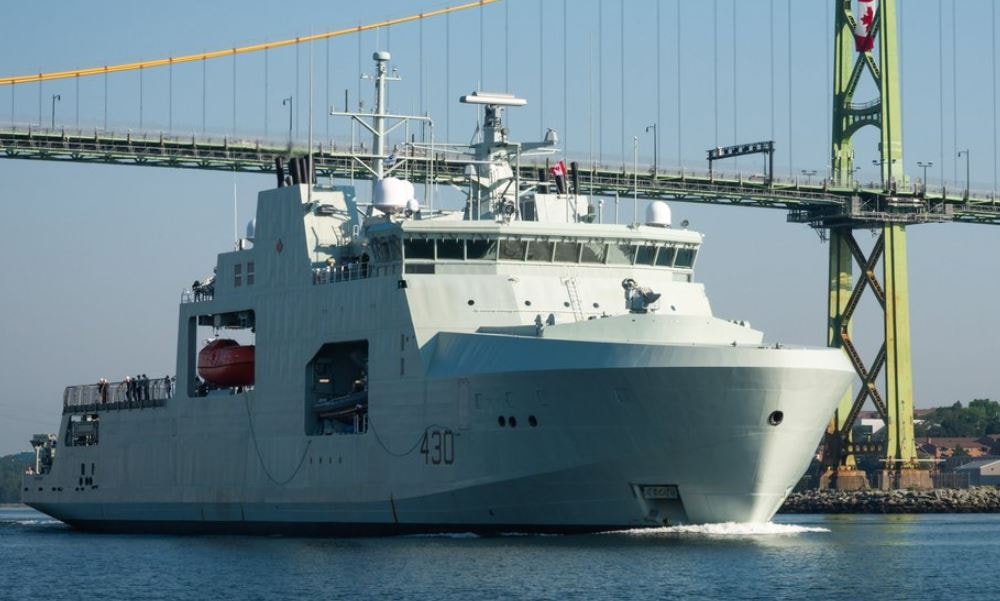
HMCS Harry DeWolf, leaving HMC Dockyard in Halifax and steaming under Angus L. Macdonald
suspension bridge crossing Halifax Harbour in Nova Scotia, Canada

Naval News reports the first of Canada’s planned eight Arctic Offshore Patrol Ships (AOPS) (six for their Navy and two for their Coast Guard) departed on its first operational deployment on August 3. The deployment is expected to take four months and will include participation in the annual Nanook Exercise with partners including the USCG, transit of the North West Passage, counter clockwise circumnavigation of North America, and drug operations in the Eastern Pacific transit zone and the Caribbean again in cooperation with the USCG.

USCGC Healy departed for a clockwise circumnavigation of North America on July 10. Presumably these two will arrange to say hello as they pass. Hopefully both crews will be home by Christmas.

“A NEW U.S. NAVY PLANNING MODEL FOR LOWER-THRESHOLD MARITIME SECURITY OPERATIONS” –CIMSEC

CIMSEC has published a two part discussion of planning for Maritime Security Operations written by retired US Coast Guard Captain Andrew Norris.

Much of the discussion is about the inadequacies of the current planning guidance. It picks up in Part 2 with a discussion of the “Constraint-Restraint-Enabler-Imperative (C-R-E-I) Model.”

While written as guidance for the planner, it might also serve as a checklist for the operator, as he prepares execute Maritime Security Operation. Have constraints, restraints, enablers, and imperatives been identified and are they adequately understood? Has training in these consideration been adequate? Do I have everything I need to implement and exploit the enablers?