Cruise Ship Stranded off Norway, Passengers being Evacuated

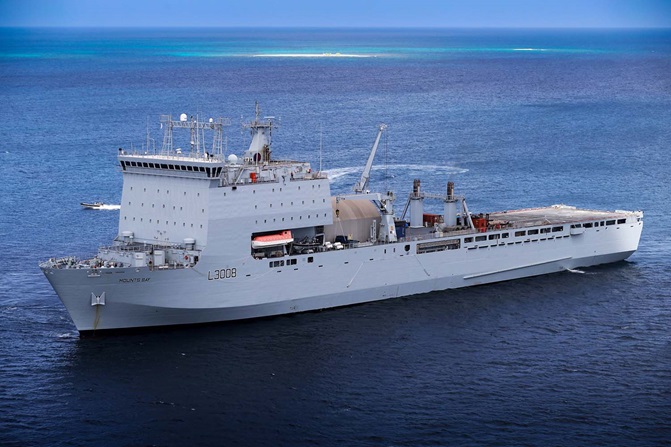
Norway is apparently in the middle of a potentially huge SAR case. Aljazeera reports,

The maritime rescue service on Saturday said the Viking Sky, which suffered an engine failure and has roughly 1,300 passengers and crew on board, had sent a mayday signal as it had been drifting towards land..

The ship has managed to restart one engine and is at anchor two kilometers off shore. Passengers are being hoisted by helicopter. Fishing vessels are assisting. More from the BBC here.

Top Coast Guard officer outlines future of service in San Pedro –News Release

Below you will find a CCGD11 news release regarding the Commandant’s State of the Coast Guard speech delivered today quoted in full. It also includes a link to the text of the speech. I will make some additional observations at the end. 

State of the Coast Guard Address 2019State of the Coast Guard 2019State of the Coast Guard 2019State of the Coast Guard Address 2019State of the Coast Guard address 2019

State of the Coast Guard 2019 State of the Coast Guard 2019

Editors’ Note: Click on above image to download full-resolution photos and view the videos.

SAN PEDRO, Calif. — The Commandant of the United States Coast Guard delivered his first State of the Coast Guard address Thursday at Coast Guard Base Los Angeles-Long Beach in San Pedro.

Speaking from the largest port in the nation, Adm. Karl Schultz highlighted Coast Guard security and marine safety operations, which facilitate $4.6 trillion in annual economic activity.

Schultz also recognized the service and sacrifice of Coast Guard men and women deployed around the world ensuring global peace and prosperity, including servicemembers supporting U.S. Indo-Pacific Command and U.S. Central Command. He also honored servicemembers in San Pedro, who help ensure the safety and timely movement of vessels operating in the Ports of Los Angeles-Long Beach.

“We must make a difference today, for the Coast Guard of tomorrow,” said Schultz. “Our Coast Guard men and women are united by a shared commitment and eagerness to serve, to demonstrate skill and courage, so that America’s Coast Guard will remain Semper Paratus—Always Ready.”

Schultz also made multiple policy and acquisition announcements including:

  • Increased presence in Southern California, including construction of a new air station at Ventura County Naval Station; the homeporting of the service’s first two new Offshore Patrol Cutters at Base Los Angeles-Long Beach in 2021; and four new Fast Response Cutters in Los Angeles.
  • Confirmed the service was poised to release an update to its Arctic Strategic Outlook in the coming weeks.
  • $675 million to fully fund the Polar Security Cutter and award the first construction contract for the cutter in the spring.
  • Provided an update on Coast Guard Cutter Bertholf’s deployment to the Western Pacific in support of United States Indo-Pacific Command combating North Korea’s maritime sanctions evasion activity.
  • Confirmed the service will accelerate delivery of unmanned aerial systems for National Security Cutters to enable operations that reduce violence and economic/political instability in the Western Hemisphere.

“As Congress makes tough fiscal decisions and looks at the best ways to spend the nation’s precious resources, there’s not a better return on investment in government than the United States Coast Guard,” said Schultz.

Download his full remarks at www.uscg.mil/AlwaysReady.


My Comments: 

The statement that the first two OPCs will go to Long Angeles/Long Beach is the first time I have heard this. Still don’t think I have heard where NSCs #9-11 are going.

The Commandant wants to double the rate at which we procure Scan Eagle for the  National Security Cutters and he wants to put them on OPCs as well.

He talked a lot about Port Security cyber. This is going to continue to grow.

He talked about making the service more inclusive, and a safe workplace. In this regard he referred to the Women’s retention taskforce. which is expected to report next week. He also indicated there will be an underrepresented minorities retention task force.

He reported that he was putting Coast Guard Reservists directly under vice Commandant for Operations.

These are inevitably feel good events, and watching it you could feel pride in the Coast Guard and in its people and accomplishments. I know I did. It is not good form to  complain too much about the administration or the Department or how Congress has treated the Coast Guard, but the Commandant did talk about how the Coast Guard had a backlog of deferred maintenance and a $1.7B shore infrastructure backlog, and that the operating accounts have been flatlined for the last eight years resulting in a 10% loss of purchasing power. He included a reminder in the third and forth paragraph from the end that we really need a steady budget increase. He did not say it, but that is not the case with the FY2020 budget, in fact it is smaller than the FY2019 budget. Congress could still fix that.

“To be the Coast Guard that America needs takes more than just recapitalization. It requires sufficient operating and support funding to maintain our platforms, to train and equip our crews, and to support our Coast Guardsmen and their families. We’re appreciative of the fiscal year 2019 enacted budget, which provided over $2.2 billion dollars for capital investments and ensured continued frontline operations. I am also thankful for the President’s fiscal year 2020 budget request, which will sustain our Service.

“However, to be an absolutely Ready, Relevant, and Responsive Coast Guard requires a 5% annual increase in operating and support funding. As Congress makes tough fiscal decisions and looks at the best ways to spend the Nation’s precious resources, there’s not a better return on investment in government than the United States Coast Guard.”

Coast Guard FY 2020 Budget Request

Below I have duplicated the Coast Guard’s FY2020 Budget “Fact Sheet”. You can see supporting documents here. My comments are at the bottom.

U.S. Coast Guard Fact Sheet

Fiscal Year 2020 President’s Budget  

BACKGROUND: The FY 2020 President’s Budget requests $11.34 billion for the Coast Guard, including $9.32 billion in discretionary funding.  This begins to address the Service’s erosion of readiness through critical investments in the workforce, cybersecurity, and depot maintenance of legacy assets and infrastructure.  The Budget also supports the Service’s highest priority acquisition, the Offshore Patrol Cutter (OPC), and continues recapitalization efforts for capital assets and infrastructure.

BUDGET PRIORITIES:

  • Maximize Readiness Today and Tomorrow—increasing global complexity and expanding demand for Coast Guard services necessitates investment in the workforce, assets, and infrastructure to address the erosion of Service readiness.   
  • Address the Nation’s Complex Maritime Challenges—as the Nation’s unique instrument across the full spectrum of maritime operations, the Budget invests in capabilities and capacity to detect, deter, and counter maritime threats in support of homeland security and defense operations.
  • Deliver Mission Excellence Anytime, Anywhere—the Coast Guard is an agile and adaptive force whose greatest value to the Nation is an ability to rapidly shift among its many missions. The Budget advances modernization efforts in both operations and acquisitions by adapting to the dynamic nature of maritime operations.

MAXIMIZE READINESS TODAY AND TOMORROW: The FY 2020 Budget requests $7.9 billion for Operations & Support (O&S).  Budget highlights include: 

  • $118 million for requisite military pay and allowances as per the FY 2019 National Defense Authorization Act requirements, which keeps DoD and Coast Guard military members compensated equitably, as well as providing civilian benefits and retirement contributions.
  • $59 million for new assets including: crew and shore-side support for NSC #9; operations and maintenance for FRCs #37-41; crews for FRCs #39-43; shore-side maintenance personnel for FRC homeports; crew for OPC #1; maintenance support personnel for the C-27J fleet; and operations, maintenance, and flight crews for HC-130J aircraft #12. 
  • $27 million for human capital support infrastructure, and vessel, aircraft, and C5I maintenance funding to address spare parts inventory shortfalls that have led to decreased operations and lower readiness levels due to unplanned repairs. 
  • $22 million for the final phase of Federal Aviation Administration (FAA) compliance upgrades, including the replacement of obsolete aircraft equipment and systems necessary to meet 2020 airspace requirements.

ADDRESS THE NATION’S COMPLEX MARITIME CHALLENGES: The FY 2020 Budget requests $1.2 billion for Procurement, Construction, & Improvements (PC&I) to continue recapitalization of the Service’s highest priority acquisitions: 

  • $792 million for vessels, including: $457 million for the construction of Offshore Patrol Cutter (OPC) #3 as well as long lead time materials for OPCs #4 and #5; $140 million for the procurement of two Fast Response Cutters (FRCs); $60 milllion for post-delivery activities for the seventh through eleventh National Security Cutters (NSCs); $35 million for program management and production activities associated with the detail design and construction contract for Polar Security Cutters (PSCs); and $15 million for a multi-year Service Life Extension Project (SLEP) for POLAR STAR. 
  • $200 million for aircraft, including: $20 million to support service life extensions for MH-60T helicopters; $50 million for a service life extension and avionics upgrade on the H-65 helicopter fleet; $120 million for missionization of fixed-wing HC-27J and HC-144A aircraft; and $9 million for small unmanned aircraft systems (sUAS).
  • $174 million for shore infrastructure projects, including funding for: utility upgrades and construction at Air Station Ventura, CA; improvements at Station Tillamook Bay, OR; replacement of moorings at Station Siuslaw River, OR; and facility upgrades and construction to support FRC and OPC homeports.

DELIVER MISSION EXCELLENCE ANYTIME, ANYWHERE: In FY 2020, the Coast Guard will make sound, riskbased decisions to efficiently allocate resources while investing in critical recapitalization initiatives.  Highlights include: 

  • $15 million to address obsolete communications equipment on cutters, aircraft, and shore facilities to ensure continued interoperability with DoD Combatant Commanders (COCOMs) in theater, as well as in the high latitudes, and during disaster response.
  • $12 million in savings associated with the planned decommissioning of one High Endurance Cutter (WHEC) and three 110foot Patrol Boats (WPBs).  These assets are being replaced by new, more capable NSCs and FRCs, respectively.

My Commentary: 

The $118M quoted above for military pay and allowances is to fund the pay increase not the full amount of pay and allowances.

The top line amount in the budget request, $11.34B, is roughly $770M less than the final FY2019 budget and about $860M less than the FY2018 budget as enacted. Fortunately Congress has usually made additions to the request, but this request is also less than last year’s request.

The big difference, more than $1B, is in the Procurement, Construction, and Improvement account. Amounts requested for Ships and Boats, Aircraft, and Shore-side Infrastructure are all lower. The $1.2B total is little more than half the approximately $2B/year the Coast Guard has been saying they need.

Items missing in the description of the budget that might have been expected, are a second “Polar Security Cutter” (better to do it in 2020 when we are not trying to also fund two OPCs), the Waterways Commerce Cutter, any additional HC-130J aircraft, and a land based Unmanned Air System. The procurement of only two Fast Response Cutters is below the optimum build rate and appears to have resulted in higher unit costs.

“Coast Guard enforces North Korea sanctions in the East China Sea” –CoastGuardNews

The crew of the U.S. Coast Guard Cutter Bertholf (WMSL 750) is on patrol of the Western Pacific Ocean Jan. 22, 2019. The crew aims to improve regional governance and security and enhance partner nations’ maritime capabilities. U.S. Coast Guard photo by Chief Petty Officer John Masson

Photo: The crew of the U.S. Coast Guard Cutter Bertholf (WMSL 750) on patrol in the Western Pacific Ocean Jan. 22, 2019.  U.S. Coast Guard photo by Chief Petty Officer John Masson

Coast Guard News reports,

The U.S. Coast Guard Cutter Bertholf pulled into Sasebo March 3 following a deployment in the East China Sea where the crew assisted in United Nations Security Council Resolutions (UNSCR) enforcement against illicit ship-to-ship transfers that violate North Korea sanctions.

Thought something unusual was going on when Bertholf departed. Plus we have the Commandant’s Thursday State of the Coast Guard address is to include, “Coast Guard deployments to the western Pacific Ocean in support of U.S. national security and foreign policy objectives.”

Thought we might get into this. 

Note, Bertholf was enforcing sanctions in the East China Sea. It may have been less upsetting to China that this was being done by a white hull, than by a gray hull with a Coast Guard detachment on board. Probably the same would be true about upsetting the Russians on the Eastern side of the Peninsula.

“Narco_2019-03” –Covert Shores

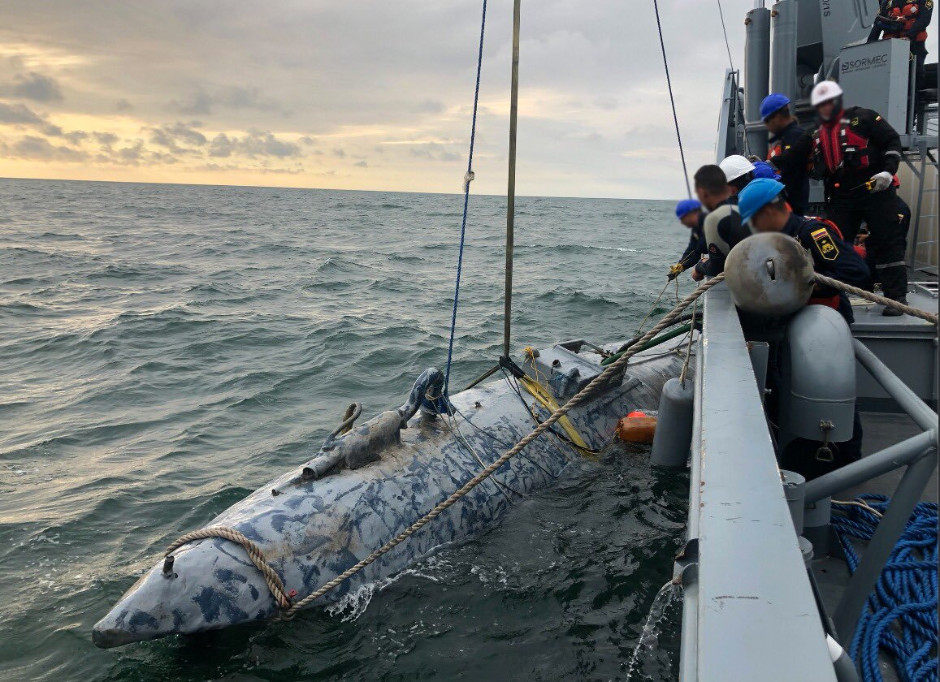
A Low Profile vessel (LPV) intercepted by the Colombian Navy in March may represent the first sighting of a new family of nacrosubs. The camouflaged vessel combines the once-standard layout of having the payload in the bow, cockpit amidships and single internally mounted engine in the stern with the recent trend to Very Slender Vessels. VSV-narcosubs started to be seen spring 2017 and have evolved into two distinct lineages, but all have featured aft-mounted cockpits and outboard motors. The boat is 20 meters long and just two meters wide giving a fineness ratio of 10:1.

Covert Shores brings us another update on Narco trafficking vessels and recent captures by the USCG and by Colombia.

Once Again Argentine Coast Guard Fires on Chinese F/V

We have multiple reports  (here) (and here) that an Argentine Coast Guard vessel, PNA Doctor Manuel Mantilla, fired several shots into Chinese fishing vessel Hua Xiang 801

This is not the first time a Chinese fishing vessel refused to stop, attempted to ram an Argentine Coast Guard vessel, and was fired into. It happened in Mar. 2016 when the Chinese vessel was sunk. It happened again in Feb. 2018.

Chinese Actions:

The Chinese vessel was reportedly not using an Automatic Identification System (AIS). The vessel refused to stop when directed to do so. Ignored warning shots across the bow, followed by shots in the forward part of the ship. At one point it appeared they attempted to ram the Argentinian vessel.

Media in Argentina have not been able to identify who owns the Hua Xiang 801 and, China’s Fisheries Management Bureau at the Agricultural Ministry, which licenses China’s distant-water fleet, hasn’t divulged the ownership details of the Hua Xiang 801.

The Chinese claim that this was a result of Argentina not providing details of the coordinates for the limits of its EEZ. The fishing vessel was reportedly less than a mile inside the Argentine EEZ, but this sounds to me like an attempt to shift the burden of responsibility to Argentina. 

The Chinese have repeatedly shown a refusal to submit to boarding and seizure (and here).

Argentine Actions:

The Argentines clearly wanted to avoid killing anyone. They warned the Chinese vessel in Spanish, English, and what I presume to be Mandarin, that they would be firing into the vessel and where they intended to hit it. Shots were aimed at the bow and above the waterline.

Why couldn’t the stop this fishing vessel?:

Whatever you may think of the Argentine decision, they attempted to stop a fishing vessel and they failed. The cutter which is similar in size to a 210, is reportedly armed with a 40mm/70 mount like the one illustrated below, and a pair of .50 caliber machine guns.

Bofors SAK-40/L70-315 naval mounting. This was a fully manual mounting intended for light patrol craft. Picture copyrighted by Bofors Defence.

On a video of a ship of this class I observed that their 40mm had been replaced by a Nexter 20mm gun like the one below.


If they really needed to stop this fishing vessel they needed to hit it in the engineroom. They might have attempted this after warning the fishing vessel of their intention. Both weapons are probably accurate enough to ensure rounds go where intended if fired in a single shot mode.

Also don’t see why they would not fire at the waterline. Would have probably limited their ability to escape. The new 30 mm swimmer round might have helped in this regard if they had been so equipped.


Navy’s New Tug and Salvage Vessel –Navajo Class

Designated as T-ATS(X) by the Naval Sea Systems Command (NAVSEA), the new class of vessels will be based on existing commercial towing offshore vessel designs . Gulf Island Shipyards rendering

Workboat reports on the Navy’s new towing and salvage ship. It is a brute capable of towing a nuclear powered carrier. The price is certainly right, $63.5M for a 263 foot vessel. It is on the slow side, but it might find some use in support of Coast Guard Law Enforcement operations.

“The 262.8’x59.06’x24.61′ vessel designated T-ATS, to be built at Gulf Island Shipyards, Houma, La., under a $63.5 million contract, will be based on an existing commercial offshore towing design, to replace the Navy’s current T-ATF and T-ARS 50 ships serving under the U.S. Military Sealift Command.

“The design by Gulf Island and Wärtsilä will have its main propulsion come from twin Wartsila 8L32 diesel engines, each producing 6,217 hp at 750 rpm. A pair of Wärtsilä 3700 mm (145″), controllable pitch, 4-bladed props and Wärtsilä marine gears will give the vessel a running speed of 13 knots.”

One of these might make a decent support vessel for Webber Class WPCs and Cyclone Class PCs operating in the drug transit zones.

“Top Coast Guard officer to outline future of service in San Pedro” –State of the Coast Guard News Release

Below you will find a CCGD11 news release quoted in its entirety. I find it significant that the address will take place in a Pacific port rather than in DC. Also note the bullet point, “Coast Guard deployments to the western Pacific Ocean in support of U.S. national security and foreign policy objectives.” It seems the Coast Guard is also “Pivoting” to the Pacific. Even the Arctic strategy and new icebreakers are PACAREA issues. Nice to see the Coast Guard recognizing the growing importance of the Pacific. As noted below, you can see the address live. (Presumably all times are Pacific Coast.) Once it shows up on YouTube I will post it here as well.

united states coast guard

News Release

U.S. Coast Guard 11th District PA Detachment LA/LB
Contact: Coast Guard PA Detachment LA/LB
Office: (310) 521-4260
After Hours: (310) 781-0619
PA Detachment LA/LB online newsroom

Top Coast Guard officer to outline future of service in San Pedro

Coast Guard Commandant Adm. Karl Schultz visits with Coast Guard crews stationed in San Diego, California, June 20, 2018. U.S. Coast Guard photo by Petty Officer 1st Class Jetta Disco.

Editors’ Note: Click on above image to download full-resolution version.

WHO: Adm. Karl Schultz, commandant of the United States Coast Guard

WHAT: The service chief is scheduled to give his first annual State of the Coast Guard address

WHEN: Thursday at 8:00 a.m.

WHERE: Coast Guard Base Los Angeles-Long Beach at 1001 S. Seaside Ave., San Pedro, CA 90731

HOW: Media may RSVP at (310) 781-0619 no later than Wednesday at 5 p.m. A government-issued identification and media credentials are required for access to Base Los Angeles-Long Beach. Media can access the event Wednesday at 7:30 a.m.

SAN PEDRO, Calif. — The Commandant of the United States Coast Guard will deliver his first State of the Coast Guard address Thursday at Coast Guard Base Los Angeles-Long Beach in San Pedro.

Speaking from the largest port in the nation, Adm. Karl Schultz will highlight Coast Guard security and marine safety operations, which facilitate $4.6 trillion in annual economic activity.

Adm. Schultz will also recognize the service and sacrifice of Coast Guard men and women deployed around the world ensuring global peace and prosperity, including servicemembers supporting U.S. Indo-Pacific Command and U.S. Central Command. He will also honor servicemembers in San Pedro, who help ensure the safety and timely movement of vessels operating in the Ports of Los Angeles-Long Beach.

Adm. Schultz is scheduled to make multiple policy and acquisition announcements:

  • The expansion of the Coast Guard’s presence in the Los Angeles area with a new base, vessels and support personnel.
  • An update to the Coast Guard’s Arctic Strategy and future Arctic operations.
  • Full funding and plans to award the contract for the construction of the Coast Guard’s first Polar Security Cutter.
  • Coast Guard deployments to the western Pacific Ocean in support of U.S. national security and foreign policy objectives.
  • New acquisitions to enhance maritime operations combatting dangerous criminal organizations off of Central and South America. These operations reduce violence and economic/political instability driving illegal immigration toward the U.S. Southern Border.

Detailed Schedule of Events:

  • 8:15 – 8:30 a.m.: Adm. Schultz will be available for media interviews
  • 8:30 – 9:40 a.m.: Displays and tours of Coast Guard assets will be available. Local Coast Guard members will be available for interviews
  • 9:50 – 10:45 a.m.: State of the Coast Guard address
  • 10:45 – 11:15 a.m.: Demonstrations of search and rescue and non-compliant vessel/use-of-force capabilities
  • 12:45 – 2:00 p.m.: Adm. Karl Schultz invites the media to get underway on a Coast Guard cutter. Adm. Schultz will be available for additional interviews aboard the vessel.

The event will also be live streamed at https://www.uscg.mil/alwaysready/ and www.dvidshub.net/webcast/19022.

“The Coast Guard Needs an Innovation Outpost in Silicon Valley” –USNI

A very interesting proposal from a very interesting young man.

There are no guarantees with this sort of proposal, but the cost is low, and the potential payoffs are huge.

Note the information on the author that was included in the US Naval Institute Proceedings Article I have included below.

Cadet Twarog is studying electrical engineering at the U.S. Coast Guard Academy.  He is interested in unmanned aircraft systems, remote sensing, and crisis mapping.  During Hurricane Harvey, he helped lead the Coast Guard’s first crisis mapping response, which ultimately collected over 1000 search-and- rescue cases posted to social media. Outside of school, he is a competitive cyclist and EMT.  He won third prize in the 2018 Naval Institute Coast Guard Essay Contest for his essay, “Hurricane Ready: The Coast Guard Adapts to the Social Media Storm.”