“Nation’s only heavy icebreaker returns home following 105-day Antarctic trip” –PACAREA

Below is a PacArea news release quoted in full. Sounds like a tough deployment, but they had the talent to pull it off.

united states coast guard

News Release

March 11, 2019
U.S. Coast Guard Pacific Area
Contact: Coast Guard Pacific Area Public Affairs
Office: (510) 437-3375
After Hours: (510) 816-1700
Pacific Area online newsroom

Nation’s only heavy icebreaker returns home following 105-day Antarctic trip

Nation's only heavy icebreaker returns from Antarctic mission Nation's only heavy icebreaker returns from Antarctic mission Nation's only heavy icebreaker returns from Antarctic mission
Coast Guard Cutter Polar Star at McMurdo Station Coast Guard Cutter Polar Star breaking nice near McMurdo Station, Antarctica Coast Guard Cutter Polar Star escorting the Ocean Giant

Editors’ Note: Click on images to download high resolution version.

SEATTLE — The 150-member crew of the U.S. Coast Guard Cutter Polar Star returned Monday to their homeport of Seattle following a 105-day deployment to Antarctica in support of Operation Deep Freeze.

Operation Deep Freeze is an annual joint military service mission in support of the National Science Foundation, the lead agency for the United States Antarctic Program. Since 1955, the U.S. Department of Defense and the U.S. Coast Guard have assisted in providing air and maritime support throughout the Antarctic continent.

This year marks the 63rd iteration of the annual operation. The Polar Star crew departed Seattle on Nov. 27 for their sixth deployment in as many years and traveled 11,200-nautical-miles to Antarctica.

Upon arrival in McMurdo Sound, Antarctica, the Polar Star broke through 16.5 nautical miles of ice, six to ten feet thick, in order to open a channel to the pier at McMurdo Station. Once the channel was open, the crew refueled Polar Star at McMurdo Station, the United States’ main logistics hub in Antarctica. At the conclusion of a three day port visit to McMurdo Station the ship provided a six-hour familiarization cruise to 156 McMurdo station personnel.

On Jan. 30, the Polar Star escorted the container ship Ocean Giant through the channel, enabling a 10-day offload of 499 containers with 10 million pounds of goods that will resupply McMurdo Station, Amundsen-Scott South Pole Station and other U.S. field camps for the coming 12 months. The Ocean Giant is an ice strengthened vessel contracted by the U.S. Navy’s Military Sealift Command for Operation Deep Freeze.

As in years past, getting the 43-year-old Polar Star to Antarctica was accomplished despite a series of engineering casualties aboard the ship. Commissioned in 1976, the cutter is operating beyond its expected 30-year service life. It is scheduled for a service life extension project starting in 2021.

During the transit to Antarctica, one of the ship’s electrical systems began to smoke, causing damage to wiring in an electrical switchboard, and one of the ship’s two evaporators used to make drinkable water failed. The electrical switchboard was repaired by the crew, and the ship’s evaporator was repaired after parts were received during a port call in Wellington, New Zealand.

The impact from ice operations ruptured the cutter’s centerline shaft seal, allowing water to flood into the ship. Ice breaking operations ceased so embarked Coast Guard and Navy Divers could enter the water to apply a patch outside the hull so Polar Star’s engineers could repair the seal from inside the ship. The engineers donned dry suits and diver’s gloves to enter the 30-degree water of the still slowly flooding bilge to effect the vital repairs. They used special tools fabricated onboard to fix the leaking shaft seal and resume ice breaking operations.

The Polar Star also experienced ship-wide power outages while breaking ice in McMurdo Sound. Crew members spent nine hours shutting down the ship’s power plant and rebooting the electrical system in order to remedy the outages.

On Feb. 10, the crew spent nearly two hours extinguishing a fire in the ship’s incinerator room while the ship was approximately 650-nautical-miles north of McMurdo Sound, Antarctica. The fire damaged the incinerator and some electrical wiring in the room was damaged by fire fighting water. There were no personnel injuries or damage to equipment outside the space. Repairs to the incinerator are already scheduled for Polar Star’s upcoming inport maintenance period.

Presently, the U.S. Coast Guard maintains two icebreakers – the Coast Guard Cutter Healy, which is a medium icebreaker, and the Polar Star, the United States’ only heavy icebreaker. If a catastrophic event, such as getting stuck in the ice, were to happen to the Healy in the Arctic or to the Polar Star near Antarctica, the U.S. Coast Guard is left without a self-rescue capability.

By contrast, Russia currently operates more than 50 icebreakers – several of which are nuclear powered.

Reserved for Operation Deep Freeze each year, the Polar Star spends the Southern Hemisphere summer breaking ice near Antarctica, and when the mission is complete, the Polar Star returns annually to dry dock in order to complete critical maintenance and repairs in preparation for the next Operation Deep Freeze mission. Once out of dry dock, the ship returns to Antarctica, and the cycle repeats.

The Coast Guard has been the sole provider of the nation’s polar icebreaking capability since 1965, and is seeking to increase its ice breaking fleet with six new polar icebreakers in order to ensure continued national presence and access to the Polar Regions.

In the fiscal year 2019 budget, Congress appropriated $655 million to begin construction of a new polar security cutter this year, with another $20 million was appropriated for long-lead-time materials to build a second.

In response to the demands of the region, the service is set to release an updated version of its Arctic Strategy, which Adm. Karl Schultz, the commandant of the Coast Guard, is scheduled to discuss March 21 during his annual State of the Coast Guard Address.

“The Coast Guard greatly appreciates the strong support from both the Administration and Congress for funding the polar security cutter program,” said Schultz. “These new cutters are absolutely vital to achieving our national strategic objectives in the Polar Regions – presence equals influence, and we must be present to meet the Nation’s national security and economic needs there in the future.”
“Northrop pitches optionally manned Firebird to monitor Australia’s coasts” –Defense News

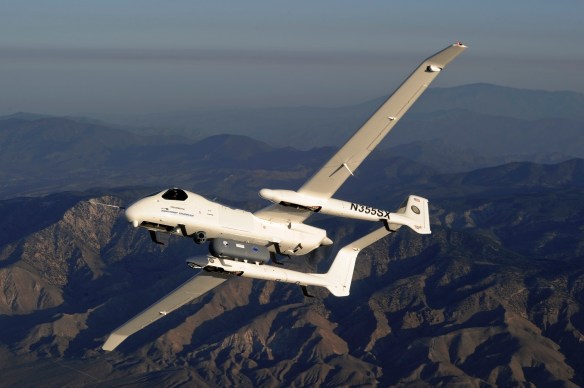
As you may know, the Coast Guard is planning on procuring medium altitude, Long Range/Ultra Long Endurance (LR?ULE) Unmanned Air Systems to enhance Maritime Domain Awareness. I was surprised to find, there may be a contender I was not aware of, and it already has a US government customer, although who it is, is not clear at this time.

Defense News reports Northrop Grumman has proposed an optionally manned aircraft to meet an Australian  Border Force maritime surveillance requirement. The plane, the Firebird, is a product of Scaled Composites

“Firebird is a medium-altitude, long-endurance aircraft with a 30-hour endurance, with a nominal payload. Chappel said the aircraft has been tested with more than 24 different intelligence, surveillance and reconnaissance payloads, which can be swapped in 30 minutes. The initial customer is the U.S. government.”

Scaled Composites is a part of Northrop Grumman now, but originally it was Burt Rutan’s  company. Rutan was known “for designing light, strong, unusual-looking, energy-efficient aircraft. He designed the record-breaking Voyager, which in 1986 was the first plane to fly around the world without stopping or refueling, and the sub-orbitalspaceplaneSpaceShipOne, which won the Ansari X-Prize in 2004 for becoming the first privately funded spacecraft to enter the realm of space twice within a two-week period. With his VariEze and Long-EZ designs, Rutan is responsible for helping popularize both the canard configuration and the use of moldless composite construction in the homebuilt aircraft industry.” Now Scaled Composites functions as Northrop Grumman’s Skunk Works.

Meanwhile the Navy is also procuring unmanned systems with a similar capability in the form of another Northrop Grumman system, the MQ-4C Triton, which is a high altitude system. Hopefully there will be a sharing of information, but inevitably Navy and Coast Guard interests differ. Still the systems might prove complementary.

“ALCOAST 071/19 – MAR 2019 2019 SEA-AIR-SPACE (SAS) GLOBAL MARITIME EXPOSITION”

Below is an ALCOAST discussing Coast Guard participation in the “Sea-Air-Space (SAS) Global Maritime Exposition” March 6-8. This is an activity under the auspices of the Navy League. More event information can be found here. This is a big event and we can expect to see news of some new developments presented at the show. The exhibitor list runs to ten pages.

united states coast guard

R 051034 MAR 19
FM COMDT COGARD WASHINGTON DC//CG-092//
TO ALCOAST

UNCLAS //N05700//
ALCOAST 071/19
COMDTNOTE 5700
SUBJ: 2019 SEA-AIR-SPACE (SAS) GLOBAL MARITIME EXPOSITION
A: Military Assignments and Authorized Absences, COMDTINST M1000.8 (series)
1. The annual Sea-Air-Space (SAS) Global Maritime Exposition will be held 6-8 May 2019 at the Gaylord National Resort and Conference Center, located in National Harbor, MD. SAS was founded in 1965 as a means to bring the U.S. defense industrial base, private-sector U.S. companies and key military decision makers together for an annual innovative, educational, professional, and maritime-based event located in the heart of Washington, D.C. Sea-Air-Space is now the largest maritime exposition in the U.S. and continues as an invaluable extension of the Navy League’s mission of maritime policy, education, and sea service support.
2. In accordance with REF (A) subject to command approval, attendance is allowed for local participants at no cost to the government. Supervisors should ensure attendance aligns with an employee’s primary duties. Employees who wish to attend for personal interests may use annual leave, accrued compensatory time off or earned credit hours (if available), or leave without pay. Commands outside the National Capital Region may submit no-cost permissive orders for military members who attend.
3. A shuttle will run from Coast Guard Headquarters to the SAS and back on a regular basis throughout the three-day exposition. The shuttle schedule is available at the SAS website: www.seaairspace.org.
4. Registration information is available on the SAS website. There is no charge to attend the SAS for U.S. Coast Guard military members and civilian employees.
5. Uniform is Tropical Blue for attendees. Uniform is Service Dress Bravo for panelists,
moderators, and other presenters.
6. In conjunction with Sea-Air-Space 2019, the annual STEM Expo will be held at the Gaylord on Sunday, May 5. Anyone attending SAS is also welcome to the STEM Expo with the same caveats listed above for the main convention.
7. The COMDT (CG-0923) POC is CAPT Sean Carroll, 202-372-4562, Sean.M.Carroll@uscg.mil.
8. RDML Melissa Bert, Director, Governmental and Public Affairs, sends.
9. Internet release is authorized.

More on the Webber Class WMECs

The Coast Guard Cutter Robert Ward (WPC-1130) is shown shortly after mooring for the first time at its homeport at Coast Guard Base Los Angeles-Long Beach, Oct. 31, 2018. The Robert Ward is the second of four new Fast Response Cutters to be stationed in San Pedro, which will help to protect the people, ports and waterways of the region and maintain security for the global supply chain and critical infrastructure within California. (U.S. Coast Guard photo by Chief Petty Officer Brandyn Hill)

Attended the commissioning of the 30th Webber class cutter, USCGC Robert Ward (WPC-1130) today, March 2.. Eleventh District Commander and Commander Pacific Area were there, and their remarks made it clear that they will try to get the most out of these little ships.

They noted that one of the class was off Central America in the Eastern Pacific drug transit zone and another was in Kwajalein (about 2125 nautical miles from Oahu). As noted earlier these vessels are performing missions that previously would have required a medium endurance cutter.

I asked crew members about what seems to be a relatively limited notional endurance of five days. I was told that they had gone six or seven days between replenishment, but once again the limited capacity of the washer/dryer was mentioned as I had heard in a comment on an earlier post. Might be worthwhile to look into a higher capacity washer/dryer and finding a bit more food storage.

In any case, these vessels are doing things that no Coast Guard patrol boats have done before.

“The Coast Guard Does Not Exist Solely for Preparing for War” –USNI

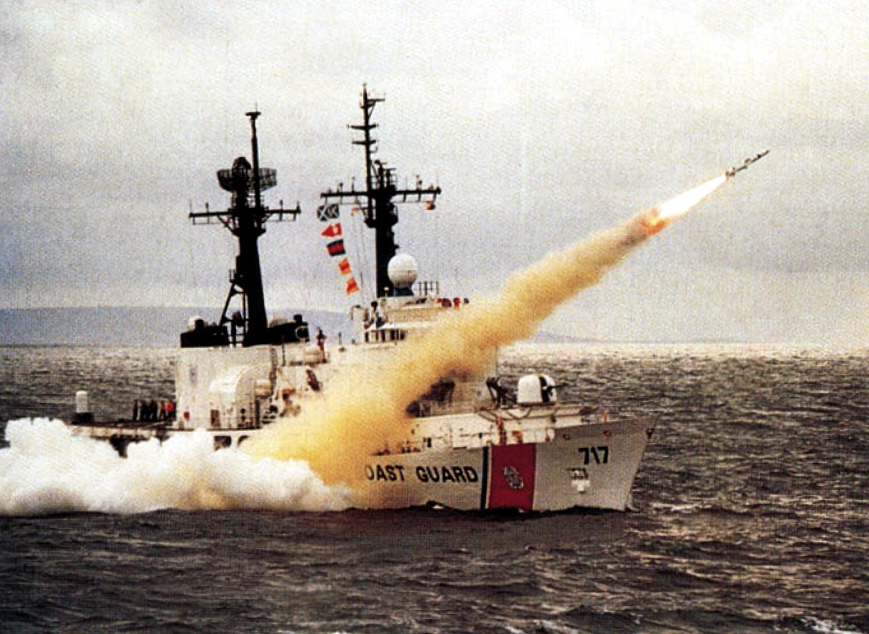
USCGC Mellon seen here launching a Harpoon anti-ship cruise missile in 1990.

The US Naval Institute Blog has a post by Cdr. Shawn Lansing, USCG, that addresses the question of the Coast Guard’s proper place in the Federal government, specifically countering arguments proposing moving the Coast Guard to the DOD. The author also spoke against increasing the military readiness of Coast Guard assets, so let me address the two issues separately.

Should the Coast Guard be part of the DOD?

Here we agree with a resounding NO. Most of the Coast Guard’s missions are outside the DOD’s sphere of interest. (I do think it might be better if the Coast Guard’s budget were considered outside the DHS budget since half of the Coast Guard’s missions are outside the DHS sphere)

Most of the arguments in favor have as their underlying assumption, the DOD is awash in money so the Coast Guard will be well funded. Since Sequestration began in 2013, short term, the Navy seems to have done better in the budget battles than the Coast Guard, but taking the long view I see it otherwise.

I can remember when the Navy was, in terms of personnel, 22 times larger than the Coast Guard. Now it is only about eight times larger. I could not find figures to support the 22 times figure. It was about 50 years ago. It was during the height of the Cold War and the Vietnam War; the Navy had about 900 ships, but looking back at some of my older books, I found personnel figures for 1982, 1999, and 2013. (Numbers of Navy ships by year and type are available here.)

In 1982 the Navy had 555 ships and a total of 548,475 active duty uniformed personnel, the Coast Guard 33, 799, meaning the Coast Guard was 6.15% the size of the Navy, or  the Navy was 16.3 times as large as the Coast Guard.

In 1999 the Navy had 336 ships and a total of 372,696 active duty uniformed personnel, the Coast Guard 35,511, meaning the Coast Guard was 9.53% the size of the Navy, or  the Navy was 10.5 times as large as the Coast Guard. 

In 2013 the Navy had 285 ships and a total of 317,464 active duty uniformed personnel, the Coast Guard 42,190, meaning the Coast Guard was 13.3% the size of the Navy, or  the Navy was 7.5 times as large as the Coast Guard. 

The Navy has been in a long and steady decline, while the Coast Guard had enjoyed moderate growth. Over the 31 years from 1982 to 2013 the number of personnel in Navy fell 42% while the comparable number for the Coast Guard went up 25%.paralleling a US population growth of 36.5% for the same period.

Somehow I cannot imagine that if the Coast Guard had been part of the DOD during that period, that they would have grown the Coast Guard while the Navy and Marine Corps shrank.

Should the Coast Guard increase its Naval Mission Capabilities?

The author quotes the Coast Guard’s first Commandant, Commodore Ellsworth Bertholf,, “the Coast Guard does not exist solely for the purpose of preparing for war. If it did there would be, of course, two navies—a large one and a small one, and that condition, I am sure you will agree, could not long exist.”

For some reason the author seems to think that this idea rules out a more combat ready Coast Guard. Combat readiness is not the Coast Guard’s reason for being, but it is one of our missions.

Naval tasks are not the reason the Coast Guard exist, but the Coast Guard will do them because it is a ready asset that can be diverted from its normal missions when an urgent need exists, just as the Navy sometimes does humanitarian missions because it is a ready asset that exists for other reasons. To do them when required, with any expectation of success requires planning and preparation. 

It is true that combat readiness has a cost. It may require additional personnel and additional training, but the cost of adding a combat capability to a Coast Guard asset that would exist for other reasons, is far less than providing the same capability in an additional Navy asset in addition to a Coast Guard asset without that capability.

It is logical that the degree of effort the Coast Guard puts into readiness will vary with the apparent threat. That is why I find the decision to remove the Harpoon anti-ship missiles and ASW capabilities from the 378s after the collapse of the Soviet Union was logical. Now the situation is changing. The situation in the Pacific is starting to bare an uncanny resemblance to the situation in the late 1930s, except that China is potentially a much more dangerous adversary than Japan ever was. Unlike Japan prior to 1945, China has an industrial capability that approaches and in some respects, particularly ship building, exceeds that of the US. Russia is not the Soviet Union. It is now China’s junior partner, but if its weight is added to that of China, the balance looks even more challenging, and the trend line looking to the future does not look good.

So far the Navy and Coast Guard have not done much about planning the Coast Guard’s role in a near peer conflict. Creative use of Navy owned equipment on cutters and augmentation by Navy Reserves could lessen the impact on the Coast Guard budget. We could see a lot more synergy between the Coast Guard and the Navy Reserve. Planning the use of Navy Reserve ASW helicopters and crew augmentation by Navy Reserve sonar techs and ASW trained officers seem appropriate. They could also augment Coast Guard assets during more routine operations to exploit Navy capabilities such as towed array sonars for law enforcement operations.

There is also the side benefit that the sensors required for Naval roles may make the cutters more capable in low enforcement, migrant interdiction, and SAR.

The Coast Guard proudly claim to be a military service at all times, once again it is time to act like one.

Bertholf’s argument, quoted above, did not mean he did not send cutters to escort convoys in WWI.


Carderock Researchers Contribute to Book on Ship Stability

Below is a Navy news release. Just passing it along for those readers who might have an interest in this topic. 

Story Number: NNS190226-15Release Date: 2/26/2019 3:17:00 PM
By Kelley Stirling, Naval Surface Warfare Center, Carderock Division Public Affairs

WEST BETHESDA, Md. (NNS) — To say this book is a collection of research would be an understatement. “Contemporary Ideas on Ship Stability: Risk of Capsizing” is more like a preservation of knowledge covering the last nine years.

Dr. Vadim Belenky, a naval architect in the Simulations and Analysis Branch at Naval Surface Warfare Center, Carderock Division, was the editor in chief for the book, the chapters of which are papers from engineers, naval architects and professors from around the world. Belenky himself co-authored four of the papers, along with 15 other current or former Carderock employees who authored these papers.

Carderock’s Dr. Art Reed was a co-author on the first chapter of the book, “TEMPEST—A New Computationally Efficient Dynamic Stability Prediction Tool.” His co-author was Bill Belknap, a former Carderock employee and now a technical warrant holder at Naval Sea Systems Command (NAVSEA).

The abstract for chapter one says, “TEMPEST is designed to be computationally efficient to support real-time training simulators, as well as high-resolution evaluation of surface-ship, dynamic-stability performance across a wide range of possible environmental conditions. TEMPEST aims to improve the state of the art for real-time computations through the inclusion of nonlinear (body-exact) hydrodynamic perturbation forces and physics-based, viscosity-influenced lift and cross-flow drag forces.”

Reed, the Navy’s senior research scientist and technical consultant for high-speed ship hydrodynamics, said TEMPEST has been very important software in the field of dynamic stability research, and it was a multi-million-dollar investment for the U.S. Navy.

Reed said that having this chapter start the book just showcases the important contribution Carderock has to the world in the realm of fluid mechanics. He said basing stability assessments solely on previous experience doesn’t allow for novel, unconventional design.

“This book provides an avenue by which the international community concerned with the stability of ships can learn of and be informed about the work on ship stability that we here at Carderock have performed,” Reed said.

Belenky said that while the research in the book, much of it experimental in nature, was not published in peer-reviewed journals, it deserved to be preserved in the form of this book, which seeks to highlight contemporary research that results in products like TEMPEST.

Dr. Jack Price, Carderock’s director of research, said having this research in a one-volume piece of referable materials is very helpful to anybody in the field.

“It really is a compilation of the knowledge of the field as it is right now,” Price said.

He said that within the Navy, there’s a tendency to focus on the advanced engineering and engineering integration that Carderock does, without the understanding that there’s a lot of comprehensive research and foundational research done at Carderock that only Carderock can do.

“We are the only Navy entity that has this understanding and they (the Navy) rely upon us, even if they don’t realize they do, to maintain that research capability,” Price said. “Because if we didn’t do it, for the naval applications that we do, there wouldn’t be anybody in the world that could do that for us—anybody we would trust.”

While the book does include research from laboratories and universities worldwide, the Carderock contribution contains the necessary research specific to the Navy as the seaborne branch of the U.S. military.

Reed said the research presented in this book has been and is being used in support of several ship design efforts. The statistical methods are being used to provide quantitative metrics as to the bounds of Carderock’s seakeeping experimental results; the statistical-extrapolation methods are being used to develop operator guidance and safe-operating envelopes for use onboard ship; and the more fundamental techniques for assessing stability are being investigated for use to provide dynamic stability assessments during early stage design.

“It serves as a resource that anyone needing to assess ship stability can use to develop their own methodologies. This includes intact stability; damaged stability; stability in waves; the verification, validation and accreditation of assessment tools; etc.,” Reed said. “This is becoming critical with the International Maritime Organization (IMO) planning to issue its Second Generation Intact Stability guidance in the next year.”

According to Reed, the book serves as a mechanism to showcase the valuable work being done at Carderock to their sponsors, both internal and external, who can then show their superiors the significance of supporting this important work.

“These papers would not have been chosen by the international editorial board if the work did not constitute a valuable contribution to the literature,” Reed said.

The book contains material from two International Ship Stability Workshops and one International Conference on Stability of Shops and Ocean Vehicles: the 2010 workshop at Wageningen, Netherlands; the 2011 workshop in Washington, D.C.; and the 2012 conference in Athens, Greece.

Belenky worked with four other editors to make the selections for the book: Dr. Kostas Spyrou from the National Technical University of Athens in Greece; Dr. Frans van Walree from the Maritime Research Institute Netherlands; Dr. Marcelo Almeida Santos Neves from the Federal University of Rio de Janeiro in Brazil; and Dr. Naoya Umeda from Osaka University in Japan.

“We pick the most important contributions that were not published in journals, and that will make into the book,” Belenky said.

The book has four major parts:

Part A: Mathematical model of ship motions in waves (15 chapters)

Part B: Dynamics of large motions (12 chapters)

Part C: Experimental research (11 chapters)

Part D: Requirements, regulation and operation (17 chapters)

Belenky said that each chapter had two independent reviewers, mostly authors looking at other chapters. The reviewers were able to send the authors their comments, thus giving them an opportunity to make adjustments to their research.

“They could significantly change their paper, or update it since it was happening over the course of a few years. This allowed them to improve the content, make it modern,” Belenky said, adding that this is the point of the book, to accumulate relevant knowledge in ship stability and preserve it.

COAST GUARD SHORE INFRASTRUCTURE –GAO

The original boathouse for the Toms River Life Saving Station in 1898. Image from Norman McClure of Toms River.

I am going to do something I seldom like to do, and point to a report without comment. I seem to have a lot of topic I have not been able to address lately so this is just a heads up to its existence. The GAO has created a report on the Coast Guard’s management of its shore infrastructure and as usual, they have suggestions. The report is 59 pages. 

Below I duplicated the opening summary:

What GAO Found

About 45 percent of the Coast Guard’s shore infrastructure is beyond its service life, and its current backlogs of maintenance and recapitalization projects, as of 2018, will cost at least $2.6 billion to address, according to Coast Guard information. The deferred maintenance backlog included more than 5,600 projects, with an estimated cost of $900 million. The recapitalization and new construction backlog had 125 projects, with an estimated cost of at least $1.77 billion as of 2018 (see figure). GAO’s analysis of Coast Guard data found that as of November 2018 there were hundreds of recapitalization projects without cost estimates—the majority of recapitalization projects. Coast Guard officials told GAO that these projects are in the preliminary stages of development.
The Coast Guard’s process for managing its shore infrastructure did not fully meet 6 of 9 leading practices that GAO previously identified. Of the nine leading practices, the Coast Guard met three, partially met three, and did not meet three. For example, the Coast Guard generally has not employed models for predicting the outcome of maintenance investments and optimizing among competing investments, as called for in leading practices. In one instance, the Coast Guard used a model to optimize maintenance for its aviation pavement and, according to Coast Guard officials, found that it could save nearly $14 million by accelerating investment in this area (e.g., paving runways) sooner rather than deferring such maintenance. Coast Guard officials told us that such modeling could be applied within and across all of its shore infrastructure asset types, but the Coast Guard did not implement the results of this model and does not require their use. Without requiring the use of such models, the Coast Guard could be missing opportunities to achieve cost savings and better manage its maintenance backlogs.

USS TAMPA PURPLE HEART MEDAL CAMPAIGN –COMDTNOTE 5700

Passing this along. Are they also going to provide Purple Hearts for the Seneca’s eleven lost crewmen?

Miami-class cutter USCGC Tampa photographed in harbour, prior to the First World War. Completed in 1912 as the U.S. Revenue Cutter Miami, this ship was renamed Tampa in February 1916. On 26 September 1918, while operating in the English Channel, she was torpedoed and sunk by the German Submarine UB-91. All 131 persons on board Tampa were lost with her, the largest loss of life on any U.S. combat vessel during the First World War. Official U.S. Navy photo NH 1226 from the U.S. Navy Naval History and Heritage Command

united states coast guard

R 261000 FEB 19
FM COMDT COGARD WASHINGTON DC//CG-092//
TO ALCOAST
UNCLAS //N05700//
ALCOAST 062/19
COMDTNOTE 5700
SUBJ:  USS TAMPA PURPLE HEART MEDAL CAMPAIGN
1. The U.S. Coast Guard needs your help with locating and contacting descendants of the USS TAMPA, which was tragically sunk during World War I with all hands lost. The Service has yet to present 84 of the outstanding Purple Heart Medals awarded posthumously to the crew. We intend to recognize as many of the descendants as possible this Memorial Day. We need your help to do this.
2. Background:
A. USS TAMPA, a Coast Guard ship and crew serving under the Department of the Navy, was lost with all hands after being torpedoed by a German U-boat off Wales on 26 September 1918. This tragic loss occurred just weeks before the end of World War I. It was the single largest loss suffered by the Coast Guard during that conflict.
B. At the time of TAMPA’s loss, the Purple Heart Medal was not in use. In 1942,
eligibility was extended to include the Coast Guard, but it was not until 1952 that the awarding of the Purple Heart Medal was made retroactive for actions after 5 April 1917. However, TAMPA was overlooked until 1999, when a retired Coast Guardsman submitted a proposal to award the Purple Heart to her crew.
C. In 1999, then-Commandant Admiral James Loy authorized the posthumous awarding of the Purple Heart Medal to the crew of USS TAMPA. Today, over one hundred years after TAMPA was lost and twenty years after the first TAMPA Purple Heart was awarded, the Coast Guard is still attempting to identify those families who have yet to receive their ancestors’ Purple Heart.
3. The purpose of this ALCOAST is to raise awareness of the Purple Heart award program and to continue to identify those families who have yet to receive their ancestors’ medals. You can help.
4. Summary of USS TAMPA Purple Heart Medals awarded:
A. There were 130 men on TAMPA, including 111 Coast Guardsmen and 4 Navy men.
B. 26 TAMPA Purple Heart Medals have been claimed since 1999.
C. 3 TAMPA Purple Heart Medals are presently in progress.
D. 84 TAMPA Purple Heart Medals remain unclaimed.
5. The names of the 84 TAMPA crew whose Purple Heart Medals remain unclaimed are listed here: https://www.history.uscg.mil/tampa/.
6. To submit applications for TAMPA Purple Heart Medals, please contact Ms. Nora Chidlow, Coast Guard Archivist, at Nora.L.Chidlow@uscg.mil or 202-559-5142. She has served as the primary point of contact between the Coast Guard and many TAMPA descendants, and also with the Medals & Awards branch.
7. To apply for their ancestor’s Purple Heart Medal, descendants are required to provide documentation showing the descendant’s relationship to the TAMPA crew member, such as family trees, pages from family Bibles, birth/death certificates, and/or pages from Ancestry or other genealogical applications. Please expect about 4-6 weeks’ time for processing.
8. I encourage all members of our Coast Guard family to share this ALCOAST with the widest possible audience. We owe it to our shipmates in USS TAMPA and their descendants to ensure their heroism and sacrifice are recognized and remembered.
9. RDML Melissa Bert, Director of Governmental and Public Affairs, sends.
10. Internet release is authorized.