“After Shutdown, Grounded Planes and Delayed Repairs Ripple Through Coast Guard” –The New York Times

“You can get the money, but you can never get the time,” The New York Times reports on the continuing ill effects of the 35 day partial government shutdown.

“The government shutdown that ended last month has taken a lasting hit on the Coast Guard, which has grounded aircraft, stopped major ship repairs and will leave parts of an air station in Puerto Rico without emergency generators for the start of hurricane season because of a backlog that will take months to process.

“Internal documents obtained by The New York Times show that the Coast Guard’s ship maintenance command lost at least 7,456 productive workdays — or 28.5 years’ worth of workdays — as a direct result of the partial shutdown, which furloughed 6,400 civilian employees.”

New Sensors for Fire Scout

170327-N-VS214-002
SAN DIEGO (March 27, 2017) A MQ-8C Fire Scout helicopter sits in the hangar bay of the littoral combat ship USS Montgomery (LCS 8). (U.S. Navy photo by Mass Communication Specialist 3rd Class Zachary Eshleman/Released)

US Naval Institute News Service is reporting that the Navy is looking at providing better sensors, in particular a better radar, on the MQ-8C Fire Scout (the larger version).

“What’s important to us right now is making sure we have the right sensors, a good multi-function radar, some kind of passive targeting capability and the right networks to push that information to the right people at the right times.”

When the Navy finally gets around to deploying LCS to the drug transit zones, these could be very useful.

Reportedly they will provide, “…a circle of influence and sea control out to about 300 miles” although probability of detection almost certainly depends on target size and characteristics. 

The radar of choice is reportedly the Leonardo Osprey 30 active electronically scanned-array (AESA) radar. This radar has no moving parts.

Leonardo’s Osprey AESA radar. The two panel configuration allows 240 degree coverage. A three panel configuration allows 360 degree coverage as on Norway’s AW101 SAR helicopters. Configurations of up to four panels are possible (Photo by Leonardo)

Aviation Week reports:

“Each antenna contains 256 Transmit and Receive Modules (TRM) – 25% more than that the single array on the Seaspray 7500E radar fitted to U.S. Coast Guard HC-130J Hercules search aircraft (also a Leonardo product–Chuck). The antennas, which can be used in several different modes including surface search, air-to-air and synthetic aperture radar and moving target indication, are controlled through a single processing unit which collects the data and displays it as presenting a single radar picture.”

They claim:

  • Class-leading maritime surveillance capability
  • AESA-enabled small target mode (STM)
  • Very high resolution, wide swath SAR Mapping
  • Small radar cross section (RCS), low minimum detectable velocity (MDV), multi-channel moving target indication (MTI)
  • Air-to-Air surveillance, track and intercept
  • Instantaneous multiple mode interleaving
  • Difficult target detection from high altitude

Ultimately as more of the “C” models are built, we might see them on Coast Guard cutters. There is also the possibility that as more of the larger “C” models come on line, the Coast Guard may be able to get some of the smaller “B” models. The “B” model did operate for Bertholf for two weeks.

The larger C model, with its higher speed, greater payload, better sensors, and 11+ hour endurance, would certainly be an improvement over the ScanEagle currently planned for the National Security Cutters. Whether the “B” model‘s presumably better sensors but shorter range/endurance would allow a greater effective search area compared to the ScanEagle I could only speculate, but I suspect it would also be an improvement, using perhaps two flights per day.

The National Security Cutters could certainly support both an H-65 and an MQ-8C, since they can support two H-65s. It is less clear if the OPC could support both. They reportedly can support an MH-60 or an H-65 and a UAS, but what size UAS?

These systems suggest that at some point, at least on our largest cutters, we may be able to relieve shipboard manned helicopters the routine search function.

Contact Interview with Task Force 55 Commander Capt. Pete Mirisola, USN –Defense Media Network

USCG Monomoy (WPB-1326) and Adak (WPB-1333), elements of PATFORSWA

Defense Media Network has an interesting post about the operations of Task Force 55 which includes the Coast Guard’s Patrol Forces Southwest Asia, a Maritime Security Response Team (MSRT), Advanced Interdiction Teams (AIT), and a Maritime Engagement Team (MET).

There are also brief comments on the 25mm Mk38 mod2, the Puma small UAV, and the Griffin small surface to surface missile system.

FY2019 Budget


US Capital West Side, by Martin Falbisoner

With a bit of help from a friend, the actual FY2019 budget documents were located:  “The Joint Explanation” and “The Conference Report.”

I found the Joint Explanation easiest to wade through. The Budget breakdown is found on pages 65 to 69 of the 612 page pdf.

Note in some cases I have rounded to the nearest $0.1M


Our total Coast Guard FY2019 budget is $12,015,921,000. This is $91,803,000 less than last year, but $577,720,000 more than the budget request.

The Operations and Support allocation is $7,808.2M. That is $434.9M more than last year (a 5.6% increase), and $215.1M more than requested.

I have provided information on the PC&I budget below including a complete list of line items that I was unable to provide before.

PROCUREMENT, CONSTRUCTION, AND IMPROVEMENTS (PC&I) $2,248.26M

Vessels and Boats

  • Survey and design:                      5.5M
  • In service vessel sustainment:   63.25M
  • National Security Cutter:              72.6M (Follow up on ships already funded)
  • Offshore Patrol Cutter:                  400M (Second of class + LLTM for third)
  • Fast Response Cutter: 340M (Six Webber class including two for PATFORSWA)
  • Cutter boats                                       5M
  • Polar Security Cutter:                     675M (First of class + LLTM for second)
  • Waterways Commerce Cutter:           5M
  • Polar sustainment:                            15M (Polar Star Service Life Extension)

—-Vessels Subtotal:  $1,581.35M

Aircraft

  • HC-144 Conversion/Sustainment:         17M
  • HC-27J Conversion/Sustainment:         80M
  • HC-1330J Conversion/Sustainment:   105M
  • HH-65 Conversion/Sustainment:           28M
  • MH-60 Conversion/Sustainment:         120M
  • Small Unmanned Aircraft:                        6M

—Aircraft Subtotal:  $356M

Other Acquisition Programs:

  • Other Equipment and System:                                               3.5M
  • Program Oversight and Managemen:                                    20M
  • C4ISR                                                                                    23.3M
  • CG-Logistics Information Management System (CG-LIMS):   9.2M

—Other Acquisitions Programs Subtotal:   $56M

Shore Facilities and Aids to Navigation:

  • Major Construction; Housing; ATON; and Survey and Design: 74.51M
  • Major Acquisition Systems Infrastructure:                                 175.4M
  • Minor Shore                                                                                      5M

—Shore Facilities and Aids to Navigation Subtotal:  $254.91M

The PC&I total, $2,248.26M, was $446.48M less than FY2018, but it was $361.51M above the budget request.

R&D was cut by almost a third. This is probably a place to spend more not less.

Reserve Training disappeared as a separate line item, so I can’t tell what happened there.

Also included in the new budget is $5M for the National Coast Guard Museum

Incidentally, the total amount appropriated for the polar security program includes $359.6M (FY2018 and prior) + $675M (FY2019), or $1,034.6M, of which $20M is for Long Lead Time Material for the second ship, and the remainder is for the first ship and other program-related expenses.

With Operations and Support up more than 5% over 2018 and Procurement Construction &Improvement (PC&I) over $2B for the second year in a row, this is the kind of budget we can live with. It just needs to keep happening.

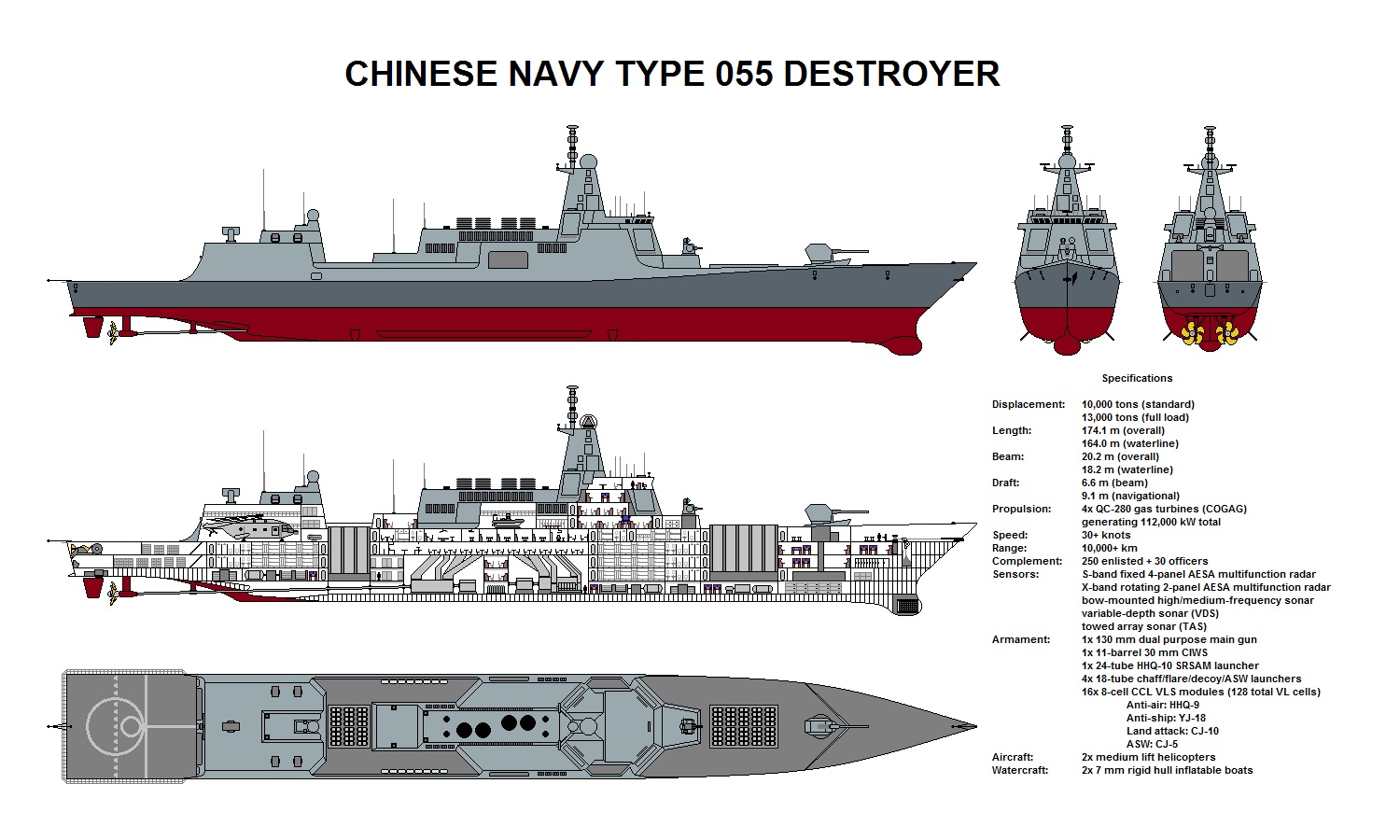
Comparison, the Chinese Navy of 2030 and USN

The Diplomat has an excellent report entitled “Predicting the Chinese Navy of 2030.” It is apparent the Chinese are now building at a rate that exceeds that of the US. They started behind. Already they are the largest navy in the world in terms of numbers of ships. In terms of personnel, it is about 80% the size of the USN. Every year the US margin in both quantity and quality for each type of ship narrows. Plus the US Navy is scattered all over the world while their fleet is concentrated in the Western Pacific, although it appears they will be creating Carrier Strike Groups and Amphibious Ready Groups which will mirror the US Navy’s ability to project power anywhere in the world.

The bottom line projections in the Diplomat article are:

  • At least four aircraft carriers (two ski jump, two catapult)
  • 16-20 055/A destroyers (12,000 ton category)
  • 36-40 052D/E destroyers (7,000 ton category)
  • 11 older destroyers
  • 40-50 054A/B frigates (4,000-5,000 ton category)
  • 12 older frigates
  • 60 056/A corvettes
  • Anywhere from eight or more SSBNs (including four to five existing SSBNs)
  • Anywhere from 16 or more SSNs (including six to eight existing SSNs)
  • Approximately 60 SSKs
  • At least three 075 LHDs (36,000 ton category)
  • At least eight 071 LPDs (25,000 ton category)
  • 25 to 30 type 072 LSTs (4,800 tons)

At least some of the approximately 83 Type 022 catamaran missile boats built 2004 to 2011, are likely to be around as well.

For comparison, the current US Navy fleet can be found here. Despite the proclaimed intent of having 355 ships in the US “battle force” actual number (currently about 288 including 60 logistics and support ships) will change only slowly, with most of the changes being in number of small surface combatants (Littoral Combat Ships and Frigates). The number of submarines will actually decline.

Based on the Navy’s “Report to Congress on the Annual Long-Range Plan for Construction of Naval Vessels for Fiscal Year 2019” page 12, table A3-4, the Navy’s 2030 inventory of comparable combatants will be:

  • 11 Carriers
  • 97 Large surface combatants (CG/DDG)
  • 41 Small surface combatants (LCS/FFG)
  • 11 Ballistic missile submarines (SSBN)
  • 45 Nuclear powered attack submarines (SSN)
  • 37 Amphibious assault ships (I think 12 big deck LHA/LHD and 25 LPD/LSD)

To make this clearer I will aggregate the results as fractions with the Chinese numbers on top as the numerator and the USN numbers on the bottom as denominator (Chinese/USN). A + sign is to indicate there may be more.

  • 4/11 carriers
  • 63/97 to 71/97 large surface combatants
  • 112/41 to 122/41  Small surface combatants
  • 8+/11 Ballistic missile submarines (SSBN)
  • 16+/45 Nuclear powered attack submarines (SSN)
  • 60/0 conventionally powered submarines (SSK)
  • 3+/12 big deck amphibs (LHA/LHD)
  • 8+/25 medium amphibs (LPD/LSD)
  • 25-30/0 smaller amphibious assault ships (LST)

The size of the Chinese submarine fleet may not increase, it is already more numerous than the US fleet, but the increasing quality, including more SSNs is troubling.

Unless the US increases its warship construction rate, the comparison for 2040 will look much worse. Equipping modern Coast Guard vessels for naval missions as part of the “National Fleet” could make a huge difference in any future conflict.


FY2019 PC&I Appropriations

I have not been able to find a complete FY2019 Coast Guard budget as it was signed into law, but we do have at least a partial list of Procurement, Construction, and Improvement appropriations for ships and aircraft based on two Congressional Research Service reports (Coast Guard Polar Security Cutter (Polar Icebreaker) Program: Background and Issues for Congress” and “Coast Guard Cutter Procurement: Background and Issues for Congress “) and a Homeland Security Today report.

$1,507.6M For Ships (LLTI refers to Long Lead Time Material):

  • $675M   for the first Polar Security Cutter and LLTM for the second
  • $400M   for the second Offshore Patrol Cutter and LLTM for the third
  • $340M   for six Fast Response Cutters
  • $72.6M  for the National Security Cutter program
  • $15M     for life extension work on Polar Star
  • $5M       for initial work on procuring an additional Great Lakes Icebreaker

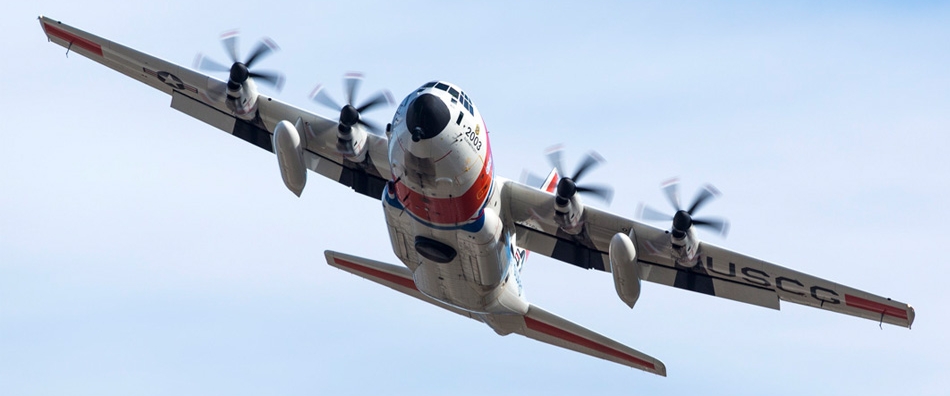
Coast Guard C-130J

$208M For Aircraft:

  • $105 for the HC-130J program (I think that is one aircraft)
  • $95M for MH-60T recapitalization (reworking existing aircraft I believe)
  • $8M for upgrades to the MH-65s

That is $1,715M for the items above. This, hopefully, is not all. I don’t have a figure for the Waterways Commerce Cutter (a small figure at this point), no information on unmanned systems, and there should also be money to address the backlog of shoreside improvements, but this does seem to show a recognition of the real needs of the Coast Guard for recapitalization. Looks like the $2+B annually for PC&I the Coast Guard has been saying they need is within reach.


First Polar Security Cutter Fully Funded

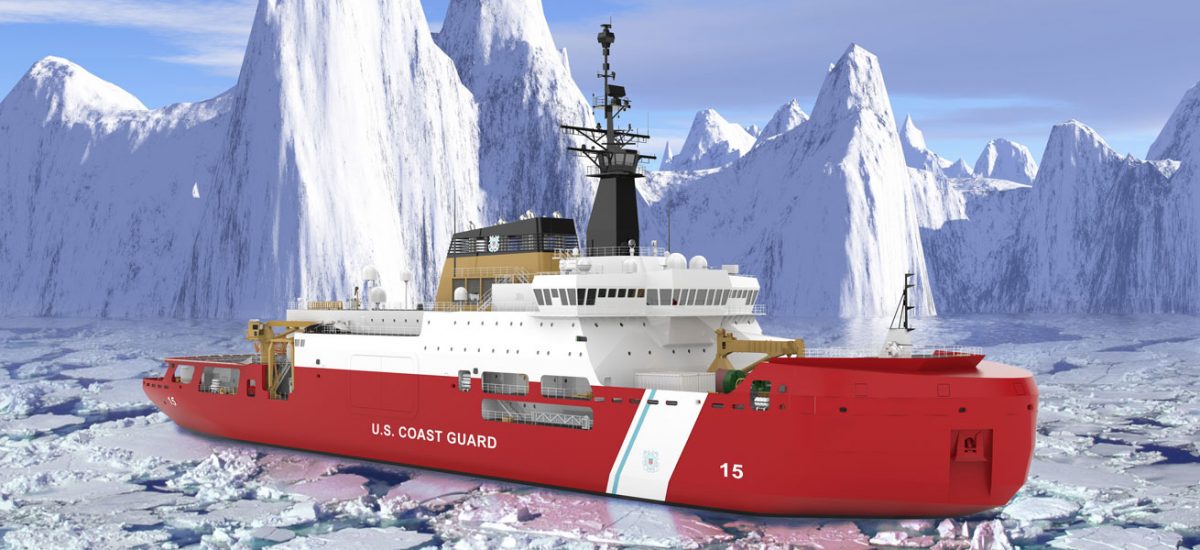
Polar Security Cutter Concept by Fincantieri Marinette Marine

If you have been wondering if the $655M allocated for the first Polar Security Cutter was enough, let me set your mind at ease. The original FY2019 request was for $750M and only $655M was included in the budget, so it appears we are $95M short. There is an explanation.

Incredibly Mr Ronald O’Rourke has already updated “Coast Guard Polar Security Cutter (Polar Icebreaker) Program: Background and Issues for Congress” (as well as “Coast Guard Cutter Procurement: Background and Issues for Congress “) to reflect passage of the FY2019 budget.

A footnote on page 19 of the report on the Polar Security Cutter (PSC) explains.

“47 The Coast Guard’s proposed FY2019 budget was submitted before Congress finalized action on the Coast Guard’s FY2018 budget. In its action on the FY2018 budget, Congress approved the Coast Guard’s request for $19 million in Coast Guard acquisition funding for the program, and provided $150 million in unrequested acquisition funding for the program in the Navy’s shipbuilding account. If the FY2019 request for $750 million is intended solely to complete the funding for the first ship, and if this figure does not assume that more than $19 million would be provided for the program in FY2018, then approving the $750 million request would provide $150 million more than needed to fully fund the first ship. “

There is also  $15M for Service Life Extension work on the Polar Star (see Table 3 on page 35.

So, if I understand this correctly, we have $824M for the completion of design work and the construction of the first Polar Security Cutter. Additionally we have $20M for long lead items for the second PSC. If as reported earlier, the first three ships should cost approximately $2.1B, then we have a little over 39% of the funding for the three ship buy.

I would really like to see us do a block buy. Congress has authorized it, and the request for proposal asked for Block Buy quotes, so it should not be impossible.

U.S., Canada conduct fisheries enforcement with partner nations in South Pacific

The following is a Fourteenth District new release. This is a follow up to an earlier post/news release. Since Nov. 2018 we have had Munro, Bertholf, and Mellon in the Western Pacific. Really looks like it is becoming routine, now with help from Canadian maritime patrol aircraft.

united states coast guard 
Fri, Feb 15, 2019 6:25 pm
Coast Guard Fourteenth District Hawaii and the Pacific News (coastguardfourteenthdistrict@service.govdelivery.co
 

News Release

U.S. Coast Guard 14th District Hawaii and the Pacific
Contact: 14th District Public Affairs
Office: (808) 535-3230
After Hours: (808) 341-9849
14th District online newsroom

Imagery Available: U.S., Canada conduct fisheries enforcement with partner nations in South Pacific

Joint boardings Mellon and CP-140 Boarding team

Editors’ Note: Click on images to view more and download high-resolution versions.

HONOLULU — The crew of the Coast Guard Cutter Mellon (WHEC 717) continues their patrol of the South Pacific with partners from several nations in January and into February.


“The U.S. is advancing a vision of a free and open Indo-Pacific that excludes no nation. We are redoubling our commitment to establish alliances and partnerships while expanding and deepening relationships with new partners that share respect for sovereignty, fair and reciprocal trade, and the rule of law,” said Capt. Robert Hendrickson, chief of response for Coast Guard 14th District. “We rely on partners, allies, and like-minded nations to achieve our missions.”

Following their first leg, the crew embarked ship riders from Fiji and Tuvalu to enforce Fisheries laws in each partner nations’ respective exclusive economic zones (EEZ). The Mellon’s boarding teams and the fisheries officers conducted a professional exchange and law enforcement training, sharing tactics and best practices. This effort was coordinated with significant support from Canada’s Department of Fisheries and Oceans (DFO).

Illegal, unreported and unregulated (IUU) fishing deprives the international economy of billions of dollars and undermines the livelihoods of legitimate fishers from all nations. It impacts food security, affecting millions of people, including many vulnerable coastal communities. It is estimated that IUU fishing accounts for about 30 percent of all fishing activity worldwide, representing up to 26 million tons of fish caught annually, valued at between $10 to $23 billion.

“Coast Guard 14th District personnel began partnering with Canada’s DFO in July when two DFO officers joined U.S. Coast Guard Cutter Sequoia (WLB 215) for a 23-day patrol on high seas west of Guam,” said Hendrickson. “Sequoia’s deployment was incredibly successful, resulting in 15 suspected violations of Western and Central Pacific Fisheries Commission’s conservation and management measures while completing 11 foreign vessel inspections. The important trip helped to cement the Coast Guard and DFO’s growing partnership for enforcement in Oceania.”

Two DFO officers joined Mellon’s crew for the transit from Hawaii to Fiji after attending the Coast Guard’s Pacific Regional Fisheries Training Center course for Western Central Pacific Fisheries Commission (WCPFC) enforcement. They conducted high seas boardings along the way. Canada’s Air Force committed a CP-140 Aurora fixed-wing aircraft to provide maritime domain awareness for Mellon over two weeks, as well as delivering fishery enforcement operations for several regional Pacific Island countries. The DFO deployed two of their officers with the Aurora, and the Coast Guard sent a specialized fisheries training officer from the Regional Training Center to assist the aircrew with specific fisheries details and information for the crew. Working with Canada’s Department of National Defence and the U.S. Coast Guard, they patrolled around Fiji and the island nations of Kiribati, Tokelau, Vanuatu, and Tuvalu. IUU fishing is of particular concern in this area as several small island developing states have some of the most vulnerable waters for IUU fishing and need support from other nations.

Throughout the patrol, fishery officers were part of seven reconnaissance flights by the Aurora, to provide a visible surveillance presence and to help enforce WCPFC conservation measures. The Aurora detected and documented 101 fishing vessels during the mission, providing critical data to the U.S. Coast Guard patrol and the Forum Fisheries Agency, which coordinates enforcement amongst the island nations. The Canadian aircraft also patrolled the Phoenix Islands Protected Area, a UNESCO world heritage site where fishing is banned. The Aurora was able to ensure the area was clear of fishing activity during its patrol. 

“The U.S. Coast Guard and the Canadian Department of Fisheries and Oceans have a long history of working together to ensure the viability of fish stocks off North America. Working with experts from Canada and regional leaders like Fiji is vital to ensuring food security and the rule of law in Oceania. Working together we are helping to ensure a more secure, free and open Indo-Pacific,” said Hendrickson.

Fishery officers aboard the cutter Mellon patrolled over 1,786 square miles (2,875 square kilometers) within the WCPFC convention area. They were also part of the enforcement team that boarded two boats: one fishing vessel and one fuel supply ship known as a bunkering vessel. The U.S. Coast Guard is investigating two potential violations of transshipment rules and vessel identification requirements aboard the vessels inspected during the mission.

These recent patrols were part of Canada’s international commitment to support fisheries on the high seas and tackle IUU fishing, which is a significant contributor to declining fish stocks and marine habitat destruction around the world.

“Illegal, unreported and unregulated fishing threatens food security, impacts the sustainability of fisheries, and causes irreparable damage to marine and freshwater ecosystems across the globe. Partnerships, like this one with Canada’s Department of National Defence and the United States Coast Guard, are the key to tackling IUU fishing that threatens many vulnerable coastal communities. We will continue to work with other countries and assist small island developing states in combating IUU fishing to increase security and protect the health of fish stocks around the world,” said the Honorable Jonathan Wilkinson, minister of fisheries, Oceans and the Canadian Coast Guard.


“Naval Group: Four OPVs for Argentina” –Marine Link

Photo: Offshore Patrol Vessel L’Adroit built by Naval Group as a private venture 

MarineLink is reporting the French Shipbuilder Naval Group will provide four Offshore Patrol Vessels to Argentina including the L’Adroit completed in 2012 and three similar new construction vessels

L’Adroit had been constructed as a private venture demonstrator which was operated by the French Navy for several years.

Specs for L’Adroit, using various sources, are:

  • Length: 87 meters (285 feet)
  • Beam: 14 meters (46 feet)
  • Range: 7,000-8,000 nmi at 12 knots
  • Speed: 20-21 knots
  • SHP: 8,100
  • Boats: two RHIBs up to 9 meter launched from two ramps in the stern
  • Helicopter: up to 10 tons plus hangar. Has operated small vertical take off UAS.

“The three new OPVs will also be adapted to navigation in the cold waters of the southern seas thanks to structural reinforcement. All four ships will be equipped with a remotely-operated 30 mm cannon.”

Schiebel S-100

A Schiebel S-100 conducts trials aboard the L’Adroit. A four-person detachment for the S-100 can be embarked on L’Adroit when the UAV is aboard. Schiebel photo

Presumably these will replace the 80 meter Fassmer designed OPVs Argentina had planned but never built.

L’Adroit was one of the vessels I pointed to as a possible basis for Cutter X.

Photo: L’Adroit’s hangar doors looking forward from the flight deck

Coast Guard Gets $578M Above President’s Budget Request in Appropriations Deal” –Homeland Security Today

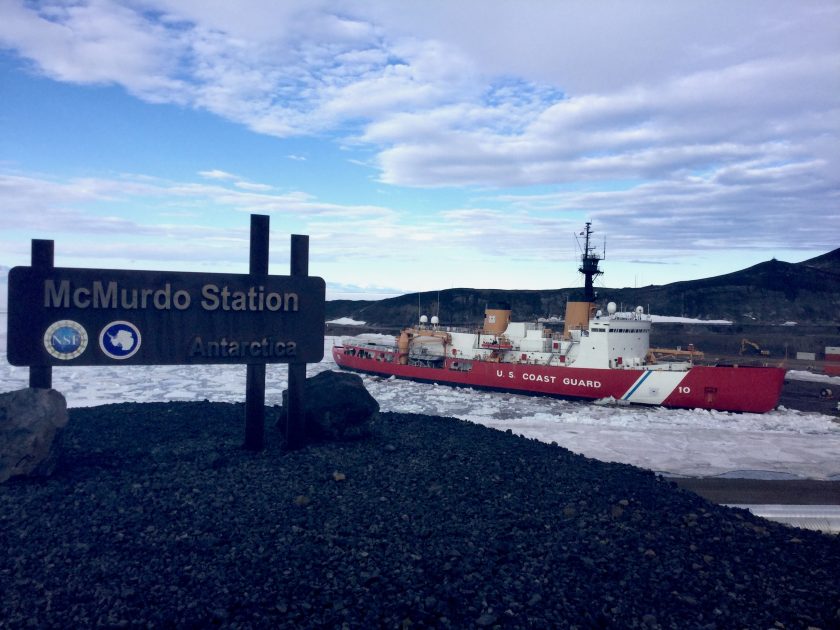
USCGC Polar Star at McMurdo Station, 2019

Homeland Security Today is reporting the newly passed Coast Guard budget contains some very good news, including $655M for the new Polar Security Cutter.

The total budget is approximately $12,016M. This is about $92M less than last year, but that budget was remarkable in funding two National Security Cutters (#10 and #11). Presumably it contains funding for the second Offshore Patrol Cutter and long lead time items for the third. These were included in the original request, but were not mentioned in the report.

The Coast Guard gets $15 million for an additional 250 military personnel in the legislative agreement, $12.9 million for the 2019 pay raise, and $2 million to increase child care benefits and cost of living increases.

The bill is reported to include a couple of reporting requirements that may indicate where the Congress thinks the Coast Guard should be heading.

The bill directs the USCG to submit a plan within 120 days for a one-year pilot program to address illegal, unreported, and unregulated fishing, which “leads to billions in losses for the global fishing industry and is a source of financing for illicit activity such as piracy, drug trafficking, human trafficking, and slavery.”

Within 180 days, the USCG is required to give relevant committees “an assessment of the Coast Guard’s ability to conduct maritime law enforcement activities in the high seas in support of international partners.” (emphasis applied–Chuck)

The illegal, unreported, and unregulated fishing could just be in reference to helping Micronesia. The law enforcement activities with partners could be about drug enforcement, but that is already pretty well understood. Could this mean we might be helping the Vietnam or the Philippines with their Chinese fisheries problems?

There is “$5,000,000 for survey and design work to support the acquisition of a Great Lakes icebreaker.” Based on earlier discussions, this ship would be at least as capable as the current USCGC Mackinaw.

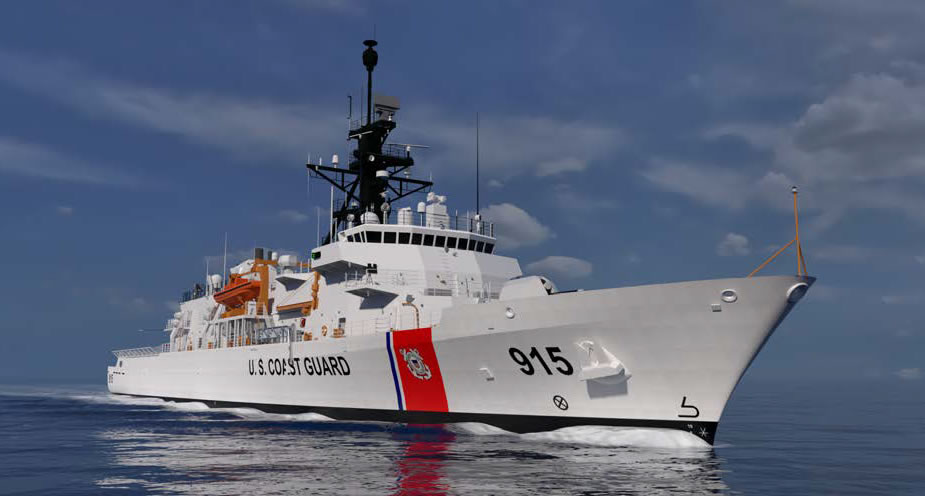
The budget includes six additional Webber class “Fast Response Cutters,” four toward the 58 in the program of record and a second pair toward the replacement of the six 110s in South West Asia.

Aviation did reasonably well. “…$105,000,000 for the HC-130J aircraft program; $95,000,000 to recapitalize MH-60T aircraft; $8,000,000 to fund both the planned avionics upgrades and the costs associated with the service life extension project for HH-65 aircraft.”

It is gratifying to see that our “Unfunded Priorities List (UPL)” made a difference since frequently in the past we had no UPL. $119M was allocated for UPL items.