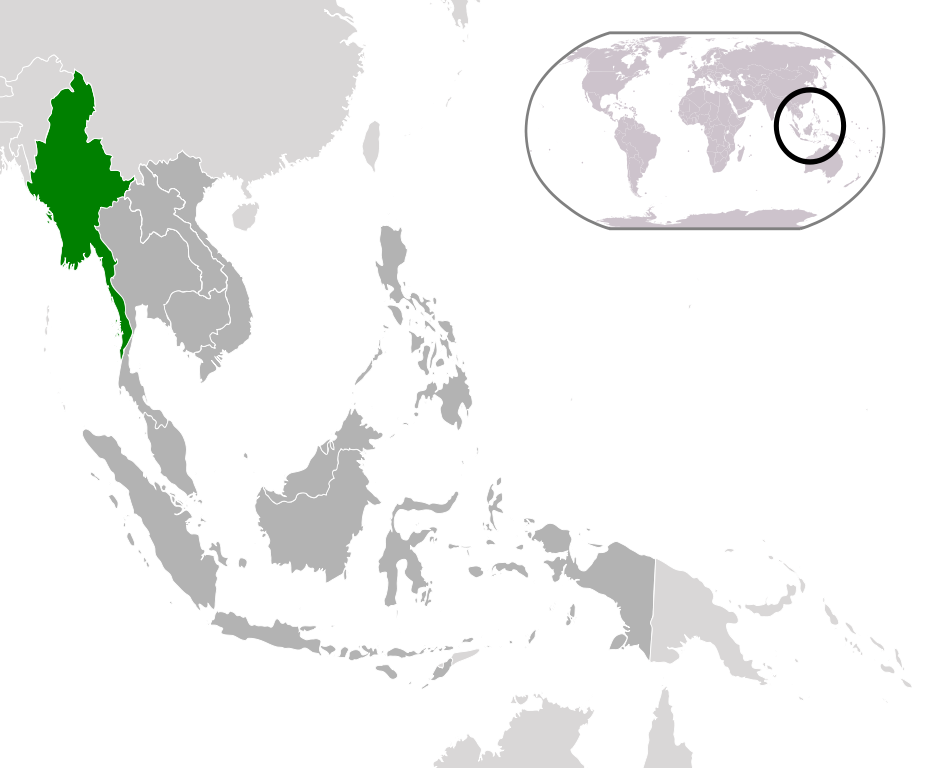
“The Myanmar government is to establish a coast guard force to safeguard its 2,080-km-long coastline and territorial waters, according to a coordination meeting held at the Ministry of Transport and Communication on January 22.”
Myanmar has an EEZ of 532,775 square km or about 4.6% of that of the US, but it does extend our to 200 miles from the shore. They also have some offshore islands, and a claim to continental shelf.
We don’t know what sort of organization or equipment the new Myanmar Coast Guard will have, but their Navy (19,000 personnel) has an eclectic collection of vessels and equipment from China, Russia, India, the US, and Israel, plus some indigenously produced vessels built in a naval shipyard provided by China.
Myanmar has had human rights issues.
It is not unlikely that they might welcome some training assistance from the US Coast Guard.
Thought this was worth pointing to, considering it looks a lot lighter and more efficient than the J-davits I remember being used for the same purpose.
MarineLink has the story. Might come in handy, especially if one of our ships needs to pull a lot of people out of the water.
Like many of you, I was unable to attend the Surface Navy Association Conference, but I did find a number of videos which may provide some of the information that would have been available there. The Coast Guard Commandant had been scheduled to speak but cancelled, apparently in response to the partial government shutdown.
I have provided three videos, each about ten minutes, that may be of general interest, and links to four others, typically 20-25 minutes. The descriptions are from their respective YouTube pages.
The second and third videos have specific Coast Guard content, which I have identified by bold typeface with the beginning time in parenthesis. Some of the other equipment may have Coast Guard applications in the future.
Day 1 video coverage at SNA 2019, the Surface Navy Association’s national symposium. In this video we cover:
– Austal latest frigate design for FFG(X)
– Raytheon DART Variable Depth Sonar (VDS)
– Raytheon / Kongsberg Naval Strike Missile (NSM)
– Lockheed Martin Long Range Anti Ship Missile (LRASM)
Day 2 video coverage at SNA 2019, the Surface Navy Association’s national symposium.
In this video we cover:
– Fincantieri Marine Group FREMM frigate design for FFG(X)
– General Dynamics NASSCO John Lewis-class T-AO (New Oiler)
– Raytheon SM-2 restart
– Raytheon SM-3 – Leonardo DRS Hybrid Electric Drive for U.S. Coast Guard’s Offshore Patrol Cutter (OPC) (time 11:10)
Day 3 video coverage at SNA 2019, the Surface Navy Association’s national symposium. In this video we cover:
– Atlas North America’s solutions for mine counter measures, harbor security and unmanned surface vessels
– Lockheed Martin Canadian Surface Combatant (Type 26 Frigate, Canada’s Combat Ship Team)
– Insitu ScanEagle and Integrator UAS (time 4:30)
– Raytheon SPY-6 and EASR radar programs
Vice Adm. Tom Moore, USN, the commander of the Naval Sea Systems Command, discusses US Navy efforts to increase public and private ship repair capabilities, lessons learned from repairing USS John S. McCain and Fitzgerald, the new Ford-class aircraft carrier, getting the Littoral Combat Ship on regular deployments and more with Defense & Aerospace Report Editor Vago Muradian at the Surface Navy Association annual conference and tradeshow in Northern Virginia.
George Awiszus, military marketing director of GE Marine, discusses the outlook for the company’s LM2500 engine that drives warships in more than 30 nations and the future of shipboard power with Defense & Aerospace Report Editor Vago Muradian at the Surface Navy Association’s annual conference and tradeshow in Northern Virginia.
Adm. Bill Moran, USN, the vice chief of naval operations, discusses dialogue with China, improving the surface force in the wake of 2017’s deadly accidents, refining Navy culture, increasing ship repair capabilities, harnessing data, improving information sharing across the force and the new Design for Seapower 2.0 with Defense & Aerospace Report Editor Vago Muradian at the Surface Navy Association’s annual conference and tradeshow in Northern Virginia.
Maj. Gen. David “Stretch” Coffman, USMC, the US Navy’s director of expeditionary warfare (N95), discusses new expeditionary warfighting concepts, the recent deployment of Littoral Combat Group 1 — composed of USS Wayne E Meyer (DDG-108) and USS Somerset (LPD-25) — to South America, new formations to replace the current Amphibious Ready Group and Marine Expeditionary Unit, unmanned ships, the performance of the F-35B Lightning II and more with Defense & Aerospace Report Editor Vago Muradian.
The first question was about the Polar Security and the Commandant gave the sort of answer we have come to expect, essentially, we need six icebreakers, at least three of them need to be heavy, and we need one now.
The second question was about head count and the Commandant made the point that we are down in personnel and purchasing power compared to a decade ago. There was a comment that I find particularly encouraging, “We’ve done a ‘mission requirements’ analysis that Capitol Hill assigned to us.” It is not clear if this is essentially a manning study, which I suspect it may be, or if it perhaps includes other resource requirement. For quite some time, I have suggested we need to do an updated Fleet Mix Study. The last (and only) one was done about ten years ago.
Not surprisingly, considering the orientation of the interviewer, there was much discussion about the Marine Inspection/Prevention side of the Coast Guard.
There was a question about virtual aids to navigation and it appears the Commandant put to rest fears that we would be replacing physical aides to navigation with virtual ones, but rather that we would be adding AIS to physical aids. We would sometimes use virtual aids after a disaster, when needed to restore safe navigation as quickly as possible.
Best you read the interview, rather than just my interpretation.
180710-G-ZV557-1313 PACIFIC OCEAN (July 10, 2018) Crewmembers aboard the USCGC Bertholf (WMSL 750) check the flight deck July 10, 2018, alongside the flight crew of the a U.S. Navy HSC-4 Black Knight MH-60 helicopter 15 miles south of Oahu, Hawaii, while in support of RIMPAC 2018. Photo by Petty Officer 2nd Class David Weydert
The February issue of US Naval Institute Proceedings has an article by Cdr. Brian Smicklas, USCG, that warns the Coast Guard may not be ready to respond to attacks on the Maritime Transportation System (MTS).
Fortunately, this article is outside the paywall so it should be accessible to all. Some selected paragraphs to give a flavor of the argument:
“… it would be foolish to assume the MTS is safe from attack. Considering its economic and military importance and its limited protection, an assault on it should be considered among an adversary’s most likely courses of action. The risk of an unprepared Coast Guard overseeing the protection of the MTS in the era of renewed interstate conflict can no longer be overlooked.”
“The Coast Guard must recommence “guarding the coast,” including the active deterrence and detection of threats from peer adversaries. Doing so would augment Navy high-demand/low-density (HDLD) warship capabilities allocated to combatant commanders while providing the Coast Guard a true course toward maritime homeland-defense competencies and renewed relevance against the threat of interstate conflict. Such a course not only would enhance national defense but also would provide the Coast Guard a fiscal lifeline to budgetary stability in the face of government shutdowns through alignment with fully funded DoD imperatives. ”
“To be clear, this should not include placing the Coast Guard in DoD. Were the service required to move to that side of the Potomac, it quickly would find failure in the zero-sum competition for DoD dollars. Remaining relevant through the dual roles of homeland security and homeland defense in an era of interstate conflict is a strategically smart position for both the Coast Guard and its executive agency. However, the keys to remaining relevant to both DHS and DoD will be increased capability and lethality in the face of peer adversaries. ”
“Enhancing the Coast Guard to address the most pressing threats facing the MTS welds the Coast Guard to national defense priorities and has the potential to demonstrate the highest level of defense and budgetary relevance for the nation’s smallest armed service. The nation must up-arm the Coast Guard to enable the Navy to fight and win. “
We have addressed many of the possibilities he discusses, including the need to protect US ports including Military Load Out ports, “Ruminating on Homeports While Playing the Red Cell.” He suggests reintroducing the Coast Guard’s ASW mission advocated here numerous times. He even talks about the possibility of using the hyper-velocity projectile and 5″ gun.
In terms of priorities the Coast Guard should first prepare to deal with covert attacks launched from merchant ships that might be the opening gambit in a larger conflict. Adding an ASW capability is certainly doable and will be needed if there is a prolonged conflict, but hopefully the Navy is already tracking potentially hostile submarines and Navy maritime patrol aircraft like the P-8 do operate from the continental US so that threat is addressed at least to some extent. I have my doubts about the effectiveness of NORAD against cruise missiles from unexpected directions, but that is probably not something that even AAW missile equipped Coast Guard cutters would be in a position to do something about without significant warning.
On the other hand, covert minelaying by merchant ships, commando raids launched from merchant ships, or perhaps even merchant ships with containerized missile launchers might be interdicted by Coast Guard units. To deal with these types of threats, every cutter from Webber class on up, and perhaps some of our aircraft, need an ability to quickly and reliably, forcibly stop even a very large vessel. 25 mm and even 57 mm guns are not going to cut it. We need to tell the Navy we need such a weapon.
Because we are the “Coast Guard,” for some crazy reason, people will expect us to guard the coast.
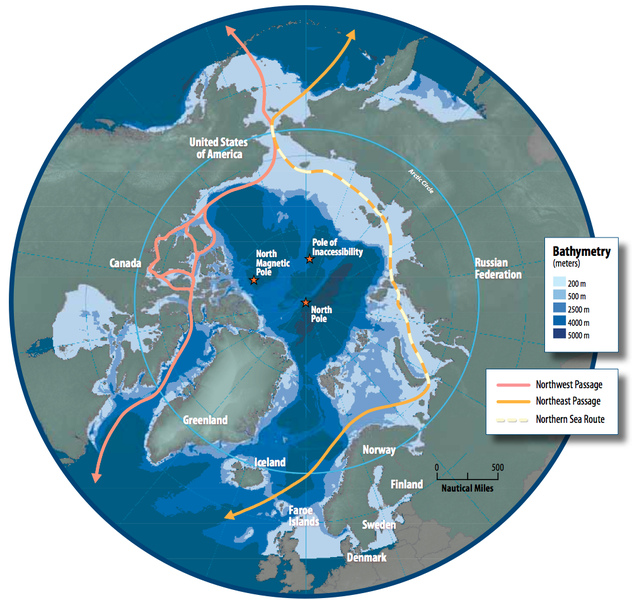
Map of the Arctic region showing shipping routes Northeast Passage, Northern Sea Route, and Northwest Passage, and bathymetry, Arctic Council, by Susie Harder
An interesting discussion of the Navy’s proposed Freedom of Navigation Operation (FONOP) in the Arctic which would presumably require Coast Guard assistance.
Within these stories are three different ideas: first, that the Navy is interested in expanding its physical presence in Alaska, through returning to Adak and/or a port on the Bering Strait ( Nome has been discussed for years); second, that Navy personnel need to regain operational familiarity with the Arctic environment; and third, that the Navy appears to be considering a freedom of navigation operation (FONOP) in the Arctic for summer 2019.
The first two ideas are unremarkable. Given the dearth of infrastructure and the challenging environment, both improved facilities and practical learning opportunities are required to ensure Navy vessels and aircraft operate safely and effectively.
The third idea—conducting a FONOP in the Arctic in just a few months—is a bombshell.
I seem to remember hearing that this had been discussed, and the Commandant had taken the position that the Coast Guard could not support the idea of a Freedom of Navigation Operation given the state of our icebreaker “fleet,” but apparently the idea is still alive, at least as of mid January.
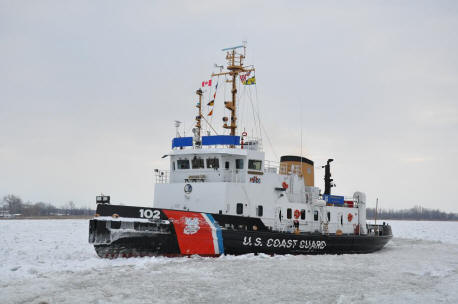
R 301515 JAN 19 FM COMDT COGARD WASHINGTON DC//CG-7// TO ALCOAST UNCLAS //N01650// ALCOAST 020/19 COMDTNOTE 1650 SUBJ: WINNER ANNOUNCEMENT – 2018 HOPLEY YEATON CUTTER EXCELLENCE AND SUPERIOR CUTTERMAN AWARDS 1. The Douglas Munro Chapter of the Surface Navy Association is honored to announce and congratulate the recipients of the 2018 Hopley Yeaton Cutter Excellence and Superior Cutterman Awards. Each of the winners were selected from amongst a highly competitive pool of nominees. This year’s winners are: A. Cutter Excellence Award (Large Cutter): CGC HAMILTON (WMSL 753) B. Cutter Excellence Award (Small Cutter): CGC BRISTOL BAY (WTGB 102) C. Superior Cutterman Award (Officer): CWO Jared Crotwell – CGC BRISTOL BAY (WTGB 102) D. Superior Cutterman Award (Enlisted): SK2 Mathew Wilson – CGC JAMES (WMSL 754) 2. Hopley Yeaton Cutter Excellence Award (Large): A. Masterfully balancing law enforcement operations in the Caribbean Sea, Eastern Pacific, and natural disaster response, the crew of CGC HAMILTON seized 4,983 kilograms of cocaine, detained 19-suspected narco-traffickers, and directed post-hurricane response operations in 2018. The crew conducted two separate and simultaneous multi-vessel (go-fast) interdictions employing airborne use of force and multiple synchronized long-range cutter boat intercepts. In the middle of a major dockside availability, CGC HAMILTON executed a storm-evasion sortie ahead of Hurricane FLORENCE after restoring severely degraded systems and equipment. The cutter went on to lead a Surface Action Group of seven cutters, executing vital command control on behalf of Sector North Carolina, conducting damage assessments of Wilmington and the Cape Fear River, and assisting Stations Oak Island, Wrightsville Beach, and Ft. Macon by removing debris and repairing station response infrastructure. B. Honorable Mentions for the Large Cutter Award are: CGC HARRIET LANE (WMEC 903) CGC SPENCER (WMEC 905) CGC MACKINAW (WLBB 30) 3. Hopley Yeaton Cutter Excellence Award (Small): A. The crew of CGC BRISTOL BAY capably balanced critical maintenance periods and operational commitments, and sailed 143 days away from homeport, amassing 2,010 underway hours, 112% of their programmed employment standard, with less than 24 hours of unscheduled maintenance on a 39 year old cutter. CGC BRISTOL BAY performed 80 direct assists of commercial vessels during 1,174 hours of icebreaking, which facilitated domestic and international trade on the Great Lakes. The crew played a pivotal role in completing 2018 OPERATION SPRING RESTORE, servicing 129 floating aids in 12 days following a casualty to another buoy tender and providing a reliable aids to navigation constellation to mariners. Servicing 207 floating aids in total, CGC BRISTOL BAY achieved an annual Aid Availability Rating of 99.7%, exceeding targeted standards. B. Honorable Mentions for the Small Cutter Award are: CGC DONALD HORSLEY (WPC 1117) CGC BAILEY BARCO (WPC 1122) CGC BONITO (WPB 87341) 4. Hopley Yeaton Superior Cutterman Award (Officer): A. CWO2 Crotwell, a 13 year cutterman assigned as Engineer Officer aboard CGC BRISTOL BAY, compressed maintenance efforts into port calls achieving a maintenance currency rating of 89.1%. As a result, CGC BRISTOL BAY did not log a single day of unscheduled Charlie amidst 1,174 operational hours of icebreaking. CWO2 Crotwell also led CGC BRISTOL BAY through a 60 day, $512,000 dockside availability. While many of the crew experienced some measure of rest and recuperation after a grueling year of 2,010 underway hours and 143 days away from homeport, CWO2 Crotwell carefully managed completion of 19 contracted work items while leading preparations for Tailored Ship’s Training Availability. Routinely arriving to the cutter before dawn and departing with merely enough time to say goodnight to his family, he worked an exhaustive pace to repair the unit’s weight handling gear. Displaying innovation and skill, he designed a trouble-shooting process to isolate the source of hydraulic power loss on the buoy handling crane. B. Honorable Mentions for the Superior Cutterman Award (Officer) are: CWO2 Justin Young-CGC HEALY (WAGB 20) CWO2 James Cullers-CGC WAESCHE (WMSL 751) CWO2 Adam Barton-CGC WALNUT (WLB 205) 5. Hopley Yeaton Superior Cutterman Award (Enlisted): A. SK2 Wilson, a six year cutterman, serves as a Pursuit Crewman and Gunner on CGC JAMES’ law enforcement team. In 2018, SK2 Wilson participated in 3 interdictions resulting in the seizure of 1,957 kilograms and detention of 11 suspected narco-traffickers. Additionally, he served as a boat crewman during Airborne Use of Force recertification and coordinated internal “Boat Colleges” to train and qualify aspiring coxswains and crewmen. Tirelessly working 12 hour shifts, SK2 Wilson supported Hurricane MARIA response operations for nearly two weeks to reconstitute Sector San Juan and assist with transporting parts, critical food supplies, and passengers critical to relief efforts. When not directly involved in reconstitution efforts, SK2 Wilson led and participated in work parties to clear storm debris at Sector San Juan and Coast Guard housing in Puerto Rico. SK2 Wilson leaps at every challenge and opportunity presented to him. SK2 Wilson stands qualified engineering machinery watches, serves as a small boat engineer and crewman, chairs the LDAC, serves on the unit’s boarding and pursuit teams, and fills flight quarters billets, all while delivering exceptional performance in his role as an SK2 and pursuing a college degree. SK2 Wilson processed $126K in backlog funding in less than three days overcoming latent underway internet connectivity and a hectic pace of operations to ensure all funds were properly obligated. B. Honorable Mentions for the Superior Cutterman Award (Enlisted) are: ME1 Kelly Brockett-CGC MUNRO (WMSL 755) BMC Christopher Hopton-CGC DILIGENCE (WMEC 616) BMCS Matthew Jordan-CGC BLACKTIP (WPB 87326) 6. The SNA will coordinate with OPCONs to recognize this year’s winners. 7. Bravo Zulu and great work to all of this year’s Hopley Yeaton Award recipients and nominees. As always, we continue to be impressed by the sheer volume of praiseworthy nominees, as well as the high quality award write-ups. Thank you to all commands for submitting and reviewing nominations. 8. RDML Michael P. Ryan, Assistant Commandant for Capability, sends. 9. Internet release is authorized.
Coast Guard 82 foot WPB and Navy Swift Boat on River in Vietnam
Some good news for those that may have been exposed to Agent Orange during the Vietnam War while serving in coastal waters.
Stars and Stripes reports that a court decision issued today, 29 Jan., 2019, has reversed an earlier decision and determined that those that served afloat in the territorial waters of the Republic of (South) Vietnam are entitled to a presumption that they were exposed to Agent Orange.
It is still possible the government may appeal this decision to the Supreme Court.
MarineLog reports a contract for an interesting new patrol boat for the Texas Parks and Wildlife Department.
“JANUARY 28, 2019 — All American Marine, Inc. (AAM), Bellingham Bay, WA, has won a contract from the Texas Parks and Wildlife Department (TWPD) for construction of an 80’ x 27’ Teknicraft design aluminum catamaran for operation in Texas State waters and offshore in the Gulf of Mexico.
This long-range hydrofoil-assisted catamaran will be … designed as a patrol vessel for an “Offshore on an Oceans” route.”
“…TPWD and Texas Game Wardens also patrol an additional 200 nautical miles into the U.S. exclusive economic zones through a joint enforcement agreement with the National Oceanic and Atmospheric Agency.”
A good look at this might inform our selection of future replacements for the 87 foot WPBs.
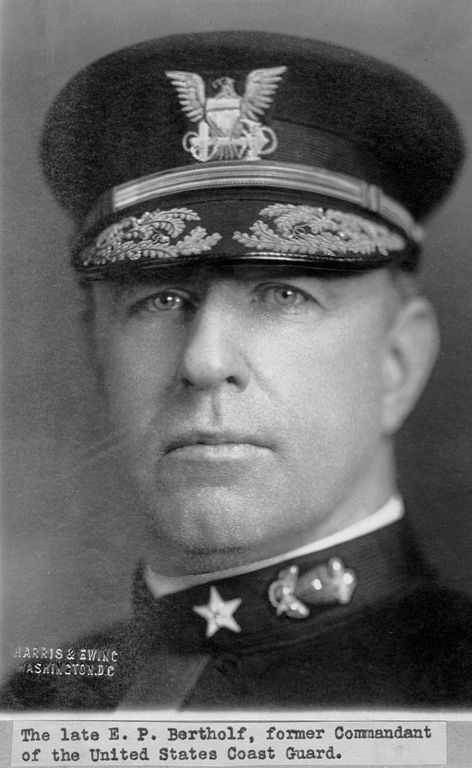
Photograph of Ellsworth P. Bertholf, Commandant of the U.S. Revenue Cutter Service from 1911 to 1915 and Commandant of the U.S. Coast Guard from 1915 to 1919. Coast Guard photo.
We all know August 4th as Coast Guard Day, but it was actually January 28, 1915 that the Coast Guard was formed by the joining of the Lifesaving Service with the Revenue Cutter Service by Act of Congress.
Take a look at the law in the link above. Its is pretty detailed and shows how different things were then. Of course it has been 104 years.


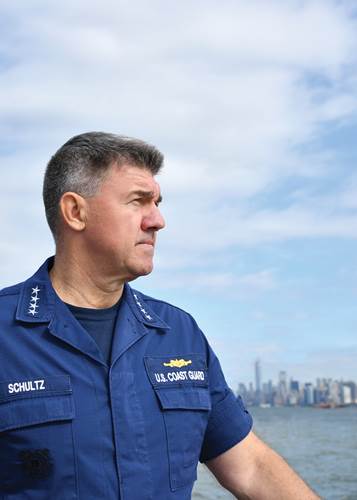 Coast Guard Commandant Adm. Karl Schultz,. U.S. Coast Guard photo illustration by Petty Officer 1st Class Jetta Disco.


 Chuck Hill's CG Blog