First Polar Security Cutter Fully Funded

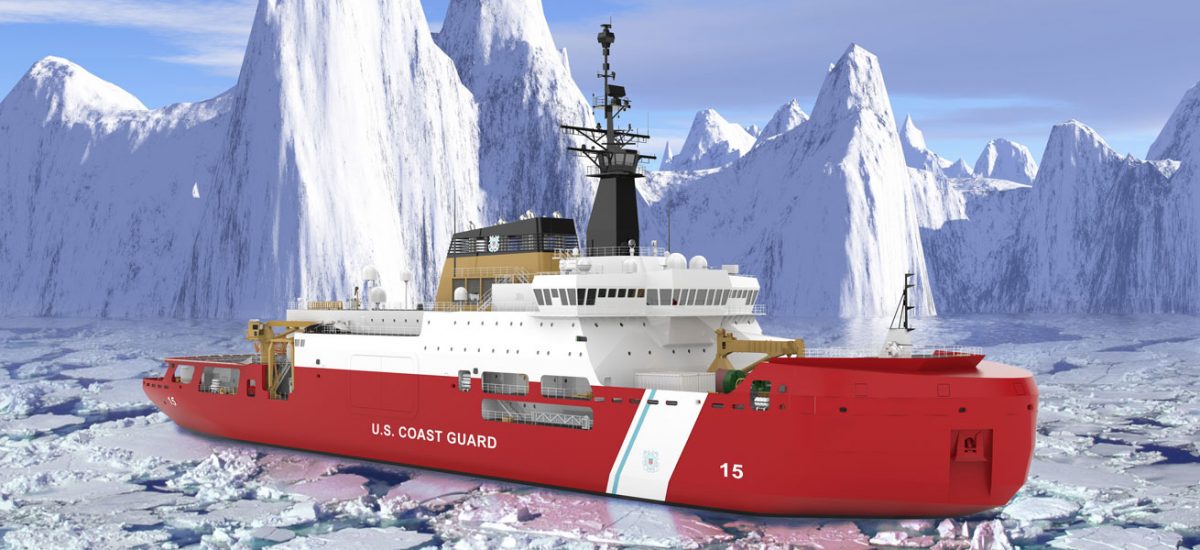
Polar Security Cutter Concept by Fincantieri Marinette Marine

If you have been wondering if the $655M allocated for the first Polar Security Cutter was enough, let me set your mind at ease. The original FY2019 request was for $750M and only $655M was included in the budget, so it appears we are $95M short. There is an explanation.

Incredibly Mr Ronald O’Rourke has already updated “Coast Guard Polar Security Cutter (Polar Icebreaker) Program: Background and Issues for Congress” (as well as “Coast Guard Cutter Procurement: Background and Issues for Congress “) to reflect passage of the FY2019 budget.

A footnote on page 19 of the report on the Polar Security Cutter (PSC) explains.

“47 The Coast Guard’s proposed FY2019 budget was submitted before Congress finalized action on the Coast Guard’s FY2018 budget. In its action on the FY2018 budget, Congress approved the Coast Guard’s request for $19 million in Coast Guard acquisition funding for the program, and provided $150 million in unrequested acquisition funding for the program in the Navy’s shipbuilding account. If the FY2019 request for $750 million is intended solely to complete the funding for the first ship, and if this figure does not assume that more than $19 million would be provided for the program in FY2018, then approving the $750 million request would provide $150 million more than needed to fully fund the first ship. “

There is also  $15M for Service Life Extension work on the Polar Star (see Table 3 on page 35.

So, if I understand this correctly, we have $824M for the completion of design work and the construction of the first Polar Security Cutter. Additionally we have $20M for long lead items for the second PSC. If as reported earlier, the first three ships should cost approximately $2.1B, then we have a little over 39% of the funding for the three ship buy.

I would really like to see us do a block buy. Congress has authorized it, and the request for proposal asked for Block Buy quotes, so it should not be impossible.

U.S., Canada conduct fisheries enforcement with partner nations in South Pacific

The following is a Fourteenth District new release. This is a follow up to an earlier post/news release. Since Nov. 2018 we have had Munro, Bertholf, and Mellon in the Western Pacific. Really looks like it is becoming routine, now with help from Canadian maritime patrol aircraft.

united states coast guard 
Fri, Feb 15, 2019 6:25 pm
Coast Guard Fourteenth District Hawaii and the Pacific News (coastguardfourteenthdistrict@service.govdelivery.co
 

News Release

U.S. Coast Guard 14th District Hawaii and the Pacific
Contact: 14th District Public Affairs
Office: (808) 535-3230
After Hours: (808) 341-9849
14th District online newsroom

Imagery Available: U.S., Canada conduct fisheries enforcement with partner nations in South Pacific

Joint boardings Mellon and CP-140 Boarding team

Editors’ Note: Click on images to view more and download high-resolution versions.

HONOLULU — The crew of the Coast Guard Cutter Mellon (WHEC 717) continues their patrol of the South Pacific with partners from several nations in January and into February.


“The U.S. is advancing a vision of a free and open Indo-Pacific that excludes no nation. We are redoubling our commitment to establish alliances and partnerships while expanding and deepening relationships with new partners that share respect for sovereignty, fair and reciprocal trade, and the rule of law,” said Capt. Robert Hendrickson, chief of response for Coast Guard 14th District. “We rely on partners, allies, and like-minded nations to achieve our missions.”

Following their first leg, the crew embarked ship riders from Fiji and Tuvalu to enforce Fisheries laws in each partner nations’ respective exclusive economic zones (EEZ). The Mellon’s boarding teams and the fisheries officers conducted a professional exchange and law enforcement training, sharing tactics and best practices. This effort was coordinated with significant support from Canada’s Department of Fisheries and Oceans (DFO).

Illegal, unreported and unregulated (IUU) fishing deprives the international economy of billions of dollars and undermines the livelihoods of legitimate fishers from all nations. It impacts food security, affecting millions of people, including many vulnerable coastal communities. It is estimated that IUU fishing accounts for about 30 percent of all fishing activity worldwide, representing up to 26 million tons of fish caught annually, valued at between $10 to $23 billion.

“Coast Guard 14th District personnel began partnering with Canada’s DFO in July when two DFO officers joined U.S. Coast Guard Cutter Sequoia (WLB 215) for a 23-day patrol on high seas west of Guam,” said Hendrickson. “Sequoia’s deployment was incredibly successful, resulting in 15 suspected violations of Western and Central Pacific Fisheries Commission’s conservation and management measures while completing 11 foreign vessel inspections. The important trip helped to cement the Coast Guard and DFO’s growing partnership for enforcement in Oceania.”

Two DFO officers joined Mellon’s crew for the transit from Hawaii to Fiji after attending the Coast Guard’s Pacific Regional Fisheries Training Center course for Western Central Pacific Fisheries Commission (WCPFC) enforcement. They conducted high seas boardings along the way. Canada’s Air Force committed a CP-140 Aurora fixed-wing aircraft to provide maritime domain awareness for Mellon over two weeks, as well as delivering fishery enforcement operations for several regional Pacific Island countries. The DFO deployed two of their officers with the Aurora, and the Coast Guard sent a specialized fisheries training officer from the Regional Training Center to assist the aircrew with specific fisheries details and information for the crew. Working with Canada’s Department of National Defence and the U.S. Coast Guard, they patrolled around Fiji and the island nations of Kiribati, Tokelau, Vanuatu, and Tuvalu. IUU fishing is of particular concern in this area as several small island developing states have some of the most vulnerable waters for IUU fishing and need support from other nations.

Throughout the patrol, fishery officers were part of seven reconnaissance flights by the Aurora, to provide a visible surveillance presence and to help enforce WCPFC conservation measures. The Aurora detected and documented 101 fishing vessels during the mission, providing critical data to the U.S. Coast Guard patrol and the Forum Fisheries Agency, which coordinates enforcement amongst the island nations. The Canadian aircraft also patrolled the Phoenix Islands Protected Area, a UNESCO world heritage site where fishing is banned. The Aurora was able to ensure the area was clear of fishing activity during its patrol. 

“The U.S. Coast Guard and the Canadian Department of Fisheries and Oceans have a long history of working together to ensure the viability of fish stocks off North America. Working with experts from Canada and regional leaders like Fiji is vital to ensuring food security and the rule of law in Oceania. Working together we are helping to ensure a more secure, free and open Indo-Pacific,” said Hendrickson.

Fishery officers aboard the cutter Mellon patrolled over 1,786 square miles (2,875 square kilometers) within the WCPFC convention area. They were also part of the enforcement team that boarded two boats: one fishing vessel and one fuel supply ship known as a bunkering vessel. The U.S. Coast Guard is investigating two potential violations of transshipment rules and vessel identification requirements aboard the vessels inspected during the mission.

These recent patrols were part of Canada’s international commitment to support fisheries on the high seas and tackle IUU fishing, which is a significant contributor to declining fish stocks and marine habitat destruction around the world.

“Illegal, unreported and unregulated fishing threatens food security, impacts the sustainability of fisheries, and causes irreparable damage to marine and freshwater ecosystems across the globe. Partnerships, like this one with Canada’s Department of National Defence and the United States Coast Guard, are the key to tackling IUU fishing that threatens many vulnerable coastal communities. We will continue to work with other countries and assist small island developing states in combating IUU fishing to increase security and protect the health of fish stocks around the world,” said the Honorable Jonathan Wilkinson, minister of fisheries, Oceans and the Canadian Coast Guard.


“Naval Group: Four OPVs for Argentina” –Marine Link

Photo: Offshore Patrol Vessel L’Adroit built by Naval Group as a private venture 

MarineLink is reporting the French Shipbuilder Naval Group will provide four Offshore Patrol Vessels to Argentina including the L’Adroit completed in 2012 and three similar new construction vessels

L’Adroit had been constructed as a private venture demonstrator which was operated by the French Navy for several years.

Specs for L’Adroit, using various sources, are:

  • Length: 87 meters (285 feet)
  • Beam: 14 meters (46 feet)
  • Range: 7,000-8,000 nmi at 12 knots
  • Speed: 20-21 knots
  • SHP: 8,100
  • Boats: two RHIBs up to 9 meter launched from two ramps in the stern
  • Helicopter: up to 10 tons plus hangar. Has operated small vertical take off UAS.

“The three new OPVs will also be adapted to navigation in the cold waters of the southern seas thanks to structural reinforcement. All four ships will be equipped with a remotely-operated 30 mm cannon.”

Schiebel S-100

A Schiebel S-100 conducts trials aboard the L’Adroit. A four-person detachment for the S-100 can be embarked on L’Adroit when the UAV is aboard. Schiebel photo

Presumably these will replace the 80 meter Fassmer designed OPVs Argentina had planned but never built.

L’Adroit was one of the vessels I pointed to as a possible basis for Cutter X.

Photo: L’Adroit’s hangar doors looking forward from the flight deck

Coast Guard Gets $578M Above President’s Budget Request in Appropriations Deal” –Homeland Security Today

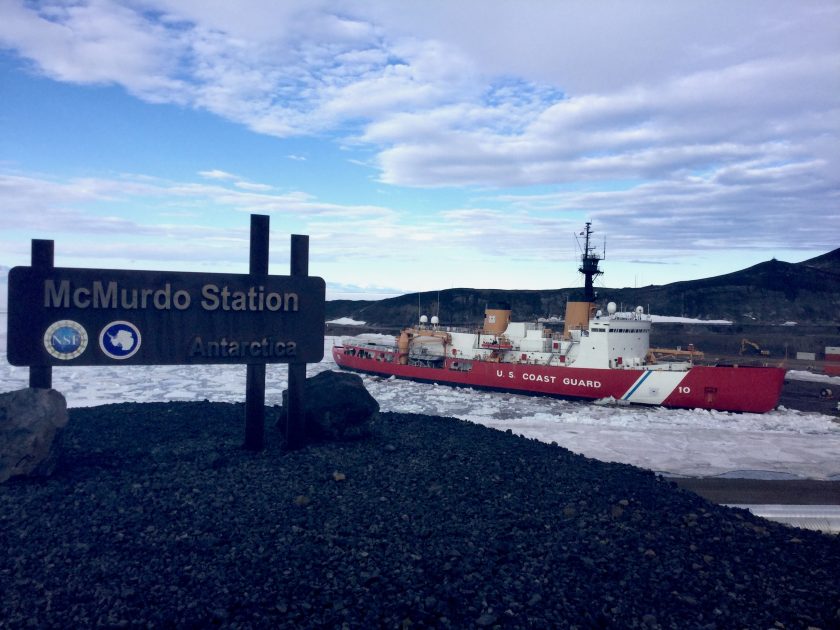
USCGC Polar Star at McMurdo Station, 2019

Homeland Security Today is reporting the newly passed Coast Guard budget contains some very good news, including $655M for the new Polar Security Cutter.

The total budget is approximately $12,016M. This is about $92M less than last year, but that budget was remarkable in funding two National Security Cutters (#10 and #11). Presumably it contains funding for the second Offshore Patrol Cutter and long lead time items for the third. These were included in the original request, but were not mentioned in the report.

The Coast Guard gets $15 million for an additional 250 military personnel in the legislative agreement, $12.9 million for the 2019 pay raise, and $2 million to increase child care benefits and cost of living increases.

The bill is reported to include a couple of reporting requirements that may indicate where the Congress thinks the Coast Guard should be heading.

The bill directs the USCG to submit a plan within 120 days for a one-year pilot program to address illegal, unreported, and unregulated fishing, which “leads to billions in losses for the global fishing industry and is a source of financing for illicit activity such as piracy, drug trafficking, human trafficking, and slavery.”

Within 180 days, the USCG is required to give relevant committees “an assessment of the Coast Guard’s ability to conduct maritime law enforcement activities in the high seas in support of international partners.” (emphasis applied–Chuck)

The illegal, unreported, and unregulated fishing could just be in reference to helping Micronesia. The law enforcement activities with partners could be about drug enforcement, but that is already pretty well understood. Could this mean we might be helping the Vietnam or the Philippines with their Chinese fisheries problems?

There is “$5,000,000 for survey and design work to support the acquisition of a Great Lakes icebreaker.” Based on earlier discussions, this ship would be at least as capable as the current USCGC Mackinaw.

The budget includes six additional Webber class “Fast Response Cutters,” four toward the 58 in the program of record and a second pair toward the replacement of the six 110s in South West Asia.

Aviation did reasonably well. “…$105,000,000 for the HC-130J aircraft program; $95,000,000 to recapitalize MH-60T aircraft; $8,000,000 to fund both the planned avionics upgrades and the costs associated with the service life extension project for HH-65 aircraft.”

It is gratifying to see that our “Unfunded Priorities List (UPL)” made a difference since frequently in the past we had no UPL. $119M was allocated for UPL items.

FRC and C-130J Team-up for Drug Bust off Costa Rica

The Coast Guard Cutter Donald Horsley conducts sea trials off the coast of Key West, Florida, on April 5. The Donald Horsley is the Coast Guard’s 17th fast response cutter and was commissioned in San Juan, Puerto Rico, on May 20, 2016. (U.S. Coast Guard photo by Eric D. Woodall)

Below you will find a Fifth District news release. It focuses on the actions of the crew of a Coast Guard Air Station Elizabeth City, NC, C-130J during the seizure of a small boat (panga) smuggling cocaine of the coast of Costa Rica, but there is another story here. The vessel they are cooperating with is USCGC Donald Horsley, a Webber class 154 foot cutter, based in San Juan, Puerto Rico. That means she was operating almost 1,300 nautical miles from her home port. These “Fast Response Cutters” continue to exceed our expectations. 

united states coast guard

Multimedia Release

U.S. Coast Guard 5th District Mid-Atlantic
Contact: 5th District Public Affairs
Office: (757) 398-6272
After Hours: (757) 434-7712
5th District online newsroom

Eyes in the sky: one air station’s Herculean efforts to stop drug smugglers

Eyes in the sky

Editors’ Note: Click on images to download high resolution version.

Story by Petty Officer 2nd Class Corinne Zilnicki

It was completely dark in the middle of the Caribbean Sea on the evening of October 3, 2018.

Dense bands of cloud shrouded the moon, obscuring all light. Storms intermittently rumbled to life, dampening the darkness with sheets of rain.

Five thousand feet above the sea, a large white airplane sliced through the gloom, its telltale orange stripe and Coast Guard shield obscured by the shadows.

Pilots and crew members inside the HC-130 Hercules airplane did not mind the obscurity; in fact, it was a critical part of their mission.

They had been sent into the black, windy night to search for a particular vessel, a Panga boat suspected of transporting cocaine northward. Beyond their “search box,” a targeted area in international waters off Costa Rica, the aircrew was armed only with the HC-130’s sensory equipment, years of training and their own intuition.

Petty Officer 1st Class Matt Lotz, a seasoned mission system operator aboard the Hercules, utilized all three to locate the target. Wrestling with various filters and scan methods, he used the plane’s installed camera to spot and track the Panga boat down below, despite the pitch-black night.

Still hovering far overhead, the Hercules crew initiated the “end game,” the final stage of the mission during which aircrews help surface assets locate targets. Coast Guard Cutter Donald Horsley, the nearest asset, steamed toward the Panga and launched a small boat crew to close the final distance.

Little did the crews know, the end game would be rife with difficulty that night.

“The small boat crew experienced some technical difficulties,” said Lt. Patrick Spencer, aircraft commander of the HC-130. “Matt thought outside the box. He figured out a way to talk directly to the small boat so he could direct them to the target.”

Acting as the boat crew’s aerial navigator, Lotz guided them within 50 feet of the Panga.

The pursuit was short, but lively, with the Panga crew leading the Coast Guard team in wild arcs through the darkness.

With the Hercules aircrew serving as their eyes in the sky, Cutter Donald Horsley’s crew seized 600 kilograms of cocaine that night, a haul valued at approximately $17 million.

“When we get to see the end game, the actual drug bust, it gives the crew a sense of accomplishment,” said Lt. j.g. Zachary Georgia, an HC-130 pilot at Air Station Elizabeth City who routinely participates in Joint Interagency Task Force South’s counter-narcotics missions.

The sense of pride and the exciting departure from routine are two reasons that the air station’s members voluntarily deploy to Central America each year, according to Georgia.

In 2018, HC-130 crews from Air Station Elizabeth City conducted more than 100 JIATF South aerial patrols, directly contributing to the arrests of 34 suspected drug smugglers and the interdiction of 27,000 kilograms of narcotics, worth over $745 million.

“Keeping these harmful drugs off the streets of America is significant,” said Capt. Joseph Deer, commanding officer of Air Station Elizabeth City. “Without these intercepts and the deterrent presence of law enforcement authorities, the flow of drugs into the U.S. would be exponentially higher.”

While working in Central America, the aircrews operate from several different locations, and their patrol coverage varies wildly during their deployments. When the crews receive task direction from JIATF South, they are directed to search an expansive area, to investigate a known target, or to insert themselves into the end game of an ongoing case.

“Flexibility is key,” said Petty Officer 1st Class Trevor Tufts, an aviation maintenance technician in charge of the HC-130’s mechanical functions while airborne. “We don’t actually know where we’re going until we get the pre-mission brief each day. I’ve had the location change 10 minutes before departure.”

While their predominant goal is to help stop the trafficking of illicit drugs, the deployed Coast Guard crews have to adapt to ever-changing circumstances on the fly.

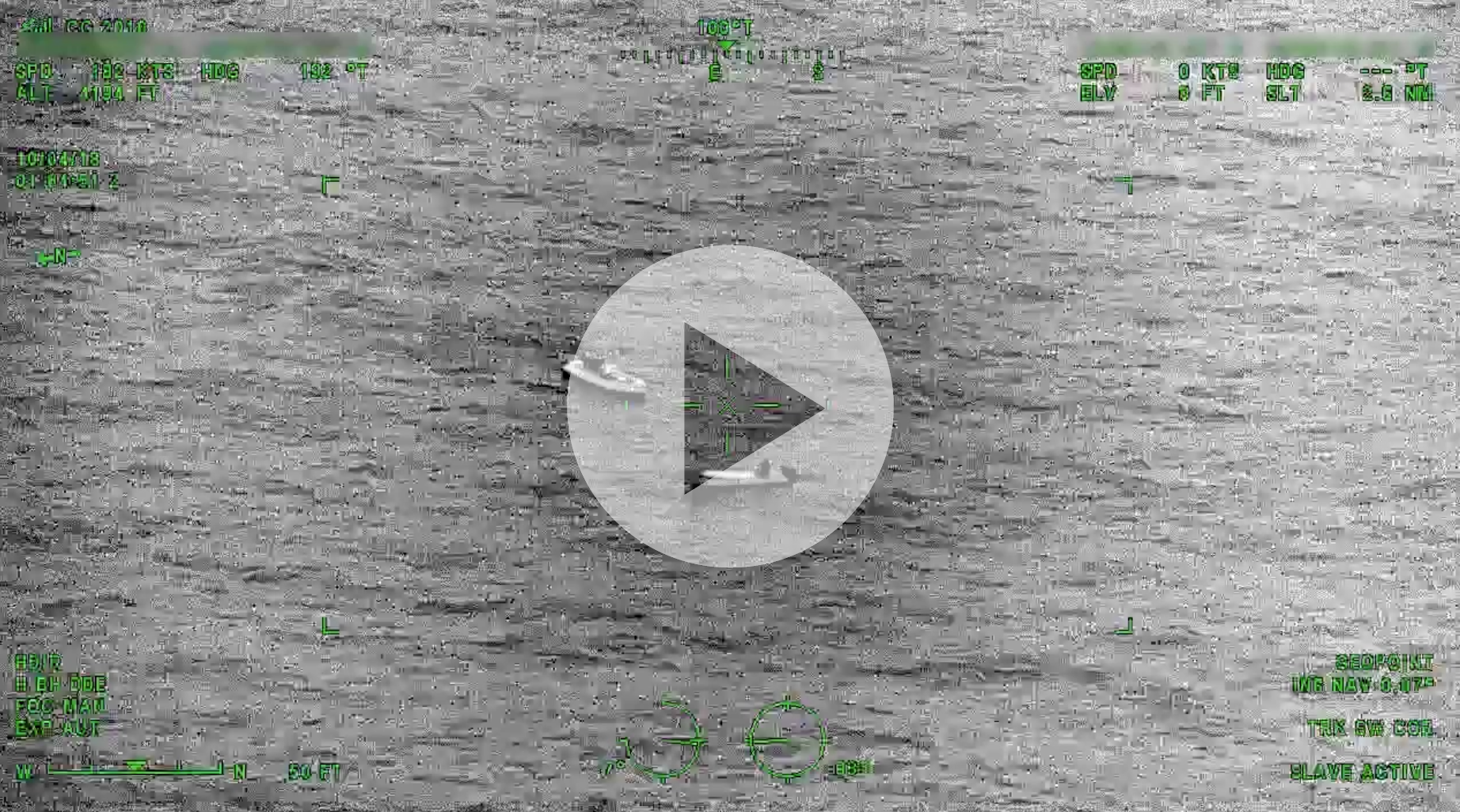
“During my last JIATF mission, we were out looking for drug smugglers, but we found a boat that had capsized instead,” Georgia said. “So the search and rescue case took precedence.”

Coast Guard aircrews work with a diverse array of entities and agencies while deployed in support of JIATF South, including the U.S. Navy, U.S. Air Force, U.S. Customs and Border Protection, and law enforcement agencies of surrounding nations. But according to the Coast Guard crews, the HC-130 Hercules airplane is what truly distinguishes them from their many teammates.

“We can offer twice the range of some of the other planes working down there,” Spencer said. “We simply have the best plane for the mission.”

Air Station Elizabeth City is home to five HC-130J Super Hercules airplanes, the more advanced version of older HC-130H airplanes, which Tufts said is an important distinction. The J-model of the HC-130 touts increased air speed, increased flight time, a camera equipped with infrared sensors, and a 360-degree surface search radar, all features that help aircrews efficiently hunt down drug smugglers.

Mission system operators like Lotz arguably benefit from the airplane’s equipment the most; as the person simultaneously communicating with JIATF South and other entities, monitoring the radar for possible targets, recording footage of action down below, and directing the movements of surface assets, he said he appreciates the HC-130’s various trappings.

“For an MSO, it’s our time to shine,” Lotz said. “I love it. I’d do it forever.”

While only a fraction of Air Station Elizabeth City’s 300 members deploy to Central America during their tour, their commanding officer said the unit is fully committed to supporting the JIATF South mission for the foreseeable future, and that everything they accomplish is achieved through a group effort by all five commands on base.

“We will continue to build on the excellent program that those before us have put in place, ever improving our training and equipment for those that follow in our footsteps,” Deer said. “I am confident the 300 professionals at Air Station Elizabeth City are up to the challenge.”

Sensor Operators on C-130J

Coast Guard MH-65E Program Completes Low Rate Initial Production, Begins Initial Operational Test And Evaluation –CG-9

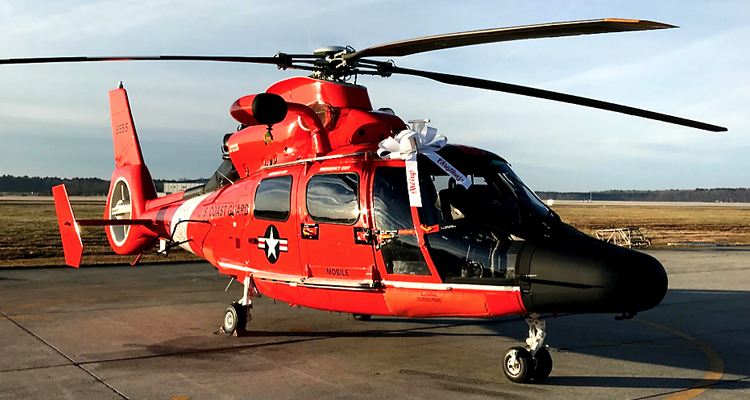
H-65 short range recovery helicopterThe Coast Guard completed Service Life Extension Program activities and an avionics upgrade on an H-65 short range recovery helicopter as part of a joint production line Dec. 18, 2018. Photo courtesy of U.S. Coast Guard.


The following is taken verbatim from the Coast Guard Acquisitions Directorate web site. 

The Coast Guard is completing the first phase of production and moving to full-rate production on concurrent Service Life Extension Program (SLEP) and avionics upgrades of the service’s H-65 short range recovery helicopters.

The avionics upgrades include reliability and capability improvements for the Automatic Flight Control System; installation of a digital cockpit display system and an upgraded digital weather/surface search radar; integration of a robust Command, Control, Communications, Computers, Intelligence, Surveillance and Reconnaissance (C4ISR) suite and modernization of the digital flight deck with Common Avionics Architecture System (CAAS), common with the Coast Guard H-60 medium range recovery helicopter and similar Department of Defense aircraft. Once the upgrades are complete, the helicopter is redesignated an MH-65E.

At the same time, the Coast Guard is completing SLEP activities to replace five major structure components – the nine-degree frame, canopy, center console floor assembly, floorboards and side panels. These mission-critical improvements are designed to extend the service life of the helicopter by 10,000 flight hours.

Work was finished Dec. 18, 2018, on the first H-65 – CG 6556 – to complete SLEP activities and the avionics upgrade in a joint production line. Termed low rate initial production (LRIP), this first phase allows the service to review and validate improvements required after the initial work on the prototype and validation/verification (CG-6587) aircraft. During this phase, Coast Guard teams discovered that the wire analysis system was not completely ready for full production. On-the-spot corrections were made to remedy the problem and rolled into the production process for future aircraft.

The avionics upgrades and SLEP are being completed at the same time to achieve schedule and cost efficiencies. The Coast Guard will also sequence the installation of new upgrade components after SLEP and programmed depot maintenance is complete, avoiding unnecessary rework that would be required if the efforts were conducted separately.

Initial Operational Test and Evaluation Begins

On Jan. 7, 2019, the H-65 Program with Commander Operational Test and Evaluation Force began initial operational and test evaluation (IOT&E) activities on two of the three aircraft that have been converted to the Echo configuration, the LRIP and validation/verification aircraft. IOT&E is the evaluation process used to demonstrate the MH-65E’s airworthiness and ensure the aircraft meets operational requirements and associated performance requirements, and is able to safely and effectively perform the Coast Guard missions prior to fleet induction.

Twenty-one ground events and 56 flights have been planned for IOT&E. There will be three test periods and one make-up test period that take place in a three-month window.

A final test report of data collected from both the operational assessment and IOT&E will be used to support a decision for the program to move into full rate production. The program anticipates an ADE-3 decision in the first quarter of fiscal year 2020.

Projected completion of the MH-65E conversion for all 98 aircrafts is fiscal year 2024.

For more information: MH-65 program page

“The shipwreck that changed the Coast Guard forever” –5th District Public Affairs

The following is a 5th District press release quoted in full.

The shipwreck that changed the Coast Guard forever

This video outlines the Marine Electric shipwreck and the incident’s lasting impact on the Coast Guard.  

Editors’ Note: Click on images to download high resolution version.

Story and artwork by Petty Officer 2nd Class Corinne Zilnicki

When the clock tolled 12 a.m. on Feb. 12, 1983, the 605-foot cargo ship Marine Electric trekked northward 30 miles off Virginia’s Eastern Shore, plowing slowly through the gale-force winds and waves stirred up by a winter storm.

An able-bodied seaman relieved the watch and peered forward, noticing for the first time that the ship’s bow seemed to be riding unusually low in the water. Dense curls of green ocean rushed over the bow, some of

them arching 10 feet over the deck before crashing back down. The crew had been battling 25-foot waves for hours, but until now, the bow had bucked and dipped as normal.

Now it seemed only to dip.

Over the next two hours, the waves intruded with increasing vigor. The entire foredeck was swallowed in 6 feet of water. The main deck was completely awash.

At 2:30 a.m., the ship’s master, Phillip Corl, summoned his chief mate, Robert Cusick, to the bridge and shared his fears: the bow was settling, they were taking on too much water, and the crew was in real trouble.

At 2:51 a.m., the captain made the first radio distress call to the Coast Guard.

“I seem to be taking on water forward,” Corl said. “We need someone to come out and give us some assistance, if possible.”

By the time assistance arrived, the Marine Electric had listed, rolled violently to starboard, and capsized, hurling most of its 34 crew into the 37-degree water. Chaos ensued.

Chief mate Cusick surfaced with a gasp, managed to get his bearings, and spotted a partially-submerged lifeboat nearby. After swimming through towering waves for 30 minutes, he pulled himself into the swamped boat and started thrashing his legs to stay warm.

“All the time I kept looking out and yelling out, ‘lifeboat here,’ just continually yelling out to keep myself going,” the chief mate said. “Then I waited and prayed for daylight to come.”

The Coast Guard had long since dispatched an HH-3F Pelican helicopter crew from Air Station Elizabeth City, North Carolina, and directed the crews of several cutters to the Marine Electric’s position, but the tumultuous weather conditions slowed the rescuers’ progress.

Naval Air Station Oceana had to recall available personnel before launching a helicopter crew, including rescue swimmer Petty Officer 2nd Class James McCann.

At 5:20 a.m., the Coast Guard helicopter crew was the first to arrive on scene. They had expected to find the Marine Electric’s sailors tucked into lifeboats and rafts, but instead, they found a blinking sea of strobe lights, empty lifeboats, and bodies strewn below.

The Navy aircrew arrived and deployed McCann, who tore through the oil-slicked waves, searching for survivors. He managed to recover five unresponsive sailors before hypothermia incapacitated him.

The Coast Guard crew scoured the southern end of the search area and discovered one man, Paul Dewey, alone in a life raft. They dropped the rescue basket so he could clamber inside, then hoisted him into the helicopter. About 30 yards away, they spotted Eugene Kelly, the ship’s third mate, clinging to a life ring, and lowered the basket to retrieve him.

Cusick remained huddled in his lifeboat until the sailors aboard the Berganger, a Norwegian merchant vessel whose crew was helping search the area, sighted him and notified the Coast Guard. The helicopter crew retrieved him in the rescue basket, then took off for Salisbury, Maryland, to bring the three survivors to Peninsula Regional Medical Center.

Meanwhile, more Coast Guard and Navy rescue crews converged on the scene to search for survivors.

Coast Guard Capt. Mont Smith, the operations officer at Air Station Elizabeth City, had piloted a second Pelican helicopter through turbulent headwinds for over an hour in order to reach the site.

He and his crew scanned the debris field below for signs of life. The people they saw were motionless, and it was difficult to determine whether they were simply too hypothermic to move, or deceased. Smith spotted one man and hovered over him, squinting through the whipping snow, trying to decide what to do.

“We all felt helpless,” Smith said. “There was no way to know if the man was dead or alive. We had to try something.”

Petty Officer 2nd Class Greg Pesch, the avionics electrical technician aboard the helicopter, volunteered to go down on the hoist cable. After some deliberation, Smith agreed.

Pesch’s descent in the rescue basket was a harrowing one.

“The whole world seemed to be churning,” Smith said. “I struggled to maintain a smooth hoist, but I know it was erratic.”

Once in the water, Pesch grappled with the basket, trying to hold it steady as he guided the unresponsive man inside. It took several attempts, and then he scrambled into the basket himself and ascended back to the helicopter alongside the victim.

The aircrew spotted another potential survivor, and although Pesch attempted to descend again, the hoist cable spooled back on itself on the drum. The crew was forced to abort their mission and departed for nearby Salisbury Airport, where the man they had pulled from the water was pronounced dead on arrival by paramedics.

Dewey, Kelly and Cusick were the only men pulled from the ocean alive that morning. Their 31 shipmates had either succumbed to hypothermia or drowned.

All told, Coast Guard, Navy, and merchant vessel crews recovered 24 bodies from the scene of the capsizing. Seven were never found. It is likely the ship’s engineers were trapped belowdecks when the vessel capsized.

“Throughout Coast Guard history, the missions of the service have been written in blood,” said Dr. William Thiesen, historian, Coast Guard Atlantic Area. “Such was the case with the loss of the Marine Electric. This tragic event led to stricter marine safety regulations and the establishment of the Coast Guard’s premiere rescue swimmer program.”

While the incident itself served as the catalyst for the major changes to the Coast Guard and maritime community at large, the rigorous efforts of Coast Guard Capt. Domenic Calicchio brought the necessity for such changes into sharper focus.

Calicchio was one of the three marine safety officers charged with investigating the capsizing and sinking of the Marine Electric. The board of inquiry launched their investigation on July 25, 1984, and examined every aspect of the WWII-era cargo ship, its upkeep, the events leading up to its demise, and the Coast Guard’s rescue efforts on that morning.

The investigation revealed that although the Marine Electric had been recently inspected several times by both the American Bureau of Shipping and the Coast Guard, marine inspectors had failed to note several discrepancies or recommend needed repairs. Investigators concluded that the casualty had most likely been caused by inadequate cargo hatches and deck plating, which allowed the crashing waves to flood the vessel’s forward spaces.

Calicchio felt the Coast Guard needed to revamp its marine safety procedures and demand more of maritime companies, but more importantly, that the Coast Guard needed to demand more of itself.

His push for reform resulted in several additions to the Coast Guard’s marine safety protocol, including guidance on hatch cover inspections, and new requirements for enclosed lifeboats and their launching systems, for ships’ owners to provide crews with cold water survival suits, and for flooding alarms to be installed in unmanned spaces on vessels.

The Coast Guard also tightened its inspections of 20-year or older ships, which led to the near-immediate scrapping of 70 similar WWII-era vessels.

“Calicchio embodied the service’s core values of honor, respect, and devotion to duty,” said Thiesen. “He championed marine safety and pursued the truth even at the risk of his career of a Coast Guard officer.”

While the Coast Guard changed many policies to make a safer marine environment after the the sinking of the Marine Electric, the service continues to make improvements on its marine safety program today. By 2025, it is estimated that the demand for waterborne commerce worldwide will more than double. The Coast Guard has published its Maritime Commerce Strategic Outlook in preparation for the increasing demand. 

The Marine Electric shipwreck also served as the genesis of another crucial development: the Coast Guard rescue swimmer program, which was established in 1984. The program’s physical fitness standards, training and organizational structure were developed over a five-year implementation period, and in March of 1985, Air Station Elizabeth City became the first unit to receive rescue swimmers.

The first life was saved two months later.

The Marine Electric, a 605-foot cargo ship, as seen underway before its capsizing and sinking on Feb. 12, 1983. The converted WWII-era ship foundered 30 miles off the coast of Virginia and capsized, throwing most of its 34 crew into 37-degree water, where 31 of them drowned or succumbed to hypothermia. (U.S. Coast Guard photo)

Capacity Building in the Philippines

Found this on Facebook, posted by fellow CIMSEC member Armando J. Heredia. That lead me to the original source. You can find more photos there. 

US Government opens new training facility for Philippine Coast Guard

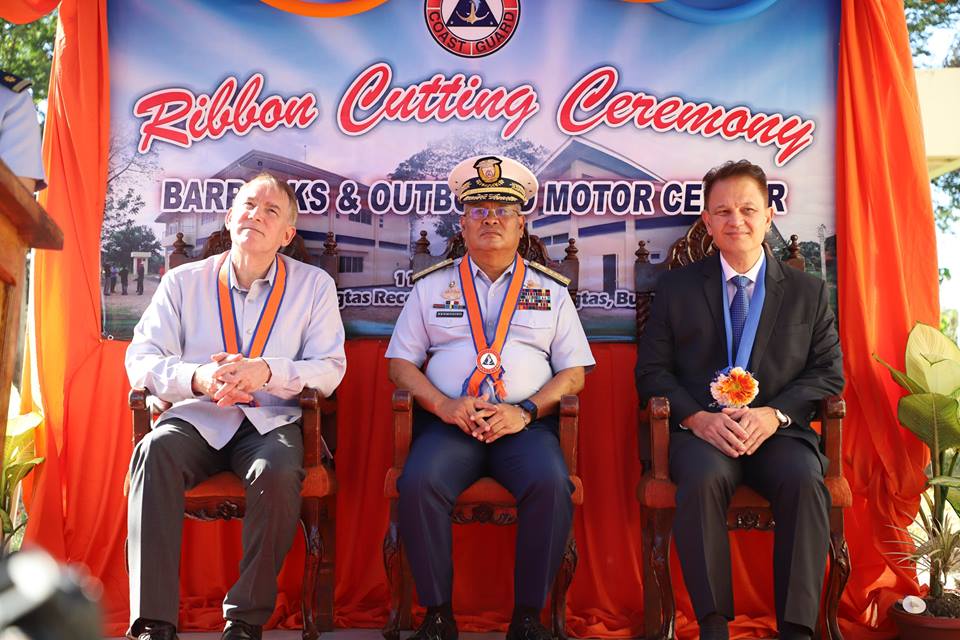
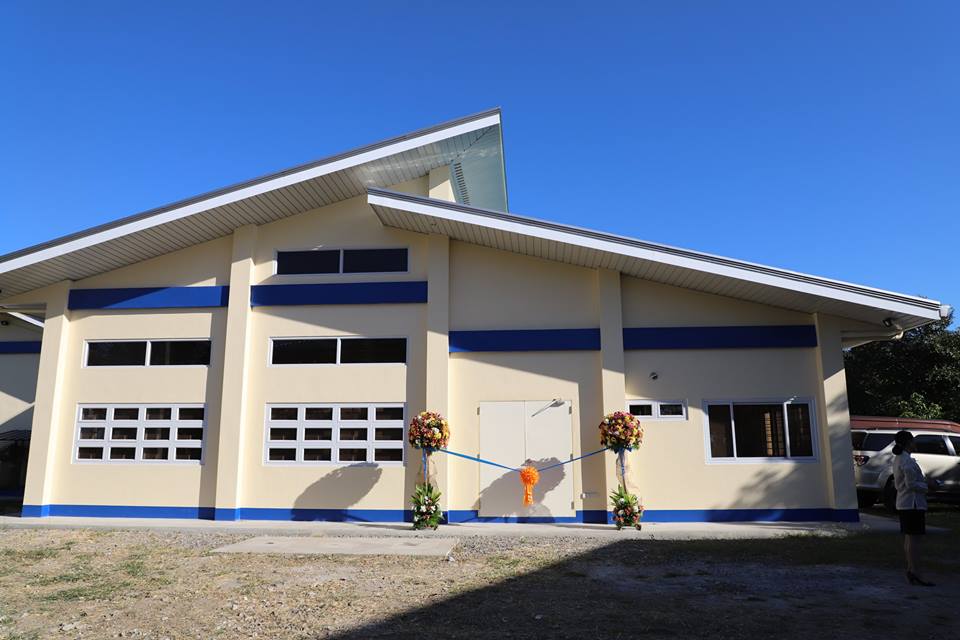
The Philippine Coast Guard and United States Government jointly held the ceremonial ribbon cutting and soft opening of the newly constructed Outboard Motor Center Training Facility in Balagtas, Bulacan today, February 11, 2019.

The event was graced by the Coast Guard Commandant, Admiral Elson E Hermogino; United States Embassy Deputy Chief of Mission, John C Law; and the Deputy Director of the Joint Interagency Task Force-West (JIATF-W), Capt Earl Hampton Jr USN (Ret).

The Outboard Motor Center of Excellence will enhance the Philippine Coast Guard’s capacity to train and sustain its workforce and equipment. It consists of classrooms, barracks and an outboard motor maintenance lab built under local contract managed by the U.S Naval Facilities Engineering Command.

The facility is a joint project between the PCG, U.S Coast Guard, the JIATF-W, the Joint U.S Military Assistance Group (JUSMAG), and the U.S Department of State Bureau of International Narcotics and Law Enforcement Affairs which is approximately worth 156 million Pesos.

In its inventory, the PCG has 300 aluminum boats and 50 rubber boats with outboard motors deployed nationwide.

The PCG frontline units rely heavily on these aluminum and rubber boats in fulfilling its mandate. These assets are primarily used in the coastal law enforcement patrols, search and rescue operations and monitoring of environmental laws compliance.

Last year, at least 40 PCG personnel were sent to US Coast Guard Training School in Virginia to undergo different shipboard courses to include training on the maintenance of outboard motors. For this year, the US Government will place a mobile training team inside the training facility in Bulacan to train qualified PCG personnel to become instructors.

Photos by Tanod Baybayin