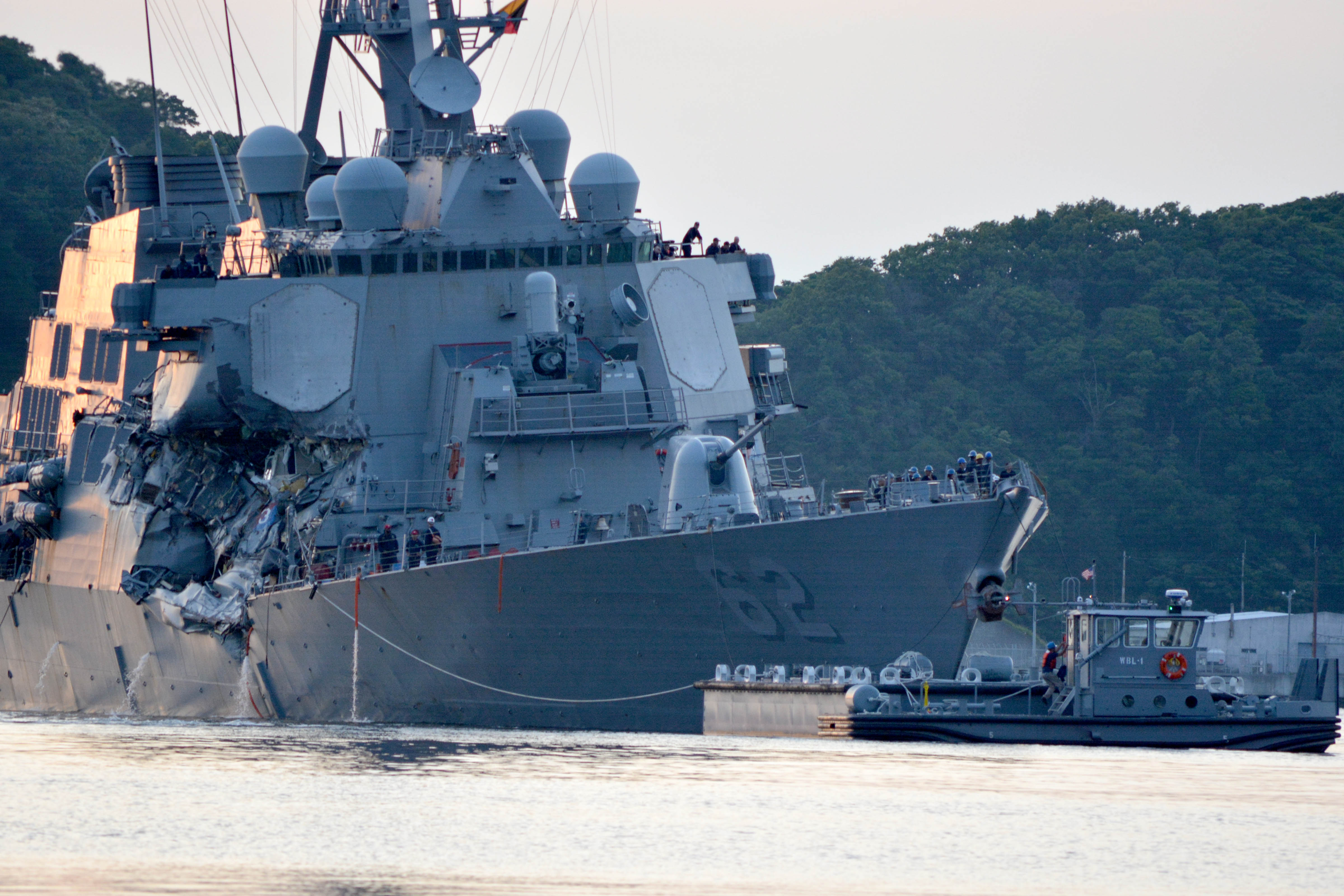
170617-N-XN177-155 YOKOSUKA, Japan (June 17, 2017) The Arleigh Burke-class guided-missile destroyer USS Fitzgerald (DDG 62) returns to Fleet Activities (FLEACT) Yokosuka following a collision with a merchant vessel while operating southwest of Yokosuka, Japan. (U.S. Navy photo by Mass Communication Specialist 1st Class Peter Burghart/Released)
Navy Times has a story about an internal Navy investigation of the USS Fitzgerald’s fatal collision with merchant vessel ACX Crystal that took the life of seven sailors and disabled a $2B DDG.
It is a bit of a horror story, but one line stood out for me,
“Procedural compliance by Bridge watchstanders is not the norm onboard FTZ, as evidenced by numerous, almost routine, violations of the CO’s standing orders,”
In my experience there is only one explanation for this, that the standing orders were proforma to check a box, but the Captain did not in fact want to be disturbed, and had made it clear that he expected his officers to handle the situation without interrupting his sleep.
Cutter Stratton sailor returns home U.S. Coast Guard photo by Petty Officer 1st Class Matthew S. Masaschi.
The current budget impasse is creating hardships for Coast Guard members and their families. If you want to help, one of the best ways is through Coast Guard Mutual Assistance. If you would like to make a donation or organize a fund raiser, this is the link.
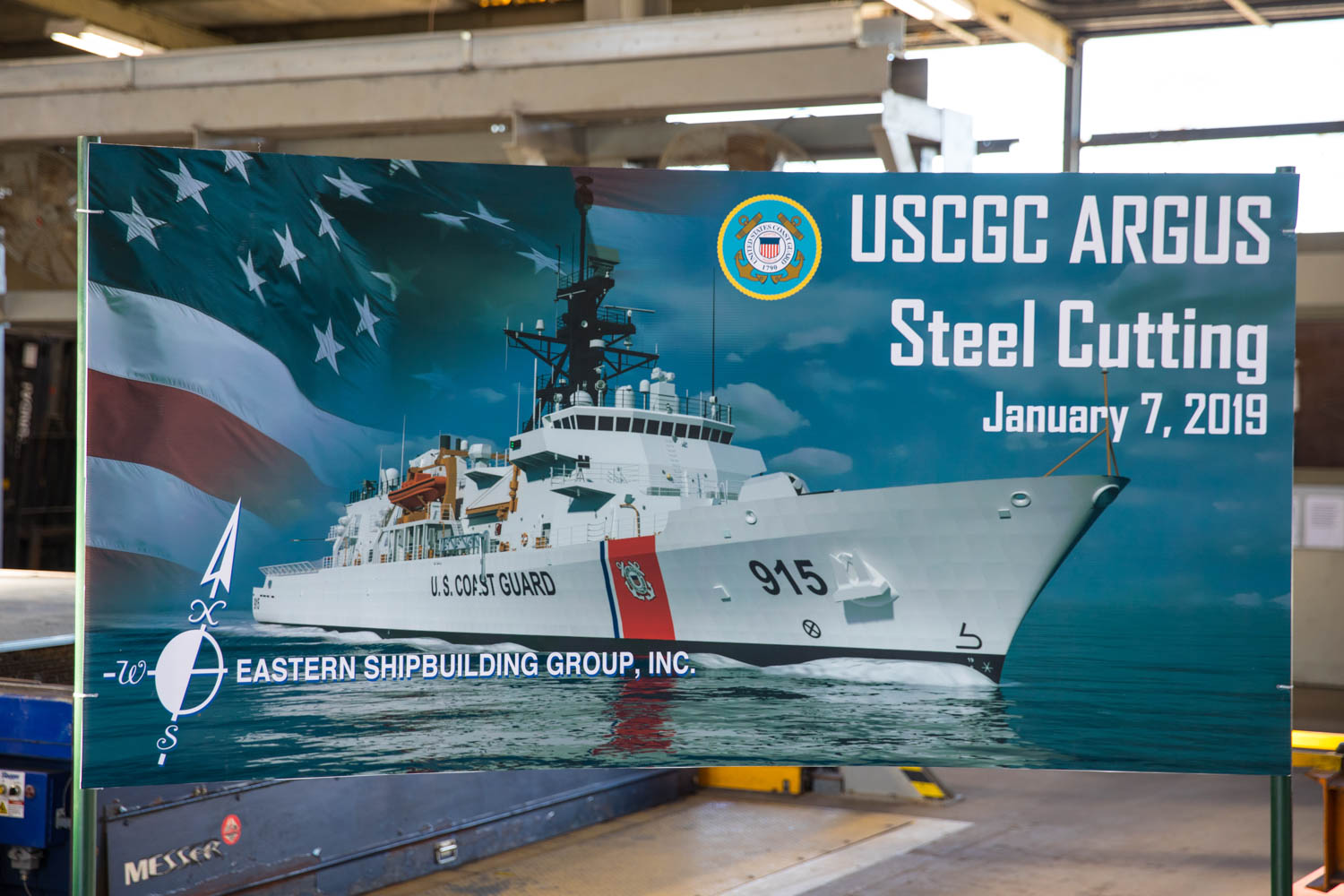
The first major milestone in the construction of the first OPC has been achieved. Steel was cut January 7.
Eastern Shipbuilding photo
Unfortunately because of the travel restrictions of the Government Shutdown, no Coast Guard flag officers or Department of Homeland Security dignitaries were present.
Eastern Shipbuilding photo
Thanks to Eastern Shipbuilding for the use of the photos.
Military.Com is reporting it is unlikely there will be a Coast Guard payday on Jan. 15. The report also mentions some steps taken by third parties that might help members manage the shortfall.
An NPR interview with former Commandant Thad Allen is also referenced and quoted. The whole interview is worth a read.
Note: Apparently as a result of the Government Shutdown, links to the House of Representative’s Website that have been included in this are no longer available and once you get their error message you will no longer be able to back arrow to this site. You will have to reload. Hopefully these link will be reestablished some time in the future, so I have left them in. I have been unable to relocate some of the quotations below to provide more specific citations so I am going to go ahead and publish without them.
All five Representatives won reelection, so it is probable we will see them on the Subcommittee next year. Representative Garamendi was clearly excited and optimistic about the becoming chair of the House Sub-Committee. He strongly reports Coast Guard recapitalization. He also expressed a desire to see Rep. Brian Mast return as ranking member.
The two topics were essentially unrelated. We have revisited the topic of the Polar Security Cutter/Heavy Polar Icebreaker numerous times.
GAO is still contending there are Scheduling and Technological risks. They don’t seem to recognize the steps that have been taken to minimize these risks and that the largest scheduling risk is in delaying the start of the project once the detail design is substantially complete. There is real urgency in the need to replace Polar Star and they don’t seem to recognize that. Yes, the Coast Guard might have done a better job, if we had started this project about a decade earlier, and we might have done that if they had not continued to insist we had to keep our AC&I (now PC&I) budget to about $1.1B, but we can no longer afford more delay to achieve a drawn out, risk free, acquisition process.
Mr. O’Rourke once again made the case for block buy vs a contract with options, contrasting the way the Coast Guard has contracted for vessels while the Navy has successfully used Block Buy and Multi-Year contracting for vessels much more complicated than those being procured by the Coast Guard.
The need for a National Maritime Strategy reflected a realization that the US ability to transport military reinforcements to a theater of conflict in American ships with American crews seems to be in jeopardy. We discussed this problem and what the Coast Guard could do about it here.
Rather than reference the exchange on the video above as I have done before, I will just highlight parts of the two source documents, the “Summary of Subject Matter” (a six page pdf) and Congressional Research Service Naval Expert, Ronald O’Rourke’s prepared statement.
Regarding the Polar Security Cutter (Heavy Polar Icebreaker or HPIB), from the summary of subject matter
The Coast Guard Acquisition Directorate is conducting a tailored technical readiness assessment to update the HPIB cost estimate with an estimated completion of June 30, 2019.
The Coast Guard Acquisition Directorate will update the program schedule within three months of the Detail Design and Construction contract award and before awarding construction, as appropriate, with an estimated completion date of September 30, 2019.
The Coast Guard Acquisition Directorate is conducting a tailored technical readiness assessment to analyze and determine schedule risks with an estimated completion of June 30, 2019.
Since presumably much of this work would be done by civilian acquisitions specialist, it is likely the work is falling behind because of the government shut down
Shift in Security Environment; New National Defense Strategy
A Maritime Strategy has not been issued. If it had it would likely need an update given that both the Administration and Geopolitical situation have changed.
Mobility Capabilities and Requirements Study 2018 (MCRS-18)
DOD states that it started the study, which it refers to as the Mobility Capabilities and Requirements Study 2018 (MCRS-18), on March 8, 2018, and that it is scheduled for completion in the fall of 2018…A September 25, 2017, press report about MCRS-18 states that “Since the early 1990s, Pentagon mobility studies have consistently identified a requirement for about 20 million square feet of roll-on/roll-off capacity to quickly transport material in support of a contingency.” Mobility studies conducted from the 1990s until recently, however, were all done in the post-Cold War era, when U.S. military force planning focused to a large degree on potential crises and conflicts against regional military powers such as Iran and North Korea. Given the recent shift from the post-Cold War era to the new era of renewed great power competition and the resulting formal shift in U.S. military force planning toward a primary emphasis on potential challenges posed by China and Russia, it is not clear that MCRS-18 will leave the figure of 20 million square feet of roll-on/roll-off capacity unchanged. A change in this figure could have implications for the content of a new national maritime strategy.
We have seen no indication of movement on these documents.
Potential Shortfall of Navy Escorts and Possible Impacts on Mariners
GAO notes MARAD’s September 2017 estimate of a potential shortage of U.S.-citizen mariners available to crew U.S.-owned reserve sealift ships during a crisis or conflict. The challenge of finding adequate numbers of appropriately trained mariners to crew DOD sealift ships in time of crisis or conflict is a longstanding issue, dating back at least to 1990, when mariners in their 50s, 60s, and 70s (and one aged 81), some brought out of retirement, were reportedly needed to help fill out the crews of DOD sealift ships that were activated for Operation Desert Shield (the initial phase of the U.S. reaction to Iraq’s 1990 invasion of Kuwait). Problems in filling out ship crews reportedly contributed to delays in activating some RRF sealift ships to participate in the operation. A potential shortage of U.S.-citizen mariners for manning DOD sealift ships in wartime has been a recurring matter of concern since then.
“Was I to die this moment, ‘Want of Frigates’ would be found stamped on my heart.”, Lord Nelson to Earl Spencer, 9 August 1798
Section 1072 of the National Defense Authorization Act for Fiscal Year 2018 (H.R. 2810/P.L. 11591 of December 12, 2017) requires the Navy to submit a report on its plans for defending combat logistics and strategic mobility forces—meaning Navy underway replenishment ships, RRF sealift ships, and MSC surge sealift ships—against potential wartime threats. The report is to include, among other things, a “description of the combat logistics and strategic mobility forces capacity, including additional combat logistics and strategic mobility forces, that may be required due to losses from attacks,” an “assessment of the ability and availability of United States naval forces to defend combat logistics and strategic mobility forces from the threats,” and a “description of specific capability gaps or risk areas in the ability or availability of United States naval forces to defend combat logistics and strategic mobility forces from the threats….”
My earlier post talks about what the Coast Guard could do to mitigate this shortfall, but the most significant step would be to bring back the Coast Guard ASW mission. Equipping eleven NSCs and 25 OPCs with ASW systems could make a huge difference.
Wanted to say thanks for looking in on my blog and a special thanks to those that elevated the discussion by making comments. Have to say, the readership is a remarkably civil group and quite knowledgeable. I think we owe a special debt to Tups for providing much needed expertise on icebreakers. Also want to thank those who engaged with me off line, often bringing items to my attention. Lee has been particularly helpful in this regard.
There were 215,180 “views” in 2018, or about 590 per day That was down 1.32% from last year’s high, but the number of separate visits was up 5.91% over last year’s high, to 54,412 or about 149 per day. There were 316 posts last year, up 14.1% from the previous high in 2015.
Many of the older posts are still being looked at. The top five posts in 2018 were:
The top ten posts ever published on his blog are listed below. I’ve updated the “Top Ten Posts” page to reflect this, along with making some additions and deletions to the list of “Other Posts of Continuing Interest.”
I also started a Chuck Hill’s CG Blog Facebook Page. I try to provide a link there to new posts shortly after they are published here. Occasionally I will provide a link there to other items of interest that I may not post here, but if you only look there you would miss the comments. I will frequently use comments as a way to update an older post.
Looking at the year ahead, I don’t think we need to worry about it being boring. I’m hoping it does not get too exciting. Certainly there are budget uncertainties. Will the icebreaker be funded? Will we get a budget at all? The Geopolitical landscape is changing and not necessarily for the better. The Coast Guard will have a role to play in hopefully keeping the rules based international system in place. Hopefully we will have another year of relative peace.
Its nice when technology makes things better, but it really nice when tech makes things better and cheaper.
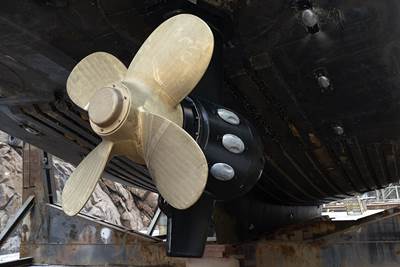
MarineLink is reporting Aker Arctic is claiming they have developed new parameters, “strength dimensioning criteria,” that will allow the use of bronze propellers on high ice class vessels, and that an ice class 1A vessel is now operating with bronze propellers designed and supplied by Aker Arctic.
“While bronze is not as strong as stainless steel, it has a number of benefits in marine applications such as good resistance against corrosion and cavitation damage. The material is also easy to work with both during manufacturing as well as when carrying out maintenance and repairs. Compared to a similarly-sized stainless steel propeller, a bronze screw is also cheaper.”
I did do a post on this new class of motor lifeboat before, there is more detail there as well as a comparison with the 47 footer, but thought you might like this video.
Thanks to Timothy Towner for bringing this to my attention.
Image: Grupo Lindley / Administração dos Portos do Douro, Leixões e Viana do Castelo
Definitely not in my wheelhouse since I never did inland aids to navigation, but Marine Link reports an innovation in marking shallows and narrow channels in flood prone rivers. Apparently it is a hybrid between marking with a pylon mounted aid and a buoy.







 Chuck Hill's CG Blog