Research, Development, Test and Evaluation Spotlight: Night vision devices evaluation

The following is copy of a release on Coast Guard Compass. Good to see new capabilities coming on line. 

Research, Development, Test and Evaluation Spotlight: Night vision devices evaluation

Written by Loretta Haring
Office of Strategic Planning and Communication
Acquisition Directorate

A law enforcement team from Coast Guard Cutter Bertholf (WMSL-750)consisting of Petty Officer 1st Class Jordan Baptiste, Petty Officer 1st Class Asher Thomas, Petty Officer 2nd Class Jean Latimer, Lt. j.g. Kenji Awamura and Petty Officer 3rd Class Brandon Scott, man the cutter's Over The Horizon (OTH) boat, Nov. 4, 2008, during law enforcement training. Team members train constantly to be proficient in their maritime law enforcement mission. U.S. Coast Guard photo by Petty Officer 3rd Class Henry G. Dunphy.

A law enforcement team from Coast Guard Cutter Bertholf (WMSL-750) consisting of Petty Officer 1st Class Jordan Baptiste, Petty Officer 1st Class Asher Thomas, Petty Officer 2nd Class Jean Latimer, Lt. j.g. Kenji Awamura and Petty Officer 3rd Class Brandon Scott, man the cutter’s Over The Horizon (OTH) boat, Nov. 4, 2008, during law enforcement training. Team members train constantly to be proficient in their maritime law enforcement mission. U.S. Coast Guard photo by Petty Officer 3rd Class Henry G. Dunphy.

The Coast Guard Research, Development, Test and Evaluation Program on behalf of the Office of Boat Forces (CG-731) recently completed a research project on newer night vision technology. As a result of that project, CG-731 developed policy and training that allows qualified Coast Guard pursuit coxswains operating the Coast Guard’s over the horizon cutter boats to use night vision technology in the execution of their missions.

Since technology is constantly changing and improving, CG-731 asked the Coast Guard Research and Development Center to research capability improvements in the latest generations of commercial off-the-shelf night vision devices (NVD). Counterdrug and migrant interdiction operations sometimes require the ability to see in low-light or no-light situations, necessitating NVD use.

“We knew night vision capabilities had significantly improved in recent years,” said Lt. Tyson Finn, who is the program lead for this initiative within the Office of Boat Forces. “We wanted to see if the newer capabilities could provide increased performance and safety for our pursuit forces. Working with the RDC and the Deployable Specialized Forces community, we did exactly that.”

The RDC first issued a commercial request for information to determine the state of the NVD market and its new capabilities, said Michael Coleman, an RDC researcher and project manager for the NVD evaluation. Researchers also communicated with commercial entities and government and military agencies to get as much information as possible. They found advancements including field of vision, depth perception, amplification methods and performance characteristics. From that research, a group of NVDs was down-selected and an evaluation methodology developed for underway evaluations.

Limited user evaluations (LUE) to assess NVD capabilities based on specific missions sets using simulated tactics were conducted in both protected and open water in San Diego, and Charleston, South Carolina. NVDs were evaluated for performance, utility and ergonomics; boat evaluation platforms were modified by filtering lights and changing light bulbs to mitigate impacts on NVD use, Coleman said.

Coxswains involved in the limited user evaluations were excited by the increased capabilities of the NVDs.

“Extremely effective, I can see really well,” one coxswain told researchers.

“Looking through the NVD it seemed like a bright sunny day in the fog,” another remarked.

The newer NVD technology demonstrated increased field of view and improved depth perception as well as significant clarity and resolution improvements.

Based on the LUEs, the RDC provided recommendations to CG-731 on specific NVD capabilities and use, Coleman said. The Office of Boat Forces used the recommendations to develop policy on specific NVD use for certain mission sets and established a training and qualification process.

“In time as the cost for this technology decreases, we hope to further evaluate whether this newer NVD technology can be safely and effectively employed on additional platforms and other missions,” said Cmdr. Mike Keane, chief of the boat forces policy division.

Coleman said it is especially satisfying to see the RDC’s research transition to the workforce.

“These updated NVDs provide another tool for the coxswain to use that can be advantageous in completing their mission,” said Coleman.

“Having the ability to evaluate how advancements in technology and equipment can make Coast Guard Boat Forces more capable is key,” Finn said. “The RDT&E Program is an important tool we have available to help us advance how boat crews execute their missions safely and effectively; without their assistance this project would not have been as successful.”

“It is the RDT&E Program’s goal to transition meaningful and impactful projects to the field to enhance mission performance,” said Steve Hager, Surface Domain lead for the RDT&E Program. “This project is a fantastic representation of how partnering with the RDT&E Program can further capabilities in the fleet at the deck-plate level.”

New French Patrol Boat

OCEA to build customs patrol boats for France

BairdMaritime reports the French Ministry of Finance has awarded the OCEA shipyard a contract for construction of a new Customs patrol boat for the West Indies. There is also an option for a second vessel.

We might have an opportunity to work with this class in the Caribbean. At 31.2 meters (102 feet), it falls between Coast Guard 87 foot Marine Protector and 110 foot Island class cutters. The speed, at 27 knots, also falls between that of the 87 footers (25 knots) and 110s (29 knots). It will have accommodations for 16 and a crew of ten.

This might be about the size of the design chosen to replace the 87 foot WPBs. The design appears mostly unremarkable, an aluminum construction mono-hull.

What I find interesting is their boat handling arrangement. Rather than a stern ramp, it appears to carry a relatively large RHIB launched by davit over the starboard side. This is the same arrangement we see on smaller patrol boats built by OCEA for the Philippines.  (see photo below.)

While stern ramps certainly allow rapid launch, recovery can be problematic in rough seas, and they require sacrifice of hull volume. Modern davit systems can be operated with no more personnel than a ramp system, are relatively quick, and impose minimal design penalties on the hull.

Ocea FPB 72

The smaller 24 meter (78.7 foot) OCEA FPB 72 provided to the Philippine Coast Guard, also with davit launched RHIB on the stern. This class is also used by Nigeria and Suriname

Cyber Attack on Port of San Diego

Aerial view of the Port of San Diego with three cruise ships in Port, from Oct. 4, 2012. Port of San Diego photo

As you may have heard, there was a cyber attack on the Port of San Diego, Sept 25, 2018. The port includes 34 miles of waterfront along Chula Vista, Coronado, Imperial Beach, National City, and San Diego.

There have been earlier attacks on the Port of Barcelona 20 Sept. 2018, and the Maersk shipping company. June 27, 2017.

Fortunately in both the San Diego and Barcelona cases, safety and maritime shipping operations appear to have been essentially unaffected.

The Coast Guard was one of the organizations responding to the San Diego attack. Quoting a Coast Guard news release.

“On Tuesday, September 25, the Port of San Diego reported a cybersecurity incident impacting port offices and some physical security aspects of Maritime Transportation Security Act regulated facilities. The local Coast Guard Captain of the Port along with other federal, state, and local partners, have been actively engaged in response efforts to ensure port safety and security. The cyber incident did not adversely impact Marine Transportation System operations.

“For the benefit of our readers, the Office of Port and Facility Compliance is sharing a Federal Bureau of Investigation public service announcement titled “Cyber Actors Increasingly Exploit the Remote Desktop Protocol to Conduct Malicious Activity,” found at the following link:

“https://www.ic3.gov/media/2018/180927.aspx”

Hurricane Ready: Coast Guard Adapts to the Social Media Storm-USNI

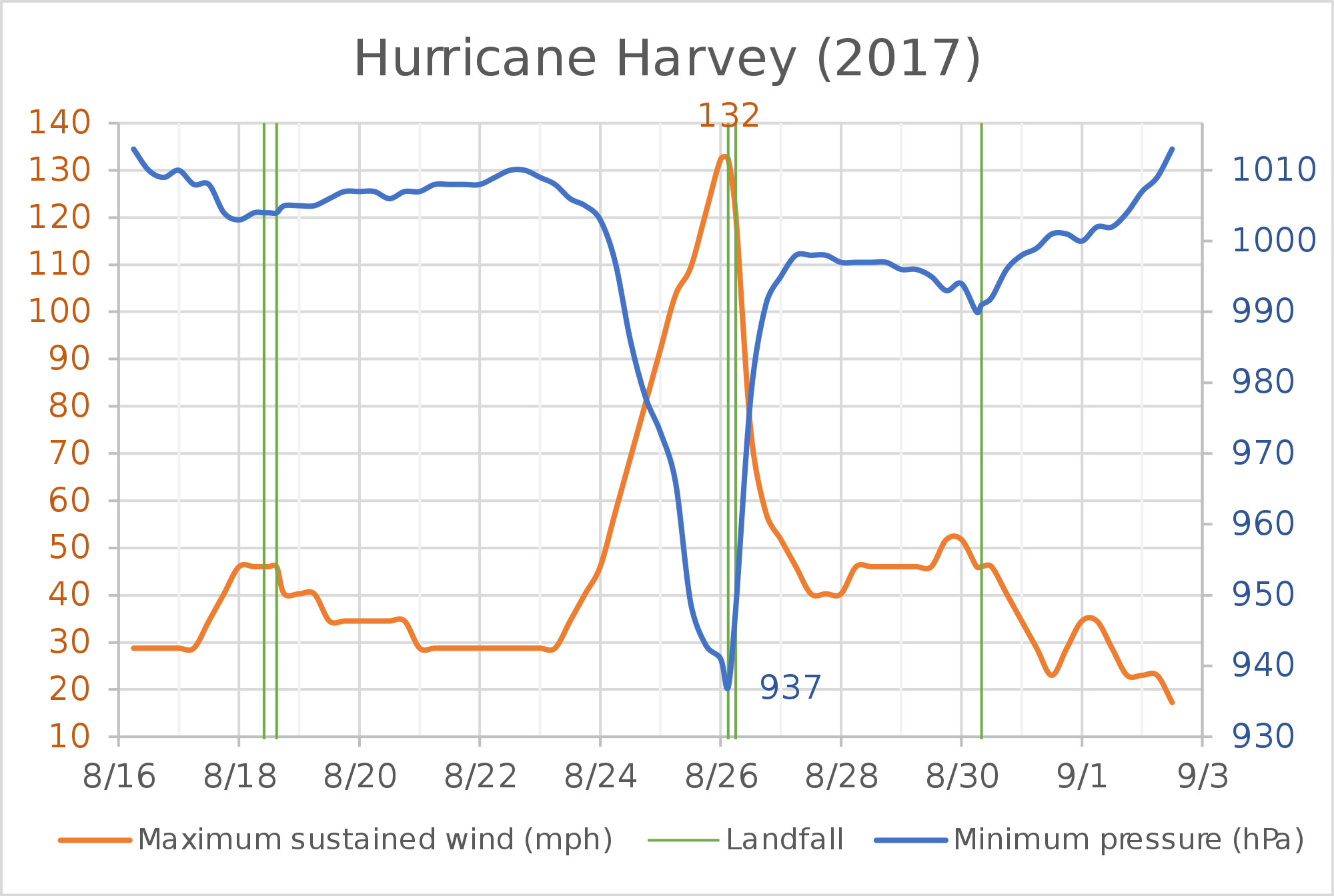
Maximum sustained wind speed and minimum pressure of Hurricane Harvey (2017), Data source: NATIONAL HURRICANE CENTER, TROPICAL CYCLONE REPORT, HURRICANE HARVEY, NOAA

The October US Naval Institute (USNI) Proceedings has what I think may be an important article, discussing the Coast Guard’s use of Social Media in response to Hurricane Harvey. The article is “Hurricane Ready: Coast Guard Adapts to the Social Media Storm,” by Cadet Evan Twarog, USCG. (Unfortunately for those of you who are not USNI members, it is behind the pay wall)

During Hurricane Harvey work with volunteer organizations and crisis mapping became critical. It is a remarkable story of cooperation and rapid innovation.

Not only does the article discuss the service’s use of social media during Harvey, it also talks about future use including standardization. Cadet Twarog points out, and to some extent answers, the following,. “Now the service needs to examine how to permanently and systematically monitor social media calls. To make this possible, four questions must be answered:

  1. “How will the Coast Guard collect information?
  2. “Who will be responsible for the information?
  3. “How will it be distributed throughout the Coast Guard?
  4. “How will the information be used?

New OPV for the Philippines

The Philippines has a requirement for six new ocean-going Offshore Patrol Vessels, and the Austal shipyard in the Philippines is making an offer.

Their design is 81.7 meters (268 feet) in length overall, with a beam of 13.3 meters (43.6 feet), and a draft of 4 meters (13.1 feet), so, similar in size to the Bear class cutters, with perhaps slightly greater displacement. The illustration shows a ship armed with a 76mm Oto Melara Super Rapid naval gun, and two auto-cannon. It has a helicopter landing deck but no hangar.

It is apparently equipped with a stern boat ramp and boat davit starboard.

There is no information on speed, but I would guess 20 to 22 knots on a pair of diesels.

Contracts for First OPC, Long Lead Time Items for OPC#2, and NSC#11

The Acquisitions Directorate has been busy. They report exercising a $317.5M contract option for construction of the first Offshore Patrol Cutter (OPC), USCGC Argus, and long lead time items (propeller and steering components, marine diesel engines, the ship integrated control system, switchboards, and generators), for the second OPC, USCGC Chase. Delivery of Argus is expected in 2021. 

They also report exercising an option for long lead time items for an as yet unnamed eleventh National Security Cutter (NSC).

“The option exercise is valued at approximately $97.1 million. This amount supports the initial order of long lead time components and material necessary to prepare for the construction of the new cutter, including steel plating, propulsion system, marine turbine/diesel engines, air search radar, ship integrated control system, switchboards and generators.”

NSC names

We currently have names for the first nine NSCs.

I am hoping we will name one for Commodore Frank H. Newcomb, who was CO of the Cutter Hudson at the Battle of Cardenas Bay. He really should have gotten the Metal of Honor. It would also give us a nice tie into the Navy since they had a heroic destroyer named for Newcomb. 

I also think Walsh would be a good choice. His Navy Cross citation.

WALSH, Quentin R., CDR, (Retired as Captain) USCG, Navy Cross, For heroism as Commanding Officer of a U.S. Naval party reconnoitering the naval facilities and naval arsenal at Cherbourg June 26 and 27, 1944. While in command of reconnaissance party, Commander Walsh entered the port of Cherbourg and penetrated the eastern half of the city, engaged in street fighting with the enemy. He accepted the surrender and disarmed 400 of the enemy force at the naval arsenal and later received unconditional surrender of 350 enemy troops and at the same time released 52 captured U.S. Army paratroopers.

Sub-Committee Hearing, Coast Guard Modernization and Recapitalization: Status and Future, 26 Sept. 2018

Note, the hearing does not actually begin until time 20:30 on the video above. 

The House Subcommittee on Coast Guard and Maritime Transportation conducted a hearing on “Coast Guard Modernization and Recapitalization: Status and Future” on September 26, 2018.

You can see the “Summary of Subject Matter” that was prepared for the Congressmen here.

This is the first hearing for both Representative Brian Mast (R-FL) as subcommittee chair and Admiral Karl L. Schultz as Commandant. What I saw looked promising.

The Commandant’s prepared remarks has some items of interest. 

The Commandant announced that he would soon issue a Coast Guard “Strategic Plan 2018-2022”

He referenced the new icebreakers as “Polar Security Cutters.”

This past March, we released a request for proposal (RFP), setting the stage for award of a Detail Design and Construction (DD&C) contract in FY 2019 for the construction of up to three heavy Polar icebreakers. We are as close as we have ever been to recapitalizing our Polar icebreaking fleet; continued investment now is vital to solidify our standing as an Arctic nation and affirms the Coast Guard’s role in providing assured, year-round access to the Polar regions for decades to come.

This seems to be a part of an effort to broaden the appeal of the icebreaker program as discussed in a recent USNI post, “Coast Guard Renames Icebreaker Program ‘Polar Security Cutter.'”. Their “…hull designation will be WMSP. W is the standard prefix for Coast Guard vessels, and MSP stands for Maritime Security-Polar, Brian Olexy, a Coast Guard spokesman, told USNI News.”

Apparently we are working toward a fleet of 64 Webber class WPCs rather than the 58 in the Program of Record. The first two additional to replace six Island class WPBs currently assigned to Patrol Force South West Asia have already been funded.

“…Earlier this summer, we exercised the second option under the Phase II contract to begin production of six more FRCs. The FY 2018 appropriation also included funding for two additional FRCs, beyond our domestic program of record of 58 hulls (emphasis applied–Chuck), to initiate the vital replacement of our six patrol boats supporting long-term U.S. Central Command missions in southwest Asia.”

Q&A. Topics discussed during the question and answer period included:

Civil Engineering/Shore infrastructure. $1.6B backlog.

40:00 possibility of a 12th NSC

42:30 Where is the $34M taken out of the FY2018 budget will be coming from–reprogramming within the Department.

44:30 Closures of the Potomac

54:00 Diversity within the service.

1:14:40 Need for larger Reserve Force

1:18:00 Icebreaker program

1:20:00 Waterways commerce cutters

In addition response to the recent Hurricanes seemed to be very much on the minds of Representatives and was referred to repeatedly.

76th Anniversary of the Death of Douglas Munro

By U.S. Coast Guard (Command) [Public domain], via Wikimedia Commons

Today marks the 76th anniversary of SM1 Douglas Munro’s death while evacuating Marines from an ambush on Guadalcanal. Among the approximately 250 Marines rescued that day was Lewis Burwell “Chesty” Puller (June 26, 1898 – October 11, 1971), who having survived, became the most decorated Marine in US history.

Currently we are in the unusual position of having two ships named for this one man. WHEC-724, now renamed USCGC Douglas Munro commissioned on this day 47 years ago, and WMSL-755, USCGC Munro, a National Security Cutter commissioned in April 2017.

Interoperability Is a Core Coast Guard Strength–USNI

Coast Guard Lieutenant Junior Grade Shane Gunderson and Investigative Service agent Bobby Brisby deliver relief supplies to victims of Hurricane Maria in Puerto Rico. (U.S. Coast Guard photo)

The USNI “Proceedings Today” has an article “Interoperability is a Core Coast Guard Strength,” that looks at the Coast Guard’s unique abilities to respond to natural disaster and offers some recommendations particularly in regard to improving the ability of the Coast Guard Reserve to respond. The author is LCdr. Eric Driggs, USCG (Reserve). He currently serves at the Coast Guard Reserve Unit at U.S. Southern Command in Miami, Florida.

Coast Guard to Mark 100th Anniversary of one of World War I’s largest U. S. naval combat losses”–Washington Post

Miami-class cutter USCGC Tampa photographed in harbour, prior to the First World War. Completed in 1912 as the U.S. Revenue Cutter Miami, this ship was renamed Tampa in February 1916. On 26 September 1918, while operating in the English Channel, she was torpedoed and sunk by the German Submarine UB-91. All 131 persons on board Tampa were lost with her, the largest loss of life on any U.S. combat vessel during the First World War. Official U.S. Navy photo NH 1226 from the U.S. Navy Naval History and Heritage Command

As we approach the 100th anniversary, the Washington Post has an excellent article recounting the loss of the Cutter Tampa and it effect on some of the families. Well worth the read.