EIGHT BELLS – A SEA SERVICE CELEBRATION ON 18 OCTOBER 2018–ALCOAST

National Security Cutters Waesche and Bertholf (far right) moored at Coast Guard Island in Alameda, Calif., next to 378-foot Coast Guard Cutters Morgenthau (far left), Sherman and Boutwell, July 22, 2010. U.S. Coast Guard photo by Petty Officer 3rd Class Melissa Leake.

I am passing along this ALCOAST for any in the sea going community that may have missed it. Some good information about the status of building programs. There is a essay/poem/chanty contest. See paragraph 4.a.

ALCOAST 326/18 – SEP 2018 EIGHT BELLS – A SEA SERVICE CELEBRATION ON 18 OCTOBER 2018

R 241155 SEP 18
FM COMDT COGARD WASHINGTON DC//CG-7//
TO ALCOAST
UNCLAS //N01710//
ALCOAST 326/18
COMDTNOTE 1710
SUBJ:  EIGHT BELLS – A SEA SERVICE CELEBRATION ON 18 OCTOBER 2018
1. The Coast Guard Office of Cutter Forces (CG-751), the Heart of the Service, is
sponsoring a Sea Service Celebration centered around 18 October 2018 that honors
the sacrifices of the men and women serving aboard Coast Guard cutters, and
highlights the hard work of the thousands of shoreside administrative, training,
and engineering personnel who enable our fleet to operate. On 18 October 1974,
the Office of Personnel promulgated the Coast Guard Cutterman Insignia program,
to “recognize the contributions and qualifications of our personnel.” Today the
Cutterman pin represents the personal fulfillment of the professional training
and sea service associated with a seagoing Coast Guard career. Additionally, there
are many serving who do not wear Cutterman pins yet make considerable contributions
to the cutter community, and the Sea Service celebration calls special attention
to their contributions as well.
2. Since 1790, professional mariners have manned the decks of our cutters and braved
the high seas, Great Lakes, and our inland waterways. This year, we celebrate more
than 228 years of our sea-going traditions, currently upheld by the nearly 8,000
active duty personnel aboard our 248 cutters. The theme of this year’s Celebration
is “Why I Go to Sea.” As nearly 20% of our active duty force serves afloat, it is
important that we recognize and celebrate those aspects of the arduous yet
incredibly rewarding profession that our mariners embrace.
3. These are exciting times to be a Cutterman – there is a great need for Coasties
who desire to crew our rapidly modernizing fleet. In funding new cutter
acquisitions, the FY 2018 Omnibus Appropriations Bill made the Coast Guard a $12
Billion organization for the first time in our history. The keel for STONE, the
9th National Security Cutter (NSC), is being laid this month, and we will be
constructing hulls #10 & #11. 25 Offshore Patrol Cutters are planned and production
on the ARGUS, hull #1, is funded with an anticipated delivery in FY 2021. 28 Fast
Response Cutters (FRC) are in commission out of the 58 planned for the domestic
program of record, with an additional 6 scheduled for commissioning in FY 2019 alone;
we are also preparing to transition FRCs to PATFORSWA. The Waterways Commerce
Cutter received funding for expedited development of plans for a replacement of
the WLIC/WLI/WLR cutters. Finally, the Polar Security Cutter is moving forward in
the acquisition process and will award the contract in FY 2019. These substantial
national investments are clear evidence of the great value American leadership
places in the hard work of our professional mariners and support personnel
fleetwide.
4. As part of this year’s Sea Service Celebration, COMDT (CG-751) encourages all
Cuttermen & operational commanders to participate in the following events:
a. One-page essay/poem/chanty contest: By 15 October 2018, our current, past
and aspiring future professional mariners are invited to submit a one-page essay,
poem, or chanty on the theme of “Why I Go to Sea.” Potential topics include, but
are not limited to, the missions, best sea stories, traditions, lore, history,
professional incentives, etc. Submissions will be judged on creativity and
ability to inspire Coasties to answer the call and stand the watch. Submissions
have no format requirement besides the page limit and must include the name of
the author, unless unit, department, or group name applies. Pictures are also
encouraged, and if included may take up an additional page. A suggested
essay/prose template is posted on the COMDT (CG-751) portal at:
https://cg.portal.uscg.mil/units/cg751/8%20Bells/Forms/AllItems.aspx.
Chain of command approved contest submissions should be sent via email to the
two POCs listed below. The top three winning entries will be posted on the COMDT
(CG-751) portal page and social media platforms, and shared with Surface Naval
Association Presidents, Rating Force Master Chiefs, and Operational Commanders
for distribution within the cutter community.
b. Cutter Public Affairs Officers (PAO) are encouraged to utilize their
Official Facebook pages to post CO/OIC-approved photos and media under the
hashtag #WhyIGoToSea throughout the year.
c. Local events: All commands are encouraged to host appropriate functions
that celebrate sea service traditions during the month of October, particularly
on 18 October. Suggestions include: local Cuttermen’s Calls, Dining-Ins, or cutter
round-ups with friendly competitions (DC Olympics, shiphandling challenge, etc.).
d. Cuttermen may join prose to a one to two minute video for possible posting
on District, Area, and HQ blogs and Facebook sites
(http://coastguard.dodlive.mil/official-sites/ or https://www.uscg.mil/home/).
Pictures and video can be submitted by using the Visual Information Management
System (VIMS) at: http://www.uscg.work/vims, choosing your local PA office, and the tag
#WhyIGoToSea. Also submit by 01 October 2018 at:
http://navysna.org/awards/komorowski-photo/ &
http://navysna.org/awards/video-competition.html for a concurrent SNA competition.
5. For more information, contact LT Paul Ledbetter at Paul.A.Ledbetter@uscg.mil and
LT Micah Howell at Micah.D.Howell@uscg.mil.
6. RDML Michael P. Ryan, Assistant Commandant for Capability, sends.
7. Internet release is authorized.
Estonia’s Hybrid Patrol Boat

MarineLink reports on a new patrol boat for the Estonian Coast Guard, only slightly smaller than the Webber class WPCs. What makes this vessel unique, is the use of a hybrid propulsion plant. It can operate in diesel, diesel-electric, or battery powered modes. Reportedly the maximum speed is 27 knots while the electric modes allow quiet, economical, low emissions cruising at up to 10 knots.

“The needs of the patrol boat made it an excellent project to build as a hybrid vessel. For example, the hybrid electric benefit of engine redundancy is important for the Estonian Coast Guard — in case of engine failure, you can switch to diesel-electric or batteries — while you also have improved fuel efficiency, and much lower noise levels in diesel-electric and fully-electric modes when compared to big diesel engines, which is a big benefit for the crew.”

They see these vessels as multi-mission, but there is a strong emphasis on pollution detection.

“While the wave-piercing ship will also be used for patrolling, firefighting and search and rescue missions in Estonian waters, its main role will be monitoring and responding to pollution threats, using state-of-the-art radar that can detect surface contamination, such as oil spills, from up to five miles away.”

New Coast Guard Sub-Committee Chair

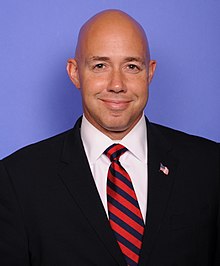
Member of the U.S. House of Representatives
from Florida’s 18th district

The new chairman of the House sub-committee with oversite of the Coast Guard has been announced.

House Committee on Transportation and Infrastructure Chairman Bill Shuster (R-PA) has named U.S. Rep. Brian Mast (R-FL) to serve as Chairman of the Subcommittee on the Coast Guard and Maritime Transportation for the remainder of the 115th Congress.

Representative Mast’s background may be significant. From his Wikipedia entry:

After graduating from South Christian High School in 1999, Mast enlisted in the United States Army Reserve in May 2000 and went to become a combat engineer. In 2006, he transitioned to the active U.S. Army and became an explosive ordnance disposal technician. Mast later joined the 28th Ordnance Company. He served in Afghanistan as part of Operation Enduring Freedom. On September 19, 2010, while clearing a path for United States Army Rangers in Kandahar, Mast took a wrong step into an IED along the road. The explosion resulted in the amputation of both his legs and one of his fingers.

Mast and his family were the recipients of a custom ADA-compliant home awarded to them by the non-profit organization Helping a Hero.

After being honorably discharged from the U.S. Army, Mast was hired as an explosives specialist for the United States Department of Homeland Security. While recovering from his injuries at Walter Reed Army Medical Center, Mast provided explosive and counter-terrorism expertise to the Office of Emergency Operations at the National Nuclear Security Administration from July 2011 to February 2012 and as an instructor of Home Made Explosives for the Bureau of Alcohol, Tobacco, Firearms and Explosives.

New Russian Nuclear Powered Icebreakers

NavyRecognition provides us some information on a new class of Russian nuclear powered Icebreaker. They are, to say the least, huge.

  • Length: 209 meters (686 feet)
  • Beam 47.7 meters (156 feet)
  • Draft: 13 meters (43 feet)
  • 120 MW (160,923 HP) (More than twice that of the Polar Star)
  • Power will be provided by four props on conventional shafts.

They are planning to build three. It is claimed they will be able to break ice 4.3 meters thick and be able to continuously break two meter ice while making 11 knots. They are expected to cost 70B rubles, or about $1.04B US.

“World’s Fastest OPV”

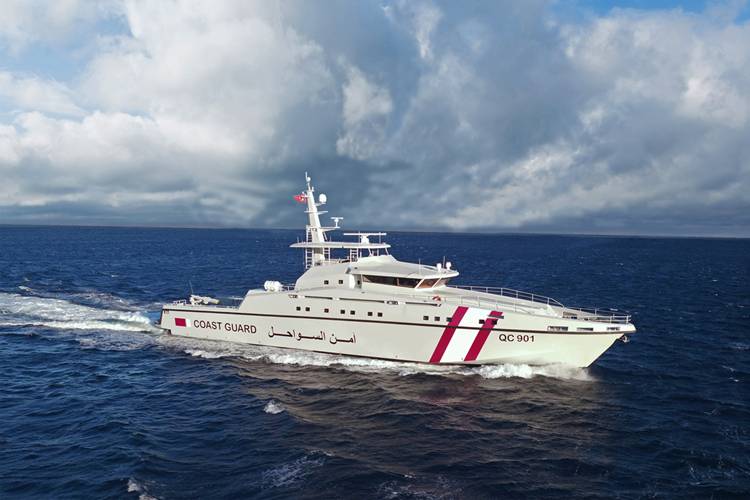
Ares 150, 48 meter OPV built for Qatar Coast Guard

Its fast, its composite construction, and its slightly longer, but lighter, than our Webber class.

MarineLink reports a cooperation between International design and engineering company BMT and the Turkish Ares shipyard (see link for more detail) resulted in an unusual vessel for the Qatar Coast Guard. (Sorry I am a little late in publishing this.)

“These boats break two important records – firstly, they have become the largest composite hull military ship to have ever been built in Turkey and secondly, with its speed of 37 nautical miles an hour (emphasis applied–Chuck), it is the world’s fastest offshore patrol vessel (OPV). It is exciting to also report that the outstanding performance of the first ARES 150 HERCULES has also led to an immediate order for a further three vessels.”

I don’t see either weapons or a boat.

Ares shipyard photo

Including the Coast Guard in Navy Planning

There is a lot going on in Navy Department planning now, prompted by the rise of a real near peer competitor in the form of the Chinese Navy. In fact the Chinese Navy is currently building ships faster than the US Navy. The trend line is not favorable so, its time to think.

Defining a Coast Guard role in a major naval conflict could have major impact on our shipbuilding, our equipment, and our budget.

Force Structure Assessment:

There will be a new “Force Structure Assessment.” It seems we already have an answer for the total number, since 355 some time in the future, has become a law, but this one is expected to better detail the types of ships needed.

The Coast Guard fleet is a significant portion of the “National Fleet” and it needs to be included in the calculus of what will be available and how it will be used.

Surface Forces, the Sea Control Mission:

The Commander Naval Surface Forces has published a new document, “Surface Force Strategy, Return to Sea Control.”

The strategy describes the return to sea control and implementation of Distributed Lethality as an operational and organizational principle for achieving and sustaining sea control at will.

Reading it over, you might notice it says nothing about the Coast Guard. Despite the admission of Cuttermen to the Surface Navy Association, we are still largely invisible to the Navy.

Don’t expect to see a war winning strategy here. This is really an administrative strategy in an attempt to find out what that strategy should be. It is laced with buzz words and power-pointese. It does nothing to tell us how we will find, fix, and kill the other guy before he finds, fixes, and kills us. Still there are some indications.

The big change is that the Navy’s surface forces are saying they will no longer circle the wagons around the carrier and play defense while the aviators provide all the offense. They have begun to see themselves as offensive players. There are even those that now suggest that the carriers should be protecting the surface forces rather than the other way around.

The strategy talks about being Forward, Visible, and Ready.

It talks about the concept of Distributed Lethality:

  • Increase the offensive lethality of each warship
  • Distribute offensive capability geographically
  • Give ships the right mix of resources to persist in a fight

Then they talk about “four Ts”

  • Tactics
  • Talent
  • Tools
  • Training

Hopefully there really is a strategy somewhere in the classified material spaces, but this administrative strategy mostly says we are going to do a lot of good things that we all recognize as good things, and we will do them better than we did in the past. It says nothing about what they will stop doing in order to make time to do these additional things.

What is clear, is that, if the Coast Guard is going to play in the Sea Control game, we are going to need to be part of the network, otherwise, at best we may just get in the way, at worst, we might be road kill in a blue on blue engagement.

Really I think we have a lot to contribute to “sea control.” The Navy has the resources to contend for the opportunity to have control of the seas, but they don’t actually have the platforms to exercise control of the sea. That requires not only excluding enemy combatants–always a hard thing, particularly when those combatants are submarines, but also checking merchant ships to make sure they are not carrying out tasks for the enemy. You also have to protect your own logistics, resupply, and merchant ships and frequently those of your allies. The Chinese have figured out that attacking our logistics is a useful strategy.

Sea Control is many faceted and I have seen few explanations that deal with all aspects. Like a blind man describing an elephant we authors tend to see only certain aspects or elements of the problem.

Cutters will be needed for escort logistics vessels, for open ocean rescue, and for boarding vessels to determine their nature and intent. These are not things you want DDG and cruisers doing.

Even dominant naval powers face the possibility of submarine or unconventional attacks and will want to shutdown the enemies covert as well as overt use of the sea.

Gray Zone Conflicts: 

The Chief of Naval Operations has said that the Navy needs to be able to compete and prevail in ‘Gray Zone” Conflicts.

But is not really just the Navy, the Coast Guard is part of the National Fleet and a potentially important element in any response violations of norms of international conduct, and it can do so without raising tensions to extent use of Navy assets frequently engender

Additional Reading:

If you are interested in an insight into some of the issues shaping the strategy debate, US Naval Institute has published a pair of fictional future history scenarios that highlight some of the issues.

The first, and probably most important of these, is “How We Lost the Great Pacific War.” Like the author, I question the wisdom of having single carrier task groups forward deployed, where they may serve more as bait than deterrent.

The second which takes a different view and looks primarily at the Marine’s role is “How We Won the Great Pacific War.”

CIMSEC just completed a series of eight post on “Bringing Back Sea Control Week.” that was mostly interesting, but still short of comprehensive.

If you really want to get into it, there is a reading list here.

To me the best source is still Julian Corbett’s “Some Principles of Maritime Strategy.” You have to rethink the distribution of roles in light of new technology, but that is itself a useful exercise.

USCG Navigation Center: Steering a steady course for safe, secure, efficient waterways–MarineLink

The above screenshot shows the display of the virtual aid to navigation established in partnership between the U.S. Coast Guard and the U.S. Army Corps of Engineers on the Mississippi River. The virtual aid is significant in that it allows mariners to see a hazard when it is not possible to place a floating aid to mark it. U.S. Coast Guard image.

Marine Link has a very interesting post on the Coast Guard’s Navigation Center. It discusses its role in management of aids-to-navigation, issuance of Notice to Mariners, interface with NOAA and the Army Corps of Engineers, maintenance of GPS including ground based differential GPS equipment, Automatic Information System (AIS) monitoring and quality control, long range tracking of US flag merchant ships, and maintenance of a Maritime Domain Awareness within 1000 miles of the US.

SAG South

Following from the USCGC Hamilton Facebook page.

CGC HAMILTON, along with 11 other Coast Guard Cutters and over 500 Coast Guard personnel have moved out of the path of Hurricane Florence in preparation for a swift response to the potential impacts of the dangerous storm. CGC HAMILTON and 5 other cutters have repositioned to Mayport, Florida in preparation to head north following Florence’s landfall. Together, these cutters have formed Surface Action Group (SAG) South, whose mission is to conduct search and rescue, provide humanitarian aid, assist maritime commerce by surveying waterways and maritime aids to navigation, and provide security to insure a prompt recovery of any impacted sea ports.

In addition to Hamilton I see three 270s, a 210, and a Webber class. Other ships in the SAG include Spencer and Harriet Lane.

Reportedly SAG South has begun to move North out of Mayport.

(Does this mean there is a SAG North?)

MH-65 Service Life Extension Program

US Coast Guard photo, by PAC Dana Warr

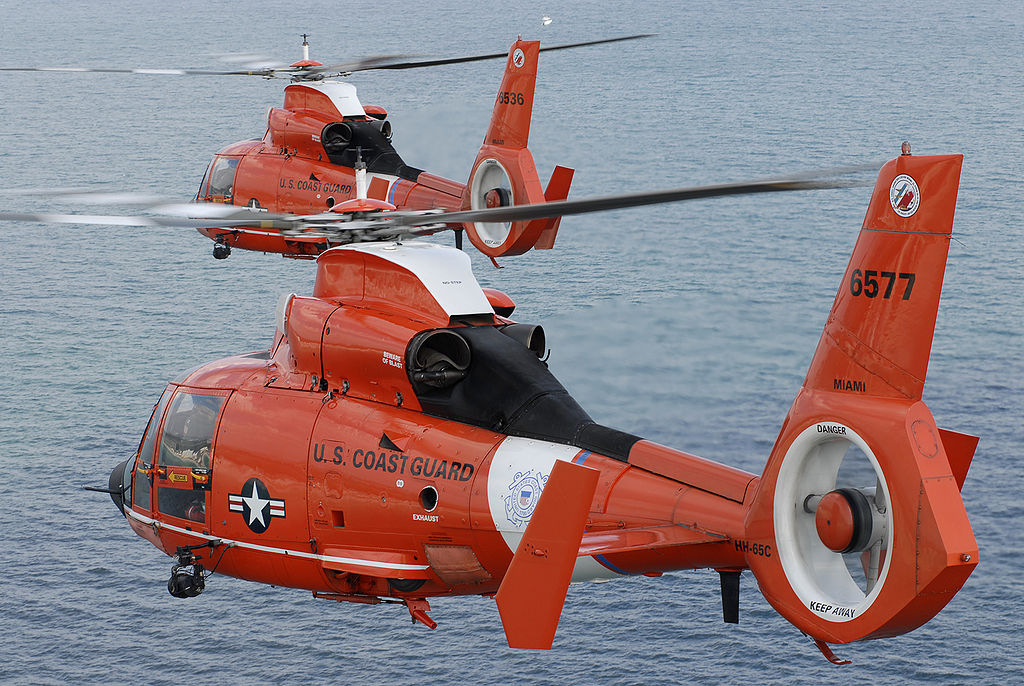
The Acquisitions Directorate (CG-9) is reporting award of a contract to Airbus for components for a Service Life Extension Program for CG MH-65s. I have reproduced the press release in full below. Significantly it indicates the H-65s will continue to serve until phased out between 2035 and 2039. We are also SLEPing the H-60s so their replacement and that of the H-65 may both come due about the same time. In the 2030s we will have an entire fleet of 50 year old helicopters. This could create a huge budgeting problem in the mid 2030s.. At least it appears the “Future Vertical Lift” program should be mature by then. 

———————-

The Coast Guard awarded a $15.9 million contract to Airbus Helicopters Inc. Aug. 22 to procure three critical structural components for its H-65 short range recovery helicopters as part of a Service Life Extension Program (SLEP).

The sole source contract includes the following commercial items; the canopy, center console floor assembly and the lower right nine degree frame. The Coast Guard elected to order 87 canopies in the base period, which resulted in a $2.5 million cost savings to the government. Under the contract, canopy deliveries will be spread out over a five-year performance period.

The SLEP will replace five critical components that are essential to the airworthiness and flight safety of the aircraft. Contracts for the other two components, the floor boards and side panel, were awarded in May.

The SLEP will extend the service life of the H-65 from 20,000 to 30,000 flight hours. The 10,000-flight-hour extension will provide a 50% increase in service life and will ensure that the Coast Guard can maintain its H-65 fleet until its planned phase-out between 2035 and 2039.

The MH-65 is also undergoing an avionics upgrades that will convert the airframe to an MH-65E configuration. In order to achieve schedule and cost efficiencies, the avionics upgrades and SLEP are being completed at the same time. One low rate initial production aircraft, CGNR-6556, is currently undergoing SLEP and the avionics upgrades; work is scheduled to be completed by the end of 2018.

For more information: MH-65 program page

“Embrace the Coast Guard’s Strength”–USNI

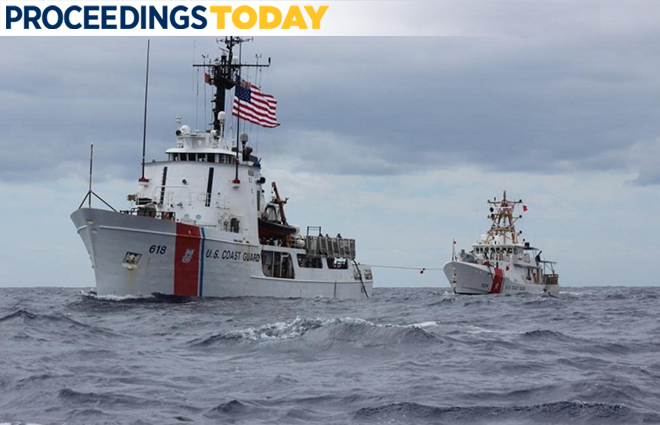
The USCGC Active (WMEC-618) was commissioned in 1966 and is still serving–a tribute to the Coast Guard’s “can do” culture.

By admitting that  Semper Paratus is an aspiration, the Coast Guard can allow itself to celebrate the truth that while the service is not  Always Ready , Coast Guardsmen embrace every task to meet their mission. That might not be the service’s aspiration, but it should be its inspiration.

Seems like I have been pointing to the US Naval Institute publications a lot recently, but it does seem they are paying more attention to the Coast Guard. Latest is “Embrace the Coast Guard’s Strengths” by LCdr. Luke Petersen, USCG. It discusses how we should view the motto, “Semper Paratus–Always Ready.”

Aspirational, Inspirational, or a curse?