MarineLink provides what is almost certainly a quote of press release from Bollinger stating they hope to build the three heavy and three medium icebreakers the Coast Guard has been saying it needs in Tampa. They are reminding every one (hay, you guys in Congress) how many jobs this could mean for Florida.
This cannot hurt our case for building more than one icebreaker.
The nuclear-powered icebreaker Arktika in the Kara Sea. RIA Novosti archive, image #186141. Also keep reminding them how many icebreakers the Russians have and that the Chinese have one, are building one, and are planning a nuclear icebreaker.
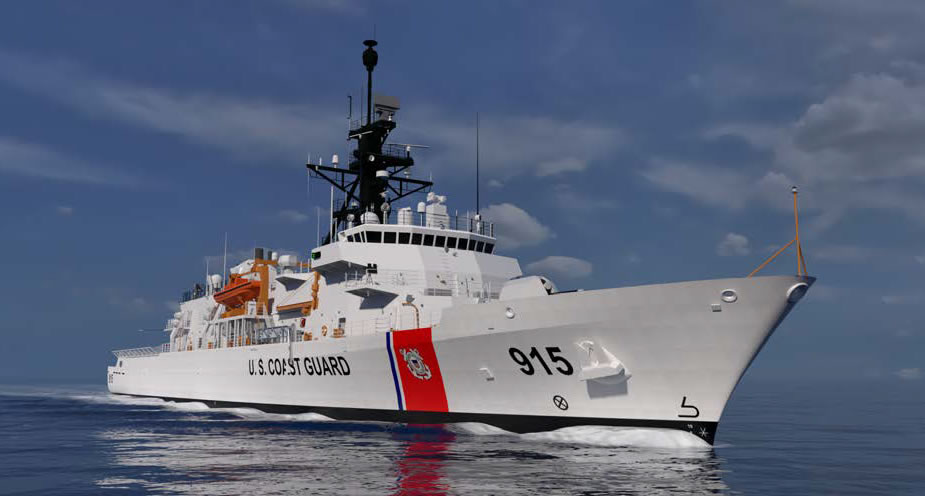
Rendering of Coast Guard Offshore Patrol Cutter. Eastern Shipbuilding Image
NavyRecognitions reports that, “Eastern Shipbuilding Group (ESG) has successfully conducted its Final Critical Design Review (FCDR) with the United States Coast Guard on 29 June 2018 for the Offshore Patrol Cutter (OPC) Program.”
Award for construction of the first of class, USCGC Argus, is expected in the Fall.
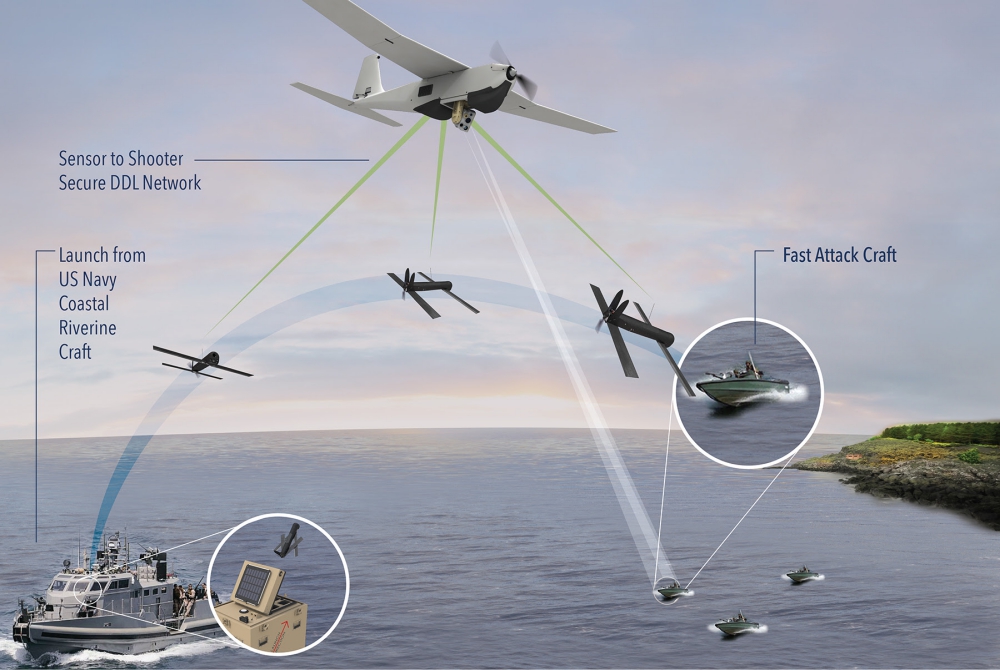
AeroVironment recently conducted a demonstration for the Navy, of how its systems might counter swarming Fast Inshore Attack Craft (FIAC). If the combination of systems works as advertised, it may be exactly what the Coast Guard needs to counter the small, fast, highly maneuverable end of the terrorists surface vessel attack threat spectrum. It is also small enough that it might fit on something as small as a Response Boat-Medium (RB-M). It would certainly fit on a WPB.
It appears to be precise and have minimal chance of collateral damage. It also has a man in the loop, allowing an attack to be aborted or redirected. It is also supposed to have a capability against other drones, presumably smaller, slower ones at low altitude. The combination consists of a Puma UAS to provide target detection, classification, and targeting, and the Switchblade “Lethal Miniature Aerial Missile System” (LMAMS). Switchblade is a missile but a very different one. It is an electric-powered, propeller driven, suicide drone.
The Puma and Switchblade both use the same control system.
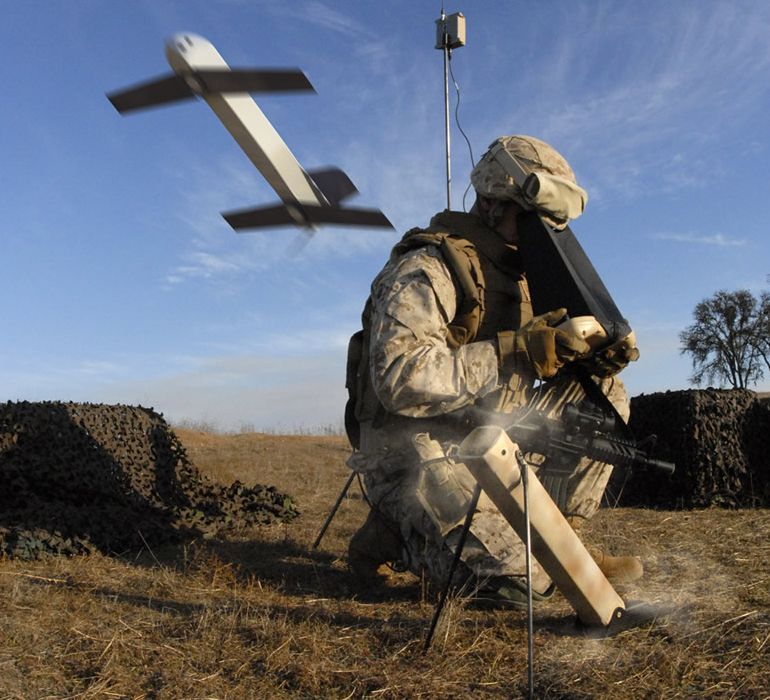
The Switchblade, seen being launched in the photo below, is very small. It is less than two feet long and weighs less than six pounds. The manufacturer’s data sheet is here.
Switchblade loitering munition
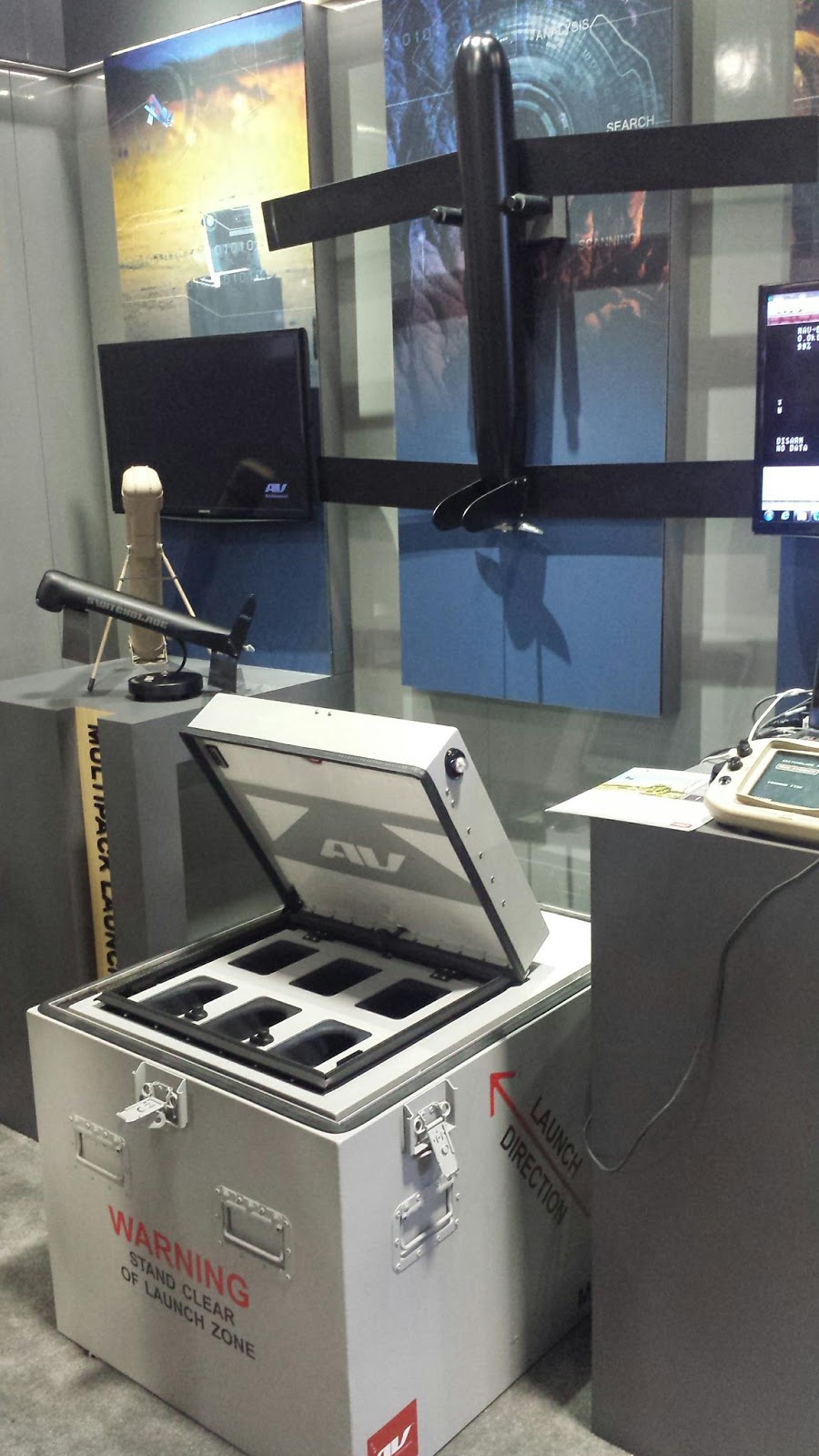
They have introduced a six-pack launch system. It weighs only 160 pounds fully loaded and is only 28″ wide, 34″ deep, and 28″ tall.
AeroVironment six cell Switchblade Launcher
Where might we use these? While these systems might become ubiquitous, if they work as advertised, there are a couple of units that stand out as having the most immediate need.
We have a Canadian report (actually more than one) that Customs and Border Protection marine units are intercepting, boarding, and questioning Canadian fishermen in a disputed area in the vicinity of Machias Seal Island “about 19 kilometres southwest of Grand Manan Island and east of Maine.”
In the past two weeks, at least 10 Canadian fishing boats from New Brunswick have been intercepted by U.S. Border Patrol agents while fishing in the disputed waters around Machias Seal Island, a spokesman for the fishermen says.
According to the report, “They’re in international waters, so border patrol shouldn’t be boarding Canadian vessels.”
Additionally it is reported the agents were asking questions about illegal immigrants. You have to appreciate the Canadians’ sense of humor.
The suggestion that the border agents were looking for illegal immigrants seems improbable, he said.
“That’s possible, but … the Gulf of Maine is not a major route for illegal immigrants sneaking into the United States,” Kelly said. “If anything, people are sneaking the other way. They’re trying to get out of the U.S. and into Canada to claim asylum.”
Just ran across a manufacturer’s web page that I thought might be interesting as an example of what can be accomplished in terms of arming smaller vessels. It is not the missiles so much as the launchers I found interesting.
These are two systems from Rafael. Rafael is the designer of the Typhoon gun mount we know as the Mk38 Mod2/3 being installed on the Webber Class WPCs and planned as the secondary weapon for the Offshore Patrol Cutter.
Typhoon MLS-ER
The first of these is the Typhoon MLS-ER (Missile Launch System–Extended Range) seen in the illustration above. The system includes the 8 km range Spike ER missile and reportedly can be installed on vessels as small as RHIBs. It is similar to Hellfire in capability, except that it has the potential advantage of providing for a man in the loop who can retarget or abort after launch.
You can see what appears to be a four round launcher mounted aft on the aft superstructure. The boat seen in the photograph is, I believe, a Super Dvora III. These boats are slightly longer than the Coast Guard 87 foot Marine Protector class WPBs, but are lighter displacement.The description of this boat says that they are armed with the Typhoon gun mount, Spike ER, and Hellfire. This makes me wonder if the missile launcher can launch Hellfire as well as Spike ER.
You can see the Spike ER, as well as the 25 mm gun in the Mk38, in operation in the video below.
Below is the Wikipedia description of the Spike-ER
Extended range or extra-long range version of the weapon. It was formerly also known as the NT-Dandy or NT-D. It has a minimum range of 400 m and a maximum range of 8,000 m (5.0 mi).[23] It has a larger diameter and is heavier than the other (older Spike missile–Chuck) systems, and is usually vehicle mounted. It is used by infantry, Light Combat Vehicle (LCVs), and helicopters. The Finnish Navy’s Coastal Jaegers also operate the version in the anti-ship role. The weight of the missile is 34 kg (74 lb 15 oz), the launchers are 30 kg (66 lb 2 oz) and 55 kg (121 lb 4 oz) respectively for the vehicle and air-launched versions. Penetration is around 1,000 mm (39 in) of RHA (Rolled Homogenous Armor–Chuck).
TYPHOON MLS NLOS has an eight cell Spike NLOS missile launcher and integrated Toplite stabilized observation and target acquisition system (same as on the Mk38 mod2). Photo: RAFAEL via defense-update.com
The Toplite is the same Electro-optic system mounted on our Mk38 mod2 gun mounts. The missile itself is about 50% larger than a Hellfire. The Wikipedia description is quoted below.
“Non Line Of Sight” is an ultra long-range version of the weapon, with a claimed maximum range of 25 km (16 mi). It is a significantly larger missile than other Spike variants, with an overall weight of around 70 kg (154 lb 5 oz). It can be launched from the ground or from helicopters. It was developed following lessons learned in the Yom Kippur War, which showed a need for a high-precision guided tactical ground-to-ground battlefield missile. Codenamed Tamuz (תמוז), the first variants entered service with the IDF in tandem with the Pereh missile carrier in 1981, though the existence of both was not revealed to the public until 2011. The Spike NLOS uses a fiber optic link similar to other Spike versions, but only out to 8 km, after which it employs a radio data link for command guidance.
In 2011 it also became known that in a highly unusual move, the British Army was hastily equipped with the missile, drawn directly from IDF inventory after being exposed to increasing insurgent attacks in Iraq and Afghanistan beginning in 2007. The UK initially acquired 600 missiles, which it designated EXACTOR-1 in British service, later procuring a more advanced variant designated EXACTOR-2. In a deal concluded on 6 September 2011, the South Korean government had agreed to purchase an unknown number of Spike NLOS missiles.
Rafael is working on expanding the missile’s versatility by enhancing the existing EO-IR/CCD seeker with semi-active laser (SAL) capability and different anti-armor, blast-penetration, and high-explosive fragmentation warheads to meet specific applications.
While I started this post to talk about the missile systems, it seemed the Super Dvora III also has features worth discussing.
This boat is very similar in size to the Marine Protector Class WPBs. Dimensions are 90×18.6×3.6 feet for the Israeli and 87×19.4×5.6 feet for the WPB. The all aluminum construction of the Israeli boat has yielded much lighter displacement, ranging from 58 to 72 tons full load for the Israeli boat compared to 91 tons for the WPB. The lighter displacement would presumably result in both higher speed and lower fuel consumption. I am hoping the next WPB will be composite construction on the assumption that that would combine these advantages with corrosion resistance and lower maintenance.
The Israeli boat initially used an articulated surface drive but switched to a water jet. Both allowed these boats to operate in very shallow water. The Israeli boat is also much faster than the WPB (45 knots compared to 25 knots) for a relatively modest increase in power. (4,175 v 2,950 HP).
The Super Dvora Mk III’s weapons can be slaved to a mast-mounted, day/night, long range electro-optic systems. We will probably want such a system on our next WPB. It could aid in SAR, Law Enforcement, and navigation as well as weapons control.
The Israeli boat does not have a stern boat ramp and may not be as sea worthy as the WPB, but WPBs really are our “fast response cutters” so dash speed is a significant characteristic. I would expect the next WPB to be larger, faster, and better armed. If it could also operate in shallower water than our current WPBs that would also be desirable.
Photo: Israeli Shipyards’ Shaldag Patrol Boat with Spike ER launcher on superstructure aft.
Thanks to Lee for bringing these systems to my attention.
China Defense Blog reports that China is has begun the process to design and build a nuclear powered icebreaker, as a prelude to building a nuclear powered aircraft carrier.
The post includes a quotation that is wrong on a couple of counts.
“The US and former Soviet Union used their experience with nuclear-powered icebreaker ships to build a nuclear-powered aircraft carrier, he noted.”
The US, of course, never built a nuclear icebreaker, and the Soviet Union never built a nuclear carrier. The Soviets did build some very large cruisers with a hybrid nuclear and conventional steam powerplants, but those were their only nuclear powered surface warships. Both nations built nuclear submarines before building nuclear surface warships. China has also already built several classes of nuclear submarines
“The China Coast Guard will be absorbed into the country’s Central Military Commission (CMC), effective July 1, after the transfer of command from the State Oceanic Administration, local media reports.”
–
“The coast guard will reportedly be integrated into the PLA Navy as an auxiliary branch.”
–
“People’s Daily revealed that the Coast guard ships would be armed with more powerful small diameter cannons instead of water cannon. Under the leadership of the CMC, ship crews could also be authorized to carry fire arms.”
“The latest change makes the fleet part of the People’s Armed Police, or PAP, a domestic paramilitary force also directly under Xi’s command in December.”
USS Sterett (DDG-104), front, participates in a photo exercise with Chilean Frigate Almirante Lynch (FF-07), second, Royal Canadian Navy Halifax-class frigate HMCS Ottawa (FFH-341), third, French Navy Floreal-class frigate FS Prairial (F-731), fourth, United States Coast Guard Cutter USCHC Bertholf (WMSL-750), fifth, the dry cargo and ammunition ship USNS Charles Drew (T-AKE 10), sixth, and Royal Canadian Navy commercial container ship Asterix. US Navy Photo
USCGC Bertholf will be there as well as a former USCG WHEC.
BRP Andrés Bonifacio (FF-17), the former USCGC Boutwell.
There are going to be a number new type exercises we have not seen in this exercise.
“During the course of the exercise, a series of live-fire events are scheduled, including: a long-range anti-ship missile (LRASM) shot by a U.S. Air Force aircraft; a surface-to-ship missile shot by members of the Japan Ground Self-Defense Force; and a naval strike missile (NSM) shot by the U.S. Army from a launcher on the back of a palletized load system (PLS), marking the first time a land-based unit is participating in a RIMPAC live-fire event, according to the 3rd Fleet statement.”
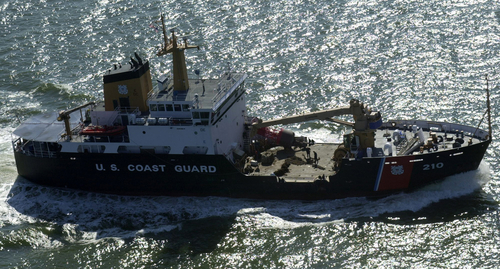
PENSACOLA BEACH, Fla. (Sept. 20, 2004)–Coast Guard cutter CYPRESS, a 225-foot buoy tender homeported in Mobile, Ala., underway near Pensacola Beach. CYPRESS was deployed in part of the Coast Guards efforts to repair aids to navigation damaged or dragged off station by Hurricane Ivan. USCG photo by PA3 John Edwards
“We trained hard, but it seemed that every time we were beginning to form up into teams, we would be reorganized. I was to learn later in life that we tend to meet any new situation by reorganizing; and a wonderful method it can be for creating the illusion of progress while producing confusion, inefficiency, and demoralization.” attributed, probably erroneously to Gaius Petronius Arbiter, Roman Satirist (c.27-66 AD)
BryMar-Consulting has provided a link to the administration’s proposal for reorganizing the government. The Coast Guard is mentioned twice, once in regard to transferring Aids to Navigation responsibility to DOT and once with regard to duplication between the Coast Guard and CBP’s marine unit.
“In addition, transferring current U.S. Coast Guard responsibilities for permitting alterations to bridges and aids to coastal navigation to DOT would better align those functions with similar functions already carried out by DOT’s.” (p.73)
(Once again the multi-mission nature of CG AtoN assets is not recognized.)
“DHS Air & Maritime Programs
“This proposal would identify efficiencies and budgetary savings to be achieved by eliminating unnecessary duplication between U.S. Customs and Border Protection and U.S. Coast Guard air and maritime programs. This could include facility consolidation, standardized data, enhanced domain awareness and coordination, and common future capability requirements. “(p. 123)





 Chuck Hill's CG Blog