“Army Corps of Engineers May Lose Its Domestic Missions”–Defense One

Defense One reports under a proposed government reorganization, our frequent partner, the Army Corps of Engineers, may have their domestic roles reassigned to other departments.

“…the Corps’ commercial navigation functions would move to [the Department of Transportation], whose mission already includes Federal responsibility for all other modes of transportation. All other activities, including flood and storm damage reduction, aquatic ecosystem restoration, hydropower, regulatory, and other activities, would move to [the Department of the Interior].”

This is a major rethink of the Federal bureaucracy. No mention of moving the Coast Guard again, but once these things start, you can never be sure where they will end. Will they want to put our AtoN mission under DOT?


Senate Appropriations Bill

Brymar-Consulting.com noted, Senator Capito (R-WV) introduced an original bill (S. 3109) making appropriations for the Department of Homeland Security for the fiscal year ending September 30, 2019, and for other purposes. (6/21/18) [https://www.gpo.gov/fdsys/pkg/BILLS-115s3109pcs/pdf/BILLS-115s3109pcs.pdf].

Looking at the bill, proposed appropriations include

  • Operations and Support: $7,792,409,000
  • Environmental Compliance and Restoration: $13,429,000
  • Procurement, Construction, and Improvements: $2,169,260,000
  • Research and Development: $20,109,000
  • Retired Pay: $1,739,844,000

If enacted, this will be a $282.51M increase in Procurement, Construction, and Improvement over the budget request. If memory serves $2,169,260,000 would be a record.

You can see the FY 2016 and 2017 enacted and the 2018 proposed budgets here. There is a comparison between the FY2017 enacted and the FY2019 budget request here. There is a good short overview of the FY2019 request here. Strangely, I have been unable to find a final FY2018 appropriations report other than the top line amount. If you know where I can find one, please include in the comments section.

“Canada taps Davie for three AHTS-conversion medium icebreakers”–Marine Log

Projresolvbig

Our resident icebreaker expert, Tups, told us in a comment this was coming. Marine Log confirms the official announcement.

“On behalf of the Canadian Coast Guard, Public Services and Procurement Canada has issued an Advanced Contract Award Notice (ACAN) to shipbuilder Chantier Davie of Lévis, Quebec, for the acquisition and conversion of three medium commercial icebreakers.

“… The three candidate ships proposed by Project Resolute for this role are the Viking Supply Ships AB vessels Tor Viking II, Balder Viking and Vidar Viking.

There was an earlier proposal to lease these three ships and the icebreaking anchor handling vessel Aiviq, but these three will be purchased and there is no mention of the Aiviq in the announcement.

Based on the accompanying illustration, conversion will add a helo deck and hangar. These ships are 82 meters (276 ft) in length, 18 m (59 ft) of beam, and 18,300 HP.

The first of these is expected to go to work this winter.

Small Missile Systems From the Army

After three decades without a significant air threat, the Army has realized they might actually need a surface to air weapon. As a result they have embarked on a program to provide Short Range Air Defense (SHORAD) against cruise missiles as well as manned aircraft. In addition they want to provide protection from rockets, artillery, and mortars (RAM) and Unmanned Air Systems (UAS), hopefully in the same launcher. The program of record is called Integrated Fire Protection Capability.

They have already built a launcher in house.

Multi-Mission Launcher (MML) firing
(IFPC, “Indirect Fire Protection Capability”) Launching Hellfire missile

This Multi-Mission Launcher somewhat emulates the Mk41 VLS, in that it is intended to launch several different missiles for different purposes. It has launched AIM-9 Sidewinder (repurposed as an surface to air missile) , the Tamir (interceptor for the Israeli Iron Dome system), the Lockheed Miniature Hit to Kill (MHTK) Missile, an Army developed missile, and the Hellfire.

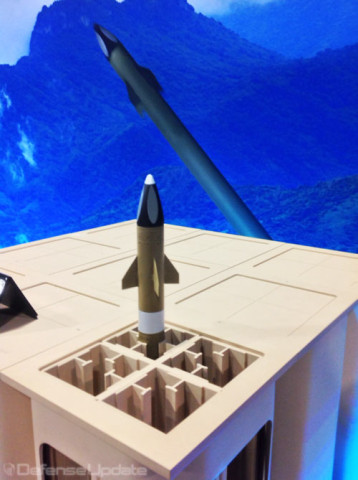
The Miniature Hit to Kill (MHTK) missile designed to counter Rocket, Artillery and Mortar (RAM) threats as well as some unmanned aircraft might be use against projectiles fired at a cutter or an asset we are protecting. Cost is only about $16K per round.

“The missile is 27 inches long, two inches in diameter (actually only 40mm or 1.6″–Chuck) and weighs 5 pounds “at launch,” he added. The semi-active missile has no warhead, using kinetic energy — or thrust — instead to take out a target. “It’s really a bullet hitting a bullet,” which is the bread and butter capability in Lockheed’s missile technology. One launcher can fit 36 of the missiles, Delgado said, and two launchers can fit onto a single truck.”

As a very small system, MKTK can be quad-packed. Photo: Defense-Update

The Navy is apparently showing some interest in this program. Since the Army developed multi-mission launcher is not a vertical launch system I presume it has to be pointed. This is somewhat complicates installation, but I can’t help but believe something, launcher or interceptors, will come out of this program that may be of interest to the Coast Guard in the future.

Late Addition:

Reconfigurable-Integrated-Weapons-Platform-Mission-Equipment-PackageRIwP-768x432

Photo: Multipurpose remote weapon station chosen for the Striker Short Range Air Defense System.  Moog Reconfigurable Integrated-Weapons Platform (RiwP) turret:: 4 Stinger missiles on one side, two Hellfires on the other, with a 30 mm autocannon and coaxial 7.62 mm machinegun in between (Leonardo DRS)

Navy Will Release New 30-Year Ship Repair, Modernization Plan with Annual Shipbuilding Report–USNI

The Navy has announced that they will release not only a 30 year shipbuilding plan, but also a 30 year ship repair and modernization plan.

He acknowledged that the timing of ship maintenance availabilities are prone to change, as deployments are extended, one ship is swapped for another to meet a warfighter need, and so on. But while the planning is complex, he said, “the only thing I know is, the best way to start getting after a complex issue is laying out at least what you know and laying that out as a baseline, so then when you do have to do – whether it’s for operational reasons or whatever – have to do changes, you’re changing from a known baseline and you can more quickly understand what the second- and third-order effects are.”

I still don’t think the Coast Guard has ever submitted their 20 year plan as mandated by GAO and Congress. We have discussed the need for a long term shipbuilding plan numerous times. These are only two:

I suspect the 20 year plan was stalled in the Department.

It is really important to build an understanding of future needs. It seems this was a part of the problem in getting a realistic shipbuilding budget. We should anticipate replacing all our ships when they reach 30 years of age. As that time approaches we can reevaluate and perhaps delay replacement if they are holding up well, and we will be heroes.

We really have to tell the administration and the Congress what we need. To do that I would reiterate the need to periodically redo the Fleet Mix simulation and study. The last one was done about ten years ago and still assumed multiple crewing of the Bertholf Class NSCs and Offshore Patrol Cutters. (Crew Rotation Concept).

Administration Considers Diversion of CG budget to Southern Border Protection

A small news story from the Washington Post, that the administration is considering transferring some of the Coast Guard’s budget allocation to other parts of the Department of Homeland Security.

Most of the funding would go to Immigration and Customs Enforcement, which also is part of Homeland Security. The department has the authority to move money around between its components and may also shift other funding to pay for ICE operations.

The Coast Guard message stated that $77 million could be shifted and that several courses of action have been presented to Adm. Karl Schultz, the Coast Guard commandant. The Coast Guard Reserve also “may be required to provide a contribution,” the message said.

Not the first time diverting money from the Coast Guard has been considered. $77M is not a lot of money, but perhaps they would be better off diverting ICE personnel now manning check points well inside the US border that have mostly proven good at catching minor amounts of marijuana.

Executive Order Regarding the Ocean Policy to Advance the Economic, Security, and Environmental Interests of the United States

I will not try to interpret the intent or implications of the President’s Executive Order of 19 June, reproduced below, but I do welcome comments. It mentions the Coast Guard specifically only once, but the CG is clearly the DHS’ primary agent in performing its role.

______________

By the authority vested in me as President by the Constitution and the laws of the United States of America, it is hereby ordered as follows:

Section 1Purpose.  The ocean, coastal, and Great Lakes waters of the United States are foundational to the economy, security, global competitiveness, and well-being of the United States.  Ocean industries employ millions of Americans and support a strong national economy.  Domestic energy production from Federal waters strengthens the Nation’s security and reduces reliance on imported energy.  Our Armed Forces protect our national interests in the ocean and along the Nation’s coasts.  Goods and materials that support our economy and quality of life flow through maritime commerce.  Our fisheries resources help feed the Nation and present tremendous export opportunities.  Clean, healthy waters support fishing, boating, and other recreational opportunities for all Americans.

This order maintains and enhances these and other benefits to the Nation through improved public access to marine data and information, efficient interagency coordination on ocean-related matters, and engagement with marine industries, the science and technology community, and other ocean stakeholders.  To advance these national interests, this order recognizes and supports Federal participation in regional ocean partnerships, to the extent appropriate and consistent with national security interests and statutory authorities.

Sec. 2Policy.  It shall be the policy of the United States to:

(a)  coordinate the activities of executive departments and agencies (agencies) regarding ocean-related matters to ensure effective management of ocean, coastal, and Great Lakes waters and to provide economic, security, and environmental benefits for present and future generations of Americans;

(b)  continue to promote the lawful use of the ocean by agencies, including United States Armed Forces;

(c)  exercise rights and jurisdiction and perform duties in accordance with applicable domestic law and — if consistent with applicable domestic law — international law, including customary international law;

(d)  facilitate the economic growth of coastal communities and promote ocean industries, which employ millions of Americans, advance ocean science and technology, feed the American people, transport American goods, expand recreational opportunities, and enhance America’s energy security;

(e)  ensure that Federal regulations and management decisions do not prevent productive and sustainable use of ocean, coastal, and Great Lakes waters;

(f)  modernize the acquisition, distribution, and use of the best available ocean-related science and knowledge, in partnership with marine industries; the ocean science and technology community; State, tribal, and local governments; and other ocean stakeholders, to inform decisions and enhance entrepreneurial opportunity; and

(g)  facilitate, as appropriate, coordination, consultation, and collaboration regarding ocean-related matters, consistent with applicable law, among Federal, State, tribal, and local governments, marine industries, the ocean science and technology community, other ocean stakeholders, and foreign governments and international organizations.

Sec. 3Definitions.  For the purposes of this order, the following definitions apply:

(a)  “Ocean-related matters” means management, science, and technology matters involving the ocean, coastal, and Great Lakes waters of the United States (including its territories and possessions), and related seabed, subsoil, waters superadjacent to the seabed, and natural resources.

(b)  “Regional ocean partnership” means a regional organization of coastal or Great Lakes States, territories, or possessions voluntarily convened by governors to address cross-jurisdictional ocean matters, or the functional equivalent of such a regional ocean organization designated by the governor or governors of a State or States.

Sec. 4Interagency Coordination.  (a)  To ensure appropriate coordination by Federal agencies on ocean-related matters, there is hereby established the interagency Ocean Policy Committee (Committee).

(i)  The Committee shall consist of the following:

(1)  The Chairman of the Council on Environmental Quality (CEQ) and the Director of the Office of Science and Technology Policy (OSTP), who shall serve as Co-Chairs;

(2)  The Secretary of State, Secretary of Defense, Attorney General, Secretary of the Interior, Secretary of Agriculture, Secretary of Commerce, Secretary of Transportation, Secretary of Energy, Secretary of Homeland Security, Administrator of the Environmental Protection Agency, Director of the Office of Management and Budget, Administrator of the National Aeronautics and Space Administration, Director of the National Science Foundation, Director of National Intelligence, Chairman of the Joint Chiefs of Staff, Under Secretary of Commerce for Oceans and Atmosphere, Assistant Secretary of the Army (Civil Works), and Commandant of the Coast Guard;

(3)  The Assistants to the President for National Security Affairs, Homeland Security and Counterterrorism, Domestic Policy, and Economic Policy;

(4)  A representative from the Office of the Vice President designated by the Vice President; and

(5)  Such other officers or employees of the Federal Government as the Co-Chairs may from time to time designate.

(b)  The Co-Chairs, in coordination with the Assistants to the President for National Security Affairs, Homeland Security and Counterterrorism, Domestic Policy, and Economic Policy, shall regularly convene and preside at meetings of the Committee, determine its agenda, and direct its work, and shall establish and direct subcommittees of the Committee as appropriate.  The Committee shall, as appropriate, establish subcommittees with responsibility for advising the Committee on matters pertaining to ocean science and technology and ocean‑resource management.

(i)    Committee members may designate, to perform their Committee or subcommittee functions, any person who is within their department, agency, or office who is:

(1)  a civilian official appointed by the President;

(2)  a member of the Senior Executive Service or the Senior Intelligence Service;

(3)  a general officer or flag officer; or

(4)  an employee of the Office of the Vice President.

(ii)   Consistent with applicable law and subject to the availability of appropriations, OSTP or CEQ shall provide the Committee with funding, including through the National Science and Technology Council pursuant to title VII, section 723 of the Consolidated Appropriations Act, 2018 (Public Law 115-141), or any successor provision, or through the Office of Environmental Quality pursuant to the Office of Environmental Quality Management Fund, 42 U.S.C. 4375.  OSTP or CEQ shall, to the extent permitted by law and subject to the availability of appropriations, provide administrative support as needed to implement this order.

(iii)  The Committee shall be administered by an Executive Director and such full-time staff as the Co‑Chairs recommend.

Sec. 5Functions.  To implement the policy set forth in section 2 of this order, the Committee shall, to the extent permitted by law:

(a)  provide advice regarding policies concerning ocean-related matters to:

(i)   the President; and

(ii)  the head of any agency who is a member of the Committee;

(b)  engage and collaborate, under existing laws and regulations, with stakeholders, including regional ocean partnerships, to address ocean-related matters that may require interagency or intergovernmental solutions;

(c)  coordinate the timely public release of unclassified data and other information related to the ocean, coasts, and Great Lakes that agencies collect, and support the common information management systems, such as the Marine Cadastre, that organize and disseminate this information;

(d)  coordinate and inform the ocean policy-making process and identify priority ocean research and technology needs, to facilitate:

(i)   the use of science in the establishment of policy; and

(ii)  the collection, development, dissemination, and exchange of information between and among agencies on ocean-related matters;

(e)  coordinate and ensure Federal participation in projects conducted under the National Oceanographic Partnership Program through the Committee’s members, as appropriate, to maximize the effectiveness of agency investments in ocean research; and

(f)  obtain information and advice concerning ocean-related matters from:

(i)   State, tribal, and local governments; and

(ii)  private-sector entities and individuals.

Sec. 6Cooperation.  To the extent permitted by law, agencies shall cooperate with the Committee and provide it such information as it, through the Co‑Chairs, may request.  The Committee shall base its decisions on the consensus of its members.  With respect to those matters for which consensus cannot be reached, the Assistant to the President for National Security Affairs shall coordinate with the Co-Chairs to present the disputed issue or issues for decision by the President.  Within 90 days of the date of this order, agencies shall review their regulations, guidance, and policies for consistency with this order, and shall consult with CEQ, OSTP, and the Office of Management and Budget (OMB) regarding any modifications, revisions, or rescissions of any regulations, guidance, or policies necessary to comply with this order.

Sec. 7Revocation.  Executive Order 13547 of July 19, 2010 (Stewardship of the Ocean, Our Coasts, and the Great Lakes), is hereby revoked.

Sec. 8General Provisions.  (a)  Nothing in this order shall be construed to impair or otherwise affect:

(i)    the authority granted by law to an executive department, agency, or the head thereof;

(ii)   the functions of the Director of OMB relating to budgetary, administrative, or legislative proposals; or

(iii)  functions assigned by the President to the National Security Council or Homeland Security Council (including subordinate bodies) relating to matters affecting foreign affairs, national security, homeland security, or intelligence.

(b)  This order shall be implemented consistent with applicable law and subject to the availability of appropriations.

(c)  This order is not intended to, and does not, create any right or benefit, substantive or procedural, enforceable at law or in equity by any party against the United States, its departments, agencies, or entities, its officers, employees, or agents, or any other person.

DONALD J. TRUMP

THE WHITE HOUSE,
June 19, 2018.

Maritime Transportation in the Arctic: The U.S. Role–House Subcommittee on Transportation and Infrastructure

Above you will find a video of a hearing held on June 7, 2018 regarding “Transportation in the Arctic”. You will find the subcommittee web page here. It includes the video, the list of witnesses which I have reproduced below, and the Chairman’s opening remarks.

The video does not actually start until time 21:45.

Witnesses:

  • Admiral Charles W. Ray, Vice Commandant United States Coast Guard | Written Testimony
  • Mr. David Kennedy, Senior Arctic Advisor, National Oceanic and Atmospheric Administration | Written Testimony
  • Ms. Heather A. Conley, Senior Vice President for Europe, Eurasia, and the Arctic, Center for Strategic and International Studies | Written Testimony
  • Dr. Lawson Brigham, Faculty and Distinguished Fellow, International Arctic Research Center, University of Alaska Fairbanks | Written Testimony
  • Ms. Molly McCammon, Executive Director, Alaska Ocean Observing System | Written Testimony
  • Rear Admiral David W. Titley, USN (Ret.), Professor of Practice, Department of Meteorology and Atmospheric Science, Pennsylvania State University | Written Testimony


As you may see, the new Vice Commandant, Adm. Ray is the first witness. He completes his prepared remarks at time 32:30.

Incidentally one of the Witnesses Lawson Brigham (prepared testimony begins at time 44:00 to 48:25) is a retired Coast Guard captain with extensive polar icebreaker experience.

Questioning begins at time 1:00:00 with the “trick question” explored further by the Washington Examiner Magazine, “The Next ‘Cold’ War: America May Be Missing the Boat in the Arctic.”

There are few surprises here. There is almost no infrastructure in the Arctic. Apparently there is a slow effort to provide better domain awareness. Only about 5% of the American Arctic waters are charted to international standards.

The most significant thing to come out in the hearing was that there is no National or Naval strategy for the Arctic Ocean. (This might be because NORTHCOM, which is air and ground oriented, has responsibility for the Arctic Ocean area.) Congress has added a requirement for development of an Arctic Strategy in the FY2019 DOD budget, and they certainly expect the Coast Guard to have a large role in the strategy.

If you don’t listen to anything else, particularly listen to John Garamendi’s remarks 1:41:30 to 1:43:30.