LastStandOnZombieIsland reports USCGC Alex Haley’s last sister ship, the former
USS Beaufort (ATS-2), now the Republic of (South) Korea Navy Ship ROKS Peyongtaek (ATS-27), is to be decommissioned and scrapped.
The blog has a suggestion that might be worth pursuing.
“Maybe the South Koreans will let the USCG go over Peyongtaek for spare parts before they send her to the breakers.”
These ships were built in Britain by Broke Marine. That is very unusual for any US Navy ship. It probably also means finding spares may be more difficult that it would be for a US built ship.
The influencial Conservative think tank, Heritage Foundation, has issued a report on the Department of Homeland Security that will likely strongly influence the incoming administration and Congress.
It does not call for any radical increase in the Coast Guard budget for FY2017 ($10.85B). In fact it calls of less funding than was enacted in 2016 ($11.112B), but more than the current administration has requested ($10.322B).
It does support the Offshore Patrol Cutter (OPC) and Polar Icebreaker (PIB) programs and continued procurement of six Webber class (FRC) rather than the four currently requested.
For the future, it appears they support a more stable AC&I budget of at least $1.5B. To me it appears likely the AC&I budget will go higher as both the OPC and PIB enter the construction phase, and they spoke against imposition of a defacto ceiling.
The most significant new direction, seemed to be strong support for Unmanned Air Systems.
Unmanned Aerial Systems. The Coast Guard would also benefit greatly from procuring UASs to support NSC operations. According to the GAO, “Coast Guard officials acknowledged that the lack of [cutter-based] unmanned aircraft would create a gap between the NSC’s actual and planned capabilities.” Dr. William Posage, program manager for the Coast Guard Research and Development Center, explained that the lack of cutter-based UAS technologies “left the NSC with an enormous surveillance gap in her ability to perform her mission.” Notably, the operational effectiveness of the NSC without a UAS component would “be comparable to that of the 378-foot Hamilton class high-endurance cutter,” the very program it was designed to replace with capability enhancements.
The Coast Guard has successfully tested the FireScout and ScanEagle UAS platforms, both of which would significantly amplify the NSC’s surveillance, detection, classification, and prosecution capabilities. Widely used for similar naval operations, they have successfully contributed to a handful of at-sea Coast Guard demonstrations. According to an assessment by the Coast Guard Office of Aviation Forces, the presence of two vertical take-off FireScout UASs aboard an NSC would enable the cutter to cover three times the presence radius of an NSC without them. Similarly, according to a Senate Appropriations Committee report, “[t]he Coast Guard has reported…that its long standing plan to add vertical take-off unmanned aircraft systems to the National Security Cutters would result in an estimated 95- to 225-percent increase in surveillance coverage within an 800 nautical mile radius of the cutter and an estimated 95-percent increase in the number of prosecutions achieved by the cutter.”
The Coast Guard’s FY 2017 budget justification states that funding for the NSC program will in part “establish sUAS [small UAS] capability aboard one NSC, to include engineering analysis, non-recurring engineering, procurement and installation of sUAS components, and system testing and certification.” Admiral Zukunft testified before the House Transportation Committee in March 2016 that this activity would involve a “down select” for a sUAS capability “that will go on board” the NSC. The NSC will amplify its aerial ISR capabilities dramatically with the longer-term integration of sUAS, while the sea service should continue to evaluate the vertical unmanned aerial vehicle (VUAV) platform.
This seems to indicate a two pronged approach, first a small UAS (Scan Eagle or something similar) in the near future and a continued interest in evaluating a vertical takeoff unmanned system like Firescout or potentially DARPA’s TERN.
All the UAS discussion centers on the National Security Cutters. There is no discussion of the possibility of using UAS on any other classes.
Just passing along the following I recieved by email.
Fellow SNA Coastguardsmen, Cuttermen, and all,
I would like to invite you to an annual cuttermen’s tradition at the Surface Navy Association Symposium — the Annual National Cuttermen Call January 12th at 1415 held at the Hyatt Regency Crystal City.
This year our Commander, Atlantic Area, Vice Admiral Shultz, and our Master Chief Petty Officer of the Coast Guard, Masterchief Cantrell, will address current topics of the our cutter fleet and engage in a question and answer session with the audience.
The event is free for Active Duty in uniform (Service Dress Blues) and all SNA members.
Following the Cuttermen call there will be a no-host social in the Tidewater Room at the Hyatt Regency Crystal City to facilitate more SNA and Coast Guard camaraderie as well as embellished sea stories.
Please look at the other events of interest to the Coast Guard, and consider starting or renewing your membership into our SNA organization and chapters.
All are welcome. Please make time to join us!
Vr, Scott Clendenin,
President, National Cuttermen Chapter of the Surface Navy Association
Part one recounted an engagement in 1939 between the “pocket battleship” (heavy cruiser) Admiral Graf Spee and three smaller British cruisers. This part will discuss the implications.
So what does a 77 year old Naval battle have to do with the Coast Guard’s ability to stop a terrorist attack using a medium to large ship?
As I said in part one (in a different order), I think it shows:
It is very difficult to sink a ship by gunfire alone.
Ships’ structure provide a degree of protection that makes it difficult to comprehensively target the crew of a ship without sinking the ship.
It is difficult to forcibly stop a ship with gunfire alone.
In comparing guns, at any given range, the longer ranged weapon generally enjoys an advantage in accuracy.
You can run out of ammunition before you accomplish your mission. The depth of your magazine may be important.
What do we have to oppose this type of attack?:
We don’t really have a lot of options.
If we have enough warning, say 24 hours, we can ask for help, but as far as I can tell there is no system of rapid response to surface threats. (When 9/11 occurred, we had no system for rapid response to air threat.) Unless we have absolute proof that the vessel in question is hostile, the Coast Guard would almost certainly have to intercept the vessel to determine hostile intent before it could be attacked. If the threat is a 20 knot ship detected 200 miles from its target we will have only ten hours to deal with the threat, and we are likely to be considerably less.
We have one Maritime Security Response Team (MSRT) on each coast, but to mobilize them, brief, organize, transport, and then get them to where we want them to act may take considerable time. Additionally while they might be effective in retaking a hijacked merchant ship, where there are relatively few hostiles who also have to control the crew, attempting an opposed boarding of a ship crewed by armed terrorist as a first step toward stopping an attack may be suicidal. If we have time to get them into place then perhaps we would also have time to get help from other services.
I think it more likely we will have at best a few hours to deal with the threat and we will have to use forces already in the area. I’ve made suggestions about additional equipment we might use to address this threat (here and here), but this time I will discuss tactics using what we have, or plan to have, and limit equipment suggestions to minimal upgrades and choice of ammunition.
While I doubt we will have cutters armed with 57mm Mk110s or 76mm Mk75s, on scene when required, we will discuss their utility and limitations. The Mk38 seems to be the key system, widely available and potentially capable, if the right ammunition is available. Other systems, .50 caliber and smaller, appear ineffective in stopping medium to large ships, but they may have their uses.
It is very difficult to sink a ship by gunfire alone:
Each of the Graf Spee’s 11.1″ projectile weighed 125 times the weight of a 57mm shell or roughly the weight of all the projectiles in a 57mm Mk110 gun mount’s 120 round automatic feed system.
Graf Spee was hit 20 times, three times by 8″ and 17 times by 6″ for a total of 2,672 pounds of projectiles. That is roughly the equivalent of being hit 500 times by a 57mm. From a distance, other than the burned out scout plane she carried, it would have been difficult to tell that she had been hurt.
Exeter was hit at least seven times excluding damaging near misses. That was 4,627 pounds of projectiles, a weight, I believe, almost equal to the total weight of all the 57mm projectiles allowed on a National Security Cutter (about 5,300 pounds assuming 1,000 rounds). While heavily damaged, Exeter was still capable of making 18 knots and completing the approximately 1,000 nautical mile journey to the Falklands.
Neither of these ships would be considered large by current standards. We can conclude, we are unlikely to sink a medium to large merchant ship with any weapon in the Coast Guard inventory.
Ships’ structure can provide a degree of protection that makes it difficult to comprehensively target the crew of a ship without sinking the ship.
Personnel Casualties were relatively light. Out of the approximately 3,000 men on the four ships, there were only 108 killed and 88 wounded.
As severely damaged as Exeter was, less than one in ten of the crew was killed. Unless terrorists choose to expose themselves, gunfire, from either cutters or airborne use of force equipped helicopters, is unlikely to allow us kill enough terrorists to stop an attempt to use a medium or large ship to make an attack.
Can We Immobilize the Target?:
None of the four ships were immobilized.
Of the approximately 30 hits, only one hit a main machinery space and it appears this was not because armor kept rounds out. It was simply that the amount of machinery space above the water line is a very small percentage of the total exposed area.
The single projectile that entered a machinery space was an armor-piercing 8″ round, and it wrecked the Graf Spee’s fuel oil purifier. That made it virtually impossible for the ship to make it back to Germany without having work done in port over an extended period. That would have allowed Britain to guarantee that Graf Spee would never escape, but it did not stop her from transiting at full speed for about 14 hours.
A modern merchant vessel diesel engine.
The task of stopping a ship by gunfire actually may have become more difficult because of the size and toughness of modern large diesel power plants, and because the large size of modern vessels puts more of the engine below the waterline and provides more space between the ships sides and the propulsion machinery.
The ship featured in the video above is no longer particularly large. The new Panama Canal locks needed to be wider and deeper than the old ones to accommodate the larger ships that have now become common. The locks are now 180 feet (vs 110 feet) wide and 60 feet (vs. 42 feet) deep. Many ships now have sufficient draft such that the 40 foot tall engine in video could be entirely below the water line.
Fuel consumption for the engine in the video above was reported twice, first as 328 tons per day and later as 400 tons per day. If we assume only 300 tons per day, that is 12.5 tons per hour or 417 pounds /minute or about 7 pounds per second.
The explosions going off in this type of engine every second are more powerful than the explosion of a 57mm shell.
There is less than a pound of explosive in a 57mm projectile. 1 pound of TNT has 13.4 megajoules of energy. We may assume a more powerful explosive in the Mk110 projectiles, perhaps 20 megajoules. One gallon (about 7.1 pounds) of diesel (the amount consumed in one second) equals 146.5 megajoules.
The 57mm gun does not have a true armor-piercing round. The current 3P fuse has a semi-armor piercing function which I presume is similar to the previous semi-armor piercing (SAP) round, “The SAP round had a delayed action fuze which allowed the round to penetrate about 2 cm (0.8 inches) of armor and then explode after traveling a further 2 m (6 feet).” If that is the case, first it is uncertain that the round will penetrate, since the plating on large ships can considerably exceed 2 cm, but assuming it did, an explosion two meters inside the hull would still be a long way from a very tough engine.
The 76mm Mk75 is the most powerful gun in the Coast Guard inventory, but we have fewer of them every year, although it looks like we will not see the last of those on the 270s until 2034. It is still a relatively small projectile at about 14 pounds. Like the 57mm there is no true armor-piercing round for this weapon. Like the 57mm its projectile would likely explode shortly after penetrating the hull, rather than on or in the engine. The 57 and 76 mm guns might have more success against the steering gear, but that will also be very robustly built on any large ship, and hitting it will require great accuracy, suggesting a close approach.
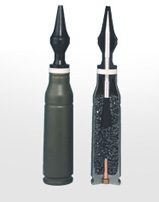
The Mk38 25 mm, with a maximum shell weight of 1.1 pound or less, might be assumed to be even less likely to do damage, but they do have an option for an armor-piercing fin stabilized discarding sabot round (APFSDS) (pdf). It is intended for use against lightly armored vehicles like Armored Personnel Carriers. It may not be commonly available for the Mk38 (the Navy thinks of the Mk38 exclusively as a counter to small craft), but the APFSDS round is in the Navy system for use by Marine LAV-25 Light Armored Vehicle. It fires a 98 gram (3.5 oz) Solid Tungsten Penetrator at a very high velocity, 1390 m/sec (4560 ft/sec).
25MM TUNGSTEN APFSDS-T Armor Piercing Fin Stabilized Discarding Sabot-Trace
The .50 caliber, 7.62 and 5.56 mm weapons are simply too light to make much impression on a medium or large ship. The only other CG gun with a possibility of forcibly stopping one of these vessels is the Phalanx 20mm Close In Weapons System (CIWS). This system uses a discarding sabot round 12.7mm in diameter Solid Tungsten Penetrator with a 3,650 fps (1,113 mps) muzzle velocity. The Phalanx is only found only on WHECs and NSCs, so they will soon be home ported only in Charleston, Alameda, and Honolulu and it is unlikely these ships will be available to respond.
If we do detect a terrorist attack, the only likely Coast Guard counter to it, is likely to be equipped with a Mk38 mount. We are not going to sink a medium or large ship with the Mk38, but we might be able to disable it, if we can accurately penetrate both the ship’s hull and the ship’s engines or disable the steering.
In comparing guns, at any given range, the longer ranged weapon generally enjoys an advantage in accuracy.
I started thinking about the results of the Battle of River Plate after reading this pdf, Offshore Patrol Cutter (OPC) SUW Self-Protection Secondary Battery Study (which compared one and two-gun solutions using .50 cal., 25mm, and 30mm) and writing a post about a possible 40mm alternative for the Mk38 gun mount currently used on the Webber class WPCs and planned for the Offshore Patrol Cutter. It occurred to me that everyone may not understand my strong preference, when considering guns, for the longest ranged weapon available, even if I don’t expect it to be used at extreme ranges.
It is not just the potential of longer range, or the fact that the projectile is probably larger and more effective. It is also the fact that, all other factors being equal, the longer ranged weapon is also almost always more accurate.
Comparing any two weapons, fired at a target at the same range, the longer range weapon will generally fly a flatter trajectory (a more direct path) and have a shorter time of flight, meaning it will be effected less by uncertainties of environment and the actions of the target between firing and impact.
In the battle we see three gun with different ranges and can compare their accuracy. If we look at the British 6″ guns as a base line, how did the weapons compare?
The British 6″ gun had a maximum range of 24,500 yards (22,400 m). They got hits 0.82% of the time.
The British 8″ gun had a maximum range of 30,650 yards (28,030 m), 25% greater range, got hits 1.55% of the time, making them 89% more accurate than the contemporary 6″ guns.
The German 11.1″ had a maximum range of 39,890 yards (36,475 m), with 63% greater range than the 6″ guns, got hits 2.4% of the time, making them almost three times as accurate as the 6″ guns at the ranges the battle was fought (193% more accurate).
While it might be argued that the Graf Spee benefitted from superior fire control, the same cannot be said for the Exeter’s 8″ guns, that for most of the engagement were fired under local control. Additionally it appears that the light cruisers’ director controls were at least as sophisticated as that on Exeter. It appears the greater accuracy is due to the flatter trajectory and shorter time of flight of the longer ranged guns.
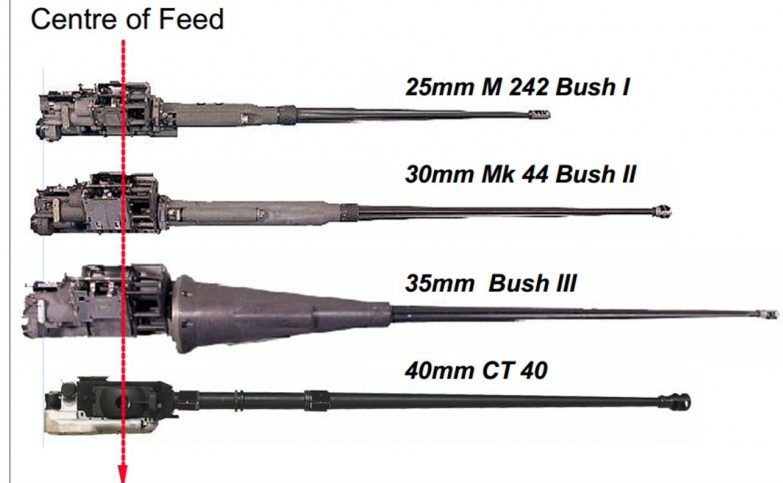
There are at least four different gun calibers that can be mounted on the Mk38 gun mount, 25, 30, 35, and 40mm. If we have the opportunity to upgrade the Mk38s to higher caliber weapons, we should take it, not just for the greater effectiveness of the projectile but also for the likely greater accuracy and effective range.
Case Telescoped 40 mm ammunition
Making the Best of the Mk38:
“No captain can do very wrong if he places his ship alongside that of the enemy.”–Horatio Nelson
When I looked at this problem earlier, I suggested that we should have systems that could disable a ship at ranges greater than 4,000 yards, so that weapons on the terrorist controlled vessel could not target specific systems on the defending cutter. With what we have now, we don’t really have that option. We are going to need to get a lot closer.
Not only is the effective range of the Mk38 less than 4,000 yards, we will need to get closer to increase accuracy to target specific parts of the terrorist vessel, and close the range to maximize the kinetic energy of the rounds.
If we are to have any chance of stopping a medium to large ship making a terrorist attack, we need to do what the British did. We need a team approach. We need to gang up on it.
The only ships we have that might have a chance are those with 25mm and larger weapons. There are relatively few of those. They would be the primary shooters. Hopefully you would have more than one to respond, but in many cases, perhaps most, there would be only one.
We can still use less capable units to take pressure off the primary shooter. These supporting units equipped only with .50 caliber and smaller weapons might be used to target the bridge, but their primary function should be to target any weapons that might endanger the more capable cutter(s).
Targeting the bridge is relatively simple, but if the terrorists plan properly they will not need to navigate from the bridge. They can use an autopilot or steer from after steering.
As we approach we will want to establish hostile intent as early as possible, preferably without putting a boarding party aboard that might become hostages.
We can demand that the vessel stop or change course away from the endangered potential target. The quickest way to do that might be with an Airborne Use of Force helicopter. Other supporting units might also be sent ahead of the primary shooter to attempt to stop or turn the suspect vessel.
After establishing hostile intent, supporting units should, if possible, precede the primary shooter and engage the threat with the idea of suppressing any weapons the vessel might employ against the cutters.
As it approached its target, before attempting to disable it, the primary shooter should probably put a few rounds into the bow of the target, in case it has been loaded with explosives.
Because the supporting units will need to stay out of the line of fire between the primary shooter and terrorists’ vessel, and because projectile will lose the minimum amount of kinetic energy if it strike normal to the target’s side, the primary shooter should move to a position on beam of the threatening vessel, while supporting units should be both forward and aft of the primary shooter’s line of fire, ready to engage any attempt to return fire.
If the supporting units include a unit with only one machine gun on the bow, like a Response Boat, Medium (RB-M) and a unit with machine guns both fore and aft, like an 87 foot WPB, the WPB should be positioned toward the bow of the target, so that it can parallel the target and still have weapons on target while the unit (RB-M) with only gun on the bow, can keep its weapon on target.
An airborne use of force helicopter could also be very useful as a supporting unit, taking out any terrorist who appeared on deck and keeping an eye out for their activities on the disengaged side of the vessel.
At some point the primary shooter is going to have to close alongside, so that it can shoot through the hull near the waterline, down and into the engine room below the waterline. The supporting units should get there first, shoot up the bridge, attempt to draw fire and suppress any return fire.
When the primary shooter comes alongside ready to attempt to disable the terrorist vessel it will need a lot of ammunition so it will need to exercise fire discipline during the approach.
If we are unable to disable the engine(s) or steering, as a last ditch effort, we can attempt to push the vessel into shoal water and run it aground. This would of course make the cutters easy targets for grenades and RPGs.
Conclusion:
The approach outlined above implies a desperate fight, with no guarantee of success. If the terrorists manage to knock out the few (or one) weapon capable of stopping them, we might have no chance of success.
This is not the kind of fight the Coast Guard should want. It puts our people, our mission, and the people we are supposed to protect in danger. Right now there is no assurance that 25mm can even do the job.
We really ought to do better.
The Future:
I would hope the Coast Guard would do some testing to find out if we have the weapons we need to stop the full range of possible maritime terrorist attacks.
That should help us pick the right ammunition. We really need to make sure we have the right types. of ammunition.
If tests show we cannot disable the largest ships, we need to insist that we get weapons that can, and they may not be standard US Navy weapons.
Alternately, we need to establish means to have other services deploy anti-ship weapons on short notice. (Coast Defense is still officially an Army mission.)
We noted earlier that a new Mk38 mod3 mount is on the way. It will have much more ammunition on the mount. While the mount appears designed for a 30mm gun, it appears we will be getting them equipped with 25mm guns. More ammunition is good, but a larger weapon would be better.
Guns may not be the answer, but any upgrade we can get in the caliber of the gun on the mount will permit it to be more effective against progressively larger ships and at longer range.
In the not too distant future we will need to start replacing the 87 foot Marine Protector class WPBs. The oldest are already 18 years old. As soon as the last Webber class is funded, we need to start funding 87 footer preplacements. Hopefully we will see fit to arm these vessels for this mission.
Coast Guard Commandant Adm. Paul Zukunft (right) meets with then-Southern Command chief Gen. John Kelly, now Trump’s nominee for Secretary of Homeland Security.
Breaking Defense’s Robbin Laird has an Interview with the Commandant and speculates on the prospects for the Coast Guard under the new administration and DHS selectee General John Kelly.
Its a good one, and even the comments are worth reading. There is much of the same we have heard before. The Commandant has a clear and consistant message and agenda, but there is more detail about a possible role in the far Western Pacific.
“I have discussed with the CNO (Chief of Naval Operations Adm. John Richardson, the senior officer in the Navy) the concept that we would create a permanent USCG presence in the South China Sea and related areas,” Zukunft said. “This would allow us to expand our working relationship with Vietnam, the Philippines, and Japan. We can spearhead work with allies on freedom of navigation exercises as well.”
This is the first time I have seen the phrase “permanent USCG presence in the South China Sea and related areas.” Does that mean we will have a CG patrol squadron working out of Sinagpore or Okinawa (or Cam Ranh Bay), like the one in Bahrain? Or are we just looking at the Webber class WPCs we already know are going to Guam? (Must be more to it than that.) I do think we should put some OPCs in Guam, if only to patrol the EEZ in the Western Pacific.
Until recently we might have considered the possibility of basing in the Philippines, but that no longer looks like a possibility.
What ever you may think of the incoming administration, for the Coast Guard at least, it looks promising.
A U.S. Navy submarine-launched UGM-109 Tomahawk cruise missile hits a North American RA-5C Vigilante target aircraft on San Clemente Island, California (USA), after a flight of circa 650 km. U.S. DefenseImagery photo VIRIN: DN-SC-86-06115 and DN-SC-86-06115
Naval Today reports, “The U.S. Naval Air Systems Command has awarded Raytheon a $303.7 million contract for the the delivery of 214 Tomahawk block IV all-up-round vertical launch system missiles and spares.“
Not that the Coast Guard is likely to buy one, the Navy buys our weapons, but the price of Tomahalk missiles may give some indication of the cost of similar sophisticated systems. I’m a bit surprised the price is as low as it is. Since this includes spares in additon to 214 all-up rounds, that puts the price at less than $1.42M each. Frankly, I expected more.
The nuclear-powered icebreaker Arktika in the Kara Sea. RIA Novosti archive, image #186141
UPI has a post on Russia’s expanding presence in the Arctic. This of course got into their icebreaker building program and a couple of paragraphs caught my eye.
“‘One more vessel of this project is under construction, and there are plans to develop an even larger icebreaker,” Kozyulin said. “She will be designated LK-110Ya Lider, and will have an ice speed of 14 knots [about 15 mph], against the Arktika’s 6 knots.”
“The new icebreaker will be designed to clear passages in ice up to 150 feet wide. “Thanks to her broad hull capable of breaking ice up to 4.4 m thick, the Lider will ensure safe navigation of large vessels along the Northern Sea Route all year round,” Kozyulin added.”
And this one in particular,
Project 10520 icebreakers can also be converted into naval cruisers. The Sovetskiy Soyuz constantly carries part of the equipment necessary to do so; the rest is kept at a ground base.
This does refer to the older class, and they do not make the same claim about the new ships. The term cruiser does not necessarily carry the same meaning for the Russian press it does for US naval audiences.
The U.S. Coast Guard cutter USCGC Morgenthau (WHEC-722) heads out to sea from its home port in Alameda, California (USA), passing under the Golden Gate Bridge.
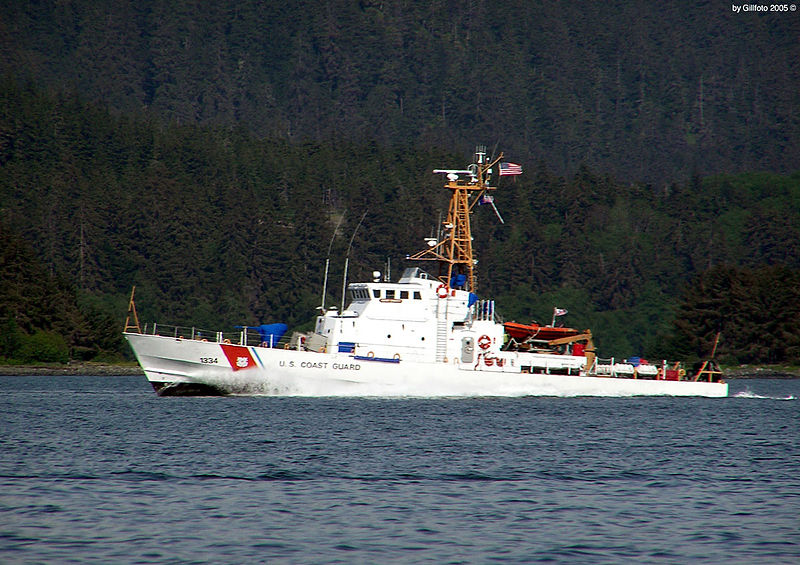
USCGC LIBERTY (WPB 1334), Credit to Gillfoto, 23 November 2012
Still, if completing 84% percent of your drills, firing 100% of your training ammuntion, and doing 93% of your engineering maintenance are notable achievements, doesn’t that tell us that something is wrong? (Plus, how can you have a 200% reduction in mission limiting casualties?)
Marine Corps Gen. John F. Kelly, commander of U.S. Southern Command, discusses the latest developments in his command’s efforts to stem the flow of drugs from South and Central America while briefing reporters at the Pentagon, March 13, 2014.
DOD photo by Glenn Fawcett
BreakingDefense has a post on Trump’s pick to head the Department of Homeland Security. If you don’t already know about retired Marine General John Kelly and his tour as SOUTHCOM, its worth the read.
It leads me to believe, the Coast Guard will not be cutting its drug interdiction mission in the Eastern Pacific any time soon.
An earlier post pointed to his history of support for the Coast Guard.