Will the Navy Be Funding and Managing Our Next Icebreaker Procurement?

PolarisAzipodsLookingAft

Azipods, state of the art propulsion technology for icebreakers. 

The Senate Appropriations defense subcommittee has proposed that $1B be added to the Navy’s shipbuilding budget for the construction of an icebreaker for the Coast Guard.

This sounds like good news, and there is precedence for this, in the form of USCGC Healy. Still, there are reasons, this may not be the best approach for the project, for the Coast Guard, or for the Navy, particularly since this should not be a one time procurement, it should be the first of a series.

The Navy contracted for the Healy and it did not turn out so badly, but there were difficulties as discussed here.

There are really two issues.

  • Who gets the money?
  • Who should manage the project?

Who gets the money?

The Coast Guard has been trying to get the government to recognize that it needs an AC&I budget of $2-2.5B/year. It needs to be a new norm. Funding icebreakers is part of that. Putting the money in the Navy budget is deceptive, and it does nothing to address the true needs of the Coast Guard..

Because of sequestration it is easier to add money to a DOD budget than to the Coast Guard budget, but if they can make exceptions for one military service, you would think they could make an exception for the Coast Guard as well.

Who would be the best project manager?

The Coast Guard got a black eye for the Deepwater project, but that was largely the result of a misguided Reagan era directive that project management be outsourced to the private sector that was followed by a gutting of in-house expertise in DOD as well as the Coast Guard. NAVSEA also lost much of its in house expertise. Since then, the Coast Guard’s Acquisitions Directorate has been rebuilt into an award winning organization. In fact, while I don’t necessarily think it is true, the GAO has suggested that the Coast Guard’s procedures may be superior to those of the Navy.

The Coast Guard has been preparing for this acquisition for years. If the Navy is to manage it, the Coast Guard will have to spend time bringing them up to speed.

There is also the question of who will procure the follow-on icebreakers. We have been saying we need three heavy and three medium icebreakers. the Coast Guard needs to continue to increase its icebreaker procurement expertise to build these vessels as well.

If the project is given to NAVSEA, it may be low on their priority list. NAVSEA is currently building or planning:

If NAVSEA were to divert their personnel from these projects to the procurement of an icebreaker, it would hurt supervision of these projects.

All of these projects are far larger than construction of one icebreaker. So, if they are given the icebreaker project, will they put their best people on it? Do they have any icebreaker expertise? Will they have to hire new people who will need to go through a time consuming clearance process and take the time to be brought up to speed?

NAVSEA may want to do their own lengthy and costly study & review process. They may impose requirements that the Coast Guard would not. These would add to the cost and these costs would likely be added on to any future icebreakers that would probably be built to the same design.

A troubling “encouragement”:

There was a particularly troubling requirement quoted on page 31 of the  Congressional Research Service’s report, “Coast Guard Polar Icebreaker Modernization: Background and Issues for Congress.” from the FY2017 DOD Appropriations Act (S. 3000) apparently from pages 98-99.

“While the effort to speed polar icebreaker acquisition by 2 years is commendable, the Committee believes more must be done now to expand our capabilities and to defend interests in the Polar Regions. In addition to concerns about our current fleet, the Committee notes that Russia has roughly 40 operational icebreakers and 11 icebreakers either planned or under construction. Therefore, to further accelerate production, the Committee recommends $1,000,000,000 in the “Shipbuilding and Conversion, Navy” account to construct domestically the first U.S. Coast Guard operated ship for the Polar Icebreaker Recapitalization Project. In order to achieve an earlier start on this project and to reduce cost and schedule risk, the Committee encourages the selection of an in-service U.S. hull design and the setting of limitations on overall ship specifications and requirements. The Committee directs the Secretary of Defense in coordination with the Secretary of Homeland Security to submit a report to the appropriate congressional committees not later than September 30, 2016 which provides polar icebreaker requirements, preferred design, overall acquisition strategy, and a breakout of funds necessary to support the acquisition.”

I find the direction to forego an opportunity to improve on the designs we have, in favor of decades old hull designs that no longer represent the best in current icebreaker design troubling, particularly since this may be the first of three heavy icebreakers, not just a single stop-gap design.

USCGC Polar Sea

USCGC Polar Sea

There are of course only two large, in service, US hull designs.

ice-breakers-540688_1280

USCGC Healy (foreground)

Our most modern, but frequently forgotten Great Lakes Icebreaker, USCGC Mackinaw (WLBB-30), is a few years younger but still designed about two decades ago, was built by Marinette Marine, which is at least still an operational shipyard, producing Freedom Class LCS for the Navy.

Would it be enough to simply say we are going to scale up the Mackinaw hull (say double all the dimensions) so that we could have a ship that at least uses azipods like most modern icebreakers?

Launch of USCGC Mackinaw (WLBB-30) on April 2, 2005. Photo by Peter J. Markham.

Launch of USCGC Mackinaw (WLBB-30) on April 2, 2005. Photo by Peter J. Markham.

Do we need the Navy?:

I would note that the Coast Guard’s intention had been to fund the Icebreaker in FY2018 not 2022, but somehow we had an unannounced delay of four years which was reduced by a much publicized decision to accelerate construction to 2020. Not only does this strike me as dishonest, but it also seems to suggest that the Coast Guard, given supporting funding, could be ready to contract for the Icebreaker on its own prior to 2020.
If the money were given to the Coast Guard instead of the Navy, I believe the icebreaker would be ready earlier, be delivered cheaper, and will be more in line with our true needs.
If we have to live with this:
As much as I dislike the prospect, we may have to live with this, because of the Congress’ self imposed “sequestration” silliness. If so, how the Navy/Coast Guard team that manages the procurement will be important. The Coast Guard needs to continue to grow its icebreaker expertise.

Perhaps NAVSEA could sub-contract the Coast Guard Acquisitions Directorate (CG-9) to procure the icebreaker.

Thanks to Tups for bringing the encouragement to select an in-service U.S. hull design to my attention.


Commandant’s Strategic Intent, Mid-Term Report

Coast Guard Capt. Douglas Nash, commanding officer of Coast Guard Air Sation Sacramento, salutes a Coast Guard C-27J pilot during a change of watch ceremony at Air Station Sacramento's hanger in McClellan Park, Thursday, July 1, 2016. The ceremony marked the final day that an HC-130 Hercules crew stood the watch at Air Station Sacramento and introduced the newest aircraft. Coast Guard photo by Petty Officer 3rd Class Loumania Stewart

Procurement of 14 C-27J aircraft was one of the achievements sited. C-27Js replace C-130s at CGAS Sacramento. 

The Commandant has issued a mid-term update on his earlier published “Strategic Intent, 2015-2019” (pdf). The new document is available in pdf format. You can find it here: “United States Coast Guard Commandant’s Strategic Intent, 2015-2019, Mid-Term Report.”

It is relatively short and readable at 21 pages. The recurring themes of the Commandant’s administration are all there, starting with TOC (transnational organized crime) and its deleterious effect on Western Hemisphere governance and prosperity. It does read a little like an Officer Evaluation Report input.

There is nothing particularly surprising here, but even for me, the enumeration of the scope the Coast Guard’s authorities, responsibilities, and international contacts is still mind boggling.

I am not going to try to summarize the report, but there were a few things that struck me.

The Commandant mentions service life extension programs for the seagoing buoy tenders (already begun), the 47 foot MLBs, and the 87 foot WPBs (in the future), but there is no mention of what we will do about the inland tender fleet. There will also be a life extension program for helicopters before they are finally replaced.

“Extend the service life of our rotary wing assets and align with DOD’s Future Vertical Lift initiative.”

There is mention of a program I was not aware of, the “Defense Threat Reduction Agency National Coast Watch System project.” The Defense Threat Reduction Agency attempts to track and reduce the WMD threat. It is not really clear what our role is here. We know about the container inspection programs in foreign ports. Is that it, or is there more to this? (that can be discussed at an unclassified level.)

Elbit’s Unmanned Surface Vessel for ASW and MCM

DefenseNews reports the Israeli company Elbit has been working on developing an unmanned surface vessel system, and they have gone beyond simply patrolling the surface and employing remotely controlled machine guns.  They are attempting to use it for Anti-Submarine Warfare and mine countermeasures.

In a separate post, Navy recognition reports that this system has successfully test launched a light weight torpedo.

Seagull_torpedo_trial_1

If you compare the vessel in the video and the one in the photo above, it is apparent that the equipment has been changed and that the craft probably could not carry both the sonar sensor and the light weight torpedoes, but it is possible multiple units might operate in groups.

Using small vessels for ASW and MCM has a long history, although not always particularly successful. As ASW assets they do offer the advantage that they are too small to be good targets for a submarine’s torpedoes. On the other hand their ability to support sensors and weapons is severely limited, and the crews’ limited ability to deal with adverse weather has always been problematic. Making them unmanned will at least help with that.

Thanks to Jim for suggesting the topic.

Maritime Cyber Security, Impressions–Juramentado

The following is a brief report of some of the content of a recent symposium that discussed a increasingly important topic, of which, I am woefully ignorant. Fortunately I have a friend who worked with me earlier on the CIMSEC Corvette Week Project who has expertise in the field, and he has been kind enough to provide his impressions. He goes by the pseudonym Juramentado.

Infragard Rhode Island Chapter recently hosted a “Maritime and Port Security” symposium in June. The speakers included representatives from various federal, military and law enforcement agencies.

Infragard is a coalition of civilian industry members and the FBI – covering multiple national security critical sectors including but not limited to Finance, Manufacturing, Energy, Maritime, Rail, and Aviation. The main theme that emerged from various presentations is the convergence of Physical and Cyber security and its impacts, especially in the Maritime space.

A good example of convergence is the risk of foreign marine traffic acting as an information gathering node. Vessels can easily house Wifi antennas connected to computing assets running software designed to penetrate vulnerable wireless networks. By “war-driving” US shorelines and ports, a lot of useful information could be gathered in plain sight. This is a variation of a long-standing malicious actor practice – “war-driving” became popular first as hackers wished to just gain free Internet access, and eventually leading to more nefarious goals.

The Industrial Internet of Things (IIoT) has many unexpected side effects – for example, many vehicles today can use firmware updates to improve performance and control of commercially made subsystems. These updates would be delivered via remote means, such as SatLinks. The updates can be vulnerable to corruption during download, and if allowed, can install automatically without notifying the operators. In one instance, this resulted in unexpected loss of subsystem control at a critical time. Many industrial zones claim to not be running wireless networks, but the proliferation of cheap and easily available wireless networking appliances, coupled with users’ natural tendencies for more convenience, have made the average network’s perimeter what security practitioners call “soft and chewy.” There are now many devices that utilize the Public Internet for both control and convenience. While wireless cameras are easy to set up (think of a home security system you can control over your smartphone), that same video feed is traveling over the world’s largest unsecured network, and subject to many possible attacks including spoofing, interference and other threats.

Food for Thought: “In this age of the IIoT, relationships equal opportunities for attackers.” The Global Supply Chain network provide entry and exploit points to get from small, relatively low risk targets to larger targets. A recent example cited hacker attempts to obtain login information to enter the computer network of a manufacturer of retail parts. This small supplier was tied to a client’s network – Supplier B. Supplier B serviced in turn – a large critical industry manufacturer. The interconnectedness of their networks is a reflection of the global economy and Just-InTime production. Each manufacturer is connected to each other’s computer systems for convenience, efficiency and speed of delivery, but this intermeshing is also a channel by which malicious actors can exploit for their purposes as well.

Efforts by commercial intelligence firms have revealed a criminal cyber campaign underway since late 2015 called “The Daily Show.” It was dubbed as such because the perpetrators used the pseudonym Jon Stewart to file for fraudulent Internet Domain addresses used in their attacks. The Daily Show is the brainchild of a Nigerian based criminal enterprise – they’ve managed to penetrate multiple industrial sectors, including maritime domains, mostly through unsecured and weakly protected computer systems. The truly concerning aspect is that “The Daily Show” has not relied on sophisticated malware and social engineering campaigns of the like conducted against the Financial or Defense sectors. Rather, they often use basic tools such as keyloggers (a virus that once installed on the target machine automatically records the keystrokes of the operator and sends it back to the attacker), delivered through fraudulent e-mails loaded with malicious attachments. Keyloggers are not new; nation-states were using them as far back as the 1970s to compromise electric typewriters in foreign embassies. This fairly unsophisticated method having such a successful outcome reflects the constant need to develop cyber-security maturity against both old and new attacks.

Notably, exploits used by The Daily Show have strong similarity to the attack methods used in the 2013 Antwerp Drug Heists, whereby entire containers of illicit drugs were smuggled into the port, then cleared for release without the proper authorities ever knowing about it.

Malicious actors are also openly attending Global Supply Chain conferences, actively looking for new technologies to exploit, interrupt or steal and reconnoitering for whitepapers and other publicly accessible documents that give context to how a particular component or product in a supply chains is built, maintained and protected. There was a recent concerted effort by unknown parties to gain as much information as possible on Industrial Flow Metering, the same kind of equipment used in POL storage, shipping and transfer. As with many things in the age of IIoT, that kind of industrial control directly connected to the Internet becomes an exploit point – to cause market volatilities, supply interruptions, all the way to a potential environmental disaster.

The bulk of malicious activity aimed against Maritime Security so far is financially motivated. But as we all know, money is what makes the world go round, and terrorism, non-state actors and even hostile nation-states needs a share of that in order to further their causes.

Juramentado is an observer of naval matters. He is an IT Risk and Information Security practitioner in the defense and financial services industries. The views and opinions expressed in this article are those of the author, and do not necessarily represent the views of, and should not be attributed to, any particular nation’s government or related agency.

USCG Contracts for Scan Eagle UAS

ScanEagleIraq

It is a small step, but NavyRecognition is reporting that the Coast Guard has contracted with Insitu to provide one Bertholf class National Security Cutter with Scan Eagle UAS.

The Coast Guard procured the necessary services through a pre-existing multiple award contract executed by Naval Air Systems Command. The initial $4.5-million task order includes operation, integration, maintenance and sparing of a contractor-owned sUAS on one NSC for one year. The task order has a total potential value of $12.3 million that includes options for deployment of and data from prototype sUAS capability for up to three additional years beyond the base year. The Coast Guard will have full ownership of the surveillance data obtained.

This is a system suggested here five years ago. Additional details on the system were included in my earlier post. There are also comments regarding our experience with the system in the intervening years.

110225-N-RC734-011 PACIFIC OCEAN (Feb. 25, 2011) Guy Mcallister, from Insitu Group, performs maintenance on the Scan Eagle unmanned aerial vehicle (UAV) aboard the amphibious dock landing ship USS Comstock (LSD 45). Scan Eagle is a runway independent, long-endurance, UAV system designed to provide multiple surveillance, reconnaissance data, and battlefield damage assessment missions. Comstock is part of the Boxer Amphibious Ready Group, which is underway in the U.S. 7th Fleet area of responsibility during a western Pacific deployment. (U.S. Navy photo by Mass Communication Specialist 2nd Class Joseph M. Buliavac/Released)

110225-N-RC734-011
PACIFIC OCEAN (Feb. 25, 2011) Guy Mcallister, from Insitu Group, performs maintenance on the Scan Eagle unmanned aerial vehicle (UAV) aboard the amphibious dock landing ship USS Comstock (LSD 45). Scan Eagle is a runway independent, long-endurance, UAV system designed to provide multiple surveillance, reconnaissance data, and battlefield damage assessment missions. Comstock is part of the Boxer Amphibious Ready Group, which is underway in the U.S. 7th Fleet area of responsibility during a western Pacific deployment. (U.S. Navy photo by Mass Communication Specialist 2nd Class Joseph M. Buliavac/Released)

WHY THE COAST GUARD NEEDS LRASM IN PEACETIME–CIMSEC

This is an expanded version of an earlier piece that was posted here. I rewrote it for the CIMSEC blog in hopes it would find a larger audience. Hopefully it is a clearer than the original. 

The Coast Guard has a problem. It is not currently equipped to perform one of its missions, and it appears no other agency is prepared to cover the deficiency. The Long Range Anti-Ship Missile (LRASM) may be a possible solution.

The Mission

One of the Coast Guard’s peacetime missions is Ports, Waterways and Coastal Security (PWCS).

“The PWCS mission entails the protection of the U.S. Maritime Domain and the U.S. Marine Transportation System (MTS)…prevention and disruption of terrorist attacks… Conducting PWCS deters terrorists from using or exploiting the MTS as a means for attacks on U.S. territory, population centers, vessels, critical infrastructure, and key resources.”

The Shortfall

Implicit in this mission is that the service should have the capability to forcibly stop a non-compliant ship, any ship, of any size. If a crew is motivated by simple greed, a .50 caliber machine gun is probably enough to convince them to take their chances in court rather than resist, but if the crew is motivated by a fanatical, or even suicidal belief in a cause, they become much harder to stop.

Terrorist targets are limited only by their imagination. They might include something like the Mumbai attack, an assault on a bridge, an LNG tanker or facility, a nuclear power plant, a passenger ship, an SSBN departing on patrol, or they might use a vessel to bring in a nuclear weapon.

The Coast Guard is an armed force at all times, but it is certainly not heavily armed. In fact, in terms of stopping a recalcitrant merchant ship, the Coast Guard seems relatively less capable now than they were eighty years ago.

This is because of the rapid growth in the size of merchant ships. Even the largest cutters with their 57 mm and 76 mm guns are far less capable of stopping today’s over 100,000 ton merchant vessels than the cutters of the 1930s, with their 5″ guns were against ships that were typically well under 10,000 tons.

Worse yet, the units that would actually be on scene to attempt to stop and board a ship suspected of being under the control of terrorists is unlikely to include any of the larger cutters because they seldom remain near harbor entrance. Rather, they are frequently sent well off shore.

The Coast Guard simply does not have the capability to deal with a terrorist attack using a medium to large sized merchant ship, and it currently appears that there is no other organization capable of answering this threat in the 30 or more port complexes terrorists might find worthwhile targets.

Our Friends

Navy surface forces, in U.S. waters, are too geographically concentrated. Navy ships tend to be either in homeport, working up in specific geographic areas, deployed, or in transit to deploy. There are no Navy surface warships homeported in the Gulf of Mexico, on the East Coast north of the New Port News/Norfolk complex, in Alaska, or on the West coast between San Diego and Puget Sound with weapons equal to or better than those on cutters. For many ports, the nearest Navy surface vessel is hundreds of miles away.

Air Force, Navy, Marine, and Army Air are not on standby around the U.S. armed with anti-ship weapons. Of the Air Force, only some strategic aircraft are training for the anti-shipping mission. Fighters and attack aircraft do not. The author suspects the U.S. would not get a timely response from the Air Force to a no notice requirement to stop a maritime target. Units that are not trained for an anti-shipping role cannot be easily pressed into that mission.

A Possible Solution

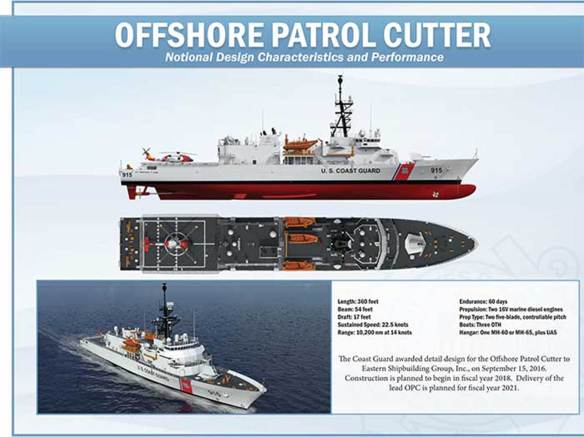
LRASM, with an over 200 nautical mile range and the ability to strike selected locations on a target ship, could possibly provide an answer. If the U.S. fielded LRASM on all nine National Security Cutters (NSC) and 25 Offshore Patrol Cutters (OPC) currently planned, its over 200 mile range could cover virtually all of these ports, and likely have a weapon on target within 20 minutes of launch.

How It Might Work

The Coast Guard is developing a Maritime Domain Awareness system. Most likely, it will tap into the Navy’s system and over the horizon radars.

When the maritime domain awareness system detects the approach of a suspicious vessel, a small patrol vessel (WPB or WPC) is assigned to intercept it and conduct a boarding to determine the vessel’s nature and intent.

When the patrol vessel is assigned the intercept, a larger cutter that may be at some distance, but within range, would be directed to provide support in the form of a LRASM launch if necessary.

The patrol craft will transmit video, position, course, and speed during its approach which will allow the start of mission planning for an LRASM launch should it become necessary. The results of the patrol craft’s attempt to board will allow determination of hostile intent.

Once a determination of hostile intent has been made, and deadly force authorized, the supporting cutter can launch its weapon. The patrol craft will continually update the supporting cutter before and during the flight of the LRASM. Navy, Joint, and/or Allied procedures would be used to call for a strike, and should also work with other service’s assets if they are available.

LRASM_TSL_Concept_Lockheed_Martin
LRASM topside launcher concept. The size and weight are comparable to launchers for Harpoon. Photo: Lockheed Martin.

Is It Affordable?

It is likely cutters could be equipped to carry eight missiles, but for peacetime purposes, two per ship would almost certainly meet the Coast Guard’s needs. Since some ships will always be in maintenance with ammunition removed, and others may be deployed where carrying the weapons would be counterproductive. The Coast Guard is unlikely to ever require more than about 50 missiles to meet its peacetime needs. A very rough estimate of LRASM unit cost would be something on the order of $2M to $5M each. That means the total cost of the missiles is likely between $100M and $250M. Adding launchers, control systems, and installations to cost would almost certainly be less than $500M. These costs would be spread over several years. This gives only an order of magnitude estimate, but it is several orders of magnitude less than the cost of other systems being deployed to protect the U.S. from attack.

Since the missiles, their launchers, and control systems are Navy type/Navy Owned equipment, the Navy would be responsible for paying for them. The cost of adding another four missiles per year for the Coast Guard to the Navy’s buy for LRASM could be lost in the rounding errors in the Navy budget.

For the Coast Guard, the program would probably require no more than 150 additional billets ashore and afloat. Not insignificant, but doable.

Conclusion

If the LRASM performs as advertised, its combination of range, warhead, and intelligent targeting may allow the Coast Guard’s small, but widely distributed force to effectively cover virtually the entire U.S. coast.

LRASM_Surface_Launch_72617-300x233

Late addition, LRASM deck mount launcher successful test. 

Happy Endings–Close Call


USCGC Polar Sea

USCGC Polar Sea

We send our only Heavy Icebreaker almost 20,000 miles, to the end of the earth with no back-up.

Take a look at this news release regarding an upcoming award ceremony where the Commandant will recognize Petty Officer 1st Class Kevin Oakes, Petty Officer 3rd Class Augustin Foguet, and Seaman Manon Mullen.

They had to repair a thrust bearing bracket. This is a really strong fitting designed to absorb the push of 25,000 HP and it broke.

EM1 Oakes fixed a generator, apparently a main propulsion generator, that had developed  a short that resulted in loss of with a surfboard repair kit.

They had ” three fires and one major lube oil leak, which can quickly ignite into fire.”

We are blessed with excellent enlisted people, who do extraordinary things, but we cannot keep doing this. It is only a matter of time until one of our two icebreakers suffers a catastrophic failure far from any assistance.

We are still close to ten years from a new heavy icebreaker, but while it will hopefully give us a more reliable replacement for the Polar Star, it will not fix the problem.

We have a acknowledged need for medium icebreakers. The Congress seems to recognize our lack of icebreakers as a problem, and there are relatively near term alternatives available in the shape of an icebreaker now excess to Shell’s requirements and another begun and well advanced in construction, which is now stopped.

Wouldn’t it be better to send two ships south?

ice-breakers-540688_1280

Innovation for Inland Tenders

Photo: BAE systems

We don’t hear about it often, but the Coast Guard also needs to recapitalize its inland fleet, WLI, WLIC, and WLRs. There are 35 of these. One entered service in 1944, another in 1945. The two newest entered service in 1990, but all the rest are much older. Two entered service in the ’50s. 23 in the ’60s, and six in the 70s. .

Whenever we belatedly get around to replacing these, there is an innovation we might want to look at, high-lift flap rudders. These were recently used on a Jones Act Articulated Tug Barge (ATB). Reportedly it provides much improved maneuverability. 

Russia’s New Nuclear Icebreaker, Largest, Most Powerful

NPR has some photos of the launching of Russia’s as yet uncompleted, 568 foot long nuclear powered icebreaker. which will be the largest and most powerful icebreaker in the world. The NPR story provided a link to a Sputniknews story.

According to sputniknews.com,

“The Project 22220 vessel is 189.5 yards long (568.5 ft–Chuck) and 37.1 yards wide (111.3 ft). The ship displaces 33,540 metric tons.”

That is almost three times as large as the Polar Star.

A second ship of the class is also expected to be completed before 2020.

Interestingly, while Russian navy projects are frequently subject to delays, this icebreaker is being launched more than a year earlier than originally planned.

Thanks to David for bringing this to my attention. 


Stratton to Participate in RIMPAC

Stratton_111031-D-0193C-002

Photo: USCGC Stratton. Image, Department of Defense ID 111031-D-0193C-002

DefenseNews has published the list of participating vessels in this year’s RIMPAC exercise. USCGC Stratton, a 418 foot Waesche class cutter will be sailing for the exercise from San Diego on June 22 in company with the US cruiser Princeton, destroyer Pinckney, littoral combat ship Coronado and the Canadian frigate Calgary.

Once again there will be a significant Chinese contingent. During the last RIMPAC, in 2014, the Coast Guard had a significant role with USCGC Waesche heading up a Maritime Interdiction exercise that included three Chinese vessels as well as five other vessels. Will be interesting to see what they have Stratton doing this year.