Photo: Heavy cruiser HMS Exeter seen after the battle, looking aft from the bow. Both forward twin 8″ gun turrets and the firecontrol system were disabled and the bridge destroyed by “splinters.”
Introduction:
Note, this has been edited from the original, based on feedback particularly with regard to the ammunition remaining on Graf Spee after the engagement. I don’t believe the thrust of the post has been changed.
This is the first of two parts. Part one will tell a story. Part two will talk about the implications of lessons learned, applied to how the Coast Guard might deal with the threat of terrorists using a medium to large merchant ship to make an attack.
These are themes that will be discussed in part 2 before looking at specific tactics to make the best use of what we have. Hopefully you will see these illustrated in the following story.
- In comparing guns, at any given range, the longer ranged weapon generally enjoys an advantage in accuracy.
- It is very difficult to sink a ship by gunfire alone.
- Ships’ structure provide a degree of protection that makes it difficult to comprehensively target the crew of a ship without sinking the ship.
- It is difficult to forcibly stop a ship with gunfire alone.
- You can run out of ammunition before you accomplish your mission. The depth of your magazine may be important.
But first the story.
To the Germans, it is the story of a lone warrior, that by guile and deception, manages to evade the world’s largest navy for three months. Graf Spee is captained by an honorable and humane gentleman of the old school, Captain Hans Langsdorff, who after seeking a fight with the British and apparently besting them, does the unthinkable, retreating to a neutral port and sinking his own ship, but sparing the lives of his crew.
From the British perspective, it is a story of three little guys, lead by Captain (later Admiral) Henry Harwood, that work together, and despite severe damage, manage to corner a bully. Then by cleaver manipulation, the bully is convinced he has no chance of winning a second round and he self destructs rather than face the Royal Navy again.

Graf Spee Cruise, 1939
The story I will tell is one of how many hits, how many rounds expended, how many rounds remained, and unlikely, almost invisible, but critical damage.
The British had made the Deutschland Class, of which the Graf Spee was the third and last, something of a boogeyman, bestowing on them the description “pocket battleships.” In fact they lacked the protection implicit in the battleship description. The Germans called them simply “Panzerschiff,” (armored ships) and in 1940 reclassified the surviving ships as heavy cruisers. Graf Spee was little better protected than the ships she would fight. She was in fact a large heavy cruiser, but there were others that were larger and better protected, including the German Hipper class (the first commissioned in 1939) and the American Baltimore and later cruiser classes (the first commissioned in 1943). The Japanese and Italians, who were also cheating on their treaty commitments, had several cruiser almost as large.
(Note: the distinction between heavy cruisers and light cruisers was one of gun caliber, not displacement. Light cruisers’ heaviest guns were 6.1″ (155 mm) or smaller. Heavy cruisers carried guns larger than 6.1″; usually 8″ (205mm) guns which were the largest cruiser guns allowed signatories of the Washington Naval Treaty.)
On the other hand, the guns of the Deutschland class were exceptional. These ships were a very real tactical problem for the British, since no single cruiser could deal with them individually. The British considered they needed 70 cruisers to meet their needs and they never approached that number. If they had to double up, there would be many needs left unfilled.

Admiral Graf Spee in the English Channel in April 1939. U.S. Naval Historical Center Photograph # NH 89566.
The Ships:
- Admiral Graf Spee, 16,200 tons (full load), 610 ft (186 meters) loa, six 11″, eight 5.9″, six 4.1″, eight torpedo tubes, 26 knots (reduced to 24 by a fouled bottom), crew 1,134.
- HMS Exeter, (one of the smallest of the treaty heavy cruisers) 10,490 long tons (full load), 575 ft (175 meters) loa, six 8″ guns, four 4″, six torpedo tubes, 32 knots, crew 630.
- HMS Ajax and HMNZS Achilles, 9,740 tons (full load), 555 ft (169 meters) loa, eight 6″ guns, four 4″, eight torpedo tubes, 32 knots, crew 570.
Note the total displacement of the three Commonwealth cruisers totaled 29,970 tons, almost twice the displacement of Graf Spee.

HMNZS Achilles. Photo, State Library of Victoria – Allan C. Green collection of glass negatives.
The Guns:
Commonwealth:
- British 8″/50 MkVIII (203mm), 256 lbs.(116.1 kg) projectile, 3-4 rounds/minute, range: 30,650 yards (28,030 m). Time of flight to 20,000 yards (18,290 m), 38.4 seconds, elevation for 20,000 yard range: 16.5 degrees
- British 6″/50 BLMkXXIII (152mm), 112 lbs.(50.8 kg) projectile, 6-8 rounds/minute, range: 24,500 yards (22,400 m). Time of flight to 20,000 yards, 47.2 seconds, elevation 24.1 degreees.
- British 4″/45 (102 mm), 31 lbs (14 kg), 10-15 rounds/minute, range: 16,300 yards (14,950 m)
German:
- German 11.1″/52 (283mm), 661.4 lbs (300 kg) projectile, 2.5 rounds/minute, range: 39,890 yards (36,475 m) at 40 degrees elevation. Would have been more if 45 degrees elevation had been possible, elevation for 20,000 yard range: approximately 11 degrees.
- German 5.9″/55 (149mm), 100 lbs. (45 kg) projectile, 6-8 rounds/minute, range: 25,153 yards (23,000 m) at 40 degrees elevation, would have been slightly greater if 45 degree elevation had been possible.
- German 4.1″/65 (105mm), 35 lbs (15.8 kg) projectile, 15 – 18 rounds/minute, range: 19,357 yards (17,700 m).at 45 degree elevation.
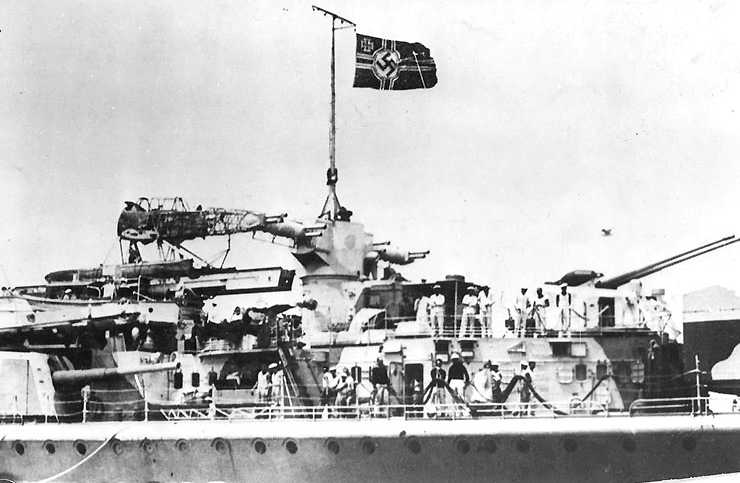
Photo: After superstructure of Admiral Graf Spee showing 15 cm/55 and 10.5 cm/65 guns. Note the burned-out Arado Ar 196A-1 floatplane on the catapult and the after main-director rangefinder. Photograph taken at Montevideo, Uruguay in mid-December 1939, following the Battle of the River Plate. U.S. Naval Historical Center Photograph # NH 80976.
How Deep Is Your Magazine?:
The number of rounds carried by each ship would become important as the engagement progressed and as options were weighed. Total weight of rounds available was also an important variable determining how much damage could be inflicted:
Graf Spee: 322.6 tons
- 11.1″: 720 rounds, 661 lbs each: 475,920 lbs or 238 tons.
- 5.9″: probably 800 rounds, 100 lbs each, 80,000 lbs or 40 tons
- 4.1″, probably 2550 rounds, 35 lbs each, 89,250 lbs or 44.6 tons
British: 296.25 tons:
Exeter: (86.05 tons)
- 8″: 600 rounds, 256 lbs each: 153,600 lbs or 76.8 tons
- 4″ 600 rounds, 31 lbs each, 18,500 lbs or 9.25 tons
Ajax & Achilles (210.2 tons)
- 6″: 3200 rounds, 112 lbs each: 358,400 lbs or 179.2 tons
- 4″, 2000 rounds, 31 lbs each, 62,000 lbs or 31 tons

From official British report into the cruise of the Graf Spee and Battle of the River Plate. Published by HMSO (His Majesty’s Stationery Office).
Battle Before Breakfast:
It is 13 December 1939. In the Southern Hemisphere, this is one of the longest days of the year. As the sun comes up, Graf Spee sights masts on the horizon. Believing the ships to be a cruiser and two destroyers escorting a convoy she had hoped to attack, she turns toward them and accelerates.
6:10: Graf Spee’s increased speed results in more smoke and she in turn is seen by Commodore Harwood’s cruisers. In accordance with their previously planned response, the cruisers divide up, so that Graf Spee will have two separate groups to engage about 90 degrees apart. Heavy cruiser Exeter goes NW and the two light cruisers go NE. Additionally this should allow the two groups to spot fall of shot and provide range correction for each other.
06:18 Graf Spee opens fire at a little less than 20,000 yards. Exeter at 06:20, Achilles at 06:21 and Ajax at 06:23.
From the first, Graf Spee’s fire, targeting Exeter, is accurate. First salvo over, second salvo short, third salvo straddled. A near miss, bursting short, kills the crew on the starboard torpedo tubes and damages Exeter’s two spotter planes, which are jettisoned. It is textbook gunnery, the rocking ladder. Only one salvo of three is expected to yield any hits. Even then, dispersion of the rounds means, even if the fire control solution is perfect, it is unlikely more than one round out of a salvo would hit. Straddles that include no hits are common. So under ideal condition, if everything worked perfectly, the best one could expect would be that, one round of 18 would hit.
But the adversary is also doing everything he can to throw off the gunnery solution. Assuming the gun line is perpendicular to the base course, at 30 knots, a 30 degree course change for only thirty seconds will change the range 250 yards. At long range, this can be done between the time the guns fire and the shells impact. Both sides used smoke and evasive maneuvers to complicate the fire control problem.
At 06:26, Graf Spee scores a direct hit on the “B” turret (second turret on the bow). Splinters wipe out the entire bridge crew with the exception of the Captain and two others. The Captain is wounded but continues to command the ship. For the rest of the action, the ship is controlled by messenger to after steering.
06:37 Ajax launches her spotter plane to observe and provide correction of the cruisers’ gunnery.
06:38 Exeter is hit twice. One hitting the “A” (most forward) turret and putting it out of action, the other strikes the hull starting a fire.
“At this point, Exeter was severely damaged, having only “Y” turret still in action under ‘local’ control, with Jennings (Gunnery Officer–Chuck) on the roof shouting instructions to those inside. She also had a 7° list, was being flooded and being steered with the use of her small boat’s compass. However, Exeter dealt the decisive blow; one of her 8 in (200 mm) shells had penetrated two decks before exploding in Graf Spee′s funnel area, destroying her raw fuel processing system and leaving her with just 16 hours fuel, insufficient to allow her to return home.
“At this point, nearly one hour after the battle started, Graf Spee was doomed; she could not make fuel system repairs of this complexity under fire. Two-thirds of her anti-aircraft guns (two out of three mounts–Chuck) were knocked out, as well as one of her secondary turrets (one of eight guns–Chuck).“
06:40 A near miss on Achilles–splinters kill four, wound several others, and temporarily disable the main fire control director.
07:25 An 11″ shell puts one of Ajax’s after turrets out of action and jams the other. She now has use of only half of her 6″ battery.
07:30 Flooding shorts out power to Exeter’s only remaining turret.
About this time, it appears Graf Spee begins to break off the engagement and heads for the River Plate.
07:40 Now listing heavily, with all major guns disabled and her speed reduced due to flooding in the bow, Exeter breaks off action and begins a long retirement to the Falklands where she will make temporary repairs before returning to Britain for a 13 month refit.
About the same time the Exeter turns to disengage and begin her transit to the Falkland, Commodore Harwood, having closed to close to 8,000 yards, hears reports he is running short of ammunition. He probably also realizes he is in a very dangerous position where his adversary’s shooting is much more accurate. He changes tactics, opens the range and plans to make a night attack when an effective torpedo attack is more likely.
Ajax and Achilles drop back and follow Graf Spee as it becomes obvious she is heading for the mouth of the River Plate. Some shots are exchanged, but these appear to be only Graf Spee warning the cruisers to maintain their distance.
Late in the evening Graf Spee anchors in Montevideo harbor.
The following day she releases her 62 merchant navy prisoners, transfers wounded to hospitals ashore, and buries her dead.
How accurate were they?:
The British light cruisers fired 2064 x 6″ projectiles and scored 17 hits or one hit for every 121 rounds fired or 0.82%. Of their original 3200 rounds 1136, 35.5%, remained.
Exeter fired 193 x 8″ rounds (possibly a few more) and scored three hits or one hit for every 64 rounds fired, 1.55%. This is all the more remarkable because 177 of these are fired by the after twin turret, most of which were fired under local control, and Exeter never closed the range to the degree the light cruisers did. It appears one of Exeter’s three hits was made while the gun was in local control.
Graf Spee fired 414 x 11.1″ rounds. Graf Spee’s 11.1″ hit Exeter at least seven times plus a particularly damaging near miss, along with several others that caused minor damage. These guns also made two hits on Ajax and a damaging near miss on Achilles. If we assume ten hits, that is one hit for every 41 rounds fired or 2.4%. Graf Spee had only 306 rounds, 42.5%, remaining. If she continued shooting with the same degree of accuracy, these could be expected to score at best eight more hits.
My primary source indicates that Graf Spee’s relatively powerful secondary armament fired 377 x 5.9″ and 80 4.1″ projectiles, but made not hits. They should have performed similarly to the British 6″. “It was not known until later that splinter damage to the director directing the 15 cm fire caused bearing track inaccuracy for the 15 cm fire…a small shell splinter entered the starboard director (of assume the forward conning tower FC station). But as luck would have it, the optic was left intact and the director function but little impaired, so the damage remained unknown until late in the evening. The casualty was not noticed by the operator during the battle at all. However, the director did not provide the proper fine bearing angle alignment to the battery, resulting in very poor on target performance.”
A Second Round?:
Diplomatic rankling begins almost as soon as Graf Spee anchors, with the Germans asking for two weeks in port to make the ship seaworthy enough to deal with the North Atlantic winter. The British first try to have Graf Spee’s stay limited to 24 hours, and then, realizing it will be several days before their heavy units arrive, they attempt to keep her in port without saying so.
The Uraguian authorities are unmoved and give the Graf Spee 72 hours.
Meanwhile the Royal Navy has ordered a battlecruiser, an aircraft carrier, and eight cruisers to converge on the River Plate to make sure Graf Spee does not escape.
22:00, 14 December, Heavy cruiser HMS Cumberland arrives, having steamed at full speed for 36 hours from the Falkland Islands. 28% Larger than Exeter (13,450 tons full load and 630 ft loa), with 33% more 8″ guns, she brings with her full magazines, 800 rounds of 8″.
17 December, Graf Spee sets sail, but a large portion of her crew has already left the ship. She stops, anchors, the rest of the crew leave the ship, transferring to waiting tugs. A series of explosions erupt and Graf Spee settles in shallow water, her guns and superstructure still out of the water.
Why did they do it?:
The British provided disinformation that the battlecruiser Renown and aircraft carrier Ark Royal were waiting outside and the Graf Spee crew members convinced themselves they saw the masts of these ships offshore.
Even an accurate view of the odds looked unfavorable for a successful sortie. After the arrival of HMS Cumberland, Graf Spee faced a force at least as powerful as the one engaged on the 13th. Additionally, the three cruisers waiting off shore did not have to sink Graf Spee to be successful. All they really had to do was shadow her until the heavy units could join them and Graf Spee’s fate would be sealed. With less than three quarters the ammunition she had used in the first engagement and her forward fire control director already disabled, Graf Spee’s chances of inflicting significant damage, escaping her tormentors in the South Atlantic, getting through the British blockade of Germany, and making it home appeared slim.
Then there is the matter of the fuel oil purifier. Without it, they could not expect to make it back to Germany, even if the Royal Navy were not in their way.
_________
Annex. Extracts from H. M Ships Damaged or Sunk By Enemy Action, 3 Sept 1939 to 2 Sept. 1945
EXETER during the “Battle of the River Plate”, came under shell fire from the German Pocket Battleship, ADMIRAL GRAF SPEE.
Hit No. l, struck the shelter deck just abaft “B” Turret and passed out through the superstructure side without exploding.
Hit No. 2, struck the front plate of “B’ Turret between the two guns and detonated on impact. “B” Turret was seriously damaged and put out of actions. Splinters caused damage and casualties on the bridge.
Hit No. 3,, struck on or very near, the fluke of the starboard sheet anchor and detonated on impact. The side plating was split and torn and much damage in the paint shop was caused by splinters.
Hit No. 4, struck the forecastle deck on the middle line just aft of the cable holders and exploded on impact. A hole 10 ft. by 10 ft. was blown in the forecastle deck and splinters penetrated the upper deck.
Hit No. 5, struck the jacket of the right gun of “A” Turret, and exploded on impact. “A” Turret was put out of action although it was found later that the turret could be trained and the left gun used. The forecastle deck was torn and the upper deck damaged by splinters.
Hit No. 6, passed through the whee!house, charthouse, out through the armament office and exploded just forward of the starboard 4 inch H.A. (High Angle-Chuck) Gun. Damage from splinters was widespread, ammunition in R.U. (Ready Use-Chuck) lockers was ignited, the lower bridge and 25% of the 4 inch armament was put out of action.
Hit No. 7, passed through the ship’s side just under the upper deck abreast “B” turret, travelled aft through the mess spaces on the lower deck and exploded abreast the E.R.A .’s (Engine Room Artificers-Chuck) mess. Damage from splinters was widespread, the fire main was fractured, communications seriously damaged and the lower deck holed. The 4 inch H.A. magazine and handing room were flooded by water escaping from the fractured fire main. Fire broke out in the mess spaces just aft of “B” turret supports.
Splinter Damage. EXETER suffered a great deal of superficial damage from splinters due to shells that burst short. Splinters on the ship’s side near the waterline caused a good deal of flooding. Most aerials were carried away and searchlights, signal projectors;, rigging etc. were badly damaged. One R.U. Ammunition locker was also ignited by splinters.
Fighting Efficiency = Seriously impaired. “A”, “B” and °Y° Turrets and 25% of the 4 inch H.A. armament was out of action. Slight loss of speed due to flooding and consequent heel and trim of the ship.
AJAX during the “Battle of the River Plate” came under shell fire from the German pocket battleship ADMIRAL GRAF SPEE. The direct hit struck the after superstructure port side passed thro’ “X” barbette and exploded in the Admiral’s cabin, starboard side causing slight structural damage. The shell did not detonate but burst with a mild explosion. Splinter damage caused, “Y” turret to jam.
(Ajax was again hit by a 283 mm (11.1 in) shell that destroyed her mast and caused more casualties, but damage was apparently not worth reporting–Chuck)
Fighting Efficiency = Impaired, “X” and “Y” turret were out of action due to the shell hit. “B” turret had one gun out of action due to failure of the hoist.
ACHILLES during the “Battle of the River Plate” came under shell fire from the German pocket battleship ADMIRAL GRAF SPEE. Splinters from shells bursting short pierced the ship’s side above the waterline, bridge screen etc, and also caused other slight damage. Minor damage was sustained in the director control tower but after casualties had been replaced it was able to continue in action.
Fighting Efficiency – Not impaired. Gun fire was not efficient until casualties in the D. C.T. (Fire Control Director–Chuck) were replaced. W/T (radio-Chuck) was out of action temporarily.
REMARKS The “Battle of the River Plate” revealed the following items.
- Increased protection to vital communications required.
- Additional portable telephones required,
- Improvement to look-out positions necessary,
- Need for increased protection for exposed personnel.
- Remote control of the smoke apparatus required.
- Square ports to be abolished.
- Automatic emergency secondary lighting to be introduced.
- Modifications required to telephone hand sets to prevent “jumping off”.
- Additional portable pumps to be supplied.
- Fire mains to be modified to provide for easier isolation and repair.
Print Sources:
- Bennett, Geoffrey, Battle of the River Plate, Ian Allen, Ltd., 1972
- Campbell, John, Naval Weapons of World War Two, Conway Maritime Press Ltd, 1985
- Chesneau, Roger, Conway’s All the World’s Fighting ships, 1922-1946, Conway Maritime Press Ltd, 1980
On Line Sources:
- https://en.wikipedia.org/wiki/Battle_of_the_River_Plate#Battle
- An Admiralty view. http://ww2today.com/the-battle-off-the-river-plate-post-action-report
- For a view from HMNZS Achilles. https://nzhistory.govt.nz/files/documents/battle-riverplate-eng.pdf
- A first hand account of the battle from a Damage Control officer about HMS Exeter. https://www.navyhistory.org.au/hms-exeter-at-the-battle-of-river-plate/