“DECEMBER 2, 2016 — Wärtsilä EnergoProFin is now available for controllable pitch propellers (CPP) as well as fixed pitch propellers (FPP).”
“The specially designed propeller cap has hydrofoil-section fins on the downstream side of the propeller, creating fuel savings of up to five percent.”
They claim the addition pays for itself in one to two years.
From our perspective, it should also increase the range of the ship, and may very slightly increase maximum speed.
The top U.S. Coast Guard official is eyeing a unique role for his fleet in maintaining peace and stability in the East and the South China seas under the incoming presidential administration.
By mirroring the role of China’s Coast Guard in parts of the Asia-Pacific, said Coast Guard Commandant Admiral Paul Zukunft, the U.S. Coast Guard could be the face of U.S. military presence in disputed waters without appearing too threatening.
“When you look at the East and South China seas, look at China’s Coast Guard, it is really the first face of China,” he told VOA. “So I’ve proposed to the Department of Defense that if they were to leverage the U.S. Coast Guard, I would look at providing resources to provide the face of the United States behind a Coast Guard ship, and should that be a consideration for our approach to the East and South China seas with the next administration.”
The post has more background.
This is a major change to Coast Guard tasking and there should be no doubt it will require some trade-off against existing tasking. In all probability our contribution will be a National Security Cutter. Keeping one in the Western Pacific probably means one less in the Eastern Pacific.
Perhaps the Navy will compensate by putting a ship under SOUTHCOM.
Thanks to Luke S. for bringing this to my attention.
Many of us have wondered about the apparent duplication of effort by the Coast Guard and Customs and Border Protection’s (CBP) Air and Marine Operations (AMO). Apparently the The U.S. House of Representatives, Committee on Homeland Security, Subcommittee on Border and Maritime Security had the same concern and asked for an audit by the Department of Homeland Security (DHS) Office of the Inspector General (OIG). This resulted in a report, “AMO and Coast Guard Maritime Missions Are Not Duplicative, But Could Improve with Better Coordination (pdf).”
Guess there is no suspense in what their findings were, but I find the methodology and conclusions less than complete and satisfying.
The recommendations of the audit were:
Recommendation #1: We recommend that the DHS Under Secretary for Management reestablish an oversight mechanism at the DHS level to ensure that AMO and the Coast Guard coordinate operations.
Recommendation #2: We recommend that the Coast Guard Commandant, CBP Commissioner, and U.S. Immigration and Customs Enforcement Director revise the Maritime Operations Coordination Plan to include requirements for coordination and information sharing at all levels, especially the local level.
So the response was equally predictable–form a committee.
I’m sorry, but my BS meter is off the scale. The alarm went off first, when they consistently called the territorial sea, “customs waters” lending a presumption that this is a Customs job.
While their conclusion may ultimately prove correct, they essentially failed to look at the most significant area of overlap–Maritime Patrol Aircraft. The audit concentrated exclusively on drug enforcement and failed to consider Alien Migrant Interdiction Operations (AMIO). And they failed to answer the most basic questions.
While coordination is always assumed to be a “good thing,” the only real reason you should want two agencies performing the same function would indicate less coordination, not more.
There is no doubt AMO does useful work, that is not the point. The question is, what is the most effective and economical way to distribute resources. Should DHS be working toward a different distribution of tasking and resources?
Unanswered questions:
Why does Customs need boats? The Revenue Cutter Service was Customs’ boat service. Why doesn’t the Coast Guard still fulfill that function? The Coast Guard operates boats. Boats are on standby with crews at the ready. When Customs needs a boat, why don’t they ride Coast Guard boats? What is the cost of an operating hour for comparable Coast Guard and Customs boats?
AMO does need aircraft to do several tasks, including interdiction of smuggling by air, but why does Customs need to have a fleet of maritime patrol aircraft for interdiction of surface vessels, when the Coast Guard also has to provide a similar fleet for a whole range of missions? The AMO operates a fleet of 14 P-3s including both Airborne Early Warning models and P-3 Long Range Trackers. They are over 40 years old and undergoing an extensive and expensive life extension program. AMO also operatesBombardier DHC-8, and Beach King Air 350ER equipped with marine search radars. What is the cost of an operating hour for comparable Coast Guard and Customs aircraft?
AMO regularly performs air interdiction. Perhaps they should be the ones doing the low speed air interdiction over DC.
Other missions:
In addition to drug enforcement, the two agencies seem to have overlapping missions in Alien Migrant Interdiction Operations (AMIO) and counter terrorism. Why weren’t these missions looked at as well?
AMO boats are suitable only for very short ranged AMIO missions while Coast Guard vessels a suitable for interception long before the approach the US coast.
It appears that AMO assets are limited to small arms. If the terrorist threat is anything much larger than a small boat, they are unlikely to be effective in countering it without assistance.
What about Jurisdiction?
AMO operates primarily within the customs waters, but it maintains the authority to pursue vessels fleeing the customs waters or hovering outside those waters as a means of avoiding AMO jurisdiction.
The Coast Guard is not similarly limited in the Marine environment. The effects of this on agency effectiveness was not considered.
Maybe AMO’s jurisdiction should be extended to cover the entire EEZ, but that is not the case now and AMO’s boats don’t seem suited for operations much beyond 12 miles. They are generally very fast, but probably short legged with minimal protection for the crew from the elements.
The characteristics of their boats don’t seem to square with the very long range character of their aircraft like the P-3s.
Why overlapping responsibility might be a good idea–coordination be damned:
There is one reason you might want two agencies responsible for the same law enforcement mission. That would be if you worry about the possibility that one of the agencies might be compromised. For instance if one agency is somehow compromised by a criminal organization. The law enforcement agency might still appear successful. The criminal organization might use the agency to eliminate its competitors, providing intelligence. A second independent agency might uncover this corruption.
Use of Force:
There is an interesting section comparing the two agencies’ use of force policies.
Approval for Employing Use of Force
Coast Guard crews must receive approval from the appropriate official in the chain of command, typically an Admiral, before using force to stop noncompliant vessels. According to the Coast Guard, the approval time can take from 10 minutes to several hours depending on the case. In contrast, AMO policy reflects a more traditional law enforcement approach and allows its agents to make use of force decisions.
According to the Coast Guard, it needs a use of force policy to cover a vast range of mission sets across a legally and jurisdictionally complex operating environment. Although the approval process has some level of risk mitigation, the Coast Guard designed the process to relieve on-scene officers of the need to access U.S. jurisdiction and legal authority to employ force against a noncompliant vessel, and allows those officers to focus on executing the tactics and procedures to safely and effectively employ that force.
We participated in use of force demonstrations for noncompliant vessels with both components and experienced the delay in the Coast Guard’s approval process. Although there are potential safety concerns for Coast Guard boat crews during a pursuit, the Coast Guard stated that it updated its law enforcement manual to “refine and streamline the process in every way possible” to reduce the time lapse from when the Coast Guard vessel is “overt” (known by the suspected vessel to be following) to when the necessary actions (use of force) are completed.
Hopefully if a Coast Guard CO sees a terrorist attack underway, he will have the flexibility to act on the knowledge, even if there is no time to get approval.
Using Statistics that do not correlate:
As noted, the report only looked at drug enforcement and only at a small part of the mission. Quoting from the report,
“There are 206 combined locations where AMO and the Coast Guard conduct operations in customs waters. Of the 206, there are 17 locations (8 percent) where AMO and the Coast Guard have similar capabilities and an overlapping area of responsibility.”
” In FY 2015, at the 17 overlapping locations, all of AMO’s drug seizures occurred on land or in customs waters, where marine units primarily conduct operations.”
“The Coast Guard is a multi-mission agency, including law enforcement that operates in both customs and international waters. In contrast to AMO, Coast Guard personnel assigned to drug and migrant interdiction do not conduct investigative or land operations. In FY 2015, 93 percent of Coast Guard drug seizures occurred in international waters (Transit Zone) (emphasis applied–Chuck). AMO only deploys aircraft in this area; it does not have the vessels to operate in these waters.”
“In the overlapping locations, 84 percent of reported drug seizures were from AMO operations. These seizures occurred, in part, because of the different activities of each agency. For example, while some of AMO operations were intelligence based, the Coast Guard conducts routine patrols looking for illegal activity. Although Coast Guard patrols are not as effective as intelligence-based operations, they show a presence and can deter illegal activity.” (Emphasis applied–Chuck)
First note that this compares Customs’ seizures both on land and on the water with the seizures of the Coast Guard, a multimission agency, on the water alone. This also seems to imply that Customs was not sharing their intelligence with the Coast Guard.
FY 2015 Drug Seizures from the 17 Overlapping Locations Agency Customs Waters (Drugs in Pounds) AMO 28,707 (land and water) (84%) Coast Guard 5,602 (16%) Total 34,309.
I doubt the Coast Guard units they looked at drug interdiction as their primary mission. Certainly the AMO units did.
Why the difference in statistics?:
According to Coast Guard statistics, Coast Guard drug seizures in FY2015 were 319,229.4 lbs of Cocaine and 78,262 lbs of Marijuana. Appendix C indicates that the Coast Guard had seized 199,749 lbs of Cocaine and 57,855 lbs of Marijuana. (Why the large difference in these figures?)
Figures reported for AMO in Appendix C were 243,387 lb of cocaine and 719,180 lb of Marijuana.
Pounds of drugs is not a very informative metric, if various types of drugs are aggravated. It also says nothing about its purity. After being cut there is less drugs in a pound of drugs.
Looking at this, I found a cost comparison of what the two agencies spend for their personnel interesting. The total AMO budget for FY2015 was $750M supporting 1,665 members, while the CG budget of $8,380M supported 41,700. Budget/Personnel equals $450,450 per AMO member and $200,959 per CG member. There are probably lots of reasons AMO cost more than twice as much per member, but it might have been worth some examination.
Conclusion:
Bottom line, this report failed to answer the question, “Why do both the Coast Guard and Customs have both boats and maritime patrol aircraft?”
What we got was a distorted comparison of the relative success of the Coast Guard and Customs drug interdiction efforts.
These distortions can have consequences and should not be allowed to pass unchallenged. I can understand the Coast Guard not wanting to offend people in the IG office, but I have no such problem, and neither should the subcommittee that requested the audit.
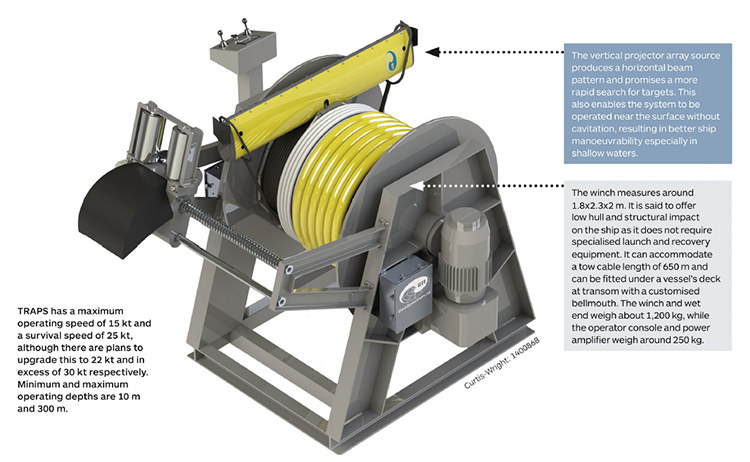
NavyRecognition reports, “GeoSpectrum Technologies Inc. is pleased to announce that it has received a contract through the Build in Canada Innovation Program. Defence Research and Development Canada will test the TRAPS (Towed Reelable Active Passive Sonar) variable depth ASW sonar on Royal Canadian Navy ships.”
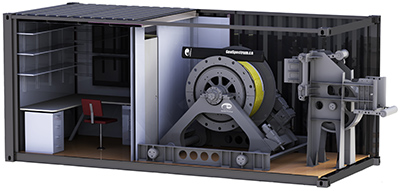
“The modular design of TRAPS provides a variety of installation options, including containerization on multi-mission vessels and standard deck-mounting.
“The TRAPS system is ideal for small combatants such as OPVs, corvettes, ships of opportunity, and USVs. Applications include naval defence/surveillance, drug interdiction, homeland security, and other water-borne policing.”
In addition to detecting submarines and surface vessels, the system is claimed to be usable for:
Active torpedo detection
Torpedo decoy
Passive receiver
Black box pinger detection
Sonobuoy processor
A typical detection range of 50 nautical miles is claimed. If it works as advertised this might give most of our larger ships an ASW capability and perhaps help us detect semi-submersibles. Thales’ CAPTAS series is similar, with CAPTAS 2 and CAPTAS 1, designed for ships of over 1,500 and 300 tons respectively.
Photo: TPSB with ballistic protection, Anmyeon Beach, Republic of Korea, June 30. Exercise CJLOTS 2015 (U.S. Navy photo by Mass Communication Specialist 1st Class Kori Melvin/Released)
Got an interesting link from Luke S. “Evaluation of Composite Armor for Coast Guard Vessels” (pdf) is a study from 1989, looking at how selected portions of the 110 foot WPBs might be protected from small arms fire. Here is the summary of their findings.
Up to a firing range of 100 yards, which was the limit of this study, personnel inside Island Class cutters are vulnerable to lethal rifle fire coming from drug smugglers. Test results showed that unconditional protection for personnel inside can be obtained by adding KRP (KEVLAR reinforced plastic–Chuck) armor panels to the cutter. This is also a more weight effective solution than increasing the thickness of the hull and superstructure. Although it was found that placing the KRP either in front of or behind the 1/8″ aluminum was equally effective, it should be noted that the aluminum by itself was overmatched by the threats. In general, it is more efficieut to place the KRP behind metal.
The USCG R&D Center defined three areas of the Island Class cuttfer that required protection in order to allow it to continue its mission if it came ander fire. These were the bridge and the communications room, both behind 1/8″ aluminum, and the magazine behind 5# steel. A visit was made to the USCGC Matinicus to take measurements and assess the feasibility of retrofitting KRP armor in those areas. Retrofitting them inside the bridge and communications room could be done by placing them in the space between the exterior aluminum skin and the interior trim panels. This might require some fit and trim but KRP panels can be cut and drilled so there should be no particular difficulty. Another option is to place the panels on the exterior of the bridge and communications room. This would appear to be an easier task but would present a different set of considerations. Since the KRP panels would have to be spaced 3″ in front of the aluminum, the panel supports would have to be designed to withstand green water loading. Environmental effects on these panels caused by exposure to seawater and UV radiation is not a problem for adequately sealed KRP. For the remaining area requiring armor, the magazine, mounting the panels against the steel hull inside the vessel did not appear to be difficult.
The amount of material and weight added in each of the critical areas is summarized in TABLE 6 for the worst case threat, the 7.62mm, M80 at point blank range.
TABLE 6 included the location to be protected, the total area to be armored, the weight per square foot for the armor, and the total weight for protection to that level. I have summarize the data below, but did not include the weight per sq.
Bridge 33′ x 4′ – 132 sq ft, 1056 lbs.
Communication rm. 14′ x 6′ • 84 sq ft, 672 lbs.
Magazine 6. x 6′ 36 sq ft, 180 lbs.
Total area covered: 252 sq. ft. weight: 1908 lbs.
These numbers are guidelines because the minimum armor density required was not determined in this study. Nevertheless, realizing these numbers are on the high side, the material cost from a commercial panel manufacturer for a KRP panel weighing 8 psf (lbs/sq ft–Chuck) with 20% resin would be about $40,000. This is basd upon a panel cost in the $20 to $24 per pound range.
Makes me wonder if anything was done about this, particularly for the WPBs based in Bahrain. Also, was anything included in the Webber class WPCs?
Even this relatively light armor would also provide a degree of protection against heavier .50 cal. and 14.5mm machine guns if fired from a greater range and/or if the round strikes at an oblique angle.
I have heard that ballistic protection for the Offshore Patrol Cutter has been deleted. This may be a mistake, particularly if it is as inexpensive as it appears.
Late addition:
Just found this. The photo below is Prince Charles boarding the HMS Middleton (a 32 year old, 750 ton mine countermeasures vessel) in Bahrain. The post is interesting regarding the situation in Bahrain, but I wanted to mention the gun crew protection visible between the stack and mast. The gun is an M134 “mini-gun,” a six barrel 7.62mm “gatling” gun. The additional pretection is apparent. Apparently the Brits recognize the need to protect their gun crews. It is not just about protecting the gunner, it is also about keeping the gun that is defending the ship operational.
gCaptain reports the Sea Shepherd organization has taken possession of their new vessel “Ocean Warrior.” The little ship could make a credible patrol boat, and the bridge layout is also interesting.
Reportedly this vessel is based on an existing design. Here you can find a product description of the “parent craft,” the here: Download ›
Based on the parent craft, it appears the dimensions are:
Length O.A. 53.25 m (175 feet)
Beam O.A. 10.10 m (33 feet)
Depth at sides: 4.70 m (15.4 feet)
Draught: 3.20 m (10.5 feet)
Speed: 30 knots
Four engines totalling 8 megawatts or approx 10,728.2 HP
They claim an exceptional range of “3100 nm. at max. speed” but they also list a range of maximum speed from 20-30 knots depending upon choice of engines, so I assume this is really 3,100 miles at 20 knots, but that is still exceptional and probably would translate to over 5,000 miles at most economical speed.
There is a “virtual tour’ of the parent craft here.
Comments:
I would note that all four engines and all the generators are located in a single compartment (good for minimal manning/not so good for damage control) and the small helo deck on the “Ocean Warrior” has a number of obstructions that would be unacceptable to the Coast Guard, but it could make a good UAV operating area.
Crew for the parent craft is only eight, and consequently only birthing for eight is provided on the parent craft, but it also includes airline style seating for 80 in the main deck compartment at the foc’sle. Presumably on the Ocean Warrior this area has been converted for additional birthing.
The Department of Homeland Security (DHS) Inspector General has issued a report on the Drug Interdiction mission (pdf) covering the entire department. It is not a particularly long report, but I will quote the summary and recommendations.
“What We Found
“We determined the Department’s oversight of its drug interdiction efforts did not align with ONDCP’s (Office of National Drug Control Policy–Chuck) National Drug Control Strategy. The strategy sets goals and objectives for the drug control agencies to reduce illicit drug use, manufacturing and trafficking, drug-related crime and violence, and drug-related health consequences. Specifically, due to a lack of formal oversight roles and responsibilities, the Department did not: (1) report drug seizures and drug interdiction resource hours to ONDCP, and (2) ensure its components developed and implemented adequate performance measures to assess drug interdiction activities.
“As a result, DHS could not ensure its drug interdiction efforts met required national drug control outcomes nor accurately assess the impact of the approximately $4.2 billion it spends annually on drug control activities.”
Recommendations: “We recommend that the Under Secretary for Management:”
“1: Develop and implement a plan to ensure compliance with 21 U.S.C. 1704 that mandates DHS must annually submit to ONDCP and the appropriate congressional committees: the number and type of seizures of drugs by each component of DHS seizing drugs, as well as statistical information on the geographic areas of such seizures; and the number of air and maritime patrol hours primarily dedicated to drug supply reduction missions undertaken by each component of DHS.
“2: Develop and implement a plan to ensure components develop outcome-based performance measures that adequately assess the success of drug interdiction efforts.”
Figure 1: “FYs 2011–2015 DHS Component Drug Control Spending,” showing spending by the three major drug enforcement components of DHS, Customs and Border Protection (CBP), Coast Guard, and ICE on page 2 (pdf page 6), and Figure 3: “FY 2015 DHS Component Drug Seizures in Pounds and by Percent of Total DHS Seizures” on page 4 (pdf page 8) were particularly interesting to me.
Its All About Reporting:
This really all about improving reporting of what is done, rather than specifically improving performance, although that is an implicit goal of improved reporting.
Generally the Coast Guard came out well in the report, without the duplication apparent in reporting by CBP and ICE. The only real recommendation for the Coast Guard was that we need to report on interdiction of other drugs in addition to Cocaine and Marijuana.
I do have a bit of a problem with the way “resource hours” are typically aggregated. Some times there seems to be no difference between an hour by a 25 foot boat and a National Security Cutter. That really is not very helpful; it becomes a statistic for its own sake; and may lead to poor resource allocation decisions. Hopefully we are reporting in much greater detail.
Coast Guard manned destroyer escort USS Menges (DE-320) showing the effects of an acoustic homing torpedo hit on the stern.
It is entirely appropriate for Veteran’s Day weekend reading, but this post was prompted by a recent update of the list of “Top Ten Posts.” I found that the 2011 post “What Does It Take to Sink a Ship?”was not only the top post since I started writing, it is also the top post of 2016. That looked at Navy major surface combatant losses in WWII, but I realized I have never surveyed the Coast Guard’s WWII losses.
This began as another shameless attempt to get the Coast Guard to recognize that they need torpedoes to stop medium to large ships, but it grew into a more comprehensive look at CG losses in WII. I did find that six (or seven, Escanaba?) Coast Guard or CG manned vessels were hit by torpedoes and in every case the ship was either sunk (four or five?) or immobilized (two).
I found a couple of good sources. “The Coast Guard at War” is a series of monographs completed shortly after WWII (between 1045 and 1950) and most of the apparently 25 volumes are available in pdf format here, along with a lot of other WWII references. In particular I used The Coast Guard At War: Lost Cutters(Official History Series, Volume VIII, 1947). It lists the loss of 16 Coast Guard vessels and the loss of 12 Coast Guard manned Navy vessels, but two of these (one Navy and one CG) were actually after the war was over. My other source was “U. S. Coast Guard Ship Losses” by Jim Gill, on the US Coast Guard Light Ship Sailors Association International web site. This source identifies 40 losses beginning with the Tahoma in 1914 up to USCGC Mesquite (WLB-305), grounded in 1989. It included three losses not listed in the official history, all by torpedoes:
(FS-255), a small Army freighter, 560 tons, torpedoed and sunk by a Japanese submarine while anchored, 11 May 1945, with the loss of four men.
USS Menges (DE-320), 1,590 tons, torpedoed while on convoy duty, 4 May, 1944, the ship survived severe damage to her stern, but there were 31 dead.
USS Etamin (AK-93), 7,176 tons, which was hit by a hit by an air launched torpedo and damaged badly enough that it was decommissioned and was used subsequently as an unpowered floating warehouse. One dead.
Coast Guard Vessels Lost:
The Coast Guard lost 15 vessels during the course of WWII. Of those, three are believed to be the result of enemy action. Of the remaining 12, eight were a result of adverse weather. 214 Coast Guardsmen were killed in these 15 incidents.
The three ships presumed loss to enemy action included the three largest Coast Guard vessels lost during the war:
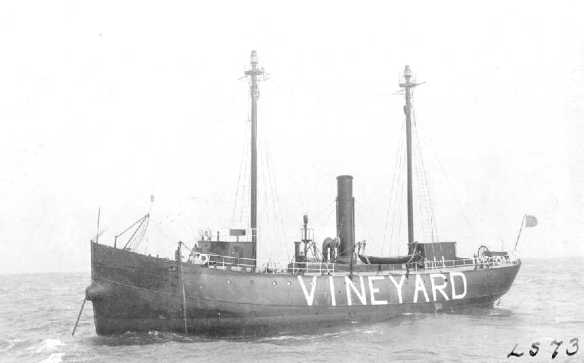
LV 73 on the Vineyard Sound station where she served from 1924 through 1944. On 14 September 1944 she was carried off station during a hurricane and sank with the loss of all hands.
It might be assumed that the non-combat casualties were not war related, but that might not be the case. The urgency of the missions, the diversion of more capable ships to escort duty, the influx of inexperienced personnel placed in responsible positions, and the use of vessels pressed into service for which they may have been ill-suited, were all a result of the war, and it led to crews being placed in more danger than would have been the case in peacetime.
Coast Guard Manned Navy Vessels Lost:
Of the eleven Coast Guard manned US Navy ships lost during WWII, seven were lost to enemy action, the others were:
LST 203, 2,366 tons, was stranded after an intentional beaching, 1 Oct. ’43, no fatalities.
USS Serpens (AK-97), 14,250 tons, destroyed as a result of an apparent internal explosion of its cargo, 29 Jan. ’45, 196 CG fatalities. (Largest single loss of CG personnel)
USS Sheepscot (AOG-24), 2,270 tons, driven ashore by adverse weather, 6 June ’45, no fatalities.
USS Serpens (AK-97) US Navy photo #NH 89186, from the collections of the US Naval Historical Center, courtesy William H Davis, 1997
USS Sheepscot (AOG-24) underway, August 1944, US Navy photo
Those lost to enemy action were:
USS Muskeget, 1,827 tons, was torpedoed, 9 Sep. ’42, 121 dead, 116 CG.
“LST discharges supplies. . .”; no date (November, 1943?); Photo No. 3237; photographer unknown. The Coast Guard-manned LST-69 disembarks equipment during the Tarawa invasion.
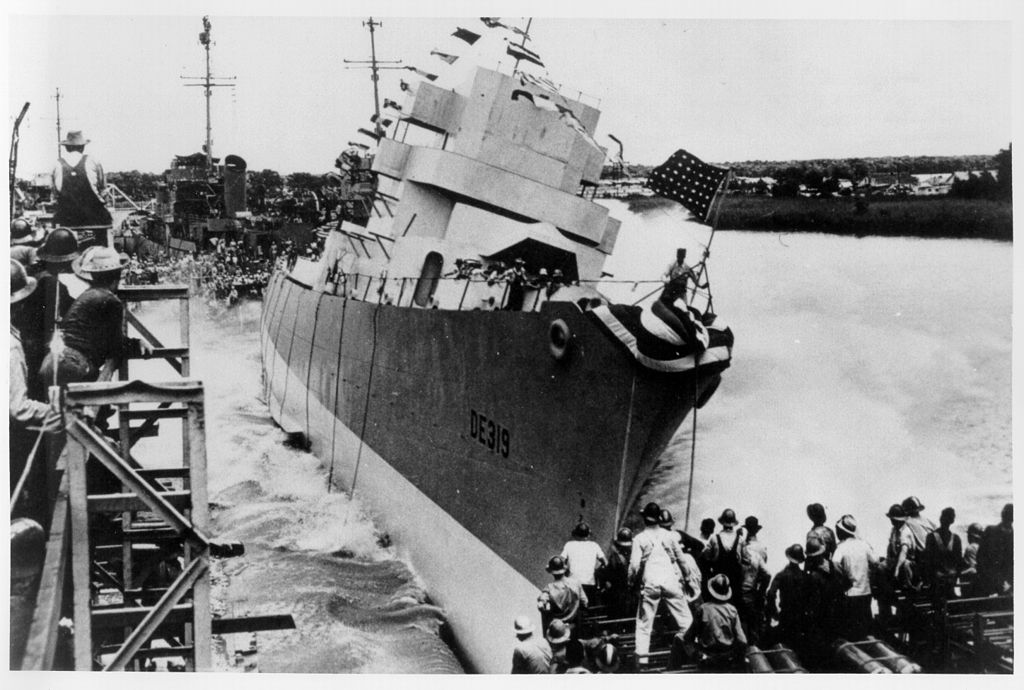
USS Leopold (DE-319) being launched.
Normandy Invasion, June 1944 A convoy of Landing Craft Infantry (Large) sails across the English Channel toward the Normandy Invasion beaches on “D-Day”, 6 June 1944. Each of these landing craft is towing a barrage balloon for protection against low-flying German aircraft. Photograph from the U.S. Coast Guard Collection in the U.S. National Archives. Photo #: 26-G-2333
“SHE FELT THE NAZIS’ WRATH:” A U.S. Coast Guard infantry landing craft still flies its flag, though knocked out of the invasion, ripped and wounded on the beaches of France. Moving in for a landing, the LCI ran afoul of an underwater obstruction, which tore a gaping hole in her bow. Then as its cargo of troops piled ashore, Nazi shells battered her out of further action.”; no date; Photo No. 2395; photographer unknown.
Conclusion:
It may be surprising that it appears the Coast Guard lost two and half to three times as many men in Coast Guard manned Navy vessels, as in Coast Guard vessels.
Two hundred and fourteen thousand two hundred and thirty-nine persons served in the Coast Guard during World War II. That number included 12,846 women. The Coast Guard lost a total of 1,917 persons during the war with 574 losing their life in action, “died of wounds” received in action, or perishing as a “Prisoner of War.”
These incidents account over 40% of all lives lost and a majority of lives lost as a result of enemy action.
If you haven’t seen it already, the Coast Guard has a web site that provides a lot of information about the status of the service. The Coast Guard Overview includes sections on Missions, Workforce, Force Laydown, Assets, Authorities, Strategy, Budget, Leadership, Partnerships, and a Resource Library. (You do have to scroll down from the intro.)
Added a link to the web site to the top of my Reference page, so it will be easy to find. I have to say I have not kept my Reference page up to date. I’ll be pay more attention to it.