Swarming for SAR

Our friend at the British Defense blog ThinkDefence has a short post regarding some experiments being undertaken by the Naval Postgraduate School in Monterey, California. They have reportedly succeeded in having 50 small unmanned aircraft operating cooperatively all under the control of one man.

The thing that caught my eye was this statement, “There are also algorithms for search-and-rescue operations, in which the flight pattern resembles that of foraging bees.”

The linked post is about doing SAR post natural disaster on land, but perhaps there are some possibility for the Coast Guard here.


Keep a Camera on the Bridge

MarineLog passed along a recommendation that a good camera be regarded as essential bridge equipment.

Their advice:

…as a minimum:

  • a digital compact camera with at least 8X optical zoom, built-in flash and video function; camera image quality of at least 10 megapixels;
  • two 8GB or larger blank SD cards (preformatted) and checked for operation;
  • spare battery pack;
  • mains charger with ship-compatible plug

“The camera should be kept on the bridge, fully charged with an empty storage card. Most cameras have an internal clock which should be checked and set to UTC. This time-stamp is used when the image file is stored, essential when the chronology of events could be questioned,” says Mr. Harrison. (Mike Harrison of marine consultancy Solis Marine Consultants, Ltd.–Chuck)

Their focus is on insurance claims, and while that certainly applies to the Coast Guard, we have other reasons to want video documentation. Good video is useful for public information and for training. It can help with evaluating and passing along lessons learned. It can also become valuable evidence in criminal cases.

Lighter Than Air Maritime Domain Awareness with Chinese Characteristics

Popular Science reports the Chinese have begun testing a largely solar powered airship capable of carrying heavy loads to high altitude (20,000 meters/65,600 feet) and remaining aloft for up to six months.

The airship is expected to have a role similar to that envisioned for the US Army’s JLENS currently being tested with apparently limited success in the Washington DC area, but it would cover a much larger area than the JLENS aerostats.

From its high altitude it can theoretically maintain radar and visual surveillance over a hundred thousand square miles.

The prototype seen in the accompanying video looks much less impressive, but remember that the gas will expand many times, filling out the envelop.

Illegal Fishing

gCaptain has an interesting post on illegal fishing off Africa and how they hope to counter it.

“We are cutting away at the model. We’ll attack the insurance, the availability of supplies and crew, attack the landing ports and the markets they use. It is death by a thousand cuts,”

They report that globally illegal fishing is a $23B business.

Are we confident this is not a major problem in the under patrolled Western Pacific? It seems every time we actually patrol the area, we find some illegal activity.

“Opinion: Coast Guard Budget Reductions Puts U.S. at Risk”–USNI

The US Naval Institute has a nice opinion piece by a retired Navy Rear Admiral, advocating restoration of funding cut from the Coast Guard budget over the last few years, and not incidentally greater number of National Security Cutters (NSC) to replace the High Endurance Cutters.

This is not the Admiral’s first editorial advocating for the Coast Guard. Whatever his affiliation, his opinions are on point, and I would really like to see the Congress add a ninth NSC to the budget

Russia’s Plans for an Arctic Coast Guard

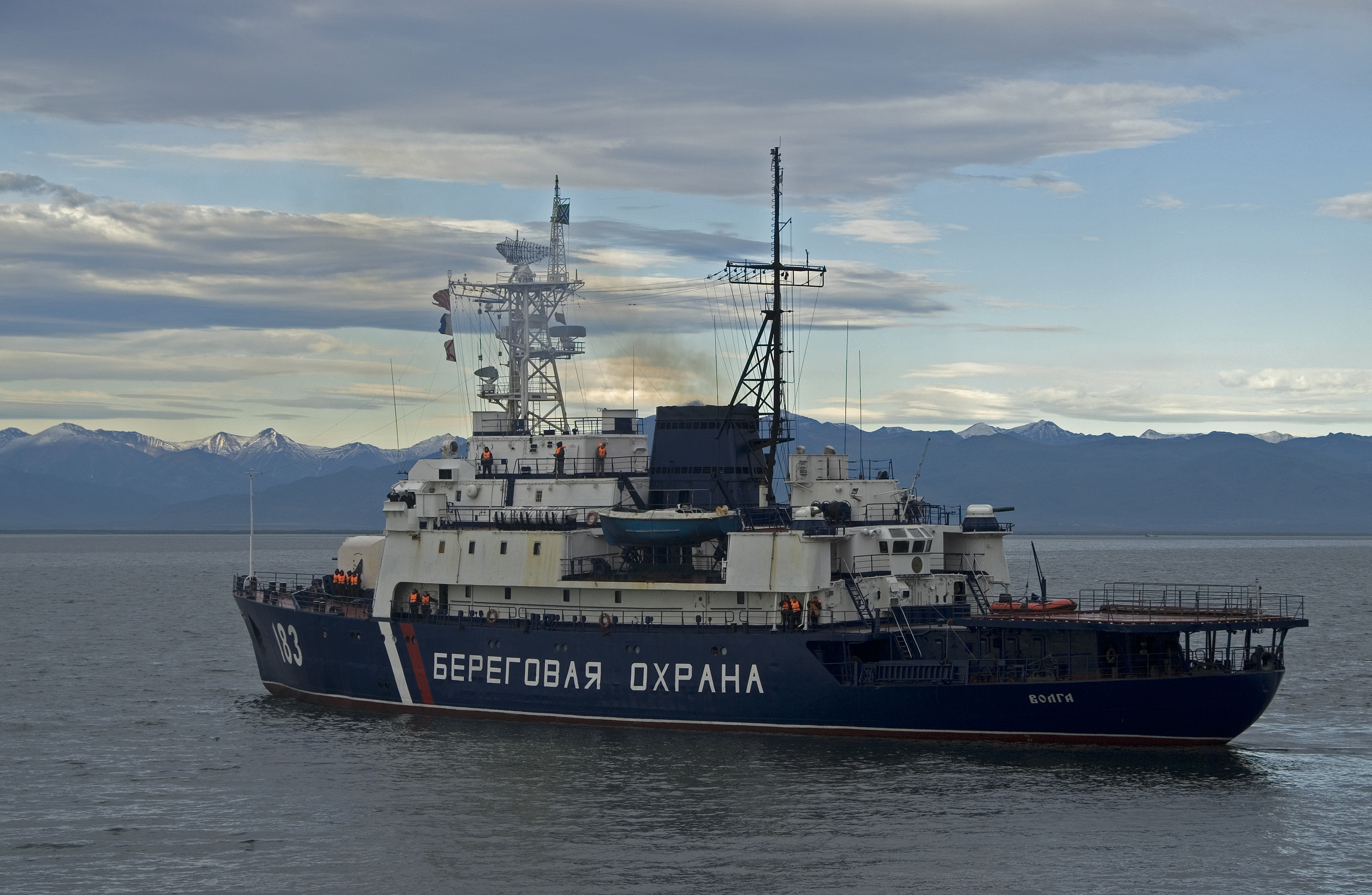
Photo: Russian Coast Guard Project 97P Border Patrol Vessel Volga (#183). The Russian Coast Guard is part of the Border Guard Service of Russia. This photo was taken by the crew of the USCGC Boutwell in Petropavlovsk, Russia during the North Pacific Coast Guard Forum in September 2007.

As is widely known Russia has plans to greatly expand use of the “Northern Sea Route,” the passage between the Atlantic and Pacific via the Arctic Ocean near Russia. To make this economical they are planning to greatly expand the presence of their Coast Guard in the Arctic. This includes a new class of ships.

“Efforts to build up an Arctic Coast Guard force have been ongoing since at least 2011, when the Federal Security Service (FSB) — the successor to the KGB, which oversees the Coast Guard and Border Guard services — ordered its first of a planned six “Ocean” patrol ships. The vessels, small ships with a displacement of 2,700 tons, are nevertheless built to withstand icy Arctic conditions.

The lead ship, known as “Polyarnaya Zvezda,” or North Star, has been completed and is undergoing final preparations for regular service in Kronstadt, near St. Petersburg. Two additional Ocean ships, known in Russia by their “Project 22100” designation, are under construction, and should be ready by 2019.

“Plans for new Arctic Coast Guard ships won’t stop with the completion of the Project 22100 class, according to Mikhail Barabanov, a naval expert at the Moscow-based Center for the Analysis of Strategies and Technologies (CAST).

“‘Construction is planned for several larger Coast Guard patrol ships with a displacement of 6,000 to 7,000 tons,’ Barabanov said, adding that the ships will double as icebreakers. Several design bureaus are now competing for tenders to design the ships, he said.

“The Coast Guard is also expanding its infrastructure along the Arctic frontier with a chain of 10 Coast Guard stations. These stations will be used to launch search and rescue operations if ships run into trouble.”

The Project 22100 ships sound a bit like the Offshore Patrol Cutters. Specs found here indicated a displacement of 2700 tons, length of 91.8 meters/301.2 feet, beam of 14.8 meters/48.6 feet, speed of 20 knots, a range of 12,000 miles, a crew of 41, and an armament of one 76mm and two 14.5mm, and accommodations for a Ka-27 (a 12,000kg/26,455 pound helicopter). The German Navy blog Marine Forum reported on 10 October that first of class “POLYARNAYA ZVEZDA completes four days of sea trials in the Gulf of Finland.” The next two ships are not expected to be commissioned until 2019.

Document Alert: “Coast Guard Polar Icebreaker Modernization: Background and Issues for Congress”

ice-breakers-540688_1280

The US Naval Institute News Service has provided access to a report to Congress, “Coast Guard Polar Icebreaker Modernization: Background and Issues for Congress,”by Ronald O’Rourke, Specialist in Naval Affairs, September 25, 2015.

I am repeating here the last two paragraphs of the Summary. I think they explain quite clearly the sad state of our icebreaker fleet.

“On September 1, 2015, the White House issued a fact sheet in conjunction with a visit to Alaska by President Obama indicating that the Administration, in its own internal planning, had at some point over the past two years deferred procurement of a new polar icebreaker to FY2022, but that this has now been changed to FY2020. The newly announced procurement date of FY2020 is a two-year acceleration from the previously unpublicized date of FY2022, and a two-year deferral from the FY2018 date implied in the FY2013 and FY2014 budget submissions. The fact sheet states that the Administration will also “begin planning for construction of additional icebreakers” beyond the one that the Administration proposes to procure in FY2020.
“A polar icebreaker procured in FY2020 might enter service in 2024 or 2025. Polar Star has been refurbished and reentered service in December 2012 for an intended period of 7 to 10 years—a period that will end between December 2019 and December 2022. Consequently unless the service life of Polar Star is further extended (or unless Polar Sea is repaired and returned to service), there will be a period of perhaps two to six years during which the United States will have no operational heavy polar icebreakers. The issue for Congress is whether to approve, reject, or modify the Administration’s plans for sustaining and modernizing the polar icebreaking fleet.”

Ramblings on the Russian Naval Attack on Syria

You have probably heard that Four Russian naval vessels based in the Caspian Sea have launched 26 missiles against targets in Syria. This attack demonstrates a capability similar to that of the US Tomahawk missile.

What you might not realize is how small the Russians ships that launched the attack really were. While the US surface vessels equipped with Tomahawk are Burke class destroyers and Ticonderoga class cruisers of 8,000 to 10,000 tons, the Russian operation involved only a one small frigate and three small corvettes. The corvettes were smaller than a 210, and the frigate was less than two thirds the size of a 378. All four were considerably smaller than the projected Offshore Patrol Cutter. All four together displace only slightly more than a single Bertholf class.

The largest ship, Dagestan, is a Gepard class light frigate or large corvette, 1,930 tons (full load), 102.14 m (335.1 ft) in length overall, 13.09 m (42.9 ft) of beam, with eight Kalibr (SS-N-27) anti-surface missiles, SA-N-4 AAW missiles, a 76.2 mm gun, two six barreled 30 mm guns, four 533 mm (21″) heavy weight torpedo tubes, and an RBU-6000 ASW  rocket launcher.

The other three, Grad Sviyazhsk, Uglich, Veliky Ustyug, were Buyan-M class corvettes, displacing 950 tons full load, with a maximum speed of 25 knots, armed with Kalibr (SS-N-27) anti-surface missiles, 100-mm and 30-mm guns, and Igla-1M air defense missiles.

While the US Navy has begun talking about distributed lethality, the Russians are practicing it.

Certainly the Coast Guard is not going to arm their ships like this in peacetime, but we might want to keep the possibility in mind if things start to go south.