French Building OPVs

FrenchOPVBSAH

NavyRecognition reports the French have contracted for two OPVs with an option for two more.

In several respects, these ships are very different from most OPVs and particularly the Coast Guard’s Offshore Patrol Cutters (OPC) and Webber class WPCs.

France has a huge Exclusive Economic Zone, very nearly as large as that of the US, which is the largest in the world. These ships are intended to support France’s many island territories far from European France. Disaster Relief and Humanitarian Assistance is expected to be an important mission for these ships.

Structurally they appear much closer to a typical Offshore Industry Support Vessel. At 70.3 meters (231 feet) long, it is sized between the OPC and the WPC. Speed is relatively low at 14 knots. The crew is smaller than that of the Webber class, while the endurance is similar to that of the much larger OPCs.

Significantly, they have no helicopter facilities.

Prototype Ocean Thermal Energy Conversion (OTEC)

OceanTemperatureDifference

Click to enlarge. From Wikipedia Commons, uploaded by StefKa81 

MarineLog is reporting that Hawaii has commissioned a prototype Ocean Thermal Energy Conversion (OTEC) facility.

Makai Ocean Engineering celebrated the completion of the world’s largest operational Ocean Thermal Energy Conversion (OTEC) power plant…Back in June, Hawaii Governor David Ige signed into law legislation directing the state’s utilities to generate 100 percent of their electricity sales from renewable energy resources by 2045.

The research and development at the plant was funded by the Office of Naval Research (ONR) through the Hawaii Natural Energy Institute (HNEI), and the infrastructure was funded by Naval Facilities Engineering Command (NAVFAC).

Why should the Coast Guard care?

This is a technology to watch. The system uses the thermal difference between deep cold water and warm surface water to power a heat engine. This particular installation appears to be shore based, but if it becomes economically viable, since shore locations adjacent to both deep cold water and energy consumers are limited, these may grow into massive offshore structures.  The working fluid is likely to be ammonia which is potentially hazardous. Most ideal locations for this technology are near the equator, much of it in the American Western Pacific EEZ, far from energy consumers. Rather that moving electricity directly ashore they may me used to produce a more portable form of energy, like hydrogen.

These facilities are also likely to provide a secondary benefit of interest to the CG as well, the upwelling of cold nutrient rich waters is expected to create a bloom of sea life. The fishery will need to be managed.

Gear That Does Not Fit

Recently the US Naval Institute put out a call for articles written by women. They got several on diverse subjects, but one in particular by a Coast Guard Academy graduate, Damage Control Assistant, boarding party member, and Diver got my attention, because it seems to indicate that, not only that we are not properly outfitting crew members that are smaller than average, but also that we may be putting their lives in dangers because they are not given gear that fits.


MEKO Energy Saving Hull

At MSPO 2015, the International Defence Industry Exhibition in Poland which took place in Kielce from the 1 to 4 September 2015, German naval vessels designer ThyssenKrupp Marine Systems (TKMS) unveiled a new variant of the MEKO A-100 PL with a unique
The new MEKO A-100 design unveiled at MSPO 2015. The variant shown here is the Mine Counter Measures (MCM) one.

NavyRecognition is reporting that the German ship builder ThyssenKrupp Marine Systems (TKMS), is offering a new hull form for its OPC- sized MEKO A-100 to meet Poland’s projected requirement for six Offshore Patrol Vessels. It is claimed that the new design will allow the ship to go 1.5 knots faster with no increase in installed power.

Two major differences are apparent,

  1. The raked stem and bulbous bow are replaced by a vertical stem which appears to provide a longer water line length.
  2. The fin stabilizers are missing.

Increasing waterline length does have the effect of decreasing wave making resistance which is predominant at higher speeds. Conversely increased length tends to result in  increased wetted area which would make ships less efficient as slower speeds by increasing skin friction. Deleting the fin stabilizers would have the benefit of reducing wetted surfaces. There may also be some less obvious changes, not apparent in the artist’s rending.

The original post has a nice side by side comparison of the conventional corvette and TKMS’s proposal to meet Poland’s Mine Countermeasures OPV requirement.

Chinese Navy Operating Off Alaska

The Wall Street Journal is reporting that five Chinese Navy vessels (three surface combatants, an LPD, and a replenishment vessel) have been operating in international waters near Alaska.

This may have something to do with their recent exercises with Russia. It may also be that they hope to discourage US freedom of navigation exercises near China with the idea, “Now you see how we feel.”

Nothing really to get excited about, but a nice reminder that for literally thousands of miles of US coast, the only US warships around are Coast Guard cutters, and they are not that well armed.

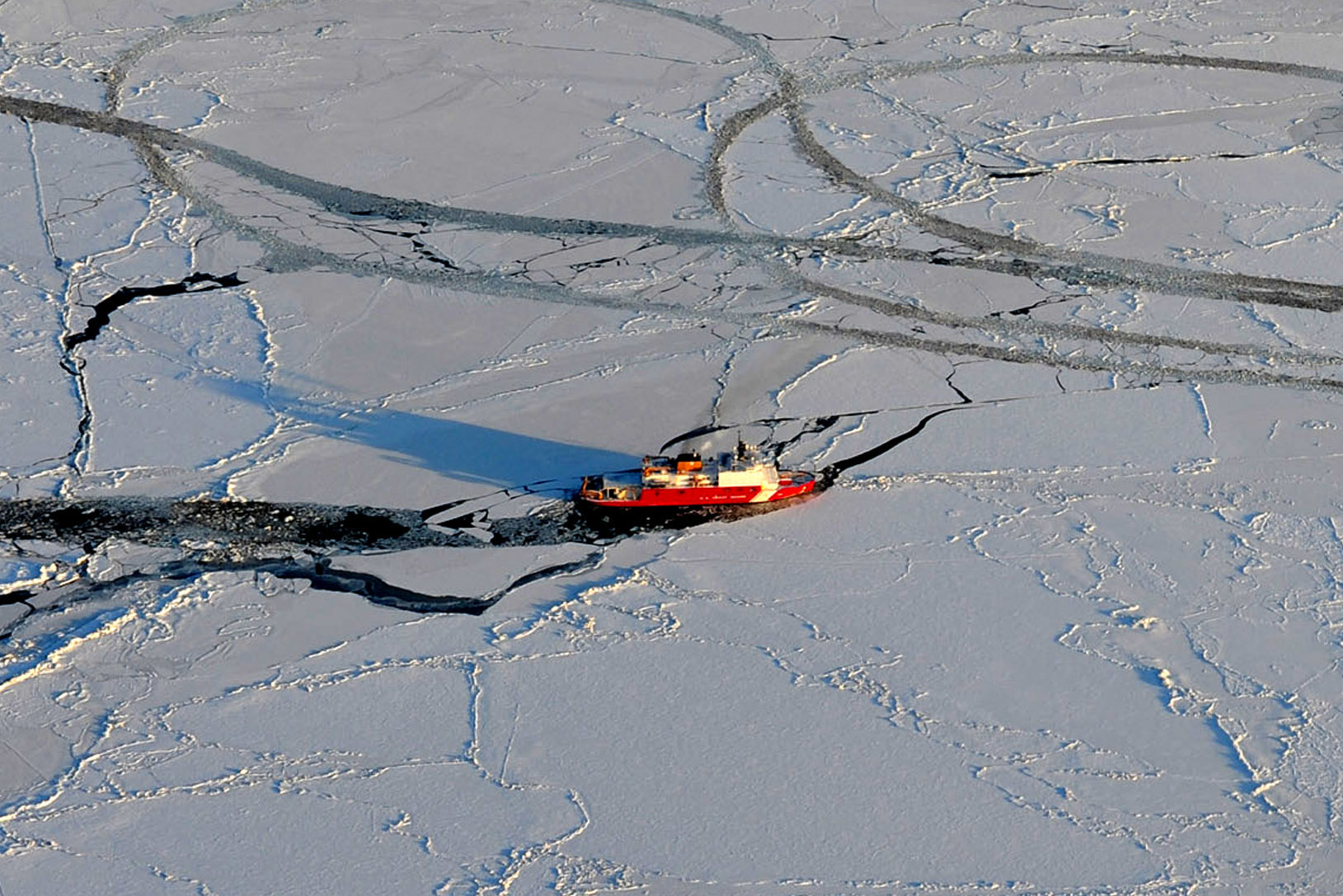
President Calls for More Icebreakers

USCGCHealeyCGphoto

The New York Times is reporting that, in a Speech today, the President will call for new icebreakers for the Coast Guard including accelerating the one currently planned and for additional icebreakers beyond that.

“The aging Coast Guard fleet is not keeping pace with the challenge, the administration acknowledged, noting that the service has the equivalent of just two “fully functional” heavy icebreakers at its disposal, down from seven during World War II. Russia, by contrast, has 41 of the vessels, with plans for 11 more. China unveiled a refurbished icebreaker in 2012 and is building another.

“Mr. Obama will propose speeding up the acquisition of a replacement icebreaker that had been planned for 2022, setting a new date of 2020, the White House said. He will also propose that planning begin on the construction of new ones, asking Congress to provide “sufficient resources” to fund them.”

Hopefully these WAGBs and the rumored additional National Security will move the perception of what is a normal AC&I budget closer to a realistic level.

New Sail Training Ship for Vietnam

From the German Navy blog “Marine Forum,” 28 August, “VIETNAM, Full-rigged sail training vessel LE QUY DON, built by Polish shipyard Marine Projects for the Vietnamese Navy, is on its transfer voyage from Poland around the Cape of Good Hope to Vietnam … mixed Polish-Vietnamese crew for final trials and crew training enroute.”

More here.

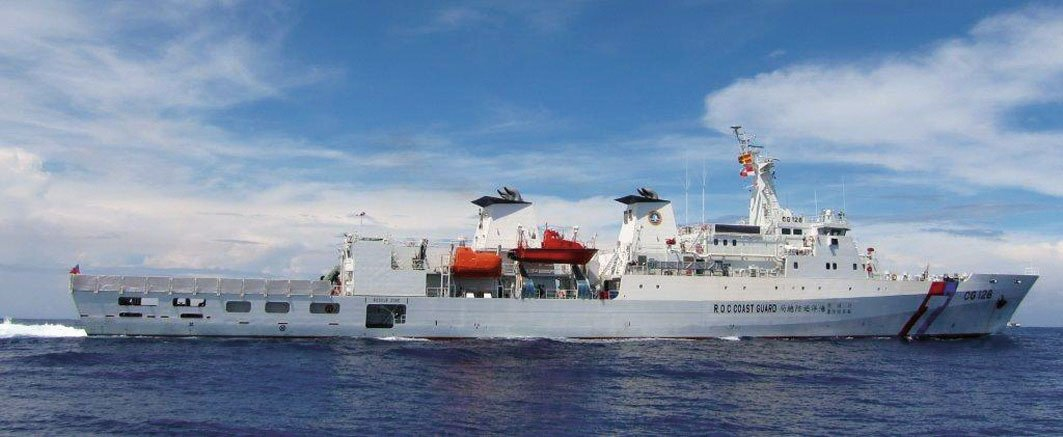
Taiwan Commissioned Two WHECs

ROCcutterYILAN(CG128)

Photo: Yilan (CG 128). (Taiwan Coast Guard Administration)

I mentioned this earlier in a comment on an earlier post, but Jane’s has more detail and much better pictures. Back on June 8, Janes 360 reported that Taiwan’s Coast Guard administration has commissioned two new 3,000 ton, 119 meter (390 foot) helo capable cutters, Yilan (CG 128) and Kaohsiung (CG 129), with a speed of 24 knots and a range of up to 10,000 miles.

Taiwan, along with Mainland China, supports the concept of the Nine Dash Line, but they have a particular beef with Japan. regarding the Senkakus Islands as they are known in Japan or the Diaoyutais as they are known in China and Taiwan, about 120 nautical miles (220km) northeast of Taiwan.

The other area where these might be assigned is protection of the area around Taiping Island, the largest of the Spratly Islands in the South China Sea (at least before the Chinese began reclamation) which the Taiwanese have garrisoned.

ROCcutterKAOHSIUNG(CG129)

Photo: Kaohsiung (CG 129). (Taiwan Coast Guard Administration)

According to the Diplomat,

“Since 2008, Taiwan’s Coast Guard Administration has been engaged in a 37-ship building program totaling 17,000 tons at a cost of  approximately NT$ 24 billion ($782 million).”