Commercial Fishing in the High Arctic Regulated

BairdMaritime is reporting the five nations bordering the Arctic Ocean have agreed to prohibit fishing in the “doughnut hole” that lies outside the EEZ of any of the five nations.

“A declaration has been signed by the five countries that surround the Arctic Ocean, to prevent unregulated commercial fishing of the 1.1 million-square-nautical mile “doughnut hole” which falls outside of any country’s jurisdiction.

“Canada, the US, Greenland, Norway and Russia have signed a document stating that they will not allow any vessels to conduct any commercial fishing until one or more international mechanisms are in place to manage fishing in accordance with recognised international standards.”

This really isn’t an issue now, because there is no fishing there now. Still I wonder how we can regulate fishing outside the EEZ. Still, good to see they are out ahead of the problem.

Unmanned SAR Assets

sUAS

MarineLink has a short post about a European effort to use networked Unmanned Air and Surface Vehicles (UAVs and USVs) to do SAR. I don’t find their particular scenario persuasive, but there probably are roles for these systems.

Unmanned systems have some potential advantages over Manned assets although they are unlikely to ever replace them.

  1. It may be possible to have UAVs more widely distributed than manned CG Air assets.
  2. UAVs operating from SAR stations might also be able to get into the air more quickly  than manned aircraft because they do not have to contend with other air traffic that may be operating on the field.
  3. At least for some applications they may be cheaper to operate.

Frankly, I had thought of unmanned systems as primarily Law Enforcement assets, but the Coast Guard is looking as the possibility of locating personnel in the water using small UAVs.

USVs:

I have a hard time visualizing a use for Unmanned Surface Vessels (USV), but perhaps there might be a benefit in dropping a USV to a distressed vessel or person(s)  in the water either from a fixed wing or a UAV.

UAVs might be used:

  1. For communications relay.
  2. To deliver medication or medical equipment.
  3. Small UAVs might be used to confirm the location of vessels in distress before other units arrive.
  4. To deliver pumps, communications equipment, or other even inflatable liferafts.

Any Other Ideas?

Any other potential uses?

Egyptian Coast Guard Vessel Hit by Militants

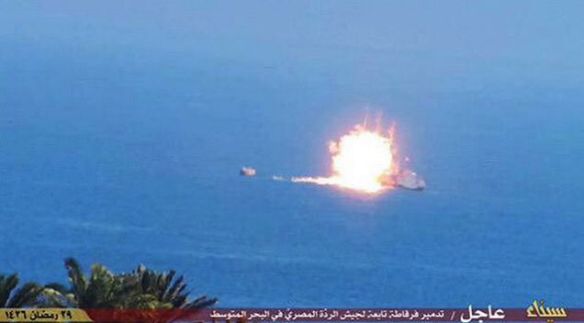
gCaptain reports that an Egyptian Coast Guard vessel has been attacked by a militant group, Egypt’s Islamic State affiliate, “Sinai Province.”

Other reports identified the vessel as a frigate, and the weapon as a guided missile. It does appear that the vessel is smaller and the missile was probably an anti-tank weapon rather than an anti-ship cruise missile.

Reportedly the vessel had been engaging elements ashore.

This is the type of extemporaneous weaponry the Coast Guard could expect a terrorist organization to use against the USCG if they attacked the US. We should be particularly concerned that they not be able to target specific critical systems on our cutters. Currently I consider 4000 yards to be a reasonable standoff distance to minimize this possibility.

Document Alert–Coast Guard Cutter Procurement

USNI news service has posted a copy of the Congressional Research Services latest take on the Coast Guard Vessel recapitalization program, “Coast Guard Cutter Procurement: Background and Issues for Congress.”  As usual their “Specialist in Naval Affairs,” Ronald O’Rourke, has done an excellent job and by simply stating the facts has made a strong case for recapitalization.

There are some criticisms implicit in the recitation of events thus far. I think it is apparent that the Crew Rotation Concept is proving an embarrassment, in that while we have now had three operational “National Security Cutters” for some time, there has been no attempt to validate the concept, and no attempt to repudiate this relic of the Deepwater program. The concept is a non-starter we have discussed several times. Ships are not cars in a motorpool. You cannot swap entire crews and expect good results. Time to piss or get off the pot. This bad news is not going to get better with age.

Limited progress on UAVs was also discussed.

Small Unmanned Aerial Systems (sUAS)

sUAS

An AeroVironment Puma All-Environment small unmanned aircraft system is launched from Coast Guard Cutter Chock as part of the Research and Development Center’s Robotic Aircraft for Maritime Public Safety (RAMPS) project. U.S. Coast Guard photo by Petty Officer 2nd Class Luke Clayton.

The Acquisitions Directorate reports that the Coast Guard is at least looking at small UAS (UAVs for us traditionalists).

“The demonstrations are part of the RDC’s Robotic Aircraft for Maritime Public Safety project, which aims to determine the risks, benefits and limitations of operating commercial off-the-shelf sUAS technology in conjunction with Coast Guard cutters other than the national security cutter.”

Tests of seven systems were conducted on USCGC Chock (WYTL 65602), a 65 foot tug, so you know the systems had to be small. In fact, I have radio controlled airplanes bigger than these. Still, hopefully these are smarter.

An interesting aspect of the trials is that it included test specifically intended to determine if the sUAS would be useful in finding a person in the water. To do this they used a dummy with an enhanced IR signature comparable to that of a person they refer to as a “thermal Oscar.”

While UAVs of this size may have uses, ultimately, I think they will find that the system we need will be something with a radar that will fit on a Webber class, that means something similar to Scan Eagle. Smaller vessels don’t actually need their own UAS, they can be supported by UAS from ashore. Perhaps every SAR station should be able to launch their own UAS to get to scene before the boat arrives. That would require SAR stations to coordinate with Air Traffic Control. USCGC Chock’s sistership, 65 foot tug, USCGC Swivel, by Windwork50

Document Alert–National Military Strategy, 2015

The US has issued a new National Military Strategy. You can see it in pdf form here, or you can see it on the Naval Institute News Service here.

Its not really very long. There are only 18 pages of text. Even so, I will provide a “Readers’ Digest” version, or perhaps more properly, a powerpoint version, in that it is in outline form, and offer only limited Coast Guard related comment.

U.S. ENDURING NATIONAL INTERESTS

  • The security of the United States, its citizens, and U.S. allies and partners.
  •  A strong, innovative, and growing U.S. economy in an open international economic system that promotes opportunity and prosperity.
  • Respect for universal values at home and around the world.
  • A rules-based international order advanced by U.S. leadership that promotes peace, security, and opportunity through stronger cooperation to meet global challenges.

NATIONAL SECURITY INTERESTS 

  • The survival of the Nation.
  • The prevention of catastrophic attack against U.S. territory.
  • The security of the global economic system.
  • The security, confidence, and reliability of our allies.
  • The protection of American citizens abroad.
  • The preservation and extension of universal values.

NATIONAL MILITARY OBJECTIVES 

  • Deter, deny, and defeat state adversaries.
  • Disrupt, degrade, and defeat violent extremist organizations.
  • Strengthen our global network of allies and partners.

PRIORITIES

  1. Maintain a secure and effective nuclear deterrent 
  2. Provide for military defense of the homeland 
  3. Defeat an adversary 
  4. Provide a global, stabilizing presence 
  5. Combat terrorism 
  6. Counter weapons of mass destruction 
  7. Deny an adversary’s objectives 
  8. Respond to crisis and conduct limited contingency operations 
  9. Conduct military engagement and security cooperation 
  10. Conduct stability and counterinsurgency operations 
  11. Provide support to civil authorities 
  12. Conduct humanitarian assistance and disaster response

There is nothing here that adds to the Coast Guard’s “to do list.” There is no specific mention of the Coast Guard or any other service for that matter. They do talk about working with DHS partners, and a couple of times they mention Coast Guardsmen along with an enumeration of all other types of US military personnel.

There is a recognition of the “Violent Extremist Organization” either acting alone or with support of a Nation State in a form of “Hybrid Warfare.”

DEFENSE OF THE HOMELAND

There may be more emphasis on “defense of the homeland,” but we are a long way from providing the kind of commitment to this, that we saw in the late 1950s and early 60s when we had Nike missile launchers around every US city and hundreds of interceptors on strip alert around the country. At that time there were also Naval Sea Frontiers that were ready to respond to naval threats.

DOD has recently begun to talk about defense against cruise missiles, but really, it is easier to get a weapon of mass destruction into the country by boat than by missile or aircraft.

I would like to particularly highlight the explanation that accompanies the #2 priority, after #1–maintaining a nuclear deterrent,  because it certainly involves the Coast Guard,

Provide for Military Defense of the Homeland.  Emerging state and non-state capabilities pose varied and direct threats to our homeland.  Thus we are striving to interdict attack preparations abroad, defend against limited ballistic missile attacks, and protect cyber systems and physical infrastructure.  Key homeland defense capabilities include resilient space-based and terrestrial indications and warning systems; an integrated intelligence collection, analysis, and dissemination architecture; a Ground-Based Interceptor force; a Cyber Mission Force; and, ready ground, air and naval forces, (emphasis applied–Chuck).  We also are leveraging domestic and regional partnerships to improve information sharing and unity of effort.  These capabilities will better defend us against both high technology threats and terrorist dangers.

Make no mistake, for countering any covert maritime surface threat to the US, the Coast Guard is the “ready naval force,” that is ready to investigate possible hostile contacts. Even if the US had aircraft armed and ready to engage surface vessels, which I doubt, I don’t think anyone is going to send aircraft to sink a ship based on a suspicion, however well founded, that the ship has some nefarious intent. Someone is going to have stop the vessel and attempt a boarding.  Navy Bases are few and far between. The only Navy surface combatant on the Atlantic coast based North of the Norfolk complex is the USS Constitution. The only surface ships based on the East Coast are around Norfolk and Jacksonville. On the West Coast they are either in Everett or San Diego. There are none based in Alaska and none on the Gulf Coast. Unless they are holding a Navy Day, celebration the majority of US ports are hundreds of miles from the nearest Navy surface combatant.

The Coast Guard’s position ought to be that we see a problem here, and the Coast Guard is the solution (and here I am not talking about the larger cutters, because they are either going to be deployed or in some sort of stand down if they are in port). The vessels that are going to do the stopping and boarding are most likely to be WPCs or WPBs, but currently they are not really armed to handle anything much more threatening than an angry outboard.

In addition to better weapons, we certainly need to continue to exploit the DOD’s intelligence organization and the Navy’s Maritime Domain Awareness hopefully including JLENS if they become more than prototypes.

REACTION. Of course the Chinese had a comment, as did Russia, “Clearly Anit-Russsian.”

US Port Revenue Up 43% Since 2007. Exports Up 60%

This is a straight news release, but I decided to quote it in its entirety because it is says a lot about the importance of what the Coast Guard does for the country. Note these increases are compared to pre-recession activity levels.–Chuck

New U.S. Port Economic Impacts Report Released
Since last nationwide analysis in 2007, U.S. seaport contributions to economy up dramatically

Lancaster, Pa.-based Martin Associates, a leading provider of economic and strategic assessments of the world’s transportation systems, today released the results of its latest economic impact study of United States seaports. Dr. John Martin, Martin Associates’ president, debuted his firm’s 2014 National Economic Impact of the U.S. Coastal Port System report during the second day of the American Association of Port Authorities’ (AAPA) 2015 Spring Conference in Washington, D.C.

In the seven years since Martin Associates’ last nationwide ports economic impact study, the contributions of America’s seaports to the nation’s economy have risen dramatically. From 2007 to 2014, the total economic value that U.S. coastal ports provide in terms of revenue to businesses, personal income and economic output by exporters and importers rose 43 percent to $4.6 trillion. This accounted for 26 percent of the nation’s $17.4 trillion economy in 2014, up from 20 percent of its $16.1 trillion economy in 2007.

Other notable gains since 2007 in Martin Associates’ new report include:
•Federal, state and local tax revenues generated by port-sector and importer/exporter revenues rose 51 percent to $321.1 billion;
•Jobs generated by port-related activity jumped 74 percent to 23.1 million; and,
•Personal wages and local consumption related to the port-sector increased to $1.1 trillion, with the average annual salary of those directly employed by port-related businesses equating to $53,723.

“The growth in jobs and economic importance of America’s seaports reflects the fact that the value of international cargo handled at these ports increased by $400 billion since 2007, reaching about $1.8 trillion in 2014,” said Dr. Martin. “It’s important to emphasize that the key growth in our international trade was in U.S. exports, which saw a 60 percent increase in value over the past seven years.”

Dr. Martin noted that each dollar increase in the value of export cargo supports significantly more jobs in the U.S. than does a dollar value of growth in imports. He also emphasized that the robust growth in the economic impact value from U.S. ports occurred despite the economic recession that severely hampered marine cargo activity between 2008 and 2012.

“The growth in the contributions of our ports to the nation’s economy underscores the need to invest in infrastructure and technology to support and foster good jobs, national security, inter­national trade and our standard of living,” said Dr. Martin.

In agreement with Dr. Martin’s assessment is AAPA President and CEO Kurt Nagle, who said that particularly with the economic contributions of America’s seaports growing rapidly, there’s a significant and urgent need for more federal investment in enhancing the connections with those ports. He added, “On the land-side alone, AAPA’s U.S. member ports have identified at least $28.9 billion in needed investments by 2025. These necessary road, rail, bridge and tunnel improvements are crucial to enable our seaports to efficiently handle their expected cargo volumes, continue providing dramatic economic and jobs impacts, and enhance America’s international competitiveness.”
—————————————————————————————————
About AAPA
Founded in 1912, AAPA today represents 160 of the leading seaport authorities in the United States, Canada, Latin America and the Caribbean and more than 300 sustaining and associate members, firms and individuals with an interest in seaports. As a critical link for access to the global marketplace, each year, Western Hemisphere seaports generate trillions of dollars of economic activity, support the employment of millions of people and, in 2008, imported and exported more than 7.8 billion tons of cargo, valued at $8.6 trillion, including food, clothing, medicine, fuel and building materials, as well as consumer electronics and toys. The volume of cargo shipped by water is expected to dramatically increase by 2020 and the number of passengers traveling through our seaports will continue to grow. To meet these demands, the AAPA and its members are committed to keeping seaports navigable, secure and sustainable.

FOR RELEASE – April 21, 2015
Contact: Aaron Ellis, Public Affairs Director, aellis@aapa-ports.org
(703) 684-5700 or (703) 254-7098
American Association of Port Authorities
1010 Duke Street
Alexandria, VA 22314
Phone: (703) 684-5700
Fax: (703) 684-6321
http://www.aapa-ports.org